Showing posts sorted by date for query 2008 financial crisis. Sort by relevance Show all posts

Friday, October 09, 2026

Spain’s housing crisis takes centre stage ahead of snap election

Longstanding anger over unaffordable housing in Spain has become a central issue in next month’s general election, as rising rents, a shortage of public housing and a boom in tourist rentals put growing pressure on households.


Issued on: 09/10/2026 -  RFI

People hold up keys as a sign of protest during a demonstration demanding stronger laws to protect renters in Madrid, Spain, 3 October 2026. © AP Photo/Andrea Comas

Spanish Prime Minister Pedro Sanchez on Monday called a snap election for 29 November, after parliament rejected housing relief measures proposed by his minority government.

It came after tens of thousands of protesters marched in Madrid and other cities to demand affordable housing, galvanised by the forcible eviction of an elderly woman, who died in hospital this week.

Maricarmen Abascal, 87, was evicted on a stretcher on 23 September after the real estate firm that owned her Madrid apartment drastically hiked the rent.

By the time she died on Wednesday, she had become the symbol of a crisis that cuts across Spanish society – young and old, renters and buyers, workers and pensioners.

The uproar at her eviction triggered national demonstrations, with hundreds of people camping in central Madrid's Puerta del Sol square.

Protesters set up tents in Puerta del Sol square, on 28 September 2026. © REUTERS - Juan Medina

On Thursday, the square turned into an improvised memorial to Abascal.

Protesters in the square wept and embraced each other after learning the news. Hundreds marched towards parliament on Wednesday night, some calling the death a "murder".

A deal had been reached with the real estate firm allowing Abascal to return home at a lower rent, but she ultimately spent her final days in hospital.

"She didn't have to die this way. Maricarmen wanted to die in her house," said Valeria Racu, a spokeswoman for the Madrid Tenants' Union, which supported Abascal in her years-long legal battle against the company.

Unions have called for a national minute's silence at noon on Friday.


Chronic shortage

As in other European countries, housing has long been a major public concern in Spain, particularly for young adults. Priced out of the market, many live with their parents into their 30s and beyond.

Growth in housing prices has outstripped wages in recent years.

According to the latest figures from the National Statistics Institute (INE), the average gross monthly salary in Spain is around €2,460. Meanwhile, renting a 50-square-metre apartment in Madrid cost an average of €1,170 per month in September, according to real estate portal Idealista – around half of a normal income.

Meanwhile Spanish inflation hit 4.9 percent in September – its highest level since February 2023.

Many residents in popular destinations like Barcelona complain that short-term tourist accommodation is limiting supply and driving up prices.

Investment funds with large housing portfolios are also accused of acquiring properties and hiking rents to maximise profits.

Protesters hold a picture of Maricarmen Abascal, the 87-year-old pensioner whose eviction triggered nationwide protests over Spain's chronic housing crisis, after her death on 7 October 2026. © AFP - THOMAS COEX

A limited supply of public housing is another major factor.

Madrid has only around 10,000 social housing units for its 3.5 million inhabitants. Such is the demand for them that some public apartments are allocated by lottery.

A history of private home ownership partly explains the small public housing stock. Under the dictatorship of General Francisco Franco from 1939 to 1975, authorities encouraged people to buy.

But the model is breaking down, especially for the young. While almost three in four households own their main residence, more than half of under-30s rented in 2025, according to the INE.

Jorge Galindo, director of the Centre for Economic Policy at Esade business school, said the 2008 global financial crash was a turning point for the Spanish housing market. The bursting of a real estate bubble sparked the "collapse" of construction and "the destruction of a million jobs" in the sector, Galindo told French news agency AFP.

Since then, supply has fallen from around 260,000 new builds per year in the 1990s to 92,000 in 2025, he said.

The expert warned that the country of around 50 million people risked becoming "a society of inheritors" in which home ownership depends on parents passing property to their children.


Election pressure

Successive governments have struggled to resolve the problem, which will be a central debate of next month's snap election.

Last week, Sanchez's leftist coalition proposed a series of measures including more restrictions on evictions, a ban on the speculative purchase of homes and the automatic renewal of tenant contracts.

But the minority government failed to pass them in parliament, leading Sanchez to bring forward a vote originally scheduled for 2027.

Spain's main unions have called a general strike for 11 November to increase pressure on the government over housing, wages and the cost of living.

In 2023, Sanchez's government passed a law that provided for more social housing, the regulation of rents in areas under the greatest stress and punishments for owners who left their properties empty. But the law has not stopped prices spiralling.

Right-wingers say the leftist central government has been unable to tackle the crisis after eight years in power. The main opposition, the conservative Popular Party, advocates a building boom to make up the deficit between supply and demand.

Sanchez, who is trailing in most polls, has accused the Popular Party and far-right Vox of siding with speculators and large investment funds by voting down his housing measures.

For Galindo, the debate contains a "paradox".

"Those who suffer most from the housing crisis are those with the least weight at the ballot box: young people, who vote less, and immigrants."

Saturday, September 26, 2026


A divided island, a divided left: Iceland after the EU referendum


Iceland No EU referendum

First published at Rosa-Luxemburg-Stiftung Brussels Office.

On 29 August 2026, Icelanders voted on whether to resume accession negotiations with the European Union. The result was close but clear: 52.8 percent voted No and 47.2 percent Yes, with a turnout of 82.6 percent. Yet the campaign revealed a country — and a political left — sharply divided on much more than Europe.

The question on the ballot was narrower than much of the debate suggested. Icelanders were not deciding whether to join the EU, but whether to re-open negotiations that began after the financial crisis in 2009 and were suspended in 2013. Even a Yes vote would therefore have marked the beginning of another political process, not accession itself. Any eventual agreement would still have required a further political debate and approval in another referendum.

Yet the campaign became a referendum on much more: sovereignty, the Króna (Iceland´s currency), fisheries, agriculture, prices, inflation, interest rates, political trust, and Iceland’s place in Europe. It exposed a divided country: Reykjavík against much of rural Iceland, university-educated voters against those with shorter formal education, and, most interestingly, a left that had no common answer.

For the left, this makes the result more complicated than either disappointment or celebration. A No vote can reflect democratic scepticism towards the EU, market liberalisation, and distant institutions. But it can also leave unchallenged concentrations of economic power at home. The central question — the one the referendum did not ask — is therefore not simply “Brussels or Reykjavík?”. It is: where does power sit, who controls it, and who benefits from it?

Sovereignty — a sensitive issue

To understand the emotional force of sovereignty in Iceland, one must go further back than 2009. Iceland is a young republic, but its history is inseparable from the struggle to recover political and economic power, first from Norway, then from Denmark. For centuries, political authority in Iceland was exercised from abroad, severely restricting trade, and economic and social mobility. Home rule came only in 1904, and Iceland became a sovereign state in 1918, but remained in personal union with the Danish king. The republic was finally established in 1944.

That history matters. A political culture built around recovering control from Copenhagen will not casually transfer authority to Brussels. In that sense, a No vote is not irrational or simply nationalistic. Independence is part of modern Iceland’s political identity; also reflected in the name of the historically dominant Independence Party (Sjálfstæðisflokkurinn).

But independence has never meant isolation. The financial collapse of 2008 demonstrated the limits of economic self-sufficiency. Iceland’s oversized, newly privatised, banking system imploded, the Króna plunged, and the country turned to the International Monetary Fund and bilateral creditors — particularly among the Nordic states — for assistance. Iceland followed a recovery path that differed from that imposed on several southern EU countries, but the idea that Iceland simply rescued itself is a myth. The IMF-supported programme included capital controls, currency depreciation, debt restructuring, and the protection of important parts of the welfare state, while limiting the socialisation of private banking losses. Recovery combined domestic political choices with international assistance, access to markets, and cooperation.

Closer to the EU — and back again

It was in this context that Iceland applied for EU membership in 2009, under the country’s first majority left-leaning government led by the Social Democratic Alliance (Samfylkingin), in coalition with the Left-Green Movement (Vinstri græn). The coalition itself was divided: the Social Democrats favoured accession, while the Left-Greens remained sceptical. The application was no mere technocratic response to the financial crisis either. Rather, it emerged from a debate within the Icelandic left over whether greater European integration or greater national autonomy offered the better route out of the crisis for rebuilding economic stability.

Negotiations began in 2010. By the time they were put on hold in 2013, 27 negotiating chapters had been opened and 11 provisionally closed. A new centre-right government suspended the process, however, and in 2015 Iceland notified the EU that it should no longer be regarded as a candidate country.

Iceland nevertheless never really left “Europe”. It remains part of the European Economic Area (EEA), the European Free Trade Association (EFTA), and Schengen. Through the EEA, Iceland participates in the European single market and implements substantial amounts of EU legislation, while remaining outside formal EU decision-making. Agriculture and fisheries, however — both important sectors for Iceland — are excluded from the EEA’s core single-market arrangements.

The road to the 2026 referendum

The paradox of the European question in Icelandic politics was intensified by its more recent return. There was no parliamentary majority committed to EU membership, nor did the three parties of the governing coalition share a common position on it: The Liberal Reform Party (Viðreisn) is pro-European, while the People’s Party (Flokkur fólksins) is opposed, and the Social Democrats took a more nuanced position. Nevertheless, the coalition promised a referendum on resuming negotiations no later than 2027.

In 2026, that timetable was brought forward. Inflation was persistently high (~5.6 percent in August), and the Central Bank of Iceland had raised its key interest rate to 8 percent. Household purchasing power, housing costs, and the price of imported goods kept questions about Iceland’s economic model on the political agenda.

The geopolitical environment had also changed significantly. The Trump administration’s threats towards Greenland (including confusing it with Iceland), and a remark by the new US ambassador joking that Iceland could become the 52nd US state, raised uncomfortable questions about the reliability of Iceland’s traditional security relationships. The search for greater economic stability increasingly became connected to a broader question: in an increasingly uncertain world, which political alliances could a small state rely on?

A divided left

The referendum exposed an unusually complicated political map. As the table shows, Icelandic Euroscepticism cannot simply be mapped onto left and right, nor did party leadership always correspond with party voters.

In addition to the differences within the governing coalition, which spans the political centre, three parties represented in parliament opposed the referendum. No party to the left of SDA is currently represented in parliament, although these parties together received just under 10% of the vote in the 2024 elections. Their absence from parliament does not mean that they were absent from the wider debate. The Left-Green Movement, moreover, had provided the prime minister from 2017 until 2024, with Katrin Jakobsdóttir retaining the premiership even after the party lost ground in the 2021 election. After a second term in government, however, the party’s support collapsed: it lost its parliamentary representation altogether in 2024 and is currently undergoing a process of political and organisational renewal.

The 2024 election result further complicates the picture. The SDA narrowly emerged as the largest party, but its success coincided with the parliamentary disappearance of all parties to its left. The last election therefore produced an apparent success for the centre-left, while at the same time leaving the broader Icelandic left considerably weaker and less plural in parliament. Table 1 List of parties in Iceland, their broad orientation, last election results, position in the negotiation talks, as well as the level of support from possible party voters regarding the referendum (according to last Gallup poll before the referendum).

PartyBroad OrientationResult in last election Nov. 2024 (in %)​Position in 2026Yes in Final Gallup (in %)

Samfylkingin

(Social Democratic Alliance)

Social-democratic / centre-left20.75Strong Yes94

Viðreisn

(Liberal Reform Party)

Liberal, market-liberal, pro-European15.82Strong Yes95

Miðflokkurinn

(Centre Party)

National-conservative / populist right12.10Strong No6

Framsóknarflokkurinn

(Progressive Party)

Agrarian / centrist / regionalist7.80Predominantly No14

Flokkur fólksins

(People’s Party)

Welfare-populist / conservative/ centre13.78Sceptical and internally divided55

Sjálfstæðisflokkurinn

(Independence Party)

Liberal-conservative / centre-right19.36No13
Parties without representation in parliament

Píratar

(Pirate Party)

Progressive / civil-libertarian/ direct democracy3.02Open to negotiations; stressed democratic choiceNot separately reported

Sósíalistaflokkur Íslands

(Socialist Party of Iceland)

Socialist3.96NoNot separately reported

Vinstri græn

(Left Green Movement)

Left-green2.34Against membership, but accepted a public decision on negotiations66

The most revealing division was within the left. The Social Democratic Alliance made the clearest centre-left case for Yes: negotiate first, then judge the actual terms on offer. From this perspective, European integration could provide economic stability and political influence. There was also a democratic argument: Iceland already participates extensively in the European economic order but has no formal role in setting the rules it must follow. In this view, EU membership was not a simple surrender of Icelandic sovereignty, but a recovery of economic decision-making power.

By contrast, the Socialist Party offered the most explicit radical-left argument for No. Its critique sees the EU as fundamentally structured around markets, competition, and capital, while also raising concerns around militarisation, food sovereignty and the space available for independent socialist economic and labour politics. The EU’s democratic deficit, and its broader geopolitical alignment, and its policy towards Gaza, were further sources of mistrust.

The most striking internal division emerged within VG. The formal Left-Green position remained that Iceland’s interests were better served outside the EU, yet the party is divided, not only between party policy and voters, but also between generations of the party leadership. Its newly elected chair, Rósa Björk Brynjólfsdóttir, and vice-chair, Bjarki Hjörleifsson supported reopening negotiations to establish what kind of agreement might be available. This approach found substantial support among the party’s supporters. In Gallup’s final pre-referendum poll, around two thirds of potential Left-Green voters intended to vote Yes.

Several prominent former leaders took the opposite position, including former chair Svandís Svavarsdóttir, founding leader Steingrímur J. Sigfússon, and former prime minister Katrín Jakobsdóttir, with the latter intervening particularly forcefully in the final days of the campaign. Katrín had supported opening negotiations in 2009 but later concluded that this process had demonstrated how little room Iceland had on critical issues such as fisheries and agriculture. She also criticised the EU’s democratic deficit, decision-making process and its treatment of member states during the financial crisis. She therefore rejected the idea that reopening negotiations was simply a neutral exercise to “see what Iceland could get” (reflected in the slogan of the Yes campaign “Já til að sjá”, “Yes, to see”).

The result was an unusual reversal: much of the old Left-Green leadership defended traditional Euroscepticism — rooted in a tradition of national sovereignty, environmental control, peace politics and distrust of centralised European power — while its new leadership and a clear majority of its potential voters were willing to reopen the European question.

Finally, the Pirate Party, which rejects a conventional left-right classification, approached the issue less through a fixed position on integration than through the lens of democracy and transparency.

One country, several political geographies and cleavages

Nationally, the result of the referendum was relatively close. Geographically, it was not. Reykjavík voted Yes, while around six in ten voters outside the capital voted No. However, it would be a mistake to reduce rural opposition to backward-looking nationalism. Rural Iceland has substantial reasons to be cautious. Fisheries and agriculture matter much more outside Reykjavík, and decisions about access to fish, farm support, and resource management can determine whether a village has jobs, and whether younger residents remain.

There is also a long history of decisions being made in Reykjavík about places hundreds of kilometres away. Replacing one distant centre with another, even more distant, one is not an especially attractive proposition for these communities.

This distinction between national sovereignty and local power is crucial, and exposes a central contradiction. Iceland may exercise sovereign control over its fisheries in international law, but individual fishing communities often have very little influence over whether quotas, boats and jobs remain there. Fishing quotas have become increasingly concentrated over decades, with research documenting significant consolidation at a company and vessel level.

This is where the rhetoric of sovereignty becomes complicated. Brussels can be presented as the great threat to Icelandic control over resources, while the concentration of control within Iceland can receive considerably less attention. The core issue is not whether Iceland should surrender control over fisheries — it is whether national control is the same thing as democratic control. Clearly it is not.

Agriculture and the politics of protection

The same tension exists in agriculture. There are strong reasons to support Icelandic farming: food security, difficult production conditions, rural employment, cultural landscapes and the maintenance of settlements outside the capital. Iceland also provides substantial agricultural support, much of it through price support, border measures, and production-linked payments. Yet protection has not solved the underlying problems. Many farms struggle to remain viable, farm numbers have declined, and succession is increasingly difficult.

This produces an uncomfortable contradiction. Consumers pay high prices partly because domestic agriculture is protected, while many farmers still struggle financially. The question is therefore not simply whether Icelandic agriculture should be protected, but whether the existing system distributes its benefits effectively between farmers, consumers, and rural communities.

Nor is EU agricultural policy simply a matter of Brussels imposing farm payments or market rules. The EU’s rural-development framework includes programmes such as LEADER, through which local groups develop and manage their own strategies and budgets. Iceland’s existing system provides regional and rural support of its own, but the possibility that European integration might change the tools available to rural communities received little attention during the referendum. The debate instead frequently presented a binary choice: protect Icelandic agriculture from Brussels or expose it to Brussels.

The unexpected question of age

Perhaps the most striking development concerned young voters. Gallup’s final survey, conducted from 24 to 27 August, found that 60 percent of voters aged 18–29 intended to vote No. Even more strikingly, this appears to have been a very late shift: in June, 63 percent of voters in that age group had intended to vote Yes. For comparison, among 30–39-year-olds the result was almost even, while older age groups leaned slightly towards Yes. University graduates were also substantially more favourable towards negotiations than people with compulsory or secondary education.

We do not yet understand why this dramatic shift occurred among younger voters, but the result complicates the familiar assumption that younger voters are necessarily the most cosmopolitan or pro-European bloc one might expect after experiences like the Brexit referendum.

Sovereignty for whom? The debate Iceland did not have

What was perhaps most revealing is what was not discussed during the campaign. Many of the longer-term social, economic, and regional challenges facing Iceland remained largely untouched. At the same time, the No side was effective in mobilising fears and resentments around Brussels, sovereignty, fisheries, and agriculture, presenting the vote as a choice between Icelandic independence and European control. This framing considerably narrowed the debate.

The central weakness was that the campaign talked extensively about sovereignty but relatively little about the distribution of power inside Iceland. Fisheries provide the clearest example. Icelanders were asked whether they wanted to protect control over fisheries from Brussels, but much less about how that control is already exercised in Iceland; by whom, for whose benefit, and with what consequences for communities. The same applies to agriculture, regional development, housing and financial policy. The larger question not asked is not whether sovereignty should move from Reykjavík to Brussels, but whether Icelanders have sufficient democratic control over the economic decisions that already shape their lives.

Outlook: The question is closed — the problems are not

The immediate result is clear: at least for now, Iceland will not resume EU accession negotiations. But very little else has been resolved. Iceland remains inside the EEA and Schengen, deeply dependent on European trade and labour mobility, outside EU political decision-making, outside the Common Agricultural and Fisheries Policies, and outside the euro. The EU remains Iceland’s largest trading partner, accounting for more than half its goods trade in 2025.

The No vote is understandable in historical terms. Iceland became a republic only in 1944, after centuries in which important political and economic decisions were made elsewhere. Sovereignty therefore carries a particularly powerful historical meaning, closely linked to national political identity.

But history can become ideology when independence is treated as an answer rather than as a means. Iceland’s recent history illustrates this contradiction. When a financial model built around large, highly deregulated banking sector collapsed in 2008, the country needed international assistance, making the mantra “we are better off alone” increasingly difficult to sustain. Yet Iceland’s recovery was also shaped by domestic choices that differed from approaches taken elsewhere, including capital controls, restructuring, and protection of the welfare state.

The lesson is not that Iceland should join the EU, nor that it should remain outside it — neither of these choices address the deeper challenges around the distribution of economic and political power in Iceland. The referendum answered a narrow question printed on the ballot paper. It did not resolve the larger disagreement within the Icelandic left between social-democratic Europeanism, left-green sovereignty and socialist Euroscepticism, nor did it resolve who governs the country’s resources, institutions, and economic decisions, and in whose interests. Those questions are not going away.

Tuesday, September 22, 2026

Breaking Through Infoglut: The Anger-Information Overload Cycle – Analysis


September 4, 2026

 360info

By Axel Bruns

Why are we so angry? The easy, lazy and entirely wrong explanation is that our technologies are to blame: the Internet, smartphones, social media, artificial intelligence, and so on.

That’s the argument behind Australia’s doomed social media ban for young people, which is inspired by the deceptive claims and cherry-picked statistics peddled by pop-psychology influencers like Jonathan Haidt in his roundly debunked book The Anxious Generation, and driven by a moral panic that was cynically manufactured by the Murdoch media.

So why are we so anxious, and angry? Take the average 20-year-old in Australia: born into the aftermath of the 2008 Great Financial Crisis, they have seen companies reap record profits while for ordinary Australians the prospect of affordable housing has slipped ever further from their grasp.

They grew up in the shadows of the unresolved conflicts in Iraq and Afghanistan and today encounter a daily dose of death and destruction in the reporting from Ukraine, Gaza, Iran and other conflict hotspots. They spent their most formative teenage years in COVID lockdowns and Zoom schooling, while conspiracy theorists tried to convince their parentsthat the pandemic was a hoax perpetuated by some global cabal.

They’ve experienced more than a decade of the hottest years in human memory during their lifetime, most likely lived through one or more natural disasters in their area and yet have seen utter political inaction on the climate crisis. And those of us who are older have simply experienced all that for longer.

So how could they, and we, not be anxious and angry – regardless of whether we use smartphones and social media, or not? As David Weinberger wrote as early as 2004, in his fabulous take-down of the ‘echo chamber’ fallacy, “the problem with an extraterrestrial-conspiracy mailing list isn’t that it’s an echo chamber”, facilitated by the digital platforms of the day: rather, the problem is “that it thinks there’s a conspiracy by extraterrestrials”.

The same goes for climate crisis denialists, anti-vaccination activists, sovereign citizens, far-right extremists, and other anti-social, anti-societal, and anti-democratic groups: it’s their angry, extreme, exclusionary and uncompromising views that are the problem, rather than the technologies they use to express and spread them; if they didn’t have X as a platform that actively endorses their views, they’d find another.


Wherever that anxiety and anger comes from, whether ‘the Internet’ (whatever that means these days) or the other threatening scenarios: together they have highlighted the complex world we live in.

Conspiracy as comfort

Let’s take one example: the observation that pandemics like COVID-19 simply happen from time to time and that there’s little more we can do than simply to prepare for the next one, is entirely correct, of course, but also deeply unsatisfying. It’s a great deal more convenient to comfort ourselves with fairytales of bioweapon factories, lab leaks, depopulation agendas, or interference by the Illuminati, aliens, or the Antichrist: they provide a concrete target for our anxiety, anger and action.

Where our modern communication technologies do come in is in the fact that they’ve made all that information – ‘real’ as much as ‘fake’ – so much easier to access and circulate, globally and instantly.

This substantially contributes to an information overload: we can readily access WHO reports about the pandemic and its causes, the more or less careful and insightful coverage of those reports by the world’s media, but also the ‘explainer’ writings and videos of conspiracy theorists and influencers that cherry-pick and misrepresent those facts in order to perpetuate their ‘alternative’ worldviews.

We’re overloaded by this infoglut: we, all of us, have neither the time nor the subject matter expertise to be able to reliably distinguish verified facts from made-up stories, or well-supported conclusions from far-fetched conjecture.

Ironically, the problem we are facing – the reason we are so angry – is the very opposite of the claims made by those still peddling the ‘echo chamber’ and ‘filter bubble’ fallacies that see us all in self-insulating bubbles: rather, the hyperconnectivity enabled by our current media environments produces an information overload which we are ill-equipped to process or reduce.


We may not consciously articulate this all the time, but deep down we recognise this, and that makes us anxious, and even angry; for many, the coping mechanism is to reach for easy explanations and ready-made scapegoats (elites, migrants, secret societies, other countries – or generally, others who simply are not like us).

But that story isn’t new; in fact, it is perhaps as old as humanity itself, even if it now plays out across a different media landscape.

It can’t be solved by banning smartphones, or social media, or AI; indeed, conspiracy theories and other disinformation usually only reach a broader audience when they’re also amplified by politicians, celebrities, and mainstream media.

Anxiety fuels scapegoating

Uncertainty produces rumours, which generate anxiety, which results in the scapegoating and exclusion of others; the commercial imperatives of mainstream media as well as social media encourage this further, as both seek sustained audience engagement.

Any attempts to deal with these destructive dynamics must focus first and foremost on the underlying causes of our anxiety and anger, of course; to return to where we started, as governments in Australia and elsewhere are beginning to find out, you don’t make young people less anxious by preventing them from communicating about their anxieties, but by paying serious attention to their actual concerns.

At the same time, we must confront the challenges of hyperconnectivity and information overload more directly, and central to this is to improve literacy in all its forms. This includes, of course, news and digital media literacy, to enable citizens better to distinguish quality, reliable information and sources from those that seek to mislead and enrage them; societal and civic literacy, to improve public understanding of the mechanisms of government and governance in Australia and elsewhere.

We must also ensure that citizens understand their individual rights and (just as importantly) obligations towards others within society, and enhance scientific literacy (across both social and natural sciences) to prevent them from falling prey to scientistic cherry-picking, whether on climate change or the effects of social media use.

Together those initiatives aim to save Australia from a trajectory that promotes deeply polarised, winner-takes-all politics as we see it played out in US politics. Instead, they redirect citizens towards an understanding of political debate that is oriented towards workable compromise between legitimate diverging opinions, even if consensus remains unattainable.

To achieve that will not be a quick fix. It will be a generational project. However, Australia can learn from other countries here: from Finland’s successful media literacy strategy, and Germany’s Federal Agency for Civic Education.

Indeed, education at all levels, from primary to tertiary and beyond to lifelong learning, is central to this, and a substantial boost in investment will be required even just to avoid a further decline in media literacy levels across the population in the short term. All the more important that we confront this urgently, then: if we don’t, we’ll only grow more anxious and ever more angry.


About the author: Axel Bruns is an Australian Laureate Fellow and Professor in the Digital Media Research Centre at the Queensland University of Technology, Brisbane.

Source: This article was published by 360info


About 360info
360info provides an independent public information service that helps better explain the world, its challenges, and suggests practical solutions. Their content is sourced entirely from the international university and research community and then edited and curated by professional editors to ensure maximum readability. Editors are responsible for ensuring authors have a current affiliation with a university and are writing in their area of expertise.
View all posts by 360info →

Monday, September 21, 2026


The smoke of capitalism

Indonesia fires

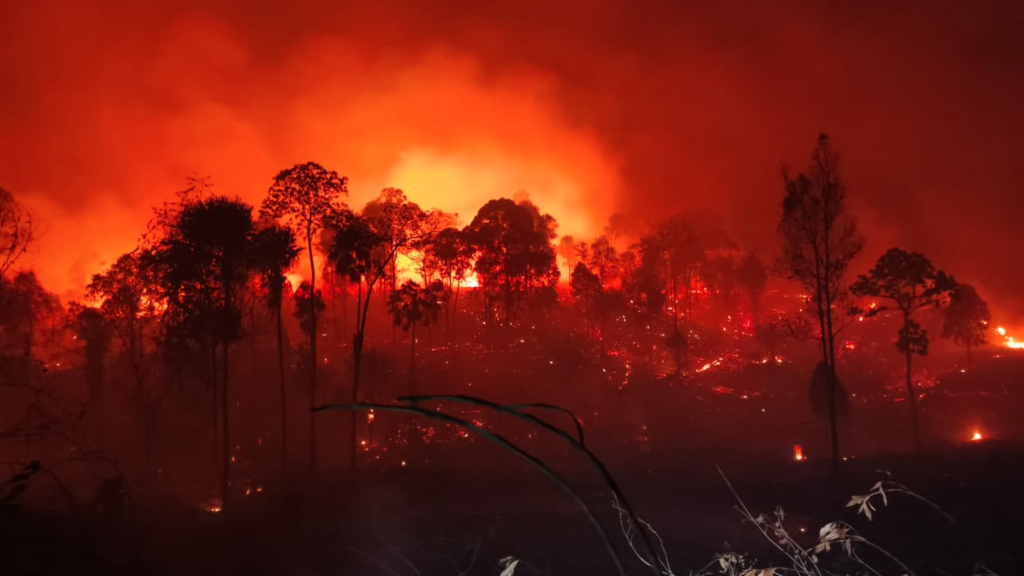
Each year, the islands of Indonesia witness colourful apparitions, oscillating between red and yellowish-brown hues demarcating the geographical locations of tropical forest fires. For nearly a month between August-September, Indonesia consumed the smoke of capitalism through forest fires and exported it to neighbouring countries without their consent. In the fires’ aftermath, tropical forests were converted into monoculture plantations, dominated by oil palm. Corporate and state occupation, facilitated by the fires, forms part of the circuit of capital accumulation within this commodity infrastructure.

During the 1960s, about 80% of Indonesia’s territory was covered in forest. However, the country experienced the world’s highest rate of deforestation, triggered by fires and illegal logging. Land became an asset that could not be removed; transforming it into a productive commodity required a regime of exclusion. By the beginning of the 21st century, Indonesia had lost 12 million hectares of tropical forests. 

Various companies and groups have monopolised Indonesia’s forest, controlling 60 million of a total of 130 million hectares. Corporate control of forests includes Forest Concession Rights covering 25 million hectares granted to 303 companies, and Industrial Plantation Forests (HTI) covering 10.1 million hectares granted to 262 companies. Furthermore, oil palm plantations cover 12.3 million hectares and are controlled by 1605 companies, while mining concessions covering 3.2 million hectares are controlled by 1755 companies, highlighting extreme inequality in land control.

Forests have been regarded as state assets since the Dutch colonial government implemented domein verklaring (free state domain), which stipulated that all land for which no one could prove ownership was state property. The transition towards forestry capitalism is becoming increasingly evident. Its primary driver is extensive extractivism through forest-based collective violence as a form of accumulation by dispossession within the state’s version of development. This is all designed to ensure the capitalist territorial logic of power remains constantly interconnected and interwoven. The smoke from forest fires marks the start of this process.

There is no safe haven, as anger mounts among Indonesia’s 280 million people, as well as in neighbouring countries forced to endure the export of unwanted haze. Responsibility has once again been shifted onto the individuals who suffering, rather than those fuelling the fires. This reveals the limitations of capitalist climate policy and explains why neoliberal solutions are so out of step with the scale of the crisis: safety must not interfere with profitability. That contradiction is resolved by shifting responsibility back onto the citizens who breathe in the smoke — the first touch of the palm oil capitalist economic cycle.

The impact of climate change remains a subject of considerable debate. This is a capitalist scheme: fossil fuel industry-funded disinformation and dependence on palm oil create political uncertainty while simultaneously ensuring the occurrence of forest fires in Indonesia. Palm oil is found in half of the products sold in supermarkets and in biofuels. About 50% of the world’s supply is grown in Indonesia, mostly on large plantations. Government land concessions granted to palm oil companies, totaling 22 million hectares, cover a third of Indonesia’s agricultural land, not to mention independent plantations operating under different land concession schemes.

Forest fires, which are used to clear land for oil palm plantations, demonstrate the importance of a rules-based global order. If rules can be bent, suspended or selectively interpreted whenever strategic interests demand, we are entitled to ask: whose order is this, and whose interests are ultimately served by these rules, such that fires become part of the global supply chain for certain commodities?

Following the occurrence of forest fires in Indonesia, there is a possibility that land use changes may be legalised through the implementation of Ministry of Forestry Regulation No. 448 of 2020. This particular regulation designates “authoritative land” under the forest area release policy scheme, thereby rendering them legally permissible for oil palm, food crops or mining activities. Moreover, in the event of a forest fire occurring in a production forest area, the designation of a “coordinated land” can facilitate its conversion to oil palm or food crop plantations. Both these factors suggest that forest fires are state-sponsored, as a straightforward and cost-effective method of land clearance.

Indonesia is the fourth-largest emitter of greenhouse gases, surpassed only by China, the United States, and the European Union. This significant contribution to global emissions can be attributed to several key factors, including substantial deforestation, frequent peatland fires and extensive coal usage. In Indonesia, the access of mining oligarchs and palm oil tycoons to policy-making, government insiders, financial institutions and opinion leaders is facilitated by the state and public officials. These entities are lauded by an international community mesmerised by the illusory image of development and growth. Within the context of a capitalist rent-seeking economy, this dynamic is seen as fundamental for capital accumulation.

The process by which less developed or peripheral countries, such as Indonesia, are steered towards integration into the neoliberal system has been shown to result in deforestation and chronic ecocide. These countries become locked into a relationship of dependency with “developed” nations and the international financing of the global economy, caught in a debt trap and lopsided trade agreement. The maximisation of production of extracted primary commodities, such as palm oil and coal, extracted from tropical forests across the planet, including in Indonesia where the prices of these non-value-added goods are kept low, serves to reinforce global supply chains despite causing environmental and social damage.

Below we will examine how the palm oil industry is embedded within capitalism — a process that begins with forest fires. Indonesia accounts for as much as 55% of the global palm oil market. Palm oil represents projects that will always exist as a defensive measure, hiding behind nationalism and economic development to remain part of the global supply chain of neoliberal capitalism, while securing policies they desire within the Roundtable on Sustainable Palm Oil (RSPO), Indonesian Sustainable Palm Oil (ISPO) and COP forums.

The concept of high conservation value is regarded as a Trojan horse of deceit, employed by palm oil companies to mislead unsuspecting communities and governments. This is done to meet the controversial assessment criteria of the RSPO and ISPO as a form of pseudo-conservation within the sustainability criteria for palm oil. The outcome is that palm oil companies gain access to North American and European markets. These standards offer a certain degree of transactional flexibility, adapted to prevailing local, national and regional political directions shaped by neoliberal policies. Through agreements such as the European Free Trade Association (EFTA), these countries aim to import only “sustainable” palm oil at lower tariffs. But what sort of “sustainability” can be offered by a commodity production system that begins with the burning of tropical forests and peatlands — the lungs of the world?

Under President Prabowo Subianto (2024–29), Indonesia has become a major force within the global capitalist system in producing palm oil and minerals such as coal and nickel, even though its domestic policies are admired even by some nationalist left-wing circles. The government’s response to palm oil resulting from forest fires will invariably feature nationalistic rhetoric about the economy and job creation, while also invoking Indonesia’s territorial integrity. What we are witnessing today is the consequence of public policy choices, not the supposedly neutral forces of the market or technological change. To speak of a natural or pre-political economic system is a profound misunderstanding of historical and social reality.

Following in the footsteps of his predecessor, President Joko Widodo or Jokowi (2014–24), Prabowo has never been willing to disclose land data, particularly regarding oil palm plantations and mines, as required by the Supreme Court in 2017, as well as Indonesian Law No. 14/2008 and a decision by the Public Information Commission No. 057/2015 to disclose the names of landowners, locations, land areas and maps of the regions — including landowners affected by fires. How can we prevent forest fires, improve the climate and reduce emissions, if the factors causing the damage are ongoing? Forest fires as a climate disaster represent an epic battle against smoke, a stark manifestation of global neoliberal corporate criminality and state capitalism.

How do those responsible for forest fires evade Indonesian law? Corruption, collusion and cronyism are rife, creating systemic impunity between corporations, particularly palm oil companies, and the state. This is facilitated by regulations protected by the House of Representatives and enforced by the police and military. There is also a lack of organised resistance and action against deforestation and the palm oil industry. We are confronted with the central issue of climate change, inextricably linked to the development of palm oil plantations that have been constructed on a foundation of capitalism and further enhanced by imperialist elements, resulting in the preservation of extinct species. The haze from forest fires blurs the landscape, creating a faint silhouette.

The damage caused by those who set forest fires with impunity is severe. This is further compounded by the spatial concentration of companies competing for concession licences and the subsequent flow of capital, thereby establishing a mutually beneficial relationship that is challenging to dislodge, particularly when major corporations support campaigns for local, national and even presidential elections as part of their corporate strategy.

Electoral democracy and regional autonomy, achieved through the 1998 reforms, conceal another side to campaign financing: one that bypasses strict regulations on corporate political spending and opens the door to virtually unlimited spending and undisclosed “black money,” which dominate Indonesia’s current political system — a system in which the palm oil and mining oligarchies wield immense influence. A palm oil tycoon can outspend millions of people to control their political future.

During the 2019 presidential election, a “palm oil is good” campaign emerged, backed by Jokowi’s incumbent administration. As in 2024, Jokowi faced off  in 2019 against Prabowo — a former military general with a history of human rights violations and a business owner who controls thousands of hectares of land in Indonesia, particularly in Kalimantan. Prabowo finally won in 2024, with Gibran Rakabuming — Jokowi’s eldest son — as his running mate. Jokowi and Prabowo are much the same: both are backed by tycoons who operate large-scale land holdings for oil palm plantations and mining across Indonesia under various company names. Consequently, any moratorium is nothing but a paper tiger, while continuing land reform and deforestation serves merely as a populist slogan.

Prabowo is a fan of oil palm, which he refers to as a “miracle crop” and strategic national commodity. He is intent on expanding oil palm cultivation in Papua beyond the current level, which has already reached 250,000 hectares. He states the claim oil palm causes deforestation is a false and cruel accusation, as oil palm is also an evergreen tree and no different from other forest trees.

Fuelled by antek asing (foreign agent) rhetoric, the harassment of activists and civil society organisations is set to continue. This has become a favoured tactic of Prabowo’s administration to discredit critics and counter public sentiment regarding foreign aid in the wake of natural disasters, citing nationalism and national resilience as justifications. This term emerged when floods and landslides struck Sumatra in 2025 as a result of deforestation and expanding oil palm plantations, leaving thousands dead and hundreds of thousands affected. 

However, during the 2026 forest fires — when the effects of smoke had already reached neighbouring countries such as Malaysia, Singapore, Brunei and the Philippines, and amid fears of international threats and sanctions — assistance to extinguish fires from Japan and Malaysia was finally accepted. Furthermore, Prabowo is reviving the colonial term londo ireng (Black Dutchman), thereby importing a dangerous authoritarian logic that trades democratic accountability for loyalty tests and targets critics in the media, including those questioning the government’s defensive response to these forest fires.

Indonesia has responded to the forest fires with a spirit of adaptation, viewing them as an inevitable disaster to be weathered to ensure investment flows in promptly. Furthermore, the farcical measures to tackle the fires — such as using manual fire extinguishers and even the president’s suggestion to use cassava flour — along with allowing children to remain in school so that the president’s “Free Meal Nutrition” scheme, which has caused tens of thousands of food poisoning cases, can continue to run, have enraged the people. The forest fires have exposed the limitations of capitalist climate policy as a palliative for a “normality” that must be dismantled, and illustrate why neoliberal solutions are out of step with the scale of the emerging crisis.

In tackling forest fires, Prabowo appointed Haji Isam — a palm oil tycoon and mining oligarch — as head of the Kalimantan Forest Fire Extinguishing Task Force. However, following public controversy, this was changed to a private entity appointed as a technical adviser, which also provided operational funding for firefighting amounting to US$500,000. As well as controlling thousands of hectares of coal mines in Kalimantan with a turnover of 400,000 tons a month, Haji Isam owns 17,000 hectares of oil palm plantations in South Kalimantan and 22,782 hectares in East Kalimantan, and is currently expanding into Papua. 

Haji Isam is a business owner who purchased 2000 excavators from China to clear tropical forests and peatlands in Papua for Prabowo’s 2.25 million-hectare “food estate” project, intended for rice production for food and sugarcane for bioethanol. However, these commodities may change, as both will struggle to be productive given Papua’s climate and soil conditions. They are likely to result in failure similar to the one million hectare food estate during the Jokowi era. Consequently, the alternative scenario would be to replace them with oil palm, under the pretext of producing bioethanol and reducing dependence on fuel imports, while also appealing to nationalist sentiment, as Indonesia has set a target of 20% bioethanol (E20) in petrol by 2028 and projects energy self-sufficiency.

A total of 25 palm oil holding companies are owned by prominent figures within the palm oil industry, 20 of which are listed on the stock exchange. These companies continue to successfully obtain capital by issuing shares. Financial institutions have provided substantial capital to palm oil conglomerates controlled by these tycoons over the past two decades, through direct lending and by underwriting the shares and bonds sold to investors. Key banks providing palm oil financing are the Oversea-Chinese Banking Corporation (Singapore), CIMB Group and Malayan Banking (Malaysia), Bank Negara Indonesia and Bank Mandiri (Indonesia), Credit Suisse (Switzerland), Rabobank (Netherlands), BNP Paribas (France) and Citigroup (US). Consequently, financial capital has supported the palm oil industry, and as the land for these plantations is acquired through the clearing or burning of tropical forests, it indirectly contributes to forest fires, the smoke from which returns without provoking any significant outrage against Indonesia.

Neoliberalism’s crisis, particularly after the 2008 economic crash, has further strengthened the search for alternative state approaches to accumulate the fruits of production through state intervention and control, in the form of state corporations or state-owned enterprises (SOEs). The relationship between the state and the mode of economic production has become increasingly close. The state no longer merely acts as a regulator through legislation, but also features as a player in economic production activities. To accommodate the palm oil sector, in 2025 Prabowo established an SOE called PT Agrinas Palma Nusantara, led by a military general, which controls 1.7 million hectares of palm oil plantations — an area set to expand, partly through the reclamation of forest areas, including those burnt or deliberately set alight.

Its resource wealth is not an intrinsic or natural quality, but a constellation of materialities, relationships, technologies and discourses that must be harmonised to make it a viable investment. At present, we urgently need to scrutinise the political and legal structures that amplify and protect capital at the expense of communities and forests. If elected officials fail to establish ecological justice, the common good and equality before the law, then it matters little who wins the presidential, parliamentary or local elections, because an oligarchy is far easier to create and maintain when insulated from political pressure. We must wait to see how these fires will end but, in the meantime, we have every right to be concerned about the direction Indonesia is heading without its tropical forests. The fires have scorched the lungs of the Earth and the smoke is already in our lungs.

Frans Ari Prasetyo is an independent researcher, planner and photographer whose work explores landscape politics, spatial planning and grassroots movements in Indonesia. His research focuses on the political ecology of land use, infrastructure development and the struggles of marginalised communities, including youth movements, underground collectives and rural populations affected by state and corporate development projects.

Wednesday, September 16, 2026

Poten: VLCC Rates Hit Unprecedented Levels Amidst Mideast Conflict

Tanker owners should take advantage of the current market, which may never happen again, says Poten & Partners

COSGRAND LAKE
Press handout / file image courtesy China COSCO

Published Sep 11, 2026 6:06 PM by Erik Broekhuizen / Poten & Partners


Participants in the tanker industry are no strangers to market cycles combined with extreme volatility. However, even seasoned veterans are looking at current developments in the market and scratching their heads. What is happening is truly unprecedented. It begs the question: What is driving this market and, more importantly, how sustainable is it? In this Tanker Opinion we will focus on the market for Very Large Crude Carriers (VLCCs), the most volatile and visible tanker segment.

Just to provide a little context, VLCCs are large crude oil tankers, with a carrying capacity of two million barrels, They are the main vehicle for long-haul seaborne crude oil transportation. As per September 1st, the global VLCC fleet consisted of 928 vessels, with an average age of 13 years. VLCC earnings are notoriously volatile, driven by supply and demand dynamics in a highly competitive market.

Chart 1 shows VLCC Time Charter Equivalent earnings over the last 15+ years (monthly averages in $/day). In July 2008, at the tail-end of the shipping “super cycle”, VLCC rates hit almost $200,000/day. On the back of China's extraordinary growth, shipping markets were exuberant, and owners had lined up at Asian shipyards to order more capacity. The orderbook ballooned. In late 2008, the global financial crisis hit, sending the world economy into a tailspin, taking the shipping markets with it. By mid-2009, tanker rates had dropped below $20,000/day.

The market has gone through a few more cycles since then. The next time the market closed in on $200,000/day was in April 2020, at the onset of the Covid-19 pandemic. Saudi Arabia flooded the oil markets after Russia refused to make the deep production cuts needed to address the demand destruction resulting from the pandemic lockdowns. The oil glut that followed quicky filled onshore tanks and raised demand for floating storage, boosting VLCC rates. This rate boom was also followed by a long period of depressed earnings. A recovery was triggered by Russia’s war on Ukraine, but that benefited Aframaxes/Suezmaxes more than VLCCs.

This brings us to the current rate spike. The war in the Middle East and the subsequent closure of the Strait of Hormuz, recently followed by significant restrictions transiting the Bab el-Mandeb Strait, have pushed VLCC rates to levels that we have never seen before. Earnings on the benchmark AG-Far East route averaged $600,000/day in August and reached more than $800,000/day in September to date.

It should be noted that these rates are for voyages originating within the Arabian Gulf. Due to the hazards associated with traversing the Strait of Hormuz, only a few owners are willing to take that risk, leading to sky-high rates. However, VLCC rates on other key routes are very high as well. Vessels loading in the Gulf of Oman, just outside the Strait of Hormuz, can earn $450,000/day. Even VLCCs that stay far way from the conflict zone can earn exceptional returns: $380,000/day for West Africa – Far East and $275,000/day for U.S. Gulf to Asia.

Not surprisingly, the exceptional spot rate environment has had an impact on time-charter rates and vessel values as well. Values for modern secondhand vessels are much higher than prices for newbuildings. A 5-year-old VLCC (if you can find one) will set you back $158 million, while you can order a new vessel for $129 million. The reason for the discrepancy is simple: You can employ a newly acquired vessel immediately in the red-hot spot market, while you have to wait several years before a newbuilding is delivered from the shipyard. And while you know what a vessel can earn in the market today, the future rate environment is much more uncertain. If history tells us anything, it is that periods of exceptional rates are usually followed by periods of low earnings, especially if the high earnings have spurred an ordering bonanza (Chart 2).

So, what’s next for the VLCC market? Opinions differ. Some people look at the unusual set of circumstances that triggered the current rate bonanza and with an eye toward the high orderbook (40% of the current fleet), they see another bust following this boom within a few years. Others are more sanguine considering the age profile of the fleet and the large contingent of sanctioned vessels that could be sidelined once the geopolitical conflicts are resolved. On top of that, restocking and a diversification trend away from the Middle East could create a higher ton-mile demand baseline. In the meantime, owners should take advantage of the current market. This may never happen again! 

This post appears courtesy of Poten & Partners.

The opinions expressed herein are the author's and not necessarily those of The Maritime Executive.

Sunday, September 13, 2026

 Poten: VLCC Rates Hit Unprecedented Levels Amidst Mideast Conflict


Tanker owners should take advantage of the current market, which may never happen again, says Poten & Partners

Press handout / file image courtesy China COSCO

Published Sep 11, 2026 
 by Erik Broekhuizen / Poten & Partners

Participants in the tanker industry are no strangers to market cycles combined with extreme volatility. However, even seasoned veterans are looking at current developments in the market and scratching their heads. What is happening is truly unprecedented. It begs the question: What is driving this market and, more importantly, how sustainable is it? In this Tanker Opinion we will focus on the market for Very Large Crude Carriers (VLCCs), the most volatile and visible tanker segment.

Just to provide a little context, VLCCs are large crude oil tankers, with a carrying capacity of two million barrels, They are the main vehicle for long-haul seaborne crude oil transportation. As per September 1st, the global VLCC fleet consisted of 928 vessels, with an average age of 13 years. VLCC earnings are notoriously volatile, driven by supply and demand dynamics in a highly competitive market.


Chart 1 shows VLCC Time Charter Equivalent earnings over the last 15+ years (monthly averages in $/day). In July 2008, at the tail-end of the shipping “super cycle”, VLCC rates hit almost $200,000/day. On the back of China's extraordinary growth, shipping markets were exuberant, and owners had lined up at Asian shipyards to order more capacity. The orderbook ballooned. In late 2008, the global financial crisis hit, sending the world economy into a tailspin, taking the shipping markets with it. By mid-2009, tanker rates had dropped below $20,000/day.

The market has gone through a few more cycles since then. The next time the market closed in on $200,000/day was in April 2020, at the onset of the Covid-19 pandemic. Saudi Arabia flooded the oil markets after Russia refused to make the deep production cuts needed to address the demand destruction resulting from the pandemic lockdowns. The oil glut that followed quicky filled onshore tanks and raised demand for floating storage, boosting VLCC rates. This rate boom was also followed by a long period of depressed earnings. A recovery was triggered by Russia’s war on Ukraine, but that benefited Aframaxes/Suezmaxes more than VLCCs.

This brings us to the current rate spike. The war in the Middle East and the subsequent closure of the Strait of Hormuz, recently followed by significant restrictions transiting the Bab el-Mandeb Strait, have pushed VLCC rates to levels that we have never seen before. Earnings on the benchmark AG-Far East route averaged $600,000/day in August and reached more than $800,000/day in September to date.

It should be noted that these rates are for voyages originating within the Arabian Gulf. Due to the hazards associated with traversing the Strait of Hormuz, only a few owners are willing to take that risk, leading to sky-high rates. However, VLCC rates on other key routes are very high as well. Vessels loading in the Gulf of Oman, just outside the Strait of Hormuz, can earn $450,000/day. Even VLCCs that stay far way from the conflict zone can earn exceptional returns: $380,000/day for West Africa – Far East and $275,000/day for U.S. Gulf to Asia.

Not surprisingly, the exceptional spot rate environment has had an impact on time-charter rates and vessel values as well. Values for modern secondhand vessels are much higher than prices for newbuildings. A 5-year-old VLCC (if you can find one) will set you back $158 million, while you can order a new vessel for $129 million. The reason for the discrepancy is simple: You can employ a newly acquired vessel immediately in the red-hot spot market, while you have to wait several years before a newbuilding is delivered from the shipyard. And while you know what a vessel can earn in the market today, the future rate environment is much more uncertain. If history tells us anything, it is that periods of exceptional rates are usually followed by periods of low earnings, especially if the high earnings have spurred an ordering bonanza (Chart 2).

So, what’s next for the VLCC market? Opinions differ. Some people look at the unusual set of circumstances that triggered the current rate bonanza and with an eye toward the high orderbook (40% of the current fleet), they see another bust following this boom within a few years. Others are more sanguine considering the age profile of the fleet and the large contingent of sanctioned vessels that could be sidelined once the geopolitical conflicts are resolved. On top of that, restocking and a diversification trend away from the Middle East could create a higher ton-mile demand baseline. In the meantime, owners should take advantage of the current market. This may never happen again!

This post appears courtesy of Poten & Partners.


Alphaliner: Economic Pressures to Push Carriers to 27,500 Gigamax Boxships

giant containership loaded with record 22,000 boxes
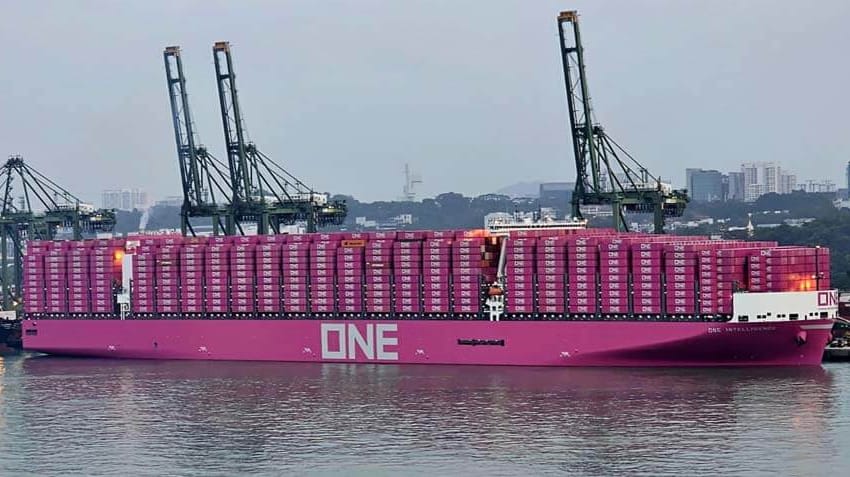
Just a few years ago, ONE was claiming records when it loaded more than 22,000 TEU in Singapore (ONE)

Published Sep 9, 2026 6:52 PM by The Maritime Executive


Do you want to supersize that containership may soon be the question shipbuilders and owners are contemplating, according to the consultants at Alphaliner. While the industry has plateaued at ultra-large container vessels, Alphaliner sees the elements that could easily lead to a new, ever-bigger class of Gigamax container vessels.

The consultancy is dusting off hypothetical concepts it presented five years ago, saying that market factors may just make the timing right for the new, bigger ship. It foresees a time by 2030 when the world’s top carriers could “theoretically deploy at least one 'full set’ of next-generation containerships on the East-West mainlines.”

“Increased cost pressure might prompt some of the largest carriers to reconsider their fleet strategies,” writes Alphaliner. It predicts some of the carriers will “opt for a novel ship type that is slightly larger than the current capacity record holders.”

The industry has a strong history of moving through these size categories. It went to the 18,000 to 19,000 TEU vessel for economies of scale. The next jump was to 23,000 to 24,000 TEU, but according to Alphaliner, for about a decade now carriers have stuck with that level. The ships are about 400 meters (1,312 feet) in length and have a beam of 61 meters (201 feet). It fits through the Suez Canal, and ports are adapted to handle this size of vessel. Shipyards and naval architects have toyed with the available space, and by making small changes to loading patterns and systems, they have squeezed the capacity by at most a few hundred boxes. The largest official TEU rating now stands at just over 24,300 boxes. 

Carriers have discussed bigger ships, but so far none has made the move. They said the 24,000 TEU load seems "about right" for the market and the operating factors.


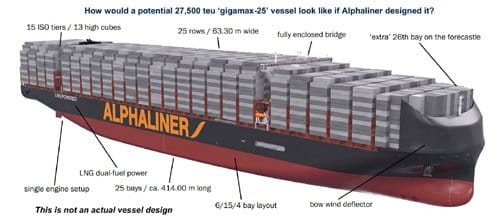
Alphaliner's hypothetical concept for a 425+ meter container vessel with 27,500 TEU capacity


The consultants at Alphaliner, however, are answering the question of why carriers might finally jump the current barrier.

“Especially in very long-haul East-West mainlines,” says Alphaliner, “factors like the increasing price of fuel and the introduction of carbon emissions taxes will give bigger ships a competitive edge in the long run.”

Its Giamax concept would be incremental, adding one hold or possibly two 40-foot bays beyond today’s 400-meter ships. They forecast a length of 425 meters or more, and that would give the ships a capacity of 27,500 TEU.

They believe that the ports that have already adapted to the 24,000 TEU ships would be able to absorb these slightly larger vessels. The applications would be limited, however, as many ports, such as in the United States, cannot handle even the 24,000 TEU ultra-large vessels.

Alphaliner is not the only one working on theories for the next generation of giants. China’s Shanghai Ship Research and Design Institute and projects looking at the future of nuclear-powered containerships have also shown the potential to leap the 24,000 TEU barrier.

The concept of going to bigger ships seems to fit with the trends in the industry. As the ships get more expensive to build and operate, more boxes will rebalance the economic equation and potentially help with the anticipated wave of older ship retirements that has long been predicted. 

The container segment already has a record orderbook as carriers continue to order new ultra-large vessels. Alphaliner points out that over a relatively short period of time the industry’s capacity has soared from 23.2 million TEU to a current 34.1 million TEU. It is up 47 percent, and deliveries from the orderbook are likely to continue to drive capacity in the sector.