It’s possible that I shall make an ass of myself. But in that case one can always get out of it with a little dialectic. I have, of course, so worded my proposition as to be right either way (K.Marx, Letter to F.Engels on the Indian Mutiny)
My friend Artem Ivanovich Kirpichenok would not hurt a fly. On 2 August 2026, he arrived in Tel Aviv and – somehow – ended up in prison. What we know is that he was arrested by the Shin Bet, Israel’s secret police. There has been no contact with him since. There has been no official reason for his detention. A historian and writer who is unusually gentle and kind has now disappeared into the Israeli prison system.
Artem was born and lived in St. Petersburg (Russia), although he lived in Israel for fifteen years and graduated from the Hebrew University (Jerusalem). He later took a PhD in History from the Department of Slavic Studies at the Center for Arab-Eurasian Studies. Working as a journalist, Artem wrote for TRT Russian (Turkey) and Caliber (Azerbaijan), where he reported on the Israeli policy toward the Palestinians and on the Israeli war on Gaza. In 2018, Artem travelled to Iran, where he visited several cities and wrote about them on his personal blog.
During the past few days, agitated about Artem, I have taken refuge in literature produced in and about our city of St. Petersburg (when we were born there, it was Leningrad). In March 1901, Maxim Gorky published Song of the Stormy Petrel about an event in the city: students in the city protested over the conscription of their fellow student in Kyiv for a war that no-one wanted; and so, the Tsar’s Cossacks came to attack these students at Kazan Cathedral. The song appeared inside a longer satirical piece called Spring Melodies, which the authorities banned. Spring Melodies is set in a land of birds, where Siskin – a small bird who stands in for the youth – sings this song. Gorky slipped the song out of Spring Melodies and published it in the journal Life. That song was later canonized in the Soviet Union as a great revolutionary song.
I love the accident of it. The most dangerous text of that era slipped by the censors because it pretended to be a harmless little bird song. I never spoke with Artem about this song, but it is impossible to imagine that he would not have – like myself – memorized it and sung it in our Soviet schools.
There are two main characters in the song: the petrel and the penguin. The petrel fights the storm, ‘soars with pride’, and as the wind picks up, perishes, but with its dignity intact. The penguin, on the other hand, ‘hides his fat body among the crags’, and therefore survives the storm. But the storm has other ideas. To rewrite Gorky’s song, we must add in verses that show how the storm now hunts the penguin as well – how there is no escape from the wrath of the storm. Artem Kirpichenok is a charming and impractical man who belonged to no political party and no activist group, who never donated money to any political cause or signed any statement. He published books about history and wrote mostly ironic posts on his personal Facebook page. He was not a penguin (he held strong views on a range of topics), but he was not a petrel either (he did not advertise his views for the wider public).
Impossible not to have a view on Israeli government policy these days, but Artem’s views are not so different than those held by the mainstream Israeli newspaper Haaretz. In which case, the question is what has Artem done and why has he been sitting in a Shin Bet prison without habeas corpus for a week? If Artem had been part of a movement or a public figure, then there would be press releases demanding his release. But he is a private individual. So, who will stand for someone like him?
To arrest Artem is to make private individuals afraid and to make them internalize their penguin-like condition, to shut up, and sit quietly in the corner. Arresting a bespectacled writer with a narrow audience is both easy and makes for a perfectly instructive example. Before Artem was arrested, it seemed to many of us – me included – that there were ‘anomaly zones’ out there: in those anomaly zones, one could be somewhat safe from arbitrary arrest. It was felt that as long as you did not cross certain well understood line, you could write, read, and speak about pretty much anything. Don’t join a party, don’t donate to certain organizations, don’t say certain things. But the lines that seemed to exist have now been erased and what you whisper in your kitchen can now get you into a prison cell.
The everyday curdles into a nightmare. The kitchen and the prison are becoming the same room. We have become like frogs that do not notice that the water in which they are swimming has started to come to a boil. We have made straightforward cannibalism normal.
When Artem was arrested, his old blog opponents said, what did he expect, going to Israel, when he could have sat quietly in Petersburg and minded his own business. Sorry. That’s just the attitude of the frog. There are no safe places left. There are no crags left to hide a penguin. Artem is not the hero-petrel. He is much more like the penguin. And so, it is now getting clear to us, that the penguin hunt has begun. Anyone at all can be picked up and tossed into the darkness.
Gorky did not know much about penguins. Although they look defenseless, they can stand their ground as a pack and peck their way out of trouble; in water, penguins are agile and fast, forming ‘rafts’ to beat adversaries and escape. Artem needs his penguins to act in unison. Please make noise for him.
Nika Dubrovsky is the director of the David Graeber Institute.
Nika Dubrovsky is an artist and writer. She is the founder of the David Graeber Institute and the editor of Graeber books.
Wednesday, July 01, 2026
Most of the World’s Wealth Belongs to All of Us. It’s Time to Start Collecting.
Let’s consider a fact so stark it barely registers: the world’s five richest billionaires have more than doubled their wealth since 2020. Meanwhile, 60 percent of humanity has grown poorer over the same period. At current trajectories, we will see the world’s first trillionaire within a decade.
We have grown so accustomed to statistics like these that they have lost their capacity to shock. But they should shock us. Extreme inequality of this magnitude — the richest one percent owning 43 percent of all global financial assets, while emitting as much carbon pollution as the poorest two-thirds of humanity — is not merely an unfortunate side effect of an otherwise functioning system. It is the system working as designed—and it is bad for nearly everyone.
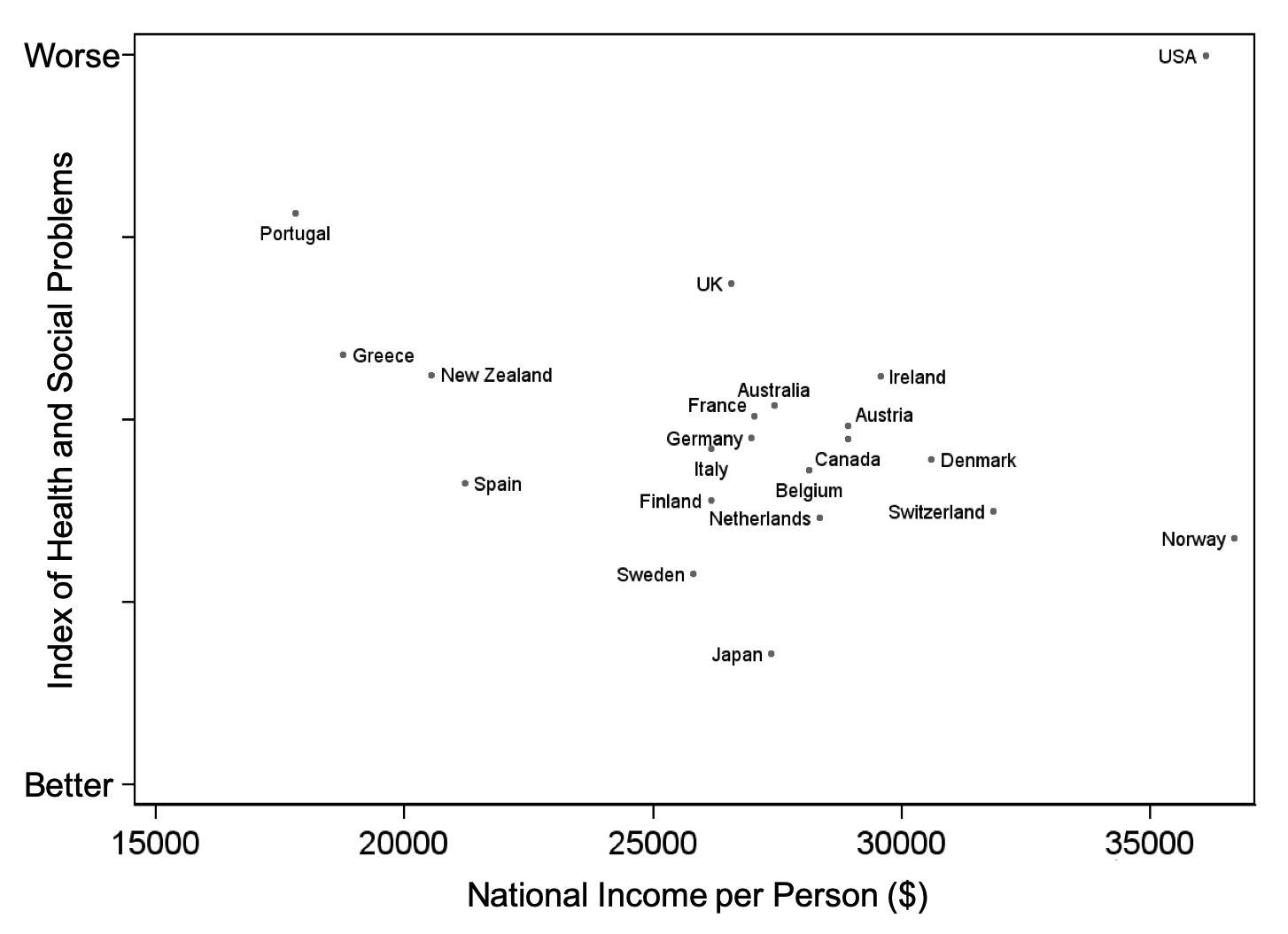
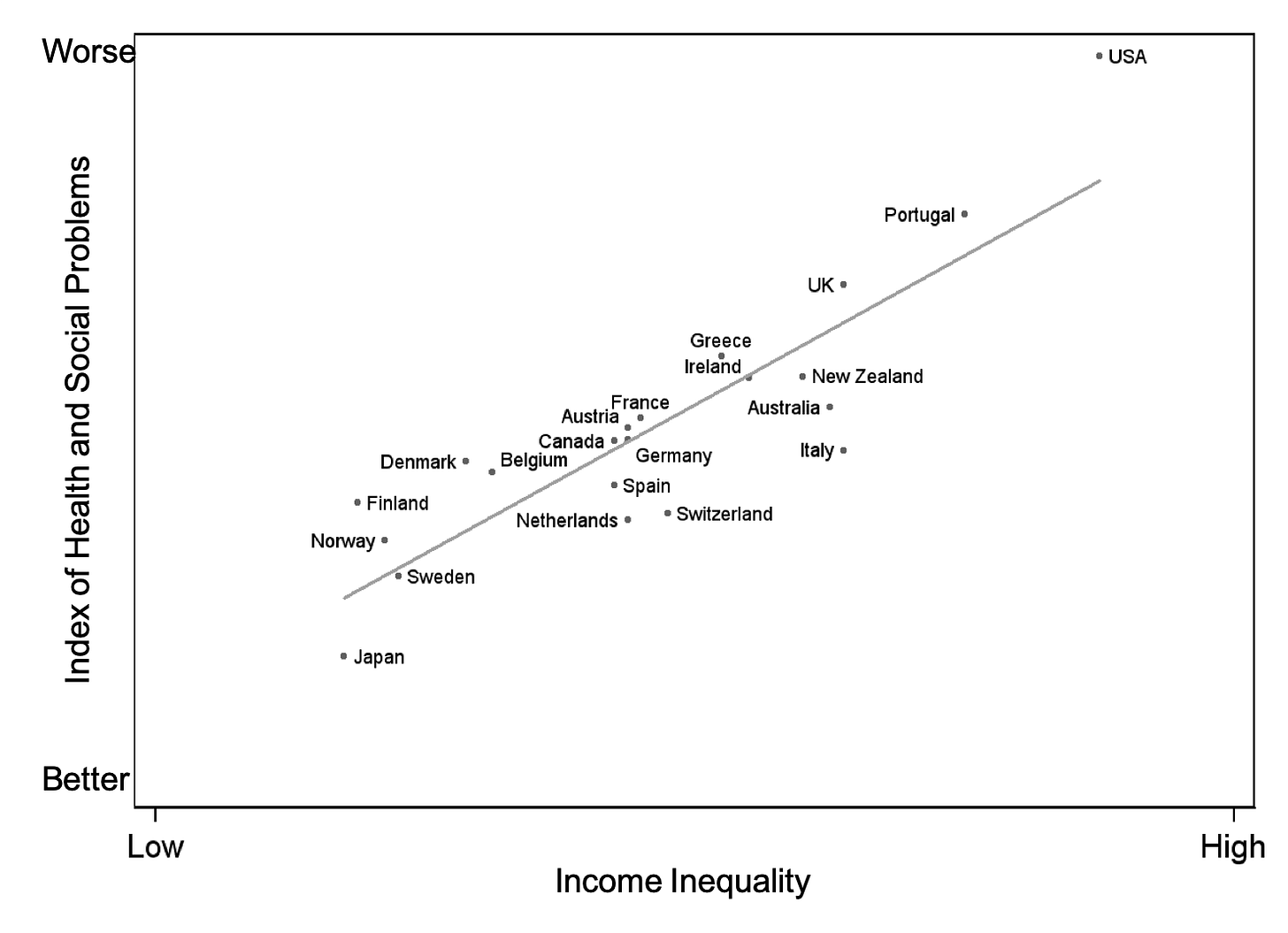
This last point is worth dwelling on, because it contradicts the intuition that inequality is primarily a problem for those at the bottom. The social scientists Richard Wilkinson and Kate Pickett spent decades studying health and social outcomes across developed countries and arrived at a finding startling in its clarity: the strongest predictor of a country’s overall health and wellbeing is not its level of wealth, but how evenly that wealth is distributed. More unequal societies have lower life expectancy, higher rates of mental illness, more crime, more addiction, more homicide, and more incarceration. People in Sweden are more than six times as likely to trust their neighbors as people in the most unequal countries. Inequality does not just impoverish the poor — it corrodes the social fabric that everyone depends on to live a decent life.
National Income reflects little correlation with health and social problems.Whereas income inequality is strongly correlated with health and social problems. Source: Richard Wilkinson and Kate Pickett, The Spirit Level: Why Greater Equality Makes Societies Stronger (New York: Bloomsbury Press, 2009).
Political philosopher John Rawls captured something essential about this when he proposed a famous thought experiment. Imagine you are about to be born into a society, but you have no idea where in the social hierarchy you will land — no knowledge of your parents’ wealth, your natural talents, or your social status. You’re behind what Rawls called a “veil of ignorance.” What kind of society would you design? The answer that most of us would choose is one that protects the least well-off rather than giving unlimited advantage to the fortunate few. By that standard — and it’s a reasonable one — almost no one would choose the world we have built.
Now add one more ingredient to this already volatile mixture: artificial intelligence.
The story of how wealth becomes concentrated is ultimately a story about the enclosure of the commons. Our civilization rests on a vast accumulated inheritance — millennia of knowledge, language, law, mathematics, medicine, infrastructure, and culture, built collectively by generations of human beings who are no longer alive to collect their share. When Mark Zuckerberg made a few tweaks to this edifice and collected a personal fortune of $250 billion, he did not build that wealth from nothing. He built it on top of everything that came before: the internet (publicly funded), computing (decades of academic research), literacy (centuries of educational investment), and the entire architecture of modern civilization.
Generative AI now represents the most dramatic enclosure of the commons in human history. In a matter of years, a handful of corporations have ingested virtually the entire accumulated text of human civilization — every book, article, scientific paper, poem, and conversation that could be scraped from the web — and now monetizing it as a proprietary product. The knowledge commons of humanity, built over millennia by countless anonymous contributors, has been captured for the benefit of a tiny elite. The rest of us, whose ancestors did the actual work of generating all that knowledge, receive nothing.
And that is before we account for what AI will do to labor markets. Past technologies displaced workers in waves but always left new industries in their wake. AI threatens something more sweeping: a historically unprecedented break in the capital–labor relationship, moving from software into robotics and the physical economy, displacing white-collar and blue-collar work alike. When AI can write code, draft contracts, analyze data, generate medical diagnoses, and automate factories, the bargaining power of workers in those fields collapses. The gains flow overwhelmingly to the owners of the AI systems, while the rest of the population absorbs the disruption.
We risk entering a new age of techno-feudalism — a tiny elite owning the productive systems of intelligence while the rest of humanity scrambles for precarious survival.
This is the context in which we need to discuss Universal Basic Income (UBI): not as some extended welfare payment, but as an urgent structural response to a civilizational emergency.
Thomas Paine — who helped inspire the American Revolution and wrote The Rights of Man— was also one of the first to articulate the moral logic of a UBI, and he framed it in terms that remain more precise and more radical than found in most contemporary discussions. Rather than proposing charity, he proposed justice. In doing so, he laid a cornerstone for what we can now envisage as an ecocivilization—a world that works for all.
“It is not charity but a right,” Paine wrote, “not bounty but justice, that I am pleading for.” The payment he envisioned was not a basic income but a dividend. A share of the commonwealth that belongs to every person by virtue of being born into a civilization built by their ancestors.
The distinction matters enormously. Welfare carries stigma. It requires means-testing, proof of need, bureaucratic gatekeeping. It is premised on the idea that most people do not deserve support, and that those who do must demonstrate their worthiness to receive it. A dividend, by contrast, is premised on the fact that we are all stakeholders in a collective inheritance. It no more requires justification than a shareholder needs justification for receiving returns on an asset they own.
All human wealth derives ultimately from the commons: from the abundance of nature itself — the air, water, sunlight, soil, and ecosystems that sustain all life — and from the accumulated knowledge and infrastructure that our ancestors built and bequeathed to us. That includes electricity, chemistry, modern medicine, the internet, and now the digital architecture that AI is built upon. This enormous legacy is a commonwealth, and the wealth it generates belongs by right to all of us.
The appropriate policy instrument for distributing a share of that commonwealth is what UBI advocates like Guy Standing call, more precisely, a “social dividend.” Every legal resident of a society would receive a guaranteed periodic cash payment — unconditional, universal, and sufficient to cover basic needs. Not as a substitute for public services, but as a complement to them: alongside universal healthcare, education, housing support, and public transportation, each person would also receive the cash equivalent of their individual share of the commonwealth.
The concern most commonly raised about UBI — that “free money makes people lazy” — turns out, on examination, to be a projection of the ideology of capitalism rather than an observation about human nature. People do not, in fact, primarily want to avoid work. What they want to avoid is degrading, meaningless, coerced work, what David Graeber memorably called “bullshit jobs.” Given financial security, people tend to invest their time and energy in activities of genuine value: caring for family members, building community, starting small enterprises, pursuing education.
The evidence from UBI pilots conducted around the world is remarkably consistent. A meta-study by the Stanford Basic Income Lab synthesizing sixteen different reviews found decisively that UBI alleviates poverty and improves health and educational outcomes across the board. In Liberia, a group of addicts and petty criminals given unconditional cash spent it on food, clothing, and medicine. In Vancouver, fifty homeless people given $7,500 with no strings attached used it for food, rent, and clothing, and remained financially stable a year later. In India, UBI recipients established fishing cooperatives, pooled income to improve village infrastructure, and enabled young women to gain independence from patriarchal financial control.
In Namibia, petty crime fell substantially because starving villagers no longer needed to steal vegetables. They began planting more, creating abundance where scarcity had generated conflict. Instead of making people passive, a social dividend empowered them to pursue their dreams.
The objection that a robust UBI is unaffordable is, upon examination, a statement about political will rather than economic reality. If every American adult received $1,000 per month — roughly the federal poverty level — the total annual cost would be approximately $4 trillion, equivalent to less than 14 percent of US GDP. That sounds large until you consider that the world’s 3,000 billionaires currently hold approximately $16 trillion in wealth. Oxfam calculates that a 12.8 percent annual wealth tax would merely have kept their wealth constant since 2016.
As Guy Standing puts it, the issue is not affordability but “what are society’s fiscal priorities?”
Here is the deeper issue: if we accept that all wealth ultimately derives from the commons — from nature, from accumulated human knowledge, from millennia of collective labor — then the current situation, in which a vanishingly small number of people have captured a wildly disproportionate share of that wealth while the majority have no meaningful stake in their collective inheritance, represents not merely inequality but more like ongoing theft. On that basis, a social dividend is not a redistribution of wealth that belongs to the wealthy but a return of wealth that belongs to everyone.
Some of the mechanisms for collecting that wealth are well understood: restoring progressive taxation, enacting internationally coordinated wealth taxes, instituting land value taxes on the unearned gains of property ownership, applying full-cost pricing that requires corporations to account for the ecological and social damage they externalize onto the commons. The G20 is already considering a proposal by economist Gabriel Zucman to ensure the world’s 3,000 billionaires pay at least 2 percent of their wealth in taxes annually — a measure that could generate $250 billion per year. It is an important first step, yet it barely scratches the surface.
A different social contract
The transformative power of a social dividend goes beyond the material. It would be based on a postulate that our civilization has not been willing to acknowledge: that each person, simply by virtue of being born into the human community, has a stake in its shared inheritance. That human dignity is not contingent on productivity and that people can be trusted to know what they need.
Martin Luther King Jr., writing shortly before his assassination, understood this: “The dignity of the individual will flourish when the decisions concerning his life are in his own hands, when he has the assurance that his income is stable and certain, and when he knows that he has the means to seek self-improvement.”
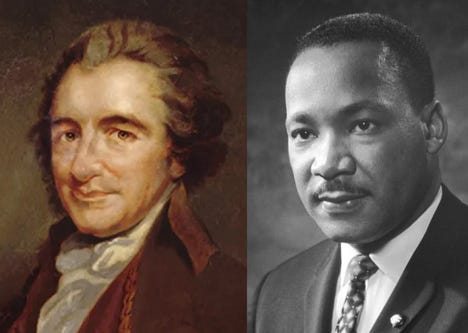
Thomas Paine and Martin Luther King, Jr.: Two vocal proponents of UBI
Future generations, looking back at this period, might struggle to comprehend that in an era of unprecedented productive capacity — when we could, for the first time in history, materially ensure that no one goes hungry or homeless — we chose instead to allow a handful of individuals to accumulate fortunes that no-one could spend in a thousand lifetimes, while billions of people remained in precarity. They might ask: why, when the inheritance belonged to everyone, did so few collect it?
The answer will define what kind of civilization we are building. Demanding our social dividend — insisting that the wealth generated by our collective inheritance be shared with all its rightful beneficiaries — is not so much a political position as a moral imperative. In an age when AI threatens to shred whatever remains of the social contract, what Paine revealed as social justice can now be understood as a foundation for an ecocivilization.
This article was originally published by Ecocivilization; please consider supporting the original publication, and read the original version at the link above.
Friday, June 19, 2026
Human Origins Destroys Core Fascist Mythology – OpEd
How deep history challenges fascist myths of purity, hierarchy, and identity.
The deeper we explore humanity’s past, the harder it becomes to sustain some of the most powerful political myths of the modern world.
For more than a century, authoritarian ideologies have sought legitimacy in origin stories: pure people, ancestral homelands, primordial hierarchies, and civilizational destinies. Fascism, in particular, has always been obsessed with beginnings. Whether in Nazi fantasies of Aryan ancestry, myths of ethnic continuity, or contemporary narratives of demographic replacement and civilizational decline, the past is transformed into a source of authority. History becomes destiny. Origins become a source of legitimacy.
Yet archaeology, anthropology, genetics, and evolutionary science increasingly tell a different story. Research across these fields has challenged older assumptions about purity, hierarchy, and human nature. Deep history reveals migration rather than isolation, cooperation rather than perpetual conflict, and experimentation rather than inevitability.
Few 20th-century thinkers saw this more clearly than Georges Bataille, who observed that competing visions of the past often conceal varying perspectives of humanity.
Better known today for his writings on eroticism, sacrifice, and transgression, French philosopher Bataille was also one of the first major European intellectuals to recognize that prehistory could serve as an antidote to fascist mythology. During the 1930s and 1940s, when fascist movements were mobilizing myths of origin on an unprecedented scale, he turned to cave art, ritual, and the earliest traces of human life, immersing himself in the latest archaeological, anthropological, paleontological, and sociological research.
His writings on prehistory drew extensively on the discoveries and debates of his time, delving into philosophical, anthropological, and political interests at once. What distinguishes humans from other animals? How did symbolic thought emerge? What forms of community existed before states, nations, and organized religions? These questions acquired a particular urgency during the rise of Benito Mussolini in Italy and Adolf Hitler in Germany, when competing visions of humanity became a matter of life and death.
Studying cave art and the discoveries emerging from sites such as the Lascaux Cave in France, Bataille became fascinated by a simple fact. The artists who painted the walls left no names. They founded no dynasties. They erected no monuments to rulers or conquerors. But they created some of the most extraordinary images in human history. For Bataille, the lack of names was not a footnote; it was the point.
The caves revealed forms of collective creation that preceded authorship, ownership, and sovereignty. Art appeared not as an expression of individual genius or political authority but as a shared symbolic activity through which a community understood itself and its place in the world.
Instead of fascism’s cult of leadership, Bataille discovered a humanity whose earliest masterpieces emerged from participation rather than domination, anonymity rather than glory, and collective creation rather than the cult of personality.
The political implications of these observations became increasingly difficult to ignore during the rise of the totalitarian regimes that would engulf much of Europe and Asia. In his 1933 essay “The Psychological Structure of Fascism,” Bataille analyzed the attraction to sovereignty, authority, and charismatic leadership. In 1936, he founded Acéphale, an anti-fascist intellectual group whose symbol was a headless human figure.
The image was deliberately provocative. Against the Führer, Il Duce, Stalin, and every cult of leadership, Bataille proposed a humanity without a head. The figure was less of a political statement than a symbolic reversal of the principles celebrated by totalitarian movements. Against sovereignty, he imagined forms of collective existence that could not be reduced to a single authority. Against hierarchy, he emphasized participation, reciprocity, and shared experiences.
Prehistory became important not because it provided an alternative mythology, but because it revealed a past that resisted mythological simplification. Bataille turned to caves such as Lascaux as they seemed to preserve traces of human existence before nations, before states, and before centralized authority. What he found there was not an original people or an ancestral race, but forms of collective life that escaped the categories through which modern politics often tends to understand itself.
Against Hobbes
In this sense, Bataille’s reading of prehistory amounted to a direct challenge to one of the founding myths of modern political thought. In Leviathan(1651), Thomas Hobbes famously described life before political authority as “solitary, poor, nasty, brutish, and short.” Human beings, he argued, originally lived in a condition of universal conflict—a “war of all against all”—from which only a sovereign power could rescue them.
This image has shaped centuries of political theory. It continues to influence assumptions about human nature and social order. If conflict is primordial, hierarchy appears necessary. If competition is humanity’s defining characteristic, strong authority becomes easier to justify.
Yet few anthropologists, archaeologists, or evolutionary researchers today would recognize early human societies that were part of Hobbes’s description. Over the past century, discoveries from prehistory have gradually eroded the picture of humanity emerging from a primordial war of all against all. Instead, these findings have shed light on how the social bond preceded sovereignty.
Cooperation and Human Success
Research in the 21st century has begun to explain the reasoning behind this. Far from being a secondary achievement of civilization, cooperation was one of the conditions that made civilization possible. Human infants require years of care, and this knowledge needs to be transmitted across generations. Food sharing, communication, and reciprocity were not late cultural inventions. They were essential to survival.
Increasingly, researchers describe Homo sapiens as a uniquely hyper-cooperative species. In a landmark study published in the journal Nature in 2014, the authors argued that cooperative breeding and exceptional levels of social cooperation played a decisive role in the evolution of human cognition and culture. Shared childcare, collective learning, and social transmission enabled forms of cumulative culture unmatched elsewhere in the animal world.
Human beings did not become cooperative because civilization imposed cooperation upon them: civilization became possible because humans were already cooperative. American anthropologist Sarah Blaffer Hrdy makes a similar point in Mothers and Others, stating that networks of care extending far beyond biological parents helped shape human evolution. Humans survived because they learned to depend upon one another.
Developmental and comparative psychologist Michael Tomasello reaches a similar conclusion. In A Natural History of Human Morality, he argues that what distinguishes human cognition is not superior individual intelligence but the capacity for shared intentionality—the ability to coordinate attention, goals, and actions with others. Human intelligence, in this view, is fundamentally social.
A similar intuition reappears today in discussions about artificial intelligence (AI). Blaise Agüera y Arcas, an AI researcher, has argued that intelligence is not simply an individual property but something that emerges through communication, learning, and exchange. Language may be less of an instrument of individual advantage than a technology of collective intelligence.
While Hobbes saw society emerging from conflict, many contemporary scholars suggest that society was shaped by cooperation.
The Archaeology of Possibility
The same shift has transformed our understanding of political development. In The Dawn of Everything, authors David Graeber and David Wengrow challenge the familiar narrative of how human societies progressed through a fixed sequence—bands, tribes, chiefdoms, and states—becoming more hierarchical at every stage.
Drawing on decades of archaeological research, they describe societies that repeatedly experimented with different political arrangements. Some adopted hierarchical structures only temporarily before abandoning them. Others alternated between centralized and decentralized forms of organization according to seasonal rhythms. Large populations sometimes existed without kings, standing armies, or centralized bureaucracies. These accounts make human history look less like a march toward the state and more like a field of political experimentation.
The implications of this outlook extend well beyond archaeology. If hierarchy is not inevitable, authoritarianism can no longer present itself as the culmination of human development. If human beings repeatedly invented different ways of organizing collective life, then political alternatives are not utopian fantasies. They are historical realities. The past does not reveal our destiny, but another possibility of how to exist.
Deep History Against Race
The anti-fascist implications of prehistory became especially visible during the 20th century.
As Nazi scholars attempted to transform archaeology into a science of racial origins, other researchers moved in the opposite direction. In Man Makes Himself, archaeologist V. Gordon Childe emphasized that human progress is a result of innovation, exchange, and collective invention, instead of a biological destiny. Anthropologist Franz Boas’s The Mind of Primitive Mandismantled theories of racial hierarchy and demonstrated that cultural differences were historical rather than biological. Ethnologist Paul Rivet’s studies of migration and the peopling of the Americas highlighted human circulation, encounter, and mixture over purity and permanence in the region. Working in different disciplines, these researchers arrived at a similar conclusion: the deeper one investigates human history, the less sustainable are the ideas of fixed origins and permanent identities.
Advances in the 21st century in genetics have further strengthened this conclusion. Ancient DNA research has transformed our understanding of the past as dramatically as the discovery of cave art transformed our understanding of prehistoric culture a century ago. Across Eurasia and beyond, genetic studies have revealed repeated episodes of migration, admixture, and exchange that challenge older narratives of stable and isolated populations.
Far from revealing isolated groups preserving fixed identities over millennia, genetics shows continuous movement and transformation. Even Homo sapiens bear the marks of encounters with other human groups, including Neanderthals and Denisovans.
The further we travel into the past, the harder it becomes to sustain fantasies of racial purity.
Why Bataille’s Thinking Remains Important
Prehistory does not provide a political program. It does not tell us how contemporary societies should be organized, nor does it reveal a lost golden age. The important point is not that prehistoric humanity was peaceful, egalitarian, or morally superior. Human violence is ancient. So are domination and conflict.
The lesson is something else.
Deep history undermines some of the stories authoritarian ideologies tell us about humanity. Against the myths of racial purity, it reveals a mixture of races. Against myths of primordial hierarchy, it reveals experimentation with political structure. Against myths of sovereign necessity, it reveals human cooperation. Against myths of fixed identity, it reveals transformation.
Bataille understood that prehistory was not simply about origins. It was also about what happens when origin stories lose their authority. Now, with nationalism and authoritarian politics again looking for acknowledgment in ancestry, identity, and destiny, deep history offers a different perspective. The further back we go, the harder it is for fascism to find validity in historical narratives. Instead, what comes into view is a history of movement and exchange, cooperation and shared invention.
Prehistory doesn’t excuse domination. It doesn’t erase it, either. It places domination in perspective. And at a moment when authoritarianism is once again on the rise, the deep past reveals something both humbling and reassuring: our greatest strength has never been purity or domination, but our capacity to cooperate, connect, and depend on one another.
Credit Line: This article was produced by Human Bridges.
About Yann Perreau Yann Perreau is a writer, educator, contemporary art curator, and writing fellow for the Human Bridges project of the Independent Media Institute. He has published several books with French publishers on climate, anonymity, and more. His articles have appeared in many publications, including Le Monde, the London Review of Books, and Art Press. He has served as a cultural attaché for both the French Embassy in London and the French Consulate in Los Angeles. He holds an MPhil in art history from Paris's EHESS. View all posts by Yann Perreau →
President Donald J. Trump and UFC CEO Dana White arrive at UFC Freedom 250, the mixed martial arts event produced by the Ultimate Fighting Championship, Sunday, June 14, 2026, on the South Lawn of the White House. (Official White House Photo by Daniel Torok)
In a March 2026 paper published in the journal Science Advances, which focused on variability in governance along the autocratic-democratic axis, my coauthors and I found that one of the strongest associations for the 40 case observations, which were part of our study, was between the nature of rituals and the concentration of power.
For this global sample, autocratically organized societies were characterized by spectacles that foment fear and awe, while participatory rituals predominated in more democratically organized contexts. For example, in the region where I study (Oaxaca, Mexico), when governance was typified by distributed power relations, the pre-Hispanic rubber ball game was played in a large court adjacent to a broad, flat open plaza, the Main Plaza at Monte Albán, a space that could accommodate many of the settlement’s inhabitants. Later, however, as political power became more concentrated, the size of ball courts was reduced, access to them became more restricted, and some were even built immediately adjacent to the houses or palaces of ruling families.
Social scientists have long recognized that communal rituals are a universal human experience that binds people together in various ways. Spectacles, often rich in disorienting noise, shock, and awe, tend to captivate observers through the powerful figures at the center of the spectacle, who inspire fear and wonderment, reinforcing authoritarian cults of personality. In contrast, participatory rituals like communal dancing, singing, or chanting tend to instill camaraderie among participants, solidarity, and trust among those involved. As a student of history and a sports fan, the mirrored reflections of the past provide an analytical perspective about the final Knicks game on June 13, a sports agenda that cannot be ignored.
During the 2026 National Basketball Association playoff between the New York Knicks and the San Antonio Spurs, Madison Square Garden, the storied home of the Knicks, once again became like a civic commons after a 53-year championship drought. The competitiveness of the Knicks during the playoffs elevated the space from merely being a site of entertainment to a participatory ritual arena. The crowd did not passively observe; it chanted, rose, groaned, anticipated, and collectively willed momentum into existence. One needed to only look at the faces in the stands—season ticket holders and first-timers, celebrities and subway riders alike—to notice that the sight was closer to what might be considered an integrative ritual: one in which meaning is not imposed from above but generated, often with spontaneity, among participants.
Basketball, by definition, is a team sport, but this is typified by the game that the Knicks currently play. It is not about consistent domination by a central figure. Even the most celebrated player, Jalen Brunson, depends on coordination, timing, and trust in his teammates. The drama unfolds collectively, and its outcome remains contingent on who makes a foul shot and who grabs a rebound. Participation matters—not just symbolically but materially. The arena amplifies the idea, however imperfectly enacted, that communal engagement shapes outcomes. And these outcomes transcended the arenas where the Knicks games were played, stimulating joy and collective actions, and bringing people together in the desire for a common outcome.
By contrast, the spectacle of an Ultimate Fighting Championship event, staged in a garish steel cage, on the grounds of the White House on June 14 operated on a fundamentally different ritual logic. It was not designed for mutual participation but for spectacle: with the concentration of attention onto a staged center, where one-on-one conflict and mayhem are distilled into physical dominance and symbolic submission. The audience’s role is not to join but to witness—to be awed, to see blood and hear pain, be unsettled, and ultimately to orient themselves toward the figures who command the stage and oversee the event.
The choice of venue was not incidental. The White House has long functioned as a site of state ritual. But traditionally, those rituals—press briefings, public ceremonies, even contentious protests beyond its gates—are tethered, at least aspirationally, to norms of decorum, accountability, and public engagement. Introducing a choreographed combat spectacle into that space shifts its symbolic significance. It recasts a locus of governance into an arena of performance, where the aesthetic of dominance and self-promotion, by a small network of cronies, overshadows any ethical prospect of leading to wider participation.
This is precisely the distinction our comparative work on governance and ritual helps illuminate. When power is broadly distributed, rituals tend to be inclusive, iterative, and co-constructed. They require participants to see one another as collaborators in a shared process, even when competition is involved. In contrast, when power is tightly concentrated, rituals often become spectacles—staged experiences that reinforce hierarchy, channel emotions toward a focal point, and reduce the audience to spectators instead of actors. The Knicks, for all the commercialism of modern sports, still lean toward the former model. Their playoff games invited identification not with an owner but with a collective—however abstract—called a team, a city, a fan base. Victory was widely shared across an entire metropolitan area, communally. The ritual binds laterally, person-to-person.
A UFC spectacle staged in the orbit of political power points in the other direction. It binds vertically. The emotional energy of the crowd is drawn upward and inward, toward a center that is insulated from participation. The unpredictability of sport is replaced by an orchestrated spectacle; even the violence, ostensibly raw, is framed and contained to produce maximum symbolic effect. None of this is to suggest that one form of ritual is wholly virtuous and the other entirely malign. Spectacle has always been part of human societies, and participatory rituals can exclude to the same extent as they can include. Madison Square Garden is not immune to hierarchy, nor is fandom evenly accessible. But the contrast remains as glaring as instructive because it reveals not just different entertainments, but different models of how people relate to power—and to one another.
At stake is more than this season’s recreational programming. Rituals, whether ancient ball games in Mesoamerica or modern sporting events in New York, are not peripheral to political life; they are constitutive of it. They shape how individuals experience belonging, authority, and agency. They encode assumptions about who acts and who is meant to watch. The event at the White House reinforces values such as “might makes right” and life is a “zero-sum game.”
Alternatively, in an era when democratic practices often feel attenuated, the spaces where participation is still enacted—even imperfectly—carry heightened significance, thereby fostering shared aims and emphasizing the potential win-win-win outcomes that interdependence and collaborative action can generate. The roar of a crowd that believes its collective voice matters stands in quiet contrast to spectacles that ask only for attention, passivity, and allegiance.
We would do well to recognize the difference.
Credit Line: This article was produced by Human Bridges, a project of the Independent Media Institute.
About Gary M. Feinman Gary M. Feinman is the MacArthur curator of Mesoamerican, Central American, and East Asian anthropology, at the Negaunee Integrative Research Center. View all posts by Gary M. Feinman →




.jpg)