Showing posts sorted by date for query SEA MONSTER. Sort by relevance Show all posts

Tuesday, October 06, 2026

CRYPTOZOOLOGY
A Fish Hidden in a Museum Drawer for 150 Years Just Filled a 50-Million-Year Gap

Ashley Driggs
Mon, October 5, 2026


 Canva.com


Key takeaways

A fossil of a new coelacanth species, Macropoma gombessae, was discovered in a London museum drawer after being overlooked for over 150 years, filling a 50-million-year gap in the evolutionary history of coelacanths.

A single fossil, overlooked in a London museum for over a century, has upended what scientists thought they knew about an enduring creature of the deep. For more than 150 years, this specimen sat undisturbed amid countless other relics, its true value hidden until researchers took a closer look, armed with cutting-edge technology.

The fish in question is a coelacanth, a species so ancient and enigmatic that it earned the nickname "living fossil." Coelacanths are rare survivors, once believed wiped out alongside the dinosaurs. Yet the fossil in the Natural History Museum contained secrets that would illuminate a 50-million-year stretch of evolutionary history no one had expected to fill.


coelacanth


A Discovery Hiding in Plain Sight

The story began in the fossil halls of London, home to specimens collected before the light bulb was invented. When researchers revisited one coelacanth fossil from the Lower Cretaceous Gault Formation, using high-resolution scans and X-ray computed tomography, they found it wasn't just another ancient fish. The results revealed a new species: Macropoma gombessae.

This species is now the oldest known member of its genus. Its discovery addresses a crucial gap in the family tree of coelacanths, offering insight into how these prehistoric fish evolved into the creatures found near Africa's Comoros Islands today. For decades, evolutionary biologists puzzled over missing links in the coelacanth lineage. Here was one, hiding in a museum drawer all along.

The name "gombessae" reverberates with cultural memory. It pays tribute to the "Gombessa," which local Malagasy and Comorian communities have long used to describe coelacanths. The term means "inedible fish" or "worthless fish," a striking reminder that today's scientific treasures were once dismissed by those who lived alongside them.


Coelacanth on black background


Peering Inside with Modern Eyes

None of this would have come to light without the new imaging techniques now at paleontology's disposal. Instead of risking damage by cutting or drilling into the precious fossil, scientists used digital scans to reconstruct its bones down to the finest details.

X-ray computed tomography made it possible to see the inner structure of this ancient fish as never before, revealing features that connect it to both its Cretaceous relatives and modern coelacanths. For the researcher who first recognized the fossil's significance, the ability to digitally manipulate an object of such age and rarity was remarkable and transformative for the study of evolutionary history.

This approach is revolutionizing how museums operate. Once viewed as static storage rooms, natural history collections are being reimagined as research powerhouses, places where even centuries-old specimens can yield new discoveries as technology advances. Old fossils, it seems, still have new stories to tell.
Reshaping a Story of Survival

Perhaps no animal embodies resilience like the coelacanth. After disappearing from the fossil record more than 60 million years ago, its presumed extinction was upended in 1938, when a living specimen was hauled up off South Africa. The fish became a symbol of evolutionary stasis, seemingly unchanged by the passage of time and catastrophe


Latimeria or Coelacanth (Latimeria chalumnae Smith), A living fossil, the oldest known living lineage of Sarcopterygii (lobe-finned fish and tetrapods).

But the identification of Macropoma gombessae reshapes this narrative. Rather than a tale frozen in evolutionary amber, the coelacanth's story is richer and more complex. The new fossil reveals subtle shifts and adaptations that bridge ancient and extant forms, showing that even so-called "living fossils" defy our expectations of biological change, or the lack thereof.

For those maintaining museum collections, the find highlights the ongoing value of these institutions. Generations may pass before a specimen's true importance emerges. But as research tools evolve, so too does our understanding of the living world's history, waiting quietly in the dark, dusty drawers of the past.


Beyond the Fossil Cabinet

The rediscovery of a single coelacanth fossil, hidden for so long, demonstrates how much is left that we do not know. As scientists revisit collections with new eyes and new tools, the boundaries of evolutionary history shift. Each specimen, old or new, offers another opportunity to see the natural world in greater detail and to appreciate the winding, unexpected paths life takes across millions of years.

A-Z Animals.


Fishing for Dinosaurs: This Ancient Species Is One of Our Most Underrated Gamefish

Joe Cermele
Mon, October 5, 2026


Jimmy Fee with a bowfin that sucked up a fresh shad chunk.

Key takeaways

Bowfins, also known as choupique, mudfish, or grinnel, are gaining popularity among anglers due to their unique appearance and aggressive feeding behavior.


IF YOU DIDN'T know better, you may have assumed the fish was dead. You could have easily walked by it, a passing glance convincing you it was just a rotten log. Its dull gray back is the same color as the mud. It camouflages beautifully with the detritus on the bottom of a shallow swamp in early spring before the lilies bloom and inject it with fresh greenery. Look closer, though, and the fish takes shape. It's lying perfectly still save for the dorsal fin that runs nearly the length of its back. Like the lines on a heartbeat monitor, the fin ripples in undulating waves that start near the head and flow back to the tail. I cast a white tube a few feet past the fish and let it settle. The target doesn't flinch. I hop the lure a little closer. No movement. Closer still, but there's no reaction. The next hop will drop the tube right on its nose and I brace myself to swing. When it lands, the seemingly comatose fish erupts like a bullet, sucking up the bait with such force and violence that I swear you can hear the vacuum and snap of its jaws coming together on dry land. It's that reaction, that moment, that made me fall in love with bowfins, a historically maligned species that's creeping its way into the limelight.

Chasing Dino DNA


Bowfin are a fish of many names. In the deep South, they're called choupique (pronounced shoe pick). In Middle America, they're mudfish. In the North and into Canada, they're grinnel. Dogfish, mud pike, swamp trout: The list goes on and on, but while the names might vary by region, what these fish have always shared across their vast range is a lack of respect and general disinterest as a rod-and-reel target. If anything, they are merely by-catch to be tossed up on a bank and left to die. In many regions, in fact, it is widely believed and accepted that a bowfin's sole purpose is to kill mass quantities of more desirable species like bass and crappies.


Bowfin have a reputation for living in nasty water, but a healthy bowfin population actually points to a healthy ecosystem. Joe Cermele

Except within a few niche groups and cultures, bowfins have little value as table fare. Their flesh, so I've been told, turns mushy very quickly after the fish dies, and even when cooked quickly it often has an overwhelmingly muddy flavor. Still, anglers aren't inclined to dispose of other by-catch species, so why bowfins? It's difficult to deny that they have a reputation for being nasty. They evoke a bit of fear, much like spiders, which many people instinctually squish under their shoe without knowing what kind it is, or if it can cause any harm. The reality is that bowfins, like spiders, do more good than harm to an ecosystem. They may be a little mean. But they've had to be to survive this long, and it's their meanness that makes them such worthy opponents

In 2021, a research team from Harvard University made a fascinating discovery. By studying bowfins from around the country, they determined that there are actually two lineages of these fish swimming in our waters. Previously, scientists had believed that all bowfins were genetically identical and had remained relatively unchanged since they first appeared during the Triassic period nearly 250 million years ago. While the differences between the two species may not be easily recognizable to the untrained eye, the discovery of the two lines has been a catalyst for more research, which brings with it more protections for the fish. And make no mistake, that research is the equivalent of studying living dinosaurs à la Jurassic Park because bowfins are, indeed, dinosaurs.


The author with a native bowfin. Courtesy of Joe Cermele

They have immense jaw power, arguably making them stronger than all other freshwater fish in North America. Rows of conical teeth angle backward toward the throat to ensure nothing they clamp down on gets away. A bowfin's skull is as thick and hard as granite. They can extract oxygen from the water through their gills or let their tubular nostrils protrude above the surface and breathe air. Combine that ability with their tough exterior and tenacity and it helps explain why come hell, high water, drought, or even pollution, bowfins have endured. It's also that engineering and resilience that makes these fish more interesting to me than many other nonnative glam species. I'm certainly not the only one who feels this way.
Clever Girls

According to Drew Price, a veteran guide on Lake Champlain who specializes in targeting trophy bowfins, these fish have also survived for millions of years because they're smart—much smarter, in fact, than many fish we routinely put on a pedestal for their alleged brain power.

"I love brown trout," Price tells me. "I love to fish for them, but while they're selective and spooky, they're not smart. But bowfin have a natural curiosity, and animals that have that are exhibiting intelligence. A fish that will swim up to a boat to see what it is, or swim over when it hears something splashing, is intelligent. I've had bowfins look me straight in the eyes."


That curiosity is what led Price to develop what he calls his "splash-bang" technique. While plying Champlain's coves and shallows in his skiff or canoe, he'll splash the water with his pushpole and even tap the sides of the hull. Quite often the bowfins will swarm. Though Price will use conventional tackle on occasion, his true passion and specialty is fly fishing. He's even led clients to tippet-class record fish, since Champlain, because of its size, depth, and cold winters, grows bigger bowfin than many other waters.


Although bowfins are commonly mistaken for snakeheads by the uninitiated, there are several key differences. The lack of scales on this bowfin's head is one clue to its identify. Joe Cermele

Price has been singing the praises of bowfin for nearly 20 years, though it's been only within the last 10 that people have started to listen. His reputation as one of the leading bowfin advocates in the country was made when he guided Jeremy Wade on River Monsters in 2013. That led to a slew of other show appearances, including on the Orvis podcast, after famed fly angler and instructor Tom Rosenbauer developed a bowfin jones after hanging out with Price. Although Price has been a guide for hire since 2008, he's seen a noticeable uptick in bowfin bookings over the past few years.


Price attributes the spark in interest to several factors. We've seen that angler obsession with sight-fishing grows when social media is flooded with sexy drone shots of rising trout, pike trashing poppers, and giant trevallies charging across flats to smoke a streamer. Bowfin, however, provide that sight-fishing rush for far less money and a lot less time in the air. It also doesn't hurt that they're challenging. Sticking a hook in their rock-hard jaws takes skill. When you do stick it, buckle up, because bowfins don't quit. They will snap rods. They will bend hooks. And even in the net, a bowfin will look at you "with malice in its eyes," as Price puts it. Ultimately, though, Price believes it's the gradual reckoning with the importance of preserving heritage in nature that is flipping the tide in the bowfin's favor.

"Bowfins are probably the most American fish out there," he says. "They have been here longer than any other species. They have remained unchanged since the Cretaceous period. I think people are beginning to appreciate native species and what they have to offer."


I wholeheartedly agree with Price, but I believe it's only one aspect of the bowfin's unfolding success story. The other is rooted, for better or worse, in increased angling pressure.
Hidden in Plain View

The cover of the February-March 2021 issue of Fly Fisherman magazine featured a shot of renowned fly angler and tier Blane Chocklett lifting a massive bowfin out of the water. The main text on the cover read, "Exotic Species in Your Backyard." At a time when media seems to push us to drool over far-flung destinations we'll likely never visit, I found this sentiment poignant. I've always preached that you can't call yourself a true angler if you only travel to fish and snub your nose at what's right down the street. The angling opportunities in your backyard, whether they're world class or mediocre at best, should be what defines you, not the fancy places you've traveled to. The funny thing is, bowfin live in a lot of backyards, including my own, but it took me about 30 years to find them.


Although he's fished all his life, the author didn't truly discover bowfins until adulthood. Courtesy of Joe Cermele

As a kid growing up in the '80s and '90s, bowfins weren't on my radar. The only recollection I have of seeing any media devoted to them during those formative years was on a TNN fishing show shot on Lake Champlain. It didn't particularly resonate with me because I viewed them as something I couldn't catch. But they were. And they were right under my nose.

In many parts of the country, bowfins live on the fringes. To use my home water, the Delaware River, as an example, the state fishing compendium has always listed them as an available species, but in all my years wading for smallmouths with my dad and fishing for shad with my grandfather, we never saw or caught a bowfin. The listing seemed to me to be honorary, or historical—yes, bowfin were recorded here at some point, but there were probably only a few kicking around. The truth was there were plenty of them, but the odds of catching one in the main river were slim. They existed in pockets far up tributary arms and in vast tidally influenced swamps and floodplains that were difficult to access. Even if you could, why would you? Mucky, skinny, weed-choked water isn't exactly prime for bass, or catfish, or crappies. I had no reason to trudge around in the mire while I was growing up. Then along came the dreaded invasive snakehead and suddenly I did.
Snake Charmed

Steve Cahn is the owner of High Octane Custom Lures, a Maryland–based company that got off the ground in 2019. Recognizing a growing interest in snakeheads among anglers in the Delmarva region, Cahn decided the timing was right to launch a line of lures aimed specifically at this market. The overriding theme of his products is toughness. His version of the Chatterbait, as an example, features stronger hooks, thicker wire, and more durable skirt material than the Chatterbaits already hanging on pegs in tackle shops. Business was slow at first, and then along came the Covid pandemic and everything changed.


Male bowfins can be identified by a black spot at the base of the tail fin. During breeding season, a ring of bright-orange or yellow-green surrounds the spot. Joe Cermele

For the next two years government entities prodded people to get outside. Don't go to a party or social gathering, go out alone and explore nature. And explore they did. The bump in recreational fishing interest during that time was unprecedented, and many anglers living in the Mid-Atlantic and lower Northeast who previously may have been lukewarm to or uninterested in snakeheads saw the light. As pressure increased during the pandemic at local fishing holes, grabbing a kayak or trudging through the mud to get away from people suddenly became extremely appealing. The byproduct of this vigor for the swamp life was that more and more anglers were ending up in bowfin territory, and these fish were happy to hit the same frogs and spinnerbaits intended for snakeheads. Cahn's business spiked so quickly that at one point he had to shut down his website to catch up on orders.

"I have absolutely seen an increase in bowfin interest over the past few years," says Cahn. "I've personally developed a greater love for bowfins since I started seriously snakehead fishing. I'd even say they fight harder than snakeheads, and once people started to figure that out, bowfin just sort of went hand in hand with snakeheads. Anglers were equally happy to stick either one."

That's how it broke down for me, too—it's just that it happened years before the pandemic. I fell in love with snakeheads, and as soon as the first bowfin blasted my frog, I fell in love with them, too. At the time, chasing these fish felt very underground. It was almost too easy at times because pressure was minimal. The irony is that had I known about my local bowfin population as kid, I might have experienced near-zero pressure Shangri-La. Now, I can't help but notice that it's getting tougher and tougher to consistently catch bowfins in spots that were fire on the regular just four or five years ago. Such is the case up and down the East Coast, and it turned out that snakeheads were both a blessing and a curse for bowfins.

Identity Crisis

When snakeheads were first discovered in Maryland in the early 2000s, it created a media firestorm. The destructiveness of the fish was so overhyped, so much fear was created around them, that anglers felt they had to do their part in the snakehead war. The problem was that bowfins and snakeheads looked similar. In time, mistaken identity became a legitimate problem. It wasn't uncommon to see forum and social media posts of bowfins from captors who were looking to confirm if what they'd caught was a snakehead. In some cases, they cut the head off the fish first and asked questions later. For folks like me who went all-in on targeting snakeheads and bowfins, the idea of confusing the two species seemed ludicrous, because while their body types are similar, their fin structure, head shape, and coloration are very different. Still, to be blunt, there were enough anglers out there unwilling to educate themselves that over time, state wildlife agencies began posting signs at public accesses pointing out the differences between the two fish. The silver lining was that despite it taking an invasive species to cast some light on native bowfins, for the first time in many years they were creeping back into the conservation forefront.


As anglers began to confuse native bowfin with invasive snakeheads, state agencies posted signs like this one at boat ramps and other access points. Joe Cermele

The most critical conservation measure in the future of bowfin was already in place in most of the states posting the signs. In New Jersey and Pennsylvania specifically, it was illegal to shoot bowfins with arrows. They were afforded this protection prior to the snakehead influx because they were a native species. In the dark, however, in the heat of the moment, parsing out what's a bowfin and what's a snakehead when you've got an arrow nocked and a second to fire proved challenging for some shooters. Meanwhile, on Lake Champlain and elsewhere throughout the bowfin's range, they are fair game for bowfishermen.

Nothing worries Drew Price more about the future of Champlain's bowfin population than the local bowfishing community, which is why he and many other defenders of "trash fish" throughout the country share data, attend meetings, and do whatever they can to profess the importance of these fish within the ecosystem.

It's ironic that bowfins have come to be associated with dirty, mucky water, since it only fuels the notion that they're worthless fish living in squalor. The reality is that a healthy bowfin population points to a healthy ecosystem. These fish, like many gamefish we love, need fertile vegetation to spawn. They need an abundance of small prey to survive. They need weed cover to rear their young. Bowfins are so tough and can withstand so much that if a population naturally declines, a much worse picture for the watershed emerges than if they're thriving.


With a scaleless head, short anal fin, and small black eyespot near the top of the tail fin, this South Jersey fish is easily identifiable as a bowfin. Joe Cermele

Luckily, the champions for these fish continue to grow. Price, Cahn, and I are just a few. Dr. Solomon David, a biologist at Louisiana's Nicholls State University, has worked tirelessly for years to get a better understanding of the role these fish play in ecosystems in the Midwest. David Graham, host of the Boundless Pursuit podcast, has been chasing bowfins across the Carolinas and Florida for decades, penning countless articles on the species and sharing his knowledge of their behavior. Even YouTube, as much as we love to rag on it for spot burning and calling too much attention to certain fisheries, is generating positive vibes about a largely overlooked and underregulated species. Years ago, when largemouth bass ruled the television airwaves, an inadvertent bowfin catch likely wouldn't even make it on the show. Today, between dedicated backwater enthusiasts and even bass-focused content creators willing to break the mold, the bowfin is finally getting a lot more media respect.
The truth, however, is that you don't need to become enamored with targeting bowfins to help these fish thrive. More than anything, you just need to recognize that they've been here longer than any other fish, and that alone—that ability to survive—should garner enough reverence to at least not want to kill them for no reason.

But if you do want to challenge yourself against these dinosaurs, the beauty of them is you can make that pursuit as hardcore or relaxed as you like. A simple piece of shrimp or shad or even hotdog (I've been told) will be sniffed out in short order. I'd recommend a 30-pound leader and a saltwater-grade hook, though. Take the hardest fight you remember with a bass that ate your live shiner, or the toughest battle you ever had with a big channel catfish, and multiply it times five. That's the bowfin. And whether you become obsessed with catching them or just want to say you gave it a shot, you won't forget that first one.


Monday, September 21, 2026

Sitting on a time bomb

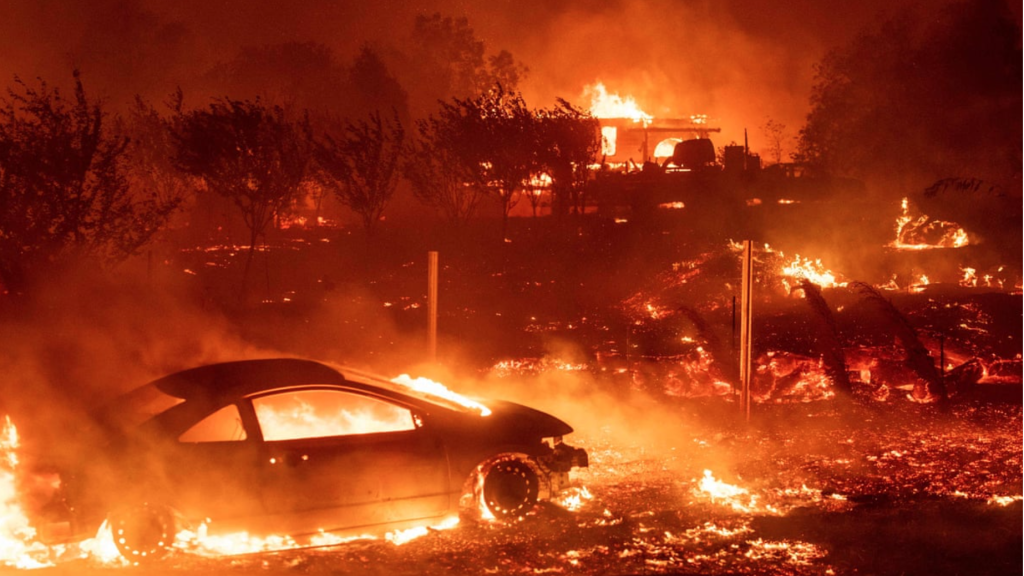
Paradise wildfire

Knowledge and concern about the climate crisis has grown exponentially in the past 25 years. But not among ultra-conservative and fascist political forces such as Donald Trump’s MAGA (Make America Great Again) movement in the United States, Alternative for Germany (AfD) and Reform UK in Britain.

In his infamous United Nations speech a year ago, Trump denounced global heating as the “biggest scam in world history.” Since his re-election, Trump has withdrawn the US from the Paris Accords, closed offices and programs dealing with climate change, terminated dozens of experts working on global heating and, crucially, withdrawn billions of dollars aimed at mitigating the effects of climate change. 

But here is the irony: the US has been the site of hundreds of climate disasters. Among the best-known are Hurricanes Katrina and Sandy and the wildfires that hit Malibu and Paradise in California.

Hurricane Katrina and Sandy

Hurricane Katrina, in August 2005, was one of the most destructive natural disasters in US history. In New Orleans, the disaster significantly worsened when levees and floodwalls failed, allowing water to flood about 80% of the city. The human consequences were enormous.

More than 1800 people died, while hundreds of thousands were displaced from their homes. Many people could not evacuate before the storm and the disaster exposed major inequalities in income, housing, transport and emergency assistance access. Katrina caused about $108 billion in damages and made hundreds of thousands of homes uninhabitable.

Hurricane Sandy affected the Caribbean and eastern US in October 2012. As it approached the northeast, the storm became extremely large and interacted with other weather systems. New Jersey and New York experienced the most serious impacts.

One of Sandy’s greatest dangers was its enormous storm surge. Seawater flooded coastal communities and large parts of New York City, including streets, road tunnels and subway tunnels. Airports were flooded, transport networks were disrupted and about 8.5 million people lost electricity. At least 650,000 homes were damaged or destroyed. Sandy caused 147 direct deaths across the Atlantic basin, including 72 in the mid-Atlantic and northeast.

The storm demonstrated the vulnerability of densely populated coastal areas. Damage was particularly serious as Sandy affected some of the country’s most economically important urban areas.

Paradise wildfire

The Paradise wildfire, officially called the Camp Fire, began in northern California on November 8, 2018. Extremely dry vegetation, low humidity and powerful winds allowed the fire to spread at extraordinary speed through Butte County. 

The town of Paradise, which had a population of about 26,000, was directly in its path. Residents were ordered to evacuate, but the fire’s speed caused severe congestion on the limited roads leading out of town. Paradise was devastated. 

The Camp Fire ultimately destroyed more than 18,000 structures and killed at least 85 people, making it California’s deadliest and most destructive wildfire. Entire neighbourhoods were reduced to ashes and thousands of residents lost their homes and possessions

The disaster highlighted the vulnerability of communities located near forests and other fire-prone vegetation. California’s dry climate creates wildfire risks, but hotter conditions and prolonged drought can dry vegetation further, contributing to severe fires spreading rapidly.

The Camp Fire also raised questions about electricity infrastructure, evacuation planning and building in high-risk areas. Paradise has since become an important example of the challenges involved in rebuilding communities after wildfire disasters.

Malibu wildfire

Southern California experienced a major disaster at the same time as the Camp Fire: the Woolsey Fire. Beginning on November 8, 2018, the fire spread through Los Angeles and Ventura counties before reaching Malibu and the Pacific coast.

The Malibu fire received huge publicity because it affected the property of celebrities such as Miley Cyrus, Gerard Butler, Kim Kardashian and Robin Thicke. Kardashian and partner Kanye West employed a private firefighting company to hold off flames while they fled to another property in LA.

Strong winds and extremely dry vegetation helped drive flames rapidly through the Santa Monica Mountains. About 295,000 people were ordered to evacuate as communities came under threat.

The Woolsey Fire burned about 96,949 acres and destroyed more than 1600 structures. Three people were killed, and many homes in and around Malibu were destroyed or damaged. The fire burned large areas of natural habitat and parkland.

The disasters demonstrated that wildfires are not only an environmental problem but a major social and economic threat. Expanding development in fire-prone landscapes means more people and properties are exposed when fires occur.

Root cause

The increasingly destructive heatwaves, droughts, floods, hurricanes and wildfires in the US are not just “natural phenomena” nor simply the result of global heating. They are the result of an interaction of both, combined with the reckless actions of US capitalism.

Hurricanes are natural phenomena, as are drought, fire and extreme rainfall. But the social catastrophe that follows them is neither wholly natural nor politically neutral. It arises from the interaction between a warming climate and a society organised around private accumulation, fossil-fuel consumption, speculative property development and profound inequalities of wealth and power.

Global heating is changing the physical conditions under which US society operates. At the same time, capitalists continue to construct houses, infrastructure and entire communities in places increasingly exposed to fire, flooding, extreme heat and rising seas.

Profits from development are appropriated privately, while substantial portions of the risks are eventually transferred to the public through firefighting costs, disaster relief, infrastructure reconstruction, subsidised insurance and emergency intervention. What appears after as an unforeseeable natural catastrophe can therefore be understood as the predictable outcome of particular relations between capital, land and the state.

Global heating and extreme weather

Across North America, record high temperatures are increasingly common relative to record lows. The Intergovernmental Panel on Climate Change (IPCC) concluded that climate change is already contributing to more frequent and intense extreme events across the continent and projects further intensification of heatwaves, extreme storms and wildfire activity.

The relationship with rainfall is somewhat more complicated but equally important. A warmer atmosphere can contain more water vapour, creating the possibility of heavier rain. This does not mean everywhere becomes wetter. Indeed, parts of western and southwestern US are experiencing increased aridity. Climate change can intensify apparently opposite extremes: heavier downpours in some circumstances, more severe drying in others.

Nor does climate change “cause” every hurricane in the simplistic sense sometimes implied in popular discussion. Tropical cyclones existed before industrial capitalism. But warmer oceans, increased atmospheric moisture and rising sea levels alter the environment in which hurricanes occur. Consequently, a storm striking a coastline whose sea level has already risen can produce greater flooding than an otherwise equivalent storm would have in an earlier climatic period.

A Marxist analysis need not exaggerate or simplify the science. Indeed, it benefits from doing precisely the opposite. The point is not that every US disaster can be individually blamed upon global heating. It is that capital accumulation has altered the background climatic system upon which human civilisation depends, changing the probabilities and potential severity of numerous hazards.

Fossil capitalism and climate change

The common terminology of “human-induced climate change” is scientifically correct but socially incomplete. Humanity in the abstract did not industrialise the world through collective democratic decision-making. Fossil-fuel dependence developed within particular systems of production and relations of power.

The industrial capitalism of the 19th century was coal-powered. Oil became central to the automobile, aviation, petrochemical and military economies of the 20th century. Natural gas became another pillar of industrial production, electricity generation and domestic consumption.

Enormous corporations accumulated capital through extracting, processing, transporting and selling these fuels. States constructed roads, airports, suburban infrastructure and military systems around abundant fossil energy.

The climate crisis is therefore inseparable from fossil capitalism: an economic system in which capital accumulation became historically intertwined with fossil energy.

This does not mean ordinary consumers have no environmental impact. US citizens drive cars, heat houses and purchase carbon-intensive commodities. But consumer behaviour occurs within infrastructures inherited from previous rounds of investment.

A worker who must commute 30 miles because affordable housing is distant from employment does not exercise the same power over the climate system as a corporation deciding whether to invest billions in new fossil-fuel production. To treat both as individual “carbon footprints” dissolves radically unequal economic power into an imaginary community of equally responsible consumers.

Capitalism also creates a structural obstacle to adequate climate action. Individual firms must compete, generate returns and protect accumulated investment. Fossil-fuel reserves, refineries, pipelines, power stations and associated infrastructure represent enormous quantities of capital. Rapid decarbonisation threatens to strand some of those assets.

The transition required by climate science consequently confronts powerful owners for whom continued fossil-fuel exploitation is not an ideological abstraction but the basis of profit. The climate crisis reveals a contradiction between the requirements of indefinite capital accumulation and the ecological conditions required for stable human societies.

Wildfires: Where climate and property meet

Wildfire demonstrates this contradiction with unusual clarity. Fire is an ancient ecological process. Many North American ecosystems evolved with periodic burning. Indigenous peoples deliberately used fire to manage landscapes long before European colonisation. It would therefore be absurd to claim that global heating invented wildfire.

What climate change alters is fire weather. Rising temperatures increase evaporative demand, dry vegetation and soils, and can extend periods during which landscapes are combustible. But climate is only one side of the equation. The other is development.

US metropolitan growth has increasingly pushed housing into the wildland-urban interface: landscapes where houses and infrastructure encounter forests, grasslands, chaparral and other combustible vegetation.

This expansion is driven partly by population growth, but also by the political economy of land. Developers purchase peripheral land, obtain planning permission, subdivide it and transform it into a commodity whose value may increase enormously once houses can be constructed upon it. Ecological risk is converted into a property market.

This process generates a remarkable contradiction. The qualities that make such locations commercially attractive — the forest, hillside, canyon, mountain view, privacy or apparently untouched landscape — may be precisely those that increase exposure to wildfire. Nature is simultaneously marketed as an amenity and encountered as a hazard.

Climate change intensifies the contradiction. A development model constructed around historical expectations of fire frequency now operates in a climatic regime in which extreme fire weather is becoming more dangerous in many US western regions. The physical landscape changes, but the imperative to realise value from land continues.

Mike Davis and the political economy of Malibu

Few US intellectuals understood this relationship more than the late historian and urban theorist Mike Davis. In Ecology of Fear, Davis deals with the interlinked issues of wildfires and urban expansion. 

Long before the present succession of climate, Davis argued Southern California’s spectacular disasters revealed the political economy concealed beneath the language of natural calamity. His work provides an exceptionally useful starting point for understanding the US today. Climate change has made Davis’s analysis not obsolete but more urgent.1

In his celebrated and deliberately provocative chapter, “The Case for Letting Malibu Burn,” in Ecology of Fear Davis attacked the conventional representation of Southern Californian wildfire as an unpredictable natural tragedy. He documented the long history of fire in the Santa Monica Mountains and emphasised that Malibu’s susceptibility to burning was hardly a secret. 

Yet expensive residential development repeatedly expanded into this hazardous landscape. Fire destroyed property; public resources were mobilised; houses were rebuilt; development continued.

Davis interpreted this not primarily as individual foolishness but as political economy. Wealthy communities possessed the economic and political capacity to demand extraordinary protection for private property. Firefighting resources, infrastructure, insurance arrangements and disaster assistance helped make settlement possible in places where the underlying ecological risks remained severe.

Davis saw affluent settlements in the hills partly as landscapes of social separation — places whose exclusivity offered distance from the working-class and racially diverse metropolis below. He argued that development in hazardous areas was sustained through various forms of public subsidy and protection.

His argument is sometimes caricatured as saying that wealthy people’s houses should simply be allowed to burn. That misses its political purpose. “Letting Malibu burn” was a provocation intended to expose the irrationality of a system that repeatedly socialised the costs of protecting highly valuable private property built within a known fire ecology.

Who benefits? Who carries the risk?

Developers receive profits when land is converted into housing. Landowners receive increased property values. Financial institutions receive mortgage interest. Affluent purchasers obtain desirable homes.

Yet when catastrophe arrives, firefighters, municipal authorities, state agencies and federal disaster programs intervene. Roads must be maintained for evacuation, utilities repaired, emergency shelters opened and ruined infrastructure reconstructed. Private accumulation thereby generates public obligations.

Davis contrasted this lavish protection of valuable hillside property with the hazards experienced by working-class inhabitants of Central LA. Poorer residents might inhabit overcrowded or inadequately maintained buildings where mundane structural fires posed persistent dangers. Their disasters lacked the spectacular imagery of flames sweeping across Malibu hillsides and frequently attracted fewer resources and less political attention.

This is the class geography of disaster.

From wildfires to urban conflagration

Davis’s warning has acquired still greater significance as settlements penetrate combustible landscapes. He anticipated the possibility of a “post-suburban fire regime”: a situation in which development and changing environmental conditions produced catastrophes exceeding the familiar category of wildland fire.

This concept helps explain why the wildland-urban interface matters so greatly. Once flames or embers enter dense settlements, houses themselves become fuel. Wooden structures, fences, garages, cars, vegetation and other combustible materials can transmit fire through neighbourhoods. What begins as wildfire can become urban conflagration.

Climate change and suburbanisation therefore interact rather than operating as separate causes. Climate change can produce hotter and drier conditions favourable to extreme fire. Property development places more structures within reach of those fires. Infrastructure introduces additional ignition sources. Once communities ignite, the built environment can amplify destruction.

The result is a chain of causation connecting the global atmosphere to the mortgage market.

The class politics of adaptation

Disaster is also profoundly unequal after it occurs.

A wealthy household may possess comprehensive insurance, savings, several vehicles and alternative accommodation. Its members may have flexible employment allowing them to evacuate early.

A poor household may have none of these advantages. Renters may lose possessions without possessing adequate insurance. Low-paid workers may lose wages when businesses close. Homeless people and outdoor workers are exceptionally exposed to extreme heat and smoke.

Even evacuation assumes resources. Instructions to “leave immediately” mean something different to a household with two cars, credit cards and relatives elsewhere than to somebody without a vehicle or enough money for a hotel.

Climate inequality therefore cannot be measured solely by those whose house physically encounters the hazard. Class determines the capacity to anticipate, escape, absorb and recover from catastrophe.

The same principle operates with heat. Air conditioning can transform lethal outside temperatures into an inconvenience, but only for those who can afford it. A construction worker, farm labourer or delivery worker encounters heat as an occupational hazard precisely because their labour must continue under conditions from which wealthier people can retreat.

Capitalist society distributes environmental vulnerability through the labour market and housing market long before the hurricane arrives or the temperature record is broken.

Trumpism and climate denial

Trump’s politics represents an unusually aggressive defence of the fossil-fuel economy. Trump has repeatedly attacked climate policies, promoted increased oil and gas exploitation and portrayed environmental regulation as an obstacle to prosperity. In September, for example, he attacked Britain’s net-zero policies while urging greater exploitation of North Sea oil and gas.

This is not merely rhetorical climate scepticism. It has been translated into state policy. In February, Trump’s Environmental Protection Agency (EPA) rescinded the 2009 Greenhouse Gas Endangerment Finding and eliminated the federal greenhouse gas emissions standards for highway vehicles that depended upon it. The administration described this as the largest deregulatory action in US history.

The administration’s argument should be represented accurately. It maintains that the Clean Air Act does not provide the EPA with the statutory authority claimed for these regulations and argues the regulations impose enormous economic costs without materially affecting global climate change.

A Marxist interpretation, however, asks whose conception of “cost” dominates such calculations.

Environmental regulation imposes visible costs upon particular corporations and consumers today. Climate damage produces costs distributed across society and across decades: destroyed homes, higher insurance premiums, failed crops, damaged infrastructure, firefighting expenditures, heat mortality and disaster reconstruction. 

Deregulation therefore appears to “save” money by shifting costs from capital onto society, workers, governments and future generations.

The Trump administration’s relaxation of vehicle-efficiency requirements illustrates this conflict. Government estimates associated with the weaker standards indicate lower initial vehicle costs but substantially greater fuel consumption and carbon emissions between now and 2050.

Trumpism consequently does more than deny or minimise climate science. It translates the immediate interests of fossil-fuel production and carbon-intensive accumulation into a populist political language: cheap petrol, consumer freedom, energy dominance and opposition to supposedly elitist environmental regulation.

Its success among sections of the working class cannot simply be dismissed as stupidity. Decades of neoliberal restructuring have made many workers suspicious of policies whose costs they are expected to bear. A badly designed transition can close a refinery, raise household energy costs or eliminate industrial employment while leaving corporate wealth untouched.

The left cannot answer right-wing climate politics simply by demanding sacrifice from ordinary people.

Climate politics and green capitalism

A Marxist climate program must instead confront ownership and class power.

Market mechanisms alone are inadequate when investment decisions controlling energy, transport and housing remain dominated by private profit. Carbon pricing may alter incentives, but a sufficiently rapid transformation requires huge planning and investment: renewable electricity, transmission networks, public transport, building insulation, resilient infrastructure and the managed retreat of development from locations that cannot reasonably be defended.

Such policies immediately raise distributive questions. Who pays? Who owns the new energy infrastructure? What happens to fossil fuel workers? Who decides where housing is constructed? Should developers profit from hazardous land and subsequently transfer disaster costs to the public?

A socialist response insists that decarbonisation cannot be achieved by making poorer households absorb the costs while leaving concentrated wealth intact. Workers leaving fossil industries require guaranteed employment, retraining, pensions and regional investment.

Public transport and energy-efficient housing need to provide material improvements rather than moral instruction. Adaptation needs to prioritise vulnerable communities rather than simply defending the most expensive property.

This is the substance behind the idea of a just transition. Without redistribution, climate policy can become another form of austerity. With redistribution and democratic planning, decarbonisation can become part of a wider transformation of everyday life.

Disaster capitalism and nature

Karl Marx described capital as possessing an extraordinary drive towards expansion. Competition forces firms to accumulate, innovate and enlarge production. Historically, this produced enormous rises in productive capacity.

But capital treats nature as a free input or waste repository. The atmosphere became, in effect, a free dumping ground for carbon generated by industry. The bill for that historical externalisation is now arriving.

The irony is that capitalism creates new commodities from the crisis it helped produce: private firefighting, air filtration, climate-controlled buildings, insurance products, carbon markets, disaster reconstruction and new adaptation technologies.

Those with sufficient money can purchase more protection while those without experience climate change directly. A society may become simultaneously richer in commodities and less secure ecologically.

Davis’s importance lies in understanding this process spatially. Capital does not merely exploit nature; it reorganises landscapes. It determines where factories, roads and suburbs appear, which neighbourhoods receive investment and which populations inhabit hazardous environments. Environmental catastrophe has a geography produced through previous rounds of accumulation.

Paying for the climate crisis

The rising incidence and intensity of extreme weather in the US cannot be understood through meteorology alone. Anthropogenic global heating is altering the climatic background, increasing extreme heat and heavy rainfall and contributing to more dangerous fire weather in substantial parts of North America.

But climate hazards become social disasters through decisions about land, housing, infrastructure and investment. This is where Marxist analysis adds something essential.

The central question is not whether climate change exists. It is who produced the emissions, who profits from the economic system that generated them, who is exposed to the consequences and who will be required to pay for adaptation and reconstruction.

Wildfires make these contradictions dramatically visible. Fossil-fuel combustion contributes to a hotter and, in many western US regions, more fire-prone climate. Property capital simultaneously extends development into combustible landscapes.

Private actors realise profits from development while public institutions assume substantial responsibility for protecting and rebuilding endangered communities. The wealthy generally possess greater resources to escape and recover, while workers and poorer communities absorb disproportionate social consequences.

Trumpism offers one response to this crisis: defend fossil capital, weaken environmental regulation, expand extraction and present continuing carbon-intensive capitalism as economic freedom. It has political power partly because liberal climate politics has too often failed to demonstrate how decarbonisation can improve rather than diminish working-class living standards.

Davis offered a radically different way of seeing the problem. His genius was to look at a burning hillside and see not merely flames and vegetation but class relations, property values, state power and urban history. The landscape itself contained a history of political choices.

His analysis has become more relevant as the climate warms. What he described in Malibu can increasingly be recognised elsewhere: private development advancing into hazardous territory, enormous resources mobilised after predictable catastrophe, and reconstruction preparing the conditions for another cycle.

The phrase “natural disaster” consequently conceals the most important question. Nature supplies the hurricane, drought, heat or fire, but society determines what stands in its path.

What society for a warming planet?

The climate crisis is therefore ultimately a struggle over what kind of society will inhabit a warming planet.

One possibility is an increasingly fortified capitalism in which wealthy communities purchase protection, insurance retreats from unprofitable territories, public money repeatedly rescues private property and the poor are left increasingly exposed to heat, flood and fire.

Another would treat energy, housing, transport and adaptation as matters of democratic planning rather than opportunities for accumulation.

Global heating has transformed that choice from an abstract ideological dispute into a material necessity. Fires, floods and heatwaves are warnings not merely about atmospheric chemistry but about a social order whose pursuit of endless accumulation is colliding with ecological limits.

Davis’s radical insight was that catastrophe exposes the normally hidden organisation of society. In the age of global heating, the US is receiving that lesson with increasing frequency: the climate may produce the hazard, but capitalism determines much of the vulnerability — and class determines who will most likely pay the price.

Phil Hearse is a veteran revolutionary socialist, a member of Britain’s National Education Union and a supporter of Anti*Capitalist Resistance

  • 1

    Much of this article is based on Mike Davis’s writing, including “ Who Will Build the Ark?” (published at New Left Review), “ El Diablo in the Wine Country” (published in London Review of Books) and Ecology of Fear (an excerpt of which can be read here).

    His writing on other topics includes The Monster at Our Door (2003), which predicted a mass epidemic that eventually occurred as COVID (this has been updated as The Monster Enters); Planet of Slums (2006); and Prisoners of the American Dream (1998). 

    See a complete list of his book at Verso’s Mike Davis page.

Sunday, August 23, 2026

Ex Oriente Odysseus: the Babylonian Connection of a Greek Hero

August 21, 2026

Odysseus, the Navigator.

Happy is he who, like Odysseus, made a beautiful journey, (…)
And then returned, full of experience and wisdom
To live among his relatives for the rest of his life!

– French Renaissance poet Joachim du Bellay (1522-1560) [1]

The Odyssey is a Greek epic poem describing the decade-long peregrinations of one of the Greek heroes of the Trojan War, Odysseus, on his way back to his home on the island of Ithaca. Its twin opus is the Iliad, which focuses on the story of that war, a conflict involving the siege and eventual destruction by the Greeks of Troy, a city in northwestern Anatolia, whose location allowed it to control passage through the Dardanelles, the strategically and commercially important strait connecting the Aegean Sea, and the entire Mediterranean, to the Black Sea; Troy was also known as Ilion (or Ilium), hence the title Iliad, meaning “Saga of Troy.”

The Iliad and the Odyssey were long believed to have been the creation of a sole ancient Greek author named Homer; however, in the late 19th century historians became increasingly convinced that those two epic poems were likely the work of different authors who, sometime between 800 and 700 BCE, put into writing what had been orally transmitted stories inspired by a historic war that had been fought much earlier, namely around 1,200 BCE, that is, at the end of the Bronze Age. A poet named Homer, then, might never have existed: Homer was almost certainly a “composite character” or “personification” of the multiple anonymous poets and singers who created and popularized the orally transmitted stories that were eventually codified in the form of the Iliad and the Odyssey.

Be that as it may, the Iliad and the Odyssey are the oldest works of Western literature and, according to AI, are generally considered to be the “foundational texts of Western literature and consciousness” and even to constitute the “bedrock” of Greek culture and Western Civilization in general. This twin opus fits perfectly in the paradigm of the “Greek Miracle,” the “Eurocentric” theory, produced by European scholars in the 19th-century, that the civilization of Ancient Greece, the primordial Western Civilization, had originated virtually ex nihilo or, to use a Greek expression, had “sprang fully grown from the brow of Zeus,” like the goddess of wisdom, Athena.

In contrast, many if not most historians now recognize the enormous influence exerted on Greece by the ancient Mesopotamian Civilization, which originated in Sumer as early as the 5th millennium BCE but reached its zenith at the time of the rule of King Hammurabi (1792–1750 BCE), when the region’s metropolis was Babylon, whose architectural emblem, a ziggurat or step-pyramid with gardens on its terraces, the so-called “hanging gardens”, was to be declared by the Greeks themselves to be one of the Seven Wonders of the World. In that golden age of Mesopotamia, the leading language was no longer Sumerian but Akkadian.[2] In any event, the notion that the “light” of civilization had reached Western lands, including Greece, from the east, has been encapsulated in the aphorism, inspired by the sunrise, Ex Oriente Lux, “the light comes from the East.”

The “eastern” culture of Mesopotamia came to the “western” Greek world by sea, via Phoenicia, as well as by land, via Assyria, situated on the upper reaches of the Tigris River, and the vast highlands of the Anatolian Peninsula. A similar fecundation of Greece was triggered by impulses originating from Egypt, again with the Phoenicians functioning as intermediaries, and to a lesser extent from the Minoan Civilization on Crete, which was not Greek in the linguistic or cultural sense. It was in those historic circumstances that Greece’s Mycenaean bronze-age civilization, whose heartland was the Peloponnese Peninsula, arose in the middle of the second millennium BCE. Homer did not describe the warriors fighting the historic Trojan War as Greeks: that appellation did not yet exist in his time.[3] He referred to them by the name of specific “tribes”, primarily the Achaeans and Danaans (or Danaoi), who are considered to belong to the ethnicities collectively described as Mycenaeans.[4] It is also not a coincidence that in the Iliad the Greek commander, Agamemnon, was the king of Mycenae, a Peloponnesian city whose impressive ruins constitute one of modern Greece’s major tourist magnets today, more than 3,000 years after its Mycenaean heyday.

The transfer of Mesopotamian culture to Greece was multidimensional, and it also featured a very important linguistic component. Akkadian, an Afro-Asiatic language of the Semitic (as opposed to Hamitic) variety, exerted a considerable influence on Greek, a member of the Indo-European family (or “phylum”) of languages, especially on the lexical level. Also important in this respect was the language of the Phoenicians, who transmitted much Mesopotamian as well as Egyptian culture to Greece; their idiom also belonged to the Semitic branch of the Afro-Asiatic family; it was very similar to Hebrew and, like Hebrew, a close relative of Akkadian.

Ionian Greece, situated on the Aegean Sea at the western extremity of Anatolia, may be said to have been the hallway through which Mesopotamian as well as Egyptian cultural and linguistic influence entered the Greek world, to be diffused from there to the Greek mainland. Already in Antiquity, Ionia was associated with Homer, who was believed to have lived in Smyrna, or perhaps on the offshore island of Chios. And according to AI, the Iliad and the Odyssey were composed in “Homeric Greek,” also known as “Epic Greek” and defined as “a literary mixture of Ionic Greek and other dialects.” Consequently, it is not surprising to learn that the Iliad and the Odyssey are teeming with names that are almost certainly of Akkadian origin.

The name of Homer himself, for example, is almost certainly a form of the Akkadian term zammeru, which means “singer” or “bard,” as the Italian paleolinguist Giovanni Semerano (1913–2005), an expert in Mesopotamian languages, has argued.[5] This interpretation is convincing in light of the already mentioned fact that the Iliad and the Odyssey were very likely the fruit of an oral tradition, to be credited to one or more anonymous bards who had lived long before the epic was put to paper by “Homer or someone else with the same name,” as Mark Twain famously quipped. A perusal of Semeraro’s multiple, extensive as well as very thorough studies, especially his two-volume magnum opus, Le origini della cultura Europea, published in Florence in 1984 and 1994, yields countless other examples of Greek words in general, and names in particular, that appear to have an Akkadian or other Afro-Asiatic origin; and that includes lots of names associated with Homer, his world, and his epic poems. Let us examine some of them.

Homer presumably hailed from Ionian Greece, but what does “Ionia” mean? The name was of Afro-Asiatic origin: it was Jawan in Ancient Egyptian, Javan in Hebrew, and uwanu (or ummanu) in Akkadian, and it slipped into the Indo-European languages of India and Iran as yavana and yauna; its meaning was “crowd,” “people,” “humans.” Originally, the name seems to have had a rather pejorative connotation. The Mesopotamians used it to refer to the (from their viewpoint) culturally less advanced denizens of Anatolia in general, regardless of ethnicity or language; but the meaning gradually shifted to specifically designate the Greeks living along Anatolia’s Aegean coast and eventually all Greeks, wherever they lived. This explains why even the waters that stretch from the west coast of the Greek mainland to Italy are called the “Ionian” Sea, meaning the “Greek” Sea. However, it was the Greeks living in Anatolia who were commonly referred to as the Ionian Greeks and their Western Anatolian territory as Ionia. Greeks continued to live there until their expulsion in the 1920s in the wake of a war between Greece and Turkey. As for the Turks, when they migrated into the Middle East and all the way to Anatolia from their Central Asian homeland around 1,000 CE, they adopted a variant of the ancient Iranian appellation for Greece, and even today, they call Greece Yunanistan, “land [stan] of the Ionians.”[6]

It was likely in Ionia that the Greeks borrowed an Akkadian term to designate the lands to the west, on the far side of the Aegean Sea, namely ereb(u), which meant “[land of] the setting sun”, “sunset”, “evening”, and turned it into “Europe”.[7] In German and in Dutch, synonyms for Europe are Abendland and Avondland, respectively, meaning“land of the evening”: a perfect interpretation of ereb!

But let us focus on the theme of Homer and his famous epic poems about the Trojan War and its aftermath. The title Iliad refers to Ilion or Ilium which, as already mentioned, was another name used by the Greeks to designate Troy. Ilion is a toponym of Mesopotamian origin, it conjures up the Akkadian noun ilum or elum, meaning “upper part of a city,” “citadel.” As for the name Troy, it reflects the Akkadian verb tarum, “to circle [with a wall],” and therefore signifies “walled city.”[8] Both names essentially designated a fortified city on a hill, which corresponds to the topography of Troy.

Odysseus was one of the great heroes of the Trojan War, on the Greek side, that is. He was the brain behind the famous equine subterfuge that sealed the Greeks’ victory, and he was of course the protagonist of Homer’s second opus, which was even named after him, the Odyssey. He personified the intelligence, bravery, and personal integrity ascribed to the Greeks but, like Homer, he actually has a Mesopotamian pedigree. Why else would he have a name that cannot be interpreted with the help of the Greek language but can easily be deconstructed with a little knowledge of Akkadian? The first part of the hero’s name conjures up no less than a duo of terms from that Babylonian idiom, (w)udu, “wise person,” and edu or idu, “to be experienced”, “to know”, etc.; and the second part of his name echoes ussu, Akkadian for “guide” or “leader.”[9] That combination proclaims Odysseus to be a “wise leader”, wise, that is, from experiences in war and especially in travel. A plausible interpretation, is it not, particularly since in Homer’s epos as well as in the movie by Christopher Nolan, the hero’s wisdom is largely the fruit of his experiences during a long voyage?

In this context it is worth pointing out that Gilgamesh, the protagonist of a famous Mesopotamian epic story, who is often cited as a prototype for Homeric and other Greek heroes, likewise achieved great wisdom in the course of a long and perilous journey.[10] For comparison purposes, the story of Gilgamesh dates back to about 2,000 BCE, so it was already more than 1,000 years old when the Iliad and the Odyssey were put on papyrus! Odysseus, the traveler, was also known in Greek as Oulixeus, which produced Ulixes in Latin, Ulysse in French and Ulysses in English; that term conjures up the Akkadian verb alik(su), which signified… “to move about,” “to travel.”[11]

As for Odysseus’ wife, her name, Penelope, can also be interpreted as an echo of Akkadian terms. Semerano argues that the name would originally have started not with pene- but with kene-, and that kene- corresponds to the Akkadian kenu, meaning “true, faithful feelings”. The Italian paleolinguist interprets the name’s second part as a form of the Akkadian libbu, “heart” or “sentiment.”[12] Penelope thus comes to mean “faithful heart.” It is an appellation she richly deserved, waiting faithfully for a decade for her warrior husband to return home.

In the movie, but not in Homer’s story, Penelope finds herself under pressure to marry so that Ithaca may be more effectively defended by a male leader against a potential attack by shadowy foreign marauders known as the Sea Peoples. This is a subplot invented by Christopher Nolan and its purpose is revealed at the end of the movie. Nolan was inspired by the historic fact that the end of the Bronze Age featured violent incursions into that era’s leading empires by hitherto unknown but very warlike folks from distant overseas lands, referred to as the “Sea Peoples.” These marauders were expelled from Egypt by Pharaoh Rames III, though not without difficulty, but they are believed to be responsible for the collapse of the Anatolia-based empire of the Hittites.

What about Telemachus, the brave son of Odysseus and Penelope? AI would have us believe that the name “combines [the Greek term] tele, meaning ‘far off’ . . ., and makhe, meaning ‘battle’ or ‘fight,’…which translates to ‘far-fighter,’ or ‘distant warrior,’ whatever that may mean. Semerano, on the other hand, while not referring to Telemachus by name, provides clues for a different and more convincing interpretation. Both parts of the name Telemachus appear to be derived from the Akkadian language. The first one reflects the term tele’u, meaning “competent” and “brave”, which Semerano claims to recognize in the name of the mythological hero Telephus, a son of Heracles (Hercules); and the second part is a form of the verb mahasu, “to fight” or “to kill,” a verb from which the Greek term makhe was derived. Telemachus did indeed prove to be an efficient fighter/killer, assisting his father in the massacre of his mother’s suitors [13]

Odysseus and Telemachus slaughter the suitors of Penelope on a painting by Thomas Degeorge.

Let us accompany Odysseus to some of the intriguing places he visited during his long and adventurous journey throughout the Mediterranean. The hero was held captive for many years by the nymph Calypso, whose name is known to reflect an Ancient Greek verb kalypto, meaning “to conceal” or “to hide”, making her “she who hides [in a cave].” What is less known, however, is that this Greek verb was nothing other than a variant of the Akkadian halapu, with the same meaning.[14]

As for the sirens, whose seductive but fatal songs Odysseus was eager to hear but could only hold out against because his men had tied him to the mast of his ship, their name can likewise be deconstructed and interpreted with the help of the Afro-Asiatic language of Babylon and Mesopotamia in general. The word “siren” appears to be a combination of the root sur, “rocks”, and (w)enu, “source”, “river”, “water,” and alludes to rocks lurking just below or above the water surface, a grave threat to inattentive sailors; in addition, the first part of “siren” conjures up two Afro-Asiatic terms, the Sumerian sir and the Aramaic sar, respectively meaning ‘song” and “to sing.” The story of the sirens has often been associated with the Italian town of Sorrento and the homonymous peninsula, separated from the island of Capri by a narrow strait of tumultuous and dangerous waters that also feature two rocky islets responsible in the past for numerous shipwrecks; now called the Galli, they were known in the past as the Sirene, Italian for “Sirens.”[15]

The toponym Sorrento – Surrentum in Latin – clearly also contains the term sur, “rock,” which simultaneously conjures up another Akkadian word, saru, “high”; and the name also seems to hide the Akkadian word for “water,” (w)enu. As for the final syllable of Sorrento, it is likely a variant of an Afro-Asiatic term designating a land or locality, ta in Ancient Egyptian and etu in Semitic idioms such as Akkadian.[16] This produces the very plausible meaning of “town on the high rocks overlooking the water,” it happens to be a perfectly accurate description of Sorrento’s picturesque site on top of lofty cliffs rising perpendicularly from the blue waters of the Bay of Naples.

En route to Sorrento to hear the Siren songs, Odysseus and his band of brothers slipped through the Strait of Messina, which separates the tip of the Italian boot from the island of Sicily; this narrow stretch of water features cliffs and rocks as well as dangerous currents, including whirlpools, undertows, and such, and is believed to have provided the inspiration for the story of the terrifying monsters Scylla and Charibdys. In Nolan’s film, Odysseus narrowly avoids being swallowed in toto by a gaping vortex, but a good number of his men are subsequently snatched and devoured by a cliff-dwelling monster. The vortex is the monster Charybdis and the terrifying creature with multiple necks and heads is Scylla, and their names reflect Akkadian terminology: the former conjures up haribtu, “womb” or “uterus”, and the latter, kullu, “to snatch.”[17]

Odysseus passes Scylla and Charybdis and is tied to the mast of his ship while sailing by the Sirens on a lithograph by Theodoor van Thulden, Paris, 1633.

Odysseus returned from his decade-long voyage “full of experience and wisdom” (plein d’usage et raison), as a French poet of the Renaissance, Joachim du Bellay, wrote in a beautiful poem quoted earlier and as Christopher Nolan emphasizes in his own cinematographic way towards the end of his production. That is when the hero shares with Penelope something he had come to understand during his long and arduous homeward voyage, namely that the Greeks’ triumph over Troy, made possible by his ruse with the horse, had not been a glorious affair but a terrible massacre, a feat warranting not pride, but remorse. The Greeks, he confides to Penelope, were in fact the Sea Peoples, or a host similar to the Sea Peoples, the shadowy marauders who had struck fear in the hearts of the denizens of Ithaca, a fear that triggered pressure on her to marry one of the suitors. The writer-director makes his point cinematographically by having the Trojan Horse dragged into Troy directly from the sea.

Sea Peoples fighting Egyptians on a wall of the temple of Ramses III in Medinet Habu near Luxor, Egypt.

Nolan’s notion that the Greeks besieging and destroying Troy were part of the infamous Sea Peoples is far from outlandish. Homer’s epic was inspired by a real war, fought around 1,200 BC, exactly at the time of the traumatic end of the Bronze Age, when “peoples from the sea” raided Egypt and ruined the empire of the Hittites based in Anatolia. Egyptian records contain lists with names of ethnicities belonging to that infamous horde, and they include Bronze-Age Greeks such as the Achaeans of the Iliad and the Odyssey, who are also believed to be the Ahhiyawa mentioned in contemporary Hittite texts.[18] And many historians equate Troy with Wilusa, a city in northwestern Anatolia that was part of, or perhaps a satellite, of the Hittite Empire.[19] These data do not prove, but certainly suggest, that the Trojan War may have been an operation carried out by Mycenaean Greeks within the general context of the destruction, by marauders from overseas, of the once-mighty state of the Hittites

According to an ancient proverb, those who “live by the sword,” will also “die by the sword,” and this is what eventually happened to the Mycenaean Greeks. Their civilization, like that of the Hittites, also collapsed in the twilight of the Bronze Age, and its demise is certain to have involved armed conflict, although it is not clear with whom. The Mycenaeans left behind impressive ruins that were also excavated by Schliemann and yielded treasures such as a wonderful golden mask the German antiquarian wrongly believed to represent Agamemnon, the Greek commander who, in the movie, is dressed in a jet-black suit of armor and looks like Darth Vader; described as the “Mona Lisa of prehistory,” the mask is now on display in the National Archaeological Museum of Athens.

As for Odysseus, no golden mask seems to exist, even though he was indisputably not only a great hero like Agamemnon, Achilles, etc., but also a decent and smart “good guy,” the “golden boy” of Homer’s opus. Maybe he was not considered to be sufficiently Greek to be receive such a high honor? Indeed, as we have seen, for his post-war adventures, Homer had him sailing off to western lands before finally returning to his island on the west coast of Greece, but the cunning hero’s origins were in the east: Ex Oriente Odysseus!

The so-called Mask of Agamemnon.

Jacques Pauwels is the author of Beneath the Dust of Time: A History of Ancient Languages and Names of Peoples and Places,  published in 2025 by Trine Day in Walterville/OR, a book that deals with topics such as the influence of the Akkadian language of Babylon and other Afro-Asiatic languages on the Greek language and culture in general.

Sources.

“Achaean,” Britannica.

Bernal, Martin. Black Athena: The Afroasiatic Roots of Classical Civilization, New Brunswick,

NJ, 2 vols, 1996. (originally published in 1987)

Burkert, Walter. Babylon – Memphis – Persepolis: Eastern Contexts of Greek Culture,

Cambridge and London, 2004.

“Calypso (mythology).” Wikipedia.

Castleden, Rodney. Mycenaeans, London and New York, 2005.

“Epic of Gilgamesh,” Wikipedia.

“Gilgamesh. Mesopotamian mythology,” Britannica.

Hall, Jonathan M. Hellenicity: Between Ethnicity and Culture, Chicago and London, 2002.

Latacz, Joachim. Troya y Homero: Hacia la resolución de un enigma, Barcelona, 2003. (Originally published in German in 2001)

Pauwels, Jacques R. Beneath the Dust of Time: A History of Ancient Languages and Names of  Peoples and Places, Walterville, OR, 2025.

Semerano, Giovanni. Le origini della cultura Europea: Vol. I. Rivelazioni della linguisticastorica, Florence, 1984.

Semerano, Giovanni. Le origini della cultura Europea. Vol. II: Dizionari Etimologici. Basi  semitiche delle lingue indeuropee, Florence, 1994.

Semerano, Giovanni. La favola dell’indoeuropea, Milan, 2005.

Notes.

[1] Original French text: “Heureux qui, comme Ulysse, a fait un beau voyage, / (…) / Et puis est retourné, plein d’usage et raison, / Vivre entre ses parents le reste de son âge. ”

[2] See e.g. the books by Martin Bernal, Black Athena, Walter Burkert, Babylon – Memphis – Persepolis: Eastern Contexts of Greek Culture, and Jonathan M. Hall, Hellenicity: Between Ethnicity and Culture.

[3] The terms Greece and Greeks as well as Hellas and Hellenes are discussed in detail in Pauwels, pp. 95-97, 163-64.

[4] “Achaean”; Latacz, pp. 186-90.

[5] Semerano (1994), p.207.

[6] Semerano (1984), pp.437-39. See also Hall, pp.70-71; Bernal. Vol. I, p.83.

[7] Semerano (1994), p.102; Semerano (2001), pp.85, 128, 242 footnote; Semerano (2005), pp.81-82.

[8] Semerano (1984), p.692; Semerano (1994), p.126; Semerano (2005), p.33.

[9] Semerano (1984), p.247.

[10] Burkert, pp. 21-48; “Gilgamesh. Mesopotamian mythology”; “Epic of Gilgamesh.”

[11] Semerano (1984), p.247.

[12] Semerano (1984), p.254.

[13] Semerano (1984), p.890; Semerano (1994), pp.185, 288, 464.

[14] “Calypso (mythology)”;  Semerano (1994), p. 131.

[15] Semerano (1984), pp.265-66, 601; Semerano (2003), p. 53.

[16] Semerano (1984), pp.197, 466, 509, 598, 644.  For an etymology of the ancient name of Egypt, Kemit or Cham-ta, “Black Land,” see Pauwels, pp.28-36.

[17] Semerano (1984), pp.263-64.

[18] “Sea People”, Britannica.

[19] Latacz, pp.110-11, 115-19, 175; Bernal, vol. II, pp.512-13.

Jacques R. Pauwels is the author of The Great Class War: 1914-1918, Myths of Modern History: From the French Revolution to the 20th Century World Wars and the Cold War, and How Paris Made the Revolution and the Revolution (Re)made Paris (Iskra Books, forthcoming)