Thursday, May 07, 2026

The UAE and Israel: A Full Partnership in Crime and Bloodshed

Source: Peoples Dispatch

The principle of “limiting power” is firmly established in military and political science, but rarely applied by an entity like Israel. This is not because decision-makers are unaware that continuing the war may be futile, but because their approach is based on a logic of dominance. In this framework, the other side is viewed as an absolute enemy in every respect.

No one in the Arab world is unaware that Israel acts according to this mentality. However, the difference between those who resisted Israel and those who remained silent about its aggression, cooperated with it, or refused to resist it, also stems from the same concept of power.

The resistance fighters do not require explanations of their position, which is based on the belief that occupation can only be ended through force. In contrast, critics of the resistance argue that the enemy is too powerful to confront and that resistance is therefore suicidal. This view often leads to the conclusion that accommodation or compromise is the only alternative, where the weaker side effectively pays the price for its security.

Those Arabs who chose this path have shown us their own ineffectiveness, from Egypt, which began, popularly and then officially, to regain the position of actual adversary to Israel, to Jordan and the Ramallah Authority, where those in power derive their positions from the occupation itself.

The sons of Zayed in Abu Dhabi: volunteer partners with Israel

In the Arab world today, a new model is emerging of those who seek to build a relationship beyond mere alliance with Israel, embodied by the sons of Zayed in Abu Dhabi. They reflect a conviction that, at first glance, seems ideological: the necessity of a strategic alliance with Israel. The concept of “interests” here is not limited to seeking protection, as some Gulf states have done when justifying the US occupation of parts of their territories as a reflection of the balance of power in the world and the region. Rather, Abu Dhabi acts as if it were a partner with Israel in a broader project of political, economic, military, and security hegemony across a vast area stretching from West Asia to East and North Africa, passing through the Arabian Peninsula, Iraq, and the Levant.

In this sense, Abu Dhabi’s role in the conflict with Iran, and with the resistance forces in Lebanon, Palestine, and Iraq, transcends traditional alignment, representing a volunteer effort by the sons of Zayed to play an exceptional role. They act from the conviction that their financial resources enable them to perform roles far exceeding their human capabilities. They live in a country that could not survive a single day if all non-Emiratis (expatriates make up 90% of the population and labor force) departed: no functioning security apparatus, no functioning government offices, no organized trade, no functioning banks, no garbage collection, and no production in factories.

In the case of Abu Dhabi, a handful of madmen who control the wealth and decision-making power staged a coup that surpassed even the dreams of their father, who had imposed himself as the permanent ruler of the alliance formed with the other emirates. They brought in every kind of tyrant imaginable, not only to consolidate their rule within the country but also to expand their financial, political, economic, and security influence throughout the region. These same individuals selected tens of thousands of their men to lead the operation, under the complete supervision initially of Britain and then the US, before Israel took over in its entirety.

While the kingdoms and emirates of the Arabian Peninsula share many commonalities, what distinguishes the rulers of Abu Dhabi from others is not exceptional shrewdness or intelligence, but rather a willingness to become deeply subservient to the US, Israel, and the West, and an even greater readiness to assume all manner of dirty political, media, and security roles in numerous countries around the world. Indeed, evidence suggests that they have even begun to cover the expenses of a portion of the Israeli lobby’s activities in the United States and the rest of the West, spending billions to support any group of mercenaries willing to engage in the Israeli project at the expense of their own countries and peoples.

Silence and submission are the price of entry into Abu Dhabi

In contrast, Abu Dhabi imposes strict rules governing its operations domestically and sets precise conditions for all those who deal with it.

First, there is a model of governance through submission. Anyone wishing to benefit from the “Emirati paradise” must accept the rules as they are, without objection or review. Those working there are now required to convey this logic even to their families: we live and work here according to the laws of this country, and we must abide by them without question.

This submission doesn’t mean, for example, not breaking traffic laws, or refraining from discussing educational curricula, financial market regulations, or market pricing. Rather, it means complying with everything the state administration wants. Upon closer examination, it becomes clear that the primary condition is the guest’s abstention from discussing any of these matters. The state only needs their opinion when it finds them a willing implementer of its policies, thus ensuring that those working with them are responsible for disseminating all harmful ideas and oppressive elements in order to be accepted into higher positions by the ruler.

Secondly, submission here means excluding any space for alternative ideas or parallel discussions. There is no room for the exchange of different intellectual theories, political sensitivities, or even independent perspectives on issues of social justice and human rights. The “guest” is required to leave his intellectual framework in his home country, and upon arrival, he will receive a sheet of instructions at the airport dictating how he eats, speaks, and sleeps. This has resulted in the continuous failure of all the political, media, and cultural programs that the sons of Zayed have attempted to implement in their country. They spent hundreds of billions to no avail, destroying the history of long-established Arab media institutions after subjecting them to their laws.

Look at what happened to the Lebanese newspaper “An-Nahar” since it came under the management of the Emirati financier, and consider the caliber of journalists, researchers, and commentators working in their media, intellectual, and research institutions. Examine the qualifications and capabilities of those who work for them as university professors, judges, or researchers in the humanities … All of these individuals were effectively undermined the moment they entered these countries and are now useless.

Third, there is an ongoing expectation that residents cannot be involved in the affairs of the country in which they live. A resident of this country cannot talk about an earthquake, or a dispute in his company, or about someone being arrested for reciting verses of poetry that the security officer did not understand and considered hostile ideas, or about an activist being expelled for liking a post on social media that contradicted the ruler’s mood.

Voices have begun to rise in Sharjah, Ras Al Khaimah, and Dubai, but the country’s rulers do not see themselves outside the American-Israeli project to control the region and its resources.

Even more appalling is that the rulers of this country expect their residents to breathe life into the desert sands, to invent an identity and history for it that suits their tastes, and to present its leaders in the way the rulers want, not based on their own understanding or experiences. Furthermore, residents are expected to recite a daily ode praising this nation of prosperity, happiness, progress, and development, fostering the idea that success is synonymous with the UAE.

Illusion, development, and control from Lebanon to the Gulf

In Lebanon, there is a situation that has gone largely unnoticed. Solidere, the company that was built at the expense of the people of the capital and their rights to their land, employed dozens of workers to sweep the dust off the traffic lights in its streets daily, and to clean the sidewalks and roads. A visitor would praise the polished, surface-level image of this usurped part of Lebanon’s land, without understanding how it was built. These visitors don’t see the damage underneath, or the amount of embezzled funds spent on cosmetics that can never hide the ugliness of wealth’s creation.

Similarly, in the UAE, no one is allowed to enter the neighborhoods where workers from India, Pakistan, and Bangladesh live. Photography and scrutiny of their living conditions, health facilities, and public services are prohibited. Questions about the high walls surrounding these small buildings, where human flesh is crammed together, are also forbidden. And, of course, no one can obtain statistics on those who have died from disease, oppression, or torture.

Today, the UAE, ruled by the sons of Zayed, stands at the forefront of the few engaged in the war against Iran and the resistance front. It is heading towards further involvement and will employ all forms of internal repression, not against residents this time, but against the citizens of the other emirates who have begun to raise their voices, from Dubai to Ras Al Khaimah and Sharjah, and who have not been spared the humiliation inflicted by the sons of Zayed. They now watch their country burn as a result of the policies adopted since the passing of Zayed the father.

Many citizens of these emirates find themselves in a very difficult position. They are neither able to rise up against a handful of criminals, nor are they able to immediately break free from a forced unity that has made them mere appendages.

Moreover, there is a broader sense of concern among the neighbors of this reckless state, from the Sultanate of Oman, which has remained silent about the injustice it has historically suffered but today feels the flames, to Saudi Arabia, which is no less involved than the sons of Zayed, but thinks of itself as a state capable of living without guardianship, passing through the rest of the Gulf states, which are suffering greatly and do not have the courage to ask the real question about how to manage their future after this war into which the United States has dragged them, and which Israel seeks to exploit to impose its control over the wealth of this region of the world…

This article was first published in Arabic on Al Akhbar.

This article was originally published by Peoples Dispatch; please consider supporting the original publication, and read the original version at the link above.

Michigan Prof’s Only Offense: Humanizing Palestinians

Source: Informed Comment

I am a Jewish American-Israeli, and a veteran of the IDF. But according to the University of Michigan administration, I am someone who needs to be protected from the truth. 

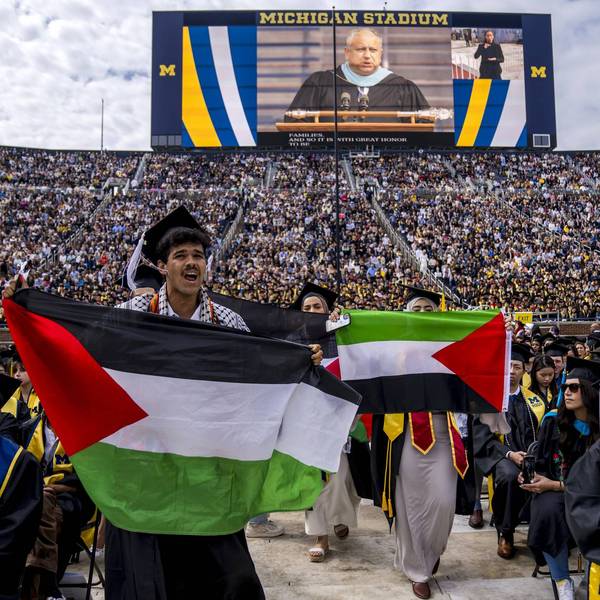
On May 2, the University did not merely censor this year’s commencement speech. It treated the mention of Palestinian humanity as a radioactive heresy that had to be scrubbed from the record as if a crime had been committed.  

The “outrageous” remarks were delivered by Professor Derek Peterson, a distinguished historian. During his address, Peterson suggested that the greatness of the University lies not so much in its scoreboard but rather in its pursuit of justice. He honored a list of pioneers: Sarah Burger, who paved the way for women to be admitted; Moritz Levi, the first Jewish professor, who opened doors for generations of Jewish students; and the Black Action Movement, which fought for the inclusion of Black people.

Then, he dared to praise a coalition of Jewish, Christian, and Muslim students who protested the worst man-made humanitarian catastrophe of this century. Specifically, he commended the pro-Palestinian student activists for opening our hearts to the “injustice and inhumanity of Israel’s war in Gaza.”

For this act of empathy, President Domenico Grasso issued a groveling apology on behalf of the administration for “hurtful and insensitive” remarks. It was a masterclass in institutional spinelessness. To honor Jewish professors is commendable. To honor Black students is noble. But to suggest that Palestinians, too, possess human rights worth defending—that, in this administration’s view, is heresy. 

It takes a profound level of moral bankruptcy to turn a blind eye to Israel’s campaign of mass killing and destruction that a global consensus of human rights organizations—including the Israeli groups B’Tselem and Physicians for Human Rights Israel, as well as the International Association of Genocide Scholars—has called the commission of genocide. The real scandal, apparently, is not the slaughter itself, but the possibility that a few donors might have had their commencement brunch disturbed by hearing those crimes named aloud.

The irony is staggering. University leaders oversee an institution supposedly devoted to truth. Yet they react to a call for empathy with the same reflexive suppression one might expect from a white Southern university in the Segregation era, terrified of the “subversive” idea that Black Americans should be granted equal rights. 

The administration’s official statement claimed that commencement was “neither the time nor the place” for such remarks. 

This rationale raises the obvious question: When, exactly, is the “correct” time to acknowledge the systematic destruction of every hospital in Gaza and the killing of nearly 1,000 doctors, nurses and medics? Is there a pre-approved window during which the University of Michigan permits its faculty to decry the murder of more than 21,000 children? Or is there a donor-vetted litmus test to determine which atrocities we are allowed to name?

As a Jewish lawyer and activist who knows this conflict intimately, I find the University’s “outrage” to be particularly ignorant and insulting. We are not protected by the silencing of truth. The administration does not honor our history or the Jewish idea of speaking truth to power by censoring those who acknowledge these horrors and appeal to conscience. Instead, it brings shame and embarrassment upon this world-renowned academic institution.

This censorship serves as a grim reminder that under the current leadership, academic freedom and the pursuit of truth end exactly where the protection of donor money begins. It must be a heavy burden for these administrators to carry all that “hurt” while tens of thousands of human beings are being extinguished.

Derek R. Peterson Michigan graduation remarks 2 May 2026

This article was originally published by Informed Comment; please consider supporting the original publication, and read the original version at the link above.
Rutgers University Condemned for Canceling Palestinian Rights Advocate’s Graduation Speech

“The message Rutgers is sending to this class and everyone around the country is alarming,” said Rami Elghandour. “Don’t dare stand for anything. Don’t dare speak up.”


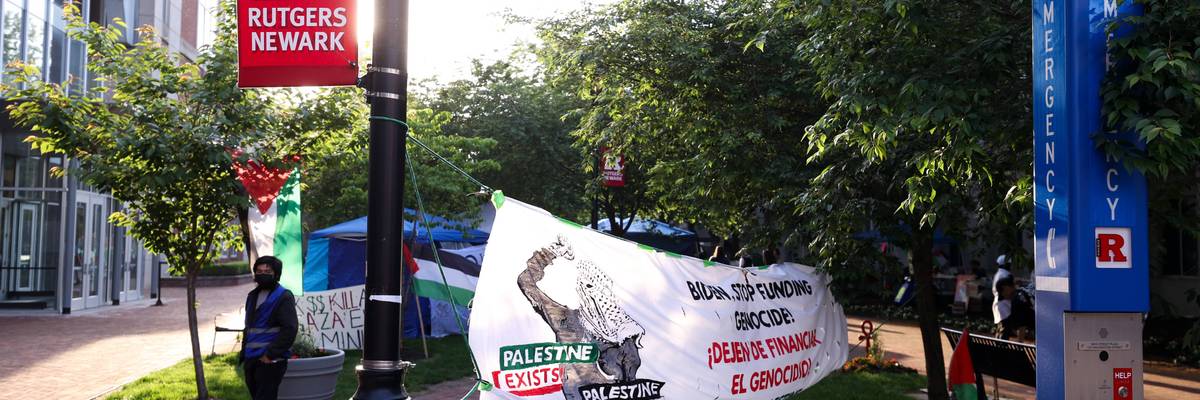
Students of Rutgers University set up Gaza solidarity encampment at a New Jersey university on the Rutgers-Newark campus in Newark, United States on May 21, 2024.
(Photo by Lokman Vural Elibol/Anadolu via Getty Images)

Julia Conley
May 07, 2026
COMMON DREAMS

Faculty members at Rutgers University in New Jersey on Thursday were among those condemning the school’s decision to rescind an invitation to Rami Elghandour, a biotech executive and producer of the Gaza-focused film The Voice of Hind Rajab, who had been invited to speak at the School of Engineering commencement next week.

Elghandour said the engineering school’s dean, Alberto Cuitiño, had informed him that he was no longer scheduled to give the commencement address after a “few” students told the administration they would not attend the graduation in protest of Elghandour’s online advocacy for Palestinian rights.


‘Cowardly’: University of Michigan Blasted After Apologizing for Commencement Speaker’s Praise of Pro-Palestine Students

“Commencement season is here, and with it the usual cycle of silencing voices that stand up for human rights,” said Waheed U. Bajwa, a professor at Rutgers in New Brunswick. “This one hits close to home... I publicly call on Rutgers to reverse this!”

Elghandour, a graduate of the engineering school, released a statement saying that the school had “decided that the feelings of a handful of students who said that my social media posts ‘opposed their beliefs’ were more important than the experience of the entire graduating class, the reputation of the school, the dignity and belonging of Arab and Muslim students, and the First Amendment.”


Speaking to the New Jersey Globe, a spokesperson for the university cited a specific post that Elghandour wrote in April on the social media platform X, saying that Israel has “committed genocide” and is “running dungeons where they train dogs to sexually assault prisoners.”

“Weapons embargo is the absolute minimum,” said Elghandour. “Sanctions and diplomatic isolation are beyond justified.”

Leading human rights organizations and Holocaust scholars are among those who have called Israel’s assault on Gaza, which began in October 2023 in retaliation for a Hamas-led attack and has killed more than 72,000 Palestinians, a genocide.

Calls for the US to suspend military aid to Israel in light of the war are hardly a fringe view in the US; a Quinnipiac University poll released last August found that 60% of voters across all parties supported a suspension of aid.

Middle East Eye reported in December on Palestinian detainees’ allegations that Israeli guards had used dogs to sexually assault them. Rights organizations including the Euro-Mediterranean Human Rights Monitor, the Palestinian Center for Human Rights, and the Council on American-Islamic Relations (CAIR) have also collected testimonies alleging such abuse.

Rutgers spokesperson Dory Devlin told the Globe that some students had accused Elghandour of making an “inflammatory claim” when they said they would not attend the graduation if he spoke.

“Rutgers chose me in part because of my humanitarian work,” said Elghandour in his statement. “They put my role as an executive producer for the Oscar-nominated The Voice of Hind Rajab front and center. They led with my social justice advocacy. Until it was inconvenient. That’s the difference between virtue signaling and principles. One withstands challenge. The other wilts in the slightest breeze.”

“The message Rutgers is sending to this class and everyone around the country is alarming,” he added. “Don’t dare stand for anything. Don’t dare speak up.”

He said he plans to record the speech he had been scheduled to give and post it online so students can still hear it.

Hank Kalet, a journalism professor at the school who serves as vice president of the Rutgers Adjunct Faculty Union, told the Globe that the university’s actions met “the definition of viewpoint censorship.”

“We have somebody who is offering, in a public way on X, some opinions about genocide in Gaza and being retaliated against because of the opinions that he has,” said Kalet, who is Jewish. He told the outlet that he did not believe Elghandour to be antisemitic.

Naureen Akhter, public affairs director for CAIR-New Jersey, noted that Rutgers had recently hosted Israel Defense Forces soldiers on its campus as part of a national tour called “Triggered: The Ceaseless Tour.”

“It is unconscionable that Rutgers rolls out the red carpet to soldiers engaged in genocide yet finds expression of pro-Palestine solidarity from one of their distinguished alumni so objectionable, they refuse to have him address graduates,” said Akhter. “We call on Rutgers School of Engineering to reinstate Rami Elghandour as commencement speaker and approach issues of student safety and freedom of expression with more care.”

The Rutgers student body is no stranger to advocacy for Palestinian rights. As on other college campuses across the US, students held a sustained protest in the spring of 2024, demanding the school divest from companies that do business with Israel, terminate its relationship with Tel Aviv University, and take other steps to demonstrate solidarity with Palestinians.

Rutgers-Newark also defended its decision to host pro-Palestinian comedian Ramy Youssef at its 2025 commencement after a state lawmaker claimed his involvement would alienate Jewish students at the university.

The decision to cancel Elghandour’s speech came days after the University of Michigan publicly apologized for a graduation speech by Professor Derek Peterson, who had applauded students who spoke out for Palestinian rights in campus protests, saying they exemplified the school’s long history of social activism.

“I think [Palestine] is the moral issue of our time, and I believe it’s been used to undermine democratic institutions in the US,” Elghandour told The Guardian on Wednesday.

Bajwa said on social media that “everyone says they’d have stood against slavery, the Holocaust, segregation, and more.”

“Easy to be righteous about the past,” he said. “But what about now? What moral tests are you failing in your own time? That’s the real test of courage.”

The Surcharge Tax Americans Pay to Finance Israel’s Wars


 May 7, 2026

Image by Planet Volumes.

The next time you pull into a gas station, watch the number on the pump as you squeeze the handle. That rapidly spinning dollar amount is not just the price of gasoline. Included in it is an Israeli-added tax you did not consent to pay.

Since early March 2026, the average American household has been spending 50 percent more to fill their tank than just one month earlier. The Trump administration and its Israel-first ideologues blamed market forces for the spike, framing it as short-term pain for long-term gain. What they will not say, what they are never permitted to say in Washington, is that Americans have been living the “pain” of the Israeli oil surcharge tax for more than half a century. The bill keeps growing, but no longer only financially. The U.S. is also paying with something harder to rebuild than a budget, its moral standing in the world.

The history of this “pain” remained a closely suppressed secret and one of the most forbidden subjects in American political discourse. Roughly fifty years ago, September 1973 to be exact, crude oil traded at roughly three dollars a barrel, or less than 40 cents a gallon at the pump. Then came the October War. Israel-first Zionists in the Nixon administration, led by Henry Kissinger, committed the full weight of American resources through what was, at the time, the largest emergency military airlift in American history. Arab oil-producing nations responded by pulling the one lever they controlled: reduction of oil production.

By January 1974, crude had climbed to twelve dollars a barrel — a 400 percent increase in less than four months. American drivers sat in lines stretching around city blocks, waiting for rationed gasoline, paying prices they had never imagined, for a war fought thousands of miles away on behalf of a state that contributes not a single penny to the American economy.

Instead of honest and frank debate, Americans were offered a carefully curated media narrative, one that avoided the most inconvenient question of all: why were they paying 400 percent more?

Corporate American media, where Israel-first loyalists run editorial boards and Middle East commentary is filtered through a reflexively Zionist prism, rarely allows non–Israel-centric perspectives into mainstream conversation. That is why a viewpoint like this is unlikely to appear in outlets such as the San Diego Union-Tribune, the Los Angeles Times, or The New York Times.

Rather than examining the root causes of the oil embargo, the Zionist-managed media reached for a familiar deflection: exploiting public prejudice to redirect frustration and foment anti-Arab racism. The politically targeted embargo was stripped of its context and detached from the reality of Israeli occupation and the Nexon administration’s unconditional financial and diplomatic support for Israel.

That was fifty years ago. The Israeli surcharge tax did not end when the embargo was lifted. It became embedded in the architecture of the American budget and the profit structure of U.S. oil corporations. The Israeli-added tax reemerges with every made-for-Israel war Washington chooses to fight and finance.

The Iraq invasion — sold on fabricated Israeli intelligence and planed by Israel-first loyalists in the dens of the US State Department and the Pentagon — added more than eight trillion dollars to the U.S. national debt. A “legal” theft, extracted from American workers, American schools, infrastructure, and future generations and poured into the sands of a war that made the Middle East less stable, not more. The one government that cheered for that war, that lobbied hardest in Washington’s corridors, coercing and or fooling American leaders with its Weapons-of-Mass-Deception, was Israel’s. The one government that bore none of its costs—in money or in blood—was Israel’s.

Now we are here again. The U.S.-Israel war against Iran has barely begun, and the Pentagon is already before Congress requesting two hundred billion dollars. Two hundred billion dollars financed by cuts to Americans’ healthcare, money to repair bridges, financial aid for higher education, or address the tentacles of the mental health crises throughout the American heartland. Two hundred billion dollars for another made-for-Israel war undermining U.S. sovereign strategic interests and moral standing in the world.

Setting aside the financial cost, the U.S. is being drained of its moral position, year by year, war by war, veto by veto — in defense of a government whose prime minister stands indicted by the International Criminal Court (ICC) for war crimes and crimes against humanity. Benjamin Netanyahu, the indicted war criminal is defended by American diplomats in international forums, exercises a dangerous power over Donald Trump, and for whom American soldiers are now dying in a war against Iran.

These Israel-first policies have eroded the idea of America that generations around the world once admired. From the Marshall Plan and the Universal Declaration of Human Rights to “give me your tired, your poor.” That America has been replaced, in the eyes of billions, by one that arms and enables genocide, vetoes ceasefire resolutions while children starve, and sends its young men and women to fight wars so that Israel does not have to. An ICC-indicted war criminal welcomed as equal alongside the U.S. president into the Situation Room to connive his next war venture. The results: Netanyahu got his new war — and Americans paid for it.

It’s no secret in Washington: “Bibi gets what Bibi wants.” In Congress, elected officials from both aisles welcome Bibi with record-breaking standing ovations, and unite when writing blank checks for Israel. Yet, they descend into partisanship over funding school lunches for American children and taxpayer healthcare coverage. All this while they borrow money to bankroll Israel’s universal healthcare and free universities. In contrast, they deny those same benefits for American taxpayers.

The Israel surcharge is real. It has a history, and a price tag. Consequently, what Americans feel at the grocery store and gas pump is not just inflation, it’s a new Israeli surcharge tax financing another Israel-first war in the Middle East.

Jamal Kanj (jamalkanj.com) is the author of Children of Catastrophe: Journey from a Palestinian Refugee Camp to America, and other books. He writes frequently on Palestine/Arab world issues for various national and international publications.