Thursday, May 07, 2026

ICE Ready to Pack Migrants into Warehouses


 May 5, 2026

Photograph by Nathaniel St. Clair

On April 24, congresswoman Rashida Tlaib announced that she “just introduced the Ban Warehouse Detention Act.” This is an excellent idea. As Tlaib wrote, “immigrant detention is already unjust and inhumane, but Trump’s administration is trying to expand it rapidly by buying up warehouses across the country. Each warehouse could cage between 1,500 and 10,000 people.” So Homeland Security wants to pack people into buildings like sardines, where, if the overcrowding doesn’t kill them, deportation to either an El Salvadoran prison or one in another rightist garden spot probably will. And who will do the hands-on dirty work? Your friendly neighborhood gestapo that should have been disbanded years ago, namely ICE.

So how and how long has ICE been snapping up these warehouses? Quietly and for months, quite under the radar. If that sounds sinister to you, your instincts are in good working order. ICE is creating an immigrant gulag (as if the one it’s already got weren’t bad, extensive and crushing enough) capable of holding 92,000 people – note the word “people,” not “migrants,” because ICE isn’t too choosy about who it nets in its enforcement sweeps, which is not, in any way, to condone how this atrocious organization treats migrants. But lots of ICE’s victims are green-card holders, people who emigrated here decades ago, or, simply U.S. citizens by birth. Currently ICE has bought at least 11 of a projected 20 detention sites nationally, and some should be up and running by the end of the year. According to Business Insider April 3, these properties have already cost ICE between $35 million and $145 million. Overall, this is a $38.3 billion plan.

Massachusetts Democratic senator Elizabeth Warren and Democratic representative Jamie Raskin are probing this latest ICE adventure, “looking into government contractors, real estate firms and property owners who may have ‘corruptly profited’ from sales to ICE,” the publication reports. I hope they investigate the entire scheme as well, because it sounds like a new, sick permutation on the privatize-the-prisons scam, with investors including The Carlyle Group and a Goldman Sachs partner. “Nearly every seller purchased the land and built the warehouses within the last five years,” Business Insider adds – a detail which should electrify the antennae of any investigator – “with the intention of flipping or leasing them to an e-commerce or logistics company.”

Historically, Business Insider notes, ICE “leased its detention facilities from private prison firms.” This latest assault on decency calls for 16 regional processing centers to incarcerate “1,500 people for up to a week at a time, and eight ‘large scale’ detention centers meant to hold 7,000 to 10,000 people for one to two months.” We know the lucky folk to get thrown into these prisons will mainly be non-white migrants, but don’t worry, ICE doesn’t totally neglect Caucasians. See for instance, the case of Marie Therese Ross-Mahe, reported by the New York Times April 26, 2026, “a French citizen who lived with her American husband until he died in January.”

The fact that Ms. Ross-Mahe is 85-years-old didn’t deter ICE, nor did her previous enthusiasm for Donald “Ethnically Cleanse the USA” Trump. In her bathrobe, slippers and pajamas, this luckless non-citizen was escorted to an unmarked car and thence to a jail cell, where commenced what she described as a process of humiliation. She’s lucky that’s merely what it was and that she now resides safely in France, because humiliation is small potatoes – plenty of ICE victims die in custody, or, like the two ICE-murdered Minnesotans, Renee Good and Alex Pretti, before they are even arrested. However, “After two weeks in detention in Alabama and Louisiana, [Ms. Ross-Mahe] feared she might die.” And die from abusive manipulation of an already criminally abusive system: a judge in this case believed that an estate fight with Ross-Mahe’s stepson “instigated her arrest.” First held “in a filthy county jail,” she was later “flown in chains to Louisiana and held in an ICE processing center…After two weeks of detention, she said, she…didn’t think she could survive much longer,” and was “waiting to die.” Quite a price to pay for coming to America.

The only reason Ms. Ross-Mahe escaped this fate was that the French consul general in New Orleans “lobbied for her release.” She now has post-traumatic stress disorder, but she’s one of the lucky ones; over 48 people have died in ICE custody or enforcement since January 2025, and the 2026 trend is upward. In other words, if ICE will do this to an 85-year-old European lady, how much care do you think they take for the health and well-being of non-white migrants or legal residents from Latin America or Africa? Or do you think the policy is to get rid of such people by any means possible, though preferably, of course, by deportation? In other words, if you’re from Tegucigalpa, as is old news, ICE ain’t too choosy about what happens to you.

That’s why it runs places like Alligator Alcatraz in the Everglades, still open despite litigation over its environmental impact, not, nota bene, over its horrible living conditions or high “disappearance” rate. According to Inside Climate News April 30, “thousands of undocumented migrants have been detained [there] since the facility opened last summer.” As a result of a very recent 11th U.S. Circuit Court of Appeals ruling, this hellhole “may keep operating while the environmental groups’ and tribe’s [Miccosukee] litigation proceeds.” Back on December 4, Amnesty International released a report on this place called “Torture and enforced disappearances in the Sunshine State: Human Rights violations at “Alligator Alcatraz” and Krome in Florida.” “These findings confirm a deliberate system built to punish, dehumanize and hide the suffering of people in detention,” wrote an Amnesty official. “Immigration enforcement cannot operate outside the rule of law or exempt itself from human rights standards.”

It’s no surprise, therefore, that in 2025 Florida had the nauseating distinction of hosting the most deaths in ICE custody of any state, while Amnesty’s research “concluded that people arbitrarily detained in ‘Alligator Alcatraz’ are living in inhuman and unsanitary conditions, including overflowing toilets with fecal matter seeping into where people are sleeping, limited access to showers, exposure to insects without protective measures, lights on 24 hours a day, poor quality food and water, and lack of privacy – including cameras above the toilets.”

These are the sorts of detention camps ICE runs. If it gets its way and snaps up who knows how many warehouses, expect more of same. The idea appears to be to make life intolerable for those ICE wants to deport, so they’ll never, ever, dream of returning here again. Or, what is even more wicked, just let them die in these sewers, of disease or of injuries. The Trump regime also doubtless hopes that word will spread back to countries these migrants came from that the American gestapo is so barbaric, it’s not worth the risk of coming here. That, I suspect, is the true motive: terror.

Eve Ottenberg is a novelist and journalist. Her latest novel is Old Man Alone. She can be reached at her website.

‘A Voice That Upholds the Conscience of the World’: Spain Honors Francesca Albanese for Efforts to Stop Gaza Genocide

The UN’s special rapporteur on Palestine has said nations seeking to punish her for documenting atrocities committed by Israel “want to silence everyone who demands an end to genocide.”


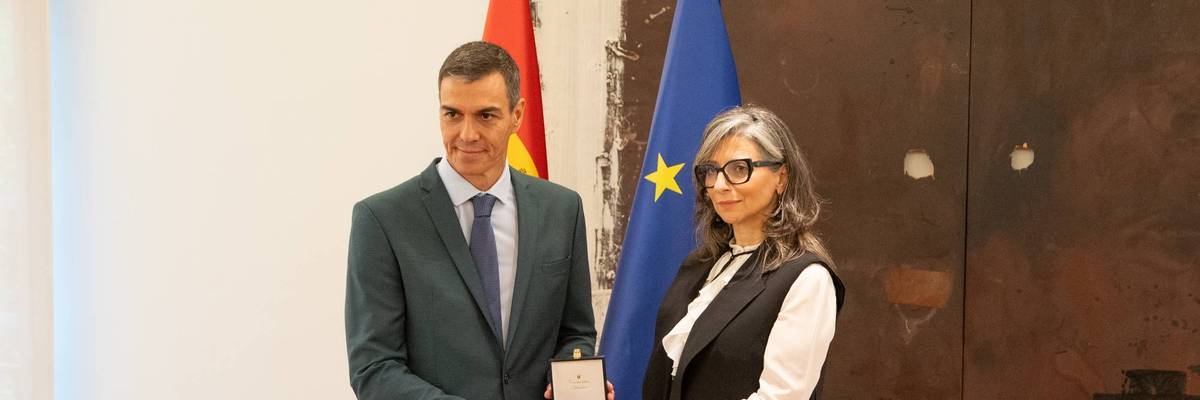
Spanish Prime Minister Pedro Sánchez awards the Order of Civil Merit to Francesca Albanese, the United Nations special rapporteur for Palestine, on May 7, 2026 in Madrid, Spain.
(Photo By Isa Saiz/Europa Press via Getty Images)


Stephen Prager
May 07, 2026
COMMON DREAMS

Spanish Prime Minister Pedro Sánchez honored Francesca Albanese, the United Nations special rapporteur on Palestine, on Thursday, in a display of solidarity as she faces sanctions from the United States over her outspoken advocacy against Israel’s genocide in Gaza.

Citing her work to document human rights violations over more than two years of conflict, Sánchez awarded Albanese the Order of Civil Merit, a knighthood granted to Spanish and foreign citizens for extraordinary services benefiting the state or society.

“Public responsibility... entails the moral obligation not to look the other way,” Sánchez said in a social media post. “It is an honor to award the Order of Civil Merit to a voice that upholds the conscience of the world: Francesca Albanese.”


Earlier this week, Sánchez petitioned the European Commission to intervene to stop compliance with the Trump administration’s efforts to punish Albanese, as well as members of the International Criminal Court who have brought arrest warrants against Israeli Prime Minister Benjamin Netanyahu and former Defense Minister Yoav Gallant.

Albanese, an Italian legal scholar, has held the role of special rapporteur since 2022, a year before Israel launched a war in Gaza in response to a Hamas-led attack on October 7, 2023. Human rights organizations and UN experts have described Israel’s assault as a genocide.

In March 2024, Albanese released the UN’s first major public report, making the legal case that there are “reasonable grounds” to believe a genocide was being committed, referring to a litany of statements by Israeli officials establishing intent to destroy the Palestinian population.

In addition to documenting Israel’s actions, she has published research demonstrating the “complicity” of nations that supply weapons and other support to Israel in what she has called a “collective crime” that they should also face responsibility for.

According to official estimates, at least 72,000 Palestinians have been killed since October 2023, many of them women and children, while independent analyses suggest the death toll is much higher, in part due to the near-total destruction of health and other public infrastructure.

Many of the buildings in Gaza have been destroyed by over two years of relentless bombings, leaving most of its 2.1 million people displaced and living in tent cities.

Albanese told a Spanish broadcaster that the US and other nations attempting to punish her and other international authorities for speaking out against atrocities in Gaza were “like an international mafia.”

“They want to silence everyone who demands an end to genocide, an end to the crimes,” she said.

Moments of Bifurcation: From Gibraltar to Hormuz

Source: Originally published by Z. Feel free to share widely.

The Moment of Bifurcation

In the scientific field, the term “bifurcation” was first used by Henri Poincaré, but in the second half of the 20th century, the concept and theory of bifurcation came to be associated with the chemist and Nobel laureate Ilya Prigogine. Prigogine’s theory of bifurcation is based on the following ideas: the fundamental indeterminacy of reality and the consequent insistence on not considering chance, chaos, and disorder as pure negativity, outside the scientific realm; complex systems create forms of self-organization that produce unpredictable changes and transitions (dissipative structures); in situations out of equilibrium (entropy, second law of thermodynamics), disorder prevails over order, and systems can enter moments of bifurcation in which small changes can produce enormous and unpredictable consequences.

Initially formulated in chemistry, the theory of bifurcation has sparked interest in philosophy, art, sociology, etc. The sociologist Immanuel Wallerstein was one of those most drawn to Prigogine’s theory and who explored it most deeply in the field of sociology. According to him, the modern world system has been accumulating contradictions; its development since the 16th century is based on certain long-term premises and trends that, one by one, have disappeared or been called into question. The world system is currently facing a structural crisis that constitutes a bifurcation point, a period of chaotic transition marked by great political and economic volatility.

According to Wallerstein, this transition could last until 2050, and what follows could be something more authoritarian and hierarchical or more democratic and egalitarian. I am convinced that history has accelerated in recent times and that new factors of unpredictability have emerged, above all three: the imminent ecological collapse, the development of artificial intelligence, and the emergence of an extremist Judeo-Christian Zionism. Unpredictability is greater than ever. Any decision involving calculated risk could result in incalculable risk. Is the world—conceived as the modern world system—entering a moment of bifurcation? Is the war in Iran the manifestation of that moment? If so, any action by any of the major players (Israel, the U.S., and Iran) or their allies, however calculated it may be, could have incalculable consequences:

A new world war (which for some has already begun)? A war that is more military than economic, or more economic than military? The end of the modern world system based on the vitality of modern capitalism and the hegemony of the West (successively: city-states of Italy, Portugal, Spain, the Netherlands, France, the United Kingdom, the US)? A new period of rival hyper-nationalisms or religious wars between extremist movements (Jewish-Christian Zionist fundamentalism versus Islamic fundamentalism)? The acceleration of ecological collapse and the resulting massive displacement of populations (environmental refugees)? A new political conflict between the politics of life and the politics of death, replacing the modern conflict between left and right? The revolution of the sub-humans and sub-proletarians of the cyber-automated world, led by repentant insiders who know better than anyone the vulnerabilities of a power that presents itself as invulnerable?

If, for a moment, we can divert our attention from the media facade temporarily composed of Benjamin Netanyahu and Donald Trump, it will be possible to focus our efforts on the search for a possible new balance between fear and hope, perhaps only viable post-bifurcation. And for that, a little history may help.

A story of two straits

During the Middle Ages (13th, 14th, and 15th centuries), the Mediterranean was the commercial hub connecting the East with the West—the Levant trade. The Indian Ocean was then dominated by the peoples of the region and, since the 8th century, by Muslim Arabs. Mediterranean trade took place between Christian merchants (primarily from the Italian city-states of Venice and Genoa) and Muslim merchants (from the Eastern Mediterranean and North Africa) and extended into the Atlantic Ocean to reach Northwestern Europe (the northwest of what is now Spain, southwest England, and Flanders, with Bruges as the final destination). In the 13th century, the banking houses of Florence had 80 branches across Europe that functioned simultaneously as financial institutions and maritime transit insurers. Everything was traded, and some products were particularly important. Since ancient times, tin from northwestern Spain and southwestern England had been essential for producing bronze, the quintessential durable metal of the era. Throughout the Middle Ages, pepper, coming from the East, held an importance that is hard to imagine today. It was such an important spice that it was frequently used as currency to pay customs duties, taxes, and debts between states. In the triangle between the Seine and Rhine rivers and the North Sea, the most precious goods were textiles. The galleys of Flanders linked the Mediterranean to the North Sea [1].

It so happened that, just as today, trade and war went hand in hand, and the Strait of Ceuta (now Gibraltar) was a key flashpoint for conflict. Muslim merchants (and others) engaged in privateering and piracy and frequently blockaded the strait, preventing Christian ships from passing or demanding heavy tolls to allow passage, which contributed to rising prices for goods. Some goods became so expensive that they disappeared from the market. It was to put an end to these blockades and the insecurity that the Portuguese conquered Ceuta in 1415. According to chroniclers of the time, at the time of the conquest of Ceuta, 12 pounds of pepper, a typical product of Levantine trade, came to cost 32 shillings. In the three decades following the conquest, the price fell successively to 16, 13, and 9 shillings [2]. 1415 marks the beginning of Europe’s colonial expansion (discoveries, explorations, and invasions, occupations) and the emergence of a world economy dominated by the West. With the capture of Ceuta, trade in the Mediterranean and the North Atlantic opened up, along with expansion toward the West, beginning with the archipelagos of the Azores, Madeira, and the Canary Islands.

One should not think that the goal was unrestricted free trade. The aim was to create new monopolies and exclusive navigation zones, the mare clausum [closed sea] that the Treaty of Tordesillas (1494) would enshrine. It was not until the 17th century that the mare clausum would be replaced by the mare liberum [open sea]. And this occurred as the bourgeoisies of Northern Europe consolidated their dominance of world trade and turned colonialism into one of the pillars of the primitive accumulation necessary for the development of industrial capitalism, a historical process that would reach its climax at the Berlin Conference (1884–95).

Less than a century after the conquest of Ceuta in 1507, the Portuguese conquered the Strait of Hormuz and built a fortress on the island of Hormuz off the coast of what is now Iran. The objective was to control trade between India and Europe that passed through the Persian Gulf (or Arabian Gulf). On December 4, 1513, Afonso de Albuquerque, Viceroy of India since 1509, wrote from Cananor to the King of Portugal, Manuel I, a letter revealing Portuguese control of the strait:

Along this entire coast, I was asked for insurance for ships from Malacca, and I granted it to all of them, as well as to ships and ports in Ormuz, on the condition that the horses be brought to Goa, so that it may be established along this entire coast that no horses from Arabia or Persia may enter any port other than Goa. And I believe they will do so, given the favorable report that last year’s ships brought back [3].

Portuguese rule lasted until 1622 and was replaced for a long time by direct or indirect rule by the United Kingdom (through alliances with the sultanates). During the 19th century and until 1921 (and later during World War II), the United Kingdom and Russia vied for supremacy over Iran. This is without forgetting Kaiser Wilhelm II of Germany, with his project for the railway line between Berlin and Baghdad, construction of which began in 1888. This railway line was to be part of the Trans-Eurasian Axis connecting Hamburg to Basra on the Persian Gulf via Prague, Budapest, Constantinople (now Istanbul), and Alexandretta (now İskenderun). It was the first version of the “Drang nach Osten,” the eastward expansion of German imperialism. One of the Kaiser’s advisors, Paul Rohrbach, argued that the British Empire could be fatally weakened in the Middle East. The second version of the “Drang nach Osten” would be led by Hitler, targeting in this case the Slavic peoples and, above all, Russia. After World War II, the struggle for supremacy over Iran came to be dominated by the U.S. As we know, the Strait of Hormuz is now part of Iran and is currently under a U.S. blockade.

The beginning and the end?

The Strait of Gibraltar (then called the Strait of Ceuta) in the early 15th century and the Strait of Hormuz today bear a striking resemblance. The Muslim Arabs’ control of the Strait of Ceuta was not intended to prevent trade, but merely to alter the terms of trade in their favor. We can say, that the same is true of the Muslim Persians in their claim to control the Strait of Hormuz. The retaliatory blockade by the US was intended solely to eliminate the commercial advantages that Iran sought to gain from its control of the strait.

The apparent similarity between the two situations hides a profound difference. Iran, like the Persian Gulf countries, has every interest in the freedom of trade through the strait. The control that Iran now seeks is merely a response to the bombings and threat of invasion by the US and Israel. As the French writer Jean Rolin would say, it is an “asymmetric tactic” to circumvent the aggressors’ overwhelming military superiority. Jean Rolin published a novel in 2013 titled Ormuz [4]. In this novel, there is a wealth of information about the nature and significance of the strait. Two different worlds, the Arab and the Persian, the same religion: two different ways of being Muslim. Based on this wealth of information, the writer argues that Iran can resort to what he calls “asymmetric tactics”—tactics capable of circumventing the adversary’s military and technological superiority. This is what is happening. In light of this, it is necessary to highlight the differences between 15th-century Gibraltar and 21st-century Ormuz.

The Significance of Gibraltar

The control of the Strait of Ceuta by the Portuguese and the West in general was not merely a temporary development serving Christian merchants. It marked the beginning of the decline of Arab/Muslim dominance in the Mediterranean and in Levantine trade, a decline that would be consummated with the fall of Al-Andalus in 1492. It was, on the other hand, the inaugural moment for a new historical period dominated by the West: the modern world system. It was one of the first manifestations of a new center of world power that had two factors in its favor: the emerging European bourgeoisie and modern science.

In the long term, the opening of the Strait benefited the Mediterranean states or those of the Iberian Peninsula less than the countries of Northern Europe. Capitalism was then emerging as a global system—a world economy—that was highly dynamic but also highly contradictory, subject to recurring crises. In turn, the defeat of Islam in Ceuta signified confidence in a new system of experimental knowledge and empirical observation that drew upon the best cartographers, astronomers, astrologers, physicians, and scientists in general—almost all of whom were Jewish—to deepen the knowledge that would ensure dominion over the seas. It is no coincidence that Prince Henry was appointed governor of Ceuta in 1416, shortly after the conquest. Prince Henry was the founder of the Sagres Nautical School and the great architect of Portuguese maritime expansion. Gomes Eanes de Azurara, who, like Luis (Alvise) Cadamosto, was very close to the Prince and wrote the chronicles of the first phase of Portuguese colonial expansion, states that the Prince spent nights on end without sleep studying astronomy and geography.

It is hard to imagine today that as late as the early 18th century, one of the most coveted prizes in Europe at the time was awarded to whoever discovered the most accurate method of determining longitude, a fundamental piece of information for guiding navigation on the high seas. A 1714 act of the House of Commons of the United Kingdom offered a prize to whoever discovered the most accurate method of determining longitude: 10,000 pounds sterling to anyone who could provide longitude observations accurate to within 1 degree; 20,000 to anyone who could determine it with an accuracy of half a degree; and 15,000 for an intermediate level of accuracy. The evaluation committee included Isaac Newton and several members of the Royal Society. France offered similar prizes. It was not until 1765 that it became possible to determine longitude with negligible errors.

If one wishes, there was also a third factor in the construction of the modern era: religion—initially Catholicism, and later both Catholicism and Protestantism. Throughout the Middle Ages, since the Crusades, the Catholic Church had been an important unifying factor among the various Christian states of Europe and among their elites. This momentum, combined with economic advantages, allowed rivalries to remain functional to the development of capitalism.

The Significance of Hormuz

The Strait of Hormuz is perhaps as important today as the Strait of Gibraltar was at the end of the Middle Ages. All oil produced in the Middle East (with the exception of Egypt and Turkey) is produced in the Persian Gulf and accounts for between 20% and 30% of global production. All of it passes through the strait, not to mention petroleum products, fertilizers, aluminum, etc. But the context in which the conflict in the Strait of Hormuz occurs today is radically different from what happened in Ceuta (Gibraltar) in the early 15th century. Unlike what happened then, the dynamism of global capitalism has shifted to the East. Iran is not alone. It is accompanied by Russia and the world’s great factory, China.

In turn, the struggle for knowledge that can translate into geostrategic advantage is also different. The rivalry to determine longitude took place among European countries, while the rivalry for technological advancement today, especially in the field of Artificial Intelligence, occurs between the United States and China.

Furthermore, the very military superiority of the U.S. is questionable. The U.S. has a strong military presence in the Middle East, and its most important military bases are located in the Persian Gulf: Bahrain, Kuwait, Qatar, the UAE, and Saudi Arabia. Reliable information shows that this entire display of military might was, after all, an easy and fragile target. The drones and missiles launched by Iran reduced these bases to ruins or rendered them inoperable, which immediately led some of the countries hosting the bases to rethink their strategy for new alliances, no longer centered exclusively on the U.S.

If the hypothesis of a turning point is confirmed, after the Strait of Hormuz, the world will be different. Iran is not Venezuela, and therefore the “easy victories” Donald Trump speaks of may result in bitter defeats. If Iran has not yet defeated the West, it has at least shown that it can be defeated. And that is irreversible.


[1] In a text of this kind, there is no room for lengthy bibliographical citations, as the literature on this subject is vast. I recommend, in particular, Jaime Cortesão (in addition to his monumental work on the Portuguese discoveries): The Portuguese Expansion during the Age of Henry the Navigator. Lisbon: Livros Horizonte, 1975; Joseph F. O’Callaghan, The Gibraltar Crusade: Castile and the Battle for the Strait. Philadelphia: University of Pennsylvania Press, 2011; L.A. Fonseca, “Portuguese Maritime Expansion from the African Coast to India,” in Michel Balard, Christian Buchet (eds.), The Sea in History – The Medieval World. Rochester: Boydell & Brewer, Boydell Press, 2017: 642–653 (and bibliography cited therein); Claire M. Gilbert, In Good Faith: Arabic Translation and Translators in Early Modern Spain. Philadelphia: University of Pennsylvania Press, 2020.

[2] Jaime Cortesão, op. cit., 156.

[3] T.F. Earle, John Villiers (eds) Albuquerque: Caesar of the East. Selected Texts by Afonso de Albuquerque and His Son (bilingual edition). Liverpool: Liverpool University Press, 1990, 264.

[4] Ormuz. Paris: P.O.L. 2013.Email
avatar

Boaventura de Sousa Santos is the emeritus professor of sociology at the University of Coimbra in Portugal. His most recent book is Decolonizing the University: The Challenge of Deep Cognitive Justice.

Why Antisemitism Obscures the Real Architecture of Power

Source: Originally published by Z. Feel free to share widely.

One of the most repellent forms of that old-new popular thinking—now once again spreading with mounting intensity across Western societies since the genocidal devastation of Gaza and the American-Israeli escalation toward Iran—is the stale, mildew-ridden yet ever-ready conclusion: that, finally, the dehumanization of the Jews has been vindicated. That the racist phantasmagoria of Jews as a “cancer of humanity” was merely awaiting its historical confirmation. Ah yes – Hitler, it seems, “knew something after all”: because Zionists, because AIPAC, because Netanyahu, because lobbies—because of that wonderfully crude analytical apparatus that explains history as if it were He-Man and the Masters of the Universe, with a single eternal villain scheming from Snake Mountain against the pious people of Eternia.

Do not misunderstand me. It is difficult, in the history of the Jewish people, to find a political leadership darker, more ruthless, more brutal, and more morally decomposed than the one governing Israel today. It is equally difficult not to notice that in various pro-Israeli lobbying houses, committees, institutes, and societies sit individuals whose empathy for Palestinian life – or for human life at all – hovers somewhere around the level of an accounting error in the U.S. military budget.

But is that because they are Jews?

No. It is because they are human beings—more precisely, that particular kind of human being whom excessive power, wealth, fear, and ideology transform into cold administrators of other people’s deaths.

And here we arrive at the question that spoils the sport for all professional hunters of the “eternal culprit”: why are other accomplices across the vast spectrum of wars, massacres, sanctions, blockades, and mass deaths somehow always deemed “less evil” than the “evil Jews”? Why are Anglo-American imperial elites – Protestant or secular, it makes no difference – and their allies in various petro-monarchies, including Wahhabi–Kharijite ideological apparatuses, so readily portrayed as misguided marionettes of grotesque Jewish caricatures lifted from Nazi propaganda, rather than as fully conscious, fully responsible accomplices in joint criminal enterprises stretching from Libya, through Iraq, to Syria, Gaza, and Iran?

So, is it therefore impossible to be evil if you are not a Jew? Are Washington, D.C., London, Riyadh, and Abu Dhabi in fact historic courts of virtue and humanism—merely bewitched by wicked counsellors, like King Théoden in The Lord of the Rings? Otherwise, would they—as a kind of global alliance of beauty queens—ceaselessly labour for peace and human understanding, if only “the Jew” were not whispering in their ear that today, of all days, is perfect for yet another humanitarian catastrophe and genocide?

Let us look at Sudan. There, far from the focus of corporate media, one of the most harrowing contemporary catastrophes is unfolding. The war between the Sudanese Armed Forces and the paramilitary Rapid Support Forces has, according to humanitarian estimates, produced tens of thousands of deaths, mass displacement, and famine; agencies describe it as one of the worst humanitarian crises in the world. The RSF, in particular, has been accused of mass atrocities in Darfur, including in El Fasher, where UN investigators have spoken of “hallmarks of genocide.”

And who, then, is pulling the strings? Israel? No—rather the United Arab Emirates: the gleaming showroom of desert capitalism, where conscience is laundered through glass skyscrapers, Formula One circuits, and conferences on tolerance. The Emirates deny arming the RSF, yet numerous reports and investigations point to their role as a key external patron of this paramilitary machinery; inquiries have also traced networks of gold trading, real estate, and companies in Dubai linked to circles around RSF leader Mohamed Hamdan Dagalo.

And here we arrive at the uncomfortable lesson: if Muslims are massacred by Zionists, it is a crime. If Muslims are massacred by other Muslims, financed through gold channels, Gulf interests, and paramilitary corporations of death—that too is a crime. Victims do not become lesser victims because their killer does not match the familiar enemy’s face. Blood in Sudan is not cheaper than blood in Gaza simply because it cannot be so easily folded into a pre-fabricated story about a single, metaphysical enemy.

The Nigerian Civil War of 1967–1970, likewise, was not a manifestation of any “clash of civilizations.” Biafra, whose Igbo population was predominantly Christian, found itself under blockade by the federal Nigerian government; that blockade brought mass starvation and the deaths of vast numbers of civilians, with estimates ranging from several hundred thousand to around two million victims. The federal government in Lagos was not some Islamic horde from the propaganda pamphlets of American Protestant Zionists: it was led by Yakubu Gowon, a Christian from the Middle Belt, while other Christians also held important commands. At the same time, Britain, according to declassified documents and historical analyses, supported the Nigerian government in part because of its oil interests.

So here, too, there is no perfect formula of the eternal enemy: Christians suffered at the hands of a government in which Christians held significant power; Muslims can perish under Muslim regimes; Jews can be victims of antisemitism, while a Jewish state can at the same time organize genocide against Palestinians and spearhead criminal projects for the remaking of the Middle East that entail millions of human victims. Whoever cannot bear a truth so plainly stated is not seeking truth at all, but settling for tribal-confessional sedatives.

The lesson, then, is simple and severe: even in the worst of times, we must not declare evil to be the inheritance of one ethnic, religious, or cultural group alone, however critical we can and must be of the depraved ideological and cultural patterns within each of them. Evil is not, in its essence, exclusively Jewish, Muslim, Christian, wholly Western, or wholly Eastern. It is a universal human scourge—but not as some abstract moralistic fog; rather, as the very concrete product of power, interest, fear, class, resources, and a predatory economic system that functions just as efficiently in the hands of a Jew as of a non-Jew. Extreme and criminal ideologies do not fall from the sky; they grow out of the ways societies produce, consume, wage war, and distribute power. And capitalism, in its imperial and crisis-ridden logic, does not produce war and genocide as a systemic error, but as one of its darkest mechanisms of self-preservation.

Let us not forget that the population of Gaza has not been killed only because it is Palestinian and Muslim, but also because it happens to live in the wrong place. It is no coincidence that, in the very same political language in which Gaza is being flattened, a kind of posthumous tourist brochure has already begun to take shape. Donald Trump first mused that Gaza could be “better than Monaco,” boasting “the best location in the Middle East,” only to go on and suggest that America might “take it over” and turn it into the “Riviera of the Middle East.” His son-in-law Jared Kushner was even more shamelessly precise in real-estate terms: Gaza’s “coastal property,” he remarked, “could be very valuable”—provided civilians were moved out while Israel “cleans up” the strip. In just a few sentences, human tragedy is translated into the language of investment: first the ruins, then displacement, then a marina, a hotel, and cocktails with a sea view—beneath which, quite conveniently, lie natural gas reserves ready for exploitation. In other words, Gaza is also the victim of a joint capitalist criminal enterprise. One might therefore reformulate Max Horkheimer’s famous dictum—grounded in Hitler’s key ties with German big industry, that “whoever does not wish to speak of capitalism should remain silent about fascism”—into something like: “Whoever moralizes about Zionism while remaining silent about capitalism has entirely missed the point.”

Accordingly, Jeffrey Epstein was not abhorrent because he was Jewish or some supposed creature of Mossad, but above all because—together with his willing international clientele—he was a poster figure for a profoundly perverse global order: one that proclaims tolerance and human rights while, in practice, most brutally crushes those who have no money and therefore no protection. From children drawn into networks of sexual exploitation by predatory elites, to children in Iraq and Palestine—the victims were not victims solely because of who they were, but because of their vulnerability, their poverty, and their total exposure to a system that, precisely because they are poor and cannot “afford” the protection of the powerful, treats them as disposable biological waste.

That is why the antisemitic “explanation” of the world is not only morally repugnant, but analytically foolish and politically harmful: it does not expose the existing system—it rescues it. It is especially useful to the system entrenched in Israel, which in fact thrives on the premise that antisemitism is the natural condition of non-Jews, a premise designed to render every new enterprise of Netanyahu’s killers intelligible, even inevitable. Instead of focusing on the nature and structure of capital, the state, lobbies, military-industrial complexes, petro-monarchies, imperialism, and comprador elites, it reduces everything to an ancient, fetid metaphysics of blood and soil—of a handful of uniquely evil people without whom the world, supposedly, would be better.

Only it would not.

Evil—as history abundantly demonstrates—has never relied on a single nation as its exclusive vehicle. That does not mean, however, that it lacks budgets, logistics, and very concrete addresses. But when all efforts are made to reduce it to just one of those addresses, it is not merely left unexplained—it is shielded from any serious analysis.

While the mind busies itself searching for a single name—ethnic or personal—upon which to pin the full weight of evil, evil itself deftly changes its forms and masters, though never its nature.

For the one who learns to recognize evil in persons and ethnic groups, rather than in the very structure of the world, is condemned to miss the forest for the trees—forever.Email

Vuk Bačanović is a Sarajevo-based historian and a long-time journalist and editor. He is the author of numerous scholarly and journalistic articles. He generally advocates a historical-anthropological approach to the study of the past, particularly the phenomenon of ethnic identities. He is currently a doctoral candidate at the Faculty of Philosophy, University of Belgrade, and serves as an editor of the Podgorica-based political portal Žurnal.me.

Omer Bartov’s Dissection of Israel/Gaza – A Review of Israel: What Went Wrong

Source: Originally published by Z. Feel free to share widely.

Last month, Omer Bartov–currently holding the title of Dean’s Professor of Holocaust and Genocide Studies at Brown University–published the book Israel: What Went Wrong. Bartov’s prestige as a Holocaust scholar is such that the New York Times gave the book a polite review, although the reviewer, Jennifer Szalai, avoided addressing the more radical ideas in Bartov’s book, such as that Israel is a settler colonial state. Since the genocide in Gaza began after Hamas’s October 7, 2023 massacres and hostage taking, Bartov has published multiple opinion pieces in the NYT–including one on November 10, 2023 where he earned the ire of pro-Palestinian activists by rejecting the idea that Israel was then committing genocide while also earning a rebuke from Holocaust scholars associated with Israel’s Yad Vashem museum for stating that while Israel may not at that point have been committing genocide, it was nonetheless guilty of a host of war crimes and crimes against humanity in Gaza. In July 2025, the NYT published two pieces by Bartov where he explained that he had eventually come around to the view that Israel was meeting the legal definition of genocide by its actions in Gaza. 

It is evidence of the epically barbaric conduct of Israel’s war in Gaza that it has pushed someone like Bartov in a radical direction: he has been for most of his academic career a respectable liberal Zionist and a respectable liberal in general. When Norman Finkelstein published The Holocaust Industry in 2000, the NYT published Bartov’s highly unfair trashing of the book. 

Born and raised in Israel, Bartov served as a soldier and officer in the IDF in the 1970s, including during the Yom Kippur War. He has lived and worked as an academic in the US since the late 80’s. Up until recently, his politics have tended towards the leftmost end of the liberal Zionist spectrum–but still Zionist. In Israel, he recounts that he sent Israel’s Defense Minister Yitzhak Rabin two letters after the eruption of the First Intifadah in December 1987, warning  that the increasing brutality of the IDF against Palestinians mirrored tendencies that he had noticed in his studies of the German military under Nazi rule. Refusing to be edified by Bartov’s scholarly wisdom (as Bartov apparently naively hoped), Rabin replied with only the same single sentence to both letters: “How dare you compare the IDF to the Wehrmacht.” 

In Israel, Bartov occasionally shows flashes of his traditional liberal Zionism. For example, after recounting Rabin’s curt response, he goes on to praise the latter’s “subsequent intellectual journey. For as we know from his later engagement in the Oslo peace process, however flawed, he did eventually recognize that in the long run Israel could not sustain the military, political and moral price of the occupation.” This is nonsense. With the Oslo agreements, Rabin had no intention of ending Israel’s occupation of Palestinian land–he merely handed off security responsibilities for Palestinian population centers to the Palestinian Authority while seeking to maintain Israel’s control over all of the West Bank’s natural resources and most of its land. The 90’s era rhetoric of Rabin and Shimon Peres about purifying Israel’s democratic soul by ending its domination over Palestinians was a fig leaf to appease liberals like Bartov while the occupation continued in reality. 

In spite of Bartov’s naivete regarding Rabin and the so-called peace process, what is remarkable and refreshing about Israel is how clear eyed and cogent Bartov is –especially given his Zionist background–in describing Israel’s real nature: a Jewish supremacist apartheid state  not only currently with such unvarnished fascists as Ben Gvir and Smotrich holding key cabinet posts but also dating back to Israel’s 1948 founding under the leadership of much less unpleasant, ostensibly progressive people like David Ben Gurion and Moshe Dayan. Bartov is also effective and full of moral clarity in critiquing the support for the Gaza genocide on the part of all too many Israeli Jewish liberals as well as describing the abuse of the memory of the Holocaust by Israeli politicians and many others in attempting to justify Israeli crimes. 

It is clear that since the Gaza genocide began, Bartov has moved into the anti-Zionist camp. In Israel, he describes Israel as a settler colonialist state and quotes the late Marxist anti-colonial theorist Aimé Césaire in support of his argument.  He argues that Israel would have been wise to discard Zionism at its founding in 1948 and instead concentrate on development of liberal democratic institutions and equality of rights for all citizens, Jewish and Arab. Instead, he writes ,Israel’s focus from its very beginning on developing its governing institutions around a philosophy of Jewish ethno-nationalism is at the very root of its current apartheid rule in the West Bank, genocide in Gaza and the second class status of Israel’s Palestinian citizens.

Bartov also spends a considerable portion of the book arguing that Israel’s oppression of Palestinians–as well as the current efforts of Netanyahu and his fascistic religious coalition government partners to transform Israel into an illiberal autocracy–is rooted in part in Israel’s lack of a written constitution. As a substitute for a constitution listing the responsibilities of governing institutions and placing limits on their power, Israel has relied on a series of basic laws which can be easily overturned by a simple Knesset majority. 

Bartov spends a significant portion of the book’s last part hammering  Israel’s most prominent progressive legal theorist  and celebrated civil libertarian Aharon Barak for his disgraceful evasions and mendacities regarding Israel’s oppression of Palestinians. Israel’s Supreme Court–on which Barak served as a Justice from 1978 to 2006–has long been portrayed as a bastion of progressive legal principles–this is the reason why Netanyahu has been trying to eliminate its power. But Bartov points out that the Court has enabled Israel’s oppression of Palestinians over the decades. It is true, Bartov notes, that Barak wrote the ruling in the 2000 Supreme Court case barring Israeli Jewish communities from excluding Arab citizens from residency–but, Bartov notes, this is easily evaded in practice. In contrast to his naivete regarding Yitzhak Rabin’s supposed desire to end Israel’s occupation of Palestinians, Bartov clearly sees Barak’s prattling over the course of his long career about the moral majesty of Israel’s devotion to human rights and civil liberties to be a fig leaf for Israel’s Jewish supremacist policies.

Bartov ends his book with a survey of constructive proposals that might bring an end to the Israeli-Palestinian conflict. He speaks convincingly in favor of the proposal for a binational confederation between Israelis and Palestinians advocated by the American-Israeli political scientist Dahlia Scheindlin. He even thinks that the 20 point peace proposal advanced by President Trump contains one or two constructive ideas. 


Overall, Bartov’s Israel: What Went Wrong is an impressive achievement. There are even better books on Israel’s Gaza genocide by Marxists like Gilbert Achcar and Pankaj Mishra–which dig much deeper than Bartov does into Israel’s broader role within Western imperialism, especially its service in securing American domination of the Middle East. Nonetheless, to Bartov’s credit, both Mishra’s and Achcar’s books are included in a “recommended reading” section at the end of his book.