Thursday, May 07, 2026

Greentech Revolution: Energy Consumption

Source: Strike!

In the previous commentary we examined the impact of the Greentech revolution on the production of energy. But energy production is only one side of the Greentech revolution. The other is providing that energy where it is needed when it is needed, shifting energy consumption from fossil fuels to electricity, and using that energy more efficiently so less of it is required. As the FT wrote in “The Reshaping of Energy Consumption,” “Just as important as the development of new wind and solar farms to generate electricity without carbon dioxide emissions” is “the overhauling of vehicles, heating systems, and factories.”

Energy Storage

After energy has been produced it often must be stored until it is needed. Enter the Greentech revolution in energy storage. Over the past 15 years the cost of energy storage has dropped 95%. In 2025, Chinese batteries appeared headed for a further 30% decline. In 2025, the world was expected to add eighty gigawatts of grid-scale storage, eight times as much as in 2021.

More change is at hand. For example, sodium-ion batteries are safer than lithium batteries and do not require destructive extraction of materials like lithium, cobalt, phosphorus, and copper. Materials for sodium batteries are far cheaper those for lithium batteries. BYD opened a sodium-ion battery factory in 2024, and is producing a large sodium-ion battery energy storage system (BESS) called MC Cube-T. Sodium-ion storage is likely to make it possible to replace fossil fuels with electricity in such until-now intractable areas as heavy trucks and long-distance shipping.

This is only one of several impending battery breakthroughs. For example, long duration energy storage is increasing today’s typical storage time of about 4 hours to many times as long. Google recently announced investment in long duration energy storage (LDES). “Through a new long-term partnership with Energy Dome, we plan to support multiple commercial projects globally to deploy their LDES technology.” Toyota has developed an all-solid-state battery that provides EVs with smaller, more durable batteries that charge in minutes and deliver longer ranges between charges.

Energy Distribution

After energy has been produced it needs to get to where it is needed. Led by China, there is a revolution in long-distance power transmission. One ultrahigh-voltage Chinese power line stretches more than 2,000 miles from the sparsely populated far northwest to the populous, industrialized southeast — the equivalent of sending electricity from Idaho to New York City. This is one of 42 long-distance power lines, each able to carry more electricity than any utility transmission line in the United States. China’s transmission technology is far more efficient than others. And China plans systematically; it is now building the world’s first nationwide grid of ultrahigh-voltage power transmission lines. By 2050, China plans to have three times more ultrahigh-voltage routes in operation.

At the opposite end of the scale, microgrids are providing new ways of distributing energy locally. According to the Department of Energy’s National Renewable Energy Laboratory, a microgrid is a group of “interconnected loads and distributed energy resources that acts as a single controllable entity with respect to the grid.” It can connect and disconnect from the grid to operate in grid-connected or island mode. It can therefore keep a local grid running even when the wider grid fails. Microgrids allow coordination and synergism among small-scale, local energy infrastructure like generators, renewables, and batteries. That allows them to save costs, reduce the need for energy, and make money by selling excess electricity.

Microgrids are now being used in hospitals, universities, neighborhoods, and many other venues. In Petaluma, CA for example, the newly constructed 131-unit Meridian at Petaluma North Station  affordable apartment complex includes a solar and energy storage microgrid. The net-zero project will generate and manage all its energy onsite. Its microgrid includes a 1-MW solar array consisting of rooftop-mounted panels and solar canopies in the parking lot. A 4.3 MWh battery is designed to support the complex for three to four days during a power outage. Parking spaces with bidirectional EV chargers directly wired into the microgrid will allow EVs to charge from the solar array — and provide electricity back to the building when needed.

Transportation

The largest shift so far from fossil fuel burning to electricity is the replacement of gas guzzlers with  electric vehicles (EVs). Not only do EVs use electrons rather than gasoline; they use 2-4 times less energy than their fossil fuel counterparts. Sales of EVs have been rapidly growing globally, increasing by over 33 times, from 0.5 million (1% of all car sales) in 2015 to over 17 million (more than 20% of all car sales) in 2024. EVs now account for almost half of all car sales in China, 20% in Europe, and more than 10% in the USA. EV sales in Asia and Latin America increased by over 60% in 2024 to almost 600,000. Electric vehicles made up 80% of Norway’s new car sales last year. Electric car sales in 2025 were expected to exceed 20 million worldwide, more than a quarter of all cars sold.

EVs are only part of the Greentech transformation of transportation. Electrification and system reorganization have the potential to transform rail transportation: In the English town of Aldershot, solar collectors are directly delivering electricity to drive trains; the developer says, “If you are a railway, this is the cheapest electricity you can buy.” In China, 30,000 miles of high-speed rail lines run on electricity. Buses, subways, light rail, and other public transit can now be provided at far less than the cost of auto transportation due to electrification and technological improvements. Due to emerging battery technologies, ships and planes may be electrified at competitive cost. At the other end of the scale, electric bikes providing “micromobility” are already a rapidly expanding transportation niche. One recent example is a four-wheeled bike for individual and commercial cargo haulers.

Agriculture

Agricultural techniques are turning farms from producers to reducers of greenhouse gases. For example, regenerative agriculture provides farming and grazing practices that withdraw carbon from the atmosphere by restoring degraded soil biodiversity. New technologies are allowing farmers to grow crops underneath solar panels. The New York Times recently featured an “agrivoltaics” installation in Houston, Alaska, adapted to the farm’s extreme northern location. “The rows of panels on the 45-acre site are set 50 feet apart, much wider than at lower latitudes, and they collect solar power on both front and back in order to capture the maximum amount of summer sunlight as the sun dances across the horizon all day and all night.” The electricity produced from such agrivoltaics can run farm equipment and be sold to provide an extra source of income for farmers; the food produced can help meet local food shortages.

As in so much Greentech, China is creating radical advances in agrivoltaics. For example, the Chinese company GCL says it has combined four new agrivoltaic technologies: Bifacial solar panels harvest sunlight from both sides, enabling them to assume a space-saving vertical position when needed. Tunable solar panels that enable more or less light to pass onto crops can be adjusted to a range of 15-40% light pass-through. Elevated racks can be raised to 9 feet with tracking capability to optimize the sun-collecting angle. Advanced system management integrates meteorological data, crop growth sensors, inverter analytics, and AI algorithms to optimize module tilt and irrigation schedules.

Greentech Unlimited

There are thousands of Greentech goods, services, and systems that have been introduced or are in development around the world that will increase efficiency and reduce GHG emissions – far too numerous and diverse to review here. For a knowledgeable review, see Mark Jacobson’s Still No Miracles Needed. A few of the most important additional sectors of Greentech advance:

  • Climate-safe factories are now being built around the world. For example, Ford has opened a  carbon neutral assembly plant in Cologne, Germany, to produce EVs for the European market. According to Ford, the plant uses “digital advancements that connect machines, vehicles and workers” including “self-learning machines, autonomous transport systems, and big data management.” New technologies are even reducing the carbon released in steelmaking, one of the most intense greenhouse gas producers on earth.
  • Circular reuse and recycling include the upcycling of waste materials into new products, promoting a cycle of continuous use, and GHG-reducing waste management practices like composting. It can include air and water filtration systems, waste-to-energy technologies, and methods for safely disposing of or repurposing industrial waste.
  • Public transit may well be the most cost-effective single way of reducing greenhouse gas emissions.
  • Green construction is substituting low-carbon materials like hempcrete and recycled steel for more climate-destructive materials.
  • Greentech building decarbonization is creating carbon-neutral buildings.It includes insulation, electrification, and on-site renewable energy. Improved heat pumps can produce three or more units of heat for every unit of electricity they use.
  • Protecting and restoring ecosystems can rebuild degraded lands, preserve endangered species, and support sustainable agriculture practices.

These are only a few of the many examples of Greentech transformations of consumption. More are being implemented every day.

Infographic: Who has pledged an INDC so far, and what percentage of the world’s emissions are covered. Credit: Rosamund Pearce, Carbon Brief, based on EU data. Only UN parties have been included in the emissions total. Greenland is an autonomous territory of Denmark, not covered by the EU’s INDC. It is not a UN party. Taiwan is also not a UN party. Source: Carbonbrief.org

Reducing energy consumption can make an important contribution to the transition to climate-safe energy. For example, the IEA’s modelling of a world on track to meet the Paris agreement targets for GHG reduction shows final energy consumption falling by as much as 15 percent compared with current levels by 2035, even as GDP continues to grow. That’s because of electrification and other energy efficiency measures such as better insulation.

As shown in this and the previous commentary, Greentech production and consumption are now far more efficient and therefore far less costly and more competitive than fossil fuel-based systems. This Greentech revolution will have profound effects on the future of the US as well as the rest of the world.

Donald Trump and his MAGA allies are determined to reverse the Greentech revolution. Their success would mean catastrophe for the US economy and the American people. Conversely, the Greentech revolution has enormous potential benefits for the US economy and for the American people. Subsequent commentaries in this series will explore what the Greentech revolution means for the American people – and how we can take advantage of it.

This article was originally published by Strike!; please consider supporting the original publication, and read the original version at the link above.
avatar

Jeremy Brecher is a historian, author, and co-founder of the Labor Network for Sustainability. He has been active in peace, labor, environmental, and other social movements for more than half a century. Brecher is the author of more than a dozen books on labor and social movements, including Strike! and Global Village or Global Pillage and the winner of five regional Emmy awards for his documentary movie work.

 Comment

  1. Graeme D on May 4, 2026 3:01 am

    Thea Riofrancos, etal, in ‘Achieving Zero Emissions With More Mobility And Less Mining’ https://climateandcommunity.org/wp-content/uploads/2023/01/23_03_08_ENG-Lithium.pdf
    make an important point regarding electric vehicles , easily glossed over, and that is that
    “Replacing all of the ICE vehicles on the road with EVs on a 1:1 basis is infeasible, particularly on the urgent timeline needed for climate mitigation.
    This would require significant increases in extraction of minerals like lithium and cobalt for EV battery packs and would also require an enormous amount of electricity.
    For the United States, researchers estimate that the 350 million EVs required to decarbonize the fleet in 2050 could use as much as half of US national electricity demand.”

    Winkler, L., Pearce, D., Nelson, J. et al. in ‘The effect of sustainable mobility transition policies on cumulative urban transport emissions and energy demand.’ Nature Communications, 14, 2357 (2023).   https://doi.org/10.1038/s41467-023-37728-x
    argue that the benefits are not that great:
    “… advancing the full phase out of fossil fuel cars, including hybrids, by 2030 reduces cumulative emissions by less than 3%.
    Advancing this phase out to 2025 only results in an emissions reduction of 5.9% …”

    Riofrancos, and many others advocate the electrification and expansion of public transport, inducements for individuals to take up healthier forms of mobility.

    The UK Commons Science and Technology Committee states such a preference explicitly:
    “In the long-term, widespread personal vehicle ownership does not appear to be compatible with significant decarbonisation.
    The Government should not aim to achieve emissions reductions simply by replacing existing vehicles with lower-emissions versions.
    Alongside the Government’s existing targets and policies, it must develop a strategy to stimulate a low-emissions transport system, with the metrics and targets to match.
    This should aim to reduce the number of vehicles required, for example by: promoting and improving public transport; reducing its cost relative to private transport; encouraging vehicle usership in place of ownership; and encouraging and supporting increased levels of walking and cycling.”
    https://publications.parliament.uk/pa/cm201719/cmselect/cmsctech/1454/145403.htm 

What an Overlooked Oil Protocol Reveals About Managing Resource Decline: An Interview With Richard Heinberg

Source: 15/15/15

This is the first article in a three-part series featuring an interview with Richard Heinberg by Manuel Casal Lodeiro of Instituto Resiliencia, originally published in the Spanish magazine 15/15\15.


This year marks the 20th anniversary of the publication of Richard Heinberg’s The Oil Depletion Protocol: A Plan to Avert Wars, Terrorism and Economic Collapse (2006). This book was based on the protocol designed by geologist Colin Campbell and later improved by Kjell Aleklett, also known as the Uppsala or Rimini Protocol. The protocol aimed to design a system to reduce oil extraction rates in oil-producing nations to match the global oil depletion rate, which was roughly 3 percent per year at that time.

We wanted to talk with Heinberg about the current state of oil geopolitics from a protocol point of view and the protocol’s present-day validity.

15/15\15: Twenty years have passed since the publication of your book, Richard. It’s obvious that wars and other kinds of conflicts over oil and energy, far from being avoided, are accelerating. Sometimes they may have more explicit energy motivations, but Ukraine, Greenland, Venezuela, Iran… it seems like instead of implementing a plan to avoid resource wars, somebody has made plans to promote those wars, of course, for self-interest. Do you share this view and agree that heed hasn’t been taken of your book?

Richard Heinberg: Of course! I was not surprised that the protocol was not adopted. It was a plan that could be implemented only by nations that prioritized long-term sustainability above short-term profit. And today we have political and economic systems that pursue short-term gain in almost every instance.

15/15\15: So, long-term political vision is the key. Without it, can nothing be done? Without it we are doomed?

R.H.: “Doomed” is a strong word. I think it’s safe to say that the path ahead will be strewn with more casualties—human and non-human.

15/15\15: While it is still in the increase phase of any non-renewable resource’s extraction (that is, while in the left or ascending side of Hubbert’s curve), the free market seems to have no problem. But during the decline phase, capitalism is of no use, and there must be regulation and plans to manage this decline to avoid serious problems. Is this idea the background of the protocol?

R.H.: Yes, you put that very well. However, even in the decline phase of resource extraction, capitalism has ways of finding a profit for the few, even if that means the immiseration of the many.

The best solution for the decline phase of the fossil fuel era is to ration what’s left. That way, we avoid fighting, unfairness, and life-threatening fuel shortages. The best energy rationing scheme I’ve seen is Tradable Energy Quotas (TEQs), which I discussed in the book.

Israel refinery at Haifa was struck by an Iranian retaliation missile on March 19th. Source: Wikimedia Commons.

15/15\15: As far as we know, there is only one country, Portugal, which, at least at the parliamentary level (without executive power), has passed the protocol which your work proposed, but with no effects in practice. Do you know of any other State or private entity which has adopted it? One that has put it into practice?

R.H.: Oakland, California and a few other municipalities in the U.S. and elsewhere passed resolutions endorsing it in principle but made no practical effort to implement it. That’s understandable: the protocol is intended for implementation at the national scale.

15/15\15: I guess it’s easier for the local scale to plan for resilience. Can you mention some examples of cities you know of that have resilience plans in place?

R.H.: There are many cities with resilience plans, including Manchester, UK; Rotterdam, Netherlands; Rio de Janeiro, Brazil; and Singapore, as well as New York, San Francisco, and New Orleans in the U.S. However, it could be argued that many of these resilience plans focus on just one or two potential threats, such as sea-level rise, and fail to account for the multidimensional polycrisis. These plans are better than nothing, though. You have to start somewhere.

15/15\15: A very noteworthy characteristic of the plan was that there was no absolute need for an international agreement: a single actor who signed it and applied it would immediately have benefited. Can you explain this, and why do you think Portugal didn’t put it into practice? I don’t know if you were in direct contact with the Portuguese political forces which put it forward.

R.H.: For oil-producing nations, implementing the protocol would ensure the continued reliable availability of oil resources, though at continually reduced rates. This would make long-range planning possible. Otherwise, the tendency is to plan for the future as though the economic benefits of oil are permanent, so falling production comes as a surprise, without preparation. In fact, of course, oil is a depleting resource, and its economic benefits are temporary.

For oil-importing nations, the protocol again offers a roadmap for planning. Importing nations would be wise to start rationing fuel, as several countries are already doing in response to fuel shortages resulting from the U.S./Israel/Iran war and the closing of the Strait of Hormuz.

As to Portugal’s reluctance to implement the plan, it probably stemmed from a desire to compete economically with other countries and achieve growth by burning more oil.

15/15\15: Is it too late now for this protocol, or do you think instead that it’s more urgent than ever? Do you think it should be updated in some respects? Campbell left us a few years ago, but I don’t know if Aleklett or anyone else, activists or academic institutions, have been working to improve it.

R.H.: I’m not aware of any ongoing efforts to improve the protocol, though I’m sure improvements are possible. One criticism I’ve heard is that if the protocol were adopted, the rate of decline in oil use would not be sufficient to prevent catastrophic climate change. I agree with that criticism. However, the protocol’s decline rate would be a significant improvement over the current global trend of rising oil consumption.

There is an ongoing effort to secure international support for a Fossil Fuel Treaty Initiative that addresses carbon emissions, equity, and renewable energy. However, I’m unsure whether the proposed treaty includes a clear, simple framework for a staged reduction in fossil fuel extraction and for rationing of the amounts still produced. The organization’s website is vague on that point. But that’s the point on which clarity is most needed. I believe the Treaty would be greatly strengthened if the Oil Depletion Protocol were included in its terms.

15/15\15: Which actions have you taken personally to promote its signing and implementation during these twenty years?

R.H.: I must admit that my efforts along those lines stalled around 2010. I continue to refer to the protocol in my writings, but I am not a successful political activist.

15/15\15: Should the protocol be widened to include other energy commodities or minerals critical for the so-called Energy Transition?

R.H.: Yes, the protocol should be seen as a template that can be applied to all non-renewable resources—even sand, which is essential for concrete and semiconductors. Certain grades of sand are becoming depleted and should be rationed. The protocol suggests a policy mechanism for that.

15/15\15: Regarding this, the International Energy Agency has been recommending for some time that the OECD hoards those minerals. This is just the opposite to what your book advocates for, isn’t it? That kind of attitude, in the end, is the same as that we are witnessing now with Trump’s imperialistic policy, don’t you think? And the EU seems to be heading the same way, militarizing with the excuse of Russia, but with its greedy eyes on Africa’s resources: uranium and other minerals, hydrogen production, etc. That’s to say, international institutions are just doing the opposite of what should be done to avoid wars, and thus making them unavoidable?

R.H.: Yes, and again it’s our economic and political systems that are at fault. The people making decisions, whether in the corporate or the political sphere, pursue current growth but place little or no value on humanity’s long-term well-being. The decision makers assume that by getting richer now, we will create opportunities for our descendants—primarily in the form of new technologies. But if resource depletion, pollution, and destruction of nature continue on their current track, our descendants face a grim future even if they have access to wondrous technologies. In fact, most of the technologies we are developing will fail under the circumstances that are unfolding.

When the “get rich now” strategy meets limits, the tendency of leaders is to hoard, which creates more inequality and shortages. The solution is to share equitably via rationing while reducing population and overall consumption.

This article was originally published by 15/15/15; please consider supporting the original publication, and read the original version at the link above.Email
avatar

Richard is Senior Fellow of Post Carbon Institute, and is regarded as one of the world’s foremost advocates for a shift away from our current reliance on fossil fuels. He is the author of fourteen books, including some of the seminal works on society’s current energy and environmental sustainability crisis. He has authored hundreds of essays and articles that have appeared in such journals as Nature and The Wall Street Journal; delivered hundreds of lectures on energy and climate issues to audiences on six continents; and has been quoted and interviewed countless times for print, television, and radio. His monthly MuseLetter has been in publication since 1992. Full bio at postcarbon.org.

Ethiopia Does Not Need a Golden Past – It Needs an Honest Future

Source: African Arguments

Public argument in Ethiopia has a habit of reducing history to moral theatre. Individuals are cast as either saviours or destroyers; whole eras are remembered as either glory or ruin. The dispute over Menelik II is the clearest example. For some, he stands as the architect of a modern state; for others, as the author of conquest and dispossession. Neither verdict, on its own, is adequate to the historical record, and neither is sufficient to the political work that confronts the country now.

Menelik was a ruler of the late nineteenth century, formed by a political world in which empire, military expansion, and coercive state-building were neither exceptional nor hidden. He was a figure inside history. To say this is not to excuse the violence associated with his rule. It is simply to insist that explanation is not the same thing as absolution, and that moral seriousness requires more than retrospective denunciation or retrospective veneration.

The larger question is less about Menelik himself than about what sort of country Ethiopia imagines itself to have been.

Ethiopia’s past includes notable political achievement, diplomatic endurance, and projects of consolidation that many continue, understandably, to value. But these did not amount to an equal inheritance for all who lived within the state’s reach. They coexisted with conquest, hierarchy, slavery, exclusion, and uneven incorporation. To acknowledge this is to reject the comforting fiction that the same history was lived in the same way by all.

An unequal inheritance

That fiction has done lasting damage. It has encouraged Ethiopians to speak of “the national past” as though it were a singular experience, differently interpreted perhaps, but ultimately shared on common terms. It was not. Some communities encountered the state as a source of prestige, protection, and centrality. Others encountered it as military expansion, political subordination, and cultural marginalisation. These are not merely competing readings of one common experience. They are, often enough, different experiences altogether, produced within the same political order but distributed unequally across it.

This is why appeals to a lost unity so often ring hollow. They ask too much of memory and too little of history. There is no version of Ethiopia’s past to which all its peoples can return with comparable sentiment. Nostalgia, in such a setting, is seldom innocent. More often it is selective memory raised to the level of political principle.

Nor did later regimes resolve these difficulties. The revolutionary violence of the Derg (the military junta that ruled Ethiopia from 1974 to 1991), the centralising authoritarian habits of the Ethiopian People’s Revolutionary Democratic Front (EPRDF), and the unresolved tensions of the present have all borne, in different forms, the marks of a deeper problem: the absence of an agreed and credible basis upon which power, belonging, and recognition might be negotiated in common. These periods were not identical, and it would be careless to treat them as such. But it would be equally careless to miss the continuity. Each, in its own way, inherited a political field in which the terms of inclusion had never been settled, and in which memory itself had become a site of struggle.

It is often said that dwelling on historical injury imperils national cohesion. In truth, the greater danger lies in refusal. A polity held together by denial is not stable; it is merely brittle. Where memories of loss, humiliation, or forced incorporation are dismissed as partisan invention, they do not disappear. They return in harder form, as grievance without channel, as suspicion without remedy, as politics conducted through mutual negation. Selective remembrance may produce temporary rhetorical unity, but it cannot sustain trust.

If peace is to mean anything more than the suspension of open conflict, it must begin from a more exacting premise: that Ethiopia’s peoples are bound to one another in a shared, though deeply unequal, historical relationship. They have not inhabited separate worlds. They have shaped one another’s conditions of life, often violently, sometimes productively, always consequentially. No group stands wholly outside the story of the others. No future worthy of the name can be constructed on the pretence that one community’s security can be secured in abstraction from the fears, memories, and claims of the rest.

Equestrian statue of Emperor Menelik II near St George’s Cathedral, Addis Ababa, unveiled in 1930

To accept this is also to accept that the past will not yield a single, settled interpretation. There will be no final account capable of dissolving contradiction. Ethiopia’s history contains state-building and subjugation, achievement and injury, loyalty and coercion. One does not honour this complexity by reducing it to symmetry, as though all claims were equal in weight or all experiences equal in consequence. Nor does one honour it by establishing a new orthodoxy and calling it truth. The point is to develop the political discipline to live with a past that remains morally and historically unsettled, without turning that unsettledness into a warrant for permanent enmity.

The work of invention

But recognition and historical seriousness, indispensable though they are, cannot suffice on their own. A country cannot live by critique alone. It must also find the imaginative and institutional resources to shape forms of common life not wholly dictated by inherited antagonism. This requires more than eloquent appeals to reconciliation. It requires asking, in practical terms, what arrangements might permit people formed by unequal histories to inhabit the same state without requiring that one must dominate in order to feel secure.

That task calls for invention in the strict political sense. It means designing institutions in which rights are not rhetorical, where legal protection does not depend upon proximity to power, where differences of language, memory, and regional attachment are not treated as threats to the polity, and where disagreement can be conducted without fear that it will culminate in coercion. It means building a constitutional order in which limits are credible, adjudication is trusted, public authority is shared rather than hoarded, and the work of education does not consist in the manufacture of patriotic amnesia. Without such forms, even the language of truth may become one more instrument of exclusion, each faction claiming exclusive custody of justice whilst denying legitimacy to all others.

Nor can this be achieved without risk. Entrenched conflicts generate habits of caution that are easily mistaken for prudence. Yet there are moments when caution merely preserves the architecture of mistrust. A more habitable future will require political actors willing to revise cherished myths, to listen where they would prefer to dismiss, to enter relationships not guaranteed in advance, and to support reforms whose full effects cannot be known beforehand. There is no serious transition that does not involve uncertainty.

Ethiopia does not need a new national myth, whether imperial in tone or democratic in vocabulary. It does not need a purified memory. It needs a more adult politics: one capable of facing the past without either worship or denial, one willing to recognise that historical experience has been shared unequally, and one prepared to construct institutions sturdy enough to bear disagreement without collapsing into domination.

That is a more difficult undertaking than choosing between pride and condemnation. It offers less emotional comfort and fewer rhetorical rewards. But it is the only basis upon which a genuinely shared future might be built.

This article was originally published by African Arguments; please consider supporting the original publication, and read the original version at the link above.Email

Geleta T. Berisso is a second-year PhD student in Peace Studies and Theology at the University of Notre Dame and an Ethiopian national

Georgia Garden Connects Cherokee Nation to Its Roots

Source: Barn Raiser

He began planting the garden in 2013. It is on the route of the Trail of Tears, along which, in the 1830s, President Andrew Jackson force-marched tens of thousands of Cherokees and members of other southeastern tribes from their homelands to Oklahoma, which the federal government had designated Indian Country. The tribes’ ancestral lands were then opened to settlers.

The trek to Oklahoma was deadly and disruptive. Half of the tribal members marched there died along the way. The starvation and stress of the journey were exacerbated by the massive dislocation of their lives and the inability to access the plants and food that were central to their traditional medicine and culture. “They might as well have been going to the surface of the moon,” Harris says.

In 2015, the National Park Service named the Cherokee Garden at Green Meadows Preserve an interpretative site of the Trail of Tears National Historic Trail. The garden lies within a Marietta public park that includes walking trails, organic community gardens, an historic home and more.

Annually, according to Tony Harris’s wife, Carra Harris, about 500 people from garden clubs and other civic groups take organized tours of the Cherokee garden (that’s in addition to the 1,400 schoolkids). Another 15,000 of the yearly visitors to the park as a whole drop by the garden as well; they look at plants, especially those that are blooming or fruiting, and ask questions of the garden volunteers at work.

Plant labels in the Cherokee Garden at Green Meadows Preserve. Both garden visitors and readers of this page can point a cellphone camera at the QR code to pull up a link to photos and more information. (Dawn Satterfield)

Through its educational mission and its preservation of Cherokee plant knowledge, the garden has an active role in re-establishing Cherokees’ connection to the earth. The reconnection fills an emotional and cultural need, Carra says, calling this a healing.

In pursuit of that idea, in April 2025 the garden welcomed middle schoolers from the Cherokee Immersion School, in Tahlequah, Oklahoma, the capital of the Cherokee Nation. “We wanted to capture video and pictures of plants we don’t have here in Oklahoma but are part of our heritage,” says their teacher Victoria Bangle. She was pleased to include the students in that process. “Plants are the center of our language,” Bangle says.

According to Bangle, the middle-schoolers took lots of pictures and are now working on giving each plant its Cherokee name, presented in the Cherokee syllabary. This writing system uses symbols based on syllables rather than on phonemes, or small units of sound, as in English.

When the Cherokee middle-school students returned home to Oklahoma from Georgia, they worked on an app that would help other Cherokees grow and utilize the plants the kids had learned about. Here, we see a student creating plant names in the Cherokee Syllabary, a set of 84 symbols used to represent expressions in their language. (Victoria Bangle)

The students are also creating an app that will help other Cherokees use this information to grow and use the plants, she says. For example, the students learned that black cohosh is used for fevers and snake bites, and wild ginger is for coughs, colds and headaches. Bloodroot’s sap treats poison ivy and repels insects, and its roots produce a red dye for crafts and regalia. The tall and durable trunks of tulip poplar trees can become canoes and timbers for log cabins, while its blooms are made into a salve for skin ailments.

Tony gave the students bloodroot, wild ginger and other plants to bring back to Oklahoma and put in their school garden. Each year, the growing season starts with a planting ceremony, and the children work in the garden until harvest time, says Bangle. “We go down once a week, check on the garden, pull any weeds.”

Cherishing knowledge

“You can’t understand Cherokee history and culture unless you understand our relationship to the land and to plants,” Tony says. He learned plants’ uses, including their medicinal function, over the course of his upbringing on the Cherokee Nation’s reservation. During his childhood there, his mother dosed him with teas and other medicaments. “I gotta tell you,” he jests, “some things taste better than others.”

In his early years, he says, this understanding was an important aspect of life—something that was always present and, it seemed, always would be. In his adult years, he began to fear that this knowledge, which is passed down orally, was slipping away. Without the continual and dedicated involvement of older Cherokees teaching youngsters, he worried it was within a generation of being lost.

One driver of this problem, Carra explains, was the fact that many Cherokees had to leave the reservation for greater access to higher education and good jobs. Tony left, too. In 1978, he went to Houston to start work with an international manufacturer of household products; four years later, the company transferred him to Georgia in a prominent executive role.

Tony Harris was featured in Listening to the Plants, a 2025 documentary by filmmaker John Perry, about the Cherokee Garden. It won an award at the 2025 Georgia Shorts Film Festival. (Image from Listening to the Plants, Vimeo)

In Georgia, he immediately felt at home and became determined to safeguard his tribe’s plant expertise in its original homeland. When he retired in 2004, he had time to pursue this heart-felt interest. In 2011, to bolster their knowledge as horticulturalists, both Harrises earned credentials as Master Gardeners through the University of Georgia Extension Service. When Tony told fellow Master Gardeners about the garden he hoped to set up, they were so enthusiastic, says Carra. They introduced him to people in the county government, helped him secure a site for the plot and still, to this day, help out weekly.

The Cherokee Nation also has a traditional-plants garden, the Cherokee Heritage Garden in Tahlequah. But, as Bangle notes above, some traditionally used Cherokee plants are not found naturally in Oklahoma. So Tony fills in the gaps. For over a decade, he and Carra have taken herbaceous plants, shrubs and trees from Georgia and donated them to the Nation’s garden. They thrive there, he says, pointing out that the two regions’ USDA hardiness zones are similar.

With one caveat, adds Carra: the Georgia plants can require extra watering once they’re in the ground in Oklahoma. Georgia is blessed with lots of water, whereas Oklahoma is drier, she says.

The Cherokee Nation’s garden has provided Tony with plants to bring back to Georgia. “We have a good working relationship,” he says. He also gets seeds from the tribal seedbank. Established in 2006, it collects seeds of traditional crops and other plants and disburses them free to tribal members, according to the tribe’s Natural Resources Office.

In 2019, the Cherokee Nation honored Tony for his work preserving tribal history and culture. His efforts and concerns are in line with those of tribes throughout the United States. Their loss of access to beloved plants was, and continues to be, disastrous—punching a hole in tribal culture and wellbeing. This is a consequence of the hundreds of treaties tribal nations signed with the federal government during the 18th and 19th centuries. Under these agreements, tribes typically transferred land to the government in return for education, health care and other services.

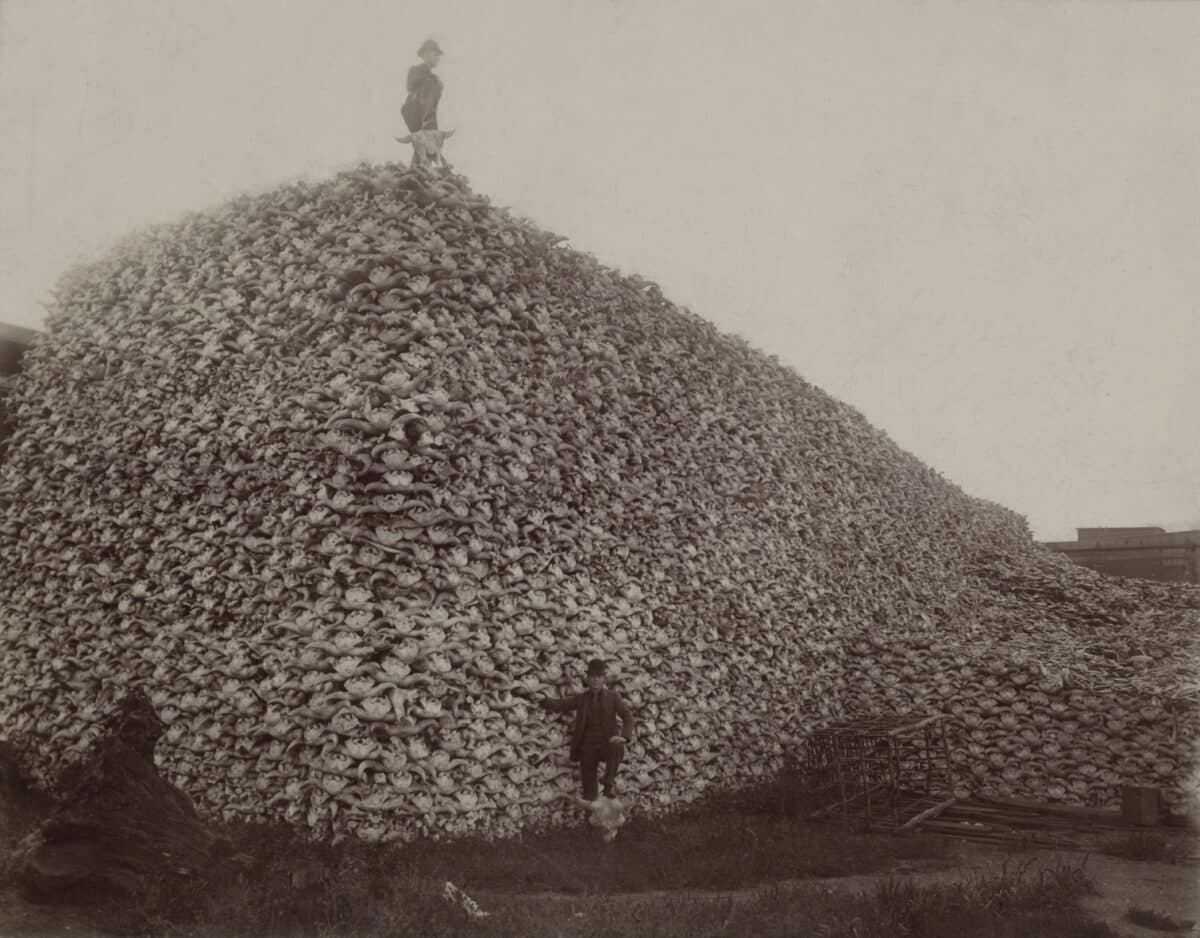
This mountain of buffalo skulls resulted from the coordinated federal campaign, using both military and civilian hunters, to starve the tribes into submission by eradicating the massive buffalo herds they relied on for food, clothing, shelter, cooking, hunting implements and more. A population of as many as 60 million wild bison was reduced to less than 800 at the time of this photograph, taken in Michigan in 1892. (Burton Historical Collection, Detroit Public Library)

The diminished tribal homelands were then subjected to continual and often violent federal efforts to further decrease Native landholdings—by forcing them to relocate to unfamiliar areas, as the Cherokees were, or by simply breaking the treaty’s promises. Every single treaty was broken in some fashion. The gardening, gathering, hunting, fishing and other activities with which tribal members had cared for each other since time immemorial were severely restricted or entirely demolished.

The United States also purposely destroyed critical food sources, such as the huge buffalo herds that once roamed the country. During the late 19th century, military and civilian hunters shot as many as 100,000 per day. The nation’s population of tens of millions of buffalo was soon reduced to a few hundred.

Error message

In 1916, Georgia made a well-meaning but regrettable effort to romanticize the Trail of Tears. It named as its state flower a rose that legends held had appeared wherever Cherokee tears fell along their arduous journey to Oklahoma. Dubbed the Cherokee Rose, the plant is in fact an Asian cultivar brought to the U.S. in the 1700s as a decorative landscape feature. It has become so invasive that the Georgia Invasive Species Council recently declared it a threat to the state’s native plants.

Since 2024, the Georgia Native Plant Society, of which Tony is a member, has led an effort to change the state flower to an actual native plant. The group supports honoring the sweetbay magnolia, a white-flowering tree that Cherokees use for medicinal and ceremonial purposes. In March, the Georgia Senate unanimously approved a bill that would make this change; the legislation now awaits approval by the Georgia House and, if this happens, the governor’s signature.

Sweetbay magnolia (Magnolia virginiana), photographed in Colquitt County, Georgia, is a traditional Cherokee plant that the state’s legislature is considering making the state flower. (Alan Cressler)

The sweetbay magnolia is an ecological anchor, providing a home for butterflies and food for birds, squirrels, deer, cattle and other creatures. Georgia Native Plant Society board chair Michael Cowan told the Georgia Recorder that the society’s support for the change raises awareness of the ecological and economic benefits of native plants.

Fans far and wide

Viewers from 37 countries have visited Tony’s blog, mycherokeegarden.com. When he started it, he had no idea of the internet’s reach, he confesses. One of his first posts, in 2013, was about sunchokes, also called Jerusalem artichokes, and how the Cherokees used the tubers as food. An hour later, a chef in Hanoi requested additional information about Cherokee food plants. A veterinarian in Montreal wanted to know about dosing sick animals with plant medicine. It was all “mind-boggling,” he says.

The Cherokee Garden at Green Meadows Preserve has enthusiastic local support. Tony has worked regularly with area developers, who give him permission to visit building sites before digging starts and rescue Cherokee plants he and his garden volunteers find there. Organizations including Bank of America and Kennesaw State University offer teams of employees and students, respectively, to weed, mulch, transplant and more.

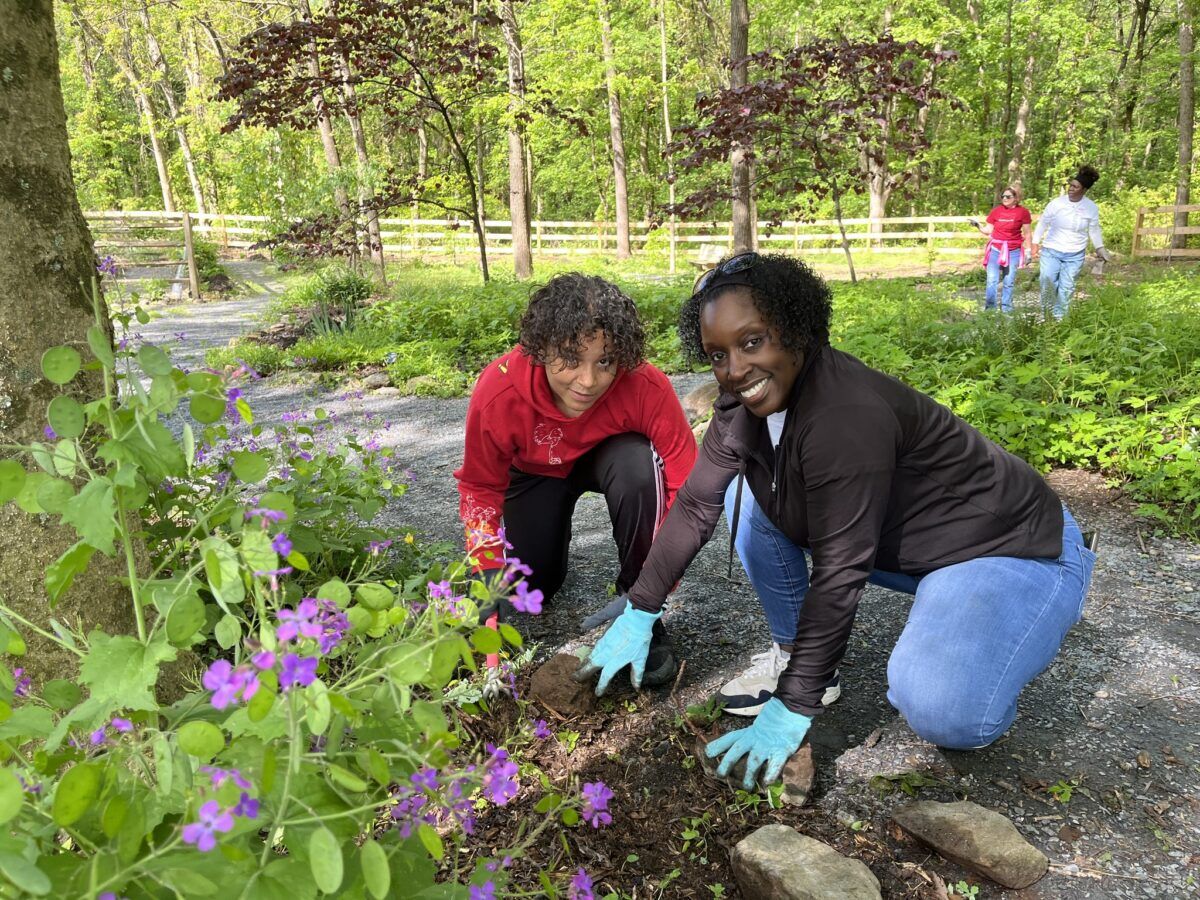
On Earth Day, April 22, in 2023, the Cherokee Garden hosted 20 volunteers from Atlanta-area Bank of America employees. They volunteered as garden helpers, removing invasive Chinese wisteria, English privet and more. (Carra Harris)

Some of the thousands of annual visitors return as garden helpers. A friend invited neighborhood resident Sue Marini to work in the garden, which she has made a weekly event. When Marini learned about the Trail of Tears, she was horrified at what had been done to the Cherokees. “To preserve their history became very important to me,” she says.

Cherokee schoolchildren will continue to make the trip from Oklahoma to Georgia to visit the garden. Bangle looks forward to teaching them in their ancestral homeland about their forebears’ accomplishments. Wyman Kirk, administrator of the Cherokee Immersion School, adds, “For a lot of the kids, it was their first chance to connect with that type of knowledge—with the sites out in the east and the knowledge that we have.”

When the Cherokee children asked Tony if they could please come back, he responded, “You sure can.”

This article was originally published by Barn Raiser; please consider supporting the original publication, and read the original version at the link above.