Monday, May 18, 2026

#FreeRuth

She Spoke Up for Due Process in El Salvador, Now She’s Behind Bars Without Charges

 May 15, 2026

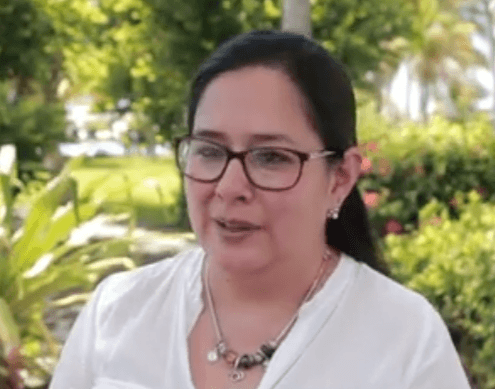
Image of Ruth Eleonora López in the video Encuentro de organizaciones de San Salvador. Photograph Source: Todas TV – CC BY 3.0

Who of us has the right to live without fear? This is the question human rights lawyer Ruth Lopez has asked fearlessly in El Salvador — the country of my birth — for decades.

It’s a question we all need to ask ourselves in the United States as well.

For speaking boldly, Ruth is now in prison. She’s been held without trial since May 18, 2025 — now a year ago — when she was torn from her bed by police and arrested without any investigation or judicial warrant. Ruth has since had minimal contact with her family and lawyers.

Ruth’s crime? She opposed corruption.

When Salvadoran President Nayib Bukele signed a secret agreement with the Trump administration to accept $4.7 million for the illegal transfer of more than 200 U.S. deportees to El Salvador’s CECOT mega-prison, Ruth spoke up to defend their basic rights. She filed habeas corpus petitions for 76 families who wanted to know where their loved ones had been taken. Soon afterwards, she herself was arrested.

Ruth’s advocacy for democracy spans two decades. She worked for El Salvador’s Supreme Electoral Court to ensure transparency in elections, then for the Social Security Institute, where she fought to expand benefits for Salvadorans living abroad. She has also defended the right of Salvadorans abroad to vote.

As a member of El Salvador’s Superintendency of Competition, she issued more than $8 million in fines to businesses for illegal mergers and anti-competitive practices. After El Salvador adopted Bitcoin as an official currency in 2021, she represented victims of fraud.

Since joining the staff of Cristosal, a regional human rights organization, she has documented the Bukele regime’s use of state resources to spy on critics, make backroom deals with violent gangs, and the misuse of pandemic relief funds. She has continued to investigate corporate corruption, filing criminal complaints with the Attorney General and motions with the Constitutional Court.

For her efforts, Ruth was named one of 100 most influential women in the world by the BBC, and has received numerous awards — including the American Bar Association’s International Human Rights Award, the Magnitsky Human Rights Award, and the OCCRP Anti-Crime & Corruption Hero Award.

More than 500 organizations — including the American Bar Association, the New York City Bar Association, the Organization of American States, Human Rights Watch, Washington Office on Latin America, Human Rights First, the Robert F, and Ethel Kennedy Human Rights Center, the Due Process of Law Foundation, Alianza Americas, and the organization I lead, People’s Action — are calling for Ruth’s immediate release.

Amnesty International has named Ruth a prisoner of conscience, and The Inter-American Commission on Human Rightshas determined she now faces “cruel and inhuman treatment” and the risk of irreparable harm to her life and integrity.

For me, Ruth represents what every Salvadoran — and every American — should want our society to be: a place where we live without fear for ourselves and our loved ones, where our rights are respected, our votes are counted, and the vulnerable have the same protections as the rich and powerful.

Here in the United States, what happened to Ruth is a warning. The Trump administration now looks to El Salvador not only as a destination for those it illegally detains and deports, but also as a model for how any of us can be detained and held indefinitely without charges.

Already, the Trump administration has indefinitely detained thousands upon thousands of immigrants as well as U.S. citizens, often without a warrant. They’ve detained and tried to deport people for writing op-eds, joining demonstrations, reporting on ICE, or otherwise exercising First Amendment rights. And they’ve been relentlessly harassing critics of all kinds with lawsuits, investigations, and trumped-up charges.

That’s why we can’t allow what happened to Ruth to stand.

To help, you can sign the petition to Congress (online at ​​https://ppls.ac/freeruth) demanding Ruth’s immediate release and calling on the U.S. to condition any future support for El Salvador on respecting human rights. You can also post a statement of support on social media with the hashtag #FreeRuth.

It is essential that El Salvador #FreeRuth now

Trump’s State Visit to Beijing and the New Cold War on Asia


 May 15, 2026

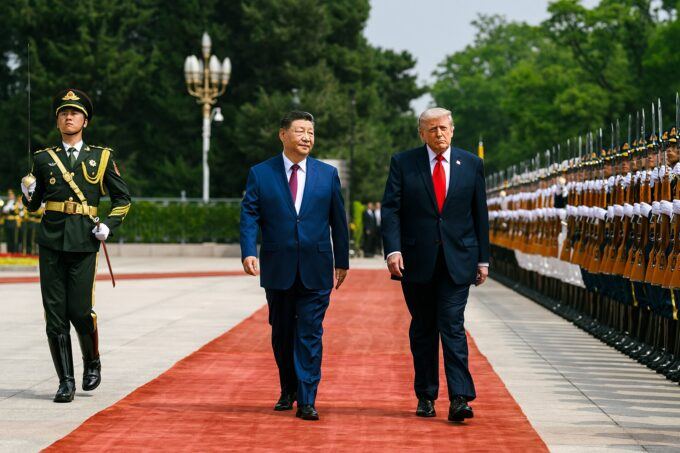
Photograph Source: The White House – Public Domain

From Beijing this week, the first US state visit to China in nine years is being staged for the world to see. The Great Hall of the People is open to Donald Trump, who has traveled with eighteen US executives—Apple, Tesla, BlackRock, Boeing, and Nvidia among them. A state banquet on Thursday, followed by tea and lunch on Friday.

On the streets of Beijing, ‘the Beast‘ has been securing the motorcade route since last week, flown in by C-17 ahead of Trump’s arrival to meet with Chinese president Xi Jinping. The international mainstream press is calling this a thaw between Washington and Beijing. Trump’s actions seem to speak otherwise.

Encountering a Different China

The last US state visit to Chinese soil was Trump’s own, in November 2017—at the start of the US-imposed trade war that would deepen under Biden and intensify in his second presidency. The China that received him then was still learning to respond to the aggressions. The China that receives him now has spent nine years diversifying its export markets, building supply chain autonomy, developing the technological leverage to push back, while turning towards Global South countries. Trump’s failed tariff war against China ended up hurting its own economy and people more than China’s, and Beijing’s export controls on rare earth elements ultimately forced Trump to back down. The eighteen US executives in the delegation, including Tim Cook, Elon Musk and Nvidia’s Jensen Huang, have come because their companies cannot do without the Chinese market. The economic instruments of US containment have not produced the result Washington wanted.

The War on Iran

Since 28 February, the illegal US-Israeli war on Iran—which postponed this summit by six weeks—has killed Iran’s Supreme Leader Ali Khamenei and thousands of Iranian civilians. Meanwhile, more than 2,700 civilians have been killed in Lebanon, where US-Israeli strikes continue.

In retaliation against the US-Israeli aggression, Iranian missiles and drones have struck fifteen US military sites across Qatar, Bahrain, Kuwait, Jordan, Saudi Arabia and the UAE—Al Udeid Air Base alone hit by 44 missiles and 8 drones, with 217 structures damaged or destroyed and an estimated $5 billion in repair costs. In its eleventh week, despite the US naval blockade and bombings, Iran has mounted sustained resistance and the war has not gone as Washington predicted. It has made unmistakable what anti-war movements across our region have long argued: the bases sold to host nations are not shields but targets.

In the days immediately before his arrival, Trump rejected Tehran’s peace proposal as ‘garbage‘. On 11 May—the eve of his departure—the US Treasury sanctioned twelve more individuals and companies over Iran-China oil trade, and the same day, a group of US senators urged Trump to approve a new $14 billion arms package for Taiwan.

Beijing has not been silent. On 2 May, in answer to an earlier round of US sanctions on five Chinese refineries, China invoked its anti-sanctions Blocking Rules for the first time since their introduction in 2021: the US measures “shall not be recognized, enforced, or complied with” within Chinese territory. The Chinese Foreign Ministry called them illegal and unilateral, without basis in international law. Though the defiance was not unconditional—Chinese banks have been quietly advised to limit exposure to the sanctioned refiners—the public position is clear. In the same week, Chinese Foreign Minister Wang Yi received Iran’s foreign minister Abbas Araghchi in Beijing. China remains Iran’s largest trading partner and the principal buyer of its oil.

An Architecture of Containment

Iran is not the only war backdrop. Across the region, the architecture of US military presence is being expanded and accelerated. The same week of Trump’s visit, the largest joint military exercises in Philippine historyconcluded—Balikatan 2026, with seventeen thousand foreign troops from seven nations, Japanese anti-ship missiles positioned on Filipino soil, and a new US fuel depot in the south of the country. In central Luzon, the Philippines has granted 4,000 acres in New Clark City to the Pax Silica Initiative—a US-controlled high-tech zone operating under US common law and granted diplomatic immunity, on a lease renewable for 99 years.

On 28 April, the commander of US Forces in Korea, General Xavier Brunson, told the Japan Times that Washington is building a ‘kill web‘—a networked system fusing Korea, Japan and the Philippines into a single architecture against China, Russia and North Korea. In August 2025, Trump told reportersof the US base at Pyeongtaek that he would like to “get ownership of the land where we have a massive military base” in South Korea, a country where the US has 66 military bases. In Japan, military spending is being doubled—the largest rearmament since 1945—with 400 US Tomahawk missiles purchased, a project that has continued and accelerated under right-wing Prime Minister Sanae Takaichi. For Taiwan, Trump authorized $11 billion in arms in December, the largest package in history, and has told the press he intends to discuss arms sales—with Xi himself.

From Hyperimperialism to Hands off Asia

What is on display in Beijing this week is not a thaw, and the executives traveling with Trump are not a sign of moderation. The economic and military aggression against China are two halves of the same project of containment. This is hyperimperialism: an empire turning increasingly to force as its economic dominance erodes, with China and other Global South countries defending their sovereignty as the primary targets. Trump’s transactional style is not a departure from US imperialism but the form it takes when its economic instruments no longer deliver.

The Hands Off Asia campaign, launched on 30 April—the anniversary of the liberation of Vietnam—by the International People’s Assembly and partner organizations across our region, calls for the removal of foreign military bases from Asia, the cancellation of aggressive pacts like AUKUS and the Quad, and the redirection of military spending towards the needs of our peoples. The architecture being expanded across our region was not built to protect the people but to encircle China and discipline the rest of Asia. As Trump arrives in Beijing this week, no deal signed at the Great Hall will hide what his administration is building across our region—and the peoples of those places, from Okinawa to Subic, from Pyeongtaek to Tehran, see this war-mongering for what it is and oppose it, calling for: Hands off Asia.

This article was produced by Globetrotter.