Tuesday, June 30, 2026


Switzerland returns 18 looted Benin Bronzes to Nigeria
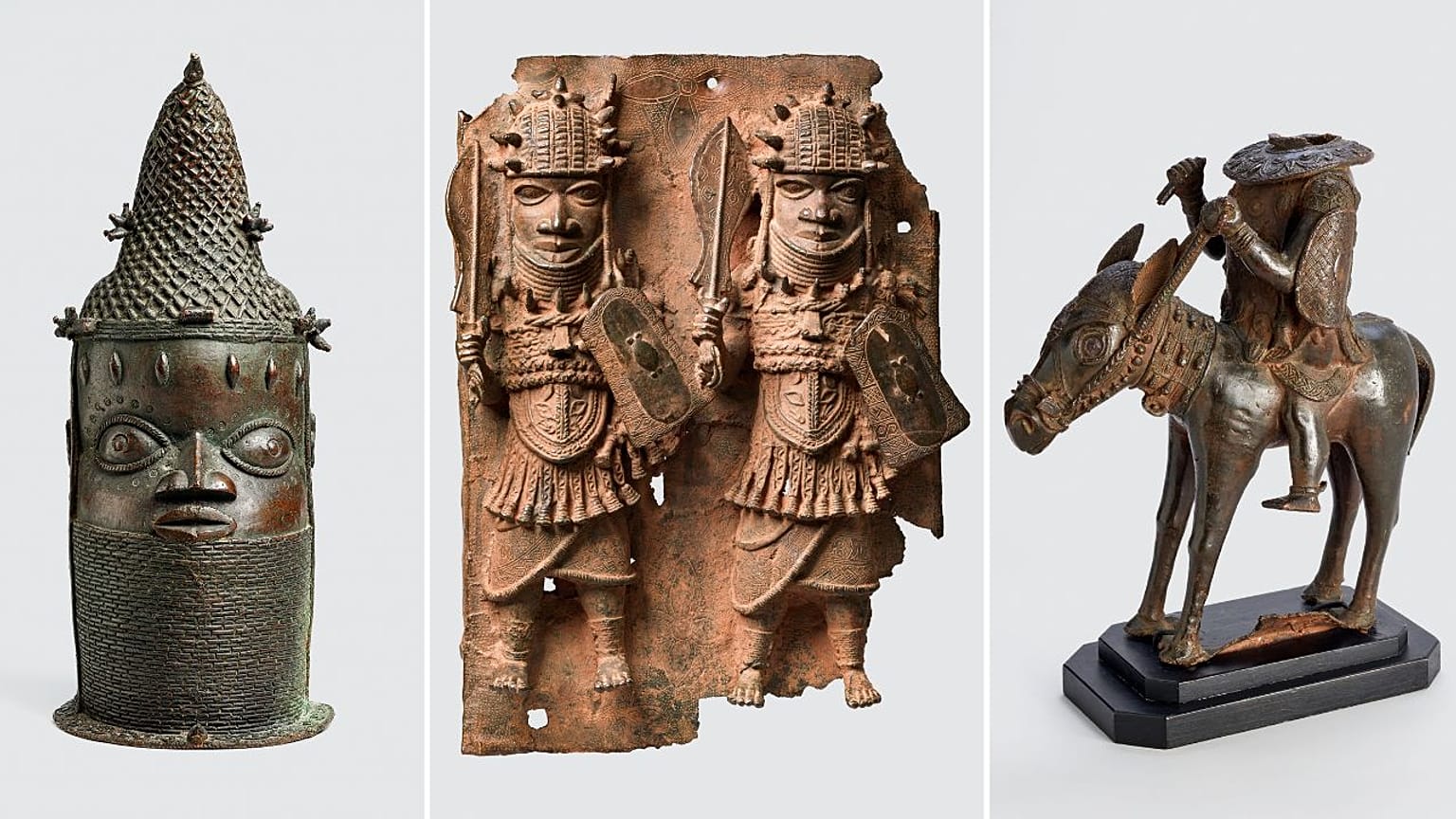
Commemorate queen head, relief plate and horse rider returned from the Ethnographic Museum at the University of Zurich to Nigeria
Copyright Kathrin Leuenberger/Ethnographic Museum at the University of Zurich

By Sarah Miansoni
Published on

Three Swiss museums have returned 18 Benin Bronzes to Nigeria, a new step in the African's country decades-long struggle to repatriate its looted cultural heritage.

Nigeria’s stolen cultural heritage is slowly coming back home.

On Monday, Swiss authorities returned 18 artefacts looted during the colonial era to Nigeria in a ceremony at the National Museum in Lagos.

The restitution is the result of a collaborative process between Swiss museums and their Nigerian partners under the Benin Initiative Switzerland. The programme was launched in 2021 to investigate the provenance of Benin objects in Swiss collections.

Monday’s ceremony marked the first step in the implementation of an agreement signed in March 2026, in which Switzerland agreed to eventually transfer ownership of 28 pieces to Nigeria.

“The return of our cultural heritage marks more than the recovery of artefacts. It reflects the power of dialogue, trust, and international cooperation,” Nigeria’s culture minister Hannatu Musa Musawa said on X.

Fourteen of the pieces came from the Ethnographic Museum at the University of Zurich, two from the Museum Rietberg Zurich, and two from the Musée d’Ethnographie de Genève.

The 18 artefacts are part of the country’s famous Benin Bronzes, a group of hundreds of sculptures and plaques mostly made of metal and ivory that decorated the royal palace of the Kingdom of Benin, now the Southern Nigerian Edo state. They performed political and religious functions and were essential to the kingdom's power.

British colonial forces stole most of these objects during a brutal punitive expedition that killed thousands of people in 1897.

After the violent raid, the Kingdom of Benin was absorbed into colonial Nigeria. The stolen pieces were eventually sold to over 130 museums in 20 countries, mostly in the United Kingdom and Germany.

The handover ceremony in Lagos also included the restitution of a bronze bracelet and four archaeological monoliths from Nigeria’s Niger Delta region which were “seized in Switzerland as part of criminal proceedings and subsequently transferred to the state,” the Swiss Federal Department of Home Affairs said in a statement.

Switzerland and Nigeria also signed a cooperation agreement aiming to further the protection of cultural heritage, as part of “a broader effort to address historical injustice.”

A decades-long restitution battle

Art historians have shown that African states’ and communities’ calls for the return of artefacts looted during the colonial period are as old as the thefts themselves. But effective returns have only started to materialise in recent years, with Nigeria among the countries at the forefront of this struggle.

Last year, the Netherlands returned 119 Benin Bronzes to Nigeria, the largest physical restitution of such artefacts to the country to date.

In February 2026, the University of Cambridge transferred legal ownership of 116 Benin Bronzes to Nigeria’s National Commission for Museums and Monuments (NCMM), with the physical transfer still to be arranged.

Other African countries have had wins in that field. Benin received 26 royal treasures from France in 2021, a process depicted in Mati Diop’s award-winning documentary Dahomey. French colonial troops had stolen the pieces during the 1892 colonisation of the Dahomey kingdom.

Earlier this year, French authorities also returned the Djidji Ayôkwé, a sacred talking drum, to Ivory Coast, 110 years after it was seized by colonial authorities.

But the restitution battle remains plagued by reservations and conflicts. Nigeria sent a formal repatriation request to the British Museum in October 2021. The institution retains over 900 objects from the Kingdom of Benin, including 203 Benin Bronzes, but has so far refused to return them under the argument that its collections are legally unalienable.

Ownership disputes can go on even after the repatriation is completed. In November 2025, protesters disrupted the opening of the Museum of West African Art in Nigeria’s Benin City over claims that its handling of repatriated artefacts violated the authority of the city’s traditional rulers. The museum’s launch was postponed sine die.

Some of the artefacts returned by Switzerland on Monday will be on display at the National Museum in Lagos, while most of them will return to their original home in Edo State, where they will be temporarily stored at the National Museum in Benin City.

“The NCMM plans to establish a world-class gallery to display all the recently returned Benin Artefacts, which will include not only the Swiss returns but also the artefacts returned last year from the Netherlands and the expected Cambridge returns,” said the Swiss Federal Department of Home Affairs.


 

AI helps scientists decipher papyrus scroll burnt in Vesuvius eruption

Scientists were able to decipher the fragile scroll without unrolling it.
Copyright Vesuvius Challenge

By Sarah Miansoni
Published on

The scroll was first discovered in the 1750s but was too fragile to open. Using AI, scholars deciphered the full text and discovered a philosophical treaties on ethics and human progress.

An ancient scroll that survived the eruption of Mount Vesuvius in 79 AD has finally revealed its secrets.

Scientists were able to decipher the fragile scroll without unrolling it. Instead, they used artificial intelligence to uncover what ended up being, rather ironically, a philosophical treatise on ethics, human nature and moral progress.

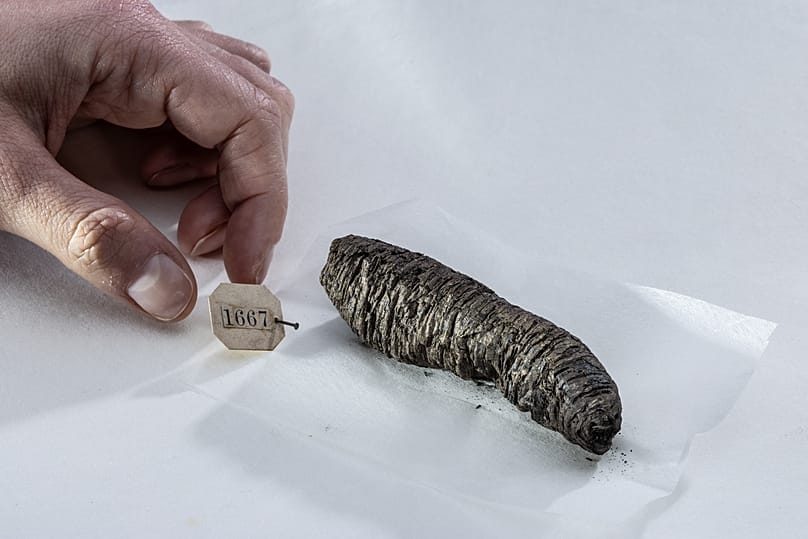
PHerc. 1667, as the scroll was dubbed, belonged to a library of carbonised manuscripts first unearthed in the 1750s in the ancient Roman town of Herculaneum.

In total, some 1800s papyrus pieces were miraculously preserved under the ruins of one of the city’s most lavish villas, which was destroyed in the eruption. The fragments form the only complete surviving library from the Greco-Roman world.

But once this treasure came to light, a new challenge arose.

The scrolls had survived a devastating eruption and had spent hundreds of years buried under volcanic ash; they were now too fragile to open. To unroll them meant risking them dissolving into dust. So they remained meticulously sealed.

PHerc. 1667 belonged to a library of carbonised manuscripts.
PHerc. 1667 belonged to a library of carbonised manuscripts. Paolo Verzone/National Geographic

In 2023, the Vesuvius Challenge provided researchers and papyrus enthusiasts with a new incentive to decipher the scrolls by turning the puzzle into a global contest with cash prizes.

Contestants used computer vision and machine learning — a subset of AI — to conclusive results.

That very year, a 21-year-old computer science student received $40,000 after becoming “the first person in two millennia” to discover a word — “purple” — from an unopened scroll.

A team of scientists from various European and US universities eventually managed to decipher all surviving text from an entire scroll this month.

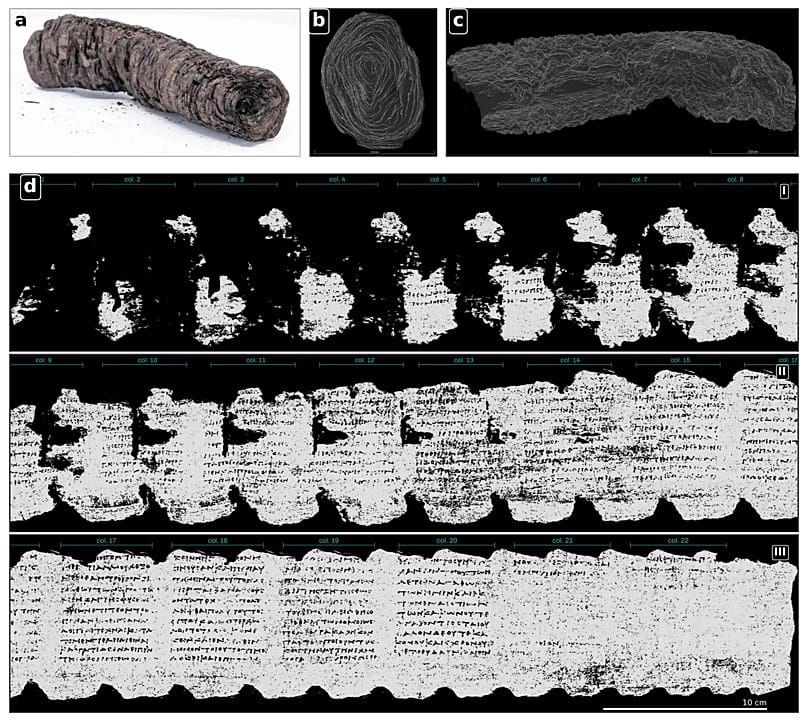
“PHerc. 1667 began as a blackened, rolled mass of carbonized papyrus,” the Vesuvius Challenged said last week. “To read it, we never unrolled it physically. Instead, we scanned it with high-resolution X-rays, reconstructed the wound sheet inside the volume, flattened it into a readable surface, and used machine learning to bring out the faint traces of ancient ink.”

Scientists used high-resolution X-rays and machine learning to reconstruct the inside of the scroll and read it.
Scientists used high-resolution X-rays and machine learning to reconstruct the inside of the scroll and read it. Vesuvius Challenge

Earlier attempts to open PHerc. 1667 damaged the papyrus and left only 8cm of an original height of 19–24cm. Researchers recovered the full text from that surviving portion to find “a philosophical treatise on ethics concerned with ethics, arts and human behavior.”

The scroll also names Aristocreon, a nephew and disciple of Stoic philosopher Chrysippus. Scholars said the text’s references, language and subject date it to the 2nd century BC and likely reflect Stoic doctrine.

“For nearly two millennia, many of these texts have been physically preserved but intellectually inaccessible,” said Vesuvius Challenge co-founder Brent Seales.

“Today - after years of interdisciplinary work combining advanced imaging, artificial intelligence (AI), academic research and an innovation contest - we are finally able to read them.”

This latest effort also led to the identification of a new book by Epicurean philosopher Philodemus from another scroll.

With just one manuscript deciphered, the Vesuvius Challenge is far from over. Hundreds more remain sealed, their secrets waiting to be discovered.

“Today, we are hearing voices that have been silent for 2,000 years,” Seales said. “For the first time, we are uncovering and reading them - but most importantly - we are beginning to understand them.


Breastfeeding linked to lower ADHD symptoms in young children, study finds

Exclusively breastfed babies show lower ADHD symptoms
Copyright Cleared/Canva

By Marta Iraola Iribarren
Published on

Scientists in Norway have found that exclusively breastfed babies are less likely to develop ADHD symptoms, with girls showing the strongest benefits.

Children who are exclusively breastfed during their first six months of life show lower risks of ADHD symptoms, a new study has found.

Researchers at the University of Bergen in Norway found an association between how long mothers breastfeed and the likelihood of their child developing ADHD symptoms.

“It is well established that psychiatric symptoms and disorders can be influenced by both genetic and environmental factors,” said Berit Skretting Solberg, a psychiatrist and researcher at the Department of Biomedicine, University of Bergen, and senior consultant at Betanien Hospital.

“We found that the longer a child was exclusively breastfed (up to six months), the lower the level of ADHD symptoms at ages three, five, and eight years,” added Solberg.

The researchers analysed data from more than 37,000 children born in Norway between 1999 and 2009, tracking breastfeeding patterns and following up at ages three, five and eight.

They found that any breastfeeding was associated with reduced ADHD symptoms, but the effect increased with both the duration and intensity, peaking with exclusive breastfeeding up to six months.

The study also found significant differences between the sexes, with girls showing the strongest associations at all ages.

Solberg noted that while heredity is probably the strongest risk factor for ADHD, neurodevelopmental disorders are shaped by multiple factors.

Attention deficit hyperactivity disorder (ADHD) is a behavioural and neurodevelopmental condition characterised by inattention, hyperactivity and impulsivity. It is usually diagnosed during childhood.

There is no cure for ADHD, but treatments include behavioural therapy and medication.

The importance of breastfeeding

Breast milk is the primary food source for several months for most children. The World Health Organization and UNICEF recommend breastfeeding within the first hour of birth and for children to be exclusively breastfed for the first six months of life, meaning no other foods or liquids — including water — are provided.

The researchers suggest several biological mechanisms may explain the link. Breastmilk contains macronutrients, vitamins, pre- and probiotics, immune components and other biologically active components that can shape brain development in early life.

Despite these benefits, many women do not breastfeed for the recommended duration, or at all. The study found that participants breastfed fully for fewer than four months on average.

There are many reasons why women do not breastfeed. Some cannot do it due to existing health conditions; others stop earlier than planned because of work schedules and inadequate support.

In such cases, infant formula, usually based on cows' milk, is the only recommended alternative to breast milk in the first 12 months of life.

As with any observational study, the authors caution that further research is needed to understand the mechanisms behind the association.


Dua Lipa opens library for banned and censored books in Portugal

Dua Lipa opens library for banned and censored books in Portugal
Copyright Screenshots Service95 - service95.com/book-club


By David Mouriquand
Published on


The Manifesto Library is located inside Livraria Lello in Porto, and is dedicated to books “that challenge power, censorship, exclusion, and dominant narratives.”

What a year Dua Lipa is having...

The ‘Levitating’ singer has released a new live album, 'Dua Lipa – Live From Mexico'; her 2017 self-titled debut has reached the impressive milestone of 450 weeks on the UK’s Official Albums chart; she’s still a fan favourite for the next James Bond theme song; she’s spoken out about the discourse surrounding the Epstein Files; and she just tied the knot with her now-husband Callum Turner, who also happens to be a 007 favourite.

Now, she’s opened her very own library.

Not just any library, mind you. The Manifesto Library is a library of banned and censored books. As part of the new international book festival BABELL – City of Books, it will permanently reside inside the famed Livraria Lello bookshop in Porto, Portugal.

In a press release, Lipa called the new library “a dream partnership” and a result of years of pushing her mission forward.

“When I founded the Service95 Book Club, my ambition was for it to become a home for writers and readers, wherever they are and whatever their circumstances,” she said, referring to her Service95 Book Club, which recommends a book each month and sees / hears Lipa interviewing its author for an accompanying podcast.

“Reading the world brings us closer - but sadly, not everyone is in favour of that,” Lipa said, adding: “Here you will find one hundred books that ask questions, or have been questioned. Some have been banned by school districts for themes of race or sexuality. Others, written for LGBTQIA+ readers, have been restricted from display. In some cases, the author has paid for their words with their life.”

She continued: “This library is a shrine to books that have disappeared, to authors whose courage unmasks structures of power and control, and to readers who refuse to be told what book they are allowed to read. You are invited to visit and decide for yourself what belongs on these shelves. Because sometimes the most subversive thing you can do is read a book and then talk about it.”

Nearly 100 books are included in Livraria Lello’s new cultural auditorium, with each relating to four key themes: power, control, voice, and memory.

Margaret Atwood’s "The Handmaid’s Tale" and Reginald Dwayne Betts’ "Felon", alongside selected works from Salman Rushdie and Olga Tokarczuk, will also be available in the Manifesto Library.

“For 120 years, Livraria Lello has been built on a simple conviction: the book is a technology of freedom. The Manifesto Library grows from that belief,” Head of Brand at Livraria Lello Francisca Pedro Pinto said in a statement. “Because what is at stake is not only the future of reading, but a society’s ability to imagine, interpret and build its own future.”

Dua Lipa has long been a passionate advocate for reading, and she is set to curate the Southbank Centre’s 2026 London Literature Festival, which takes place from 21 October to 1 November.


EU ends tax loophole exploited by SHEIN, Temu, and Aliexpress

Clothes by Chinese company Shein are seen in the BHV (Bazar de l'Hotel de Ville) department store,
Copyright Copyright 2025 The Associated Press. All rights reserved.

By Leticia Batista Cabanas
Published on

The European Union is imposing a new tax on small imports, which will heavily impact Chinese giants like SHEIN, Temu, and AliExpress. What does this mean for European consumers, product quality, and brands?

On July 1, a flat €3 customs duty on low-value e-commerce imports will come into effect. Until now, goods imported into the EU worth under €150 were exempt from customs duties.

This temporary measure means small parcels entering the bloc, largely through online shopping platforms, will face a fixed customs charge. It addresses what the European Council describes as "unfair competition" for European retailers, as well as concerns over unsafe products, fraud and the environmental impact of vast volumes of cheap imports.

The Council also clarifies that this customs duty is separate from the proposed "handling fee" (expected to be €2) currently being negotiated under the EU's broader customs reform and long-term budget plans, another blow to the Chinese e-commerce sector.

"The urgency was so big that there was deep political consensus", Dirk Gotink, a Dutch MEP for the EPP, told Euronews. But the measure was slow to arrive, "because countries were slow to accept that, to do something about the tsunami of non-compliant [fast fashion] products, you need to integrate European customs."

A juicy tax loophole

The EU receives over two billion e-commerce packages worth under €150 annually. This overwhelms customs infrastructure and allows up to 65 per cent of parcels to enter with misdeclared values or unverified safety profiles. The unprecedented volume hampers border inspections and demands regulatory action.

"I think only 0.006 per cent of parcels get checked by customs. The number of products coming into Europe means not all of them can be tested", estimated Laura Clays, spokesperson for consumer organisation Testachats. "Too many non-compliant products can enter the market."

For years, companies like SHEIN operated in a zero-tariff environment by routing individual orders directly from China. This was possible under the "de minimis" loophole, a customs policy allowing low-value shipments (under €150 in the EU) to enter free of customs duties.

Firms used the loophole to avoid up to 12 per cent in import duties, keeping shipping and production costs artificially low while avoiding European oversight. The system also channelled billions in untaxed retail revenue into Chinese logistics.

SHEIN, for instance, used this model to generate over €30 billion in global revenue while bypassing levies on European imports. By avoiding up to 12 per cent in customs duties, foreign platforms could also undercut European retailers, who face higher structural costs (30 to 50 per cent per garment).

Gotink describes it as "tax avoidance on an industrial scale, basically."

Safety and environmental issues

"Fast fashion has destroyed the second-hand market in Europe and caused huge unfair competition for European clothing brands. The taxpayer pays a high price for this trade: fast fashion can contain chemical substances that shouldn't be in Europe, like PFAS", shared Gotink.

Independent assessments by European consumer groups, including Testachats, found that "around 70 per cent of the products did not comply or did not fully comply with all EU safety requirements", said Clays.

A Greenpeace Germany investigation also found that 32 per cent of tested apparel contained illegal concentrations of hazardous substances, including heavy metals, formaldehyde and PFAS "forever chemicals" in jackets at levels up to 3,300 times the legal European threshold.

Safety checks on toys and children's clothing also uncovered serious non-compliance. Certain items had dangerous shapes and loose components that posed a high choking risk.

"International e-commerce offers lots of opportunities for consumers. But any product entering the EU market must comply with safety, consumer protection and environmental standards. That is our goal: to ensure products entering Europe meet the same standards as those made in the EU", said Clays.

The hyper-production of ultra-fast fashion goods also generates a major environmental toll. Flying billions of individually packaged items directly from Chinese factories to consumers greatly increases aviation emissions compared with bulk maritime shipping.

What the EU wants to do

"What the EU and especially member states need to do is invest massively in their ability to control the products that are coming into the European market", said Gotink.

The €3 customs duty applies according to the item's type.

The fee is determined by the specific Harmonised System commodity code of each product. For example, if a package contains a textile item, footwear and a tech product, it will face a €9 charge because three different codes are triggered. If a package contains multiple items of the same type, the €3 charge applies only once.

The measure applies to non-EU sellers registered under the Import One-Stop Shop VAT system, which accounts for 93 per cent of all e-commerce imports into the EU. Enforcement relies on digital sales logs transmitted directly to authorities.

Another change is that, under previous rules, consumers were legally considered the "importer" when ordering a non-EU package. If a dress from SHEIN or a toy from Temu contained illegal chemicals or posed a choking hazard, the consumer technically bore the legal liability. The platforms acted merely as "intermediaries" with no responsibility for the product itself.

As of March 26, the new EU Customs Code Reform removes this shield by legally reclassifying digital marketplaces as "deemed importers". As recognised importers, they are liable under EU product safety laws, including the General Product Safety Regulation. This makes them legally responsible for safety certifications and chemical testing, while exposing them to severe financial penalties or market bans for non-compliance.

The new duty will remain in force until a broader permanent system for low-value imports, agreed in November 2025 as part of wider customs reforms, takes effect. In 2028, the permanent EU Customs Data Hub will go live, removing the €150 threshold entirely and taxing every item dynamically from the first cent.

Rise of fast-fashion consumption

For consumers: more expensive, less dangerous

Under the new rules, European shoppers will face higher prices and longer waiting times.

A typical low-cost online order worth €20 could easily exceed €30 once the new fees are added. For example, if a customer buys a €10 summer dress and a €10 pair of sunglasses, the order triggers two separate €3 category duties, adding €6 to the bill. Add the planned €2 handling fee and the final checkout price reaches €28, a 40 per cent increase on a basket of cheap goods.

Customs agents must digitally screen every package, and border checkpoints are likely to face backlogs. Shoppers used to receiving air-freighted packages from Asian warehouses within a week may have to wait while customs agents verify product category codes.

This benefits consumers in the long run. "If it makes sure more non-compliant products are rejected, or that producers and sellers increase compliance with European laws before listing products online, then it's a good thing", said Clays.

The changes also provide stronger safety protections. Because platforms are now legally classified as importers, the risk of unknowingly buying dangerous goods, such as children's clothing containing toxic chemicals or cheap toys with choking hazards, should fall. The rules also remove surprise cash-on-delivery charges, as all duties must be paid upfront at checkout.

For companies: a fairer playing field

Once the levy takes effect, marketplace apps such as SHEIN, Temu and AliExpress must either absorb these multi-billion-euro compliance costs or risk losing price-sensitive shoppers through price rises.

To survive, they may be forced to restructure their business models by moving away from direct-to-consumer air mail and investing in large EU-based warehouses. Analysts estimate this shift to local distribution hubs could erase up to 40 per cent of profit margins, while penalties for non-compliance could reach 6 per cent of annual import values.

The policy will also affect China's trade strategy. Cross-border e-commerce exports reached 2.75 trillion yuan (about €350 billion) in 2025, and these online platforms are major drivers of the economy.

For European businesses, however, the new rules level the playing field by removing the artificial price advantage enjoyed by non-EU sellers.

Traditional high street and online retailers can regain competitiveness as the 2.3 billion untaxed parcels entering the bloc each year are brought into standard taxation regimes.

Domestic fast-fashion brands such as Zara and H&M can better exploit their European supply chains, restocking stores faster than overseas rivals facing border friction. Brands emphasising durability and compliance with EU sustainability standards are also likely to become more attractive to consumers.

"The fast fashion sector, as it works now, is simply unsustainable as an economic model. I hope we will be able to stop the non-compliant and overly cheap trade flows, where consumer goods are used once and then thrown away", added Gotink.


Over 1 million migrants apply for Spain's mass regularisation, PM Pedro Sánchez says


By Christina Thykjaer & Gavin Blackburn
Published on

Sánchez has long argued that immigrants are needed to sustain the economy, the welfare state and pensions amid Spain's ageing population and depopulation in rural regions.

More than 1 million undocumented migrants in Spain have sought legal status under a scheme that has defied a wider European crackdown on irregular immigration, the government said on Tuesday, the final day for submissions.

The vast scheme was predicted to benefit around 500,000 people, mostly from Latin America, when the left-wing government launched it in April.

"The more than one million applications submitted...show how necessary this recognition of rights and responsibilities was," Socialist Prime Minister Pedro Sánchez said at an event in Madrid.

Sánchez has become a standard bearer of more open immigration policies as his European neighbours, including some Socialist peers, toughen measures in response to pressure from ascendant far-right parties.

He has long argued that immigrants are needed to sustain the economy, the welfare state and pensions amid Spain's ageing population and depopulation in rural regions.

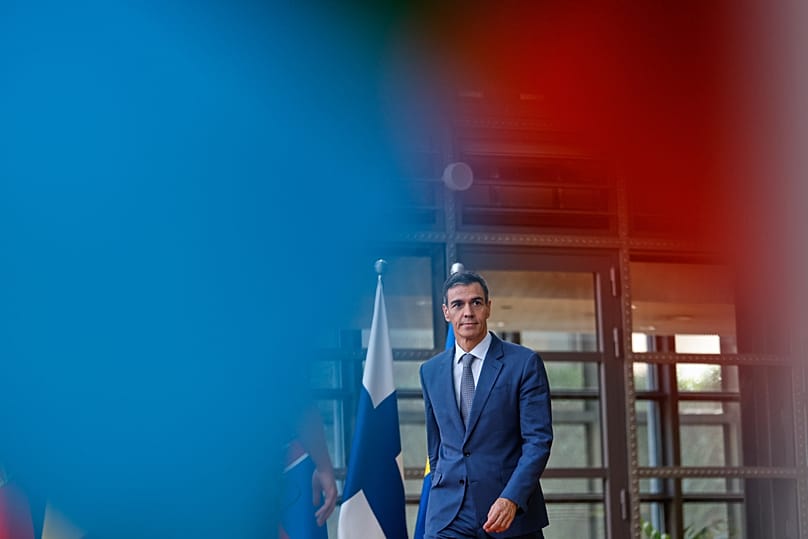
Spain's Prime Minister Pedro Sánchez arrives for the EU summit in Brussels, 18 June, 2026 AP Photo

The number of applications submitted does not necessarily indicate how many migrants will secure their legal status.

Applicants must prove they have a clean criminal record and spent at least five consecutive months in Spain before 1 January.

The authorities have three months to process their paperwork and decide whether to issue a work and residence permit only valid in Spain.

"When we condemn a person to invisibility, I think we make our country a worse country. We all lose," Sánchez explained, saying his government aimed to "offer an opportunity and future" to migrants.

"We want the world to view Spain as a country that respects, protects and upholds human rights."

Economic boost

For Juana Hernandez, a 59-year-old Cuban who has lived in Spain for two and a half years and whose application was recently approved, the plan "is a huge opportunity."

She told the AFP news agency she had paid a lawyer roughly €200 to handle the administrative formalities "to be on the safe side," as well as receiving help from a migrant aid association.

Although she was "a little worried" at the start, the English degree holder now aims to work at Madrid airport.

A land of emigrants for centuries, Spain is a key entry point into the European Union for tens of thousands of undocumented asylum seekers and migrants, alongside Italy and Greece.

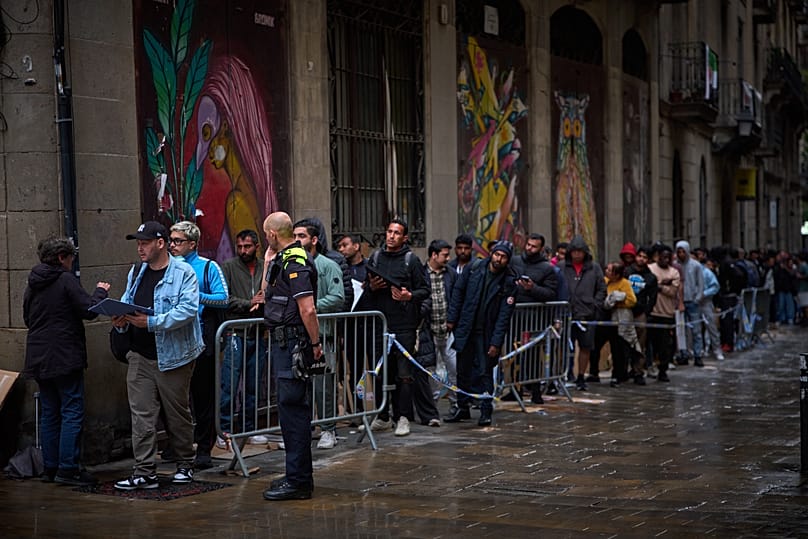
Migrants queue outside Barcelona City Hall to obtain paperwork needed to apply for Spain's immigration amnesty, 20 April, 2026 Copyright 2026 The Associated Press. All rights reserved.

Many come via a long and perilous Atlantic route from West Africa to the Canary Islands, although numbers dropped last year after peaking in 2024.

Since April, streams of men, women and children have queued in the streets to obtain documents and attend appointments for their regularisation, in addition to online applicants.

Although fears arose of a saturation of the services handling the scheme, Mohamed, a Moroccan who lives in the northern region of Cantabria, felt the administrative journey was "relatively easy."

The 23-year-old jobseeker, who declined to give his surname, has been in Spain irregularly for about four years and hopes "to be able to work legally, to pay contributions."

Gaining legal status will also spare him from unscrupulous employers who "take advantage" of irregular migrants "by paying low salaries, without any rights or...don't pay at all," he told AFP.

Migrants queue outside Barcelona City Hall to obtain paperwork needed to apply for Spain's immigration amnesty, 29 April, 2026 AP Photo

Sánchez, who has presided over one of the world's fastest-growing developed economies in the last few years, has touted the benefits of immigration for sectors such as construction that need to boost their workforce.

Spanish business leaders have welcomed the regularisation drive but the conservative and far-right opposition are furious about a policy they claim will encourage more irregular immigration.

While accepting "tensions" and "challenges" linked to immigration and integration, Sánchez on Tuesday accused the right of "fuelling fear (and) stirring up xenophobic discourse that does not solve any problem."


UK watchdog moves to break Apple and Google's grip on app payments

FILE - FILE - In this 6 December 2020 file photo, the logo of Apple is illuminated at a store in the city center of Munich, Germany.
Copyright AP Photo/Matthias Schrader, File

By Una Hajdari
Published on

Buy an app subscription today and there is a good chance Apple or Google is taking a cut. The CMA wants developers to be free to point customers elsewhere to pay and is asking the tech giants to justify any fees they charge for the privilege.

The UK's competition regulator has opened a consultation that could force Apple and Google to loosen their grip on how UK customers pay for apps.

The move is designed to bring down prices and spur innovation in the country's tech sector.

The Competition and Markets Authority (CMA) said on Tuesday it was consulting on new conduct requirements for the two companies under the UK's digital markets competition regime, targeting restrictions that currently stop app developers from directing customers towards cheaper payment options outside Apple and Google's own platforms.

The CMA designated Apple and Google's mobile platforms as holding an "effective duopoly" last October, citing the 90-100% of UK mobile devices running on their platforms.

What is 'steering'?

The practice, known as steering, is basically about letting developers tell customers there is a cheaper way to pay, one that skips the mandatory fees baked into Apple's App Store or Google's Play Store.

Right now, Apple bans it outright in the UK, while Google only allows it in a limited way.

Scrap those restrictions, the CMA said, and developers would finally be free to point users elsewhere to pay.

But Apple and Google could still charge for allowing that, so the regulator is also drawing up principles to make sure any new steering fees are fair.

Under its proposed framework, the CMA said it would expect those fees to come in lower than existing app store charges, with the savings either landing in customers' pockets or ploughed back into developers' businesses.

Google changes its terms

The consultation comes days after Google announced new global terms for its Play Store which include allowing developers to steer users towards completing transactions outside the store, subject to certain conditions.

Google has also altered the fees it charges developers, including those who use steering. The CMA said it would assess the impact of these changes during the next phase of its work on mobile platforms.

Under the Digital Markets, Competition and Consumers Act, the CMA must consult before imposing any new conduct requirement.

App store terms, including steering practices, remain under regulatory scrutiny in several other jurisdictions, including the EU, the US and Japan.