Friday, August 21, 2026


How Secretary Bessent Is Going Full-Hegseth Retard to No Avail


by | Aug 20, 2026 | 

Six months after Trumpy & Bibi launched Operation Epic Fury against Iran on February 28th, the so-called kinetic campaign has settled into a costly stalemate, at best. And a de facto military defeat as a practical matter.

In fact, what began as another furious “shock and awe” military offensive designed to quickly and fatally degrade Iran’s nuclear program, missile forces, leadership, and regional power projection capability has instead produced:

  • no regime change.
  • no collapse of Iranian governance.
  • the severe depletion of American high-end munitions.
  • badly damaged US forward bases across the entire Persian Gulf (Bahrain, UAE, Qatar, Saudi Arabia, Kuwait, Iraq, Jordan)
  • significant personnel casualties, including 18 dead and 400 injured US servicemen.
  • Massive Federal budget costs now approaching $100 billion and rising rapidly.

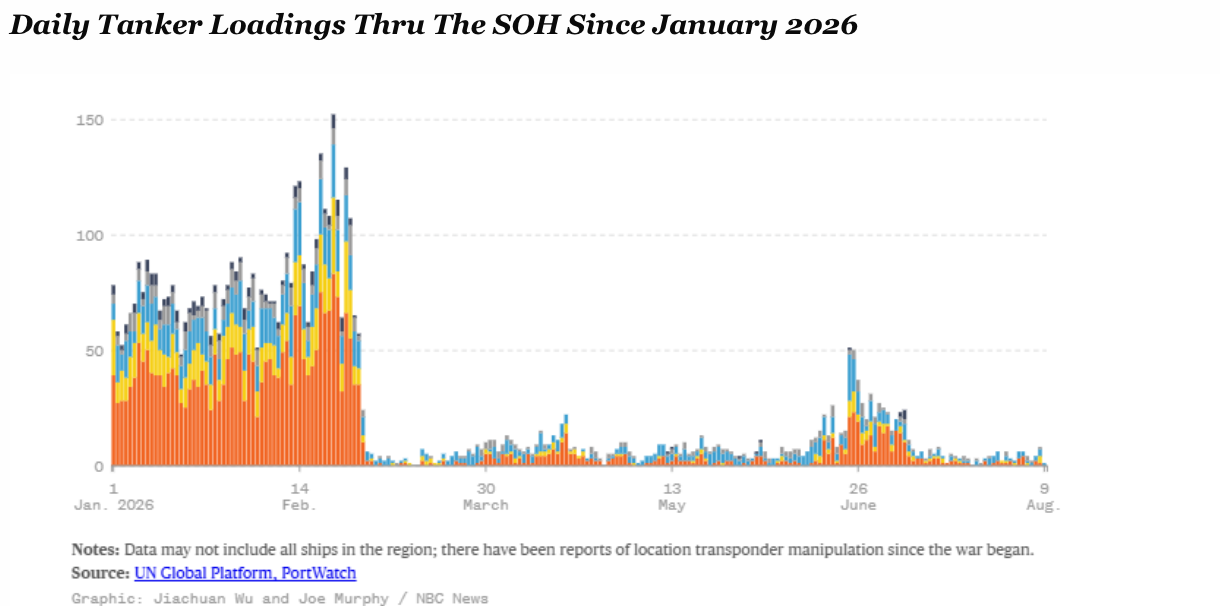
Even more importantly, this misbegotten war has handed Tehran a durable pretext for restricting maritime traffic through and around its territorial waters and the Strait of Hormuz (SOH). That is, with virtually inexhaustible supplies of homemade missiles, drones and other tools of sabotage, Iran has been handed what amounts to a global economic Kill Switch.

Yes, Washington’s naval blockade can reduce Iranian oil exports to a trickle, as shown in the table below. But the inverse is also true. Iran’s residual capacity to inflict damage on ships transiting the SOH, in combination with the resulting soaring insurance premiums, has also reduced non-Iranian export shipments through the SOH to barely 25% of steady state pre-war levels:
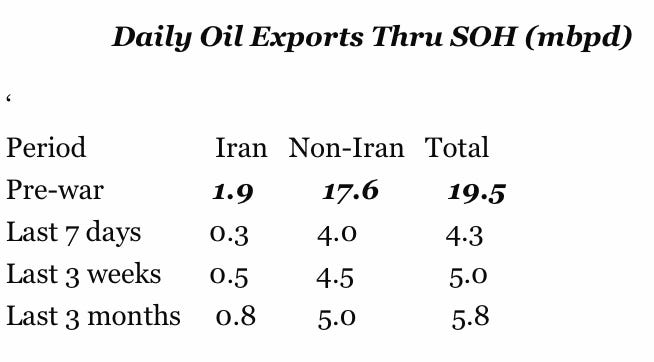
Needless to say, the cumulative economic disruptions from this drastic supply restriction, as measured in sharply higher energy prices, deep inventory draw-downs and increasing global growth drag, is making the current military stalemate untenable – especially as the November mid-terms draw ever closer.

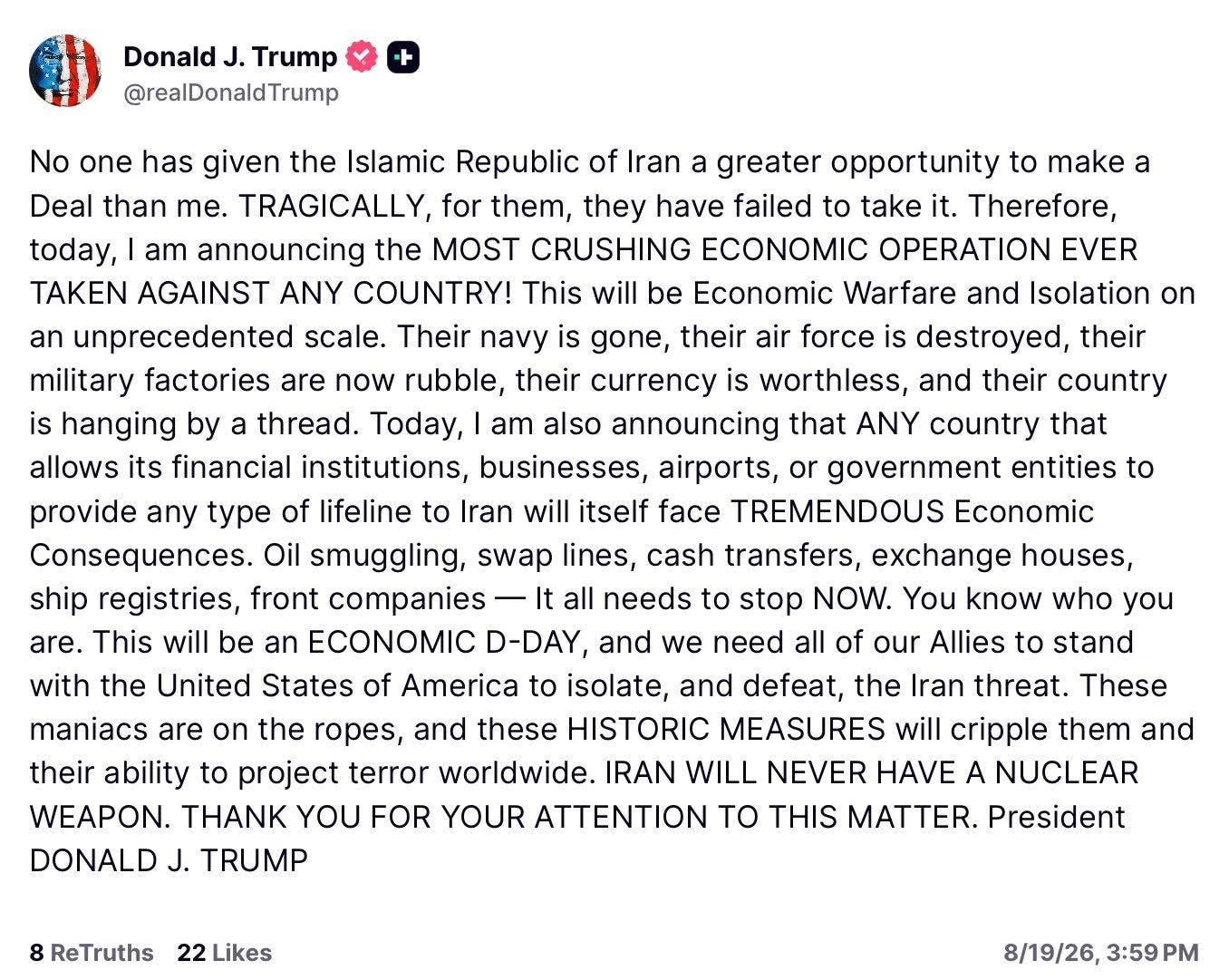
Accordingly, Trumpy has now pivoted to an all-out economic war. Over the weekend Treasury Secretary Scott Bessent bombastically promised measures of economic isolation “never seen” in history. He was referring to an enhanced version of his ballyhooed Operation Economic Fury that is to be paired with the ongoing naval blockade.

Yet this economic escalation is not even remotely likely to succeed on the timeline or at the cost Bessent & Co assume. That’s because Iran remains substantially self-sufficient in food and many essentials, retains residual oil revenues through black-market channels and pre-blockade floating cargoes, and can endure prolonged isolation far longer than the already-strained global refined-product markets – especially diesel and jet fuel – can tolerate continued severe supply curtailment.

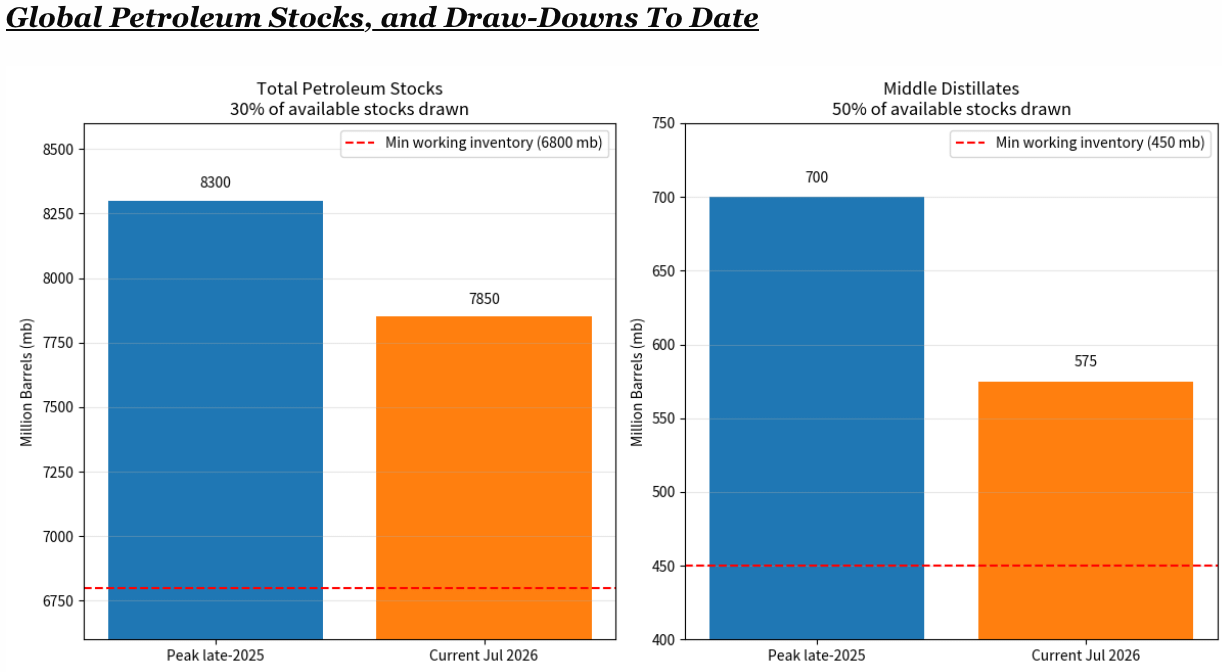
The fact is, global petroleum markets are badly strained, notwithstanding the more modest indications from what appears to be the Washington manipulated crude oil futures markets. As it happened, global physical stocks of petroleum were unusually high at the onset of the war – especially in China – so the initial impact of the 75% average reduction in shipments thru the SOH has been a one-time draw-down of these plentiful stocks.

As shown in the chart below, total global stocks (including government controlled “strategic reserves”) stood at 8.3 billion barrels in the peak months before February 2026. That compared to an estimated “working level minimum” for the global petroleum supply system of about 6.8 billion barrels. Accordingly, 30% of the pre-war excess stocks have already been drawn down – a safety valve that has kept a lid on global prices.

Moreover, on the crucial matter of middle distillates – diesel and jet fuel – which drive the global transportation of goods and people, the draw-down has been even more severe. The prewar stock level of 7oo million barrels contained 25o million barrels above the working minimum (est. 450 million barrels). Already, however, 125 million barrels or 50% has been consumed.

Needless to say, as stocks get ever closer to working minimums, the likelihood of consumer and distributor hoarding action increases sharply, thereby setting the stage for a blow-off top in global prices.
Indeed, a blow-off top in middle distillates and even gasoline is likely to happen long before the mullahs and their IRCG warlords are forced to cry UNCLE!

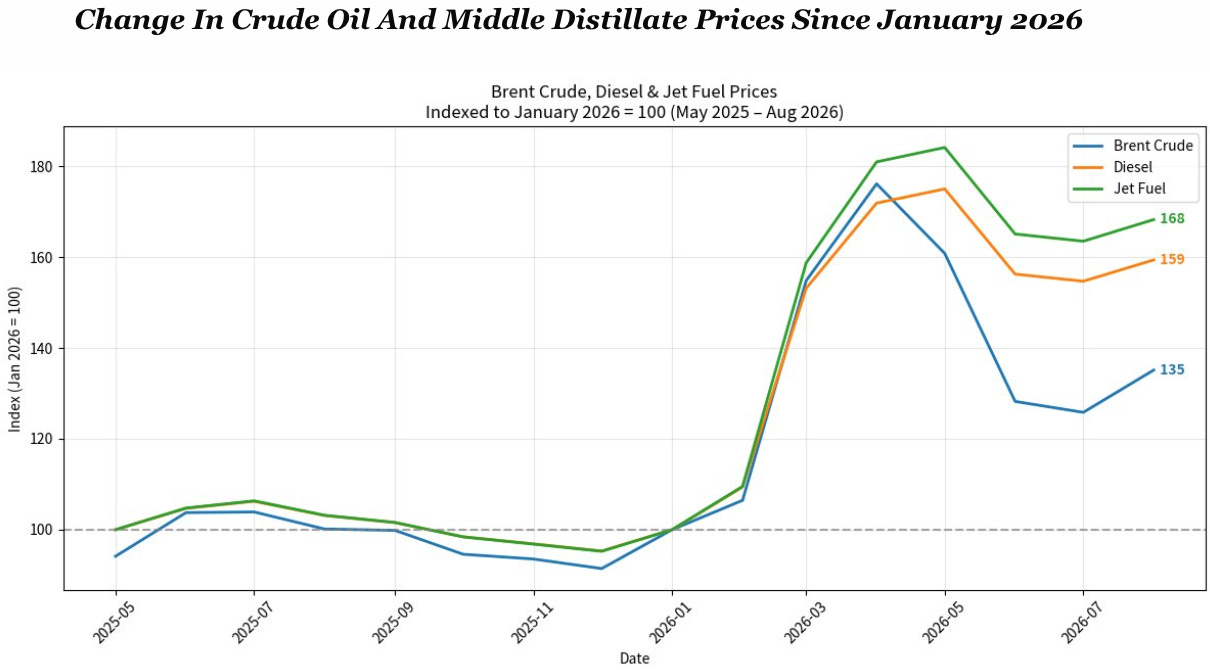
As shown in the graph below, while Brent crude (blue line) is currently up +35% from its pre-war level, diesel prices (orange line) are up by +59% and jet fuel prices (green line) are higher by+68%. This large differential is due to the sharp curtailment of middle distillates from Persian Gulf refineries and the manner in which overall crude shortfalls have impacted refinery slates around the world.
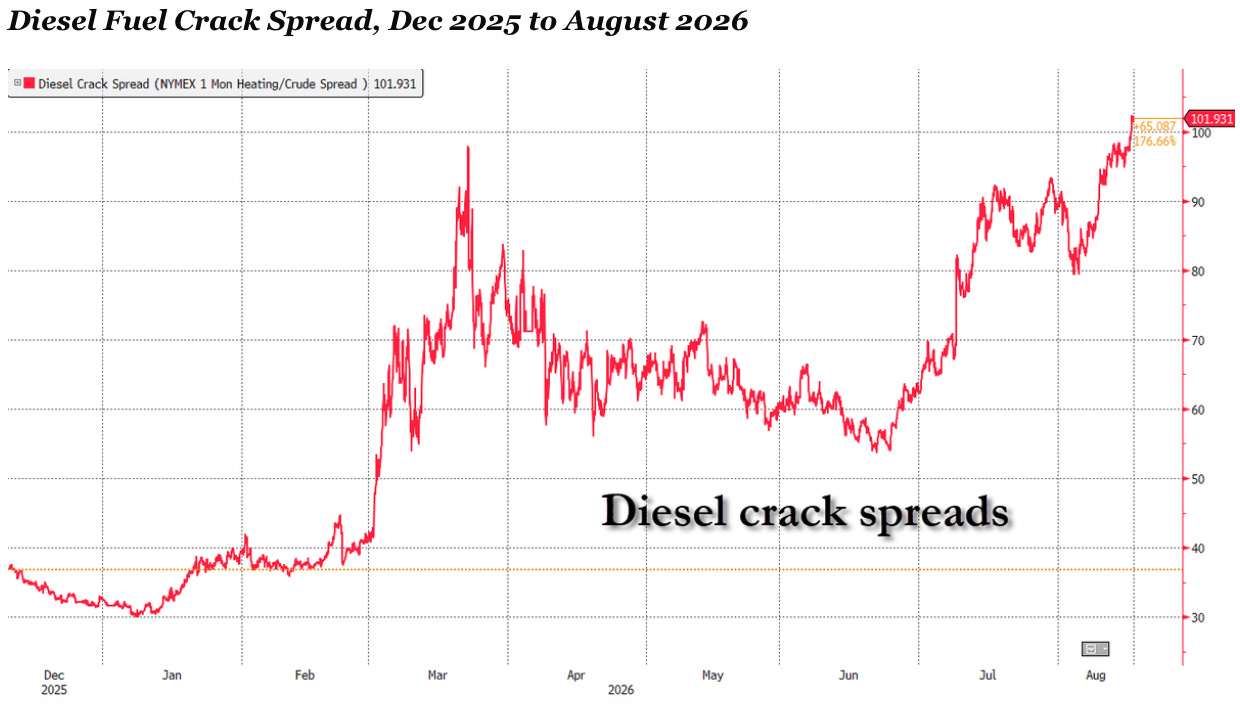
The evidence that the end product markets are far tighter than implied by the crude oil marker prices is clear as a bell in the graph below. The diesel crack spread – the per barrel price of input crude versus output diesel fuel – is now at previously imagined highs. As opposed to a normal spread of $40 per barrel, the diesel crack spread now exceeds $100 per barrel – a thundering testimony to the scarcity of a product that literally drives the goods-based economy.

So just give our wanna be warrior at the Treasury Department a few more months of 75% closure of the SOH export routes – and potentially a Houthi-caused jam-up in the Red Sea – and he will likely send refined product prices soaring – including for heating fuel uses just as the northern hemisphere heating season approaches.
Accordingly, Secy Bessent’s blustering proclamation of a new phase of Operation Economic Fury mirrors the same clueless overconfidence that marked the kinetic phase under Defense Secretary Pete Hegseth. That is to say, an exaggerated belief in the coercive power of American policy instruments and an under-appreciation of adaptation, second-order effects, and the relative resilience of the Iranian target versus the fragility of the global system that must absorb the costs.

The result, of course, is a lopsided race between a blockaded Iranian economy and the diesel- and jet-fuel-dependent economic arteries of the United States and the world. And on current evidence, the global petroleum market is the side closer to buckling.

The Kinetic Failure of Operation Epic Fury

At this point it is well to recall how badly the military phase of Operation Epic Fury has failed. It opened with much fanfare and overweening confidence that the intensive airstrikes that killed senior Iranian leaders, including Supreme Leader Ali Khamenei, degraded air defenses, struck naval and missile infrastructure and damaged nuclear-related sites would deliver a knock-out blow.

Indeed, early DOD claims spoke of thousands of targets hit and rapid progress toward decisive outcomes. But by mid-2026 the picture is drastically different. Fragile ceasefires and the June 17 Memorandum of Understanding produced temporary pauses and limited re-openings of SOH. However, hostilities quickly resumed, the U.S. blockade of Iranian ports has continued, and Iranian missile and drone attacks on U.S. and regional bases have persisted.

What has emerged, therefore, is ab echo of the stalemated trench warfare of WWI: That is, a “no end, no peace” equilibrium in which neither side can compel the other’s full capitulation without unacceptable further costs.

U.S. human costs include roughly 18 service members killed and more than 400 wounded – most owing to Iranian strikes on US Gulf bases. Financial estimates from the Center for Strategic and International Studies place direct war costs at upwards of $40 billion by late June, with munitions the largest component at approximately $26 billion.

However, when you factor in current defense supplementals and broader accounting estimates, the totals push far higher. Base and infrastructure damage across some 20 facilities in Kuwait, Bahrain, Qatar, the UAE, Saudi Arabia, Jordan and elsewhere have run into the tens of billions, rendering certain sites nearly uninhabitable and forcing personnel dispersal. Aircraft losses – dozens of platforms including Reapers, fighters, tankers and helicopters – add further hundreds of millions to billions.

Most constraining of all, however, is the munitions drawdown. Reliable reporting indicates Washington has expended virtually all of its global stockpiles of ATACMS and Precision Strike Missiles, roughly half of its Tomahawks, approximately 65 percent of Patriots, and upwards of 70% of THAAD interceptors. Replenishment will require years even under accelerated production.

At the same time, Iran’s residual capabilities remain significant. The nuclear program was heavily damaged but not eliminated; highly enriched uranium stocks and reconstitution potential persist. Missile and drone inventories were reduced but not exhausted, allowing continued strikes. And its deeply protected underground manufacturing sites continue to produce more missiles and drones.

Most importantly, the regime survived leadership losses and continues to function effectively owing to the highly decentralized governance structure put in place before the war but in anticipation of exactly the kind of strikes that the DOD carried out,

Critically, and as indicated above, the US/Israel initiated conflict gave Iran political cover to restrict or close traffic through the Strait of Hormuz – normally carrying roughly one-fifth of global oil and significant LNG – while the reciprocal U.S. blockade compounded the disruption, as quantified above.

In strategic terms the initiator of an offensive war that settles into attritional stalemate after six months without achieving its principal political or military objectives has failed. Epic Fury imposed real pain on Iran but at a steep cost and with residual Iranian agency that prevent any claim of victory.

Iran’s Resilience Under Blockade

The assumption underlying Bessent’s forthcoming Economic Fury measures is that tighter economic isolation, layered on the naval blockade, will rapidly compel Iranian concessions. But that assumption collides with Iran’s long-demonstrated structural resilience. Decades of prior sanctions and isolation forced Tehran to prioritize self-sufficiency and embrace an autrakic modelfor its domestic economy.

Domestic production covers approximately 85 percent of food needs; agriculture has continued to expand output in poultry, eggs, meat, greenhouse crops and wheat deliveries even amid drought and war. Northern ports and land borders with neighbors have facilitated continued imports of remaining essentials, while diversified trade routes and crisis-management mechanisms have prevented acute shortages of the sort that would force immediate political collapse. Iranian officials report that strategic food reserves have not drawn down during the conflict to date.

To be sure, the Iranian economy is under severe stress: year-on-year inflation has exceeded 70-80 percent, food inflation is higher still – even as the rial’s FX rate has collapsed and GDP is projected to contract several percentage points in 2026.

But these stresses are not the same as imminent buckling. Self-evidently, oil revenue has been sharply reduced by the blockade. Yet residual channels persist. Substantial volumes of Iranian oil left the Gulf before the tightest enforcement and remain in floating storage or on the blue water. Estimates of pre-blockade offshore stocks ran into the tens of millions of barrels, providing a multi-month revenue cushion as cargoes reach buyers (primarily China) and payments clear.

Shadow-fleet operations, ship-to-ship transfers off Malaysia and elsewhere, and temporary windows during the June-July MoU period allowed additional exports measured in tens of millions of barrels. Limited overland or alternative routing, while far smaller than seaborne volumes, further softens the oil revenue cut-back Black-market sales continue to generate hard currency even at steep discounts.

Iran is not immune to pressure, of course. Industrial damage, lost export revenue, hyperinflation and job losses are real. Input-output analyses suggest structural exposure in the range of 10-15 percent of output and value added from the combined kinetic and blockade shocks. But an economy that has practiced survival under sanctions for years, that feeds itself largely from domestic production, and that retains residual oil monetization can absorb months and months of further isolation.

The time horizon required for the blockade and new secondary measures to produce decisive political change is measured in multiple quarters or longer, not weeks.

The Global Stock Drawdown and the Tightness of Diesel and Jet Fuel

While Iran endures, the global stock buffers that absorbed the initial Hormuz shock have been largely exhausted, as we demonstrated above. Before February 28th commercial and strategic petroleum inventories sat well above recent historical ranges in many regions. China’s commercial and strategic holdings were estimated at well over one billion barrels after years of opportunistic filling.

IEA members also held emergency strategic stocks sufficient for coordinated release. After the conflict began, the market absorbed the largest supply disruption in modern oil-market history – at peaks more than 12–14 million barrels per day of affected Middle East flows – through a combination of demand destruction, alternative routing via pipelines, U.S. and other non-Gulf supply growth, the largest-ever IEA emergency stock release (400 million barrels), and aggressive inventory draws.

Despite all those mitigating factors, observable global crude inventories nonetheless fell at record rates in the March–May period. China reduced seaborne imports dramatically (by several million barrels per day at points) while drawing selectively on commercial stocks. So by mid-2026 China’s draws had totaled tens of millions of barrels even while total holdings remained large.

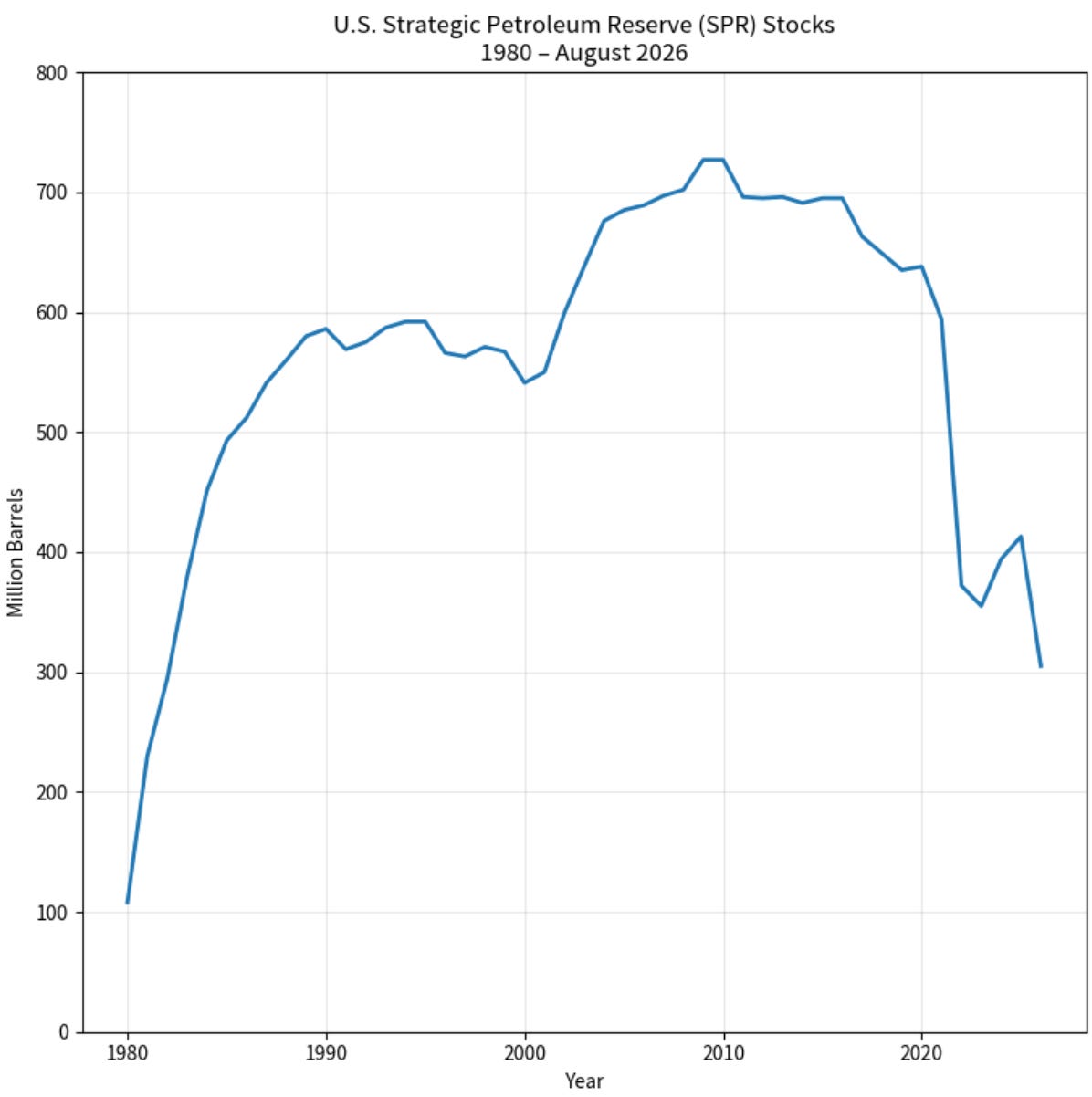
As shown above, U.S. and OECD commercial stocks also declined sharply. And now, after the coordinated IEA release of strategic reserves, the US SPR is down to 305 million barrels – the lowest level since 1983!

That’s especially salient because it was your editor who back then pushed Washington policy into the subsequent huge build-up shown in the graph below – to a peak of 720 million barrels around 2010. This build-up was based on the proposition that the SPR constituted a more efficient and sensible alternative to a high cost policy of domestic petroleum autarky that had been embraced by both parties during the 1970s.

In effect, therefore, the Donald’s pointless war on Iran has caused the remainder of 40 years of investment in efficient petroleum security to be liquidated in a matter of months – on top of the large 2021-2024 liquidation under Sleepy Joe Biden in behalf of his own re-election considerations prior to July 2024.
As also indicated above, the stock levels for refined products, especially middle distillates, have tightened even more severely. Pre-war Middle East exports supplied meaningful shares of seaborne diesel and roughly 20 percent of seaborne jet fuel. Their disruption, combined with reduced Chinese product exports and later Russian refining constraints, produced acute imbalances.

Jet-fuel prices in major hubs roughly doubled in the March-May window relative to early-2026 levels; crack spreads widened dramatically. Diesel prices rose sharply as well, at times overtaking jet fuel prices in European markets amid competing demand for scarce barrels.

Accordingly, excess inventories of both products have experienced the aforementioned 50% draw-downs already, and in some regions diesel stocks have approached multi-decade lows. By August 2026 the IEA was revising global demand and supply forecasts downward again, noting that previously available inventory buffers were rapidly depleting and that the continued Hormuz constraints were sharply curtailing product availability.

In short, the pre-February global petroleum stock cushion is largely gone. What remains is a far thinner global inventory position, elevated and volatile refined-product prices, and heightened sensitivity to any further interruption. Diesel powers freight, agriculture, construction and industry; jet fuel underpins aviation and military logistics. Both, obviously, are the lifelines of modern economies.

Further sustained restriction of Middle East product and crude flows, or renewed Iranian attacks on non-Iranian tankers attempting to exit the strait, would press these already fragile markets even harder precisely when buffers are lowest.

Again, it needs be recalled that the interaction of global stocks and market prices is not linear: When draw-downs reach critical thresholds relative to working minimums the distributor and end user demands for precautionary stocks can rise abruptly and dramatically. That, in turn, precipitously drains apparent above ground stock levels, sending prices in prompt and spot markets soaring skyward.

So if Secy Bessent thinks he has another six months of minimal flows through the SOH like that since February 28th, he surely has another think coming.
The Race and Bessent’s Overconfidence

The strategic picture is therefore a race. Iran’s blockaded economy can draw on self-sufficiency, residual oil monetization, and experience with isolation. The global economy – and the United States within it – must operate with sharply depleted commercial and strategic stocks, tight diesel and jet-fuel balances, and the constant risk that Iran will resume or intensify strikes on even the minimal levels of petroleum tanker traffic seeking to leave the Gulf.

Bessent’s forthcoming “never seen” measures and the continued naval blockade are presented as the financial equivalent of kinetic pressure—tools capable of bringing Iran to its knees before the global system feels unbearable strain. That framing, however, replicates the same analytical error that marked Epic Fury: to wit, an exaggerated estimate of American coercive leverage and an under-estimate of the target’s adaptive capacity and of collateral damage to the initiator’s own interests.

Iran’s oil trade has already migrated heavily to China and the shadow fleet; secondary sanctions on facilitators will raise costs and friction but will not instantaneously eliminate Iran’s oil revenue or force political surrender.

To the contrary, what Trumpy and Bessent are fixing to launch is an all-out Washington war on global commerce. American and third-country firms in shipping, insurance, brokerage and trade finance will absorb compliance burdens and lost business. That is to say, American business is being heavily taxed by Operation Economic Fury, and without representation or Congressional authorization to boot.

In any event, crude oil and product prices will remain elevated or spike further, feeding inflation and growth headwinds precisely when domestic political calendars are sensitive.

History offers little support for the belief that additional layers of isolation will succeed where decades of prior sanctions and six months of military pressure have not. The more probable outcome is prolonged mutual attrition in which the global diesel and jet-fuel markets, already operating with minimal buffers, reach critical stress before Iran’s domestic survival economy does.

In that contest the United States and its partners have more to lose from systemic disruption than a regime long practiced in enduring isolation has to lose from further hardship.

Epic Fury demonstrated the limits of kinetic force against a resilient adversary in a complex theater. Now, Secy Bessent’s unhinged Operation Economic Fury, launched from a position of depleted inventories and over-stretched munitions, risks demonstrating the same limits with higher systemic stakes.

The prospective announcement of “unprecedented measures” later this week will not alter the underlying arithmetic: Time favors the side that can live longer with less, and on present evidence that side is not the one whose refined-product lifelines are already stretched to the breaking point.

David Stockman was a two-term Congressman from Michigan. He was also the Director of the Office of Management and Budget under President Ronald Reagan. After leaving the White House, Stockman had a 20-year career on Wall Street. He’s the author of three books, The Triumph of Politics: Why the Reagan Revolution Failed, The Great Deformation: The Corruption of Capitalism in America, TRUMPED! A Nation on the Brink of Ruin… And How to Bring It Back, and the recently released Great Money Bubble: Protect Yourself From The Coming Inflation Storm. He also is founder of David Stockman’s Contra Corner and David Stockman’s Bubble Finance Trader.

Really, O’Reilly? Bill Demands War Crimes In Iran

by | Aug 21, 2026 | 

Hasn’t Bill O’Reilly done enough harm beating the drums for America’s failed foreign wars? But he’s still around somewhere, trying to top his earlier act with more of his trademark fever-swamp rants, now offering advice to President Donald Trump on the Iran War.

His latest advice is the stuff of world historic war crimes.

The danger is acute. The president watches Fox News “incessantly.” No one is real in Trump-world unless they are seen on TV. Those who are real assume a larger-than-life influence if they’ve been Fox fixtures. The passageway between Fox News and the Trump administration is like an eerie science fiction wormhole between galaxies. It not only seems to defy space and time, it defies common sense. How else could Trump have gotten Pete Hegseth?

Other Fox New hosts and contributors who ended up in the Trump administration include Sean Duffy, Jeanine Pirro, John Bolton, Larry Kudlow, Mike Walz, Dan Bongino, Sebastian Gorka, Mike Huckabee… There are more, but you get the idea. A preponderance of war enthusiasts, some for Iraq, others for Ukraine, all for Iran.

O’Reilly supported all three wars. And since he was the biggest Fox star for sixteen years, one must assume he looms large in Trump’s consciousness. That makes his pathogenic influence especially menacing.

O’Reilly does not appear to be given to intellectual exertions. During the heyday of Dr. Ron Paul’s presidential campaigns, for example, when the Federal Reserve, fiat money, and monetary policy were front and center, Bill asked a guest, “Who is this guy Keens [sic] that everybody is talking about?” Despite bloviating about politics and policy every night for years, O’Reilly simply had no idea who John Maynard Keynes was, the North Star of Washington’s calamitous economic policies for generations now.

In the twilight of a career riddled with little knowledge and worse judgement, O’Reilly showed up on NewsNation recently with advice for Trump in the Iran War. This, said O’Reilly, is what he would do if he were president of the United States:

“I would tell Iranians living in Tehran, the capital city, to get out. Because we’re going to wreck your infrastructure. That means water. That means power.”

Given his intellectual indolence, one immediately suspects that strategic advice isn’t original with O’Reilly. He is merely giving structure to a babbling, midnight Trump post during the June 2025 U.S.-Israeli attack on Iran: “Everyone should immediately evacuate Tehran!”

Let us unravel this nightmarish idiocy. Tehran is a city of almost ten million people. The greater Tehran metropolitan area has an estimated population of 16.8 million people. What does anyone think will happen if 16.8 million people are told to flee at once because the president of the United States is about to make their lives a living hell?

It is almost impossible to imagine the gridlock and the chaos in housing, water, food, medicine, roads, fuel shortages, disease, accidents, and violence that would ensue.

World historic war crime?

Consider: When Pol Pot’s Khmer Rouge forced the evacuation of Phnom Penh, Cambodia on April 17, 1975, the city’s population was estimated to be between two million and 2.5 million people. Although the communist Khmer Rouge had already decided to expel the population of the cities, the evacuation was announced as necessary to escape an imminent U.S. bombing attack. Everyone, the well and able as well as the sick and the dying, some pushed on hospital beds, were force-marched into the countryside and jungles. Looting began at once. Famine and epidemics followed. 20,000 died just along the roads. A quarter of the country’s population, a third of the men and about half that many women, died before the entire communist madness and violence came to an end some years later.    

25,000 people died in the firebombing of Dresden. That is a modest death toll compared to a panicked evacuation of sixteen million people. 140,000 died from the atomic bombing of Hiroshima, over 70,000 in Nagasaki. Even that horror could be dwarfed by O’Reilly’s recommendation.

R.J. Rummel, the demographer of deaths by democide – mass killings by governments – estimates that 7.7 million died in Chairman Mao’s Cultural Revolution. That may be somewhere in the order of magnitude of O’Reilly’s barking lunacy.

“Now the world would go crazy,” acknowledges O’Reilly, if Trump were to follow his advice. “You know what would happen. The Democratic Party would jump up and down here. Trump would be almost alone. But that is the way to do it.”

That is the way to do something. That is the way to take a spot in the pantheon of the world’s most villainous state criminals. That is the way to blacken America’s name for generations.

In my latest book EMPIRE OF LIES: Fragments from the Memory Hole, I identify Bill O’Reilly as among those suffering from a malady I call “Combat Envy.” The evidence provided is the bogus claims he makes about his personal war experiences. Combat Envy is a pernicious syndrome shared by others, including former NBC anchorman Brian Williams, who fabricated accounts of his own war experience. There is some evidence that Trump is similarly afflicted. Last year, he characterized himself as a war hero for ordering air strikes on Iran.

It is hard to know what is more destructive: the fevered illusions of the president or the surreal war propaganda and commentary that Americans let stream into their homes year after year, night after night from Fox News.

Observers on every side, from realists like Andrew Bacevich to neoconservatives like Max Boot, have noted that Donald Trump seems to act on the advice of the last person he talks with. That is why we must hold our collective breath when Israeli Prime Minister Benjamin Netanyahu comes to town. We can only hope that O’Reilly’s depraved howling isn’t heard any time soon anywhere in Trump’s vicinity.

And that someone in the White House turns off the TV.

This originally appeared on The Libertarian Institute.

New York Times bestselling author Charles Goyette’s new book THE EMPIRE OF LIES: Fragments from the Memory Hole is available on Amazon.  The publisher describes it as “The Sorrowful Story of the Deep State’s Warlords, War Lies, and Failed Foreign Interventions.”  Charles can be contacted at EMPIREofLIES.com.

Has Trump Turned the Tables on Iran – or Is Another Round of War Coming?

For the first time, Trump thinks time is on his side. But Iran appears unfazed – for now

by | Aug 21, 2026 | 

Reprinted with permission from Trita Parsi’s Substack.

The Trump administration believes it has turned the tables on Iran. Washington assesses that the rerouting of maritime traffic through the Omani corridor, combined with a global shift away from Persian Gulf oil, has reduced the effectiveness of Tehran’s closure of the Strait of Hormuz. At the same time, the U.S. blockade has sharply constrained Iran’s ability to sell its oil. The result, in Washington’s view, is a status quo that imposes greater costs on Iran than on the United States.

That calculation changes the strategic equation. Rather than being forced to accommodate Iranian demands, President Donald Trump now believes he can afford to wait Tehran out. For the first time since the war began, the White House has concluded, time is working in America’s favor.

Assuming that assessment is correct, the more important question is what Trump intends to do with this newfound leverage. If Washington interprets Iran’s vulnerability as an opportunity to extract capitulation rather than to negotiate a durable settlement, the result is more likely to be another round of war than an end to the conflict. Tehran has already demonstrated that when confronted with a choice between surrender and escalation, it will choose the latter. Giving Iran the same choice again is therefore unlikely to produce a different outcome.

The only way to turn this unexpected shift in the balance of leverage into a political victory is through diplomacy. If Washington’s assessment is correct, it now has an opportunity to use its leverage to secure a compromise that addresses its core interests while giving Tehran sufficient reason to accept an agreement. If, instead, the administration pursues maximalist demands, it risks converting a moment of leverage into another cycle of war.

Historically, however, Washington has tended to make precisely this mistake. Whenever U.S. policymakers have concluded that time and leverage are on their side, they have often treated Iranian weakness not as an opening for compromise, but as an opportunity to seek capitulation. The danger is that Trump will repeat that pattern. He will mistake leverage for victory and turn a potentially favorable negotiating position into the continuation of the tragedy that is US-Iran relations.

Trump failed militarily, but thinks he can win economically

America has run out of military options. The clearest indication is that the Trump administration has stopped striking Iranian targets even as Tehran continues to attack ships transiting the Strait. On Monday, an Iranian attack killed a sailor aboard a vessel using the southern corridor. Yet Washington did not respond militarily – even though the second round of the war began precisely because the administration had declared that it could not accept Iran firing on ships.

According to Reuters, U.S. forces have used virtually all of their global stockpile of ATACMS and Precision Strike Missiles (PrSM) during the five-month Iran conflict. Moreover, roughly 65% of Patriot interceptors, 38% of THAAD interceptors, and almost half of the Navy’s Tomahawk cruise missiles have been expended.

The depletion of these stocks appears to have forced Trump to abandon its pursuit of a military knockout and instead shift the burden of economic pressure onto Tehran. That strategy, in turn, appears to be producing results faster—and to a greater degree – than the administration anticipated.

In the American description of events, this success is mainly due to three factors: New, much larger ships are being used that carry primarily crude oil. These VLCCs (Very Large Crude Carrier) can carry up to 2 million barrels of oil. In comparison, other oil tankers can transport between 350,000 and 1 million barrels.

Before the outbreak of the war, approximately 21 million barrels of petroleum and crude oil passed through the Strait of Hormuz on a daily basis. These were carried by 65 to 80 tankers. Roughly the same amount of oil transition through the strait can now be achieved by only ten VLCCs a day. And given that the vast majority of ships transitioning through the Strait in the Southern Corridor have their transponders off, this traffic has not been noted by outlets tracking the traffic.

Secondly, demand for Persian Gulf oil has significantly dropped as numerous economies have started to transition to other sources of supply. Brazil, for instance, has increased its exports and started to serve markets that previously relied on Persian Gulf oil. Most importantly, Beijing appears to have deliberately reduced its oil consumption to prevent prices from remaining above $100 a barrel and thereby aggravating the risk of a global recession.

Third, the war has created economic incentives strong enough to attract ships and crews willing to assume substantially greater risks. The growing volume of traffic through the Southern Corridor, despite the obvious dangers, is evidence that these incentives are surprisingly powerful.

Unlike its earlier illusions about the blockade as a guaranteed knockout blow against the Iranian theocracy, Washington no longer expects economic pressure to produce a quick surrender. Instead, the administration appears to be betting on a slower process of economic strangulation that will eventually force Tehran to capitulate. Faith in a knockout blow has given way to the more fragile hope of prolonged strangulation.

Tehran isn’t worried – for now

Iran’s calculation is effectively the opposite of Washington’s. Tehran doubts the United States can sustain the flow of VLCC traffic through the Strait and believes Trump will have little choice but to return to the Islamabad MOU within the next two to three weeks. Trump may have made progress on oil exports, but LNG and many petrochemical products, including fertilizers, remain unable to leave the Persian Gulf.

Tehran also appears to believe that it retains the ability to halt the VLCC traffic, but is deliberately refraining from doing so for now. The calculation is to avoid escalation while waiting to see whether the United States’ depleted military options ultimately compel Trump to return to the MOU.

In short, Tehran does not appear overly concerned – for now. But that could change. If Trump refuses to return to the MOU, or succeeds in turning the balance of economic pain against Iran, Tehran will face a far harsher reality. Just as Washington underestimated Iran’s resilience, Tehran may have underestimated the both resilience of the global economy and Trump – the former’s ability to shift away from oil and the latter’s craftiness in finding non-military ways to effectively reopen parts of the Strait.

Between surrender or escalation, Iran will almost certainly choose escalation. Even if Trump has gained the economic upper hand, Tehran still believes it holds a military advantage. Its options range from more aggressive attacks on VLCCs to strikes on Emirati pipelines that bypass the Strait, and potentially to renewed escalation in the Red Sea.

Indeed, it was precisely Trump’s erroneous assumption that Iran would choose surrender over war that helped drive the United States toward escalation in the first place. Washington’s recurring search for Iran’s breaking point has repeatedly produced escalation rather than capitulation. There is little reason to expect the pattern to be different this time.

The US-Iran tragedy

Herein lies the tragedy of the lethal dance between Washington and Tehran. America’s winner-take-all approach makes agreement unacceptable when Iran has the momentum. When the momentum shifts to Washington, the United States comes to believe that nothing short of Tehran’s full capitulation is palpable.

Because Iran fears surrender more than war, the cycle oscillates between economic pressure and military escalation, interrupted only by brief and often fragile periods of diplomacy. Put simply, the structure of the situation favors war.

This is particularly visible today as neither side is investing in any real diplomacy with the other. Tehran’s “diplomacy” is to simply wait for Trump to return to the MOU, while Trump has barred U.S. officials from engaging with Iran and committed himself instead to economic warfare.

When you don’t negotiate when you’re weak, because you are weak, and you don’t negotiate when you are strong, because you are strong, then war becomes the baseline.

Trita Parsi is the Executive VP of the Quincy Institute for Responsible Statecraft and an award-winning author. Washingtonian Magazine has named him one of the 25 most influential voices on foreign policy. Noam Chomsky calls him “one of the most distinguished scholars on Iran”

Visit Trita Parsi’s Substack and subscribe.

‘We’ll Bomb the Sh*t Out of Them’: Trump and the War on Morality

If anybody besides the sitting president made a threat like this, we would correctly view them as an enemy of civilized society.


by | Aug 20, 2026 | 

Consider this hypothetical:

Two apartment buildings share a single parking lot. Management from both Building A and Building B are engaged in negotiations over how the parking lot will be organized, painted, maintained, and paid for.

Across the street is a restaurant. The restaurant’s customers primarily come from Building A, and internal studies have shown that Building B’s tenants overwhelmingly patronize the restaurant’s competition. Therefore, the restaurant is seeking to sway the parking lot negotiations to make it easier for Building A’s tenants to get to their shop, and harder for Building B’s tenants to get to the competitor.

Through back-channel discussions, the restaurant learns that Building A may be conceding to many of Building B’s requests for how the parking lot should be organized. Worried that this will help their competition, the restaurant announces on social media that if Building A doesn’t get their act together and negotiate more aggressively, they will “bomb the sh*t out of them.”

Now, that’s quite a leap. How did we go from negotiations one day to threats of mass murder the next?

If this scenario were to occur in Anytown, USA, we would immediately see this as unhinged and immoral. No, you cannot use murder as your default method of settling disputes. The vast majority of us accept this in our day-to-day lives, and the proof of this is that the vast majority of us have never murdered anybody. We settle disputes verbally, or through contractual agreements, and if negotiations fail we tend to just walk away. But for some reason when it comes to the global stage, where the harm caused by these decisions is far greater in scale, many struggle to see the issue with this type of rhetoric.

The Hormuz negotiations

Iran and Oman have been engaged in negotiations over the future governance of the Strait of Hormuz for the past few weeks. We were told in the early stages of the talks that a deal was within reach, but it is yet to materialize. The fact that these talks are even happening seems to imply a quiet U.S. admission that Iran will control the waterway in some capacity going forward, which is a major diplomatic climb-down from Donald Trump. With this concession, the focus seems to have shifted. Whereas before the goal was to “liberate the Strait,” the objective now is to get a deal that Trump can spin into a victory.

To this end, Trump has sought to influence the Iranian-Omani negotiations. In an August 17 phone call with Fox News correspondent Trey Yingst, Donald Trump said “If Oman gets in the way, we’ll bomb the sh*t out of them.”

This frustration seems to have been caused by the lack of progress towards opening the Strait of Hormuz. The Iranians and Omanis said weeks ago that a deal was almost complete, only to have negotiations extend longer than anticipated. Trump, desperate for a deal that can help bring down oil prices and sooth the economic stress at home, chose to lash out at Oman, who he believes is being too favorable to Iran.

This sadly is not an unusual sentiment from Donald Trump, who has made a habit out of threatening to bomb countries as a negotiating tactic. The regularity with which Trump threatens mass murder does not make it civilized or moral, however. It makes it even more unsettling.

As a result of Trump’s loss at the hands of Iran, the American empire has been dealt a severe dent to its armor. The image of American bases scattered across the Middle East – once a symbol of military dominance – has been quite literally shattered. Trump can no longer rely on previously held assumptions about American power in order to get his way. Thus, he must lower himself rhetorically to the level of a brutal warlord.

The war on morality

In order to support this war, you must necessarily be morally inconsistent.

In fact, many of this war’s advocates seem to have outsourced their morality to the government, which has spoon-fed them with lies in order to justify their actions.

Return to the hypothetical I outlined at the beginning. Of course we would all see these actions as moral abominations if they were done by private individuals. You do not get to murder somebody because you are in a dispute over the layout of a parking lot, or the price of healthcare, or political disagreements. A civilized society does not put up with this level of brutality.

The hypocrisy becomes apparent once we look at the government. How can it be that the group we are told is supposed to bring murderers to justice (government) is also the group which commits the most murders? The U.S. military bombed an elementary school in Iran in the early days of this current war, killing over 175 innocent people, many of whom were young girls attending the school. Yet, nobody has been held accountable for this crime against humanity.

This, by any consistent standard of morality, is an outrage. However, because this crime was committed by the government and not a private actor, the media has largely moved on. Their refusal to admit fault has barely been scrutinized. Because we view the government in this false “collective” sense, many tend to forget the basic fact that the people who fill its ranks are individuals, just the same as the rest of us, and the immoral acts they commit are just as immoral as they would be if you or I had committed them.

This is the war on morality. To be supportive of this war is to not principally believe in the immorality of murder. If killing an innocent, non-aggressive person is wrong in a domestic, private context, then it must also be wrong when committed by people in the government. Just because somebody has a fancy title does not make them any less of a human, with a responsibility for their actions.

Nolan Denaro is an independent political analyst, writer, and host of “The Quest For Clarity” podcast, which can be found on YouTube and Spotify. His work has been published by Antiwar.com, Responsible Statecraft, the Libertarian Institute, and the Ludwig von Mises Institute. He writes on U.S. foreign policy, economics, and current events, with a particular focus on war and imperialism. He writes opinion pieces on his Substack, and you can follow him on X @nolandenaro. Nolan can be reached for correspondence at nolansdenaro@icloud.com.

Korean Peninsula: One Small Step in the Right Direction

by | Aug 19, 2026 | 

“President Donald Trump’s decision to scale back joint military exercises with South Korea,” Matthew Lee and Ben Finley write for the Associated Press, “does not just slight a longtime ally but raises broader concerns about the security interests of the United States in Asia and elsewhere.”

Trump’s reason for supposedly, and in unspecified ways, downsizing the annual “Ulchi Freedom Shield” exercise is that South Korea has been insufficiently supportive of his  war against Iran. That doesn’t seem like a very good reason … but there ARE good reasons, and it’s a tiny move in the correct direction of drawing down US military entanglement on the Korean Peninsula.

The history, in brief:

After World War 2, Korea — which had been occupied by the Japanese — was split into two states. In the north, a Soviet/Chinese-backed communist regime under Kim Il Sung held power, while the south  was ruled by a US-backed  fascist regime under Syngman Rhee. Each side wanted to invade, conquer, annex, and absorb the other’s territory, but the US held Rhee back from doing so and Kim beat him to the punch.

The resulting war technically goes on to this very day, although it’s been in a tense state of ceasefire since 1953. More than 35,000 American troops, hundreds of thousands of South Korean, North Korean, Chinese, and Soviet soldiers, and millions of civilians died to reach that stalemate.

North Korea remains “communist” in name and pageantry while actually embodying absolute , quasi-religious monarchy under the Kim dynasty’s third generation.

South Korea is theoretically a “democracy,” but mostly just a big state capitalist enterprise operating under military protection from, and advantageous trade deals with, the US . The US spends $5-6 billion per year to support 80 military bases and 27,000 deployed US troops, and has now been doing that much or more for 80 years.

Interestingly, the AP story quotes Dan Fried, an official in George W. Bush’s administration, to the effect that “there is no American interest I can see” in reducing US military commitments to South Korea.

But in 2004, Bush himself proposed a much bolder plan than small cuts to joint military exercises. He wanted, he announced, to completely withdraw US forces from the Korean peninsula over the course of ten years.

Granted, Bush made that proposal under duress after rushing to New Mexico when his campaign learned that Libertarian Michael Badnarik was polling at 5% in the state, that Democrat John Kerry had scheduled a speech of his own there, and that New Mexico’s electoral votes might hang in the balance. He needed an olive branch to the growing anti-war movement, and quickly dropped the plan once he was re-elected.

But it was a good idea then, and it’s a great idea now.

American taxpayers have been throwing blood and treasure at South Korea for most of a century even as it has become an economic powerhouse that competes with US producers, and that commitment also feeds into US entanglement in every regional argument involving not just the Koreas, but China, Taiwan, Japan, the Philippines, etc. It’s a raw deal for America.

South Korea possesses abundant means to provide for its own defense , especially since Kim Jong-Un  certainly understands that even success at military conquest of a population twice the size of the one he already rules would eventually bring his own regime down.

I hope that President Trump will continue on, and accelerate ambitiously along, this course. The US armed forces should stand down in South Korea. Whether the South Korean regime stands up in their place, and if so in what ways, isn’t a matter for the US regime to decide. Bring the troops home.

Thomas L. Knapp is director and senior news analyst at the William Lloyd Garrison Center for Libertarian Advocacy Journalism, publisher of Rational Review News Digest, and moderator of Antiwar.com’s commenting/discussion community.


Another Trump-Kim Carnival?


by | Aug 21, 2026 |


A Trump-Kim summit would be a spectacle like no other. A carnival extravaganza with the Korean Peninsula holding center stage, and every handshake, expression, seating arrangement, and stray remark dissected by troupes of North Korea pundits across the world’s news networks. But like any great traveling carnival, a few days later ticket holders will be left with an uncomfortable queasiness and a sense that they’ve somehow been cheated. Spectacle, not strategy.

As the media fawned over the prospect of another Trump-Kim carnival, Chinese Foreign Minister Wang Yi arrived in Seoul for two days of talks with South Korean Foreign Minister Cho Hyun. Strategy, not spectacle.

Washington is lost in spectacle, Beijing is focused and strategic. The differing approaches will transform the region.

Iran as a warning

The decision to attack Iran demonstrated that U.S. decision-making was driven less by strategic or operational considerations than by personal motivations. The conflict was poorly planned, employing the wrong military tools at the wrong time. Earlier operations had already exposed these limitations: the United States struggled to achieve its objectives against Houthi positions in Yemen between March and May 2025, and again against Iranian targets during the Twelve-Day War in June 2025. These warnings went unheeded. The resulting conflict exposed a deeper problem: an inability to match military means to strategic ends.

The continuation of the conflict appears to be shaped by political, financial, and reputational incentives as much as a coherent assessment of strategic costs and benefits. The distinction between the national interest and personal interests is increasingly difficult to discern. The problem therefore extends beyond poor strategy or operational failure: the machinery of war itself has become a vehicle for presidential profit.

The failure to come to terms has demonstrated that the U.S. is “agreement incapable”. The weakening of the State Department and the reliance on poorly qualified presidential envoys has hollowed out the institutional capacity needed to negotiate, conclude, and sustain credible agreements.

Then there’s the treatment of allies, such as South Korea. Start with removal of the Patriot and THAAD platforms, their effective failure in high-intensity conflict, the departure of the last U.S. carrier group from East Asia, and unilateral changes to long-planned military exercises, and the value of the U.S. alliance begins to look very different. Add the ever-present demand that South Korea play a larger role in containing China, and the alliance itself begins to look like a risk.

Awaiting Washington’s move?

Unarguably, South Korea currently needs the U.S. – and Donald Trump in particular. Securing an end to the Korean War would replace a temporary armistice with a permanent peace regime, reduce the risk of renewed conflict, and open space for a more stable relationship with North Korea. Achieving this requires U.S. participation and presidential authority, as well as the narcissism and recklessness to break with decades of established policy.

An end to the Korean War would also fit nearly two decades of South Korean preparation to survive a weakening of the U.S. alliance or its end.

South Korea regained peacetime OPCON in 1994, while the formal process for transferring wartime OPCON began in 2006, when Roh Moo-hyun and George W. Bush agreed on the basic principles of the transfer. Twenty years later, the process remains incomplete, but its direction has not changed: greater South Korean responsibility for its own defense and less dependence on U.S. command.

The growth of South Korea’s arms industry points in the same direction. Once dependent on U.S. weapons, South Korea now produces and exports tanks, artillery, aircraft, warships, missiles, and air-defense systems. More than an export success, this is building the industrial capacity for greater strategic independence.

The nuclear “wish list” points further in the same direction. South Korea currently moving toward a domestically produced nuclear submarine, with the first planned for the mid-2030s. At the same time, public support for an independent nuclear deterrent remains strong, even though the government currently formally rejects the development of nuclear weapons.

All three point in the same direction: greater autonomy, military-industrial independence, and ultimately independent deterrence. South Korea still needs the alliance, but it is preparing for a future in which it may no longer have one.

However, the current South Korean push for Trump to play a role on the Korean Peninsula is more about cognitive and institutional reflex than strategic foresight – and this reflex is rapidly weakening. South Korea is increasingly aware that this is Beijing’s region.

The future lies in Beijing?

America’s greatest supporters in Seoul are aware that that the Iran conflict suggests the U.S. no longer has the capacity to decisively shape events on the Korean Peninsula. The deeper strategic logic is difficult to ignore: the long-term dynamics of East Asia increasingly point toward U.S. departure.

The regional balance is shifting from maritime toward continental power, while technological change is making forward bases, surface fleets, and extended supply lines increasingly vulnerable. At the same time, the military and political costs of maintaining regional primacy are rising faster than the benefits it provides. Withdrawal will not be immediate, but the strategic trajectory is clear.

Across the West, it’s assumed that middle powers seek to balance nearby great powers by securing the support of more distant great powers. South Korea’s alliance with the U.S. fits this logic. But East Asian history shows that accepting and even profiting from a nearby great power sometimes makes more sense. Much of Southeast Asia’s more acquiescent approach to China fits this logic.

For South Korea, coming to terms with this is politically and socially difficult. Yet, in strategic terms, it makes sense to “negotiate” the departure of the U.S. with Beijing before, rather than after. Waiting until the U.S. leaves of its own accord, or is pushed out in a region-changing diplomatic failure, will not improve South Korea’s position. Time is not on Seoul’s side.

Another Trump-Kim carnival may take place. If it soothes and engenders favor with President Trump, then it serves a purpose. If it supports immediate objectives, such as securing greater military independence or an end to the Korean War, then it serves a purpose. But beyond the immediate spectacle, the future of the Korean Peninsula will not be decided on Trump’s social media, but by talks at the Zhongnanhai.

Jeffrey Robertson previously worked for the Australian government in the fields of foreign policy and diplomacy with a focus on East Asia. He now writes from the other side of the line as an academic at Yonsei University in Seoul, South Korea. His updates can be found at https://junotane.com.