Friday, August 21, 2026


NATO and the North Atlantic left: A road to nowhere
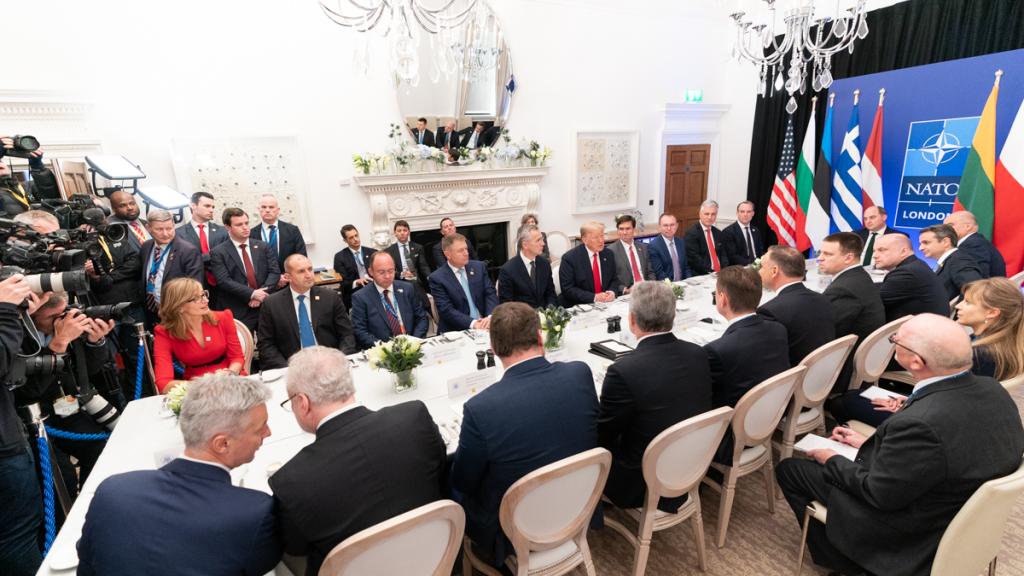
Trump at NATO. Photograph by Shealah Craighead.

First published at Socialist Forum.

Any analysis of the North Atlantic Treaty Organization (NATO) and its current geopolitical role has to begin with a puzzle: Why did the institution outlive the enemy it was created to deter? Why is it still so beloved by Western liberals and neo-conservatives alike, despite the on-again, off-again grumbles by Trump and other neo-isolationists that it has become a burden for the coffers of the US Treasury? And what alternatives can socialists on both sides of the Atlantic propose in order to truly promote geopolitical stability in the face of a social, economic, political and environmental polycrisis (understood to be a situation in which “crises in multiple global systems become causally entangled in ways that significantly degrade humanity’s prospects”) engulfing the planet? In this article, we postulate that the North Atlantic left must advocate for a full decoupling from NATO and the social, political, and financial costs that sustaining the organization entails, and instead advocate for a vision of geopolitical security based on environmental sustainability, social equality, and democratic and inclusive multilateral frameworks that are not hegemonized by the US or any other individual neo-imperialist power.

For most of the North Atlantic liberal-left, NATO has long been part of the furniture of the international order: an institution whose particular wars might be criticized, but whose existence and indefinite expansion are taken for granted as the guarantee of a “rules-based order” or, at most, regarded with an ambivalence that never matures into opposition. The reflex is bipartisan and transatlantic. When thirty members of the US Congressional Progressive Caucus signed a letter in October 2022 gently urging the Biden administration to pair military support for Ukraine with diplomatic effort, they withdrew it within twenty-four hours under a hail of accusations of appeasement, a measure of how narrow the permissible spectrum of transatlantic debate has become. Socialists do not share that ambivalence, and cannot afford its silences. Our argument is that an European decoupling from NATO, in the military, digital, and environmental sense, looking for real independence and sovereignty is not one demand among many, but the precondition for social and ecological progress on either shore of the Atlantic.

The NATO puzzle has acquired a further layer of irony in the second Trump era. The President who muses about leaving “delinquent” allies to their fate, who has refused to rule out economic or even military coercion to annex Greenland (which is an autonomous territory of Denmark, a founding NATO member) and who dispatched his Vice President to scold European allies from an American base on Greenlandic soil, has nonetheless declined to junk the organization. This article will address the reasons behind his strategy in the context of the current configurations of late-stage capitalism.

NATO’s original purpose

NATO, the West’s quintessential Cold War security alliance founded in 1949, which aimed to shelter key European allies from the “Soviet threat” by including them under the US’ “ nuclear umbrella,” was not discarded and deactivated as its counterpart Warsaw Pact was in 1991 (Miles 2023/2024). Instead, the Golden Years of the so-called Pax Americana that followed the disbandment of the Soviet Bloc in the 1990s led to a surprisingly small decrease in military expenditure by the United States, which registered a mere –21% decline in its military budget during the period 1986–1994, as compared to a –49.5% drop in military spending in the non-NATO world (including the former Soviet Union) during the same period. During the Clinton years, NATO did not shrink or disappear, instead it expanded eastward and began a series of military interventions outside of its core area of influence: former Yugoslavia in 1999 without UN Security Council authorization, Afghanistan at the height of the post-9/11 “anti-terrorism frenzy” from 2001-2014, and Libya in 2011 far beyond its mandate, just to name a few.

Despite NATO outliving its original purpose, it began to repurpose its existence, while simultaneously revealing the purpose that it served all along, in accordance with the argument made by Panitch & Gindin in The Making of Global Capitalism (2012). According to these authors, NATO continues to be an essential part of the machinery through which the US State supervises global capitalism, with Western Europe’s ruling classes as junior partners in an imperial alliance. In this way, post-Cold War NATO has stopped acting as a guarantee of security and peace for the Western world, because it was never designed to principally function as a mutual security pact. From its founding, indeed, the alliance’s internal enemies mattered as much as its external one. NATO’s first decades were dedicated as much to insulating Western European states from their own Communist-friendly working classes (from Marshall-conditioned aid to the stay-behind networks later exposed as Operation Gladio) as about deterring the Red Army. An offensive imperial instrument can never be reformed into a defensive one, even under deeply transformed political, social, and military conjunctures.

From burden sharing to protection racket

The need for maintaining a robust NATO in the post-Cold War, increasingly multipolar world began to be seriously questioned during the first Trump administration. Trump’s insistence on economic “burden sharing” came to the forefront of NATO’s agenda by 2018, when he pushed hard for European members of the organization to pledge 4% of their annual GDP for defense expenditure (up from a 2% commitment made by the Europeans in 2014). Shocked by Trump’s abandonment of Western mutual defense grand strategy, liberal foreign policy analysts began to wring their hands at the notion of an unmoored and underfunded NATO without the capacity to defend Fortress Europe from the evils of Vladimir Putin, cast as the new post-Cold War “boogie man” (despite or perhaps because of his similarities with the former Cold War “boogie men”) by Washington establishment elites.

The complaint itself was hardly new. American elites have grumbled about European free-riding since Eisenhower complained privately that the allies were making a “sucker” of the United States. Senate majority leader Mike Mansfield spent the early 1970s introducing amendments to halve US troop levels in Europe; and Robert Gates devoted his 2011 farewell address as defense secretary to warning of a “dim if not dismal” future for an alliance in which Americans paid and Europeans merely philosophized. This grumbling is a signal of imperial decay. A hegemon that has full confidence in its powers subsidizes its allies, as post-WWII Washington did, because protection purchased markets, dollar seigniorage, and political obedience at a discount. A hegemon in relative decline, however, begins to monetize its protection directly.

As part of its intentions to restore US standing in the world through rejoining global alliances and reprioritizing multilateral commitments, the incoming Biden administration “bent the stick” in the opposite direction when it came to foreign relations with Western European powers. Under Biden, the US simultaneously returned to non-contentious relations with its traditional Western European allies and reinforced claims of the “indispensableness” of NATO (not only as a military shield but also as an instrument for democracy promotion), through actively encouraging the expansion of the geographic scope of the organization. While that expansion undoubtedly was a motive behind Putin’s February 2022 invasion of Ukraine, its logic went unquestioned and even celebrated by Biden who was eager to unleash both the “hard” and “soft” versions of US imperial power on the European continent. As Biden stated at a 2024 summit celebrating NATO’s 75-year anniversary, “for those who thought NATO’s time had passed, they got a rude awakening when Putin invaded Ukraine. […] Some of the oldest, deepest fears in Europe roared back to life because once again a murderous madman was on the march. But this time, no one cowered in appeasement, especially the United States.”

Now, under the second Trump administration, the Russia-Ukraine conflict continues to drag on, tragically transformed into yet another forever war that is being underwritten on both sides of the Atlantic by capitalist interests linked to the military-industrial complex. It is important to say that the motivations for Trump “staying the course” in Ukraine are quite different from that of the former Biden administration. For Western liberals, Ukraine is the legitimating war — the conflict that redeemed NATO after Iraq, Afghanistan, and Libya. It restored the moral vocabulary of the “defense of democracy,” and made alliance politics electorally viable again. Trump’s coalition has no need of that legitimation, as it organizes consent through civilizational nationalism at home, not liberal internationalism abroad, and the fractions of capital closest to it have different balance sheets. Fossil-fuel capital eyes sanctions relief and Arctic hydrocarbons; the venture-backed tech-defense complex of Palantir, Anduril, and SpaceX profits from Pacific-facing rearmament regardless of what happens in the Donbas; and the MAGA strategic imagination treats Russia as a potential junior partner in a world of great-power spheres, with China as the only rival that counts. Ukraine, in this scheme, is a European liability to be offloaded, profitably, since the offloading takes the form of European purchases of American weapons. As US foreign policy towards Europe becomes more and more unilateral and erratic the NATO burden sharing debate is now back front and center, in a context underlain by mistrust on the part of European partners and inflated imperialist bravado exhibited by Trump.

An alliance of equals?

At the June 2025 Hague summit, European NATO members adopted a target of 5 percent of GDP for defense and security spending by 2035; Spain, the only country to refuse, was answered not with coherent arguments but with Trump’s unilateral threat to make it “pay twice as much” through trade. When Madrid in March 2026 would not allow US aircraft to use the Rota and Morón bases for strikes on Iran launched outside the UN Charter, Trump ordered a full cut-off of trade with Spain. Alliances of equals do not behave this way; metropoles disciplining peripheries do. The discipline has a business model. Rosa Luxemburg called militarism a province of accumulation in The Accumulation of Capital (1913), and the description has aged well: according to figures cited in the Draghi report, 63 percent of EU defense procurement between mid-2022 and mid-2023 went to US suppliers. Rearmament on NATO’s terms is a historic transfer of European public money to American arms capital. The 5 percent target is less a strategy than a tribute schedule with a procurement funnel attached.

The Spanish alternative

The case of Spain matters analytically because it shows how resistance is possible, what this strategy depends on, and why it is domestically and internationally important. The how is documented: at The Hague, as the Spanish government secured the alliance’s only exemption, arguing NATO’s own capability targets could be met at roughly 2.1 percent of GDP. It has since dropped the F-35 in favor of European aircraft (a substitution of suppliers rather than a reduction in lethality, a distinction whose importance will become clear below) and in March it conditioned any use of Spanish territory on conformity with principles enshrined in the UN Charter.

The why is material as much as political. Politically, the governing coalition depends on left and peripheral-nationalist parties for whom rearmament carries a price — above all on Sumar, the ecosocialist coalition led by Yolanda Díaz, which formally rejected the government’s rearmament plan. Sumar instead supports a different political project, based on strategic autonomy, European independence and real sovereignty, without subordination to the United States, and security as protection of people’s social and ecological conditions of life, not weapons procurement, as the EU already outspends Russia threefold in this budget line item. Materially, Spain has doubled its wind and solar capacity since 2019. Due to this, by early 2026 gas became the minority source of energy domestically, equalling only 9 percent of total megawatt hours. When the war on Iran sent European gas prices surging, Spanish wholesale power averaged €42 per megawatt-hour against €143 in Italy, while heavily gas-dependent Germany absorbed the full shock. Andreas Malm’s Fossil Capital (2016) traces how fossil energy systems embed class power and imperial hierarchy; the Spanish case shows the inverse. Every gigawatt of domestically owned renewables removes a lever of external coercion.

The Spanish exception should not be idealized, however. As Ekaitz Cancela has argued, the same Sánchez government that refused access by the US to the Rota and Morón bases has presided over the largest defense budget in Spanish history, mutating from the “pandemic Keynesianism” of the post-COVID recovery period to military neoliberalism. In December 2025, the Defense Ministry adjudicated €15.8 billion to private contractors to comply with NATO targets, while the State’s digital backbone was quietly handed over to Silicon Valley: SpaceX satellites for military communications, Palantir software inside the armed forces’ intelligence systems (under NATO eyes), and Microsoft software licenses for federal administrative employees. What is marketed to European electorates as “military Keynesianism”, specifically, jobs and growth through rearmament, operates in practice as military neoliberalism: public spending to prop up the private military-industrial complex. A decoupling from Washington of this type would merely Europeanize the suppliers of militarism while leaving a NATO-focused political economy intact. That is why Sumar’s position within the coalition against the rearmament plan as a whole, and not just a veto of American vendors, marks the actual dividing line regarding defense policy in the Sanchez administration.

Two sovereignties

Here conceptual precision matters: the idea of “European sovereignty” is now being invoked to support two diametrically opposed projects. What the European Commission calls strategic autonomy — the €800 billion ReArm Europe program, hastily rebranded Readiness 2030 — suspends neoliberal deficit rules for weapons purchases while leaving Europe’s deeper dependencies untouched, for example, US firms hold 85 percent of the European cloud market.

The EU spending rules are notorious for their harshness. Since the ratification of the Maastricht treaty in 1991, EU member states have been bound to keep budget deficits below 3 percent of GDP and public debt below 60 percent. After the 2008 global financial crisis, these restrictions were the building blocks of the austerity architecture that gutted Southern Europe’s health care, education, and social protection systems. In March 2025, the Commission moved to activate “national escape clauses” exempting increases in military spending of up to 1.5 percent of GDP from precisely those ceilings, laying bare the real priorities of “social” Europe. These policies undermine any attempt at popular sovereignty, which would allow for budget priorities to be set on the national level in consonance with the real needs of each country’s working classes.

That is not an exit from imperialism but an application for promotion within it — and the application will not be granted. Poulantzas explained why in Classes in Contemporary Capitalism (1975): postwar American capital did not confront Europe from outside, as a rival across a frontier, but was replicated within European social formations themselves. In this way, a Western European capitalist class was created, that was neither a national bourgeoisie capable of an autonomous project nor a typical comprador class. Instead it was (and still is) a bourgeoisie with its own domestic base of accumulation but whose conditions of reproduction and valorization nonetheless depend on American technology, finance, and military prowess. The procurement and cloud figures are not deficiencies to be corrected by better industrial policy; they are the shape of the relation. An anti-imperialist Europe is therefore a project impossible to reproduce without dramatically transforming the inherently US-dependent nature of the modern Western European capitalist class. Sovereignty can only be reclaimed by another historical subject — the working class.

A socialist concept of sovereignty starts from a radically different focus on the well-being of peoples, not States. Popular sovereignty is inextricably linked to the concept of what Marxist feminists call social reproduction (Bhattacharya 2017) — the everyday systems of energy, food, housing, care, tech and knowledge through which a society maintains its vitality. Whoever controls those systems governs, no matter what national Constitutions say; that is why popular sovereignty is built in grids and cloud infrastructure as much as in armaments and military readiness.

National and regional defense follows the same materialist logic. What principally matters is not how much is spent, but what is defended. NATO’s rearmament defends the circuits of accumulation — sub-Arctic shipping lanes, mineral extraction frontiers, capital’s investments far beyond Europe. On the other hand, a socialist concept of defense protects and uplifts the well-being of all peoples, and is therefore defined by its self-imposed limits by what it refuses to do as much as by what it protects. Where NATO doctrine is organized around the unlimited projection of “hard power,” a socialist doctrine of defense, independence and sovereignty is bounded: by the UN Charter’s absolute prohibition of wars of aggression; by the consistent application of human rights principles within and beyond Western borders, without the exemptions Washington and Brussels grant themselves; and by solidarity as an organizing principle (as expressed by energy interconnections, technology transfers, and robust protections for refugees and migrants) rather than protection rackets between States.

Using a consistent socialist logic, we should also reaffirm that Russia’s war on Ukraine is also a form of imperialist aggression, and a left that answers NATO’s imperialism by excusing Moscow’s will never find emancipatory solutions to the existential challenges faced by the working class posed by competing fractions of global capital. Those fractions can be named. On one side stands the Northern Atlantic military-industrial-fossil fuel bloc, now enhanced by a venture-backed tech-defense complex. These fractions of Western capital need permanent rearmament and therefore a permanent enemy, in order to guarantee increased profit margins. In competition with Western capital is the Russian extractive-military oligarchy, for which war has become a dual strategy to ensure capital accumulation and political survival. Who gets left behind on both sides of this transnational duel for the spoils of extraction and exploitation is the global working class, including the Ukrainian and Russian workers currently being used as cannon fodder on both sides of the battlefront. As formulated by Bah, this war is an expression of the modern “banality of oppression” suffered by the global working classes, which serves to brutally reinforce ingrained economic, social and racial injustices.

The ecological question

The ecological question is not a superfluous issue here; it provides a material base for any effective anti-war strategizing. The war economy and the fossil fuel economy are structurally fused not because the working class family heating its home with natural gas is complicit in war, but because both economies run on the same infrastructure, the same fiscal circuits, and the same premise of limitless extraction. It is undeniable that fossil fuel energy is still needed for material survival — people still cook, heat, and move with it. But this fossil fuel dependency was not inevitable. According to Malm (2016), it was engineered as a function of the current neoliberal capitalist order, and has created a form of thermodynamic and geopolitical path dependency. The US Fifth Fleet patrols the Gulf because the Carter Doctrine pledged military force in defense of hydrocarbon flows. The fiscal circuits overlap one another, petroStates recycle profits into weapons, and weapons then secure additional profits for these same States and for their imperial allies. Likewise, the world’s militaries are the fossil economy’s most voracious institutional consumers (Crawford 2022) — accounting for an estimated 5.5 percent of global emissions, a larger footprint than even Russia’s.

An ecosocialist transition starts from the opposite premise: the planet has biophysical limits, and production must be democratically planned within them. This means scaling down what is destructive for human existence, namely military and fossil fuel infrastructure first, in order to then expand what sustains life. That is the rift Marx saw opening between capital’s compulsion to grow and the natural cycles it exhausts — the ecology Saito (2023) has reconstructed from Marx’s late notebooks as degrowth communism. That transition cannot be financed from inside an arms race; a continent mobilizing €800 billion for weapons has already chosen which limits it respects. Decoupling from NATO across military, energy, and digital dimensions is therefore not a gesture but a precondition. This precondition, though, is not yet a binding program. We can perfectly imagine a unilateral exit from NATO by the Trump administration which would still keep the fossil fuel-military coupling intact under new national management. A real geopolitical transformation would transcend the issue of NATO per se, and point towards a national and transnational realignment of political values and economic priorities away from death and extraction and towards ecological sustainability and egalitarian social reproduction.

A Transatlantic horizon

The logic for an ecosocialist transition is equally applicable in Europe and in the US. As growing US defense and security expenditures are increasingly used to wage war both abroad and at home, with a hyper-militarized ICE terrorizing immigrant communities, and an emboldened CIA and Special Forces illegally kidnapping sovereign heads of state in America’s “backyard,” socialists must lead the fight against the devaluing and precarization of life on both the domestic and international fronts. DSA was right in including the abolition of NATO as a plank in its political platform approved at the 2021 Convention. And, on the other shore of the Atlantic, Sumar was right to say no to more spending in defense and to begin a process of decoupling from NATO grounded on energy sovereignty, technology and internationally-recognized human rights.

Now, as we gain organizational strength and greater political representation in both the institutional and extra-institutional spheres, DSA must take its “No to NATO” position to its next logical step, by working to build a new kind of peoples’ transnational mutual defense, based on the preservation and expansion of the global commons outside of any profit- or war-seeking logic, in conjunction with our foreign partners in networks such as the Foro de Sao Paulo (the standing conference of Latin American and Caribbean left parties and movements first convened in 1990 and of which DSA is an associate member), and Progressive International, the global coordinating body of left parties, unions, and social movements launched in 2020 of which DSA is a full member. We have a world to win, or to lose, depending on our willingness and capacity to promote popular, anti-capitalist and anti-imperialist human security, in the weeks, months and years to come.

Jana Silverman is a Co-Chair of the DSA International Committee. 

Jaime Caro is a Member of the DSA International Committee and Political Advisor for Sumar (Spain).

References

Miles, Simon. 2023/2024. “We All Fall Down: The Dismantling of the Warsaw Pact and the End of the Cold War in Eastern Europe,” International Security. 48(3): 51-85.

Bhattacharya, Tithi. 2017. Social Reproduction Theory: Remapping Class, Recentering Oppression. Pluto Press.

Cancela, Ekaitz. 2026. “Pedro Sánchez contra el trumpismo.” Revista Anfibia, 5 March. Extended Spanish version of “ Sanchismo’s Last Stand,” The Ideas Letter, 2026.

Crawford, Neta C. 2022. The Pentagon, Climate Change, and War: Charting the Rise and Fall of U.S. Military Emissions. MIT Press.

Lenin, V.I. 1917. Imperialism, the Highest Stage of Capitalism. International Publishers.

Lundestad, Geir. 1986. “Empire by Invitation? The United States and Western Europe, 1945–1952.” Journal of Peace Research 23(3): 263–277.

Luxemburg, Rosa. 1913. The Accumulation of Capital. Routledge.

Malm, Andreas. 2016. Fossil Capital: The Rise of Steam Power and the Roots of Global Warming. Verso.

Panitch, Leo, and Sam Gindin. 2012. The Making of Global Capitalism: The Political Economy of American Empire. Verso.

Saito, Kohei. 2023. Marx in the Anthropocene: Towards the Idea of Degrowth Communism. Cambridge University Press.


 

Why is Spain in Africa?

Cueta’s border fence in 2012. Photo by Mario Sánchez Bueno/Wikimedia Commons.

First published at Canadian Dimension.

“No one leaves home unless home is the mouth of a shark.” This passage from Warsan Shire’s Home has become one of the defining passages of the 21st century, quoted beneath photographs of overcrowded boats, following wrecks and rescues in the Mediterranean, whenever another image forces the world to confront displacement, movement, and migration. The images that emerged from Ceuta — a Spanish enclave on the northern coast of Morocco, where tens of thousands of people crossed from Morocco last week — felt hauntingly familiar. People of all ages in the water, a sea of plastic sandals, clothes soaked through, phones and babies held above the waves, families waiting for word that someone had made it across. A boy wrapped in a wet shirt, phone pressed to his ear before he’d even dried off, calling his mother. Aerial photographs reduced thousands of individual lives into what looked, from above, like movement itself. The geography had changed, but the visual grammar had not. A decade ago, the photograph of three-year-old Alan Kurdi gave the Syrian crossings a name and a face, briefly breaking through the language of crisis and provoking immense public empathy. Yet the crossings in Ceuta — or Sebta, as it is known in Arabic — were met, in many left-wing circles, not with empathy but with debates about geopolitics.

The resemblance between the images does not mean northern Morocco is Syria; the histories are different, as are the legal and political realities that shape the movement of human beings. Their familiarity reveals something worth sitting with: we have become remarkably fluent in reading images of migration while remaining surprisingly illiterate in reading images of empire. The camera arrives at the shoreline, but history is not captured in the frame. Images move us quickly; they provoke outrage, sympathy, and fear almost instantly. What they rarely do is explain themselves, and what we rarely do is think beyond the politics and geography we already know.

Canadian audiences, like those elsewhere, have encountered this visual archive before. The Mediterranean crossing became one of the defining images of the last decade, with photographs of overcrowded dinghies and exhausted families becoming synonymous with displacement itself. Canada responded with a humanitarian narrative that celebrated refugee resettlement, one that rightly transformed many lives while also drawing a quiet line between the carefully selected refugee and the person who simply arrives. Much of that welcome was, in practice, offloaded onto the public: private sponsorship groups fundraised, housed, and resettled families in numbers the government’s own systems could not have processed alone, letting Ottawa claim credit for generosity that citizens were doing the work of. That generosity was also politically useful. Canada resettles refugees every year, but the Syrian initiative allowed the government to expand that image of generosity without bearing the full cost itself. Months after the resettlement push began, Trudeau announced Canada’s bid for a seat on the United Nations Security Council, and Canada’s ambassador to the UN later cited the country’s welcome of Syrian refugees as part of the case for why it deserved one. The bid failed in 2020, but the instinct behind it is worth naming: even a humanitarian welcome can double as statecraft. The images from Ceuta belong to that same visual archive. They expose a different blind spot, wherein we have learned to recognize migration but have not learned to recognize the colonial geography that produces it.

Most reports described what unfolded in Ceuta as a migration crisis. Politicians debated border security, while some on the left interpreted the crossings primarily through the lens of Palestinian liberation and competing state interests. Instagram activists advanced arguments about Moroccan diplomacy, European policy, and imperial power. Almost none of this commentary paused to ask the question that should have preceded all the others: Why is Spain in Africa?

If it is mentioned at all, Ceuta’s history is often compressed into a footnote. Leftists point to Western Sahara as the last colony in Africa — revealing an ignorance of, or amnesia about, Ceuta and Melilla. Ceuta was captured by Portugal in 1415 and transferred to Spain in the 17th century; the city has remained under Spanish administration since Morocco gained independence in 1956. Morocco continues to claim Ceuta and Melilla as occupied territories, while Spain regards them as integral parts of the Spanish state. Today, the enclaves are among the European Union’s most heavily fortified external borders, regulating movement across a disparate colonial geography. Time has a remarkable ability to convert colonial occupation into unquestioned geography. The longer a colonial border survives, the less colonial it appears. Maps acquire the authority of being normal and natural renderings of the world order. Spain in North Africa becomes a geographical fact rather than a political question.

A day after the crossings, I found myself writing that colonial geography becomes invisible when it is European. Looking again at the photographs, I think that is precisely what unsettled me. Many people immediately recognized the images as migration, while far fewer recognized them as images of a European colonial border on the African continent. In the absence of that history, the people in the water were easily reduced to an act of Moroccan retaliation against Spain. But people risking, and in some cases losing, their lives in pursuit of another future cannot be reduced to instruments of retaliation by one state against another. If this was a “failure” of Moroccan border enforcement, was it not equally a “failure” of Spanish border enforcement? Anyone who has crossed that border knows the level of scrutiny involved. A border — especially an externalized European border — is enforced from both sides.

Looking carefully at the videos and photographs, what struck me was not only desperation but ordinariness: plastic sandals, cheap jeans darkened by seawater, a plastic bag with a phone held above the waves because it was the most valuable thing someone had, a woman holding a baby, a man carrying a woman on his back. Yet almost everyone rushed to explain the people in the water as instruments of retaliation against Spain. Proof that European borders had failed. Proof of Moroccan government retaliation. The categories arrived almost immediately, and the people disappeared inside them. As people commit to imagining a more just world, we need to be wary of the language we use and the world that will inherit it. Our political vocabularies are rich in categories and often poor in curiosity. The more useful question isn’t which label best fits the geopolitics of this situation but what conditions made that crossing imaginable, and what histories produced those conditions.

One of the more striking reactions to the Ceuta crossings was how quickly some pro-Palestine accounts folded the images into a broader geopolitical theory. They suggested that Morocco had deliberately facilitated the crossings with the backing of Israel and the United States in order to “punish” Spain for its position on Palestine. One Instagram video advancing the narrative received more than 3.2 million views while prominent figures and commentators, including George Galloway, Javier Bardem, and Hasan Piker helped circulate versions of the same claim. Yet little hard evidence was offered for this claim, and the theory transformed thousands of people into instruments of state strategy. It also reproduced a premise long associated with the European far-right: that irregular migration is not human movement but an organized invasion directed at Europe. Changing the alleged architects of the invasion does not make that premise any less dangerous. Whatever role Moroccan border enforcement or diplomatic tensions played in the timing of the crossing, the people in the water were not reducible to anyone’s geopolitical manoeuvre. Before making Ceuta evidence in an argument about Palestine, NATO, or regional diplomacy, we should first ask the more immediate question: Why is there a European colonial border in Africa, and why do so many people overlook its colonial character only when doing so supports an argument they already want to make?

If we are committed to liberation, we should demand more of ourselves than choosing which migrants deserve solidarity based on whether they fit neatly into narratives we already hold. Freedom of movement cannot be a principle we defend only when it embarrasses an empire we already dislike. If we oppose walls, checkpoints, and colonial borders in one place, we have to be willing to interrogate them everywhere, including in moments that don’t hand us a tidy geopolitical win. People have long crossed at Ceuta, and they will continue to. Empire has to reckon with its past — and in this case, its present — with a physical presence in Africa, in Morocco. The colony and the metropole were, and are, never truly separate.

Notably, Ceuta is not a crossing point only in moments dramatic enough to make international news. For decades, people from across the African continent have travelled through northern Morocco seeking an opportunity to enter Europe. Some spend months or years in transit, repeatedly displaced by police raids and border enforcement while waiting for a possible route across. People have attempted to reach Ceuta by swimming around the breakwater, climbing its fortified fences, or hiding in vehicles passing through official checkpoints. The sudden visibility of thousands of people should not be mistaken for the sudden appearance of their desire to move. The border did not create that desire; it concentrated it, forcing ordinary hopes into increasingly dangerous routes.

Writer and organizer Harsha Walia, who has written about border imperialism for over a decade, made a post on Instagram that held onto nuance amid the invasion theories circulating on the left, warning that entertaining claims of a US-Israeli military manoeuvre only reinforces the far-right’s premise that irregular migration is an invasion to be repelled. Her point cuts through what gets lost when human movement is reduced to geopolitical strategy: people will keep crossing. Borders and pushbacks do not hold against material conditions, and the attempt to explain every mass movement as someone else’s strategy erases the much older and simpler fact that people go where survival and possibility take them.

The ease with which some commentators slipped into the language of invasion should concern all of us. So should the temptation to celebrate movement only when it seems to punish the right villain. Both responses flatten people into pawns and symbols, stripped of the agency they had just exercised in its fullest form. Few acts in life require more courage than entering open water and swimming toward a shore that offers no guarantee. A politics of liberation demands more of us. It requires us to remain attentive to the ordinary aspirations that rarely make headlines: the right to study, to work, to care for family, to play, to move, to imagine a future larger than the present, without reducing every migrant to fit someone else’s geopolitics.

Over almost three years, Palestine has taught many of us to recognize walls and checkpoints as political structures rather than unfortunate facts of life, to ask how a border came to exist and whose interests it serves. Those moments of recognition shouldn’t stop at Palestine’s contours. An anti-colonial politics can’t just be an attachment to particular places we’ve already decided matter; it has to become a way of seeing borders more broadly.

If the images and videos from Ceuta teach us anything, it is that anti-colonial politics cannot end with recognizing only certain occupations. Image after image has shown African migrants stranded, thirsty and hungry, denied refuge, and pursued by guards after surviving a dangerous crossing. To reduce their movement to an attempt to “punish” Spain is to erase both their humanity and the conditions that brought them to the border. Anti-colonialism must become a way of seeing the world: one that asks how borders came to exist, whose movement they regulate, and whose histories they conceal. It must resist the xenophobic narratives that invariably accompany moments of mass movement while refusing to turn migrants into symbols in someone else’s geopolitical argument.

We often quote Warsan Shire to explain why people leave home. The images from Ceuta suggest another question. What happens when home itself has been divided by empire, when Europe is visible from your shoreline and demarcated on your land? When colonialism has become so ordinary that the border itself disappears for non-Moroccans? The headlines called it migration. I couldn’t stop seeing a colony.

Nashwa Lina Khan is a Moroccan-Pakistani Canadian writer, researcher, artist, and community educator based in Montreal. Her work explores migration, colonialism, public health, and the politics of narrative. She hosts and curates the podcast project Habibti Please and her writing has appeared in The New York Times, Vice, Briarpatch, and other publications.


Solidarity Is Not Enough: Why the World Must Force Accountability on Gaza Now

by | Aug 17, 2026 |

It is now official: Israeli Prime Minister Benjamin Netanyahu has flatly rejected the core conditions of the Board of Peace framework, explicitly stating that Israel will neither adhere to a ceasefire nor withdraw its forces from Gaza.

During a cabinet meeting on Sunday, Netanyahu stated with unambiguous language: “Israel rejects the 15-point document published by the Board of Peace for Gaza”.

In a previous conversation with lead envoy Nickolay Mladenov, Netanyahu set conditions – such as demanding unilateral operational freedom for the Israeli military to strike inside Gaza at will – that render a genuine peace agreement structurally impossible.

The Israeli army leadership, under Chief of Staff Eyal Zamir, reinforced this posture by outlining three uncompromising “red lines” to the political establishment: complete operational freedom to eliminate perceived threats anywhere in the Strip, strict control over all weapons entering or exiting Gaza, and zero military withdrawal unless Hamas is completely disarmed.

One can fault Netanyahu for many things, including ongoing genocide. But in recent years, he has been remarkably straightforward about his intentions; therefore, no one can claim that Netanyahu has fooled anyone.

Earlier this year, while speaking at a conference in an occupied West Bank settlement, Netanyahu explicitly boasted that he had instructed the Israeli military to expand its physical footprint and permanently occupy at least 70 percent of the Gaza Strip – a massive expansion far beyond the temporary administrative demarcation lines established in previous truce outlines.

Meanwhile, his far-right ministers have pushed the government’s rejectionist stance even further. Finance Minister Bezalel Smotrich and National Missions Minister Orit Strock issued a joint demand for an emergency cabinet meeting to roll back authorization for the deployment of the International Stabilization Force (ISF).

The ISF, designed under the Board of Peace framework as a transitional peacekeeping body, was meant to oversee humanitarian security, starting with pilot recovery zones in Rafah.

Yet Smotrich and Strock claimed the security cabinet was “misled” into approving the force, arguing that allowing international personnel into Gaza endangers Israeli operational freedom and directly contradicts their explicit war aims.

These latest moves, along with the military’s strict “red lines,” confirm what recent months of relentless bombardment have made clear: the Israeli government has no intention of ending its genocide in Gaza or relinquishing control over the besieged and devastated territory.

But highlighting such positions will make no difference, aside from once more accentuating Israel’s total lack of desire for peace and its intention to perpetuate conflict.

While true, such realization on its own is worthless considering that what is taking place in Gaza and the West Bank is beyond horrific, and that the daily killing of Palestinians makes the term “ceasefire” a cruel joke.

While diplomats debate frameworks, Israeli strikes continue to claim civilian lives daily – bringing the post-truce death toll to over 1,250 and the total killed since October 2023 to more than 73,000.

Therefore, action is needed, and urgently so. Indeed, Israel’s official position leaves the international community with no choice but to take direct, coordinated action across five key fronts:

First, Arab, Muslim, and allied governments must leverage every available international platform, starting with the UN General Assembly and Security Council, to formally condemn Israel’s violation of the Gaza peace framework and expose its bad-faith negotiations.

States must move beyond symbolic statements and invoke mechanisms like the ‘Uniting for Peace’ resolution to bypass Western vetoes, push for binding sanctions, and implement a universal arms embargo against Israel.

Second, a renewed global campaign must recenter Gaza and the West Bank, exposing Israel’s broader territorial objectives – specifically the systematic ethnic cleansing of Gaza and the quiet, administrative annexation of the West Bank.

Civil society, trade unions, and grassroots organizations worldwide must pressure their respective national governments to sever diplomatic, economic, and military ties with Israel until it complies with international law.

Third, International legal bodies must accelerate their proceedings. Pressure must be renewed on the International Criminal Court (ICC) to execute arrest warrants for senior Israeli leadership, while the International Court of Justice (ICJ) must enforce provisional measures and issue definitive rulings regarding Israel’s violations of the Genocide Convention.

Legal compliance must be treated as a non-negotiable prerequisite for international relations.

Fourth, a unified international media push is necessary to counter state-sponsored propaganda, keeping public focus fixed on Israel’s long-term strategic plans: the permanent displacement of Gaza’s population and the formal takeover of Palestinian land.

Independent media outlets, journalists, and cultural institutions must challenge official narratives that frame Israeli aggression as self-defense, centering the lived realities and testimonies of Palestinians under siege instead.

Fifth, the international community must bypass Israeli obstruction to ensure massive quantities of food, medical supplies, and shelter materials enter Gaza immediately to prevent widespread starvation and winter exposure.

International aid agencies must establish protected humanitarian corridors by global mandate, refusing to allow Israel to use manufactured famine and humanitarian denial as weapons of war.

With Israel’s intentions fully unmasked, the global community must shift from passive mediation to active enforcement.

Israel wants to normalize genocide, just as it normalized the illegal siege on Gaza before that, the military occupation of the West Bank, East Jerusalem, and Gaza before that, and the ongoing displacement of Palestinians since 1948.

We must resolutely reject the premise that the slaughter of the innocent can ever become an accepted routine.

Knowledge of the atrocity is not enough. Expressing solidarity in words alone is not enough. Concrete, decisive action is required today – and holding the perpetrators accountable remains entirely within our power if the world finds the political courage to act.


Dr. Ramzy Baroud is a journalist, author and the Editor of The Palestine Chronicle. He is the author of six books. His forthcoming book, ‘Before the Flood,’ will be published by Seven Stories Press. His other books include ‘Our Vision for Liberation’, ‘My Father was a Freedom Fighter’ and ‘The Last Earth’. Baroud is a Non-resident Senior Research Fellow at the Center for Islam and Global Affairs (CIGA). His website is www.ramzybaroud.net

How the US-EU Partnership Is Fracturing

For China and the Global South, US-EU tensions are part of a broader struggle over selective globalization.

by | Aug 18, 2026 |

The US increasingly prioritizes technological dominance, supply-chain security, industrial protection and strategic competition with China.

Under Trump, this approach has become openly transactional and unilateral: tariffs, market access and security instruments are used to compel partners and competitors alike. The EU, by contrast, seeks regulatory power, industrial resilience, climate leadership and greater strategic autonomy.

Brussels remains firmly embedded in the Western alliance, but is increasingly unwilling to accept Washington’s unilateral priorities as Europe’s own.

Managed confrontation by another name

The 2025 US-EU framework agreement illustrates the contradiction. Washington committed to an all-inclusive 15% tariff ceiling on most EU goods, while Brussels agreed to eliminate tariffs on US industrial goods and provide wider access for selected US agricultural and seafood products.

In June 2026, the EU completed legislation implementing its commitments. But the agreement contains safeguards, monitoring mechanisms and a sunset clause, and the EU has retained the ability to suspend concessions if US commitments are not respected.

This is no longer reconciliation. It is managed confrontation.

The deeper disputes concern technology, investment, regulation, industrial subsidies, carbon policy and global standards. Washington is pressing Brussels to dilute EU sustainability legislation and objecting to the Carbon Border Adjustment Mechanism (CBAM), while the EU insists on its regulatory autonomy.

On August 14, 2026, the US was again demanding that the EU “deliver” on non-tariff commitments, while Brussels rejected pressure to rewrite its regulatory framework.

The conflict is consequently no longer simply about tariffs. It is about who has the power to define the rules.

For emerging and developing countries, it is about the threat of fragmentation into competing economic blocs. 

Securitization compounds divides in world trade

Earlier US-EU conflicts over agriculture, steel and aircraft subsidies were serious but largely sectoral. Today’s disputes are embedded in great-power competition and global restructuring. Semiconductors, artificial intelligence, digital governance, clean energy, critical minerals and advanced manufacturing have become strategic assets.

Trade is increasingly securitized: supply-chain diversification, “de-risking,” export controls and industrial subsidies are justified through national security.

The result is a transformation of trade from a mechanism of integration into an instrument of geopolitical power.

Technology and regulation are now central battlegrounds. The US objects to EU digital and sustainability rules that it regards as discriminatory or extraterritorial. Europe views such rules as legitimate exercises of regulatory sovereignty.

Strategic competition permeates transatlantic ties

The 2025 framework itself recognizes the need to address digital trade barriers, cybersecurity and critical minerals – evidence that the transatlantic economic relationship is becoming inseparable from strategic competition.

CBAM is particularly revealing. Brussels presents the mechanism as climate policy designed to prevent carbon leakage; Washington increasingly portrays it as a tariff by another name.

The dispute exposes a deeper problem: both sides increasingly use domestic policy instruments with international consequences, while accusing the other of protectionism.

The cost is not merely diplomatic. If every major economy subsidizes strategic industries, restricts technology and screens investment, the world risks a self-reinforcing cycle of retaliation and duplication. Investment decisions become increasingly political rather than economic; technology diffuses more slowly; and production costs rise.

For the Global South, the missed opportunity costs could be enormous. 

Sado-masochistic tango

Despite persistent friction, transatlantic trade has been resilient because the underlying economic relationship remains deep, thanks to decades of investment, technology exchange, finance and multinational production.

But nothing is forever.

The 2025 framework has reduced the immediate risk of a full-scale tariff war, yet the EU’s own implementation legislation contains safeguards, monitoring requirements and conditions allowing concessions to be suspended.

In July 2026, Brussels extended indefinitely its suspension of retaliatory measures against US exports – while explicitly warning that Washington must honor its commitments.

In a sado-masochistic tango, Europe is thus simultaneously accommodating and resisting Washington: accepting substantial tariff concessions to preserve market stability while defending the right to retaliate and protecting its regulatory autonomy.

That distinction matters. Aggregate trade can remain strong even while the underlying relationship becomes more adversarial.

From the Global South perspective, this is selective globalization: open markets where they serve the West’s strategic interests, restrictions where they don’t.

Selective globalization

Semiconductors, pharmaceuticals, energy, automobiles, critical minerals and advanced manufacturing are increasingly organized around geopolitical preferences rather than global efficiency.

The consequences extend well beyond the Atlantic. Developing economies can face higher input costs, disrupted supply chains and pressure to align with one major power. None of these outcomes is economically benign.

The US-EU relationship will not collapse. Its economic scale, institutional links and common security interests are too substantial. But the alliance is increasingly being managed through bargaining rather than shared strategic assumptions.

Europe wants the US security relationship but greater room for independent economic and regulatory choices. Washington increasingly expects alignment with US strategic priorities – and is prepared to use tariffs and market access as leverage.

The current tensions also reveal a growing asymmetry in perceptions. Washington increasingly sees European regulatory choices through the lens of American commercial and strategic interests.

Europe, meanwhile, increasingly sees US economic pressure as a reason to strengthen strategic autonomy. The relationship can therefore become more transactional even without a formal political rupture.

Greater insecurity, costly decoupling

Officially, the shift is presented as security and resilience. In practice, excessive securitization can produce greater insecurity, costly decoupling and a less efficient world economy.

The irony is stark. The Global South has generated much of global growth for more than two decades, yet major Western institutions and rules still disproportionately reflect the economic and geopolitical conditions of the mid-20th century. That imbalance is increasingly difficult to sustain.

The future transatlantic partnership will remain powerful – but less cohesive, less dominant and more transactional. The 2025 agreement may contain the conflict, but it does not resolve it.

For China and the Global South, the strategic imperative is therefore not to choose between Washington and Brussels. It is to preserve policy autonomy, diversify economic relationships and resist a world in which great-power rivalry dictates the terms of development.

Dr. Dan Steinbock is an internationally recognized visionary of the multipolar world and the founder of Difference Group. He has served at the India, China and America Institute (US), Shanghai Institutes for International Studies (China) and the EU Center (Singapore). For more, see https://www.differencegroup.net 


The GOP’s Fading Economic Advantage

Why the cost of living – and the economic spillovers of the Iran war – could turn a traditional Republican strength into a liability in 2026.

by | Aug 19, 2026 | 

As the 2026 midterms approach, a nationwide poll released in early August delivered a warning that goes to the heart of the Republican Party’s political identity: for the first time in nearly a decade, voters said Democrats were better stewards of the economy than Republicans. For years, Republicans benefited from a broad perception that they were more trustworthy than Democrats on economic management, even when the record of Republican administrations was contested. Lower taxes, stronger domestic production, a robust private sector, affordable energy, and limited government intervention became part of the party’s economic identity. Now that advantage is beginning to crack – not because the U.S. economy is necessarily on the verge of collapse, but because many Americans are judging it less by macroeconomic indicators than by groceries, electricity bills, healthcare and insurance costs, housing, and what remains in their bank accounts at the end of the month. For Donald Trump and the Republican Party, that change in how voters measure economic performance could be costly.

Mitchell Brown, a Republican pollster, has noticed the same change in focus groups with voters in battleground states. People are not merely complaining that costs have risen; they know the numbers. They know how much their power bills have increased, what they pay for healthcare, and how much the price of beef is taking from the household budget. These details may look mundane, but in politics such details can drive larger shifts. For policymakers, the economy can mean GDP growth, unemployment, investment, and market performance. For voters, it is often much simpler: whether their income lasts until the end of the month.

That gap between the “economy on paper” and the “economy of everyday life” has become a serious problem for Republicans. The party can point to growth, investment, and the strength of the U.S. economy, but those arguments lose force if voters feel their cost of living is still rising. For Trump, the problem is especially sensitive because a central part of his political brand is the claim that he can make an economy that is failing ordinary Americans work better. Unlike many presidents, he has long presented himself not merely as a politician but as a successful manager – someone able to make tough decisions, strike better deals, and use American power to produce better economic outcomes. Economic dissatisfaction therefore cuts directly into one of his core political promises.

The challenge, however, is not confined to domestic policy. In Trump’s second term, the U.S. economy has also been exposed to geopolitical instability, disruptions in energy markets, and uncertainty over the future of global trade. These pressures can generate costs that are difficult for any White House to control. In that environment, a Middle East crisis can reach American households through energy and transportation costs. This is where the war with Iran matters, even if it is not always at the center of the administration’s domestic political narrative. Instability in the Persian Gulf and global energy markets can raise energy costs and put pressure on other parts of the economy. For Washington, that is part of a broader geopolitical calculation; for a household, it may simply mean more expensive gasoline, transportation, and goods.

That connection between foreign policy and domestic economics creates a political vulnerability. Trump may frame policy toward Iran in terms of confronting U.S. rivals, strengthening deterrence, or preserving Washington’s position in the Middle East. Voters do not necessarily judge those objectives through the same framework. They may see only the result they experience: higher costs. And when economic anxiety is already high, even factors outside the government’s direct control can be politically charged to the administration. Voters rarely separate the effects of global shocks, central-bank decisions, wars, supply disruptions, and government policies with precision. In the end, they judge the government that is in office while costs are rising.

This is the deeper risk for Republicans. The problem is not simply weaker approval of Trump’s economic management. It is the possible erosion of a longstanding belief that, whatever their other disagreements with the party, voters can trust Republicans more to manage the economy. If that belief fades, the electoral terrain changes. Democrats no longer have to concede the economy as Republican territory. They can instead define the contest around something far more tangible: the cost of living.

That shift in the political narrative matters enormously in a midterm election. Republicans can talk about growth, domestic production, tax cuts, and energy independence. Democrats can ask voters to look at their daily lives and decide whether their families are actually better off financially. Midterms are, in large part, political audits. Voters are judging the president and the governing party. They do not need to believe the opposition has a perfect substitute for every administration policy; they only need to conclude that the status quo is not working well enough. A question rooted in household experience can therefore matter more than pages of economic policy proposals.

Economic dissatisfaction also differs from many other political grievances because it continually renews itself. The next bill arrives. The next grocery trip happens. The next rent or mortgage payment comes due. The price at the gas station appears again. If a sense of economic pressure becomes entrenched, the administration receives a new reminder of that dissatisfaction every month. Time therefore matters for Republicans. They can argue that some problems began years earlier, that external shocks lie beyond the government’s control, or that higher energy production, tax cuts, and stronger domestic industry will eventually help. But those arguments work politically only if voters can connect them to a visible improvement in their own lives.

Otherwise, Republicans face a narrative problem: the party may say the economy is moving in the right direction while voters ask, “For whom?” That may be the most important economic question of the 2026 election. A government’s economic success is not measured only by what economists say about national performance. Politically, it is also measured by how secure ordinary people feel about their own economic future.

This is why foreign policy cannot remain separate from the economic argument. Wars, energy crises, and geopolitical rivalries become domestic political issues when their costs reach everyday life. If pressures associated with the Middle East crisis raise energy costs and deepen economic anxiety, Trump will have to answer not only for the objectives of his foreign policy but also for its economic consequences. That leaves him with one of the hardest equations of his second term: how to pursue an assertive, high-risk policy abroad while presenting an image of stability and declining living costs at home. The answer could shape important parts of the 2026 electoral contest.

For Republicans, the greatest danger is therefore larger than a bad poll or the loss of a handful of congressional seats. It is that voters may stop seeing the party as uniquely competent on the economy. If that happens, an important shift in American politics will have begun, and it could outlast the Trump administration. Political advantages rarely disappear overnight; they erode when voters compare their everyday experience with a party’s political story and can no longer reconcile the two.

Republicans still have an opportunity to show that the U.S. economy, despite domestic and external pressures, can improve in ways ordinary Americans can feel. But if bills, prices, and economic uncertainty continue to move faster than the administration’s promises, the 2026 midterms could become more than a contest over control of Congress. They could mark the point at which Americans stop viewing Republicans as the “party of the economy.” And once that image collapses, rebuilding it may be far harder than Washington now assumes.

Greg Pence is an international studies graduate of University of San Francisco and my articles have been published on websites like Middle East Monitor.


Support the Troops: Bring Them Home!

by | Aug 18, 2026 | 

Last week we heard that US sailors and Marines aboard the USS Abraham Lincoln and other ships in the Middle East were being fed food that, from photos that surfaced in the media, looked worse than what you would feed a dog. Parents and spouses of service members risked disciplinary action against their loved ones to highlight to the US Navy Secretary and to the media the revolting conditions aboard the carrier, which has been at sea with no port of call for a record period of time.

Stories of broken toilets, filth, and mold everywhere were reported in the media last week. One troubling story in the Guardian claimed that multiple sailors aboard the Lincoln have attempted suicide due to the unbearable conditions aboard the carrier.

The Trump Administration’s response speaks volumes about its claim to “support the troops.” Defense Secretary Pete Hegseth immediately brushed off concerns about conditions aboard the Abraham Lincoln as “fake news.” He didn’t utter a word of concern for the troops he so enjoys being photographed working out with. He didn’t order a thorough review of the conditions on the ship. He didn’t promise to get to the bottom of things. He didn’t express any concern for the troops. He just said reports were “fake news.”

President Trump responded to the allegations even more callously than Hegseth. When a reporter told him that family members are concerned about conditions aboard the Abraham Lincoln, President Trump said, “no they’re not.” When asked whether the carrier’s record eight-month deployment was too long, he responded, “no no no, not nearly long enough.”

I am sure the parents and spouses of the sailors aboard the Lincoln would disagree.

By the end of last week, we learned at least some of the reasons for the lack of decent food for the troops. According to a report in the New York Times, on the first day of the US attack on Iran, Iran responded by nearly destroying the US Naval base in Bahrain. That base, the (former) home of the US 5th Fleet, had been a major logistics hub for the US in the region and was critical for re-supply of fresh food for the service members on board. With Bahrain no longer capable of functioning as a major US base, the fallback was a US facility on the tiny island of Diego Garcia, more than 2,000 miles away.

There is a bigger lesson here than lack of planning for Trump’s war of choice on Iran. Our Constitution – the supreme law of the land – only allows the United States to go to war if the war is approved beforehand by “the people’s branch” of government, the US Congress. There is a reason for this. Unless under direct attack, the use of the military must be subject to a thorough public debate. It was never meant to ride on the whim of a President. Given the opportunity, the executive is much more likely to take the country to war for reasons not related to defending our country. That is the chief reason we broke with King George in the first place.

As I always said on the campaign trail, the best way to support the troops is to bring them home. Never has that message been clearer than today.

Ron Paul is a former Republican congressman from Texas. He was the 1988 Libertarian Party candidate for president.