Friday, October 02, 2026

DESANTISLAND
Fox forced to cut away from JD Vance's speech as protesters repeatedly heckled him


David Edwards
October 1, 2026 
RAW STORY


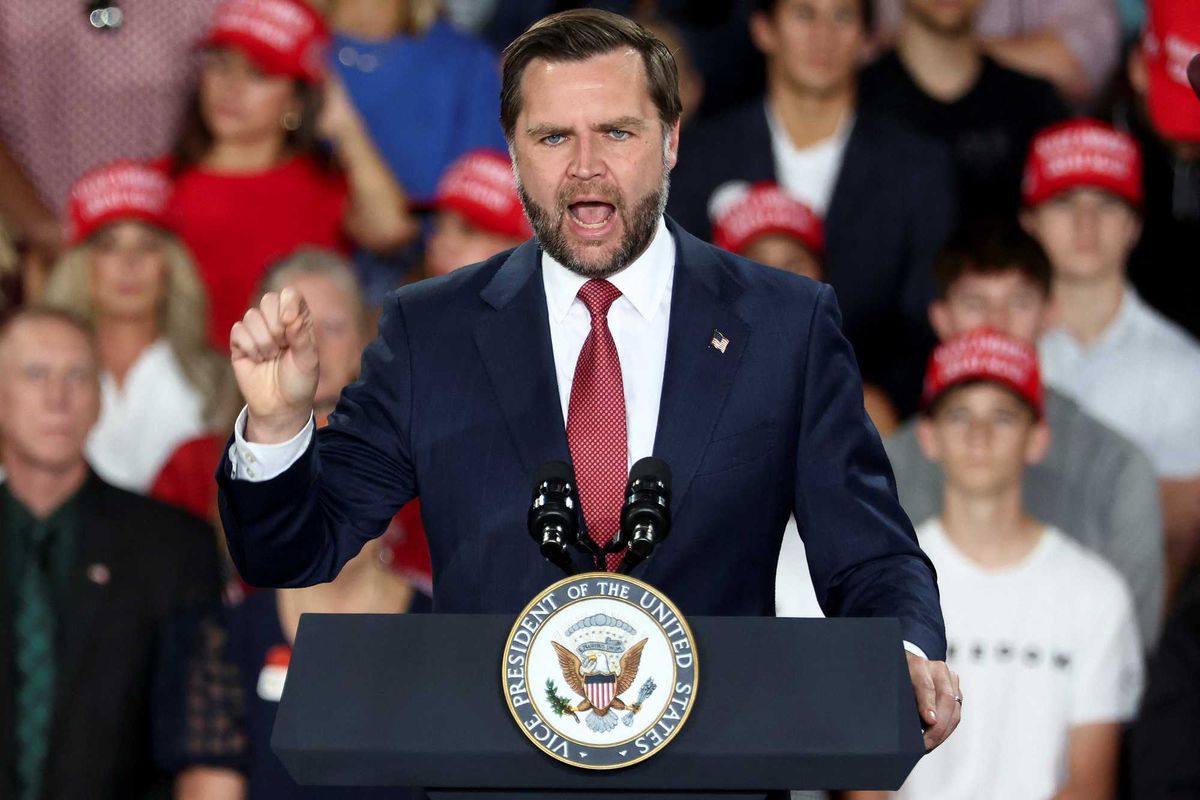
US Vice President JD Vance speaks during a midterm campaign rally to support the GOP gubernatorial candidate Byron Donalds in Lakeland, Florida, US, October 1, 2026. REUTERS/Kevin Lamarque/Pool

Fox News sister network Live Now from Fox cut away from Vice President JD Vance after hecklers repeatedly interrupted his speech at a rally boosting Rep. Byron Donalds (R-FL) campaign for Florida governor.

The network was streaming Vance live Thursday from a Lakeland, Florida, midterm rally paid for by the Trump 47 Committee, according to the event listing. The rally was held to boost Donalds and Sen. Ashley Moody (R-FL), who both spoke before Vance.

Vance was praising Moody when a man in the crowd began heckling him.

"She wants…" Vance said as the man shouted over him.

"She wants to make sure…" he tried again.


"We got a clown over here, ladies and gentlemen," Vance said as the crowd booed.


"We…" Vance started, before the man shouted again and the audience jeered.

"You know, you always have to laugh at these protesters, because that guy, you know, he pretends like he just broke out into an emotional protest, but he made sure to bring his cell phone at the end of a pole," Vance told the crowd.

"This is not a representative voter from the state of Florida. That guy is a Democrat plant who wants… he wants to raise your taxes and release illegal aliens on the streets of Florida," the frustrated vice president continued. "Well, we kicked him out just like we're gonna kick out the rest of the Democrats who wanna do the exact same thing!"

Vance had moved on to Donalds and his push to help Florida homeowners when a woman began shouting.

"Byron Donalds…" Vance said. "Byron Donalds is fighting to protect…"

The vice president increased his tempo as he struggled to finish the sentence.


"...Florida parents every single day," Vance said quickly.

"USA! USA!" the crowd chanted over the boos as Live Now from Fox cut away from the speech.

"And there you have it, another protester being led out of this rally right here," Live Now from Fox anchor Christina Evans told viewers. As she spoke, the network's footage showed a protester being escorted from the building.

The network soon cut back to Vance as the crowd's "USA! USA!" chant continued.

Within seconds, another woman began yelling.

"And here's the thing," Vance said. The woman kept yelling for several more seconds as boos rose again.


"Now what… What that woman is yelling is that she wants… is left-wing bureaucrats in control of your schools," Vance said, speeding up again to finish over her.

"But Byron thinks you ought to be in control of your kids' schools," Vance said as the crowd cheered and the yelling went on.


Kimberly Guilfoyle 'unfit' to serve after her overseas antics were exposed: lawmakers

Bennito L. Kelty
October 1, 2026 
RAW STORY


FILE PHOTO: Greek Minister of the Environment and Energy, Stavros Papastavrou, U.S. Ambassador to Greece Kimberly Ann Guilfoyle, Greek Prime Minister Kyriakos Mitsotakis, Vice President New Ventures at Chevron, Gavin Lewis, Chief Executive Officer Hellenic Hydrocarbon Resources Management S.A. Aristofanis Stefatos react, after signing Chevron-led consortium contracts for gas exploration off Greece, in Athens, Greece, February 16, 2026. REUTERS/Louisa Gouliamaki/File Photo


President Donald Trump's ambassador to Greece, Kimberly Guilfoyle, faces calls for her removal after reportedly pulling a lobbyist into meetings with foreign officials.

Guilfoyle, a former Fox News host who was once engaged to Donald Trump Jr., was confirmed to the post last year. The Wall Street Journal reported Thursday that top lawmakers on the House and Senate foreign affairs panels have pressed Secretary of State Marco Rubio to examine her conduct. They cited a recent Journal investigation into her campaign to promote natural gas deals involving a Greek company across southeastern Europe.

"If these reports are accurate, Ambassador Guilfoyle is unfit to represent the United States abroad and should be removed from her position," Rep. Gregory Meeks (D-NY) wrote in a Wednesday letter to Rubio.

Sen. Jeanne Shaheen (D-NH), who supported Guilfoyle's confirmation, sent her own letter Thursday. "Such actions do not serve U.S. credibility overseas and risk undermining U.S. diplomacy," she wrote.

The lawmakers want records of every meeting attended by Christos Marafatsos, a registered lobbyist for Aktor Group. Aktor's joint venture with a Greek state-backed energy firm signed a 20-year agreement last fall to buy American liquefied natural gas from Venture Global. They also asked about Guilfoyle's financial interests and her travel on private jets, including one flight covered by Aktor's chief executive. Former embassy staffers told The Journal that ambassadors rarely fly private and need explicit approval to do so.

The Journal previously reported that Guilfoyle clashed with Greece's energy minister at a March dinner in Athens. Referring to Romania's government, which was then nearing collapse, she allegedly said, "We can do that to any country we want. We can do that here." Her lawyer disputed that account, per The Journal. Romania's government fell in a no-confidence vote in May.

A U.S. Embassy official in Greece said Guilfoyle "continues to follow all State Department ethical guidelines" and that "any insinuation that she was operating outside of ethical guidelines are categorically false."

A lawyer for Aktor told The Journal, "The Ambassador has been consistently promoting U.S. interests."

Trump's approval rating plunges to 'extremely rare' level as midterm message flatlines

Matthew Chapman
October 1, 2026 
RAW STORY


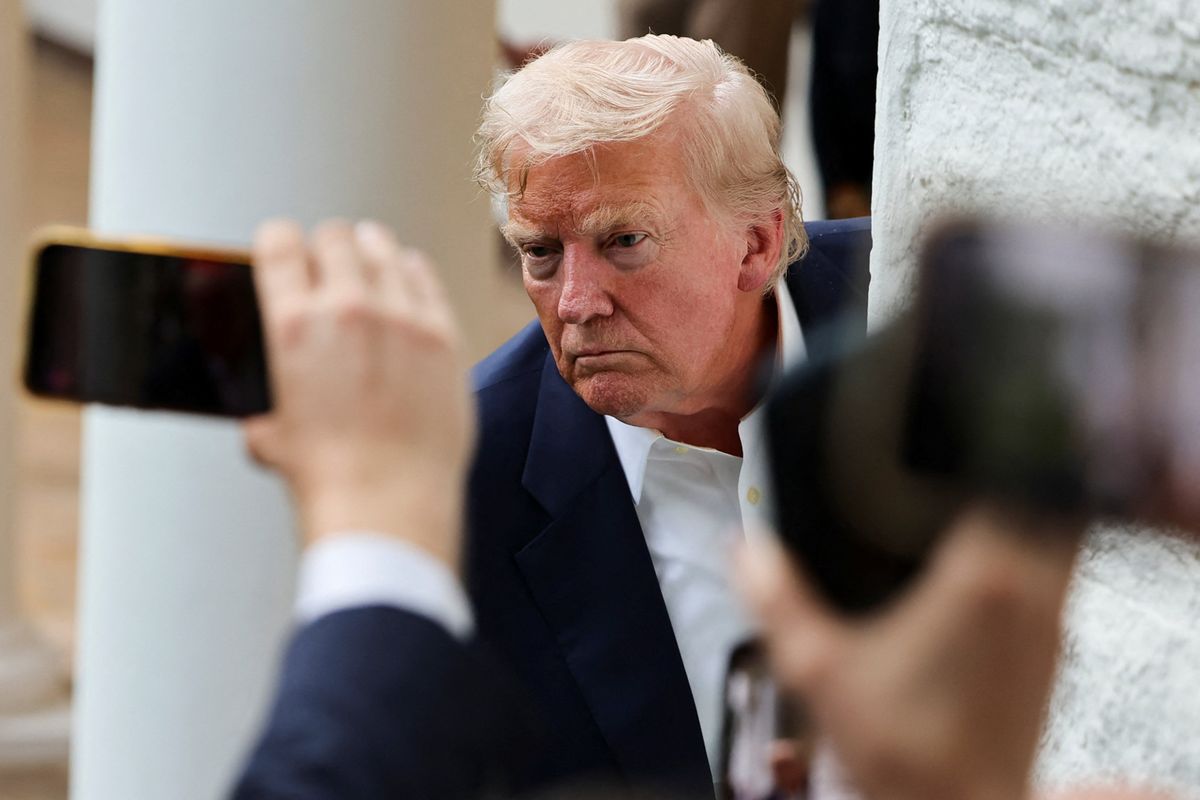
U.S. President Donald Trump looks at media members after returning to the White House from Scotland, Britain, in Washington, D.C., U.S., July 29, 2025. REUTERS/Umit Bektas

President Donald Trump's handling of inflation has become a defining liability of his presidency, with new polling showing roughly 8 in 10 Americans disapproving of his approach to the cost of living.

A new AP-NORC poll released Thursday found Americans disapprove of Trump's handling of cost-of-living issues by a staggering 82 percent to 17 percent margin. Reuters-Ipsos and Marquette Law School polls also put his approval in the high teens, while Marquette and CNN separately found disapproval at 80 percent. Such a level of unity against the president, wrote CNN's Aaron Blake, is "extremely rare" in American politics.

Even within Trump's own coalition, cracks are showing, with at least half of Republicans disapproving across four separate polls, 29% of self-identified MAGA Republicans souring on his handling per Fox News polling, and between 63 percent and 72 percent of white voters without college degrees, historically among his strongest supporters, expressing disapproval as well.

Few issues in recent presidential history have generated this kind of consensus. Economic troubles came close for past presidents; George W. Bush faced heavy criticism over the 2008 financial crash, and Jimmy Carter dealt with similar backlash amid runaway inflation and unemployment decades earlier, but neither reached quite the same depths Trump is seeing now.

Past scandals offer a similar contrast. Ronald Reagan weathered serious backlash over Iran-Contra, and Richard Nixon faced widespread public anger during Watergate, yet both stayed below the threshold Trump has now crossed on economic frustration alone. Even Gerald Ford's deeply controversial decision to pardon Nixon didn't generate disapproval this severe.

The closest Trump himself previously came to matching these numbers was over his decision to pardon violent January 6 defendants, which also fell a few points short of where his inflation numbers sit now.

Despite the historic unpopularity, Trump pushed back in a new Time magazine interview published Thursday, insisting Americans shouldn't blame him for affordability struggles and pointing fingers at Biden instead, even though inflation is currently running higher than when Trump took office. Polling suggests that messaging isn't landing: a clear majority of Americans hold Trump's own policy choices responsible for today's high prices, a far larger share than blamed Biden's policies at a similar point before the 2022 midterms.
Reporter spots nefarious plot behind Trump's exclusive crypto dinner


Matthew Chapman
October 1, 2026 
RAW STORY


President Donald Trump's latest crypto dinner looks like a predatory scheme to steal money from investors, Russ Buettner of The New York Times told CNN's Anderson Cooper on Thursday.

It isn't the first round of shady crypto dealings, he noted, as the whole enterprise has made Trump and his family vastly wealthier.

"Overall, this past year of crypto wealth and Donald Trump's life, I think, has been more income, pure profit than anything else," said Buettner. "Probably the sum total of his entire life and business before ... absolutely more than his inheritance, and the money from 'The Apprentice' and his best business deals all combined."

The other notable aspect, he said, is that "they were so roundly criticized for the first go-round because they offered these coins as he was entering office; 58 people bought them. We can't tell who bought a lot of them and sold them immediately. The period when they owned it raised the price a lot. Those people made all more than $10 million each. Almost everybody else who bought it after that lost a ton of money, I think to the tune of $700 million."

"Which is just incredible when you think about it," said Cooper.

Buettner agreed.

These tokens, he added, are "essentially a baseball card where you don't get the baseball card. It's just a piece of electronic, ephemeral. And it doesn't have any value unless somebody else wants to pay you more for it. You can't use it, typically, to buy other things. And they were really roundly criticized even by the crypto industry for doing what's called a rug pull, which is the equivalent of, like, a pump-and-dump scheme."


BUYING ALASKA VOTES

US ally shoots down Trump's $50 billion investment boast: 'Far beyond what was agreed'

Tom Boggioni
October 1, 2026
RAW STORY


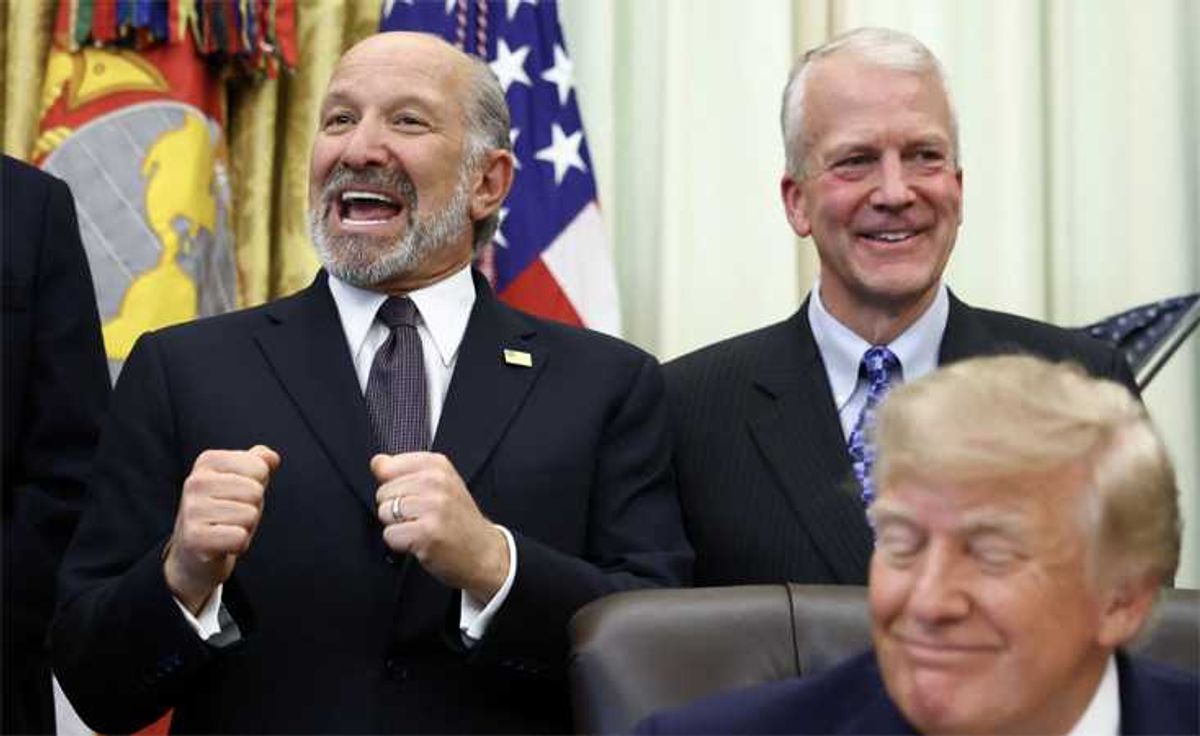
US Commerce Secretary Howard Lutnick speaks about an energy infrastructure project in Alaska as US President Donald Trump and US Senator Dan Sullivan (R-AK) listen in the Oval Office at the White House in Washington, D.C., US, September 30, 2026. REUTERS/Kevin Lamarque

A $50 billion investment deal touted by President Donald Trump during a Wednesday Oval Office event is running into pushback from the ally he says agreed to it.

Commerce Secretary Howard Lutnick told reporters South Korea would invest more than $50 billion in the long-stalled Alaska LNG pipeline project, plus another $120 billion in U.S. nuclear power plants, as part of a "broader trade package."

That earned applause in the Oval Office on Wednesday.

Sen. Dan Sullivan, an Alaska Republican who has pushed the pipeline for years, celebrated on X: "Alaska LNG is happening thanks to a $50 billion+ investment from South Korea that we announced today at the White House. This project will deliver low-cost energy for Alaskans for generations and create 10,000+ good-paying jobs. A historic day for our state!"

But South Korea's government says the celebration is premature, the Wall Street Journal reported early Thursday morning.

Industry Minister Kim Jung-kwan pushed back on the U.S. framing, saying "the announcement went far beyond what was agreed, as the countries agreed to proceed with the Alaska project only on the premise that commercial reasonableness is guaranteed," according to the Korea Times.

South Korean President Lee Jae Myung echoed the objection, insisting no blank check had been written.

"We agreed to begin working on the Alaska LNG project on the conditions that, first, its commercial viability is confirmed and, second, it complies with Korea's legal procedures," Lee said.

According to the Journal, Seoul has reportedly secured "a $20 billion annual investment ceiling and a $200 billion overall cap" as part of the broader trade framework, guardrails that leave the specific Alaska pipeline commitment far from finalized despite Wednesday's applause line.


"The clashing versions add another twist to protracted, and often contentious, talks between Washington and Seoul over last year’s trade pact. South Korea has pledged $350 billion in U.S. investments, plus an additional $100 billion for American energy purchases, in exchange for dropping tariffs on most goods from 25% to 15%," the Journal reported.
Trump's trade war wrecked industry he swore he was defending: 'Everyone is losing'

Bennito L. Kelty
October 1, 2026 
RAW STORY


President Donald Trump's trade war with Canada is battering the American dairy producers he has repeatedly claimed to be protecting.

In a Thursday article for "The Bulwark," economics editor Catherine Rampell said U.S. dairy "was supposed to be the one industry President Donald Trump was actually helping." Instead, she wrote, "American dairy farmers are now saying: Please, stop helping."


Trump often points to dairy as proof that Canada cheats the U.S. on trade, and he has put Canada's dairy tariffs at 250 percent or 400 percent, depending on the day. Rampell noted that those steep rates apply only to sales above a tariff-free quota set under the USMCA, the trade deal Trump negotiated in his first term. Citing the International Dairy Foods Association, she reported that U.S. producers have never come close to hitting that cap. The U.S. also sells roughly three times as much dairy to Canada as it buys.

Mateo Kehler, CEO of Vermont's Jasper Hill Farm, told Rampell his Canadian customers disappeared almost overnight last year as tariffs, counter-tariffs and boycotts piled up. His farm's Winnimere cheese recently won Best of Show from the American Cheese Society.

"I can't figure out who's winning here," Kehler said. "Everybody I know is losing."

He added that he doesn't fault Canadian shoppers.

"Honestly, if I were a Canadian consumer, I would not be buying anything from the U.S. either," he said. "This is a time for resistance, and I applaud Canadians for voting with their dollars."

The pressure has grown in recent weeks. Canada began imposing a 25 percent tariff on U.S. cheese last month, and this week Trump banned some Canadian dairy imports, mostly whey products, along with Canadian motorcycles and alcohol, according to Rampell.

Pete Hardin, longtime editor of the Wisconsin dairy publication the Milkweed, said two Wisconsin cheese-plant owners told him their large Canadian orders had been canceled.

"The notion that for dairy, Canada is a problem to the U.S. is a joke, in my opinion," Hardin said.

Rampell had a blunter view, writing that "whatever the f— Trump is doing now is making things worse. For everyone."
Trump started a fight that's giving his rival 'unthinkable' popularity: WSJ

Tom Boggioni
September 30, 2026 
RAW STORY


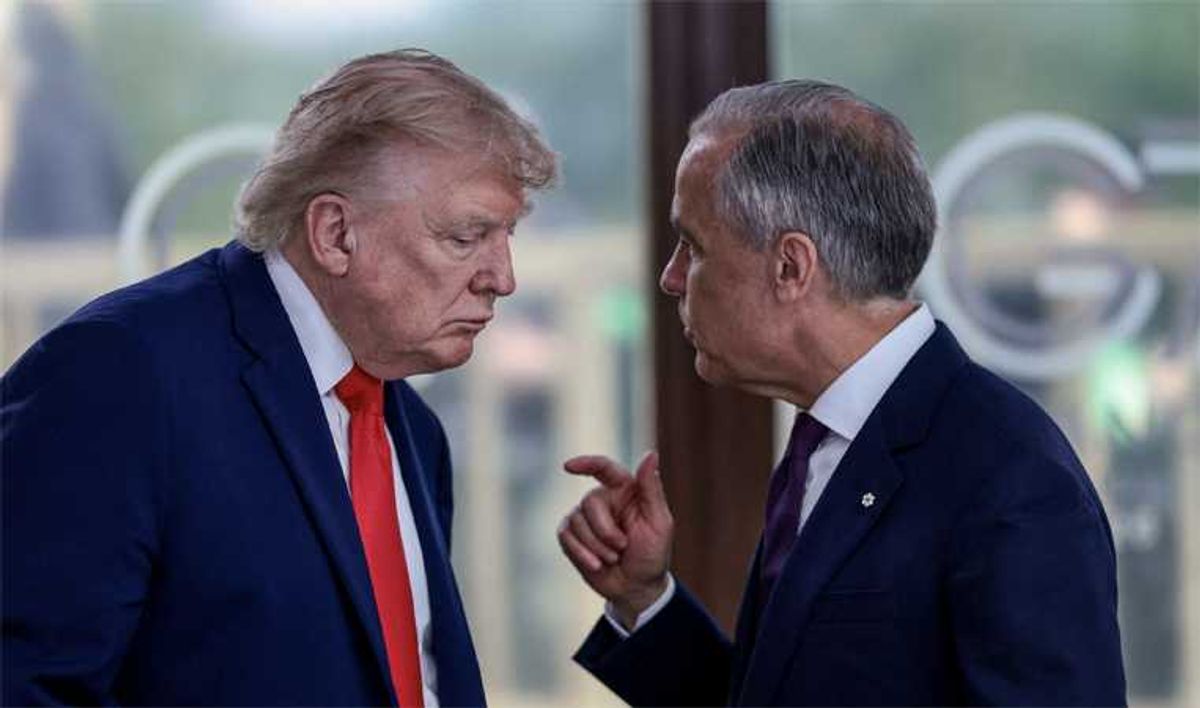
U.S. President Donald Trump speaks with Canadian Prime Minister Mark Carney at a working lunch with leaders of G7 and the Middle East, in Evian-les-Bains, France, June 16, 2026. REUTERS/Evelyn Hockstein/Pool/File Photo

At the same time Donald Trump's approval numbers are hitting lows never seen before, Canadian Prime Minister Mark Carney is enjoying a burst of popularity that's letting him push his agenda through with little resistance.

The reason? His refusal to be bullied by the American president has Canadians and political rivals lining up behind him as his party adds new members.

Carney is barreling forward with "a rewiring of Canada's economic, national-security and foreign policies" that, in some cases, would once have been "unthinkable" and unpopular, according to a report from the Wall Street Journal.

A political novice until he won the premiership last year, Carney has vanquished opposition that might have felled his predecessors thanks to a confrontation with Trump that has given him "unthinkable" popularity.

Polls show Carney's Liberals would win a majority if an election were held today.


According to the Journal, "Polls show that Carney’s Liberals would win a majority if an election were held today. A survey released Tuesday from Nanos Research found that Carney was the preferred choice for prime minister of more than 60% of respondents, the highest level it has recorded for him."

That has lawmakers from "across the political spectrum" defecting to the Liberals over the past year, and his opponents are struggling to land a punch; Conservative leader Pierre Poilievre has spent recent months fending off critics in his own party."


Even in Alberta, a conservative stronghold, people view Carney more favorably than Poilievre or Premier Danielle Smith, according to the report.

"I cannot remember, in my adult life, a prime minister having this good an 18 months," said Darrell Bricker, chief executive of Ipsos told the Journal. "There has been very little pushback against any of the things that he's proposed."

Lori Turnbull, a political scientist at Nova Scotia's Dalhousie University, said Carney likely wanted to pursue many of these policies regardless, but the conflict with the U.S. "gives him a logic, gives him a narrative that might make more sense to people."

She added: "The way he's describing it is essentially we're in an emergency situation, we're in a kind of something that's similar to a war. He's made this about our sovereignty, and so it all kind of fits together."


Thursday, October 01, 2026

'Catastrophic': Swiss glaciers lose fifth of mass in five years


Elodie Le Maou with Agnes Pedrero in Geneva
Thu, October 1, 2026 


Matthias Huss with a four-metre-long measuring stake indicating the amount of ice that melted over the past year on the Scex Rouge glacier (Fabrice COFFRINI)

Switzerland's glaciers, which are disproportionately impacted by climate change, have lost nearly 20 percent of their mass in five years, experts said Thursday, with 2026 registering the second-biggest melt on record.

Swiss glaciers saw 5.5 percent of their volume melt away this year, the Glacier Monitoring in Switzerland (GLAMOS) network found in a new study, published after a record hot summer preceded by a winter with little snowfall.

"The glaciers this year have lost enormous quantities of ice," said GLAMOS chief Matthias Huss, describing 2026 as "a catastrophic year".

Perched on the Scex Rouge glacier, at an altitude of nearly 3,000 metres, he gazed across the landscape in despair.

"This is a glacier that isn't surviving," he said.

"There will be probably no ice in 10 or maybe 15 years."

He carefully dismantled the four-metre-long aluminium measurement stake inserted at the centre of the glacier.

In late July, when it was installed, it was completely embedded, but now more than three metres protrude from the grey surface of the ice.

"It's not that we are surprised, because we know how fast the glaciers are melting," Huss said.

"But to see the colours of the mountains where there is no snow left, there is just these rocks and these dark glaciers that are a relic from the past... it's just incredible."


Between 2022 and 2026, the melt rate at Switzerland's glaciers was "more than twice as high as in any previously monitored five-year period", the GLAMOS report said, noting an ice volume loss of almost 20 percent since 2021.

While Switzerland's glaciers have long been shrinking, the melt has recently sped up dramatically.

While 10 percent of Swiss ice volume disappeared between 1990 and 2000, 27 percent was lost in the past 10 years, the report showed.

GLAMOS based its findings on extensive measurements at 23 reference glaciers in September, which it extrapolated to the nearly 1,300 glacial formations still found in Switzerland.

- 'No chance of surviving' -

The report comes after a summer where the months of June, July and August were each the hottest ever recorded in Switzerland since measurements began in 1864, according to the Swiss Federal Office of Meteorology and Climatology.

This year, the protective snow cover on the glaciers had already partially disappeared during the June heatwaves, and had completely disappeared by September, even at high altitudes, GLAMOS said.

"Alpine glaciers have no chance of surviving in the long term under such conditions," GLAMOS said in a statement.

Due to significant melting this year, the researchers even had to reposition measurement stakes -- including on the highest-altitude glaciers -- further up after the ice melted away in the original locations.

The average ice thickness of some glaciers decreased by 2.5 to 4.0 metres, while the more exposed glacier tongues saw losses of up to 10 metres of thickness over the summer.

- Rhone and Aletsch Glaciers -

Although temperatures were higher this year, the ice loss did not surpass the record set in 2022, since many glaciers saw more snow before the summer melt than they had four years ago.

Less dust from the Sahara Desert also settled on the glaciers this year, allowing more sunlight to be reflected back into the atmosphere rather than being absorbed by the snow.

There were exceptions, however.

Four major glaciers experienced record melting this year, including the iconic Rhone Glacier and the Aletsch -- the biggest glacier in the Alps.

As the glaciers retreat, concern is meanwhile growing over the future availability of water resources.

Between July and September this year, the glaciers lost a total of around 2.2 trillion litres of water.

Huss said that quantity was "difficult to imagine".

"It's more than four times the annual freshwater consumption of Swiss households," he pointed out.
‘The Lion King’ Got It Backward. 6 Years of GPS Data Just Revealed Lions May Be the Villains in This Famous Rivalry


Jeremy Phillips
Wed, September 30, 2026
A-Z Animals.


Pair of adult Lions in zoological garden© ArtMediaFactory/Shutterstock.com

Key takeaways

GPS data from six years of tracking lions and hyenas in Namibia and Botswana revealed that hyenas tend to avoid lions, with 8 out of 10 tracked hyenas moving away from lions within 10 kilometers.

In The Lion King, the hyenas are the villains: sneaky, greedy, always creeping toward the lions' food. Real hyenas spend a lot of their time doing the opposite.

For six years, scientists in Namibia and Botswana fitted lions and spotted hyenas with GPS collars that logged where each animal was every five minutes. When they lined up the tracks of lions and hyenas moving near each other, one pattern showed up again and again. The hyenas were walking away from the lions, and the lions weren't walking away from them.


The rivalry we think we know

I grew up on that movie too, and it plants a pretty clear picture: hyenas as the thieves, lions as the noble ones defending their turf. Our own coverage of the real rivalry tells a different story. Hyenas tend to avoid lions, and lions often treat hyenas as pests they'll attack given the chance. Pop culture loves the idea of sneaky hyenas stealing a lion's kill, but in reality it usually runs the other way. The Ngorongoro Hyena Project, a team of biologists who study wild hyenas, says lions steal more food from hyenas than hyenas steal from lions, and there isn't much a hyena can do about it besides lying down and waiting for the lion to finish.


Lion vs. Hyena: The Similarities and Differences Between These African Predators

So if you could watch every step both animals took, day after day, who would actually be moving toward whom?

Six years of collars

This wasn't a researcher parked in a truck with binoculars. Seventeen lions and 14 spotted hyenas wore GPS collars that recorded a position every five minutes during their most active hours, and over six years, from 2013 to 2018, those collars sent back 349,163 positions. Picture a dot on the map every five minutes, for six straight years, whether or not a human was anywhere nearby to see it.

The study ran in two places: Etosha National Park in Namibia and the Chobe-Linyanti area in Botswana. Ten times, a lion and a hyena happened to have collars logging positions at the exact same five-minute moments, which let the researchers line up their movements step by step and see who was heading toward whom. The team says this kind of tracking can stand in for watching the animals directly, in places where following them on foot just isn't possible.


When Numbers Matter: 30 Hyenas Challenge a Male Lion
©Mark Sheridan-Johnson/Shutterstock.com


The hyenas kept leaving

Here's the part that would surprise anyone who grew up rooting against the hyenas: they were the ones with cold feet. Within 10 kilometers of a lion, 8 of the 10 tracked hyenas spent more of their steps moving away than toward it. Zoom in closer, to 5 kilometers, and all nine pairs with usable data showed the hyena retreating, every single one strongly enough that it wasn't just chance.

A hyena's odds of moving toward a lion were 0.461, a coin landing on "away" slightly more often than "toward". The researchers say that lean showed up no matter which of the three separate ways they checked the numbers.

One pair makes the whole pattern easy to picture. Lion OF-34309 and hyena SA-33872 had their collars logging at the same moments, and the two animals moved in opposite directions. The lion's toward-ratio was 0.687, a clear and significant approach. The hyena's was 0.299, just as clearly a retreat. Same two animals, same patch of ground, and one of them was closing the distance while the smaller of the two was opening it.


See What Happens When the King of the Jungle Gets Annoyed with a Group of Hyenas
©AfricaWildlife/Shutterstock.com

So were the lions the ones chasing?

Here's where the headline needs to get more specific, because the lions didn't behave as one group. Across the whole population, lions showed no consistent lean toward hyenas at all: the overall chance of a lion moving toward a hyena was 0.517, which sits right on the coin-flip line of 0.5. Only three of the ten pairs showed a significant approach by the lion.

But here's the sentence that matters most. The researchers write plainly: "If hyena activity were aversive to lions, we would expect lion movement relative to hyenas to be biased toward retreat in at least some dyads. We see none."

No lion in the study avoided a hyena, not one.


Inside the Fierce Rivalry Between Lions and Hyenas
©MintImages/Shutterstock.com

And the lions weren't all the same. Male lions leaned toward hyenas: across three male-lion pairs, the mean toward-ratio was 0.573, and all three male pairs came in above the coin-flip line. Female lions, meanwhile, sat at 0.486, which is basically a coin flip. The researchers had actually guessed this before they ran the numbers, predicting that male lions would track hyenas more consistently than females, which is part of why they take the pattern seriously even though it's small.

I'll be honest, two animals is a small number. The male-lion result rests on just two unique lions across those three pairs, and the difference between males and females wasn't statistically significant, meaning there weren't enough animals to be fully sure it isn't chance. And none of this tells us why. The collars record positions and times, not motives. "Villain" is the movie's word, not the scientists'. What the data shows is a lopsided rivalry: the hyena moves off, the lion holds its ground, and if that lion is male, it drifts a little closer.

Why nobody caught this before

This is the part I keep thinking about. Earlier studies that looked at whole landscapes, tracking which parts of a park each species used, found that spotted hyenas don't systematically avoid lions. From far away, that looks like the two species sharing the neighborhood without much fuss. Zoom in to a single afternoon, though, and the hyena in front of a lion is leaving. The fine-scale, step-by-step data caught something the landscape-level studies were never built to see.


Wild Dog Pack Miscalculates Attack On Lone Lioness
©A-Z Animals

That zoomed-in avoidance fits with other things we already know about hyenas adjusting around lions. Hyenas have been found to be more active in daylight in places where lions are present, likely to dodge competition. And hyenas only steal food from lions when they have the numbers to drive them off, rarely doing it when male lions are around, because the presence of a male lion is a significant deterrent to that kind of mobbing. That lines up neatly with the GPS finding: the one kind of lion hyenas are least willing to crowd is the same kind of lion the collars show drifting toward them. The researchers add that hyenas don't respond to lions with one fixed rule; individual hyenas are known to react differently depending on the situation.

The hyenas in the movie creep toward the lions, cackling and scheming. The hyenas wearing collars in Namibia and Botswana spent six years doing the opposite, keeping their distance from an animal that never once leaned away from them. It's sense, given who actually steals from whom. The scientists won't call anyone a villain, and this piece won't either: the collars record where each animal went, not what it wanted.

But if you had to point at who's leaning into this rivalry, the tracks point at the lions, and at the males most of all.



Kurdish leader in Iraq slams 'shameful' withdrawal of US forces

DPA
Sun, September 27, 2026 


PAK Peshmerga members stand stand amidst the debris at the PAKShar camp in Erbil's Ashkawt Saqa district. The Kurdistan Freedom Party (PAK) is a prominent opponent of the Iranian regime based in the Kurdistan Region. (is associated with: «Kurdish leader in Iraq slams 'shameful' withdrawal of US forces»)
Ismael Adnan/dpa


Key takeaways

Prime Minister of Iraq's Kurdish region criticizes US withdrawal from the country as "shameful" due to vulnerability to attacks.

The prime minister of Iraq's Kurdish region has described the imminent withdrawal of US forces from the country as "shameful."

"The threat is real - we are vulnerable, we are being attacked," Masrour Barzani told the Financial Times. "Now, to be left alone without any, let's say, appropriate defensive system, it's shameful."

The Kurdish regional government could not purchase its own air defence systems, he said. Only the central government in Baghdad could do so.

The withdrawal of US forces from Iraq is due to be completed by September 30, this coming Wednesday. The move was agreed in 2024, after the combat mission against the extremist militia Islamic State was declared over in 2021.

US forces invaded Iraq in 2003, when ruler Saddam Hussein was toppled. After the mission ended in 2011, US troops returned in 2014 to fight Islamic State.

Since the start of the Iran war in February, the Iraqi Kurdish region has been struck by hundreds of rockets and drones, including an attack on Barzani's own office.

Iran regards the autonomous Kurdistan Region as an ally of the West and Israel on Iraqi soil. Erbil is home to a multinational base where US and German soldiers are stationed. That base has also come under fire. US forces repelled some of the attacks.

The Kurds are an ethnic group of an estimated 30 million people living mainly in Iraq, Iran, Syria and Turkey. They have fought for decades for their own state and were long persecuted and suppressed in both Iraq and Iran.

The semi-autonomous Kurdish region in Iraq emerged after the fall of Saddam Hussein in 2003. Before that, the region had been protected by a no-fly zone enforced by the US military from 1991. Relations today between the Kurdish government, based in Erbil, and the central government in Baghdad are marked by ongoing disputes.