Friday, October 02, 2026

Trump’s 'so-called businessman' myth in ruins as he wrecks economy: experts


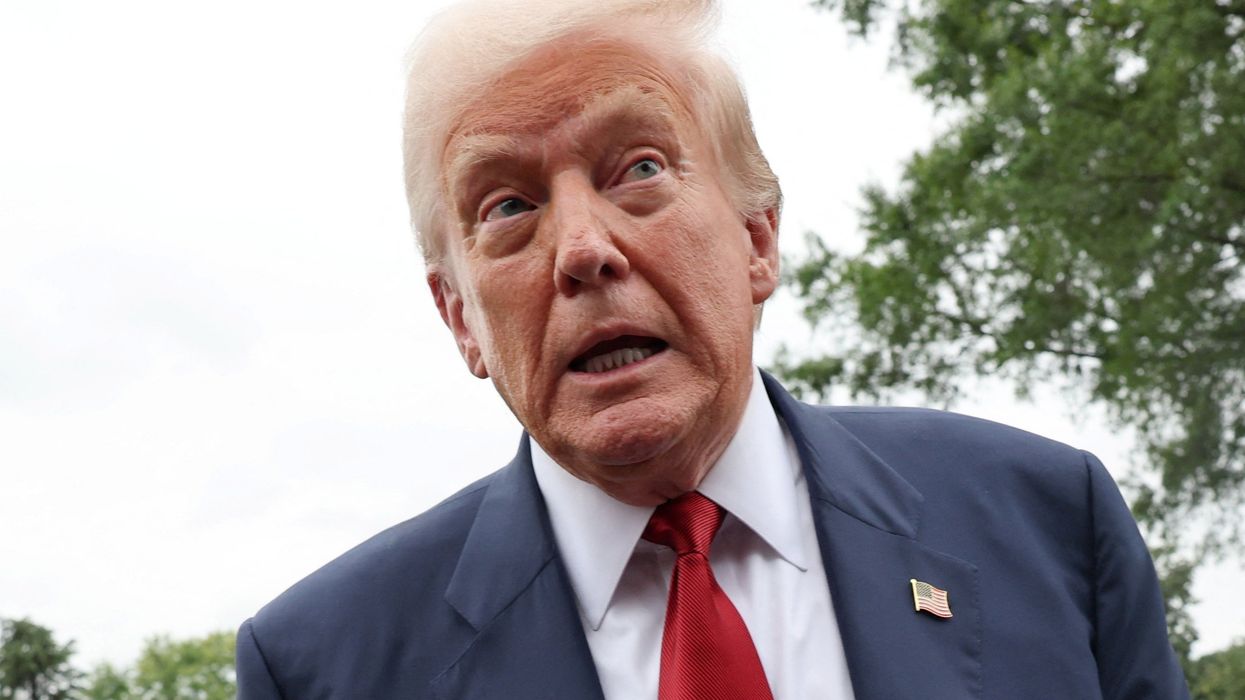
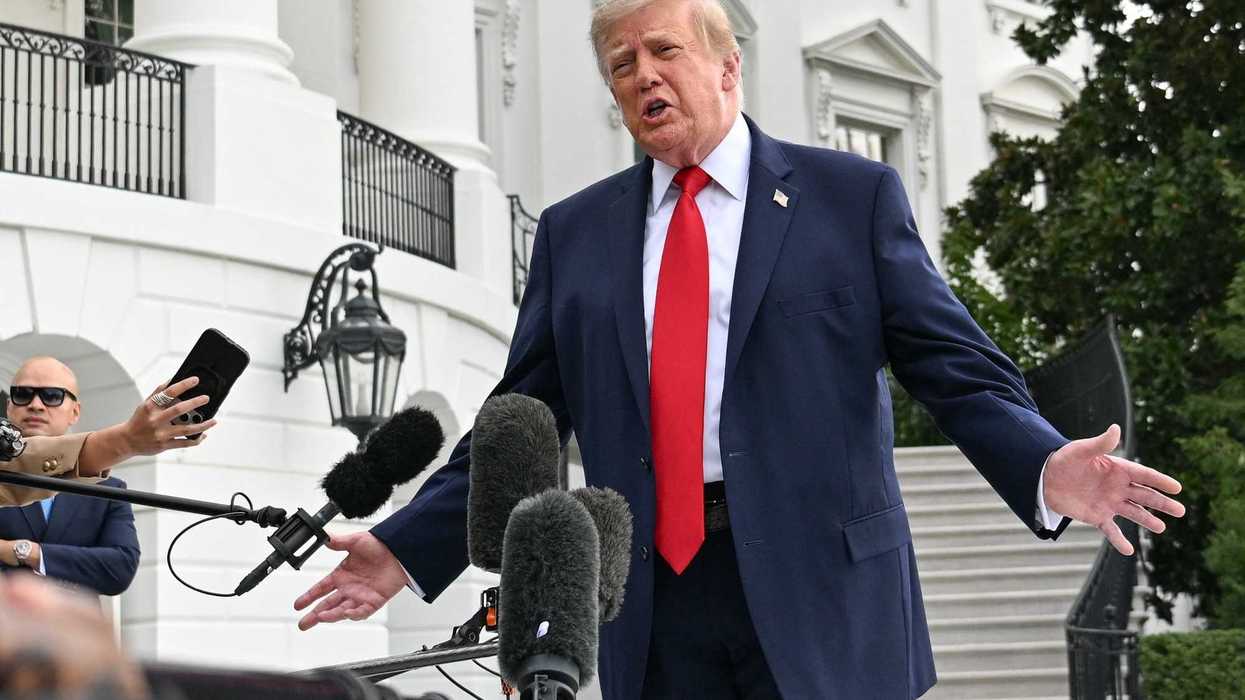
US President Donald Trump speaks to the media as he departs the White House on the South Lawn in Washington, DC, US, September 26, 2026. REUTERS/Annabelle Gordon
September 28, 2026 
ALTERNET


In 2024, President Donald Trump was elected largely because voters hoped his background in business would equip him to help bring down prices. But by September of 2026, writes the New Republic editor Michael Tomasky, the myth of “so-called businessman” Trump’s financial acumen has been destroyed as a growing number of experts admit that his policies have a recession on the way.

“About once a month,” explains Tomasky, “I go to Google News and type in the single word ‘recession’ just to see what comes up. Most of the time, the headlines are reassuring: ‘Despite downturn, experts don’t see recession coming’ — that sort of thing. Sunday, the headlines read a little differently. ‘Is the World Staring at a Big Stock Market Crash — and Recession? 5 Uneasy Signs.’ ‘The Fed Just Raised Interest Rates. Recession Is Next.’ ‘Billionaire investor Leon Cooperman sees a recession in 2027 and a stock drop ahead.’ ‘Legendary economist Gary Shilling says consumer signals point to a recession in the next 12 months.’ And so on.” While many factors can contribute to a recession, according to Tomasky, the driving force behind the current economic decline is obvious: the whole thing has been caused by Trump.

“Every decision he makes is the wrong one and makes the situation worse,” writes Tomasky. “Take the tariffs. The Tax Foundation keeps track of the economic impact of the tariffs Trump promised would ‘liberate’ us. Short answer? They’ve been a disaster. They increased taxes on the average American household by $1,000 in 2025, will reduce long-run gross domestic product by 0.4 percent, and more.” Then there’s the war with Iran, which has wrought wide-ranging economic damage. Even so, Trump has just rejected Iran’s latest offer for negotiations and to end the war within seven days, apparently because he thinks he can secure a better deal.

According to Tomasky, the list of Trump’s economic missteps goes on, but it all comes down to one thing: “Trump is wrecking the economy. And he’s wrecking the economy for the same reason that most Republican presidents wreck the economy.” As Tomasky explains, ever since the GOP began emphasizing unregulated markets in the 1970s, Republican presidents have consistently presided over “economic calamities,” with five of six seeing the economy crumble under their watch. According to Tomasky, “It’s not a coincidence that the last five recessions, and seven of the last eight, have happened under Republican presidents.”

“The reason is that they believe in economic nostrums that are either lies or fairy tales,” asserts Tomasky. “Lie: that lower taxes can produce revenues equal to or even greater than higher taxes. Fairy tale: that the unregulated free market will unfailingly find solutions to society’s problems. As we’re seeing right now with cryptocurrencies and AI, the unregulated free market of the sort we have in this country now creates more problems than it solves.”

While Trump’s previous term saw one such economic calamity, it was caused in large part by pandemic pressures beyond his control. But as experts are once again warning that recession looms, this time, concludes Tomasky, “it will be entirely on him. He may have driven the country into the ditch, but at least he will have exploded the ‘we need a businessman’ myth.”
Anxiety reaches fever pitch as Wall Street sours on Trump economy


REUTERS Jonathan Ernst
September 29, 2026
ALTERNET

Bloomberg reports analysts and investors alike are finally wising up to President Donald Trump’s up-and-down roller coaster of oil prices, and they’re finally settling in for a long-term slog with Trump in the White House.

“The conflict in the Middle East and the implications for forward inflation remain the primary macro narrative and are likely to dictate price action in US rates for the foreseeable future,” BMO Capital Markets’ Ian Lyngen told Bloomberg as a Tuesday drop in oil prices failed to keep stocks and bonds from sliding into an ugly drop.

Previously, Wall Street investors had rallied whenever Trump announced progress in ending his unilateral war on Iran — which has bottlenecked global oil supplies and driven up prices on the international market. But Tuesday drop in oil prices “did little to allay Wall Street’s concerns that still-elevated energy costs could fuel inflation and spur Federal Reserve rate hikes,” according to Bloomberg.


This means Trump’s magic button for temporarily manipulating stock markets with unreliable claims of peace now appears to be failing. Bloomberg reports the dollar rose and Brent crude dropped below $103 a barrel as the Trump administration ordered another release of oil from emergency reserves amid a stalemate in US-Iran talks — but to no avail with investors.

“In economic news, US job openings fell to a five-month low, suggesting employers grew more cautious about expanding their workforces toward the end of the summer, while layoffs remained subdued,” reported Bloomberg. “Consumer confidence dropped to the lowest level since 2014,”

eToro’s Bret Kenwell told Bloomberg that the latest labor-market data reinforces the “low-hire, low-fire” backdrop that has taken hold of the nation, and he added that lagging consumer-confidence “should not come as a surprise.”

“Sentiment now sits at multi-year lows as persistent inflation and higher costs weigh on households,” Kenwell said. “The question becomes whether we’ll see this materialize into weaker consumer spending — a question that earnings season will help answer.”

But in the meantime, Bloomberg reports market worries sent Treasury 30-year yields to the highest level since 2002. Most companies in the S&P 500 fell, with the gauge posting back-to-back losses.

The year 2002, notably, was marked as a terrible time for the U.S. economy with former President George W. Bush’s onerous tax cuts raiding federal coffers and Bush’s disastrous war in Iraq devastating budgets and consumer confidence.
D.E.I.

Trump targets the 60-year 'Star Trek' legacy that built modern NASA


Screenshot/Desilu-Paramount Television
September 08, 2026 

“Star Trek” began as a television series but grew into a cultural phenomenon.


When it premiered in 1966, no one could have predicted that it would lead to more than a dozen spinoff shows, more than a dozen movies and one of the most enduring fandoms in popular culture.

“Star Trek” is also unusual for its close connections to NASA, both in its storylines and in the real world. Decades of “Star Trek” adventures have ignited a love of spaceflight across generations, inspiring many who now work as space professionals.

I’m a cultural anthropologist who studies why people work in space exploration. I’ve interviewed astronomers, engineers, flight surgeons and astronauts. Although I focus more on science fact than science fiction, I’ve noticed in my interviews how much the two threads intertwine.

Because of this, I found myself at a “Star Trek” convention in early August 2026, just ahead of the show’s 60th anniversary on Sept. 8. The convention participants included people of widely different ages, appearances and identities. I was struck by just how much those gathered reflected the series’ values.
When NASA met Star Trek

In the original series, the show’s creator, Gene Roddenberry, came up with a philosophy held by the Vulcan people. He called it IDIC: infinite diversity in infinite combinations. It suggests that an ideal society is made up of many different types, all working together.

It represented Roddenberry’s rejection of conformity. It also explained why the Enterprise crew included a Russian alongside Americans, and Black, Japanese and female characters all in positions of responsibility and authority. While many ordinary viewers absorbed “Star Trek’s” lessons of camaraderie and acceptance, those involved in real space exploration also took notice

. 
The cast of ‘Star Trek: The Original Series’
 included a diverse crew of characters. Walters Art Museum

Roddenberry established relationships with NASA personnel in the early days of his series. NASA provided photographs of planetary bodies and advice about the realities of spaceflight, as well as stock footage and access to certain NASA facilities.

Leonard Nimoy, who played the popular character Mr. Spock, was even brought to the National Space Club’s Goddard Memorial Dinner in 1967 as a special guest. Then-Vice President Hubert Humphrey gave the keynote speech. Afterward, though, it was Nimoy, not Humphrey, who found himself surrounded by the club’s members, including NASA employees, aerospace engineers, members of the military and government officials, all eager to meet the actor portraying the starship Enterprise’s first officer.

The relationship between NASA and “Star Trek” benefited the show by legitimizing the series. It also helped NASA by publicizing its work and depicting a positive future where its efforts to land on the Moon would eventually lead to visits to distant worlds – and amazing scientific advances like the show’s transporter and warp drive.

The connection between the space show and space agency was reflected in NASA’s decision to name its first space shuttle Enterprise, after some encouragement from the “Star Trek” fan community.
Inspiring astronauts

In 1977, actress Nichelle Nichols, who portrayed communications officer Uhura, was hired to recruit for NASA. The space agency had expanded its pool of astronauts to include scientists and other “mission specialists.” For the first time, an astronaut no longer needed to be a pilot to participate in a space mission.

NASA selected its first Black astronaut candidates and its first female astronaut candidates in 1978. While this move toward inclusivity may not have been directly influenced by infinite diversity in infinite combinations, it was compatible with it. “Star Trek” inspired many of NASA’s future employees. In interviews for my book “The Ultraview Effect,” a quarter of the space professionals I spoke with mentioned “Star Trek” as an influence.

 
Nichelle Nichols sits in the space shuttle simulator at the Johnson Space Center in March 1977. NASA

An Apollo astronaut I interviewed, for instance, said he believed humans would eventually “be able to go anywhere in the universe, just like ‘Star Trek.’”

A young engineer who had grown up in the 1990s told me his motivation came from the “opening line of ‘Star Trek’… to explore strange new worlds.”

A space shuttle mission specialist emphasized Roddenberry’s decision to make the starship crew multicultural, explaining: “Today I look at the diversity of it … he was setting the stage back when it wasn’t acceptable [in order] to be acceptable!”
A changing future

That influence has accompanied a changing astronaut corps.

Both the 2025 astronaut class, which for the first time included more women than men, and the crew of Artemis II, which sent the first woman, first Black astronaut and first Canadian on a lunar mission, resemble the future that “Star Trek” imagined.

The “Star Trek” fans at the convention I attended were even more diverse. It was clear to me that Roddenberry’s “infinite diversity in infinite combinations” isn’t just a concept from the series, but something that has become a defining value of contemporary Trek fandom.

NASA’s Spitzer Space Telescope captured a region of the galaxy that looks a little like the USS Enterprise, which NASA highlighted in a news release in 2016. NASA/JPL-Caltech

One such fan, Bjo Trimble, holds special status. She is credited with “saving ‘Star Trek’” when the series was almost canceled in 1968 after two seasons. Wearing a rainbow “IDIC” pin, she signed autographs at the SyFy Sistas booth, where T-shirts featuring Black “Star Trek” icons such as Uhura and Benjamin Sisko were on display.

However, with the Trump administration’s recent orders to dismantle all of NASA’s diversity, equity, inclusion and accessibility programs and policies, institutional support for “Star Trek’s” vision of acceptance and inclusivity, which flourishes in its fan base, is being undone. This rollback occurred just as NASA’s crews were reaching new milestones in representing the diverse future that “Star Trek” has encouraged for decades.

Sixty years later, some of the diverse future that “Star Trek” imagined has become part of everyday spaceflight. Other parts of that ideal remain unfinished.

Deana L. Weibel, Professor of Anthropology, Grand Valley State University

This article is republished from The Conversation under a Creative Commons license. Read the original article.

Left Behind: Trump is abandoning the evangelical base that elected him


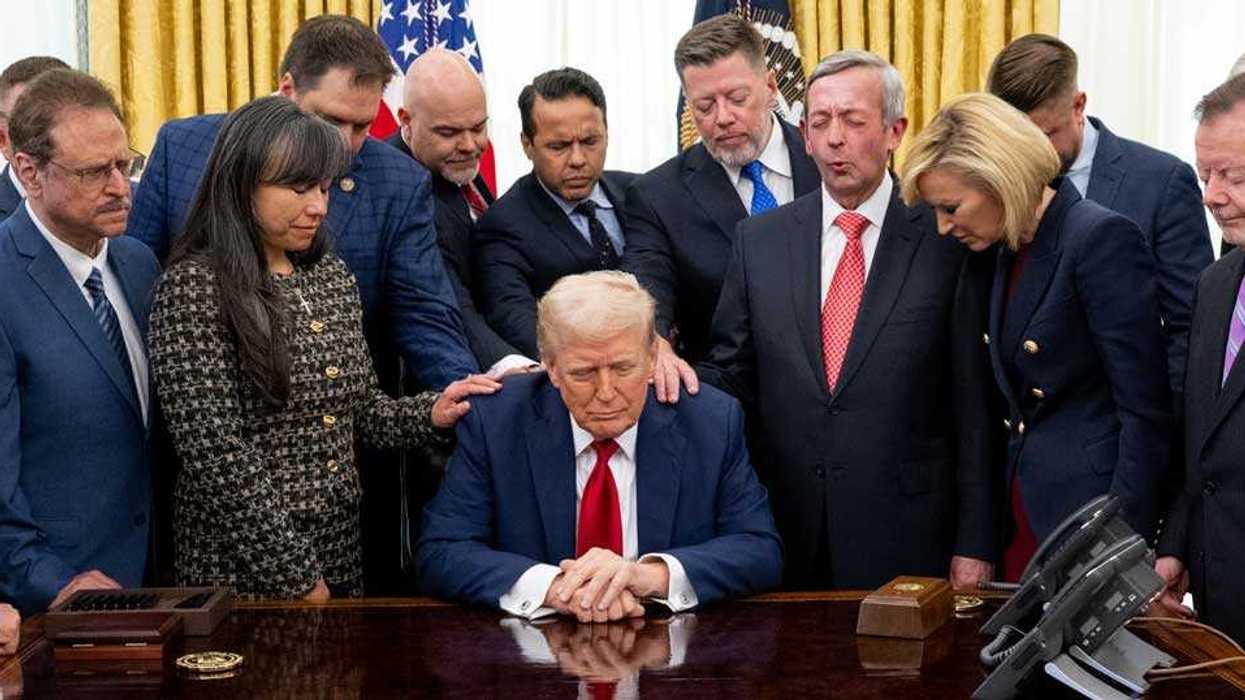
(Official White House Photo)
September 29, 2026
ALTERNET


President Donald Trump long relied on evangelicals and other religious Christians to power his presidential campaign. Now, according to a recent report by The Bulwark, these same devout individuals are finding that Trump is abandoning their political interests.

"One of the major subplots in American politics over the past half-decade is evangelical Christians—the political constituency without which Trump would have never been elected president—becoming the dog that caught the car," wrote The Bulwark's Joe Perticone on Tuesday. "They just haven’t had much reason to go to the polls since June 2022, when the Supreme Court overturned the legal right to an abortion in its landmark Dobbs v. Jackson Women’s Health Organization decision."

Perticone added, "The Family Research Council’s Pray Vote Stand Summit was once a marquee political gathering for evangelicals and their allies in politics. But at this year’s event in Leesburg, Virginia, decline was evident everywhere, from the downsized venue far outside the Beltway to the sparse attendance and general lack of interest from elected officials. When the organization’s leader, Tony Perkins, addressed the audience, it became clear that he has been relegated to the D.C. sidelines after enjoying years of high-contact play as a leader in the anti-abortion movement."


The reporter added that Tony Perkins, who leads the Family Research Council, has called out Trump as well as a Democrat they more traditionally oppose, former President Joe Biden.

"Throughout the event, he expressed frustration with the Trump administration for a lack of interest in addressing abortion rates, and with Congress for claiming to be pro-life while showing little follow-through," Perticone observed. He quoted Perkins as saying that "we’re fighting for this life issue that many people thought was solved in 2022 when the Court overturned Roe, but it’s more of a battle today than it was then,” continuing that conservatives “have an administration that’s not as committed to it as we’ve seen before.”


Perticone also detailed how several prominent Republicans have snubbed the once-hot ticket of going to the Family Research Council events.

"House Speaker Mike Johnson moved from confirmed speaker, to no longer on the roster, to appearing via Zoom on the final day," Perticone wrote. "Rep. Keith Self (R-Texas), Rep. Mary Miller (R-Ill.), Sen. Katie Britt (R-Ala.), and Sen. James Lankford (R-Okla.) all appeared on the confirmed speakers list at one point or another, but none was on the final roster. Sen. Roger Marshall (R-Kan.), who is struggling through a surprisingly tight race this November (ironically, facing a Democratic nominee who pastors a megachurch), also dropped off the confirmed speakers list at some point this summer."

While the Christian right today is rife with anti-Semitism, racism and misogyny, there are also individuals within the movement who criticize Trump for his intolerance. For example, earlier in September MAGA loyalist Tim Moore wrote an editorial for Washington Examiner arguing that Trump's anti-immigrant agenda is abandoning persecuted Christians in non-white countries.


"There’s one confusing inconsistency in Trump’s defense of Christians, though, and as a stalwart supporter, I fear he may be listening to some bad advice on this theme that could significantly depress evangelical turnout in November," Moore wrote.


After pointing out that Biden had welcomes 29,478 Christian refugees from 50 countries during his term, in 2026 Trump had invited none.

"Countries like Afghanistan, Burma, Iran, and the Democratic Republic of Congo," Moore wrote, saying that among the 50 countries on the Watch list roughly 388 million people are persecuted for their religious beliefs.


"And hundreds of thousands were newly forced to flee their homes because of religious persecution," he added.

Fundamentalist legal group dives into church fight with Native Americans


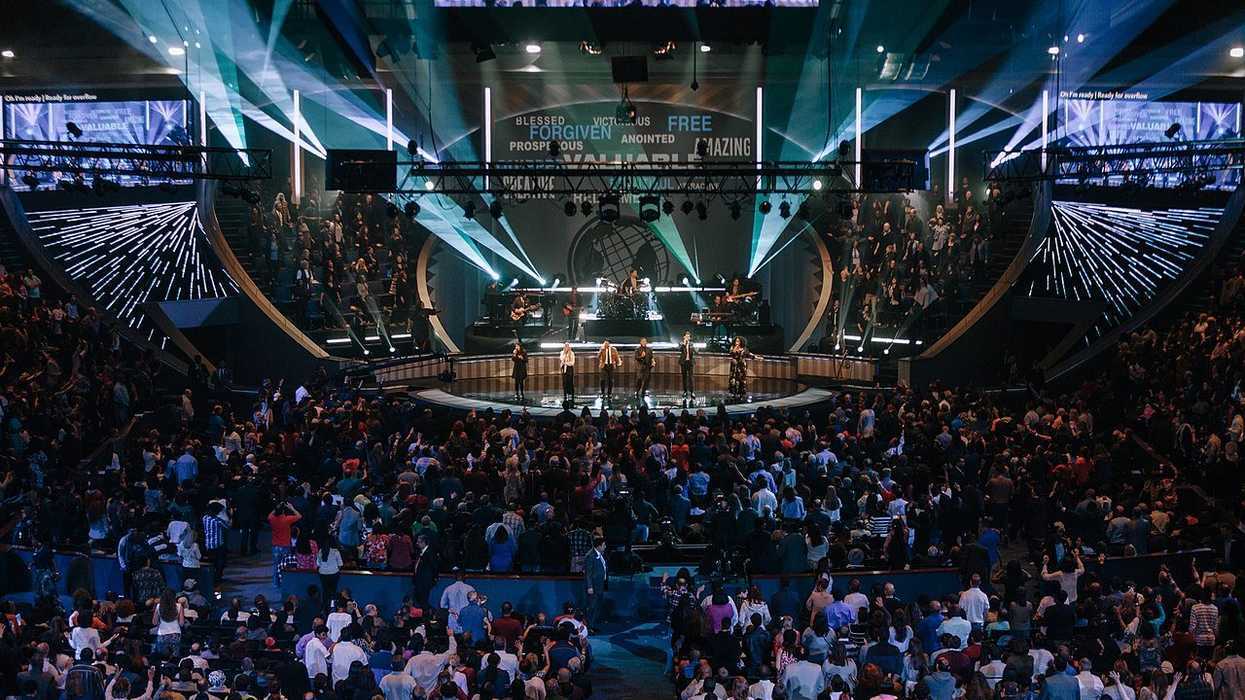
An evangelical megachurch in 2019 (Wikimedia Creative Commons)

September 24, 2026
ALTERNET 


Founded in 1989 during George H.W. Bush's presidency, the Christian fundamentalist legal group Liberty Counsel has a long history of representing white evangelicals in far-right causes. The Florida-based nonprofit has a new client: Foundations for Nations, a Wyoming church being asked to leave a Native American reservation. And Liberty Counsel is representing the church on a pro bono basis.

According to WyoFile reporter Maya Shimizu Harris, Foundations for Nations is "facing demands to leave the Wind River Indian Reservation after its pastor delivered a sermon urging Native congregants to renounce Northern Arapaho traditions has a formidable ally in its corner as tensions continue to simmer."

"Last month," Harris explains, "the Foundations for Nations church lodged a complaint with state and federal agencies against the Food Bank of Wyoming, alleging the organization unlawfully cut off its support on the basis of religious, political and racial discrimination. According to Foundations For Nations Pastor Sarah Lucas, Food Bank of Wyoming ended the partnership after her controversial sermon, telling her that it was in response to a call claiming her message was discriminatory, the Ranger reported."

Liberty Counsel, Harris reports, "filed the complaint on the church's behalf" and "is providing legal services to the church for free."

Richard Mast, senior litigation counsel for Liberty Counsel, is claiming that Foundations For Nations' situation is a free speech/freedom of religion battle.

Mast told WyoFile, "When a matter arises in their local area, we reach out to them, offer them an opportunity to participate, and we are frequently taken up on that. We appreciate our local counsel in Wyoming … People have reached out to us from Wyoming. We've come to their assistance, and at least one of those cases I recall was successful."

Over the years, Liberty Counsel has repeatedly clashed with liberal and progressive attorneys — many times, in cases involving gay rights and abortion.

"In addition to filing the discrimination complaint," Harris notes, "Liberty Counsel sent a letter to Northern Arapaho Business Council Chairman Keenan Groesbeck in July after the council had adopted a resolution stating that outside organizations should consult with the council before initiating or expanding recurring organized activities on lands governed by the Northern Arapaho Tribe. While stating that the church believes it's in compliance with the resolution, the letter asserted that the church 'requires no authorization' from the Northern Arapaho Business Council 'to conduct religious activities on its own private fee simple property,' and that the church 'will not be leaving its property.'"

Harris continues, "Following Lucas' sermon, the Northern Arapaho Business Council told church officials to leave the reservation, and some called on the Northern Arapaho and Eastern Shoshone tribes to use the 'bad men' clause in their treaties with the U.S. government to oust the church from the reservation. But in an August 31 resolution, the Northern Arapaho Business Council stated that it doesn’t regulate activities on the church’s private property, and that it hadn't designated the church or any person as 'bad men.'"
More Americans are becoming liberal —and it’s not for the reason you think


REUTERS/Aaron Schwartz
September 29, 2026
ALTERNET

President Donald Trump's policies, which in some respects have broken from traditional Republican doctrine, have reportedly pushed many Americans to the left — and caused Republicans to become far angrier than other political groups.

This is the conclusion that was reached in a study published by the journal American Politics Research earlier this year and first covered by mainstream media on Tuesday. Noting that Americans often become more liberal during Republican presidencies and more conservative during Democratic presidencies, the researchers found that this trend continued during President Donald Trump's first term but then persisted during President Joe Biden's administration.

Additionally, the study found that "the long-term increase in affective partisanship was given a further jolt with Trump’s election and presidency, with Republican in particular showing a noticeable increase in partisan animosity. This further short-term increase in affective partisanship is associated with the increases in partisan differences on some issues."


"The research was conducted by Alan Yang, a senior lecturer at the School of International and Public Affairs at Columbia University, and Robert Y. Shapiro, a professor in Columbia’s Department of Political Science and School of International and Public Affairs," reported PsyPost journalist Eric W. Dolan on Tuesday. He added that Yang and Shapiro told him that “we were interested in whether the election of an ‘untraditional’ Republican president in 2016 may have upended or accelerated past patterns of opinion change, partisan divergence, and ‘affective partisanship.'”

Per Dolan, "To explore these questions, the researchers analyzed data from the 2016-2020 American National Election Study (ANES) and the 2016-2020 General Social Survey (GSS). Both datasets are uniquely useful because they use panel designs, meaning they surveyed the exact same individuals at multiple points in time. This setup allows researchers to track whether an individual actually changed their answer from one election year to the next."


He continued, "The team examined 32 specific policy questions from the ANES and 40 questions from the GSS. These questions covered a wide range of topics, including government spending, racial equality, immigration, foreign affairs, and social issues like abortion and gay rights. The researchers tracked how responses changed between 2016 and 2020 across the entire sample and within specific political groups. To measure affective partisanship, the surveys used a feeling thermometer scale. Respondents were asked to rate their feelings toward Democrats and Republicans on a scale from 0 to 100 degrees, with higher numbers indicating warmer, more positive feelings."

Dolan also pointed out that the study's methods, though thorough, were not perfect.

"The relationship between emotional animosity and policy opinions is also highly complex," Dolan explained. "The data shows an association between the two, but untangling which one causes the other is a challenge. People might develop stronger negative feelings toward the opposing party because they disagree on policy, or they might change their policy views because they want to distance themselves from a party they dislike. Both processes likely happen at the same time."

Speaking to AlterNet in August, University of Bristol cognitive scientist Stephan Lewandowsky argued that one reason Trump supporters have become so angry is that the president feeds into their various prejudices.

"There's so much tied up in this," Lewandowsky told AlterNet. "There's latent racism. There's religion. There's the general conservative idea that poor people are — it's their fault, they're just lazy, everybody is responsible for what happens to them… except me, because I'm a farmer, and therefore I'm not lazy, and I've tried everything, and I deserve a subsidy."

Comparing Trump's movement to a cult, cult expert Steven Hassan told AlterNet in August that people can try to ease them out of their views through compassion and respectful dialogue.

"What works best is a warm, respectful, curious, questioning approach: 'Help me step into your shoes,' or 'I'm really curious what you think about this or that,'" Hassan wrote. "Referencing other cults that the person knows — Trump supporters will listen to conversations about Chinese communist brainwashing, and they'll be open to learning about Lifton's model [for helping people reform their ways of thinking]. Many of them who got into Trump through the QAnon psyop are open to hearing about traffickers and pimps, and how they recruit, groom and indoctrinate people to become sex slaves or labor slaves. So what I'm trying to convey is that an indirect approach is the most effective way to help people in the cult of Trump start reality-testing."
Warning US Is ‘Moving Toward a Surveillance State,’ Sanders and AOC Propose Crackdown on Flock Cameras

“AI-powered cameras are keeping track of our every move and weaponizing this data against working people to make record profits,” said Rep. Alexandria Ocasio-Cortez.


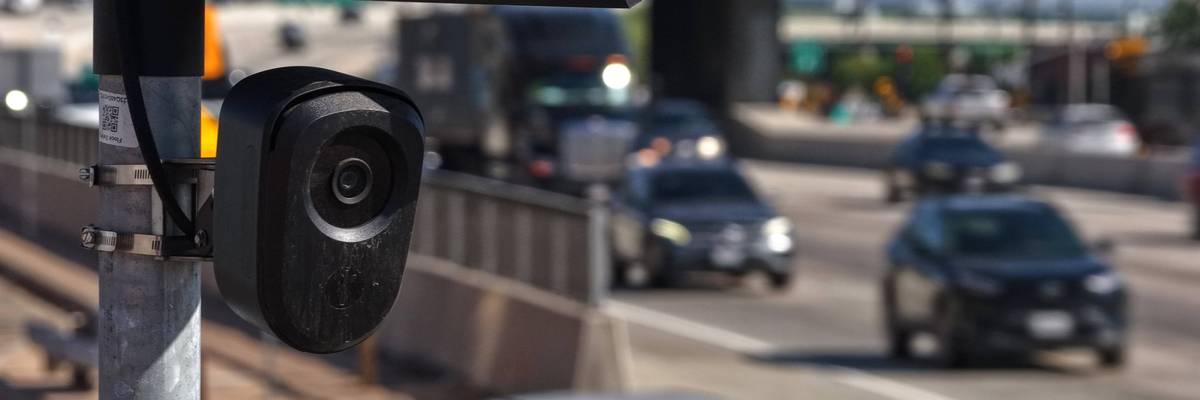
A Flock camera is seen on September 14, 2026 in Burbank, California.
(Photo by Justin Sullivan/Getty Images)

Jake Johnson
Oct 02, 2026
COMMON DREAMS

Sen. Bernie Sanders and Rep. Alexandria Ocasio-Cortez introduced legislation on Friday that would crack down on artificial intelligence-powered Flock cameras increasingly used—and abused—by law enforcement agencies across the United States to track and log vehicle data.

Sanders (I-Vt.) said in an interview with The Washington Post, which was first to report on the new legislation, that the US is “moving toward a surveillance state where a handful of giant companies make huge profits by giving the government, by selling to the government, the power to track our every move.”

According to a summary released by Sanders’ office the Ban Flock Act would bar the federal government from using automatic license plate readers (ALPR) or accessing the information that they gather. The legislation would also halt federal grant funding to state and local governments that use ALPRs and allow Americans to “sue the federal government for violation of their rights through the use of automatic license plate readers.”

Sen. Jeff Merkley (D-Ore.), who joined Sanders and Ocasio-Cortez (D-NY) in sponsoring the legislation, said in a statement that the maker of Flock cameras, Flock Safety, is “selling its cameras nationwide, laying the groundwork for a surveillance state while enriching corporate executives.”

“Your right to privacy includes the freedom to move around your community without every move being monitored,” said Merkley. “No one should have this unchecked surveillance power at their fingertips, which is why I’m teaming up with Sen. Sanders to rein in this dangerous technology.”

Ocasio-Cortez warned that “across the country, Big Tech companies like Flock Safety have built a mass surveillance system to harvest Americans’ private and personal data without their consent.”

“AI-powered cameras are keeping track of our every move and weaponizing this data against working people to make record profits. The widespread integration of this technology into American society is unconscionable,” she added. “I am proud to introduce the Ban Flock Act with Sen. Sanders to enforce our constitutional right to privacy and protect Americans from both corporate and government surveillance.”


The new bill comes after President Donald Trump and his FBI director, Kash Patel, defended Flock cameras as useful tools for law enforcement, even as investigations showed significant abuses. One such investigation, published by the libertarian Institute for Justice in August, “identified well over 100 incidents of ALPR abuse, including romantic stalking, wrongful stops and detentions, non-law enforcement use, and other types of misconduct.”

Trump nevertheless told reporters in September that “I sort of like them... because of law enforcement, but some people don’t.”

“They think it’s an infringement,” said of the cameras’ critics. “I like them.”

According to the ACLU, Flock operates more than 120,000 ALPRs nationwide.

“Flock’s ALPR cameras aren’t like your normal traffic cameras,” the group noted. “This surveillance technology records and tracks every car that comes into view, and then an AI algorithm catalogs the make, model, color, license plate number, bumper stickers, and even scratches. This personal information is then uploaded into a nationwide database that any law enforcement agency with a Flock contract can search—with few regulations or oversight on how they use what they find.”

Sanders said in a statement Friday that “at a time of growing concern about the unchecked power of artificial intelligence, Flock is eviscerating the very notion of privacy by installing tens of thousands of cameras in communities across America without their consent.”

“Going to the doctor? Flock knows. Dropping your kid off at school? Flock is tracking you. Flock is always watching,” the senator said. “We cannot allow America to become a surveillance state where a handful of AI oligarchs profit by giving the government the power to track our every movement.”


Cornell University Journalists Kept Rape Case in Spotlight

“We have the right to demand safety from our university administrators,” said one student journalist.

By Shireen Akram-Boshar , 
Truthout
Published
October 1, 2026

A student walks on the campus of Cornell University on September 29, 2026, in Ithaca, New York. The New York state attorney general has announced a review of the university’s initial response to allegations by a former Cornell student that she was raped at a campus fraternity in 2024.Spencer Platt / Getty Images

Truthout is a vital news source and a living history of political struggle. If you think our work is valuable, support us with a donation of any size.

Student journalists at Cornell University who have relentlessly pursued the story about the alleged gang rape by seven fraternity members on campus are demanding accountability from their institution.

“The Sun is really asking for something that everyone deserves, which is a level of transparency and accountability,” Sophia Dasser, editor-in-chief of Cornell’s student paper, told CNN’s Erin Burnett on Tuesday. “We are students, we have the right to demand safety from our university administrators, and we have the right to demand things like anonymized data reports of outcomes and sanctions and punishments from [sexual assault] cases that were reported.”

On September 16, Jane Doe filed a civil lawsuit accusing seven members of a campus fraternity of drugging and raping her in October 2024. The lawsuit also names the university and university leaders — as well as a local bar, the fraternity, and her sorority — for failing to protect her.

In November 2024, a month after the assault, the Tompkins County District Attorney had declined to file charges against the fraternity members accused of rape. But Jane Doe’s civil suit released new details — including messages in the fraternity’s group chat in which the alleged perpetrators encouraged other men to join — that sparked widespread outrage, pushing the DA’s office to reopen the case.

Central to this push was Cornell’s independent student newspaper, The Cornell Daily Sun, which published an editorial shortly after Jane Doe’s September lawsuit — “Cornell Won’t, We Will.” The piece began by naming the seven men accused of rape and sexual assault, and went on to condemn the university for its treatment of the case.

“We ask the questions the University has left unanswered,” the editorial team wrote. “If Cornell follows the law, then we should have access to a public deposition issued from the school, the Title IX investigation opened in January 2025 and how it concluded. Why were these men allowed to ‘pursue their education in a secure and nourishing environment’ and [Jane Doe] was not? Why was she not informed of the outcome of her own Title IX investigation? Who benefited from the 23 months of elapsed time when the public knew nothing? “

“Cornell has failed to protect its students,” the editorial concluded, and “failed to address the growing issue of sexual assault on campus with its pathetic task force.”

The student newspaper — one of the oldest student newspapers in the country – has reported on the case since 2024.

“I really wanted to look at what was happening,” student journalist Cereese Qusba, who has reported on the story for The Sun, told CNN on Tuesday. “I wanted to find out where the defendants were, what happened to the Title IX proceedings, what happened to a criminal investigation. So I started to look into this and I was able to get in contact with Jane Doe, and communicate with her and with her lawyers.”

But The Sun did not stop at coverage of the case. It has also demanded that the university revise its approach to handling sexual assault on campus.

“To The Sun, it was extraordinarily concerning that the last we had heard on any solution from the case was a sexual assault task force that had approached sexual misconduct as an educational problem, one that could be solved with workshops and lectures and website links,” said Dasser. “The individuals who would probably be committing the sexual misconduct are not the ones who would be showing up to these workshops. So we fundamentally believe that this was a poor approach to this issue.”

In a September 29 letter from the editor — “Cornell Won’t Listen, We Will” — Dasser fended off the university’s statements that have put blame on reporting of the case, writing: “We know reporting on a case does not make survivors less safe; silence does.”

The newspaper has also pointed out the university’s double standard in punishing Palestine solidarity activists more harshly than alleged perpetrators of sexual violence. On September 27, The Sun published an anonymous guest submission — “Cornell’s Dereliction of Duty” — pointing out that the university had arrested students for engaging in a sit-in that called for divestment from Israel in early 2024.

In the fall of that year, punishments for student activism in solidarity with Palestine became even harsher, the article states, “entail[ing] not only arrests but also months-long disciplinary proceedings and partial campus access bans.” At the same time, five of the seven men accused of rape were allowed to remain on campus following the Title IX proceedings, and their punishment largely focused on writing essays, the article notes.

The Sun has announced that on Thursday afternoon, Cornell’s Student Assembly will hold an open forum on sexual violence, where students can voice complaints regarding the university’s process. National groups like the Women’s March have now linked their October day of action to the Cornell case, suggesting that coverage of the case could spark wider mobilization against sexual violence across the country.

AOC Calls Out Cornell and ‘Culture of Rape’ as Prosecutors Reopen Campus Assault Case


The congresswoman spoke in Ithaca, New York and other cities ahead of a possible 2028 US Senate run.


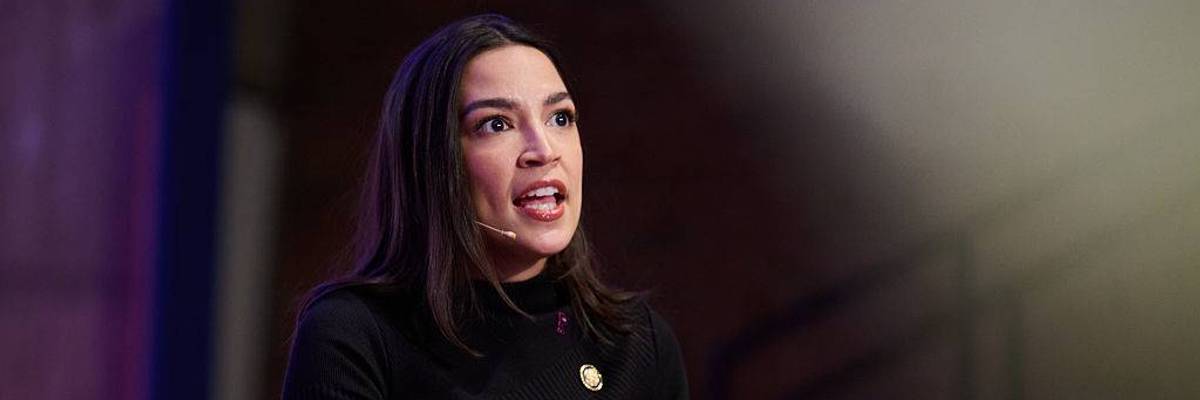
Rep. Alexandria Ocasio-Cortez (D-NY) speaks at TU Berlin on March 15, 2025.
(Photo by Annette Riedl/picture alliance via Getty Images)

Julia Conley
Sep 28, 2026
COMMON DREAMS

As national outrage grew over an alleged rape of a former Cornell University student by seven members of a fraternity in 2024, US Rep. Alexandria Ocasio-Cortez on Sunday condemned a culture in which students accused of sexual assault are “protected” while survivors like the woman in the Cornell case, identified as Jane Doe, are often forced out of their campus communities.

The progressive New York Democrat spoke at a town hall in Ithaca, which has been rocked in recent weeks by the news that Doe filed a lawsuit against the school and several campus organizations and individuals over the alleged crime.

Ocasio-Cortez is visiting several cities across New York State this week, kicking off a voter outreach effort and meeting local officials ahead of a possible 2028 US Senate run. She has also been named as a potential presidential candidate. The event she spoke at Sunday was hosted by More Perfect University and titled “Students vs. Billionaires,” but Ocasio-Cortez began by speaking about the case, which prosecutors on Monday said they were reopening after learning of new evidence.

“The fact that Jane Doe, that survivor, lost her education—because you can’t stay in school when something like that happens to you... the fact that she had to lose her education and those men were protected by an institution and granted an Ivy League degree as a reward—never again,” said Ocasio-Cortez. “Never again.”


The Cornell case centers around an incident that allegedly took place in October 2024 at the Chi Phi fraternity house in Ithaca, according to the plaintiff’s lawsuit.

The student was visiting a friend at the house and was intoxicated when two male students coerced her into snorting a substance that they said was ketamine, the lawsuit says. She was then sexually assaulted, and one of the men subsequently sent a message in the fraternity’s group chat on Snapchat inviting other members to assault the victim.

Doe’s attorney, Thomas Giuffra, has said that two of the seven men named in the lawsuit were expelled from the school, while others were temporarily suspended or required to attend workshops or write essays.

Giuffra has also said that the Cornell Police Department did not follow up with Doe after her initial report, and that she was never contacted by a “specially trained detective or district attorney” regarding her allegations.

“In my experience, speaking with an abuse survivor requires delicacy, understanding, and specialized training,” Giuffra told ABC News. “An average university police officer would not have these skills.”

Matthew Van Houten, the district attorney for Tompkins County, New York, told ABC News Monday that his office was reopening an investigation into the case and considering whether to bring criminal charges. He told the outlet that the details of the assault in the lawsuit were “dramatically different” from the plaintiff’s statement to police in 2024, when his office relied on the Cornell Police Department’s investigation.

Two of the men accused in the lawsuit denied to ABC that they had committed sexual assault.

In 2024, Van Houten said, the victim did not allege that she was drugged or that she didn’t consent to sexual activities. He also said his office had not been not provided with a screenshot of the Snapchat messages.

Giuffra suggested the university authorities had not passed the evidence along to the DA’s office for its review of the investigation.

“My client went to the Cornell University Police because a crime was committed,” Giuffra told ABC News. “It was the obligation of the police to investigate the complaints. They were given the group chat inviting the members of the fraternity to rape my client. This was a critical piece of evidence supporting that a crime had occurred. Despite this there was no follow-up with Ms. Doe either by the Cornell Police or the Tompkins County district attorney.”

Ocasio-Cortez said Sunday that the fact that the students “posted in a group chat... means it was normal to them. That means it was acceptable to them. This is a culture, this is norms, these are practices. And what we must do is understand that we cannot protect those spaces anymore. We cannot.”

After the lawsuit was filed on September 14, student journalists at the Cornell Daily Sun expressed outrage at the university’s failure to publicly release information from a Title IX investigation Cornell officials opened regarding the alleged rape, which resulted in the expulsions and lesser punishments of the men accused of the attack.

“Safety is not adjacent to the educational mission—safety is, in fact, its precondition,” wrote the editors of the student-run newspaper. “Cornell has said as much, in the document that governs the student conduct, which announces that it is ‘intended to preserve a higher education community and residential campus where ‘any person’ in the community can pursue their education in a secure and nourishing environment.’”

“So we ask the questions the university has left unanswered,” continued the editors. “If Cornell follows the law, then we should have access to a public deposition issued from the school, the Title IX investigation opened in January 2025, and how it concluded. Why were these men allowed to ‘pursue their education in a secure and nourishing environment’ and she was not? Why was she not informed of the outcome of her own Title IX investigation? Who benefited from the 23 months of elapsed time when the public knew nothing?”

The editorial named the seven men accused in the plaintiff’s lawsuit, writing, “We know who you are and we refuse to let you benefit from this university’s concealment.”

Cornell on Monday released a statement saying it supported the Tompkins County DA’s decision to reopen an investigation into the case, and rejecting claims that officials had not properly sanctioned the men named in the lawsuit.

In Ithaca, Ocasio-Cortez said that “a lot of work” needs to be done at the federal level to protect college students from assaults on campuses.

“The culture of rape,” said the congresswoman, “is protected in elite institutions across the United States, including Cornell University... This entire country is sick and tired of not just financially corrupt, but morally corrupt leadership.”


Preservation Group ‘Gobsmacked’ as Trump Admin Dismisses Public Concern Over Triumphal Arch

By abruptly closing public consultation on the massive project, the administration “decided the public’s role is meaningless, unimportant, and of no value whatsoever,” said critics.


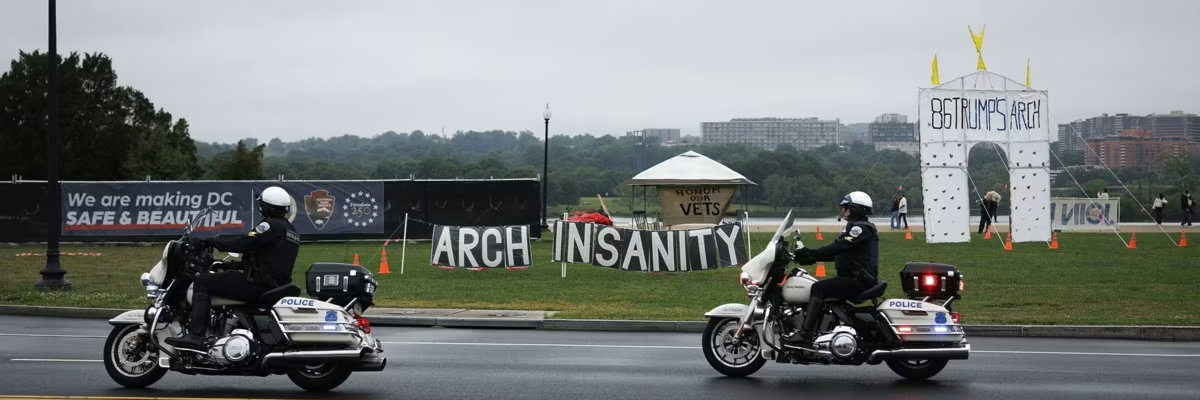
Washington, DC Metropolitan Police Department motorcycle police ride past a demonstration in protest of President Trump’s proposed arch planned to be erected near Arlington National Cemetery, near the Lincoln Memorial on May 24, 2026, in Washington, DC.
(Photo by Tom Brenner/Getty Images)


Stephen Prager
Sep 28, 2026
COMMON DREAMS


A historical preservation group said it was “gobsmacked” on Monday after the Trump administration said it was closing down its consultation with experts about President Donald Trump’s plan for a triumphal arch in Washington, DC, because addressing their concerns and those from the general public would require them to deviate from the president’s vision for the project.

On Thursday, Travis Voyles, the Trump-appointed vice chairman of the Advisory Council on Historic Preservation (ACHP), sent a letter informing civil society and historic preservation groups that it was ending the federal review of how the 250-foot-tall arch would harm nearby historical sites.


‘We Won’t Let Him’: Efforts to Stop Trump Grow as Work Observed at ‘Illegal and Immoral’ Arch

‘No Legal Basis’ to Begin Excavation for Trump ‘Vanity Arch’ in DC, Say Critics


That review is required under Section 106 of the National Historic Preservation Act, which mandates that federal agencies, including the National Park Service (NPS), consider how a project will affect historic properties and seek ways to “avoid, minimize, or mitigate” the harms of a planned project.

The federal regulations governing the Section 106 process explicitly state that “the views of the public are essential to informed federal decisionmaking,” and require agencies to “seek and consider” those views.


The administration, via the NPS, has acknowledged that the Triumphal Arch would have “adverse effects” on historical sites, disrupting views of Arlington National Cemetery, the Lincoln Memorial, and dozens of others. Meanwhile, the proposal has received over 107,000 public comments, most of which are negative, according to a sample from the DC Preservation Office.

But rather than taking the public concern as a reason to reevaluate or scale back the project, Voyles explained that the ACHP was choosing to end public consultation altogether because taking it into account would require changing the “fundamental nature” of the project in a way that the administration would never accept.

“It is clear that the proposed undertaking and its potential effects on historic properties have raised significant public interest, and the NPS stated in its September 22, 2026 correspondence that it believes additional consultation on the existing proposal is unlikely to result in agreement... to resolve adverse effects,” he wrote.

“Further, the NPS stated that implementation of alternatives to avoid or minimize the adverse effects would alter the fundamental nature of the proposed undertaking and fail to achieve its goals,” he continued, explaining that “in recognition of the public’s significant concerns,” they were “hereby terminating” consultation.

Voyles said the ACHP would create its own recommendations and deliver them by October 7 to Interior Secretary Doug Burgum, whose office is overseeing the project. Burgum is legally required to consider and formally respond to those recommendations, but unlike a legally binding memorandum of agreement, he does not have to follow them.

The ACHP has set a deadline for public comments for Tuesday night at 11:59 pm and said it planned another meeting with consulting parties.


One of the outside groups involved in the consultation process was The Cultural Landscape Foundation (TCLF), a national historic-landscape preservation nonprofit, whose founder and CEO, Charles Birnbaum, worked at the NPS for 15 years and was the principal author of the federal guidelines for cultural landscapes.

Section 106 requires consultation to begin “at the early stages of project planning.” But TCLF says the review began only after the Commission of Fine Arts had approved the arch’s design.

Meanwhile, the TCLF has said that it and other relevant preservation groups were invited to only a single meeting on September 9, just weeks before public consultation was terminated. They said this indicated that any real alternative proposals had essentially been taken off the table.

On Monday, Scott MacFarlane of MeidasTouch News published a letter from the TCLF savaging the administration’s “extraordinary” reasoning for canceling the public consultation.

“Mr. Voyles has written a singularly audacious letter,” it said. “Rather than address the ‘public’s significant concerns regarding the adverse effects’ on one of the nation’s most revered and symbolically important cultural landscapes through an authentic public engagement process that doesn’t foreclose avoidance as a precondition, the administration, through its proxy, the ACHP, has decided the public’s role is meaningless, unimportant, and of no value whatsoever.”

The question of historical preservation is one of numerous legal issues facing Trump’s effort to build the arch, which is estimated to cost at least $100 million, though the administration has not published an official price tag.

Although it will be partially funded by taxpayers, Congress has not yet authorized the project, leading to a federal lawsuit seeking to block construction.

Outcry over the public funding for the project led Trump last week to propose using the monument as a “military complex” that would house drones, ammunition, and snipers. He has similarly attempted to justify his taxpayer-funded White House ballroom project by giving it a dual national security purpose.
Trump and RFK Jr.’s Gutting of CDC ‘Should Terrify Everyone,’ Advocates Say

“This is not normal,” said the president of the union representing CDC workers. “What we are witnessing is the dismantling of public health infrastructure our country relies on.”


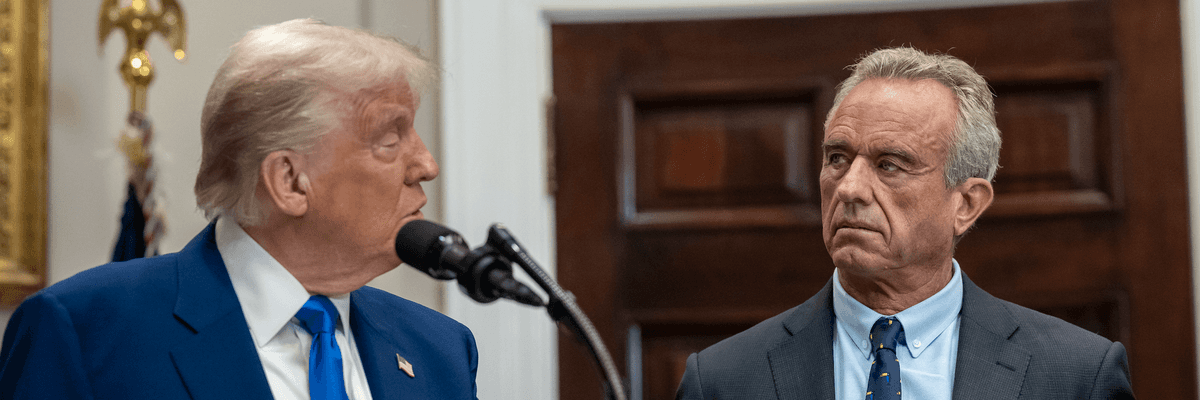
US President Donald Trump speaks while Health and Human Services Secretary Robert F. Kennedy Jr. looks on in the White House in Washington, DC on May 12, 2025.
(Photo by Joyce N. Boghosian/White House/flickr/cc)

Jake Johnson
Sep 28, 2026
COMMON DREAMS


Reporting published over the weekend detailing the “zombified” state of the preeminent public health institution in the US, the Centers for Disease Control and Prevention, sparked deep alarm among advocates and experts, who warned that President Donald Trump’s gutting of the agency leaves the country badly unequipped to handle future emergencies.

“The grim state of affairs at the Trump CDC should terrify everyone,” Brad Woodhouse, president of the advocacy group Protect Our Care, said in a statement on Monday in response to reporting by The New York Times, which shows how Health and Human Services Secretary Robert F. Kennedy Jr. and other administration officials have made the CDC “a skeleton of the powerhouse it was.”

The Times noted that, as of May 2026, the CDC had 30% fewer employees than it did before the Trump administration initiated mass layoffs at the agency and across the federal government last year.

There is also a leadership vacuum at the agency, according to the Times, which reported that “only one of the 11 center directors from March 2025 remains at the agency” and “most of the other centers are being run by acting directors, some of whom were elevated from jobs one or two levels below.” The current CDC director is Dr. Erica Schwartz, who “has made no public statements about the importance of childhood vaccines or corrected misinformation from her boss, Mr. Kennedy,” the Times observed, even as recorded measles cases reach levels not seen in decades.

“Interviews with more than 30 current and former employees reveal the agency is now tightly controlled by Mr. Kennedy and his associates, and its scientists are finding it increasingly difficult to do their jobs effectively,” the newspaper reported.

Dr. Demetre Daskalakis, who headed the CDC’s respiratory disease center before resigning in protest last year, told the Times that the Trump CDC “is not acting like how an agency like that should act.” In his resignation letter, posted to social media in August 2025, Daskalakis warned that “the nation’s health security is at risk and is in the hands of people focusing on ideological self-interest.”

According to the Times, the CDC’s center for emerging and zoonotic diseases, which manages Ebola and hantavirus, “now has nearly 300 fewer employees than in March 2025, and the respiratory disease center has lost nearly 200—about 17% in each case.”

“RFK Jr. has gutted the office that works on dangerous, killer emerging diseases,” US Sen. Chris Murphy (D-Conn.) wrote over the weekend. “Disaster in waiting.”

Woodhouse of Protect Our Care said Monday that “after a catastrophic global pandemic followed by a record-breaking measles crisis, the CDC should be better prepared than ever.”

“Instead, the agency keeps getting caught with its pants down thanks to Donald Trump and RFK Jr.'s self-sabotage and war on science,” said Woodhouse. “Investigations are coming, but resignations should come much sooner.”

The Times reporting coincided with new data from American Federation of Government Employees (AFGE) Local 2883, which represents CDC workers. The union said the CDC has lost over 3,800 employees during Trump’s second term, nearly a third of the agency’s total workforce.

“This is not normal,” said Yolanda Jacobs, president of AFGE Local 2883. “What we are witnessing is the dismantling of public health infrastructure our country relies on.”

“CDC workers have endured eighteen months of chaos and confusion, from detrimental layoffs and RIFs, to being left in a constant state of panic about job security. This turmoil cannot continue,” Jacobs added. “Our workers, who have dedicated their lives to serving the American people, deserve better. Our country deserves an agency that is fully prepared to protect the public’s health within and outside its own doors. Protecting our nation’s public health workers also protects our nation’s public health.”