Friday, October 02, 2026

DeSantis, Cabinet Designate Major Muslim American Group as “Terrorist”

Florida Republicans have spent months maneuvering to grant DeSantis the authority to ban the group.

September 30, 2026


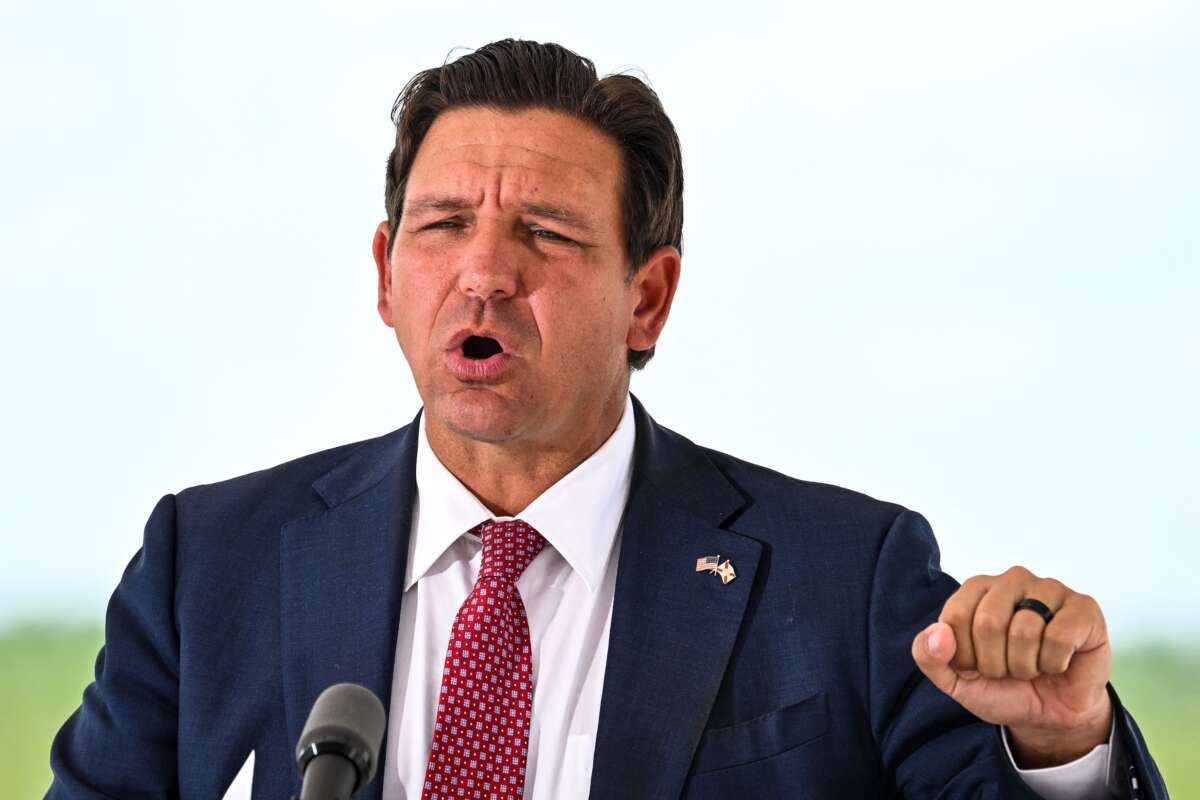
Florida Governor Ron DeSantis speaks during a press conference at the South Florida Detention Facility, nicknamed "Alligator Alcatraz," at the Dade-Collier Training and Transition Airport in Ochopee, Florida, on June 25, 2026.CHANDAN KHANNA / AFP via Getty Images

Far right Florida Gov. Ron DeSantis and his cabinet have voted to designate the U.S.’s leading Muslim civil rights group as a “domestic terrorist organization,” threatening to shutter and impose severe penalties on the group and its state affiliate simply to serve the GOP’s political crusades, critics said.

The 427-page document recommending “terrorist” designations for the Council on American-Islamic Relations (CAIR) and its Florida chapter was approved over the course of just 30 seconds at DeSantis’s cabinet meeting on Tuesday, according to the American Civil Liberties Union (ACLU).

Contained within the approved packet, submitted by the Florida Department of Law Enforcement, were also recommendations for “antifa” and dozens of other groups already named as foreign terrorist organizations by the federal government to be listed as “terrorist” groups.

CAIR is the largest Muslim civil rights group in the U.S. If these designations go into effect, CAIR and CAIR-Florida could be forced to shutter its work in the state.

Because of the broad design of the designation, those who associate with the group could also face harsh penalties. Universities would be mandated to expel students who “promote” the group. And, according to the ACLU, CAIR and CAIR-Florida would be barred from seeking legal representation because their lawyers would face prosecution from the state for doing so.

The ACLU and other legal partners have pledged to file a legal challenge against the designation on behalf of CAIR and CAIR-Florida, preventing it from going into place. ACLU counsel say that, at the meeting on Tuesday, they were barred from being able to present arguments against the designation, which they say was done simply because DeSantis and his Republican cabinet see CAIR as a “threat” because of its faith-based mission.

“Gov. DeSantis’s use of Florida’s dangerous new ‘terrorism’ designation regime against CAIR and its Florida chapter is baseless and unconstitutional,” said Hina Shamshi, who directs the ACLU’s National Security Project. “As the country’s leading Muslim civil rights group, CAIR is being targeted not because it poses a threat to public safety, but because doing so serves a political agenda at the expense of Floridians’ rights.”

The legal filing would build upon the ACLU’s existing lawsuit against the designation, which DeSantis and Republicans have been trying to push through for months. Last December, DeSantis issued an executive order to designate CAIR as a “terrorist” group, but that was quickly paused by a federal judge, who issued an injunction against it. The judge said that DeSantis exceeded his authority in issuing the orders.

Then, in April, the legislature passed two new laws, HB 1471 and HB 1473, aimed at granting DeSantis the authority to make the designations. The newly passed laws grant DeSantis and his cabinet the unilateral power to designate domestic terrorist organizations, ban state funds from being sent to schools with any affiliation with those groups, and ban Florida courts from enforcing Islamic law, or Sharia.

One version of one of the bills, introduced in the Florida Senate, was reportedly authored by DeSantis’s office as he sought more ways to punish student protesters for pro-Palestine demonstrations.

CAIR, meanwhile, issued a statement in January questioning whether DeSantis’s original orders were done in retaliation for the group’s public records request “seeking to expose possible coordination between his administration, Israeli government officials, and anti-Muslim influence networks that have worked to smear Florida Muslims and civil rights organizations.”
‘Gobsmackingly bananas’ El Niño shatters global records


NASA / VIIRS data courtesy of NOAA.
September 27, 2026 | 08:24AM ET

By now, you’ve seen the headlines, and there’s more of them every day: It’s “jaw-dropping.” It’s poised to make global warming worse. California has just declared a statewide state of emergency. This year’s El Niño — a shift in Pacific Ocean trade winds that scrambles global weather patterns — has been hotly discussed as one of the strongest on record, and one that could bring about potentially disastrous consequences. One study projects that it may cause as many as 451,000 heat-related deaths around the world by February.

This story was originally published by Grist. Sign up for Grist's weekly newsletter here.

The current El Niño has also been given an array of eye-catching descriptors. When Jeffrey Shaman, a climatologist at Columbia Climate School, heard the phrase “super El Niño” for the first time earlier this year, he said, “I literally googled it.” The phrase isn’t officially used by the National Oceanic and Atmospheric Administration or the World Meteorological Organization. But he still sees value in the label as a way of communicating the significance of this year’s likely unprecedented El Niño to the general public.


“It’s colloquial, and there’s nothing wrong with that at all,” Shaman said.

By all accounts, this year’s El Niño will also give the world a glimpse into a future of unabated warming due to the burning of fossil fuels — and an opportunity to change course before the worst effects occur.

Back up — what is El Niño?

El Niño is a naturally occurring weather phenomenon that begins when sea surface temperatures in the Pacific Ocean rise above average. Although it doesn’t occur on a set timeframe, it tends to happen every two to seven years. Typically, trade winds blow east to west across the Pacific and push warm ocean water along the equator toward East Asia. But during an El Niño year, these winds slow down and sometimes reverse. The warm water that typically gets dragged westward sloshes back, now toward the western coast of the Americas.

This change in sea surface temperatures has ramifications far beyond the Pacific. It drives extreme weather across the globe, threatening crop harvests in several key agricultural regions, as well as worsening both drought and severe rainfall.


The impact of climate change on El Niño is complex. Research has shown that global warming has led to more frequent El Niños. But El Niño events are also associated with jumps in global mean surface temperature — or the average temperature of the Earth itself, a measure commonly used as a stand-in for climate change. It’s not easy to delineate how much additional warming is from El Niño and how much is from climate change, but what is clear is that the combination will be devastating. This year may turn out to be the hottest year on record, and 2027 may be even hotter. It could be a preview of the typical levels of warming the world might see by 2040, according to one high-end estimate.

Scientists don’t know exactly how that combination will play out. “It’s going to be a very, very strong event occurring against a backdrop of very rapid global warming,” said Christopher Callahan, a climate scientist at Indiana University. “I think we’re going to, unfortunately, learn a lot this year,” he said.
What makes this El Niño ‘super’?


There are many ways to measure the strength of an El Niño event. (NOAA keeps track of several of them here.) Some measure the sea surface temperature in different regions of the Pacific; there’s also indexes that take into account atmospheric changes as well as oceanic ones. The one used most often today is called the “Niño 3.4 anomaly.” In the U.S., in order for NOAA to declare an El Niño event, warming in this region of the Pacific must be 0.5 degrees Celsius above normal. If warming is 1 degree above normal, that gets labeled as “moderate”; if it’s 1.5 degrees above normal, then it counts as “strong”; and if it’s 2 degrees above normal, then it’s considered “very strong.”

The term “super” is broadly considered to be synonymous with “very strong.” However, a recent analysis of sea surface temperatures by Carbon Brief, released this week, shows that as of Monday, warming in the Niño 3.4 region reached 3.11 degrees.

That number is significant, because it means this year’s El Niño has already broken the record for the strongest El Niño, which peaked in November 2015.

El Niño events typically peak around December or January. (Fun fact: The phenomenon was named El Niño by South American fishers who noticed its timing and associated the warmer temperatures with the story of baby Jesus.) It’s possible that sea surface temperatures in the Pacific will drop over the next few months. However, that looks increasingly unlikely. Sea surface temperatures in June, July, and August were the warmest we’ve ever seen, and forecast models show that there is now a 90 percent chance that this El Niño will stay “very strong” through the end of the year.


“I was a little bit skeptical earlier this year of some of the more dire predictions,” said Callahan. But as more data kept coming in, he said, it became clear “that we’re going to see a generationally strong event this year.”
Where did the phrase ‘super El Niño’ come from?

While it might sound like a phrase an overzealous journalist invented, “super El Niño” was actually coined by scientists — a fact that surprised Jovana Vurdelja, an ecolinguistics researcher in Serbia. “I really thought it was just media sensationalism,” she said. The phrase first appeared in a 2003 paper looking at how a strong El Niño can be followed by a strong La Niña, its cooler counterpart, according to Vurdelja.

“Super El Niño” has taken off in English-speaking countries but also across Europe, where it’s been adopted by speakers of Serbian, Norwegian, Italian, German, French, Croatian, and other languages.


When extraordinary weather is on the way, people reach for amped-up language to communicate the scale of the hazard. But finding the right word to match that danger is like trying to find the right shoe size, Vurdelja said. The language can be too small, minimizing the threat, or it can be too big — exaggerations that can lead to nihilism or desensitization. “It’s extremely important that the word communicates the seriousness, the magnitude, the severity of the event itself,” Vurdelja said. She thinks “super El Niño” hits the mark, since it’s been embraced by scientists and the media alike.
What comes after ‘super El Niño’?

If super El Niños become a common occurrence — that is, if warming in the Pacific regularly reaches 3 or more degrees above normal — the language we use to describe these events may need to evolve. Some scientists have already suggested that the phrase du jour doesn’t go far enough: “This is going to be so far beyond a super El Niño, if the models are right, that we sort of need a new term for it,” the climate scientist Zeke Hausfather said in the podcast Shift Key last month.

We’ll “need stronger words, stronger language, and that’s when we get into this spiral,” Vurdelja said. That’s how you end up with scientists reaching for words like “mind-bogglingly crazy” and “gobsmackingly bananas” (a phrase Hausfather coined) to describe record heat. The term “Godzilla” El Niño, now taking off in news headlines, was coined by NASA climate scientist Bill Patzert in 2015.


The official categories for what counts as a strong El Niño used to make sense. “We hadn’t gotten above 2 degrees Celsius except occasionally,” Shaman said, and so the language experts initially settled on “seemed like a reasonable place to be.”

Whatever you call it, the most important thing will be planning for the potential impacts of this very strong El Niño — to understand what it means for food production, hydropower generation, public health, and extreme weather in the coming year. Given California’s recent state of emergency declaration, for now, maybe “super” will do just fine.

This article originally appeared in Grist.

Trump DOJ on a new mission to clear Nixon’s name
October 01, 2026
ALTERNET


According to a new exclusive report by the Wall Street Journal published on Thursday, the Department of Justice is seeking to relitigate the legacy of disgraced former President Richard Nixon. “For nearly two years, the Justice Department has made it a priority to investigate people who previously investigated President Trump,” writes the Journal. Now, “the department is reviewing whether the special prosecutor’s office that investigated the famed Watergate break-in committed misconduct, according to people familiar with the matter, more than half a century after that scandal led to Nixon’s resignation.”

According to the Journal, Geoff Shepard – a former Nixon aide turned Watergate historian and revisionist – recently delivered a two-hour presentation at Justice Department headquarters that laid out his theory that the deep state took Nixon down. The title of his 78-page slide deck was “Watergate As Lawfare," and the language used by Shepard is notably similar to that wielded by Trump when complaining about investigations against him, as he has long asserted that “deep state” actors have waged “lawfare” against him on behalf of his opponents.

“The review comes at a moment of renewed interest in the Nixon legacy,” writes the Journal. “Republicans see in the combative former president, who was loathed by the press and besieged by investigations, a historical analogue for Trump. During remarks at the Nixon Presidential Library this summer, Vice President JD Vance made the comparison explicit.” In Vance’s estimation, “If you look at the story of how the deep state took down Richard Nixon, it’s not all that different from what the same groups of people — the same institutions — tried to do to Donald Trump in the first Trump administration. There is a parallel.”

The Journal reports that a senior Justice Department official invited Shepard to come to Justice Department headquarters and make his case before the Office of Professional Responsibility, an internal watchdog that investigates allegations of misconduct. Ironically, notes the Journal, “the office itself is a product of the Watergate era, one of a number of changes aimed at shielding criminal investigations from White House influence.” Shepard has previously requested an investigation into his theories during the Biden Administration, but was denied.

“Shepard has served as a sort of godfather for the Watergate revisionists,” writes the Journal. “Mainstream scholars have long concluded that Watergate generated a genuine constitutional crisis and that Nixon, not those who investigated him, was guilty of a malfeasance which not only doomed his presidency but also led to overhauls that significantly curtailed executive power. Nixon’s tenure has been of growing interest to Trump, Vance and the larger conservative movement. Trump has asked former Nixon aides on several occasions why Nixon resigned rather than fight it out. The current president also has moved to roll back many post-Watergate overhauls, challenging limits on presidential authority to fire inspectors general and career civil servants.”


A Judge Ruled Trump Can Deport Salah Sarsour. But the Fight Is Not Over Yet.


Legal experts say far right groups conspired with the Trump administration in an effort to deport Palestine activists.
October 1, 2026


Salah Sarsour is released from immigration jail in June 2026.
Yaseen Najeeb


Did you know that Truthout is a nonprofit and independently funded by readers like you? If you value what we do, please support our work with a donation.

Shortly before announcing his own retirement, a federal immigration judge in Chicago ruled on Tuesday that the Trump administration can deport Palestinian-American human rights activist Salah Sarsour under a controversial law that Secretary of State Marco Rubio has used to target activists who speak out against Israel’s genocide in Palestine.

Sarsour is an award-winning human rights activist and the president of the largest mosque in Wisconsin, where he is a beloved advocate and organizer. Along with anti-genocide activists such as Rumeysa Ozturk and Mahmoud Khalil, Sarsour was targeted for removal after he was singled out by Zionist groups in response to his advocacy for Palestine, making his case a major test of the First Amendment under President Donald Trump.

“While today’s decision is deeply disappointing, I will not give up,” Sarsour said in a statement on Wednesday.

After four hearings featuring testimony from multiple witnesses, the judge rejected allegations that Sarsour obtained his green card through fraud and falsely claimed to be a U.S. citizen in order to vote. Sarsour had denied both charges.

However, under a Cold War-era law that has been weaponized by the Trump administration to target pro-Palestine activists and make a fascist spectacle of their arrests, the judge ruled Sarsour can be deported based on Secretary Rubio’s assertion that his advocacy for Palestinian liberation could have “adverse consequences” for U.S. foreign-policy interests.


Deportation Case of Palestinian Activist Salah Sarsour Tests First Amendment
Sarsour, the president of Wisconsin’s largest mosque, says he is being targeted for speaking out about Palestine. By Mike Ludwig , Truthout September 16, 2026


The judge also deferred to Israeli charges against Sarsour dating to the late 1980s and early 1990s, when Sarsour was growing up in the West Bank. At a previous deportation hearing, Sarsour’s former attorney brought up his client’s experience in Israel’s military court system, sharing with the deportation court that Israeli intelligence officers tortured him so severely that they brought him to a hospital.

“The decision by a U.S. judge to deport Salah Sarsour based on information from a country committing genocide and known for the torture of Palestinian prisoners is shocking,” said Janan Najeeb, executive director of the Muslim Women’s Coalition, in an email.

Sarsour was ultimately convicted in that Israeli military court system, which convicts over 96 percent of Palestinians charged. Experts during Sarsour’s deportation hearings testified that Israel regularly arrests Palestinian youth on bogus charges based on false confessions extracted using torture.

“In my case, all evidence was thrown aside, and instead, a foreign country’s false information and unjust military courts were used to trample on my rights and ignore the truth,” Sarsour said. “But this fight is bigger than me, and I will not stop standing up for what’s right and for justice in Palestine.”

After being jailed and tortured by Israel as a teenager, Sarsour came to the United States in the 1990s as a lawful permanent resident. His family includes his six citizen children.

“A great deal of evidence that we presented was ignored,” said Patrick Taurel, one of Sarsour’s attorneys, during a press conference on Wednesday. “We know the records ICE filed were incomplete, and we know the government of Israel had no evidence — none — that Salah engaged in these activities for which he was convicted, besides false confessions [written] in Hebrew.”

Sarsour is a board member of American Muslims for Palestine and was arrested by federal agents near his home in March after years of pro-Palestine advocacy. By fighting against his own deportation, Sarsour said he is defending a “vision of America where everyone can speak out against injustice without fear of government retaliation.”

The removal proceedings against pro-Palestine activists with green cards are the result of a partnership between far right and Zionist groups and senior members of the Trump administration that aims to crush pro-Palestine organizing and silence advocates for Palestinian liberation, according to the Center for Constitutional Rights.


“Salah is determined to continue speaking out. He has the soul of a lion, he will not be silenced, and he will not be cowed.”

Mahmoud Khalil, an activist who led anti-genocide protests at Columbia University, filed a lawsuit in July alongside the Center for Constitutional Rights against Canary Mission, the Heritage Foundation, Trump adviser Stephen Miller, and others. They allege that Project Esther has served as a blueprint for dismantling the pro-Palestine movement on college campuses, violating the Ku Klux Klan Act, which Congress passed in 1871 to address violent white supremacist paramilitaries during the southern Reconstruction.

Khalil has also sued Columbia University for failing to protect pro-Palestine student activists from harassment and political retaliation.

Project Esther and related campaigns attacked activists with baseless accusations of “terrorism” and “antisemitism” in order to make them targets for deportation. Like Sarsour, Khalil was also arrested at his home in March. Khalil spent 104 days in Immigration and Customs Enforcement (ICE) detention, including at a prison in Louisiana that is more than 1,000 miles from his family in New York.

In September 2025, a federal court in Massachusetts found that targeting non-citizen students and faculty for arrest and deportation due to their political speech is unconstitutional. The landmark ruling by Judge William G. Young declared that non-citizens have the same free speech rights as citizens under the First Amendment.

However, in Sarsour’s case, Judge Jayme Salinardi ruled that Rubio’s letter identifying Sarsour’s advocacy as a threat to U.S. foreign policy is sufficient evidence for removal from the U.S. regardless of whether Rubio’s claims are factual, according to Taurel.

“You have to throw any notion that you have about due process out the window, the judge cannot act as a fact finder in this case,” Taurel said.

Salinardi was brought in from out of state to oversee Sarsour’s case and announced his retirement in court shortly after issuing the ruling. Immigration courts have suffered a wave of resignations and retirements by judges amid Trump’s mass deportation campaign, which has clogged the system and severely undermined due process.

Unlike the independent federal judiciary, immigration courts are separately run by the Department of Justice, where Salinardi and other judges are employees. They are ultimately under the Trump administration’s purview and can be fired; the administration has already purged more than 100 immigration judges.

Meanwhile, the Trump administration has boasted about reducing immigration from majority Muslim countries by 96 percent and has stripped refugees of their legal protections — unless they are white people from South Africa.

“We know that there is a tremendous amount of pressure on immigration judges at this point in time, and we feared this outcome,” Taurel said. “But Salah is determined to continue speaking out. He has the soul of a lion, he will not be silenced, and he will not be cowed.”

The next step for Sarsour’s team is filing with the Board of Immigration Appeals, where they are expected to argue that Sarsour is likely to face persecution and torture if he is returned to Palestine under the Israeli occupation. Under federal laws that codify the UN Convention Against Torture, the government cannot deport people to countries where they are likely to face persecution.

If the Board of Immigration Appeals rejects Sarsour’s arguments, then his team will appeal to a federal district appeals court where, unlike Salinardi, the judges are independent from the Trump administration.

“We believe we will be vindicated on appeal when we get out of the immigration court system and get into an independent court,” Taurel said. “He is going to be here for the foreseeable future.”
Retired general says Trump official’s purge has reached 'next level'


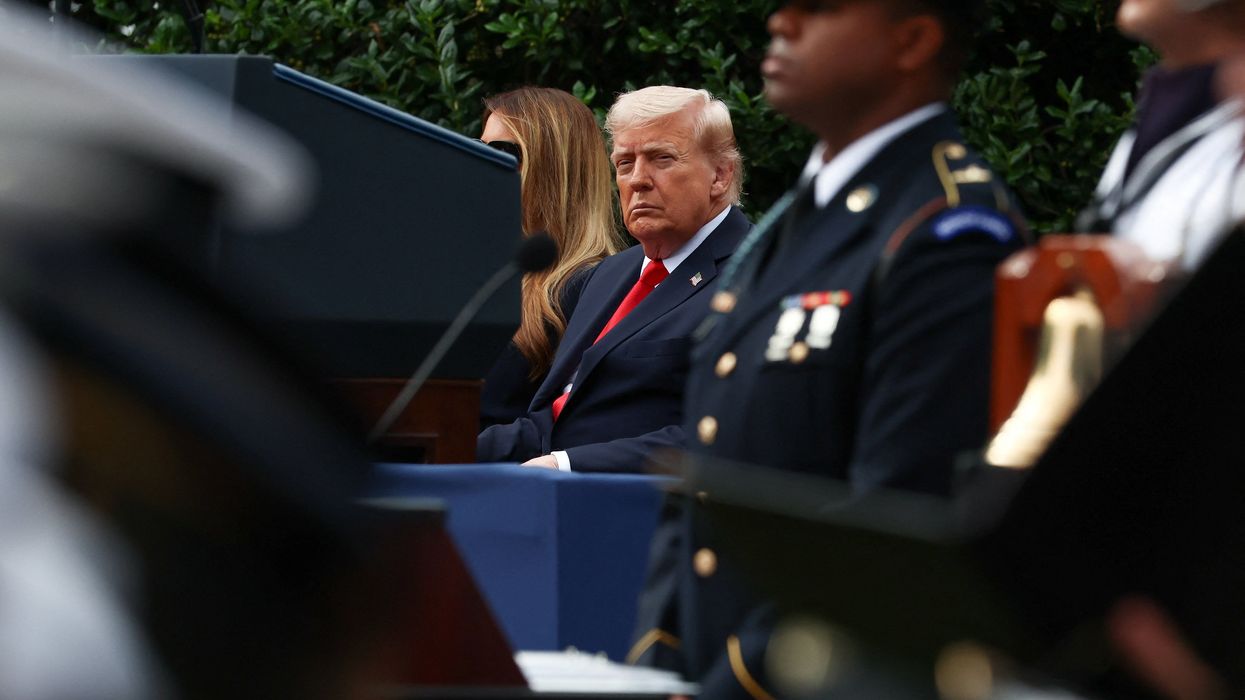
U.S. President Donald Trump and U.S. first lady Melania Trump attend a ceremony marking the 24th anniversary of the September 11, 2001, attacks on the United States at the Pentagon, in Washington D.C., U.S., September 11, 2025. REUTERS/Evelyn Hockstei

October 01, 2026  
ALTERNET


A retired Air Force brigadier general is warning Defense Secretary Pete Hegseth that removing top military officers and pushing cultural changes at the Pentagon has become a distraction that could weaken the military.

John Teichert, who previously served as the head of Joint Base Andrews and Edwards Air Force Base, expressed his opinions in an opinion article for the Washington Post on Thursday. Although he previously criticized the military policies of former Presidents Barack Obama and Joe Biden, he now claims Hegseth has gone too far in the other direction.

“Secretary Hegseth’s actions have taken ideological cleansing to the next level,” Teichert wrote. He added that the atmosphere inside the Pentagon is now “rife with groupthink” and argued that officers may increasingly see silence as safer for their careers than challenging senior leaders.


Teichert comes following Hegseth's latest purge of the military's highest ranks. In a speech at Marine Corps Base Quantico on Wednesday, Hegseth said the Pentagon would reduce the number of generals and admirals by 20 percent and described these reductions as a way to cut bureaucracy and improve accountability.

Hegseth stated that the department has already got rid of about 10 percent of its generals and admirals and has also reduced the number of general officer positions by 10 percent. “The media calls that a purge. I call it accountability,” Hegseth said.


According to the Associated Press, Hegseth has been focusing on getting rid of what he calls "woke" culture at the Pentagon; this includes reversing diversity initiatives, examining ground combat units that include female troops, and launching a screening program for testosterone deficiency among male service members.

Teichert said he agrees with some of Hegseth's criticisms of previous Pentagon priorities, believing the military lost its focus under Democratic administrations, and he strongly criticized the Biden administration's decision to withdraw from Afghanistan in 2021.

On the other hand, he said Hegseth is creating a new problem by emphasizing ideological loyalty and the image of a physical warrior over other qualities needed for military readiness.


Teichert said experienced officers are being displaced when the military needs leaders who can think for themselves and challenge established ideas; he cited a leadership principle from former Joint Chiefs Chairman Colin Powell, who cautions against senior officials being surrounded by people who will not disagree.

The general, now retired, also objected to the notion that physical toughness alone determines military readiness. He said effective commanders must also be creative, disciplined, experienced, and able to make tough decisions.

This warning comes as Hegseth carries out a major reshuffle of the Pentagon's leadership. The most recent cutbacks are expected to lead to further changes in the military's senior ranks, even as U.S. operations continue overseas.
As Affordability Crisis Grows Under Trump, Workers Are Losing Half Their Income Gains to Debt Payments

“Families are going further into the red just to cover basic essentials, all while the Trump administration touts hollow talking points about a booming economy.”


A person shops at a grocery store in Brooklyn on December 12, 2025.
(Photo by Spencer Platt/Getty Images)

Jake Johnson
Sep 29, 2026
COMMON DREAMS


Research published Tuesday shows that more than half of the income gains seen by the typical American worker since 2022 has been swallowed by debt payments, as high and still-rising costs of housing, groceries, utilities, and other essentials force families to turn to credit cards and other sources of borrowing to stay afloat.

The new report released by The Century Foundation and Protect Borrowers estimates that take-home income for a typical US household rose by approximately $109 per month while the average worker’s debt payments rose by $57. In households with a single earner, the groups noted, “52 cents of every dollar a worker gained went to paying down their debt before they could actually spend it on other things.”

In two-income households in which both earners faced the average debt payment increase, “the household’s entire real income gain was lost to debt, and then some.”

Credit cards and auto loans—which often come with extremely high interest rates—account for most of the debt burden carried by typical US households, which have seen their debt payments grow more than eight times as fast as their income over the past four years, according to The Century Foundation and Protect Borrowers.

“The economy is rigged against working families, and this report shows one big reason why,” US Sen. Elizabeth Warren (D-Mass.), the top Democrat on the Senate Banking Committee, said in a statement. “For the typical worker, more than half of every dollar of income growth is going right back out the door in debt payments. Instead of letting lenders rip off families, [President] Donald Trump and congressional Republicans should act today to protect families from getting trapped in cycles of debt, including a cap on credit card interest rates.”

Trump repeatedly vowed during his 2024 presidential campaign to cap credit card interest rates at 10%, but he has since done nothing substantive to fulfill that promise as the nation’s credit card debt crisis continues to spiral amid deteriorating economic conditions, with sluggish hiring and inflation—fueled by the president’s illegal war on Iran—outpacing wage growth.

“Families are going further into the red just to cover basic essentials, all while the Trump administration touts hollow talking points about a booming economy and fails to deliver on promises to lower costs,” said Aissa Canchola Bañez, policy director for Protect Borrowers. “Today’s report shows just how dire the affordability crisis is for working people who are being forced to surrender their hard-earned income gains to paying off debt and padding the pockets of credit card executives and debt collectors.”

“Growing household debt is burying America’s workers,” she added, “and policymakers must take action to get them real relief.”

The new research warns that, in the absence of ambitious policy action, the debt emergency facing working-class US households “is about to get worse,” with many student-loan borrowers about to be forced into expensive repayment plans due to the Trump administration’s assault on Biden-era relief efforts.

“Cancelling student and medical debt, capping interest rates, and restraining employer debt traps are all examples of solutions available to provide help to struggling households,” the new report states. “We should also address the ways workers end up in debt in the first place through stagnant wages, eroded bargaining power, and lack of public provisioning. Together these interventions represent a coherent alternative to the status quo so that economic growth is measured by what workers actually keep and not just by what employers pay.”

Trump SEC Accused of Letting Wall Street ‘Prey On’ Everyday Americans With New Proposals


“The Trump SEC is seeking to bail out the struggling private equity and private credit industry with hardworking Americans’ retirement savings.”


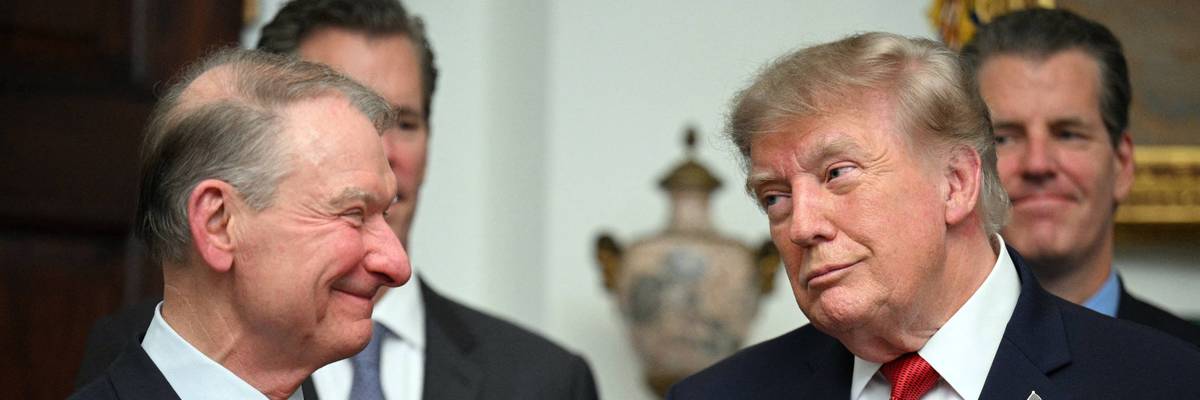
US Securities and Exchange Commission Chair Paul Atkins and President Donald Trump smile at each other during a meeting with cryptocurrency executives in the Roosevelt Room of the White House in Washington, DC on August 19, 2026.
(Photo by Jim Watson/ AFP via Getty Images)

Jessica Corbett
Sep 30, 2026
COMMON DREAMS


The US Securities and Exchange Commission on Wednesday proposed policies that SEC Chair Paul Atkins framed as an effort to promote private market investments by retail investors—or everyday Americans—while also “protecting those investors from bad actors and fraud,” but critics accused the Republican-dominated federal agency of serving Wall Street at the expense of the public.


“Chair Atkins talks about the ‘responsible retailization’ of the private markets, but the rules the SEC proposed today are irresponsible,” declared Benjamin Schiffrin, director of securities policy for the nonprofit Better Markets. “The SEC is supposed to protect retail investors from risky private market assets. Instead, it is encouraging investors saving for college and retirement to direct their savings to private market investments that do not offer greater returns but that do offer less disclosure and more limited legal recourse when harmed.”

“Although hedge funds may charge fees based on performance to their investors, the SEC has long prohibited investment advisers from charging retail investors performance-based fees,” Schiffrin explained. “This protects them from arrangements that might encourage advisers to take undue risks with retail client funds to increase their compensation. Yet the SEC’s proposed rules would make such arrangements permissible. This change would eliminate a limitation on the ability of private funds that charge performance-based fees to sell to retail investors and would incentivize advisers to push retail clients into risky private funds that have performance-based fees.”

The new rules would also make it easier to sell interval funds, which “hold complex and illiquid assets and charge high fees,” Schiffrin noted. “Given that many interval funds have faced heightened redemption requests from existing investors seeking to exit these funds in recent months, now hardly seems like the time to further expose retail investors to these funds.”

“Perhaps most troublingly, the SEC expands the categories of individuals who qualify as so-called ‘accredited investors’ to whom private market assets may be sold,” he continued. Specifically, the agency said it is considering letting individuals with some certificates or licenses—such as certified public accountants, research analysts, and financial analysts and planners—qualify.

“Accredited investors are supposed to be institutions and individuals with enough assets to bear the risk of loss inherent in private market assets,” Schiffrin stressed. “Now, the SEC would allow individuals to qualify as accredited investors without regard to their ability to lose money in the private markets.”

The expert also highlighted the timing of these proposals, pointing to the agency’s Monday statement that “reminded the private funds industry of its obligations regarding valuing assets and providing disclosure to investors,” which Schiffrin said was “obviously intended to provide cover for the SEC’s desired expansion of the private markets.”

“Having previously downplayed the turmoil in the private credit markets, continued redemption requests by private credit investors forced the SEC to acknowledge that private market assets are particularly risky and to reassure investors it was not asleep at the switch,” he said. “Yet the statement begs the question of why the SEC would seek to expose retail investors to the private markets at the same time it acknowledges the risks that private market assets pose even to institutional investors.”

“The answer is that the SEC has lost its way,” he concluded. “Its agenda is now the financial industry’s agenda, and private funds need access to retail investors and their savings as institutional investors increasingly pull back from private markets. So the proposed rules the SEC issued today have nothing to do with ‘democratizing access’ to the private markets and everything to do with allowing the financial industry to prey on unsuspecting retail investors.”

The SEC chair said Wednesday that the agency’s latest moves “complement efforts undertaken pursuant to” President Donald Trump’s August 2025 executive order on Democratizing Access to Alternative Assets for 401(k) Investors—which Schiffrin warned last year “exemplifies the administration’s determination to prioritize the interests of Wall Street over the interests of Main Street and retail investors.”

“Let’s be clear: Neither 401(k) plan sponsors or 401(k) plan participants—regular, hardworking Americans—are asking to replace stocks and bonds in their 401(k)s with risky private assets,” Schiffrin said at the time. “Instead, the private funds industry needs a way to get its hands on the $12 trillion in Americans’ retirement accounts to boost its profits and make up for the fact that institutional investors are fleeing the private markets due to mediocre returns, higher fees, and more risk.”

Despite such criticism of Trump’s order, the US Department of Labor unveiled its related proposal in March. Jim Baker, executive director of the nonprofit Private Equity Stakeholder Project, pointed to the pending DOL policy in a Wednesday statement responding to the SEC action.

“With the proposed rules, combined with the DOL’s 401(k) rule, the Trump SEC is seeking to bail out the struggling private equity and private credit industry with hardworking Americans’ retirement savings,” he said. “Private equity funds have lagged public markets while charging much higher fees, and institutional investors are pulling back from the asset class. These rules risk shifting more financial risk onto workers who rely on their retirement savings for long-term security.”

“Private equity firms are already under pressure from a backlog of unsold assets and declining distributions to investors,” Baker emphasized. “At the same time, policymakers are giving private equity access to retirement savers’ 401(k) plans, raising serious questions about whether these investment risks are being shifted onto everyday retirement savers.”

“Retirement accounts exist to provide security, not to bail out private market investments by shifting liquidity risk onto workers when markets turn,” he added. “At a minimum, the SEC should hold private equity to the same disclosure and transparency standards expected of publicly traded stocks, mutual funds, and [exchange-traded funds], including clear reporting on what funds are investing in, the fees and expenses retirement savers are paying, the amount of debt funds are using, and how these investments are actually performing compared with stocks.”

Key members of Congress also responded to the SEC’s Wednesday proposals. While Republicans on the US Senate Banking, Housing, and Urban Affairs Committee welcomed the push to expand the accredited investor definition, which aligns with Chair Tim Scott’s (R-SC) Empowering Main Street in America Act, Ranking Member Elizabeth Warren (D-Mass.) was critical.

“Today, the SEC proposed a new rule that would override decades-old protections for Americans’ retirements to allow Wall Street to start charging high, private equity-level fees on lower-cost retail funds,” Warren said. “Americans already struggling to save in Trump’s economy shouldn’t be used as piggy banks to boost the profits of Trump’s Wall Street buddies.”
Billion-dollar federal contracts tied to Trump allies and family members


REUTERS/Evelyn Hockstein
October 01, 2026
ALTERNET

Democratic candidates should be talking about ONLY two things in these last five weeks before the midterms, and show how they’re connected: higher prices and Trump-Republican corruption.

Consider:

1. The Trump-Republican war on Iran has been a huge windfall for Big Tech supplying the military — such as Palantir, a core artificial intelligence and data-integration partner for the U.S. Department of Defense, founded by Trump and JD Vance buddy Peter Thiel. But it’s costing Americans dearly.


At the same time, investment companies backed by Donald Trump Jr. and Eric Trump have accumulated at least $3.2 billion to $6.3 billion in direct Pentagon contracts, current funding, and future contract options since January 2025.

But Trump’s Iran war is causing Americans to spend some $1.50 a gallon more on gas (gas was $2.98 per gallon before the war; it’s now $4.42 to $4.47 per gallon). Since the war began, Americans have spent $65 billion more on gas.


The price of diesel fuel has soared to an average of $7.00 a gallon — and because trucks that transport everything to retail stores now pay so much more to get it there, this price increase is also being passed on to consumers.

2. Trump has given out tariff waivers and carve-outs to industries and companies making kickbacks to him, while the tariffs have jacked up prices overall.

For example, when polyethylene terephthalate, the thermoplastic used to make plastic bottles, got a tariff exemption, it was a win for Reyes Holdings, a Coca-Cola bottler that ranks among the largest privately held companies in the U.S. and is owned by a pair of brothers who have donated millions of dollars to Republican causes.


Just after Tim Cook, Apple’s CEO, dumped $1 million into Trump’s inauguration, Apple got tariff exemptions for its products.

After Elon Musk sank a quarter of a billion dollars into Trump’s 2024 campaign, Tesla got a tariff exemption for electronics.

And so on.


But the worldwide tariffs that made these corrupt exemptions possible have increased annual household costs by an estimated $1,100, according to The Budget Lab at Yale.

3. Trump’s support for artificial intelligence is another form of corruption that’s pushing up prices.

The AI industry’s war chest for the 2026 midterms is projected to exceed $200 million, with almost all of it going to Republican candidates and Trump’s own super PAC.

But AI is already harming average Americans by increasing borrowing costs. Together with the costs of Trump’s war in Iran, Big Tech’s huge borrowing — over $500 billion so far this year — is crowding out other borrowers, thereby contributing to sky-high interest rates on mortgages, auto loans, and credit-card overdrafts.


In addition, Trump’s encouragement of AI data centers is raising electricity prices in areas where data centers are sucking up energy.

4. Trump’s tariffs and support for AI are increasing the costs of housing.

Housing affordability is among voters’ top concerns this election cycle, yet:

— The average 30-year fixed mortgage rate is now 7.33 percent — higher than at any point since late 2023 — due in part to Trump’s war and his encouragement of AI borrowing.


— The prices of lumber and building materials have soared because of Trump’s tariffs. The National Association of Home Builders estimates that tariffs on lumber and building materials have added $10,900 to the cost of constructing a new U.S. single-family home.

— The price of copper, a key material for electrical wiring in residential and commercial construction, has soared 40 percent in the past year due to Trump’s tariffs and data center demands — adding even more costs to building a typical home, which requires hundreds of pounds of copper.

5. Trump’s tax cuts for America’s wealthiest corporations and individuals have come at the expense of healthcare and health insurance for average Americans.

To pay for the tax cuts for America’s wealthiest families and corporations — including their largest donors — congressional Republicans slashed Medicaid and failed to renew healthcare tax credits, forcing millions of Americans to spend more for coverage or forgo it altogether.


Trump and congressional Republicans passed the biggest Medicaid cut in history, which will result in 10 million people becoming uninsured and make healthcare providers that serve low-income populations vulnerable to private equity takeovers.

Millions of Americans will spend an average of $2,136 in annual Affordable Care Act (ACA) premiums this year — 58 percent more than last year (in some states they’re paying up to 220 percent more). Nearly 5 million Americans will lose healthcare coverage this year because congressional Republicans failed to renew the Premium Tax Credit. Additionally, at least 115 hospitals and clinics across 32 states have closed or reduced services as a result of the Republican healthcare cuts.

The corruption runs even deeper. When Trump rolled out TrumpRx earlier this year, he claimed Americans would get access to more affordable prescription drugs. But the platform fails to disclose information about less expensive generic alternatives and in some instances charges consumers more for products that are available for less elsewhere.

As the Groundwork Collaborative has shown, the biggest winners from TrumpRx are the Trump family and Big Pharma. Donald Trump Jr. is on the board of drug platform BlinkRx, which benefits from the regime’s promotion of direct-to-patient medicine sales. BlinkRx donated $50,000 to the Trump inaugural committee. When patients use TrumpRx instead of insurance, they have to cover the drug cost themselves — saving money for insurance companies as they continue to rake in premiums.

And despite Trump exempting 17 of the largest pharmaceutical companies from his threatened pharmaceutical tariffs, these firms have continued to raise prices on nearly 900 different drugs. At least three of these firms — Gilead, Merck, and Pfizer — each donated $1 million to the Trump-Vance inaugural committee, alongside the Pharmaceutical Research and Manufacturers of America, which lobbies on behalf of Big Pharma.

These connections between the higher prices Americans are paying and the corruption of the Trump regime and its Republican enablers need to be widely understood. The richest Americans and biggest corporations have made out like bandits — and average working Americans are paying dearly for what the bandits have stolen.

Less than five weeks until the November 3 midterm elections, Democrats must show Americans not only that they’re paying more for just about everything, but that the reason they’re paying more is the rot at the heart of Trump-Republican deal.

Robert Reich is a professor of public policy at Berkeley and former secretary of labor. His writings can be found at https://robertreich.substack.com/.
'Not okay': Disappointed ranchers go on expletive-filled rant against Trump


US President Donald Trump speaks on the day he makes an announcement about an energy infrastructure project in Alaska, in the Oval Office at the White House in Washington, D.C., US, September 30, 2026. REUTERS/Kevin Lamarque

October 01, 2026 
ALTERNET

Ranchers in battleground states are furious about diesel prices and beef imports. According to a new report published on Thursday by the conservative newspaper the Washington Examiner, not only has the situation made said ranchers cursing mad toward President Donald Trump, but it could “cost Republicans a Senate seat in Kansas.”

“He doesn’t know what s—— is coming out of his mouth,” one particularly blunt farmer told the Examiner when asked about Trump’s performance. As the paper explains, “High diesel prices, expensive feed, pickups that cost almost as much as a house, and escalating land prices are putting the squeeze on the state’s cattle industry. Kansas produces almost a quarter of the nation’s beef and the issue has moved to the center of a tight Senate race, heaping pressure on the Republican candidate, Sen. Roger Marshall. And then there was the decision by President Donald Trump to lift tariffs and allow in hundreds of thousands of tons of ground beef from Central and South America.”

“I’m disappointed in Trump and the cattlemen’s association for not raising cane,” said 82-year-old rancher Chuck Madron. “They’re letting cattle in from Uruguay. They’re letting beef in from Mexico, Argentina, Brazil. What about us ranchers? Diesel is over $6.”


The high cost of diesel is being felt by everyone, stockyard owner Tylen Layton told the Examiner, saying it is driving down the prices of cattle at auction. His numbers show that the cost of moving an animal has risen by $1.50 per mile. “It just changed the whole dynamics of everything,” he explained. “You know, people can’t afford to give as much for the cattle now because they’re trying to afford the trucking to get them to their final destinations.” That translates to a reduction of $40 to $60 per 100 pounds, or about $300 to $600 less per head.

What’s more, writes the Examiner, “Trump’s move to allow in cheap exports has exasperated locals, who see it helping meat processors, or packers, or McDonald’s, but not shoppers or ranchers.” As Layton explained, “The problem is that we haven’t done the first thing to make beef cheaper for the Wichita, Kansas, housewife or the New York City housewife. They’re hurting us, making it cheap for the packers, but the packers aren’t going to bring their prices down when they sell it to the retailers.” According to the Examiner, ranchers are also concerned about an ICE crackdown on meatpacking plants in the state. As the paper explains, “The fear is that processing will grind to a halt if staff — mostly immigrants, some legal, some undocumented — stay home. The result is an outpouring of frustration with the Trump administration, which people see as too close to voters on the coasts and too far from beef country.”


As a result, “Democrats see an opening in a state that has not let them have a look in since the 1930s. Their challenger, Adam Hamilton, a megachurch pastor, took a 2-point lead over Marshall in a recent Emerson College/Nexstar poll.” In a recent debate, Hamilton blasted “trade wars, which actually in the last Trump administration cost beef farm beef ranchers in Kansas a billion dollars in trade that went to Brazil and Argentina.” He also decried the “diminishing of the workforce and arresting the workforce,” asserting that it was “making it harder for people to work in the livestock industry,” adding, “This is not okay.”

For his part, Marshall attempted to defend the tariffs, though he later gave a nod to political reality, toning down his once full-throated endorsement for immigration enforcement to signal a degree of disquiet. “When ICE operates in Kansas, it needs to coordinate with our local law enforcement,” Marshall posted. “Our sheriffs and police know these communities better than anyone, and working together keeps officers and residents safe.”

“That leaves Kansas ranchers, like farmers across the country, dealing with crippling diesel prices,” writes the Examiner. “Jim Moore, a fourth-generation rancher, said it costs him $2,000 now to fill up his three tractors. A president who made much of his support from the farming community, he said, had forgotten his friends when they needed him.”

The most right-wing county in Texas is shifting


Texas Gov Greg Abbott addresses former U.S. President Donald Trump in Weslaco, Texas, U.S. June 30, 2021. Brandon Bell / Pool via REUTERS

October 01, 2026 
ALTERNET

The right wing can't stop the changes in Texas.

Houston Chronicle journalist and columnist Chris Tomlinson reported on Thursday that Fort Worth, Texas, isn't what it once was — and those changes likely won't end with the 2026 midterm election.

Tomlinson spoke to Republican state Senate candidate Leigh Wambsganss, who once said that she wasn't merely a MAGA Republican but she was “Ultra-MAGA." Like Rep. Byron Donalds (R-Fla.), however, she began scrubbing President Donald Trump from her website. In fact, she's removing the word "Republican" too.

"The once bright red color is now dark blue," said Tomlinson.

"Wambsganss made her name as political director for Patriot Mobile, a Christian nationalist wireless provider that backed fundamentalists in school board elections," the Chronicle reported. "She was once considered a shoo-in on the party’s conservative fringe, where Fort Worth politicians have traditionally done well."


That has changed significantly. Wambsganss previously lost the seat to Democrat Taylor Rehmet in a Feb. 2026 special election.

The report said the state is experiencing one of the biggest political shifts since 1820. Demographics are changing, economics are changing and with it the social shifts and politics come with it.

Now, Wambsganss' campaign is looking a lot like Rehmet's.


"Her strategy of running away from her past begs the question: Are voters leaving the Republican Party, or is President Donald Trump’s Republican Party leaving them?

The important part to know about the Fort Worth area is that it wasn't along ago that "white men chased Black Union soldiers from a polling station in Falls County," Tomlinson recalled from a story his great-grandfather told him. His grandfather was a member of the Dallas Klan, believing that "God intended for them to rule the world." The Klan controlled both Dallas and Forth Worth.

In all of Texas' 254 counties, "Fort Worth and Tarrant County have always leaned hardest to the right," the reporter explained.


Rehmet told him, “They've lost a lot of folks in the middle. We can talk here all day about Republican-Democrat, but most people are just regular working folks. They don't have the luxury to really be super politically active. They're working two jobs. They're taking care of their kids. And those are the folks that I think of whenever I'm ready to go serve, because that's the majority of this district.”

Tony Ortiz, the publisher of the right-wing daily newspaper Current Revolt, said that a lot of this comes down to immigration and the harsh policies from the Republicans to remove anyone who may look like an immigrant, regardless of whether they are criminals, documented or not. It isn't isolated to Latinos either; he said that those in North Texas are worried about "South Asians and Muslims."

The Tarrant County diversity shift began in 2015, though whites still dominate the county's population.

“A lot of this is like a sudden realization of an entire demographic realizing that they are becoming the minority,” Ortiz said. “You blink and you’ve got all of these temples and restaurants and mosques and different driving habits and different languages, and you think, ‘Whoa, what happened?’”


“You think, ‘I need to do something,’ but you’re a little late in doing something. You should have been doing something maybe five, seven or eight years ago,” he explained.


Ortiz identifies as "brown," and accepts his Mexican American heritage.

President Donald Trump and Vice President JD Vance are set to appear in the state this week, where they will celebrate all of the work they've done on "the economy," another report from the Houston Chronicle said.
'Post-MAGA era' is here as big business breaks with Trump: Nobel economist


US President Donald Trump attends a Hispanic Heritage Month reception in the East Room at the White House in Washington, D.C., US, September 30, 2026. REUTERS/Kevin Lamarque
October 01, 2026  
ALTERNET


There are major signs that big business is breaking with President Donald Trump over the chaos sown by his agenda. This is according to Nobel Prize-winning economist Paul Krugman, who explained on Thursday why the actions of one of the country’s most prominent financial figures suggest that the “post-MAGA era” is here.

“On September 28th, Jamie Dimon, CEO of JPMorgan Chase, one of the most prominent, most successful financial figures in the United States, published an article in the Wall Street Journal titled, ‘The Hell with Trump, Let’s Go Back to Globalism,’” said Krugman. “Okay, that’s a lie. That wasn’t what the article was titled, but it was, in effect, what it said. And it was a very interesting message to be coming at this moment in time. I think Dimon’s op-ed can be viewed as a harbinger of a big shift in the business community’s political positions and its attitudes that may be coming in the very near future — in effect a bet that Trump and MAGA in general are going to be in the rearview mirror, not too far from now.”

As Krugman explains, Dimon is an “extraordinarily successful financial leader” and a “very, very smart political operator” who has managed to stay on good terms with administrations from both parties. After the 2024 election, he neither joined the “cavalcade of business leaders rushing to prostrate themselves at Trump’s feet,” nor did he end up on his list of enemies. But now, says Krugman, he’s calling to repair the Western alliance and rebuild ties with Europe to confront the rising power of China, proposing that the best way to achieve that is by forging a free trade agreement between the United States and the European Union.


“That’s quite something,” asserts Krugman. “That’s a very un-MAGA position to take. You want to bear in mind that, first of all, we’re currently under a government of people who do not at all believe in the virtues of free trade. In fact, are extremely hostile to globalism. Certainly don’t believe in binding international agreements. Maybe they want agreements that bind other countries, but not them. And they are also not of the mind that we have a lot of shared values with the democratic governments of Europe. The MAGA position, if anything, is that they like the anti-democratic forces in Europe. J.D. Vance essentially campaigned for Viktor Orban in Hungary. Trump officials have been quite clear that they have sympathy for the AfD in Germany. So if we have common values with some Europeans, the Europeans with whom they have common values are neo-Nazis. And Trump’s de facto support for Putin in his invasion of Ukraine has been alarmingly clear over the past two years.” But now Dimon is rejecting that, and Krugman argues that it suggests he believes Trump and MAGA are on their way out.

According to Krugman, the economic benefits of Dimon’s free trade idea are actually not all that drastic. Europe only exports roughly three percent of its production to the US, and before Trump’s second term, the two entities were practically on a free trade basis anyways. But in Krugman’s estimation, “Dimon believes that the process of negotiating towards a free trade agreement would in itself help to improve politics. That it would be a signal that the ultra-nationalist, anti-democratic, often anti-European policies of theTrump era are behind us. So he’s looking forward to the day when we can start to try to repair some of the immense damage that has been done to our international relations during the Trump years.” With the writing on the wall for the Republican midterms, Dimon thinks the time for “rebuilding an alliance” is near. “He thinks that this is possible,” concludes Krugman, “and that it’s worth positioning himself and his institution for a post-MAGA era.”
Nobel economist lays out ‘really bad news’ for Trump before midterms


U.S. President Donald Trump speaks at the Republican National Midterm Convention in Dallas, Texas, U.S., September 9, 2026. REUTERS/Evan Vucc

October 02, 2026 
ALTERNET


Nobel Prize-winning economist Paul Krugman says a combination of sour economic sentiment, the worsening job market, and higher borrowing costs amounts to “really, really bad news” for President Donald Trump and Republicans heading into the midterm elections.

Writing Thursday on his Substack, Krugman argued that the White House is trying to sell Americans on an economic picture that increasingly conflicts with how voters say they are doing. He pointed to the latest AP-NORC poll, which found 74 percent of adults described the national economy as poor, compared with 26 percent who called it good.

The same poll showed brutal numbers for Trump, who campaigned on economic prosperity for everyday Americans. Just 26 percent approved of his handling of the economy, while 73 percent disapproved. On the cost of living, 17 percent approved of Trump’s performance and 82 percent disapproved. The survey of 2,140 adults was conducted Sept. 24-28 and had a margin of sampling error of plus or minus 2.9 percentage points.


Krugman also highlighted a change in how Americans view the economy close to home. During the Biden administration, he wrote, “Americans generally had a much more positive view of their local economy — which they could observe with their own eyes — than they did of the national economy.”

The September AP-NORC survey found 61 percent of adults said the national economy was worse off than when Trump took office in 2025, while 23 percent said it was better. Fifty-five percent said their local economy was worse off, compared with 20 percent who said it was better.


Krugman’s second warning sign was the labor market with official employment measures remain relatively strong by historical standards, but he noted that Americans’ perception of job availability has deteriorated.

The Conference Board reported this week that 23.6 percent of consumers said jobs were plentiful in September, down from 24.5 percent in August. At the same time, 21.9 percent said jobs were hard to get, up from 20.3 percent. Consumer confidence fell for a third consecutive month.

Housing costs add another problem, with the average rate on a 30-year fixed mortgage jumping to 7.28 percent this week, according to Freddie Mac, its highest level since November 2023 and the biggest weekly increase in four years.


Krugman pointed out the “troubled environment” based on those numbers, go against the administration's characterization of the country as being in a Golden Age.

“And while I’m not a political consultant, I don’t think ‘Who are you gonna believe, me or your own eyes?’ is a winning strategy,” he wrote.

With a month remaining before the midterms, Krugman said the economic environment matters as much as political polling. Although some headline economic statistics remain solid, he argued that voters’ experience with prices, housing costs and the job market is moving in the opposite direction from the White House’s message.