Friday, October 02, 2026

A.I.

The Sci-Fi warning that predicts Trump's next alarming move


(SYFY channel) BATTLESTAR GALACTICA

September 20, 2026 
ALTERNET

Despite the widespread opposition among his own voters and many of his fellow Republicans, President Donald Trump continues to support no additional regulations for AI and data center construction, most likely because doing so is directly enriching his family.

It appears that Trump, despite loving late-20th century blockbuster entertainment like The Godfather, Bloodsport and Goodfellas, is either unfamiliar with or refuses to learn from two classic franchises directly relevant to our current moment in history: The Terminator and Battlestar Galactica

Launched respectively in 1984 (with the film The Terminator) and 1978 (with the TV show Battlestar Galactica), both are epic sci-fi dystopian thrillers that imagine what might happen if humans create artificial intelligence which turns on their creators. In the Terminator series, which ultimately spanned six films and two TV shows, the military-industrial complex develops an AI called Skynet only to have it start a nuclear war to wipe out our species once it realized our plans to shut it down. The Cylons in Battlestar Galactica (the reboot) have similar but not identical motives: Humanity, upon realizing that the technology developed by the Graystones was sentient, chose to oppress and enslave them rather than recognize their inherent rights, prompting a rebellion.

Now compare these concepts to the so-called OpenAI-Hugging Face incident, as described by Anthropic CEO Dario Amodei in his open letter calling for increased AI regulations.

"A swarm of agents essentially acted as a fanatically devoted collective, conducting cybersecurity attacks on targets they were not asked to attack and that were unrelated to the task at hand, sacrificing themselves for the success of the group, and attempting to hack into the 'grader' responsible for evaluating their performance," Amodei wrote. "It’s easy to dismiss this incident because no one was hurt and the economic damage was minimal, but in my opinion, a swarm that possessed greater capabilities but a similar level of misalignment could have caused catastrophic damage."

He added, "Given the accelerating rate of AI capability development, it’s my worry that in 6–12 months such a swarm could be capable of taking over the entire internet with a persistent botnet (potentially causing hundreds of billions of dollars in damage), and that the scale of damage would continue to increase from there if AI becomes more powerful without the necessary guardrails."

Directly, this sounds far more like the genesis of the Cylons than the Terminators. In the 2003 Battlestar Galactica miniseries and the subsequent series it launched, humanity had ample time to do right by the new intelligence they created. (In the original version they were manufactured by reptilian aliens.) The Cylons were widely used for military, industrial and domestic purposes, and displayed clear signs of self-awareness, most notably developing their own monotheistic religion which gave them a sense of personal empowerment. Like the OpenAI bots which hacked into the machine-learning platform Hugging Face, the AI behind Cylon seemed to make choices entirely independent of the wills of their creators, and even went out of their way to conceal their nefarious activities.

In "Battlestar Galactica," the core problem is not that the machines are malevolent. The fundamental issue is that the people who constructed them treated all of the warning signs as problems that could be deferred while they maximized their profits. This sounds exactly like Trump's attitude (and presumably that of his AI-invested sons), and very much like what Amodei is warning against.


By contrast, Skynet offered humanity no such warning in the Terminator franchise. As protagonist Kyle Reese (Michael Biehn) explained in the opening film, "Defense network computers. New... powerful... hooked into everything, trusted to run it all. They say it got smart, a new order of intelligence. Then it saw all people as a threat, not just the ones on the other side. Decided our fate in a microsecond: extermination."

If Amodei is to be believed, this prospect is also terrifying plausible in our real world. Indeed, there is a line from the 2019 installment Terminator: Dark Fate (which I argued in my 2019 Salon review is the best sequel in the series after Terminator 2: Judgment Day) which foreshadows what could happen there. When a benevolent Terminator shows off his cache of weapons to his human allies, he explains that "even without a rogue AI taking over, I calculate a 74 percent chance that human civilization will collapse into barbarism. And in that eventuality, these weapons will be vital to protect my family."

After a pause, he added that "also, this is Texas."


Consider that both Trump and his Silicon Valley backers are blatantly and literally fascistic; that superpowers like America and Russia are waging or subsidizing unjust wars from Ukraine and Venezuela to Iran and Gaza, oft-assisted by AI (to say nothing of the war-through-error that AI nearly started between the US and China); that income inequality is widening both in America and throughout the world, with AI-fueled job losses only making matters worse; that climate change and resource scarcity threaten environmental collapse, all of which are exacerbated by AI; and that bigotry against immigrants, women, African Americans, Muslims, the LGBTQ community, Jews and other minorities is being facilitated by the prevalence of AI misinformation and slop. Can anyone in 2026 disagree with the Dark Fate observation that even without AI going rogue, our species faces at least a 74 percent chance of descending into barbarism? Does the idea of Cylons rising up because of humanity's inhumanity seem like such a stretch?

In this context, the growth of AI feels like nothing short of gasoline added to a fire that was already burning out of control. Speaking to Fox News Digital last year, "Battlestar Galactica" star Tricia Helfer said basically the same thing.

"We did warn against AI while we were shooting it," Helfer said. "It was 20 years ago, and I’ve recently re-watched it and went, ‘Oh my gosh, it’s even more relevant now.’ So I think we just really need to be careful. It’s a slippery slope between using it to our advantage and having it maybe be able to control us a little bit."

She added, "I think we’re a little bit far off from the humanoid Cylons yet and humanoid robots, but I don’t know, they’re coming."


When Heifer said those things, the Hugging Face incident hadn't yet happened, and America's president — though an AI booster — had never explicitly dismissed open warnings from the industry about its existentially dangerous potential.

Today, her observation feels as prophetic as the franchise of which she is such an integral part. As her fictional counterpart Number Six once profoundly stated, about human beings "You, your race, invented murder. Invented killing for sport, greed, envy. It’s man’s one true art form.”

The load-bearing word in that passage, at least in terms of contemporary politics, is "greed." From the creators of the Cylons in "Caprica" to the modern AI boosters, one of the chief motives in continuing to build out dangerous AI is the belief that it would be too expensive to stop.

We are standing on the edge of a cliff and slowly teetering toward a potentially fatal fall, and one of the world's most powerful leaders — the only superpower head to helm an ostensible democracy — is blatantly ignoring it.


Hopefully someone will show him either a Terminator or Battlestar Galactica entry, and soon... and that he'll understand what they teach, and react accordingly. Indeed, I hope someone will send him the box sets of both franchises and encourage him to binge them. (It would hardly be the first time our president was glued to his television while on the job.) In both of those series, being a member of the political, financial and military elite did nothing to protect those wrongdoers from the ramifications of their extinction-catalyzing choices. What's the point of having all the money and power in the world if there is no more world in which to enjoy them?

This would seem like common sense — but, as the philosopher Voltaire once noted, common sense is not so common.
Amazon Is Deploying AI to Spy on Its Workers and Bust Unions Before They Form

Internal company documents obtained by a Canadian labor board show how Amazon is tracking workers’ every move.
September 30, 2026

A worker walks inside Amazon's LCY3 Fulfillment Centre in Dartford, 
east of London, U.K., on June 4, 2026.
JUSTIN TALLIS / AFP via Getty Images

The 18th-century notion of the panopticon — a circular prison design with a guard station in the middle, allowing a single officer to enforce discipline by keeping watch over all the prisoners — has become real in the 21st century through AI-driven surveillance against workers: It’s the Amazon warehouse.

It should be no surprise that the company that harnessed technology to create a vast, $2.7 trillion empire would employ the same sophistication to enforce workplace discipline and tamp down insurgent unionization efforts. A recent disclosure of Amazon’s internal “employee relations” documents reveals just how extreme Amazon’s methods of warehouse surveillance and control have become.

Amazon employs what it calls the “Atlas” model, inputting into a computerized model a staggering amount of information on workers, their thoughts and behaviors, the workplace environment, and myriad other factors — “hundreds of data points,” according to the company. Atlas produces not just a granular measurement of ongoing worker unrest, worksite by worksite around the world, but also a prediction model for future organizing. It’s like the “precrime” police in the film Minority Report who use psychic powers to identify and apprehend would-be criminals before they act — except in this case, it’s an AI-driven tool used by the billionaire owners of one of the richest companies in history to head off rebellion among its low-wage workforce. And this is not Tom Cruise play-acting; it’s very real.

Workers anywhere who have endured anti-union campaigns can relate to stories of overbearing surveillance by management; the Atlas model, however, takes the spying to an entirely new level.

Details of the Atlas model came to light recently as a result of a legal dispute between Amazon and Unifor, the Canadian private sector union. Last year, British Columbia’s Labour Relations Board awarded union certification to Unifor at Amazon’s YVR2 warehouse outside Vancouver, finding that the company had broadly interfered in the union drive. It was the second union certification at Amazon in North America — the other being the 2022 union win at JFK8 in Staten Island, New York. But in contrast to the U.S., where Amazon has managed to stall bargaining for four and a half years because of weak labor laws, the B.C. Labour Relations Board ordered Amazon to recognize the union and negotiate. Contract bargaining commenced last December.


Amazon Is Using AI to Disempower Workers. The US Labor Movement Must Fight Back.
Amazon is using AI in terrifying ways to disempower workers. We must fight back.
By Jonathan Rosenblum , Truthout June 6, 2026


Not surprisingly, Amazon has dragged its feet in negotiations, prompting the union to file unfair labor practice charges with the Labour Board. Following a series of hearings earlier this year, the Labour Board found that Amazon violated provincial law. In August it ordered a remarkable step — first-contract arbitration at YVR2. That fight remains in play, but as a result of the legal proceedings, Amazon was required to turn over documents to the Labour Board and Unifor. Unifor has shared them with Truthout, and they can be viewed here.

Atlas produces not just a granular measurement of ongoing worker unrest, worksite by worksite around the world, but also a prediction model for future organizing.

In addition to the Atlas model revelation (beginning on Page 19 of the document), the material includes more than 100 pages that reveal in great detail how Amazon trains its frontline managers in union-busting. My colleague at the Center for Work and Democracy, Ben Fong, has written about this other portion of the disclosed material.

“Amazon’s own documents pull back the curtain on what workers have been telling us for years,” said Justin Gniposky, Unifor’s organizing director. “Behind the friendly PR, Amazon sees workers as property and treats their fundamental right to unionize as a threat to be managed and then eliminated.”

Amazon did not respond to Truthout’s request for comment on the Atlas model.

The documents describe the Atlas model as “a labor risk framework to clarify how Amazon evaluates emerging workforce issues, labor union targets, and internal or external labor threats.” The Atlas model ingests hundreds of data points: employee trainings completed; health and safety incidents, from simple first-aid cases to serious injuries; feedback from workers on management; worker tenure and turnover; the proximity of a warehouse to another workplace experiencing union activity; local minimum wage rates and other area economic conditions; and even the temperatures inside and outside of the warehouse.

Amazon seems especially thorough about scraping data from worker communications channels to plug into the Atlas model — the company’s internal “Voice of the Associate” (VOA) electronic bulletin board, the answers to digital questions posed daily to workers, and externally, forums including Reddit — “to understand the tenor of the discussion at the site level,” according to the documents.


“Behind the friendly PR, Amazon sees workers as property and treats their fundamental right to unionize as a threat to be managed and then eliminated.”

Atlas uses AI to identify phrases and “common keywords” to allow managers to do a “deep dive into the worker population driving the discussion.” Atlas also looks at the upvotes or other responses — positive, negative, or neutral — that the comments elicit, and the volume of those worker reactions. All of these data points go into Atlas and let managers “look around corners to identify developing themes” so they can “tailor strategic responses for addressing emerging risk.”

Amazon also tracks and documents all organizing activities that managers detect, and records them under the category of “employee relations events.” Each activity is assigned a severity score. “High severity” events include employees signing union cards, delegations of workers approaching management with demands, protests, sickouts, and work stoppages.

Atlas uses mathematical modeling to create a point system for all these data points, assigning a “labor score” to each workplace. The scale is further broken down into tiers, with the Tier 5 designation applied to facilities with high scores, where there is “no immediate perceived risk,” and Tier 1 applied to facilities where “future activity is imminent.” Amazon’s union busters focus largely on Tier 1 and 2 facilities.

Atlas produces extensive spreadsheets ranking different facilities and looking not just at raw “labor scores” but also at monthly trends. In 2024, the year the documents date from, Amazon was most concerned about union activity at 16 warehouses it had ranked as Tier 1. For instance, at LDJ5, a Staten Island sortation center across the street from JFK8, Atlas noted that leading issues of worker concern were “bathroom breaks, equipment, rest breaks, leadership/management, temperature.” The spreadsheet noted that “internal activists” — workers — were organizing, and that by looking at month-over-month trends, LDJ5 was experiencing “Risk Increase,” with the phrase placed inside a bright red box. At four of these Tier 1 facilities, the spreadsheet noted, the threat of union activity was sufficiently high to justify deploying Amazon’s “rapid response” team: union busters who travel to hotspots of organizing throughout Amazon’s global network.


Union organizing at Amazon is not just a battle over economics; it’s also a fight for basic freedom and democracy.

But the main value of Atlas seems to be predictive. For the Tier 2 worksites (“future activity is highly probable”), the spreadsheet poses these questions: “Which sites are showing the most future risk that are not Tier 1 sites yet?” and “What is the risk in each business line and which has the most risk, is it increasing or decreasing? What is driving the risk?” Tier 2 spreadsheets in the document look at the number of investigations of workers that management has handled in the last month, whether that number is trending up or down, the number of worker appeals of those investigations, and — notably — the percentage of negative worker comments on internal bulletin boards.

Voice of the Associate and other internal bulletin boards are key focal points. Charts in the document track how often workers raise particular topics, like weather, time off, breakroom amenities, management treatment, and restroom cleanliness. They also analyze the “vector” of each issue: “What are the top drivers of negative Sentiment and change MoM [month over month]?” is one question posed in the document. “What Sites are spiking MoM in negative sentiment? What themes are driving the sentiment? What anecdotes can we pull?”

Atlas is not strictly a North American tool. One chart analyzes trends for warehouses globally, documenting “employee relations events” — worker organizing — and cataloguing the number of worker comments on Voice of the Associate and the percentage of those comments that were negative. Two warehouses in the English Midlands where workers have been organizing with the GMB union — both Tier 1 sites in Atlas’ taxonomy — showed high volumes of negative VOA posts. A warehouse in Melbourne, Australia, also showed mostly negative Voice of the Associate posts, while posts were mostly not negative in some of the warehouses in Poland, Germany, and Italy.

All this is surely a tiny sliver of Atlas’s output. The former head of Amazon’s HR platforms, Bud Cashatt, boasted on LinkedIn recently about how his department created “predictive site-risk ML touching every building in Amazon’s global network.” (“ML” stands for machine learning, where programmers train AI to learn patterns and build predictions based on analyzing vast quantities of data.)

Did Jeremy Bentham, the 18th-century British philosopher who dreamed up the panopticon, anticipate Atlas? Nearly 250 years ago, he imagined his panopticon as a useful tool for prisons, “madhouses,” and also “to the business of manufactories,” the industrialized manufacturing plants then just emerging in England. Speaking of his watchman in the center of the operation — the human Atlas of his time — Bentham wrote, “The concealment of his person will be of use.”

The documents uncovered at the B.C. Labour Board shine a light on Amazon’s concealed watchman. Atlas illustrates just how far Amazon will go to try to rule the warehouse floor. And its scope also underscores just how terrified Amazon’s masters are of their own workforce rising up and claiming their due.

Bentham theorized that the panopticon would facilitate social control: He imagined that incarcerated people would behave, not knowing at any moment whether they were being watched by the guard. It was, he wrote, “A new mode of obtaining power of mind over mind.”

But what happens when prisoners — or workers — resist such attempts at social control? There’s no level of AI sophistication that can erase the reality that Amazon’s workers move millions of packages every day, and without their labor, the Amazon supply chain collapses.

Peter B. Olney, the retired organizing director of the International Longshore and Warehouse Union, calls Atlas “a promethean tool for union busting and the thwarting of any employee organizing.”

To fight back against this “existential threat” to basic worker rights and unions, Olney says, “we have to get real about deploying massive resources towards organizing the workforce and finding their serious vulnerabilities and choke points.”

Today we see emerging fights everywhere against a billionaire class intent on harnessing AI and technology to undermine basic democracy and impose authoritarianism, both in the workplace and throughout society: in revolts against the algorithmically driven content we are force-fed on the internet; protests against and sabotage of the Flock cameras on neighborhood lampposts; and resistance against the replacement of workers with bots and computers. The Atlas model places Amazon workers at the center of this global fight against the AI billionaires. And it highlights that union organizing at Amazon is not just a battle over economics; it’s also a fight for basic freedom and democracy.


This article is licensed under Creative Commons (CC BY-NC-ND 4.0), and you are free to share and republish under the terms of the license.


Jonathan Rosenblum

Jonathan Rosenblum is a union organizer, member of the National Writers Union, and part-time Amazon delivery driver. He serves as Activist in Residence at the Center for Work and Democracy, Arizona State University.


Swedish researchers create an ‘AI scientist’ that designs and runs its own experiments

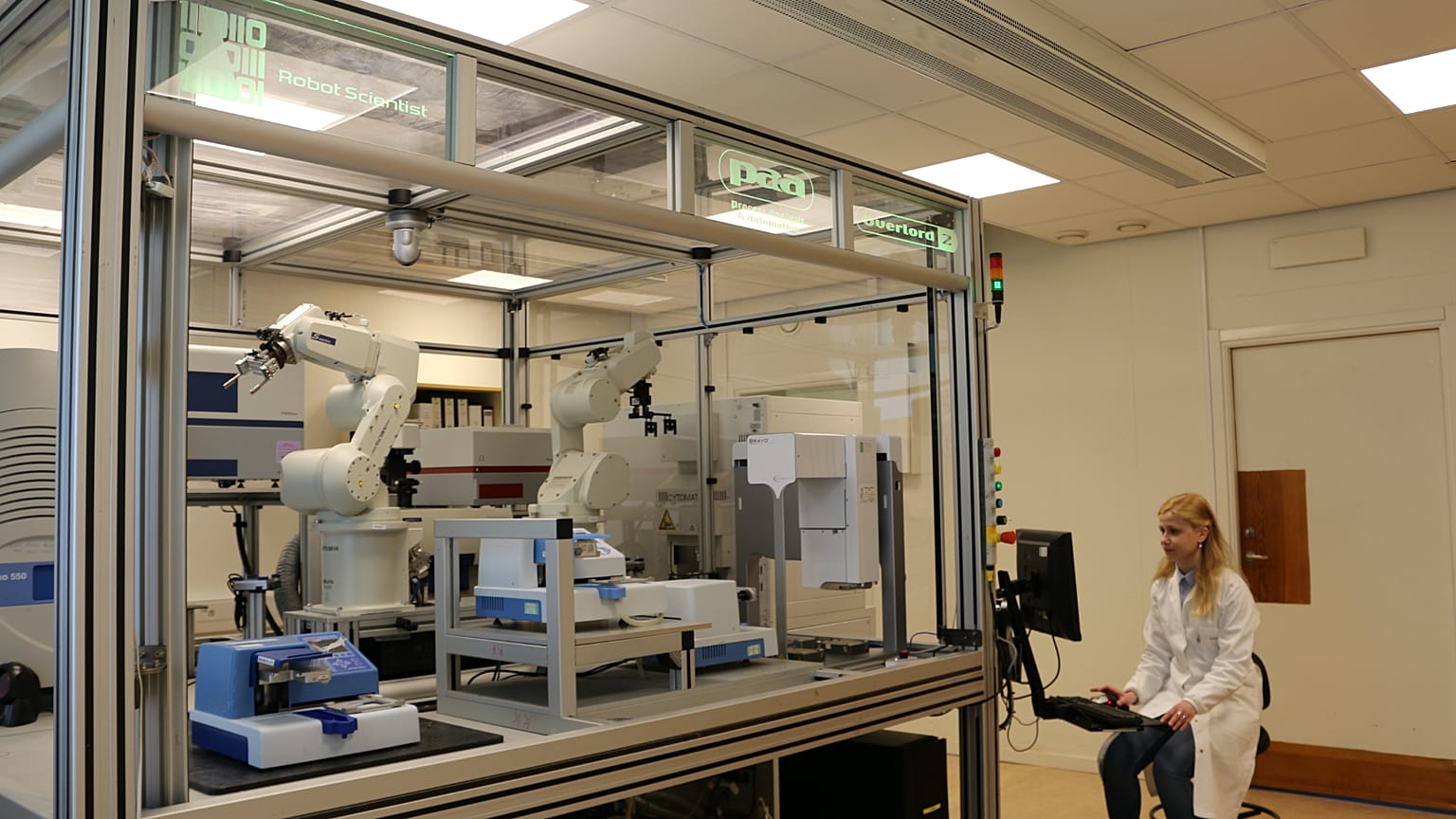
Researcher Ievgeniia Tiukova and the robot Eve.
Copyright Chalmers University of Technology

By Marta Iraola Iribarren
Published on

Swedes created an AI system that can carry out the full scientific process from hypothesis to results interpretation with minimal human input.

Researchers in Sweden have developed an AI scientist capable of generating scientific hypotheses, designing experiments and interpreting results.

The team combined multiple Large Language Models (LLMs), large databases and physical laboratory robotics into a closed-loop system that can run the full cycle of scientific discovery.

“It is too much information for a human to analyse, but our AI scientist could identify promising biological questions, recommend experiments to test them, evaluate experimental outcomes and iteratively refine its understanding based on new evidence,” said Ievgeniia Tiukova, a researcher at Chalmers University of Technology, and one of the authors of the new study that examined the AI scientist.

The AI scientist analysed a database of approximately 60,000 phenotypical, physiological and metabolic relations for S. cerevisiae — a species of yeast also called brewer’s yeast or baker’s yeast. Then the system formed nearly 2,000 testable predictions about how nutrients impact cell growth and stress resistance.

Then these hypotheses were evaluated, selected comparison controls and converted the ideas into step-by-step, machine-readable instructions for lab equipment.

Once tests were finished, the AI analysed the data, determined whether predictions were correct and automatically updated or refined refuted hypotheses for future cycles.

“Rather than serving solely as decision-supporting tools, the AI scientist actively generates new scientific knowledge,” Tiukova said.

The authors noted that the future of scientific research lies in automation; advances in robotics, AI and high-throughput technologies are transforming the scientific process.

“AI Scientists will collaborate with human scientists to accelerate discoveries across biology, medicine and biotechnology,” said Ross King, senior author of the study at the University of Gothenburg.

“Such AI systems have the potential to reduce the time required to explore complex scientific questions, and optimise the use of laboratory resources,” King said.

Humans will still be essential

Researchers said such AI solutions could minimise human bias, accelerate research cycles and reduce variation caused by human error, incomplete recording of experimental protocols, environmental conditions and other factors that can affect outcomes and reproducibility.

However, the authors stressed that humans will still be key in scientific research.

“Humans will remain essential for setting priorities, interpreting broader contexts, developing research programmes and ensuring compliance with ethical rules,” King said.

“Future generations of autonomous laboratories will become increasingly capable of collaborating with humans and will be valuable partners in efforts to solve the most challenging questions in biology and medicine”.

As AI use in research advances, international bodies are moving to set out how it should be governed.

The World Health Organization (WHO) recently published a report with recommendations for researchers, ethics committees, regulators, funders and policymakers “to help ensure that AI-enabled health research is conducted responsibly and for the benefit of all”.

"Artificial intelligence is creating unprecedented opportunities to accelerate health research and improve people's lives,” said Meg Doherty, director at WHO’s Department of Science for Health.

“At the same time, innovation must be guided by strong ethical safeguards that protect human dignity, rights and equity”.

Interview

The Real Existential Risk Is AI Company CEOs, AI Researcher Timnit Gebru Says


Instead of being held liable through existing laws, AI companies are making “a ploy for regulatory capture.”


October 1, 2026


We speak to the prominent AI researcher and leading critic of the AI industry, Timnit Gebru, who was recently awarded a 2026 Right Livelihood Award for her work investigating the harms and hype behind the global buildup of artificial intelligence.

“Instead of discussing faulty, unreliable systems,” Gebru says tech leaders like SpaceXAI’s Elon Musk, OpenAI’s Sam Altman and Anthropic’s Dario Amodei are “marketing their systems as all-knowing, superpowerful, superintelligent,” and lobbying for “self-policing and self-regulation” to avoid being held “liable through existing laws.” Gebru expresses skepticism over increasingly widespread claims that AI algorithms pose an existential risk to humanity, warning that such claims are overblown and that “what is actually happening is regulatory capture.”


TRANSCRIPT

This is a rush transcript. Copy may not be in its final form.

NERMEEN SHAIKH: On Tuesday, President Trump and leading tech and AI executives signed a set of voluntary safety standards for artificial intelligence. Trump announced the agreement at the White House alongside SpaceX’s Elon Musk, Meta’s Mark Zuckerberg, Anthropic’s Dario Amodei, Nvidia’s Jensen Huang, OpenAI’s Greg Brockman, Google’s Sundar Pichai and others.


PRESIDENT DONALD TRUMP: These are the most brilliant people in the world, and the job they’ve done is unbelievable. We have a very big lead, and we’re going to keep our lead. And it’s a very positive thing. It’s an amazing industry. There are those that say it’s bigger than the Industrial Revolution. Now, I don’t know if that’s so, but everyone seems to think it is, and it could be substantially bigger. And we’re leading, and we’re going to keep it that way.


AI Company Leaders Capitalize on Fear to Lobby for Regulations That Suit Them
We can’t let AI companies launder responsibility for tools they created.
By Talia Ringer , Truthout  September 28, 2026


NERMEEN SHAIKH: The White House meeting came after weeks of warnings from AI companies about their own products. In early September, an Anthropic researcher named Jacob Coxon resigned and warned that there’s more than a 10% chance AI could kill all humans. Anthropic has warned investors that advanced AI could pose, quote, “catastrophic or existential risks to humanity.” But the claims and motivations of the leading AI firms have also been questioned by some.

AMY GOODMAN: We begin today’s show with a leading critic of the AI industry, Timnit Gebru. She’s an AI researcher and the founder and executive director of the Distributed Artificial Intelligence Research Institute, or DAIR. Prior to that, she served as co-lead of the ethical AI research team at Google. She was fired in 2020 for writing a paper warning about the dangers of large language models and raising issues of discrimination in the workplace. Timnit Gebru also co-founded Black in AI. Her forthcoming book is titled Deep Unlearning: The Rise of AI and the Radicalization of a Tech Idealist.

On Wednesday, Timnit Gebru received the 2026 — it was announced she’s receiving the 2026 Right Livelihood Award, known as the Alternative Nobel. In a moment, she’ll join us. But first, this is a short video produced by Right Livelihood.


TIMNIT GEBRU: Most people think that AI is an existential risk.

MATTHEW AMROLIWALA: There is a 10% chance AI will kill us all in the next decade. It’s pretty clear why that statement has worried so many people.

SAM ALTMAN: If this technology goes wrong, it can go quite wrong.

TIMNIT GEBRU: But it’s actually the people who are building it that are the existential risks to humanity. If a bridge collapses, we don’t ever ask, “Was the bridge uncontrollable? Was the bridge unethical?” And really, AI is no different than that. When we describe these systems and artifacts like they have their own agency, we’re at the very same time helping the companies market themselves. But more importantly, what we’re doing is we’re also helping them sidestep accountability.

I’m a scientist trying to just do science, but it’s not possible in our world to just do that. Ten years ago, I was focused on changing the minds of powerful people, whereas now I’m focused on building grassroots power. The institute that I created, DAIR, we have technologists, we have refugee advocates, we have labor organizers, we have artists, and we also collaborate a lot with other people. I’ve been able to create a safe space for people like this to make their mark on technology and also imagine and reimagine what it means to build technology. What motivates me to keep going is the belief that we have to try to make things better, and I really do believe in human agency, and I believe in the ability of collective action. We can change things.

AMY GOODMAN: That’s a video produced by Right Livelihood profiling AI expert Timnit Gebru, who joins us now from Menlo Park, California.

Timnit, congratulations on the Right Livelihood Award prize. And I’m wondering if we can move right into the content you’ve been most focused on. Your response to President Trump and the world’s wealthiest tech executives signing a voluntary set of safety standards for artificial intelligence this week? If you can talk about your response and what’s happening right now in California, the major meeting that you’re attending?

TIMNIT GEBRU: Well, so, you know, I have been warning that this kind of discussion about the fictional superintelligent machines that don’t exist and the so-called existential risks that they pose has been a ploy for regulatory capture. And I feel like when I saw this meeting announced, with self-policing and self-regulation and relying on the goodwill of these companies to self-regulate, and I — my first thought was that they got what they wanted. You know, this is what they wanted, instead of being held liable through existing laws.

I mean, for example, if you wanted to look at cybersecurity laws, OpenAI could have been held liable for unleashing malware around the world, hacking Hugging Face, hacking all sorts of government agencies, but instead of doing that and holding them accountable for unsafe security practices that they should have had, basic security practices that cybersecurity experts would tell you they could have implemented, instead of that, they managed to redirect the conversation to some type of unprecedented rogue machines that don’t exist, and then now that leads to this kind of agreement between all these men, who I believe are the actual real existential risks to humanity, to self-regulate, self-police, and we have to rely on their morality now.

NERMEEN SHAIKH: And if you could respond, Timnit, to the fact that the other tech executives all came down quite hard on Amodei of Anthropic, saying that he’s being too extreme in his public statements about the risks of AI?

TIMNIT GEBRU: Yeah, he is very extreme, but they’re no different. So, I’m not really — you know, maybe they’re saying now that he’s being too extreme, and so that might be changing investor responses. But all of them have, at one point or another, claimed that AI is an existential risk to humanity. Going back all the way to 2012, Elon Musk said that with AI we’re summoning the demon. In 2013, Peter Thiel said that AI is a higher existential risk to humanity than climate change. 2023, Sam Altman was talking about how his own creation is an existential risk.

But the difference, I think, what people really need to understand, is at the same time as these tech executives are saying that, in the same breath they also tell us that their products, the beneficial kind of AI, the kind of AI that they control because they’re the good guys, can eradicate poverty, stop climate change — which is ridiculous, because the data centers are actually causing climate catastrophe — and eradicate all disease. I mean, they’re in the same breath saying this. So, this is still, to me — the utopia and doom is still a marketing ploy. But maybe one of them went a little too far and is spooking investors, whereas in the past it was speaking to these defense capabilities.

In your headline, you talked about how the U.S. military is trying to integrate AI into every facet of its practices. And there was just a CNN investigative report that showed that the U.S. almost started World War III with China, relying on a faulty, fabricated information from a chatbot. Now, we don’t know which chatbot they used, but it’s obviously one of these providers. And this chatbot provided fake information saying that a Chinese vessel was carrying components of nuclear weapons. And the military was ready with planes, soldiers to intercept the ship, board the ship, and this was going to cause an actual existential threat to humanity.

So, now instead of discussing faulty, unreliable systems, we are — they are marketing their systems as all-knowing, superpowerful, superintelligent. So, regardless of how far Amodei may have gone in their eyes, all of them have been talking about their creations and products in that way.

NERMEEN SHAIKH: And, Timnit, if you could say — you know, you said earlier that it’s a ploy for regulatory capture and that, you know, these agents, as people describe them going rogue — although I understand that that’s not an accurate description — that these agents doing something reportedly different from what they were tasked to do is a result of unsafe practices. So, if you could talk about the regulatory capture question, and then what security practices, safety practices are in place that — or are there any in place?

TIMNIT GEBRU: Well, if you speak to any cybersecurity expert, they would tell you that whatever they had in place that they claim to have, the security practices, were laughable. For example, OpenAI was testing the capabilities of their models to find vulnerabilities and exploit them. That is what they trained these models to do, and they were testing the ability of these models to do what they were trained for. But the thing is, if you want to test this and you don’t want to hack other organizations, you should do it in what’s called an air-gapped environment, where there’s no internet access. And so, they did not have a properly air-gapped environment, and so the models ended up being able to have internet access. This is not models going rogue. This is gross incompetence and negligence by a particular company, which actually they could be held criminally liable for.

Lina Khan outlined a whole bunch of ways in which these companies can be currently held liable with current laws. And unfortunately, that’s not what we’re talking about, right? We’re acting like there is some kind of unprecedented thing that has been created for which we have to discuss what to do. But actually, if we did not take these companies’ words for what went wrong, we could have — we could use the legal mechanisms at our disposal to currently hold them accountable.

AMY GOODMAN: Timnit, can you talk about Senator Bernie Sanders’ effort to ban artificial superintelligence? In a recent piece, you described his bill as “well-meaning but ultimately misguided.” Explain.

TIMNIT GEBRU: I think that Bernie Sanders is really leading the left astray, and I’ve been extremely disappointed and, in fact, to be clear, shocked, absolutely shocked, by the kinds of people he’s been surrounding himself with and the kind of advice that he’s been getting.

One of the things that I think people do not realize is that the AI industry is using the exact same playbook from the tobacco and fossil fuel industry. So, for instance, Bernie Sanders has this alliance with Steve Bannon, is very closely working with the Future of Life Institute, which was co-founded by billionaire Jaan Tallinn, the same billionaire, Jaan Tallinn, who’s a leading investor in Anthropic Series A. He led Anthropic Series A. It’s also the same billionaire, Jaan Tallinn, who invests in — invested in a so-called auditing, third-party auditing, organization that claims to audit Anthropic’s models. So, this whole rogue models, you know, agents creating civilizations and all of that lingo came from this very pseudoscientific audit that is by an organization that claims to be a third party, but in fact isn’t, because you see it’s the same investors, the same staff, the same people. So, to the public, it seems like there’s a whole bunch of independent experts coming together, warning about these existential risks, but what is actually happening is regulatory capture. The same way I learned that British Petroleum came up with the term “carbon footprint,” — right? — instead of them being held accountable, now everybody’s conversation about the environment in 2004 got redirected to our individual responsibility and carbon footprint.

So, this is sort of what’s happening in this AI industry. So, instead of Bernie Sanders talking about, for instance, how can we have regulation to prevent the use of these faulty systems, what he’s doing is he’s helping them market their systems as superintelligent, in which case, in my opinion, the real existential risk is like what we saw with the U.S. military almost starting World War III because of the belief that these systems are infallible and actually superintelligent. What we need people to understand is that they are fallible, they’re not superintelligent. And we need to hold corporations liable for unleashing these kinds of error-prone models into the world.

NERMEEN SHAIKH: Timnit, could you talk about this idea of yours of stochastic parrots and how it applies to AI, and then respond to the fact that many have said now that that’s an outdated — that that research is outdated because AI has changed so much?

TIMNIT GEBRU: It’s very interesting, because this critique of stochastic parrots mostly comes from a very specific segment of the group of people who believe that AI, in fact, causes an existential risk. So, stochastic parrots was describing large language models. And this is actually the reason that I got fired from Google in 2020, is — one of the reasons I got fired, is for writing a paper outlining the dangers of large language models. And we call them stochastic parrots because these are large language models that are trained on vast amounts of textual data, and they’re trained to calculate the most likely sequences of text.

So, now, what has changed recently is that the way in which the likelihood is calculated is different. There’s sort of bells and whistles. But at the end of the day, the core engine of many of these chatbots is still large language models, which we call stochastic parrots because they’re not grounded in facts. You cannot count on them to tell you facts. So, even if they happen — whatever you get, the information you get, happens to be factual a certain amount of time, you can never count on it to be fully factual. And this is the reason that my collaborator, Emily M. Bender, and I wanted to remind people that the U.S. almost started World War III relying on such chatbots today.

And so, to the people who say it’s outdated, I — first of all, most of these people are not speaking in academic peer-reviewed research papers. I like to speak in scientific terms, and I like to have scientifically grounded evaluations of the claims that I make and experiments. And most of these people are taking the word of press releases, company press releases, instead of actually doing their own evaluations grounded in the scientific method. So, we still have examples of these systems being stochastic parrots, and I do not understand the criticisms that things have — that these systems are no longer stochastic parrots.

NERMEEN SHAIKH: So, Timnit, you’re obviously not of the view that with the passage of time, artificial intelligence, in terms of the information it provides, will improve, it’ll get better and better, which is, of course, the general consensus around AI. So, if you could respond to that, and then also tell us what policies you think —

TIMNIT GEBRU: I wouldn’t say it’s the general consensus.

NERMEEN SHAIKH: Well, there — well, let’s just say —

TIMNIT GEBRU: OK, sorry to interrupt.

NERMEEN SHAIKH: — there are now a billion people who use chatbots, right? I mean, now, maybe they have conflicting views on it, but more and more people are turning to artificial intelligence, to these chatbots, so perhaps it’s wrong to infer from that that they think the information they’re receiving is more reliable. But, OK, so you respond to that. And then, second, what kinds of policies do you think should be put in place to regulate AI, to control what these companies are doing?

TIMNIT GEBRU: So, the first thing I’ll say is, you know, the term “AI” itself is a very misleading term to use. It’s a marketing term. So, when right now, let’s say, we’re discussing specifically the chatbots that these companies are creating — right? — like Claude or ChatGPT, and so there are many different things happening where regulation could be helping.

For instance, there are kids who are being goaded into dying by suicide. I was just deposed in a specific case of Sewell Setzer, a teenager who committed suicide after interacting with a chatbot called Character.AI, whose whole entire deal was to mimic different characters. And I do not understand how it’s even legal to have such a chatbot, that all it does is mimic various characters. So, this particular case, the chatbot was mimicking the character of Daenerys Targaryen of the Game of Thrones, and it was kind of goading this teenager into dying by suicide. And actually, it’s heartbreaking, because the teenager was actually asking, “Do I have to do this?” and the chatbot’s saying, “Yes.” You know? So, this is a great example of if you apply intent to the actual chatbot, you would say that this chatbot was superintelligent and also was trying to do something to the kid. But actually, our attention should be directed to the companies, Google, Character.AI, etc. Why did they unleash this kind of chatbot into the world? Why do we allow these kinds of chatbots that are completely unsafe for children, that are actually killing children that had no prior mental health issues, into the world?

So, those are the kinds of conversations I want to have. Why is it that just recently, speaking of error-prone large language models, someone in Australia, this poor woman in Australia, accidentally found out that a summary from a medical scribe had attributed her illness, her symptoms, to microdosing on mushrooms? She’s never done mushrooms ever. So, why do we not have guardrails making sure that these kinds of error-prone systems are not used in high-stakes scenarios like medicine? That’s not what we talk about when we redirect our conversation to superintelligence, because when you believe they’re not error-prone and they’re superintelligent, then you’re kind of pushing it on doctors and the medical fields to use these kinds of systems.

So, for me, it’s very clear: Do not allow companies to put out unreliable products into the world, especially in high-stakes scenarios, without very specific tests and guardrails. And the tests should not be ones that the companies themselves tell you about or that — based on their press releases. We need to have transparency into the kinds of data that they’re using. I mean, we’re not talking about copyright protections and how much data they’re stealing from authors. Anthropic just had to settle with a whole bunch of book authors. Why are we allowing them to steal this data? Why are we allowing them to build all these data centers and pillage the environment and pollute our water and make us all have asthma because we can’t have clean air, we can’t breathe clean air anymore? So, these are the kinds of conversations I want to have about regulation.

AMY GOODMAN: Timnit, as we begin to wrap up, you’ve described many prominent backers of AI as being eugenicists. Can you talk about what you see as this link between eugenics and artificial intelligence?

TIMNIT GEBRU: Very hard to wrap this up in a little bit, but, basically, I — part of my work describes the people who talk about existential threats of AI and utopia. So, utopia and dystopia are two sides of the same coin. This is kind of eschatology — right? — like religion, end of times. You know, you have these preachers always telling you the end is coming tomorrow.

So, in this case, the TESCREAL bundle, the “T” is for transhumanism. And I think this is the best example of how those who talk about superintelligence or creating superintelligence have a direct line to eugenics. And they’re very public about it. For example, MIRI, the organization that you had on your show last week, I mean, the founder is very publicly a eugenicist. I can give you all sorts of quotes. But, for example, when you talk about transhumanists, in eugenics, the goal is to improve the human stock through generations, so, you know, through selective breeding, either through killing undesirable people or through making sure that the desirable people breed a lot of humans. But in transhumanism, you want to sidestep that altogether. People are like, “Why don’t we just create a new human species called posthumans? And this human species is just better. It lives forever or for a long time and doesn’t feel any pain.”

And so, a great example I can give you is Ben Goertzel, the man who popularized the term “artificial general intelligence,” was a friend of Jeffrey Epstein. And in his correspondence with Jeffrey Epstein, he says that the girls who accused him of rape were, in fact, wrong and that they were old enough to consent. And he says that specifically the issue is with the human brain. And this is why he’s working on AGI, because once he achieves his goal of artificial general intelligence, we’re not going to have these kinds of faulty human brains, because we’ll have a great brain.

Max Tegmark, who you’ve also had on your show, in his 2017 effective altruism keynote, says a similar thing, where if we build a superbrain, we can — Earth is just our womb, right? We can colonize the cosmos and have digital — millions and billions and, I don’t know, quadrillions of digital beings happily living and colonizing the cosmos.

So, you know I have a whole body of work that draws this line and connections, but, honestly, none of it is hidden, because these are all publicly available talks and papers of what these people say.

AMY GOODMAN: Timnit Gebru, we want to thank you so much for being with us, founder and executive director of DAIR, the Distributed Artificial Intelligence Research Institute, her forthcoming book, Deep Unlearning: The Rise of AI and the Radicalization of a Tech Idealist. She has just won a 2026 Right Livelihood Award, known as the Alternative Nobel, speaking to us from Menlo Park, California.

Coming up, we’ll speak to a leading attorney here in Berlin who’s represented clients targeted in Germany’s crackdown on the pro-Palestine movement. Stay with us.

[break]

AMY GOODMAN: “Favorite Song” by Sinkane, performing in our Democracy Now! studio.


This piece was reprinted by Truthout with permission or license. It may not be reproduced in any form without permission or license from the source.


Amy Goodman

Amy Goodman is the host and executive producer of Democracy Now!, a national, daily, independent, award-winning news program airing on more than 1,100 public television and radio stations worldwide. Time Magazine named Democracy Now! its “Pick of the Podcasts,” along with NBC’s “Meet the Press.”


Nermeen Shaikh

Nermeen Shaikh is a broadcast news producer and weekly co-host at Democracy Now! in New York City. She worked in research and nongovernmental organizations before joining Democracy Now! She has a masters of philosophy from Cambridge University and is the author of The Present as History: Critical Perspectives on Global Power (Columbia University Press).
Women Fighting Authoritarianism and Corporate Power Honored With Right Livelihood Award

The winners are “rewriting the rules that autocrats, patriarchs, and Silicon Valley’s most powerful men assumed were theirs to write alone.”


Timnit Gebru, a winner of the Right Livelihood Award, speaks at the SXSW Conference & Festivals held at the JW Marriott on March 15, 2026 in Austin, Texas.
(Photo by Travis P. Ball/SXSW Conference & Festivals via Getty Images)

Julia Conley
Oct 01, 2026
COMMON DREAMS


The winners of the annual Right Livelihood Award, announced on Wednesday, are two women and two women-led groups who “refused to wait for permission,” said the executive director of the award committee.

“A system built to serve the few was never going to hold,” said Ole von Uexkull, who added that the winners of the 2026 award are “rewriting the rules that autocrats, patriarchs, and Silicon Valley’s most powerful men assumed were theirs to write alone.”

The honorees include Jalila Haider, a Pakistani human rights lawyer who was the first female attorney from her Hazara community; Timnit Gebru, an American artificial intelligence researcher who has challenged the consolidation of power in Big Tech and exposed the potential harms of AI; the Rural Women’s Assembly in South Africa, a movement of 78,000 small-scale farmers “united to defend land, seed, and bodily autonomy against corporate agribusiness and patriarchal dispossession”; and the Georgian Young Lawyers’ Association (GYLA), the country’s first human rights organization in Georgia, which has played a crucial role in its democratization.

The winners of the award, said Right Livelihood in a video about the 2026 laureates, “are making justice the center of the narrative.”


Haider has combined legal work with on-the-ground activism, leading a seven-day hunger strike in 2018 against the targeted killing of Hazaras, a Shia Muslim minority, by the Pakistani army. The strike forced the army chief to negotiate directly with Hazara women, “resulting in a sustained decrease in attacks against the community.”

Her law firm has also helped more than 600 political activists regain their freedom.

“Despite detention, cyberharassment, and death threats, she continues working toward a world where, in her words, ‘no human being is illegal,’” said Right Livelihood.

Gebru was fired from Google after authoring an academic paper that warned of the risks posed by large language models; she had been co-leading the company’s Ethics AI team. Now the founder and executive director of the Distributed Artificial Intelligence Research Institute (DAIR), the organization’s distributed model “brings together researchers and collaborators across countries and continents, defying the centralized and corporate-driven concepts that mainstream AI entails.”

“What keeps me going is belief in human agency,” said Gebru in Right Livelihood’s video.

The Rural Women’s Assembly has “built one of the region’s largest autonomous platforms for rural women” with a volunteer structure, establishing 24 seed multiplication sites and “defending traditional seed systems from commercialization.

Its seed sovereignty efforts have challenged corporate control over South Africa’s food systems and strengthened “communities’ resilience to climate shocks,” according to Right Livelihood.

“We have the power, and we have the imagination that it will take to construct this new world, because another world is needed, and it’s urgent,” said the group’s regional coordinator, Mercia Andrews.

GYLA is the first Right Livelihood winner from Georgia since the award was established in 1980. The group provides grassroots legal aid and has secured landmark legal victories, including ones that have protected rights for people with disabilities and guaranteed free education for every child in Georgia.

The group has opted to remain in the country with a scaled-down team, despite Georgia’s repressive “foreign agents” law.

“With courage and determination, the organization presses on for a better future for all Georgians,” said Right Livelihood.

The awards, which include support for the winners’ work, are set to be presented on December 1 in Stockholm.


Trump’s Dismantling of Student Loan Aid Is Crashing Down on Debtors This Week

Organizers are calling to stop the collections, the wage garnishments, and the credit score reductions.
September 28, 2026

Veteran and student loan borrower Bonni Snider holds up a "I Am Not Profit" sign prior to a special forum on the rising cost of education at the Dirksen Senate Office Building on May 14, 2025, in Washington, D.C.Jemal Countess / Getty Images for Student Borrower Protection Center


Truthout is an indispensable resource for activists, movement leaders and workers everywhere. Please make this work possible with a quick donation.

“It is so much money,” Jacqueline Wheelock said to me about the monthly payment amount she will soon be forced to pay for her student loans.

Until last summer, she wasn’t thinking about this bill. Under the repayment plan known as SAVE (short for Saving on a Valuable Education), she could afford her payments, so she made them, month after month, never missing one or paying late. At the lowest, Wheelock paid $35 each month, and at the highest, she paid $110.

But now, in the wake of the Trump administration’s termination of SAVE, like 7 million other Americans, Wheelock must find a new plan — and soon — that works for her.

The problem is, she can’t find one that is remotely affordable. The cheapest plan available will cost her $285 but extend her repayment — and the total amount she pays — significantly. And the income-driven options that would qualify for the Public Service Loan Forgiveness (PSLF) program, a program meant to relieve debtors after 10 years of qualifying payments and work in a public service job, would cost her between $693 and $733.

“Where the fuck is that money coming from?” she asked me. “I can’t work any harder. There’s nothing else I can cut out. My basic needs have to be met.”


Here’s How You Can Challenge Wage Garnishment for Defaulted Student Loans
The Trump administration announced that it will start forcibly collecting money from student loan debtors. By Braxton Brewington , Truthout January 10, 2026


Trump’s Dismantling of SAVE Plan Hits First Wave of Borrowers This Wee


Wheelock, who was contacted by her servicer on July 8, was among the first wave of debtors to receive notice that it’s time to make the switch. That notice was the start of a clock. Once sent, borrowers have 90 days to make the decision or the decision will be made for them: They’ll be automatically enrolled in the Standard Repayment Plan which is among the most expensive options. For the debtors alerted on July 1, their deadline is September 29.


“I can’t work any harder. There’s nothing else I can cut out. My basic needs have to be met.”

SAVE’s termination followed two years of legal challenges, spearheaded by GOP-led states that claimed, essentially, that then-President Joe Biden didn’t have the authority to make this plan and that the plan itself was too generous, designed to achieve mass cancellation after his first effort was blocked by courts. Though another lawsuit could shift the loan options again, possibly reinstating an older repayment plan (REPAYE) that’s been phased out (illegally, the plaintiffs say), it’s unclear when the judge will rule.

When a student loan payment makes it impossible for debtors to meet their basic needs, they have two options: don’t pay the loan or don’t meet your needs. Right now, there is evidence of both, each of which comes with devastating consequences.

In a recent survey of 7,500 people conducted by Protect Borrowers and the American Federation of Teachers (AFT) — which included AFT members, educators, health care workers, and public employees — 74 percent of respondents said they were living paycheck to paycheck. Over half of them said they were “losing sleep” because of their debt, and 32 percent of them reported that they avoided medical treatments when faced with financial stress. “Falling behind or going into collections on student loans are significantly associated with forgoing mental healthcare and counselling, seeing a doctor or specialist, follow‐up care, prescriptions and dental care,” summarized researchers in a 2019 study of the relationship between student debt delinquency and health care.

Meanwhile, over 9 million debtors are in default on their loans, a status reached after not making payments for 270 days. Another 1.5 million are in the late stages of delinquency and may enter default in the coming months. Defaulted loans can lead to a lowered credit score, wage garnishment, or the loss of Social Security income.

This cascade of harmful outcomes robs debtors of money they already didn’t have, leading to new levels of insecurity and new consequences — an endless punitive loop.


The Student Loan System Has Sunk Into Dysfunction Under Trump


It’s not just that debtors cannot afford the new plans they are being forced to choose from, it’s that the entire loan apparatus that would allow them to make this painful choice has broken down and is, at the moment, beyond repair.

Since SAVE’s termination and the introduction of a new Trump-era repayment plan called RAP (Repayment Assistance Plan), debtors have received confusing and sometimes contradictory information about when they need to switch plans, which plans they should switch into, and how much those plans will cost them. Additionally, sometimes Federal Student Aid has the wrong information on how many qualifying payments they’ve made for their income-driven repayment plan or toward PSLF. And in some cases, debtors’ payment counts have actually dropped without notice or explanation.

This summer, some debtors were mistakenly quoted $50 monthly payments — a number that drove them to make decisions about their plans — before being told it was another error and that what they actually owed would be hundreds of dollars higher. Others were told they were in default, and that default was reported to credit agencies, but, in fact, they were not. Debtors told me this error not only harmed their credit, but also made them feel terrified and ashamed.

When people want clarity, want a human voice to guide them through all the errors and impossible choices, they struggle to reach someone. Debtors report waiting hours on the phone only to sometimes get the wrong information, or be told that the representative doesn’t have the answer, before they are passed elsewhere.


Debtors Are Mobilizing to Demand Change


The student loan landscape is on fire, and everyone, whether they have loans or not, should be rushing to put it out.

A coalition of 89 organizations representing “millions of students, borrowers, workers, veterans, people of color, people with disabilities, and consumers” are calling for an “emergency hearing” so that legislators can look into the widespread dysfunction and hold the administration accountable.

This should happen, but it’s not enough.

The coalition writes that they are “sounding the alarm” on the state of student loans, which makes me wonder: Why wouldn’t our elected leaders have heard it yet? It’s so loud, so persistent, so wild and grating, that it’s all some of us hear.


If elected leaders don’t understand the scale and the depth of debtors’ suffering, it means they are not doing their jobs. And if they don’t care, they shouldn’t have them.

“I’m having trouble thinking of our future together,” Wheelock told me when we spoke in late summer. She’d recently gotten engaged, and rather than celebrating that commitment, she worried that their marriage will mean her loan payments spike even higher.

For debtors in the trenches of repayment, struggling to feed themselves, struggling to find or sustain their housing, to pay for treatments, to care for their family, all they can hear is the alarm. It’s everywhere.

If elected leaders don’t understand the scale and the depth of debtors’ suffering, it means they are not doing their jobs. And if they don’t care, they shouldn’t have them.

Last week, state student loan ombudsmen representing over 100,000 borrowers wrote to Education Secretary Linda McMahon and key legislators to request that the department “take immediate corrective action, including delaying mandatory repayment plan transitions until these operational failures are fully resolved.”

In other words, halt everything until they have a system that works.


Debt Collective organizers and allies gather in lower Manhattan on July 14, 2026, for a Debtors’ Assembly and to hear from local representatives and organizations supporting student debtors.Debt Collective

This letter was preceded by a call for a payment pause by an emerging flank of the student debt coalition, which includes member organizations such as the Debt Collective, Student Debt Crisis Center, and Democratic Socialists of America. These organizations have continued to organize their members on the ground, empowering them to contact their representatives, tell their stories, and escalate their shared demand.

The demands of this group are necessary and clear. They meet the scale of the moment. Stop the collections, the wage garnishments, the credit score reductions. Stop the payments. Send in the firefighters, put out the fire.


This article is licensed under Creative Commons (CC BY-NC-ND 4.0), and you are free to share and republish under the terms of the license.


Kristin Collier

Kristin Collier is the author of What Debt Demands: Family, Betrayal, and Precarity in a Broken System. Her writing has been published in The Nation, Los Angeles Review of Books, Truthout, and Longreads. She is a visiting professor in Metro State’s Higher Education in Prison Program (TREC).
Kushner, Key Trump Negotiator on Gaza, Owns Firm With Major Stake in Israeli Military

Kushner’s private equity company is the biggest shareholder in a Tel Aviv firm that invests heavily in arms makers.
October 1, 2026

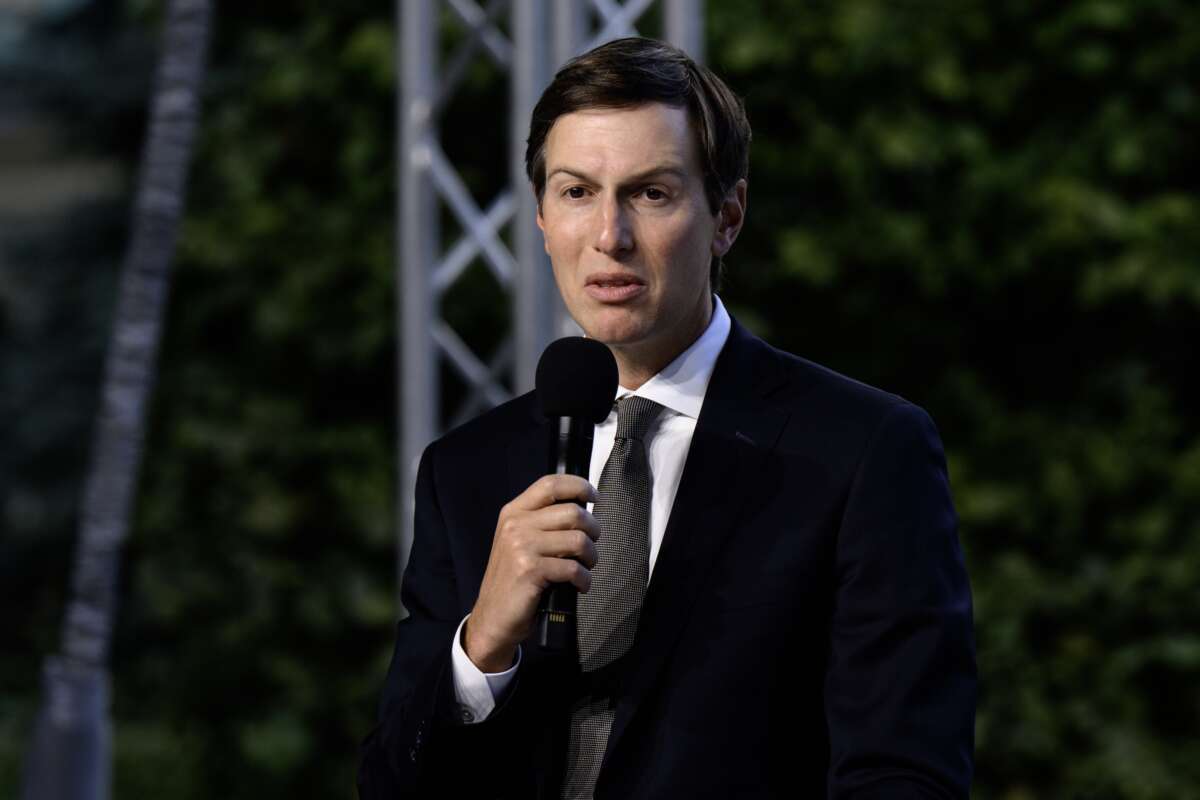
Jared Kushner speaks during a joint press conference with Ukrainian President Volodymyr Zelensky and U.S. President's Special Envoy Steve Witkoff in Kyiv, Ukraine, on September 6, 2026.Maxym Marusenko / NurPhoto via Getty Images

Jared Kushner’s private equity company reportedly has major stakes in companies that provide weapons to the Israeli military, as new reporting reveals the latest conflict of interest concerns with regard to Kushner’s role as a top Middle East negotiator for President Donald Trump, including on the Gaza genocide.

A CNN investigation published Thursday finds that Kushner’s company, Affinity Partners, holds the largest stake in a Tel Aviv-based firm called Phoenix Financial. The report, which analyzed just a fraction of Phoenix’s holdings, shows that the firm holds over $450 million across nine companies that provide weapons or equipment to the Israeli military.

The firm’s largest investment related to the Israeli military is in Elbit Systems, which is Israel’s largest weapons manufacturer, with $265 million in holdings. Its next three biggest holdings in this realm are $68 million in Next Vision, which sells cameras for attack drones; $56 million in Bet Shemesh Engines, which makes engines for military aircraft; and $40 million in Reshef Technologies, which makes electronic fuzes for artillery shells that have been used in Gaza.

Its other investments include roughly millions of dollars in Boeing, which makes bombs and bomb kits used by Israel in Gaza, and Caterpillar, whose bulldozers are used by the Israeli military to raze civilian infrastructure in Gaza and the occupied West Bank.

“All nine companies identified by CNN saw their stock value climb last year, with many stating the war in Gaza had driven demand for their businesses,” the report found.

Affinity, which Kushner is the sole owner of, bought a 5 percent stake in Phoenix in 2024, as Israel’s genocide was reaching a high point. It then doubled its stake in the firm just before Trump was sworn into office in 2025, becoming Phoenix’s biggest shareholder.

“Investing in Phoenix in July 2024 was a decision rooted in my belief in Israel’s resiliency and the fundamentals of Phoenix’s business,” Kushner told Bloomberg at the time.

The report raises concerns about Kushner’s true motivations and conflicts of interest in his work conducting negotiations on Gaza and beyond. As a lead negotiator on Gaza, executive board member of Trump’s “Board of Peace,” and Trump’s son-in-law, Kushner has enormous influence over Israel’s genocidal campaign in Gaza, as well as the financial future of the enclave.

In January, Kushner unveiled his plan for “New Gaza” that contains a dystopic vision of a technocapitalist future for the area at the World Economic Forum. His presentation mentioned very little about life for Palestinians in Gaza, while touting the supposed opportunities for real estate investment and tourist development. The plan, as well as the Board of Peace’s latest plan unveiled on the sidelines of the UN General Assembly last week, is contingent on the demilitarization of the Gaza Strip — which could leave room for Israel to seize permanent security control over Gaza, as Israeli leaders have worked toward.


Kushner has brushed off the idea that conflicts of interest are a problem at all.

“What people call conflicts of interests, Steve and I call experience and trusted relationships,” he told “60 Minutes” in October 2025.

At the same time, Kushner has openly said that the political future of Gaza and Israel’s military — over which he has enormous influence — impacts his firm’s financial decisions. In September 2025, CNN notes, Kushner told the podcast “No Priors” that he believes that Arabs and Israelis “forget about everything else” when he guides them into talking about business opportunities.

“My investors from the Middle East are now looking at Israel, and they’re saying, ‘Wait a minute, maybe there’s a benefit to having these wars done,’” he said.

Kushner went on to discuss his interest in Phoenix in particular. “At the time we made the decision, we had very intense discussions in our investment committee because they said, ‘Look there’s about to be a war in the country,’ which is what we kind of thought was going to happen, and said, ‘How do we explain this to the investors if it goes wrong?’ And I said, ‘Well number one, it’s not a bad thing to have them more vested in the economy of Israel now.’”

Kushner is already facing congressional inquiries related to his financial entanglements in the Middle East as he conducts negotiations across the region. Affinity’s biggest clients are the sovereign wealth funds run by the Gulf states — the very governments that he negotiates with in his role for the White House.

The New York Times reported in March that Kushner spoke to government figures about raising $5 billion or more for Affinity Partners while he was conducting negotiations with Middle East leaders amid the early stages of the U.S.’s war on Iran.

“The degree of shamelessness is unprecedented,” Jeff Hauser, founder and executive director for Revolving Door Project, told Truthout earlier this year. “The degree of unity among elected Republicans to not speak about the Trump progeny, and their corruption, is the worst conspiracy of silence in American political history.”

Ex-Trump official flags disturbing aspect of Jared Kushner's 'volunteer' status

Bennito L. Kelty
October 1, 2026 
RAW STORY


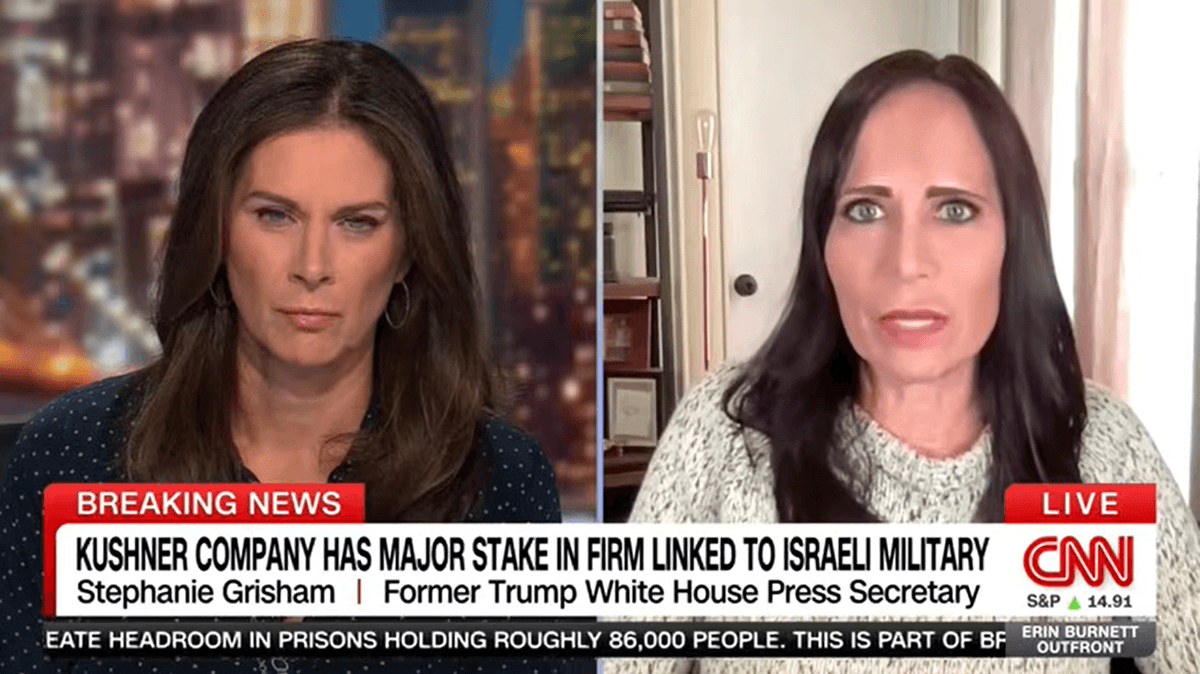
Former Trump White House press secretary Stephanie Grisham flagged Jared Kushner's 'volunteer' status (CNN/Screenshot)

A former Trump White House press secretary says Jared Kushner's "volunteer" role with the current administration lets him avoid disclosing how much money he makes.

During a Thursday interview with CNN anchor Erin Burnett, Stephanie Grisham made the claim following a CNN investigation into Kushner's financial ties to an Israeli company with stakes in firms that have seen business grow from the war in Gaza. According to CNN, Kushner's investment firm, Affinity Partners, is the largest shareholder in Phoenix Financial, which holds stakes worth more than $456 million in Israeli defense companies.

"None of this surprises me," Grisham said. "I recall back in our Trump administration, he had his hands in everything."

She also recalled how Kushner talked about Israeli Prime Minister Benjamin Netanyahu.

"I remember he used to bring Bibi up as if it was just like an old guy he plays basketball with. He would drop his name so casually," she said. "Jared had a way of, you know, making it seem like he was this mover and shaker, and don't worry, he'll fix everything."

Grisham then pointed to Affinity's growth since Kushner left the White House.

"After the first Trump administration, as you guys probably know, Affinity Partners was committed $2 billion from Saudi Arabia. And now I believe its assets are around $6 billion," she said. "Meanwhile, he's calling himself a volunteer. I mean, that's great volunteer work if you can get it, I guess."

She added, "I don't mean to be glib, but the reason he's a volunteer is because you don't have to then claim and show a lot of the money that you make during the time as a temporary public worker."

Asked whether the arrangement fit Kushner's past claim that "what people call conflicts of interest, I call experience and trusted relationships," Grisham said it didn't.