It’s possible that I shall make an ass of myself. But in that case one can always get out of it with a little dialectic. I have, of course, so worded my proposition as to be right either way (K.Marx, Letter to F.Engels on the Indian Mutiny)
Monday, October 12, 2026
World fears Trump's 'cruelty' is crumbling US power 'before our eyes'
The U.S. benefited from a major sociocultural "superpower" for decades, but now, President Donald Trump's "cruelty and lawlessness" have that power "crumbling before our eyes," per a new analysis from The i Paper.
Writing for the outlet on Saturday, special correspondent and columnist Patrick Cockburn highlighted the now "grossly out of date" sentiments from the beloved 1942 film, Casablanca, in which would-be refugees desperately tried to reach the U.S. in order to escape "fascism, violence and corruption." This image of the country, he argued, "had at least some substance" at the time, and until very recently.
"This benign perception was the basis of American 'soft power,' the belief that the U.S. was – with many reservations – a force for good in the world, a view which made it a cultural and political superpower," Cockburn explained. "This image was reinforced by the extraordinary cultural dominance achieved by American films (of which Casablanca is a prime example) as well as television and popular music. The U.S. was seen as a country where most people in the world felt they would be happy to live, even if they did not take practical measures to go there."
He added: "But two years into Donald Trump’s second term this once huge American advantage in 'soft power' is swiftly disappearing like an iceberg melting in warm water. Trump and his lieutenants are furiously attacking all that was best in American government and society, replacing it with a cruelty and lawlessness."
The latest "grotesque" example of this decay, Cockburn argued, was the announcement that the firing squad execution of Fort Hood shooter Nidal Malik Hasan would be livestreamed for the public to view, a revival of the practice of public executions which "brings the U.S. into line with Afghanistan, Iran and North Korea, and it is only a step behind Islamic State which filmed decapitations and dowsing victims with fuel before setting them ablaze." This sort of highly visible state-backed violence, he added, has become commonplace under Trump's second term, be it from the treatment of immigrants by ICE, or from the bombing of boats in the Caribbean Sea.
"U.S. 'soft power' was cumulatively built up over the past century, but is now dissolving by the hour," Cockburn wrote. "Some might argue that America was never as good as it purported to be, but there was much goodness there all the same."
He later concluded: "In my experience, even those Europeans familiar with the U.S. seldom have an accurate idea of what made it tick. They ignore the impact of its diversity and internal conflicts, which have obvious negative consequences, but they also provide the friction that generates immense political and cultural energy. This creativity and resilience might just be enough to defeat Trumpism, which truly embodies the dark side of America past and present."
'So much for bringing jobs back': GOP voters seethe as Trump policies decimate workers
As oil flooded the market, demand went down, and as a result, oil prices have fallen below $30 a barrel. Photograph: Sergei Karpukhin/Reuters
Often touted as a tool to reshore manufacturing jobs, President Donald Trump’s tariffs have been named as the primary cause for thousands of layoffs — and a number of longtime GOP voters are expressing outrage.
“So much for bringing jobs back,” said Nelson Vandermeer, who’s voted for GOP candidates for decades but lost his job at a clockmaker after the company shut down, speaking with the Associated Press.
While a longtime GOP voter, Vandermeer “balked at” supporting Trump out of fear of his tariffs, a fear that ultimately materialized with him losing his job as a product designer. He now plans to vote “straight Democrat in the midterms,” the Associated Press reported.
Tracy Chew is another former GOP voter who voted for Trump in 2016 but then backed Democrats in 2020 and 2024. She lost her job in April after a backhoe manufacturer shut down its plant in Iowa, as did several of her family members.
“I’m furious he isn’t doing enough,” Chew told the Associated Press. “Tariffs are not targeting the right companies, the right amount.”
The employment research firm Challenger, Gray & Christmas documented 7,908 layoffs in 2025 that it classified as tariff-related.
The United States experienced a 40-plus-year decline in manufacturing after the abandonment of protectionist trade policies in the 1980s and onward. While supporters of Trump’s tariffs argue that the president’s tariffs are a return to such protectionist trade policies, critics argue that the tariffs failed to take into account the tens of thousands of factories that shuttered over the past few decades, decimating America’s manufacturing infrastructure.
“I understand the mindset behind tariffs, but I just don’t know if it’s working,” said Heather Kingston, who voted for Rep. Dan Meuser (R-PA) but is now reconsidering supporting him in the midterms, speaking with the Associated Press. “There doesn’t seem to be many manufacturing jobs moving into the area.”
Trump sees closure of steel facility that survived the Great Depression
The Milwaukee Journal Sentinel reports the Trump era is getting to witness the death of an American steel-making legend.
According to the 120-year-old company's website, Maynard Steel was created in 1907 in Milwaukee by Charles Maynard at 716 Reed St. It began life as Maynard Electric Steel Casting Company before it was bought be Sylvester Wabiszewski and renamed Maynard Steel Casting Company.
When the Great Depression hit, employment at the company shrank from 400 employees to fewer than 90, but World War II was a life-saver for steel workers, according to the Milwaukee Journal Sentinel, blasting employment up to more than 600 employees as the company churned out materials for the war effort.
Soon after, the company won the Army-Nave "E" flag for excellence in productivity in 1945.
During the 1960s, employment then grew to more than 725 workers, and the facility had to adopt a new water recycling cooling system to save 55 million gallons of water a year.
But that was then, reports the Sentinel.
Sales have declined from $27,698,425 in 2024 to $19.865,569 in 2025,” according to the company, and “due to the sales volume being below the break-even point, the Company has experienced losses in 2025 and for the first quarter of 2026.”
Now nearly 100 Wisconsin workers will be out of a job less than a month before Christmas Day after plant experienced “unforeseeable business circumstances.”
According to a press release, Maynard Steel Casting Company and Maynard Alloy Casting Company LLC will have to fire all 77 workers at its Milwaukee facility because a court-appointed receiver cannot sell the company’s assets. In addition to the Milwaukee facility’s workers being laid off on December 4 of this year, their health care benefits will also end that day, reports local news.
“We regret having to make this decision,” the press release reads. “However, business and industry circumstances leave us no alternative.”
Meanwhile, the President Donald Trump is touting his controversial tariffs as helping U.S. steel companies. Trump even claimed construction had already begun on a $15 billion steel plant in Iowa, which he called the largest in U.S. history; however, local records undermined that argument.
On September 28, Trump announced the Mesabi Metallics project from the Oval Office together with officials from Iowa and company executives. The White House described it as "the largest steel plant ever built in the United States", and Commerce Secretary Howard Lutnick told reporters that there was no doubt regarding the project.
However, an investigation by Iowa television station KWQC found no major property acquisitions connected with the project in Lee County this year. The county authorities also stated that no permits had been submitted to the supervisors and that they had not obtained detailed plans from the company.
Trump digs in as White House ignores escalating farmer fury
President Donald Trump gambled that importing more beef—at U.S. ranchers’ expense — would lower prices enough to mitigate the political hit from the ranching industry.
“There’s a lot of frustration and anger,” said Glenn Brunkow, the president of the nonpartisan Kansas Farm Bureau and a fifth-generation farmer and stockman in deep-red Pottawatomie County.
It turned out that beef prices have barely budged, U.S. ranchers — a key constituent of the Trump coalition — remain furious, and vulnerable Republicans in Iowa, Kansas, Nebraska and Texas are fighting for their lives to convince rural voters to turn out in November as farmers “confront economic headwinds fueled by the president’s policies.”
Brunkow told Politico that Trump’s August proclamation to temporarily allow cheaper beef imports from countries like Brazil knocked $200 to $400 off the $2k value of an American farmer’s cow, just to compete on the same market.
“We knew it wouldn’t have much of an effect on the hamburger price in the store. But the markets took that news, and it really knocked the price we get for our cattle down,” Brunkow said.
“[That] hit us with $6 diesel,” said Brunkow. “This has been pretty, pretty tough to swallow.”
Politico reports Republicans from top beef-producing states, as well as agriculture industry representatives and administration officials (including Agriculture Secretary Brooke Rollins) all warned Trump that his beef import plan would “hurt ranchers and imperil Republican candidates.” But Trump rolled on with his policy.
Now Trump's stubbornness is decimating Trump’s farming coalition as declining profits hollow out the reliable part of the Republican base.
“It wasn’t worth the headache and what it did to the market,” ranted Jenna Stanton, federal policy director at Western Skies Strategies. “It’s doing exactly what we thought it was going to do, which was nothing.”
Despite this, Trump isn’t backing down, reports White House sources.
“The White House isn’t currently planning to scale back or end the proclamation early, allowing it to expire as intended in November, according to two people familiar with the plans who were granted anonymity to discuss them,” reports Politico.
In many cases, the damage to American farmers is already done, said sources.
“I just think it’s had limited impact on consumer behavior, limited impact on family budgets. And it had a … significant negative impact on producers,” said a person close to the administration.
AMERIKA
'Food or rent': Families face agonizing choices as health coverage vanishes
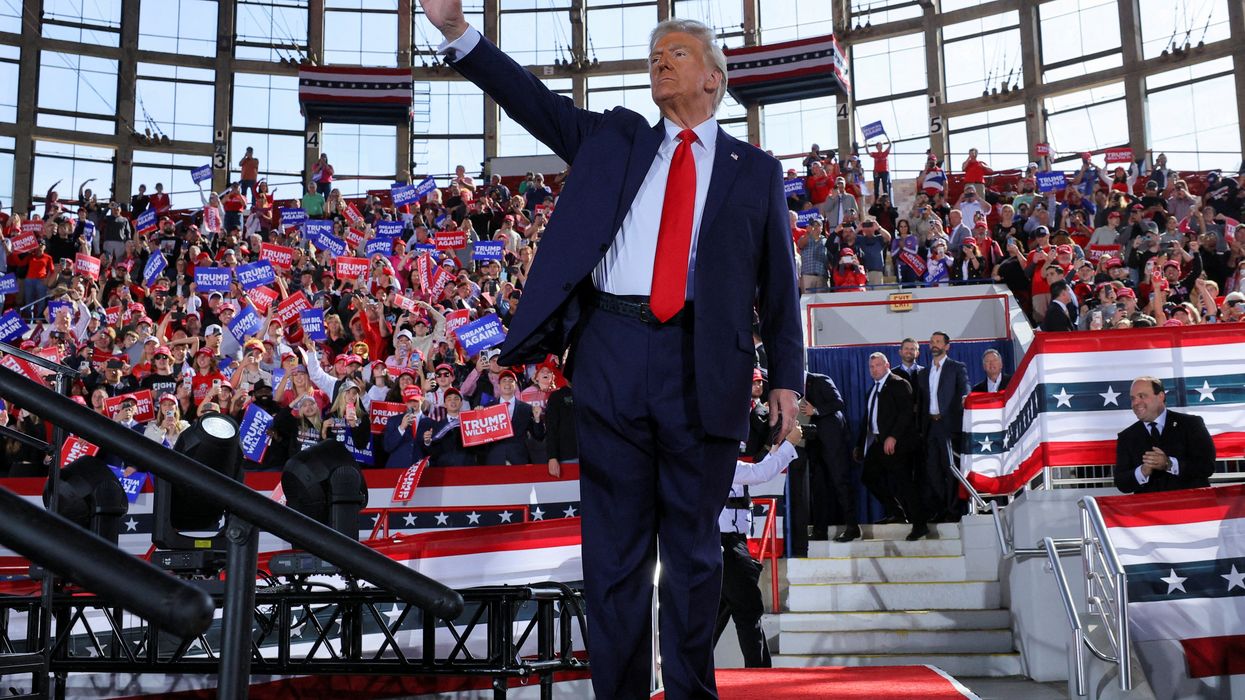
Donald Trump gestures to the crowd as sons Eric Trump and Donald Trump Jr. look on near the exit, during a campaign rally at J.S. Dorton Arena in Raleigh, North Carolina, U.S., November 4, 2024. REUTERS/Brian Snyder
President Donald Trump may have promised to lower health insurance premiums, but residents of a deep red state are experiencing higher costs as a result of his signature economic law, the so-called One Big Beautiful Bill.
"A new round of Medicaid changes tied to the 'One Big Beautiful Bill' went into effect Oct. 1, impacting around 1,000 people in Nebraska, including refugees and asylum-seekers, according to the state Department of Health and Human Services," reported News Channel (KOLN)'s Darsha Dodge on Thursday."
Dodge quoted Kelsey Arends, a senior staff attorney for health care access at Nebraska Appleseed.
“That means higher insurance costs for all of us, higher costs at the hospital, at the doctor, longer wait times in the emergency room for everyone because folks aren’t able to access the preventive care they need,” Arends told the Nebraska outlet.
She added that people will be forced to choose between health care and other essentials, such as food and rent, once their insurance vanishes.
“When your neighbor doesn’t have access to health care, when your neighbor is forced to choose between paying for food and going to the doctor, paying for rent, it destabilizes our communities as a whole,” Arends told Dodge.
Despite the ongoing health insurance crisis in America, Republicans like Texas attorney general and Senate nominee Ken Paxton argue for slashing more services that people rely on, such as Medicaid and Medicare, while giving more tax cuts to the rich.
“There’s no doubt we have to cut some of the mandatory spending,” Paxton said in a secret recording that was leaked on Thursday.
He added, “Making some reasonable cuts to mandatory spending — you’re gonna have to do it. Or there is no solution. That’s just the reality. We have to suck it up.”
In September, Axios reported that UnitedHealthcare “has dropped around 13 percent of plans offered across 18 states.” Healthcare Dive reported that the company “expects to end 2026 with up to 1.1 million fewer MA members than it had last year.”
“UnitedHealthcare — the largest MA insurer in the US — offered plans in one fewer state and 109 fewer counties this year, cut allowances for certain over-the-counter health and wellness items, and prioritized plan designs with more limited provider networks,” Axios reported, basing its article on a study by Healthcare Dive. “The company also shifted commissions to brokers to incentivize enrollment in more profitable plans.”
‘No regulation’: Trump officials bypass the public to boost invisible code
A cadre of elite techies, financiers, and high-level Trump administration officials have spent a year quietly charting an extraordinary and rapid campaign to persuade Americans to use apps and other artificial intelligence-powered tools to manage their healthcare and medical records.
As that campaign has unfolded, administration officials have granted tech companies an unusual opportunity to nudge the nation’s health department toward a loosely regulated future for AI health apps in which the government reimburses them for services as it does medical professionals.
In February, federal health officials invited those businesses — including tech giants Microsoft, Anthropic, OpenAI, Apple, and Google — to a listening session on conversational AI products for patients, such as chatbots. Representatives from at least 35 industry organizations attended the meeting held by the Food and Drug Administration, which is responsible for regulating health apps as medical devices. Companies were prompted in advance to explain their AI products and how they access patients’ sensitive medical information.
But the meeting did not appear on the FDA’s public calendar or regulatory notices, nor was the public invited. Rather, the invitation for a select group to help shape federal policy governing AI in healthcare was extended in a chat room on the messaging service Slack.
“This is a great opportunity to support HHS’ goals and share your state-of-the-art understanding of safe Conversational AI development and monitoring to help FDA shape future guidance,” CMS senior policy adviser Morgan Taylor wrote in the Slack workspace.
The Centers for Medicare & Medicaid Services has not formally announced the chat room through federal regulatory channels, though CMS officials have talked about it at industry conferences. Legal experts said the chat room resembles a federal advisory panel, which would be required to operate in public view.
KFF Health News reviewed thousands of Slack messages, meeting transcripts, and video recordings that reveal how the Trump administration has granted the industry a direct line to top government officials — including former head of the Department of Government Efficiency Amy Gleason.
The conversation took place behind the scenes as federal health officials publicly worked to integrate AI and other technology into nearly every aspect of healthcare, a plan they’ve branded the “Health Technology Ecosystem.”
“We wanted to give industry a chance to play in the sandbox of government-supported healthcare,” CMS Administrator Mehmet Oz said in September at the public launch of an initiative that allows health apps to bill Medicare for AI services such as wearable device tracking. Last week, Health and Human Services Secretary Robert F. Kennedy Jr. delivered an enthusiastic endorsement of AI in healthcare, claiming it is “much better informed than any doctor in the country.”
Meanwhile, HHS staff even promised that a recently launched Medicare App Library would serve as a lucrative pipeline for those businesses to get new users. The library's webpage currently promotes only two dozen commercial apps to millions of American seniors and those with disabilities.
As Trump officials sell it, Americans will get easier access to their medical records so apps can swiftly provide health or wellness advice. In practice, however, so will the tech companies.
Doctors, meanwhile, are increasingly worried about how patients use and share their medical records with the nascent technology.
“Some of these tools just aren’t ready for primetime,” said John Whyte, CEO of the American Medical Association. “We don’t have enough data about them. We don’t understand how they work, how they’re using the information. There’s no liability if these tools get things wrong.”
CMS officials declined to answer several questions about the Slack workspace, including about its legality.
“CMS is focused on giving Medicare beneficiaries greater access to their health information and useful digital tools while promoting an open, interoperable healthcare system,” Gleason, now chief product officer for the newly created Office of Health Technology and Products at CMS, wrote in an emailed statement. “The Health Technology Ecosystem is an open, voluntary technical collaboration. CMS will continue working with patients, providers, payers, technology organizations, and other stakeholders to make health information more accessible and useful to the Americans it serves.”
The FDA did not respond to a request for comment.
The Conversation Begins
The behind-the-scenes effort to funnel more Americans to AI-powered health apps began in August 2025 in the Slack workspace.
“Welcome all!” Gleason wrote. “Please be sure to read the Code of Conduct and see the Channel list as well to help you find channels that are relevant to you.”
Gleason is best known for serving as the acting administrator of Elon Musk’s Department of Government Efficiency, as it gained access to millions of Americans’ sensitive personal and financial data, including at the Social Security Administration.
As her work with DOGE wound down last year, Gleason welcomed a variety of tech leaders, investors, and entrepreneurs to the chat room.
The Slack workspace’s participants include representatives from major digital wellness companies like Oura Health, AI companies like Palantir, and investment outfits like 8VC, a venture capital firm associated with Kennedy’s son Finn. While the Slack’s member count has ballooned to 1,700 over the past year, only a handful of patient advocates, doctors, and hospital representatives are in it.
The code of conduct Gleason shared on Slack in August 2025 documented that CMS had quietly established a technology working group.
The document also set ground rules for the Slack workspace, noting that the group does not constitute an “advisory committee,” nor would it be used “to obtain advice or recommendations for HHS, CMS, or any HHS/CMS officials.” The code also advises that federal employees “are prohibited from endorsing any product, service, or enterprise.”
Joseph Daval, a former FDA lawyer who is now a research specialist at Harvard Medical School, reviewed messages from the Slack workspace at the request of KFF Health News. He said the chat room in some ways resembles a federal advisory committee — an independent panel that can be formally stood up by an agency head, Congress, or the president to ensure agencies act in the best interest of the public rather than industry.
The law on advisory committees “was passed in part out of a concern about interest group capture, about anticompetitive capture of agency policymaking, about corruption,” he said.
Daval said the chat group looks like a committee, with members interacting with one another and building consensus on preferred courses of action.
If it were a formal advisory committee, though, Daval said, it would be subject to certain “membership requirements having to do with independence and fair balance.”
A ‘Sales Engine’
Over a series of video calls, CMS officials promised tech leaders participating in the Slack workspace that the agency would promote their health apps.
Jacob Shiff, the chief AI and technology officer at CMS’ Innovation Center, told industry representatives in a Zoom meeting in February that he hoped the agency’s work would be a “sales engine” for the health apps.
“We’re going to have a directory of all the organizations,” Shiff said in a video recording reviewed by KFF Health News. “The people on this call who hopefully will have amazing solutions that work will be the winners, and you have every incentive to obviously drive down your costs so you can be extremely profitable and scale. So hopefully we’re selling — or enabling you guys to thrive.”
A recording of the call had been publicly available through a Google Drive link but was made private the day after KFF Health News asked about comments made during the meeting.
CMS did not respond to queries about how the agency has decided which AI-powered health apps appear in the Medicare App Library or why federal employees have promised to promote the products.
Days before publicly launching the Medicare App Library, CMS officials promised AI tech leaders during an informal meeting that the new webpage would become an important distribution channel for health apps because Medicare enrollees would place trust in products listed on the CMS website.
“If medicare.gov is promoting it, for lack of a better word, then yeah, it would be an app that I would trust and explore,” CMS’ Taylor said during the April 7 meeting, channeling enrollees, according to a transcript of the call.
The Medicare App Library’s webpage encourages older and disabled Americans to manage health conditions such as obesity, cancer, or diabetes using two dozen AI-driven apps developed by some of the world’s largest corporations, including Microsoft and Google. Many of the apps promise in their product descriptions to give insight, perform analyses, or develop plans that will help patients lose weight or manage diabetes.
CMS officials have suggested to tech representatives during at least two meetings this year that those apps will be prioritized for a new agency program that reimburses companies for AI chatbot advice or wearable device tracking, according to video recordings.
CMS has not publicly divulged all the criteria it uses to decide which apps are listed in its library, but the webpage promotes apps still in their infancy.
Among them is Slothwise, a health app launched this year from a San Francisco apartment by a young, self-described biotech entrepreneur and triple citizen of Russia, Israel, and the U.S. The app says it “knows your whole health” by analyzing medical records and tracking health data for $9.99 a month. It has been reviewed on the Apple and Google app stores only a handful of times.
“I trusted slothwise with my health info because it was endorsed by medicare,” one reviewer wrote in a Google review in August. “Connecting info was smooth and I learned a lot about my health.”
In a statement, Slothwise CEO Sofia Sigal-Passeck did not answer questions about the size and medical expertise of her current team, nor about the availability of a doctor to consult with patients who use the app. The app, she said, is only “informational” at this time.
“I’ve spent years building at the intersection of AI and complex biological data,” Sigal-Passeck wrote in an email. “A small team is not the same thing as an inexperienced team. Slothwise is built by physicians, PhD researchers and engineers.”
‘No Regulation, No Rulemaking’
What’s often less clear — and buried deep in lengthy privacy policies — is that these apps are tapping into the intimate details of patients’ medical records to fuel their AI-driven analyses.
Tech vendors have lobbied the government to treat these apps, once they are vetted and authorized by a third-party organization, like a patient requesting records. That position gives apps sweeping access to pull sensitive health data from the national network through which providers electronically exchange medical records, called the Trusted Exchange Framework and Common Agreement, or TEFCA.
A small but influential group of those tech company executives directly made the case to federal health officials during a formal meeting in May, arguing that when health apps request medical records they should be treated as if they are standing “in the shoes” of a patient.
On Slack, tech vendors have lobbied for a “frictionless pathway” for verified users, after they’ve consented once, that allows the app to gain limitless access to patients’ medical records from the TEFCA network.
Ryan Howells, a healthcare management consultant who lobbies for a Washington, D.C.-based digital health tech organization called the CARIN Alliance, has spearheaded an effort for patients — vis-à-vis apps — to more easily access medical records. He has regularly noted in Slack that health apps accessing TEFCA must be vetted by a third-party organization — one of which he sits on the board of — and agree to a code of conduct, developed by the alliance he lobbies for.
“What more can you do to have trust in these apps?” he wrote in a March Slack message, responding to concerns about how much patient consent is needed for apps to access medical records on the network.
Kristen Valdes, the CEO of b.well, a company that also connects apps to the TEFCA network, made a similar argument.
“My opinion is that we need to stop protecting patients from themselves,” she wrote in the same message thread. “Full stop.”
Howells did not respond to an emailed list of questions from KFF Health News. In an interview, Valdes told KFF Health News that her comment reflected her frustration at the “paternalism” of the healthcare system, which she said has historically made it difficult for patients to access their records. Although, she said, “there are going to be good and bad apps.”
Other tech leaders worried in Slack about the approach.
One startup founder cautioned the group to think about the pitfalls of giving health apps broad leeway to pull medical records.
“We might all be good, honest actors here but security & privacy systems have to be designed around the presence of malicious actors – especially if we want this system to scale up to thousands of apps,” wrote Jason Kulatunga, who runs Fasten Health, a medical records management platform.
Gleason, the CMS official, has publicly championed the vision shared by Howells and Valdes. In her speeches, she frequently urges doctors to accept patient medical records directly from apps and calls on them to “Kill the Clipboard,” also the title of a 2025 white paper co-authored by Howells that urges doctors' offices to abandon paper records.
Last month, Gleason spoke to a crowd gathered at a swanky hotel in Washington for an event hosted by the MAHA Institute, a think tank that supports Secretary Kennedy’s agenda. She laid out her work with tech companies over the past year as she discussed the Trump administration’s efforts to make medical records more digitally accessible.
As she told it, more Americans can now download an app and access their medical records.
“Once you’ve verified your identity you can just click a simple button and say, I’d like my medical records into whatever app I choose,” Gleason said.
She continued: “That was all done just — no regulation, no rulemaking — just by challenging industry to work together.” KFF Health News is a national newsroom that produces in-depth journalism about health issues and is one of the core operating programs at KFF—an independent source of health policy research, polling, and journalism. Learn more about KFF.
Historian preps for disaster scenario as Trump plans to do 'what losers do'
U.S. President Donald Trump addresses House Republicans at their annual issues conference retreat, at the Kennedy Center, in Washington, D.C., U.S., January 6, 2026. REUTERS/Kevin Lamarque
Historian Timothy D. Snyder knows what is likely coming on the evening of Nov. 3 and it's allegations that the election was "rigged." He wants Americans ready and prepared to respond quickly, if not before he makes the claim.
Speaking to former GOP strategist Steve Schmitt, Snyder said he doesn't want to think of it as first you vote and second you act.
"The other part is being prepared to win," he said, "because I agree with you completely in your forecast. I think this is going to be overwhelming. I think it's going to be bigger than people think basically. And I think, if anything, the Democrats are scared to imagine how big their victory is going to be because if it's big they're going to have to take responsibility for stuff. So, part of it is not just voting and being like, 'oh, what is Trump going to do?' But think, you know what? The people I'm voting for are going to win. And I'm willing to take action along those lines, which means telling people how I voted, telling people what I expected, doing your own media work."
The other thing it means, he said, is that Americans must "call the shot in advance," a pool metaphor for calling which ball will go into which pocket.
"However we think it's going to go, your scenario is very plausible, probably I have some other ideas of what they might do," he continued. "But whatever they do, it's what losers do. And you have to get that out ahead of time and you have to be ready to laugh at it. Like every trick that Trump can play has been played by Viktor Orban, or has been played by somebody else in the last couple of years. You have to get out in front of people and say, look, when they do that, like when Trump claims that he won, that's what he did because he lost, right? And it's the kind of thing that losers do."
In the media space, he said that Democrats must come out ready to tell their story about why they won and how they intend to use that win to deliver on the top issues like the affordability crisis, gas prices and corruption.
"Morning of Nov. 4th we should be thinking about money out of politics, end of corruption. We should be thinking about things that are good that could happen," Snyder said.
Doing that will inoculate everyone against Trump's idea that he really won and that it was all rigged.
"Trump going on TV and saying, well, you know, I'm raising my hand to say that by the way they stole the election again, it will seem a little archaic and silly," Snyder explained. Especially "if you can put it in the context of, 'Hey, we actually have a moment of hope.'"
He warned that letting Trump frame the narrative gives him a better chance of being taken seriously. Instead, he wants Democrats and those around them to frame it as "we're going to start doing really important and transformative stuff, I think that makes the setting much harder for Trump to do the kind of thing that you're describing."
One of the disaster scenarios that conservative retired Judge Michael Luddig warned about is that Republicans could refuse to seat any of the Democratic lawmakers elected. Snyder thinks Trump has likely already had that conversation, along with every other possibility.
"We should deny that Trump is omnipotent, because he's not. And the things that he might wish to happen still depend on other people fulfilling his wishes, and whether they fulfill his wishes are going to depend on how big the Democratic victory is, whether those people think that they might go to prison for what they're doing and also the overall atmosphere."
Trump physically and mentally lost as rallies put decline on full display
U.S. President Donald Trump speaks during a dinner with the leaders of the C5+1Central Asian countries of Kazakhstan, Kyrgyzstan, Tajikistan, Turkmenistan, and Uzbekistan, in the East Room of the White House (REUTERS)
"He has become confused during on-stage rants, mixing up the names of people he is attacking or losing the thread of what he was talking about," the Beast pointed out.
At the Friday night rally, convicted abuser Mike Tyson stood on stage with Trump as he spiraled down his dream of winning eight Nobel Prizes and taking over Greenland.
The Beast pointed out that convincing the world that Trump "is still lucid" will be a heavy lift for the new press secretary.
He then flashed his jacket open, showing that despite years of railing against overseas manufacturers, it turns out Trump is wearing one. Instead of tailored suits made with the highest quality for a billionaire, Trump was sporting Jos. A. Bank. Even "Saturday Night Live" mocked the brand as cheaper than paper towels in a fake commercial a few years ago.
This week he also had a meltdown over the crowd sizes at his rallies. Despite claiming that the place was filled to the brim with excited supporters, photos and videos show that Trump couldn't fill all of the seats at the Butler High School gym in Vandalia, Ohio.
"Of course, he meant to fill empty seats, but his dilapidated logic was dwarfed by the sheer hysteria and venom of receiving such a sad crowd," wrote former conservative Jennifer Rubin for The Contrarian this week.
When he then appeared at his campaign stop in Mobile, Alabama, he complained about the New York Times reporting on the lackluster rally sizes, saying that he'd "MAXED OUT" the crowd in Ohio.
Psychologist Dr. John Paul Garrison has been doing his own analysis based on his observations of the president from the rallies. Known as "Dr. G." on social media, Garrison frequently analyzes nonverbal communication, detailing social and physical cues that alert him to possible health concerns.
Trump giving Canada the excuse to pull trigger on plans they've had for years
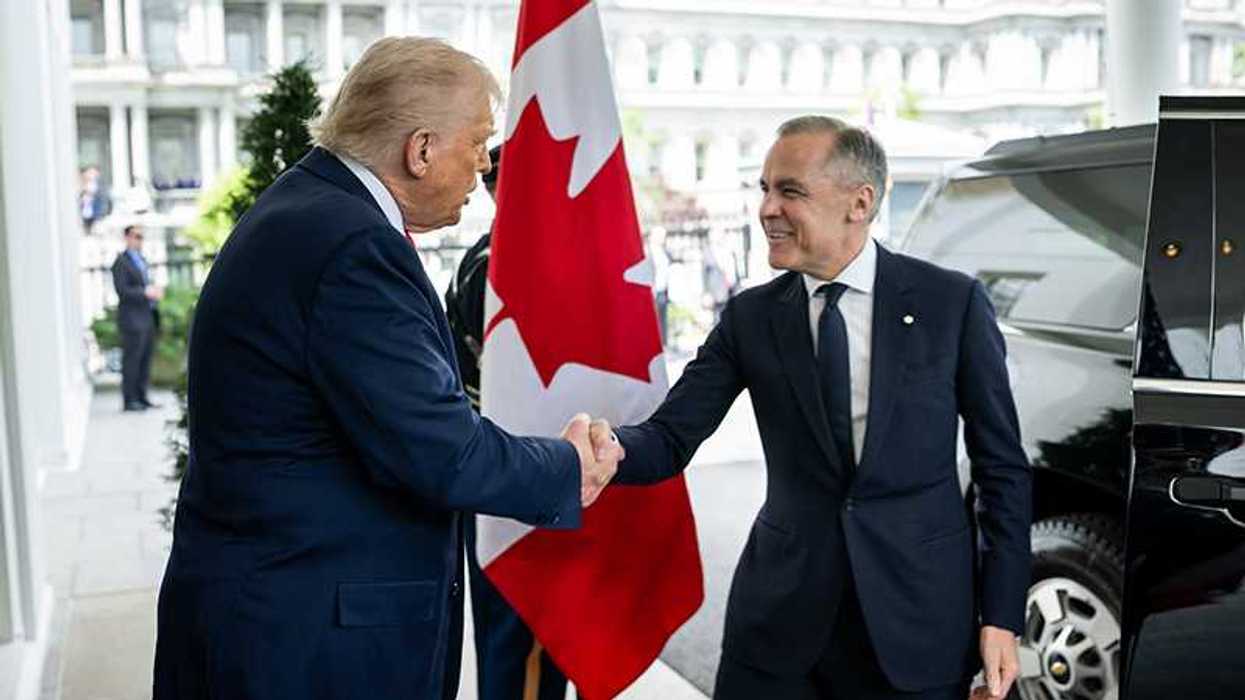
President Donald Trump greets Prime Minister of Canada Mark Carney, Tuesday, May 6, 2025, at the West Wing entrance of the White House. (Official White House Photo by Daniel Torok)
President Donald Trump has developed a heatedrivalry with his counterpart across the border, Prime Minister Mark Carney. Yet according to a new report, Carney is taking America's unexpected turn against Canada with cool calculation — allowing the northern democracy to implement policies it had been longing to do anyway.
"Canada’s last breakup, with Great Britain, took roughly 100 years of painstaking and piecemeal constitutional reform to accomplish," reported The New Republic's John Last on Sunday. "This time, things are moving a little faster. Since President Donald Trump launched his trade war against his closest neighbor shortly after taking office a second time—leveling tariffs of up to 50 percent on hundreds of goods—relations have been icy, and keep getting icier."
Last proceeded to describe how Carney, who previously worked as a highly successful banker, has utilized his skills and connections to appeal to modern European countries. From the European Union to individual nations like the United Kingdom and France, Canada has long identified more closely with the culture and politics across the pond, in particular their more robust social safety nets and outspoken advocacy for diversity.
As characterized by Last, now Carney is urging European nations to develop trade relationships with the world's second largest nation by area, one with vast untapped natural resources in oil, agriculture and rare minerals. The situation is cast one in which other countries could be vastly enriched because they more closely align Canada's center-left political values than the increasingly far right United States.
"The answer to that question is hard to discern while Trump continues blustering from the White House," Last wrote. "Canadians, Carney likely may have an inclination to lean away from America anyway—from its increasingly crass politics, debased culture, and unrestrained greed. Canadians may be more American than they like to admit, but they are not as American as America is now. Another few years of accelerating decay may simply be too much to come back from. For now, at least, Canada is exploring its options—and it doesn’t seem inclined to wait around."
He concluded, "Jilted lovers seldom do."
Speaking with AlterNet in August, Dr. Richard D. Wolff — professor emeritus of economics at the University of Massachusetts Amherst — contextualized Canada's shifting of economic and political relationships away from America as existing within a large pattern.
Our government is busy strong-arming people around the world in every way that it can, militarily, economically, politically, and discovering time after time to their amazement, if you take them seriously, that the folks are going to resist," Wolff said. "And that's what's going to happen."
Linking the US-Canada trade war and the US-Iran war, Wolff added that "Israel and the United States thought they could bomb Iran June 2025, and that was a 12-day war because they couldn't get them to bend over and surrender. So they went to work, tried it again February 28th of this year. And they're not doing it. And so now you discover, gee, the people of Canada being threatened in this way and that way by the tariffs are not bending and are putting pressure on their leaders to find a way other than capitulation."
‘Abolish ICE,’ Say Potential 2028 Candidates AOC and Khanna After Latest Shooting in NYC “No child should have to sit and watch while masked officers open fire on his father.” US Rep. Alexandria Ocasio-Cortez (D-NY) speaks to the media outside of the US Capitol on August 31, 2026 in Washington, DC. (Photo by Finn Gomez/Getty Images)
Two top progressive Democratic leaders were among those demanding an end on Friday to the 23-year-old federal agency that has provoked outrage and fear across US communities over the past 21 months under Trump administration—most recently on Thursday night, when a US Immigration and Customs Enforcement agent fired seven shots into a car being driven by an immigrant in New York City, while his 5-year-old son sat in the back seat.
“ICE’s already unwelcome presence in our city has been growing more escalatory and dangerous by the day. Today’s shooting is a grave development that requires a swift and immediate response to protect the safety of all New Yorkers,” said US Rep. Alexandria Ocasio-Cortez (D-NY), whose district lies near Marble Hill, the site of the shooting of 28-year-old Oscar Belgal.
Belgal was taken to a nearby hospital and treated for injuries to his neck before ICE agents took him away in an unmarked vehicle. His son was physically unharmed and was in the care of relatives on Friday, but a number of Democratic officials, including New York City Mayor Zohran Mamdani, condemned the agency for leaving the child “traumatized and terrified.”
“ICE is a rogue, lawless paramilitary and surveillance agency,” said Ocasio-Cortez, who has been named as a potential 2028 presidential candidate or a contender for US Senate in New York, where Senate Minority Leader Chuck Schumer (D-NY) is up for reelection in 2028.
“It does not belong in New York City and it should not exist in the United States of America,” said Ocasio-Cortez. “Abolish ICE.”
Rep. Ro Khanna (D-Calif.), another potential candidate for president in 2028, joined the congresswoman in calling for ICE to be abolished—a demand once dismissed as a fringe viewpoint, but now shared by about half the country, including 77% of Democratic voters and 52% of independents.
Khanna said that Democrats in Congress must take action after the midterm elections, which are widely expected to put them in control of at least one if not both chambers of Congress.
“No child should have to sit and watch while masked officers open fire on his father,” said Khanna. “House Democrats have a duty when we take the majority. Get ICE agents off our streets. Keep them away from our children. Abolish ICE.”
A federal judge in New York City ordered ICE not to deport Belgal, an immigrant from the Dominican Republic, while the court considers an emergency petition requesting his release from detention.
Agents approached Belgal when he was parked in front of a fire hydrant on West 225th Street. The officers were dressed in construction vests and had face masks on, and one was wielding a long gun on the busy street where children were walking home from school.
Rep. Yassamin Ansari (D-Ariz.) noted that ICE’s use of “disguises and masks” was not an isolated incident in Marble Hill, with some posing “as electricians in Phoenix last month to arrest a man in his own home.”
Belgal was reportedly pulling away when an officer shot at him. It is against Department of Homeland Security policy to shoot into a moving vehicle, with limited exceptions.
Rep. Ayanna Pressley (D-Mass.) called on President Donald Trump and Secretary of Homeland Security Markwayne Mullin to “hold rogue ICE agents accountable.”
“What type of president and country not only allows, but causes, our children to be traumatized?” said Pressley. “Abolish ICE NOW.”
.png)





.jpg)