Monday, October 12, 2026

India faces fresh protests over alleged disenfranchisement

India faces fresh protests over alleged disenfranchisement
/ Cockroach Janta Party homepageFacebook
By IntelliNews - Chennai Bureau October 12, 2026

India's Supreme Court on October 11 ordered authorities to restore metro, rail and internet services in New Delhi, a day after police detained thousands of people during a protest by the Cockroach Janta Party (CJP), the BBC citing local media reported.

Estimates of people present at protests held on October 10 2026 ranged from 3,000 to 7,000 as police sealed off the centre of the capital.

The CJP had previously secured a major concession from the Indian government over irregularities in India’s medical education entrance exam NEET, after a months-long protest briefly turned violent and then ended with the resignation of India’s then Minister of Education Dharmendra Pradhan in July.

The renewed protest centres on the Special Intensive Revision (SIR) of India's electoral rolls. The CJP and many civil society groups in India allege the exercise has wrongly struck off more than 130mn voters, mostly from marginalised and minority groups, and want it frozen.

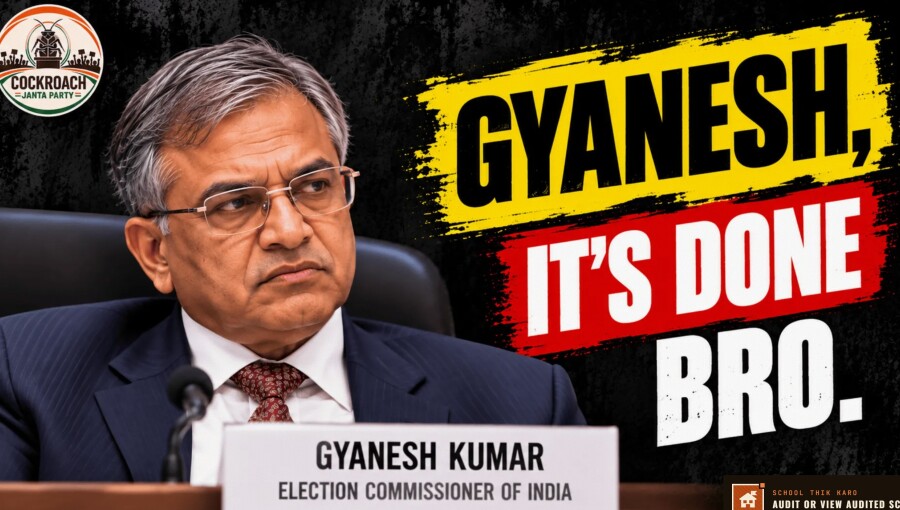
The CJP is also demanding the resignation of India’s Chief Election Commissioner Gyanesh Kumar. The Election Commission of India rejects the accusations and says the revision only deletes duplicate or ineligible entries. In a special sitting, the Supreme Court ruled that police could not illegally detain protesters who were peaceful and unarmed. It told officers to scale back barricading it considered disproportionate.

Authorities had moved to block the gathering days in advance, on October 8 and 9, Delhi Police refused permission for a rally at the central Delhi site Jantar Mantar and deployed 23,000 personnel. They also curbed mobile internet within a 4km radius, asked for 57 metro stations to be shut, cancelled incoming trains and served notices on activists travelling from other states.

On October 10, police stopped CJP founder Abhijeet Dipke and co-convenors Saurav Das and Ashutosh Ranka on board their plane at Delhi Airport after a flight from Mumbai. Opposition figures Arvind Kejriwal, Mamata Banerjee and Pinarayi Vijayan were briefly held before being freed. YouTuber Dhruv Rathee and student leader Neha Bora, both critics of the Indian Prime Minister Narendra Modi, were also detained, according to a report by NDTV.

A magistrate court freed Dipke, Das and Ranka on October 11 after roughly 24 hours in preventive detention, on condition they sign a good behaviour bond lasting one year. The party's leaders said the bond did not bar them from assembling peacefully. They accused police of hacking their phones and of holding back news that Dipke's grandmother had died while he was in custody.

As of the morning of October 12, CJP leaders intended to ask Delhi Police to set an official date for a peaceful sit-in at Jantar Mantar, and vowed to keep the nationwide campaign going.

Border Patrol Unleashes Violence on Protesters Over Trump’s Border Wall

Activists say federal agents dragged protesters across a barbed wire and used “extreme pain compliance” tactics.

October 8, 2026

A protest banner hangs from earth moving equipment at a border wall construction site near Lochiel, Arizona.Tierra Libre

Since construction began on President Donald Trump’s border wall in haste on October 5, federal agents have clashed with land defenders and arrested roughly two dozen activists who camped out on private land to protest the destruction of fragile desert ecosystems on both sides of the imaginary line that separates Mexico from the tiny town of Lochiel, Arizona.

The protest received media attention after Border Patrol agents extracted and arrested a tree sitter and cut down the “Grandmother Tree,” an ancient cottonwood in a grove of several trees that stood in the way of contractors building the border wall. Estimated to be around 200 years old — older than the current border — the grove’s branches reached from the United States to Mexico, a symbol of international solidarity for the protesters.

The felling of the Grandmother Tree may have also symbolized the Trump administration’s disregard for nature and public opinion, but it did not mark the end of the protests, as construction continues. Video captured by journalist Max Granger shows land defenders climbing into a tree on the Mexican side Tuesday morning and setting up another tree-sit style blockade in a renewed attempt to halt construction. Clashes with Border Patrol continued throughout that day, with activists accusing federal agents of dragging protesters across a barbed wire fence during a chaotic confrontation that was caught on video.

On Wednesday afternoon, a protester locked themselves to moving construction machinery, according to a statement from activists. Border Patrol agents attempted to remove the protester with “extreme pain compliance” and pepper sprayed the surrounding crowd, the activists said. Protester continued to lock themselves down after construction came to a halt and construction crews left, the activists noted. “We do not intend to back down,” said Adriana, a Tierra Libre activist identified only by first name, in a statement on Wednesday. “Our resolve only grows with their violence.”

Jason, an activist from the Tierra Libre protest camp in Lochiel who declined to use his last name due to concerns over state repression, said roughly two dozen people have been arrested. Some received citations on the spot, and others were taken into custody and released onto the streets of Nogales or Tucson hours later, he noted.


Trump Is Destroying Pristine Public Lands to Build His Border Wall — Again
Contractors damaged federally protected habitats in Big Bend National Park and areas near sacred springs in Arizona. By Mike Ludwig , Truthout  August 21, 2026


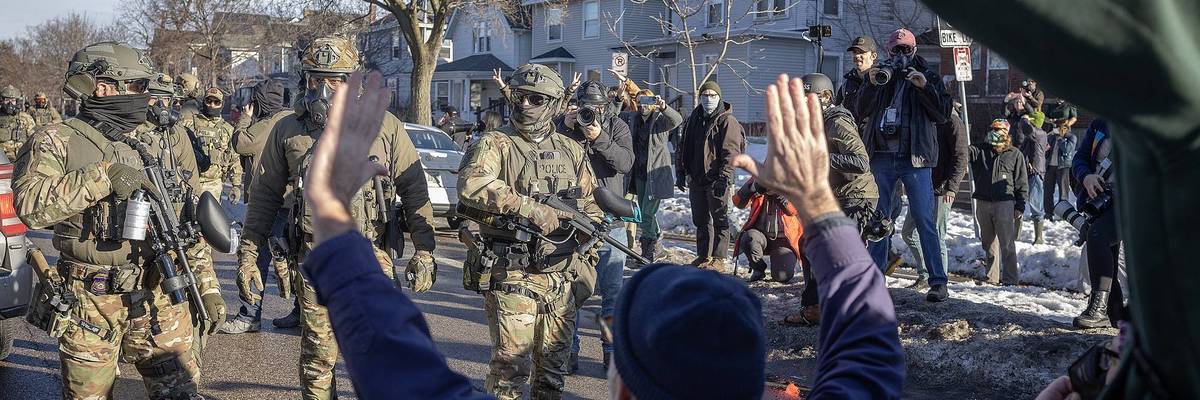
Among the police presence is an elite unit known as the Border Patrol Tactical Unit (BORTAC). BORTAC was also deployed to Operation Metro Surge, the now-defunct federal invasion of Minnesota’s Twin Cities launched in December 2025 as part of the Trump administration’s violent immigration crackdown.

Activists say the tactics that the unit are using now in Arizona are similar to the ones deployed in Minnesota. “BORTAC was kind of one of the units famous for their brutality in Operation Metro Surge,” Jason said. “We are seeing a lot of the same tactics on the ground that they started to use during Metro Surge and some of these other large mobilizations against various cities like Chicago and Los Angeles.”

Border Patrol agents surround a protester who is locked down to movable construction equipment on border of southern Arizona and Mexico.Tierra Libre

“A lesson from past attempts at a fascistic regime is that, if they are able to [abuse] one population of people that is easy to ‘other,’ what they are doing to that population will always expand out to other populations,” said Jason. “It’s all the more reason to take what they are doing to immigrants seriously, and what they are doing in Lochiel seriously.”

In their statement on Wednesday, protesters said Border Patrol and BORTAC have “beaten, detained, arrested, and maced activists engaged in morning prayer,” and “kidnapped” fellow protesters who faced further abuse while in custody for about 24 hours. Jason said arrestees were released at random public places such as a fast-food restaurant, mirroring stories about people swept up in Trump’s immigration crackdown.

Jessica Turner, a spokesperson for Customs and Border Patrol, said Border Patrol conducted an “enforcement operation” in Lochiel to protect personnel and the federally managed area around the border line. While most activity remained peaceful, Turner said agents took appropriate action in response to “alleged violations” and an “alleged assault on a federal officer.”

“U.S. Border Patrol respects the public’s right to lawfully express their views,” Turner said in an email. “Individuals are expected to comply with lawful orders and avoid conduct that endangers others or interferes with authorized federal operations.”

Based in El Paso, Texas, BORTAC is a specially trained “rapid-response force” that was typically deployed for “high risk” missions involving “terrorism and drug enforcement, sometimes abroad,” before Trump took office, according to Human Rights Watch. Under Trump, BORTAC and other militarized immigration enforcement units have also been deployed in immigration policing operations like the one in Minneapolis.

Despite violent arrests, more than 2,300 deportations, and the killing of two U.S. citizens by federal agents during Operation Metro Surge, the people of Minnesota famously continued to protest and provide for immigrant families. Operation Metro Surge was called off amid widespread public outcry on February 12.

The land defenders in Lochiel initially set up their protest camp shortly after contractors began clearing the area in late August. From Arizona’s Organ Pipe Cactus National Monument to southern Texas, a secondary 30-foot wall is being built 100 feet from the existing border wall. Flush with more than $46 billion in funding from Congress, Customs and Border Protection is building a “border barrier system” that includes a “primary and secondary wall” with a road between them, as well as “waterborne barriers, patrol roads, and the technology required to tie it all together, such as cameras, lights, and other detection technology.”

The area around Lochiel is historically Yaqui and Tohono O’odham territory, and Indigenous activists are protesting construction at multiple points along the border in and around the Tohono O’odham Nation. Jason said activists regularly gather to pray as a form of protest at the Quitobaquito Springs, a rare oasis ecosystem a few miles from Lochiel that has served as a sacred ceremonial site for generations of Tohono O’odham and Hia-Ced O’odham.

Members of the Border Patrol’s specialized BORTAC tactical unit face off with protesters in Lochiel, Arizona.Tierra Libre

In May, federal border wall contractors clearing land in the nearby Cabeza Prieta National Wildlife Refuge damaged Las Playas Intaglio, a fish-shaped geoglyph made by human hands 1,000 years ago. Lorraine Marquez Eiler, a Hia-Ced O’odham elder, told High Country News in September that the Quitobaquito Springs are also a direct connection to their ancestors.

“All of my lifetime of work has been for the memories of my ancestors, of what they went through,” Marquez Eiler said. “With the incoming wall, should it be disrupted?” she asked. “That’s just another slap in the face, as far as I’m concerned, to my ancestors. And so, I ask: Why?”

The border wall also disrupts wildlife by blocking off migration routes and hunting grounds for species such as the endangered desert jaguar. As contractors began clearing and damaging areas near the spring to make way for border wall construction, conservationists removed endangered mud turtles from the springs to prevent the species from being lost forever.

“The water runs just a couple dozen feet from the border; if they put a second wall there, they will destroy the hydrology,” Russ McSpadden with the Center for Biological Diversity told Truthout in August.

While the Tohono O’odham Nation has for years allowed Border Patrol onto its territory to chase after a dwindling number of migrants and smugglers, the tribe sued the Trump administration in July over construction of border wall infrastructure along 62 miles of border that bisects the nation. However, a federal judge refused to issue an injunction to temporarily block construction, ruling in July that that government’s purported national security interests outweigh the tribe’s claims of sovereignty. To defend their sovereignty, the Tohono O’odham also put up “no trespassing” signs warning contractors to stay off their land or risk legal consequences.

Jason said the Trump administration has ignored the warnings and rushed to build as much of the “border barrier system” as possible before residents and federal courts have a chance to step in and start asking questions. “It all comes down to wanting to assert their control without any checks or balances and just do what they want, and anyone who stands in the way be damned,” Jason said.

Jason said contractors are working quickly, but the protest camps are located on private property and not going anywhere. A tree-sitter in the last remaining cottonwood on the Mexican side of the border was still blocking construction as of Wednesday evening, and activists on the ground say the fight is far from over.

“The tree has saplings already planted in several places, and the symbol of the tree has become more than the individual tree herself,” Jason said. “She lives through everyone’s actions and determination to defeat the border wall.”

Mississippi Is in Danger of Executing Woman on Death Row, Despite Key Evidence

Lisa Jo Chamberlin’s co-defendant confessed to coercing her into their crime. Will that be enough to stop her execution?
October 8, 2026


This photo of Lisa Jo Chamberlin was taken at Central Mississippi Correctional Facility by her spiritual advisor, in February 2021.

Lisa Jo Chamberlin’s life has always been a tangle of drug use, abuse, and extreme violence. Her mother drank and used Sudafed heavily during her pregnancy. As a result, Chamberlin was born with Fetal Alcohol Spectrum Disorder (FASD), a group of medical conditions, including poor reasoning and judgment skills, learning disabilities, and intellectual disability, that occur when a fetus is exposed to alcohol.People with FASD are more vulnerable to manipulation by others. For Chamberlin, that vulnerability led to a death sentence.

The 45 women on death row across the country make up 2 percent of the total number of Americans sentenced to death. The vast majority of women behind bars have experienced abuse before arrest. Ninety-six percent of women on death row had experienced gender-based violence before arrest, 80 percenthave intellectual or psychosocial disabilities, and 90 percent have no prior conviction for a violent felony. Chamberlin checked all of these boxes.

As a child, she suffered constant physical and sexual abuse from her father, her mother, her stepfather, her brother, and even her fourth-grade teacher. Her mother beat her with whatever was on hand, sometimes whipping her with a wooden spoon until it broke. When she was six, her 11-year-old brother put her into a closet with three neighborhood children, instructing them to touch her sexually. He also sexually abused her for years. Chamberlin told her mother, who dismissed her complaints.

When she was 12, Chamberlin began using drugs to numb the constant violence and abuse.

As an adult, her boyfriends used her substance dependency to exert control. They also physically and sexually abused her. Roger Gillett, who would become her co-defendant, strangled her, attempted to drown her, and raped her. He ordered her to move with him from Oregon, where her family lived, first to Kansas and then Mississippi in 2004. That was where Gillett killed two people.


Tennessee Attempted to Execute a Sexual Assault Victim
Christa Pike’s lethal injection is booked for September 30. She may be the first woman Tennessee executes in 200 years.
By Renée Feltz , Truthout/TheAppeal September 22, 2026

Now 53, Chamberlin is the sole woman on Mississippi’s death row. If her appeals fail, she will be the first woman the state executes since 1944.

“In capital cases, women who have experienced some of the most extreme forms of gender-based violence and oppression are also among those who have received the least support from the legal system, from their communities, from their families, and from society,” Sandra Babcock, founder and director of the Cornell Center on the Death Penalty Worldwide, told Truthout. “There are two dynamics: One is that these women are among the most damaged and vulnerable survivors to become involved in the criminal legal system. But their experiences of violence and trauma go unrecognized by the legal system when they are charged with a capital crime.”
A Trial Rife With Gender Stereotypes

In Mississippi, Chamberlin and Gillett stayed with Gillett’s cousin, Vernon Hulett, and his cousin’s girlfriend, Linda Heintzelman. At first, they all got along. Then, after an auto accident between the two couples, they hatched a plan for Heintzelman to report the accident, collect insurance, and split it with Gillett and Chamberlin.

Heintzelman never filed the insurance claim, leading to tension between the two couples. When their hosts suggested that they move out, Gillett tortured and killed them. He and Chamberlin then placed their bodies into a freezer, loaded it into Heintzelman’s truck, and drove to an abandoned Kansas farm owned by Gillett’s grandfather.

There, police conducted a drug raid, arresting both. They later found the freezer and charged the couple with the deaths of Hulett and Heintzelman.

The pair were tried separately. Both were convicted and sentenced to death.

Chamberlin’s trial was marked by demonizing gender stereotypes. The prosecutor painted her as the mastermind behind the murders. He introduced testimony about Chamberlin’s sex life, including testimony from two jailhouse informants. Jailhouse informants’ testimonies, commonly motivated by law enforcement, are inherently unreliable and have been the leading cause in 46 percent of death row exonerations. Even the Mississippi Supreme Court recognized the problematic nature of relying on jailhouse informants, stating in 1989, “The testimony of jail-house informants, or ‘snitches,’ is becoming an increasing problem in this state, as well as throughout the American criminal justice system.”


“It is much easier to conclude that this is simply an evil person, that this is not someone who is herself damaged, who is herself a crime victim.”

Nonetheless, the informants’ testimony was not contested. One of the informants, Marsha Petrofsky, already on probation for five fraudulent checks, had been jailed for arson. A year after she testified, she pled guilty to first-degree arson and was sentenced to five years’ probation and $4000 restitution even though Mississippi law requires a 5-to-20-year sentence and restitution of triple the amount of damages. The other, Vanessa Stringfellow, was contacted by the state in 2006, the year of the trial. She testified that she overheard Chamberlin tell other women that she and Gillett had sex in front of the corpse and it was the best sex she ever had.

Their testimonies painted Chamberlin as an immoral and hyper-sexualized woman, a portrait that the prosecutor drew upon to inflame the jury. Additionally, Chamberlin’s attorney did not present testimony about FASD and how it made her more easily dominated by Gillett.

A psychologist for the defense testified about her abuse history, but the prosecutor dismissed her testimony, suggesting that Chamberlin was not a victim of repeated gender-based violence but instead a “sociopath” or “psychopath.” The jury believed his version and sentenced her to death.

That’s not unusual, said Babcock. “Prosecutors will minimize, distort, dismiss women’s accounts of sexual violence, whether they come via women’s testimony or through an expert.”

During the penalty phase, the prosecution painted Chamberlin not only as a sexually promiscuous woman, but also a bad mother, stating that she “abandoned [her children] like a reptile.”

In Mississippi, the jury, not the judge, makes the decision on whether to impose the death penalty. Chamberlin’s jury returned a sentence of death.

“When somebody is charged with a capital crime, particularly offenses that make people recoil, it is much easier to conclude that this is simply an evil person, that this is not someone who is herself damaged, who is herself a crime victim, but that [her actions] are attributable to her depraved character,” said Babcock.
Will the Courts Allow a Confession?

It is a tragic irony that it often takes a death sentence appeal for a person to receive better legal help — help that in many cases could have prevented the sentence in the first place. In Chamberlin’s case, that help came in the form of the Mississippi Office of Capital Post-Conviction Counsel. The office also representedGillett when he appealed his death sentence. The Mississippi Supreme Court vacated his sentence because the jury heard inadmissible evidence of an invalid sentencing factor (a previous felony for escaping from a Kansas jail). In 2018, he was resentenced to life without parole.

In 2022, the Mississippi Office of Post-Conviction Counsel began representing Chamberlin. None of her legal team had represented Gillett, avoiding any conflict of interest. They found three experts to attest to the effects of FASD. They also approached Gillett who, in 2023, submitted an affidavit admitting that he had “complete control over her.” He also stated, “When my attorney told me Lisa was painted as the mastermind behind the homicide, I almost didn’t believe him. It is laughable to think that Lisa is the mastermind behind anything. Her involvement was minor, and she would not have participated had I not clearly been in control.”


Chamberlin has been the only woman on Mississippi’s death row for the past decade. The isolation has impacted her mental health — in 2025, she was placed on suicide watch at least twice.

The Mississippi Supreme Court ruled that this new evidence was time-barred (or not filed within a certain timeframe) and was contradicted by evidence presented at trial. The court denied her appeal.

In 2025, the U.S. Supreme Court ruled in Andrew v White that the Due Process Clause forbids the introduction of evidence that is so unduly prejudicial as it renders a criminal trial fundamentally unfair. In the case of Brenda Andrew, sentenced to death in Oklahoma for her husband’s death, the prosecutor’s inclusion of her sex life, her dress and demeanor (complete with holding her lacy bra and thong up in court), and closing comments painting her as a bad mother were so prejudicial that they violated the Due Process Clause. The court sent her case back to the Tenth Circuit Court, which declined a re-hearing. Andrew remains on death row while her legal team plans to appeal to the U.S. Supreme Court.

Given that ruling, Chamberlin’s attorneys again appealed to the Mississippi Supreme Court for a rehearing. The court denied it.

“In 2006, Lisa Jo’s jury only heard one side of the story,” her attorneys told Truthout. “They did not hear that Lisa Jo was born with FASD, and organic brain damage. They did not hear that Lisa Jo’s actions are shaped by Battered Woman Syndrome. They did not hear that Roger Gillett was primarily responsible for the crime and that Lisa Jo believed Roger would kill her if she did not participate.”

Her attorneys plan to file a petition for certiorari to the United States Supreme Court. Should it decline to hear her petition, she can turn to the federal district court, which has already granted a Rhines stay (or a pause on the strict timeline for federal filing). Should that court deny her petition, Mississippi will set an execution date. If the state-sponsored killing is carried out, Chamberlin will be the first woman executed since the state executed 23-year-old Mildred Johnson in 1944.

Chamberlin has been the only woman on Mississippi’s death row for the past decade. The isolation has impacted her mental health — in 2025, she was placed on suicide watch at least twice. At one point, she considered signing papers allowing her execution to proceed but later decided against it. After she spoke about her conditions with Mississippi Today, prison officials retaliated. She spent up to 48 hours confined to her cell, was denied access to showers, and was given less outdoor time than men on death row. Friends, family, and Chamberlin herself told Mother Jones that her communication with the outside world was blocked for months.
Media Scrutiny Stopped Mississippi’s Last Attempt to Execute a Woman

In 1999, Michelle Byrom’s husband was found shot at home with a pistol that was a family heirloom. Byrom was medicated and recovering from pneumonia at a local hospital when the sheriff questioned her. She said that she was responsible for the murder.

Her son, Edward Byrom Jr., testified at trial that Byrom had hired his friend Joey Gillis as a hit man. Both Edward Byrom Jr. and Gillis were convicted of lesser charges and were released from prison in 2013 and 2009, respectively.

Michelle Byrom was convicted and sentenced to death. When the U.S. Supreme Court declined to hear her case in 2014, Mississippi set an execution date. But media scrutiny into her conviction uncovered a pretrial confession from Edward Jr. to his mother, a letter that she had never seen. That attention sparked outrage. People called the governor, demanding he halt the execution.

The Mississippi Supreme Court — the same court where Chamberlin is now appealing — vacated Byrom’s conviction after her new legal team presented evidence that jurors had never seen, including the confession letter and a separate confession by Edward Byrom Jr. to a court-appointed psychiatrist. Gillis submitted an affidavit admitting that Byrom did not hire him to kill her husband.


Opposition to Chamberlin’s execution has also come from an unexpected source — Vernon Hulett’s mother

The court granted her a new trial.

Byrom was taken to the local jail to await a new trial. In 2015, she agreed to an Alford plea, which allowed her to maintain her innocence while accepting a felony charge on the record. The judge sentenced her to time served and Byrom, after 16 years behind bars, left the courthouse. She moved to Tennessee, where she died in 2019 at age 62.

“Mitigating evidence and new evidence can really put a case in a different light and a different perspective,” Krissy Nobile, one of Chamberlin’s attorneys, told Truthout. “In this post-conviction process, we are now learning of the new evidence,” she said. “Anyone and everyone that has seen her case, especially after Roger’s affidavit, has been outraged. The more the public knows, the more outraged people will be about [her death sentence].”

Opposition to Chamberlin’s execution has also come from an unexpected source — Vernon Hulett’s mother, Caroline Hester.

In 2019, Hester sent a letter to then-governor Phil Bryant. “As I told our local DA for years, I do not need for Lisa Chamberlin to be put to death,” she wrote. Hester clarified that she does not want Chamberlin freed, but said that life imprisonment was enough. She ended her letter stating, “I need for this to be over!”
“Lisa Jo Saved My Life”

In 2022, Chamberlin connected with a sister she never knew she had. Yvonne, born 10 years earlier to the same father, had been abandoned by her biological parents at eight months old. She was adopted by what she described as a loving family. But she never stopped searching for her history. (Yvonne asked that only her first name be published to protect her privacy.)

In 2022, an organization that helps adoptees connected her with her oldest sister, who told her about Chamberlin. She wrote her a letter. “Now, we talk on the phone once or twice a month,” Yvonne told Truthout.

“The life she had could easily have been my life,” Yvonnereflected.

Yvonne has watched true crime shows about her sister. But, she said, Chamberlin is not the monster they portray. The sister she knows is warm, compassionate, and, at times, funny. She cares for baby birds that fall out of trees. She ministers to others in the prison. Once, during a cold night, she gave her only blanket to a woman who had none. Knowing her has also pushed Yvonne to become more active in fighting for her beliefs.

“She has profound remorse for her participation,” noted Chamberlin’s attorneys. “She found faith in prison and stopped using drugs. Now she seeks to help other women in prison struggling with addiction. Lisa Jo can be a force for good in prison if she is no longer under a sentence of death.”

Even with execution hanging over her head, Chamberlin has helped others in the prison. Laykin Bordelon met Chamberlin when she was 19 years old and placed in the behavior modification unit at Central Mississippi Correctional Facility. Chamberlin, as the only woman on death row, was also on that unit.

“Lisa Jo saved my life,” Bordelon, now 36, told Truthout. “I spent 13 years incarcerated. I felt so forgotten.”

She and Chamberlin talked through the tray slots of their cells, never having the opportunity for face-to-face or physical contact. After Bordelon was transferred to general population, she would sometimes go on suicide watch just to talk to Chamberlin. “That was laying butt naked on a concrete floor, no clothes, no blanket, nothing, just so I could talk to her.”

Bordelon is now home, but she hasn’t forgotten the woman she calls her godmother. Earlier this year, she attempted to draw official attention to Chamberlin’s extreme isolation, sending letters to legal organizations and the Department of Justice’s Office of Civil Rights Division requesting an investigation into her godmother’s conditions.

“I have completely turned my life around,” Bordelon reflected. She’s a manager at a local business and plans to get involved with advocacy for incarcerated people. “It’s because of her.”

“I have always been against the death penalty,” Yvonne said. “Now that it’s personal it brings a deeper perspective into my feelings on the subject.” She has offered to help Chamberlin’s attorneys in any way possible. She’s also become involved in advocacy to stop the execution of Christa Pike, whose lifetime of abuse mirrors Chamberlin’s.

On September 30, which was Chamberlin’s 54th birthday, Pike survived the horrific experience of Tennessee’s attempt to execute her. After two doses of lethal pentobarbital, Pike was still breathing and sent to the hospital.

“I’m hoping that this leads other states to change their death penalty sentencing. There are so many things that can go wrong and these two cases are so similar,” Yvonne said. “When I see [Christa Pike’s] case, my mind is on her.”

This story has been updated to note that the Mississippi Supreme Court denied Chamberlin’s latest motion for a rehearing on October 8.


This article is licensed under Creative Commons (CC BY-NC-ND 4.0), and you are free to share and republish under the terms of the license.


Victoria Law
Victoria Law is a freelance journalist who focuses on incarceration, gender and resistance. Her books include Resistance Behind Bars: The Struggles of Incarcerated Women (2009), Prison by Any Other Name: The Harmful Consequences of Popular Reforms (2020), “Prisons Make Us Safer” & 20 Other Myths about Mass Incarceration (2021), and Corridors of Contagion: How the Pandemic Exposed the Cruelties of Incarceration (2024).
ShareShare via Facebook


As Catholic Convert Vance Casts Doubt on Execution Livestream, Lead US Bishop Says Plan Promotes ‘Culture of Death’

“The public execution even of one who has done grave harm will only further undermine the moral fabric of our nation and be a blight on the conscience of its people,” Archbishop Paul Coakley.


US Vice President JD Vance speaks during a midterm campaign rally on October 1, 2026 in Lakeland, Florida.
(Photo by Kevin Lamarque-Pool/Getty Images)

Jessica Corbett
Oct 09, 2026
COMMON DREAMS

While US Vice President JD Vance—a Catholic convert—suggested on Friday that the administration may not actually livestream a firing squad execution at a military base in December, the church’s top bishop in the country denounced the widely decried plan.

US Secretary of Defense Pete Hegseth pledged this week to make the execution of Fort Hood mass shooter Nidal Hasan “public,” and officials said that would mean a livestream. As Religion News Service noted, the Pentagon chief is an evangelical Christian who has often spoken about his faith and “attends a church led by Pastor Doug Wilson, a self-described Christian nationalist.”


On Friday, the vice president—who recently published a book about his religious experiences, including his conversion to Catholicism—told reporters that despite those statements about a livestream, “I don’t know that that’s actually gonna happen.”


Vance argued that Hasan, a former Army major and doctor, committed “the worst terrorist attack on American soil outside of 9/11,” but also said that “if it’s ultimately livestreamed, I’m not gonna be watching it.”

Meanwhile, using President Donald Trump’s preferred term for the Department of Defense, Archbishop Paul Coakley, president of the US Conference of Catholic Bishops, said in a statement that “it is with shock and great sorrow that I have learned of the Department of War’s decision to publicly livestream the execution of Nidal Hasan.”

“Our God is the God of life. In no way can Hasan’s actions be condoned, but this decision is a barbaric promotion of a culture of death and must be reconsidered. The word of God exhorts us: ‘Do not repay anyone evil for evil’ (Romans 12:17),” declared Coakley, a “conservative culture warrior” elected to his leadership role last year.

“The public execution even of one who has done grave harm will only further undermine the moral fabric of our nation and be a blight on the conscience of its people,” he added. “I pray for the intercession of Our Lady of Good Counsel that we as a nation may always choose life even in the most trying times and circumstances.”

Coakley joined a growing chorus of critics who have condemned the Pentagon plan, including the Office of the United Nations High Commissioner for Human Rights, which said Friday that “the livestreaming of an execution is tantamount to a public execution and would breach the absolute prohibition of torture.”


American Immigration Council senior fellow Aaron Reichlin-Melnick, who had blasted the livestream decision on Thursday, called the archbishop’s statement a “strong response from the Catholic Church.”

James Martin, a Jesuit priest and editor at large of America Magazine, explained that “the Catholic Church teaches that the death penalty is ‘inadmissible,’ primarily because every human being has God-given dignity, even a murderer, even a mass murderer. The televising of an execution is barbarism of the worst kind, offering up death as entertainment.”

“Some Catholics still reject Pope Francis’ magisterial pronouncement on the death penalty, which is now included in the Catechism,” he noted. “But opposition to the death penalty, grounded in the respect for all human life, is not a brand new doctrine. Rather, it is one that took time to develop, as the church came to understand more deeply the innate dignity of every human life.”


Sharing Coakley’s comments on social media Friday, journalist Paul Blest wrote that “this happening so soon after the botched Tennessee execution is creating the conditions for real momentum against the death penalty.”

Tennessee last week botched two attempts to kill Christa Pike with injections of pentobarbital, after which she was rushed to the hospital. Pike’s legal team said Thursday that she “continues to experience cognitive challenges” but is taking “limited steps” with assistance. While Republican Gov. Bill Lee has responded by halting executions and ordering a probe, the incident has fueled fresh calls for the US to outlaw the death penalty at the state and federal level.

The Vatican’s secretary of state, Cardinal Pietro Parolin, also weighed in on the livestream plan, saying Friday that “it is truly incomprehensible that anyone would want to use this method in this day and age. I do not know for what purpose. It is certainly unacceptable to turn death into a spectacle. However guilty the person may be, there are other ways.”

“The church’s position is one of total opposition to the death penalty. It is incompatible with human dignity and does not serve as a deterrent,” Parolin said, acknowledging Coakley’s comments and pledging that “there will be a statement from the Holy See.”


As the Catholic leaders and others from various faiths spoke out against the Defense Department plan, Robert Jeffress, a Texas-based American Southern Baptist pastor and televangelist, wrote on social media that “I support the Pentagon’s decision to livestream the execution of mass murderer Nidal Hasan. Capital punishment is commanded by God in Genesis 9:6 to remind people of the sanctity of human life. The more people that can see that truth illustrated through a public execution, the better.”

Christa Brown, a former lawyer, sexual abuse survivor, and author of the memoirs This Little Light and Baptistland, responded: “Livestreaming an execution is barbaric. And no amount of Bible verses will change that.”


Evangelicals revolt against Trump's 'culture of death'


REUTERS /Umit Bektas

October 09, 2026 
ALTERNET

A prominent group of conservative Christians are denouncing President Donald Trump's top military official, Secretary of Defense Pete Hegseth, for ordering that convicted terrorist and mass murder Nidal Malik Hasan — who committed the 2009 Fort Hood shooting that led to 13 deaths and 32 injuries — be executed publicly by firing squad. It is the first public execution in modern American history.

"The National Association of Evangelicals (along with several other religious groups) are now joining the USCCB in condemning Defense Sec. Pete Hegseth’s plans to publicly execute Nidal Malik Hasan, also saying doing so promotes a 'culture of death,'" reported journalist Jack Jenkins of the religious news outlet RNS on Friday.

In an excerpt from his report, Jenkins wrote that "Walter Kim, president of the National Association of Evangelicals, told RNS that while he affirms the 'need for justice' regarding Hasan’s crime, 'at the same time, a live-streamed execution by firing squad risks turning one of the state’s most solemn responsibilities into a public spectacle, promoting a culture of death, rather than a culture that upholds the dignity of every human being.'"

Evangelical Christian organizations are not alone in slamming Trump and Hegseth for choosing to publicly execute Hasan. On the social media platform X, prominent commentators from all sides of the political spectrum expressed disgust with the decision.

Billy Binion, reporter for the libertarian magazine Reason Magazine, posted, “This is sick. You can support justice for Nidal Hasan’s victims without making his execution a source of entertainment. This administration so often governs for the online mob. It’s depraved.”

Glenn Greenwald, formerly of The Intercept and ideologically heterodox, argued, “There are a very small number of countries that still carry out public executions. Those are the countries we are constantly told are uniquely primitive, barbaric, sick and evil. It’s revealing that Pete Hegseth wants the US to join that group but also entirely unsurprising.”

Wajahat Ali of the liberal Substack The Left Hook stated, “Public lynchings will be next.”

Trump and Hegseth are also under fire for terminating the employment of dozens of top staff at the Pentagon, amounting to more than 900 years of combined experience, and replacing them with partisan loyalists.

"Since January 2025," Michael N. Schmitt, a law professor at New York University, wrote for Just Security in June, "the Defense Department has removed, replaced, or forced the early retirement of a remarkable concentration of operationally experienced senior officers. Among them are the chairman of the Joint Chiefs, the chief of naval operations, the chief of staff of the Army, and the commander of U.S. Cyber Command, who concurrently serves as director of the National Security Agency. Most recently, Gen. Christopher Donahue, one of the most decorated and combat-experienced officers of his generation, has been forced out as commander of U.S. Army Europe and Africa and, in his NATO (North Atlantic Treaty Organization) role, as commander of Allied Land Command. Public explanations have been sparse and, to the extent they have been offered, largely general."

Schmitt added, "The question regarding these departures is not whether the president and secretary of defense have broad lawful authority to reshape the senior officer corps. They unequivocally do. Nor is it a question of whether personnel decisions of this kind are ever warranted. Sometimes, they certainly are. Instead, at its core, a central question is their impact on the combat effectiveness, indeed the lethality, of our armed forces."

Even Gen. Christopher LaNeve, Hegseth’s senior military aide, indirectly admitted the mass firings could become a problem.

“Every shortcut in training and lapse in discipline will be paid for in blood,” LaNeve wrote.


INTERVIEW

Extreme Weather Disasters Cost Hundreds of Billions. Let’s Make Polluters Pay.


As the Trump administration guts disaster aid, it’s time for an extreme weather superfund paid for by fossil fuel firms.
October 10, 2026


A sign is seen at a "People Over Profits" vigil for those affected by Hurricane Helene to protest against the G20 Finance Ministers and Central Bank Governors' meeting in Asheville, North Carolina, on August 30, 2026.Allison Joyce / AFP via Getty Images

One of the most visible consequences of global warming is the increased frequency and intensity of extreme weather events, such as the powerful nor’easter that hammered the East Coast and mid-Atlantic for several days in late September with heavy rain, winds, and flooding. Indeed, a wide array of scientific studies over the past couple of decades have shown how human-caused climate change affects the intensity, frequency, and impact of extreme weather — from wildfires in the U.S. and Australia to record-setting flooding in China. And now, a major study prepared by two dozen scientists from across the globe has found a link between industrial emissions and the warming of the snow-capped Himalayan region that led to the collapse of the glacier that caused the catastrophic floods in Nepal and Tibet last month, in which over 1,300 people were killed while thousands are still missing.

In light of such developments, programs designed to address climate disasters are urgently needed. In the interview that follows, economist Michael Ash makes the case for the establishment of an Extreme Weather Superfund to protect U.S. communities from extreme weather events like those discussed above. Ash is professor of economics and public policy and co-director of the Corporate Toxics Information Project at the Political Economy Research Institute (PERI) at the University of Massachusetts Amherst.

The interview that follows has been lightly edited for clarity and length.

C.J. Polychroniou: This past summer was the hottest on record in the United States as well as in western Europe. Indeed, new data shows that global warming is accelerating and the UN says that exceeding the 1.5 degrees Celsius goal above pre-industrial levels looks now unavoidable. As such, extreme weather events like last month’s nor’easter storm that produced strong winds, large waves, and coastal flooding along the East Coast, and Hurricane Helene, which ripped across the U.S. Southeast two years ago and was responsible for at least 250 fatalities, are expected to become more intense. Yet, instead of increasing funding for extreme weather, the Trump administration has actually slashed disaster aid programs and gutted agencies whose mission is to protect communities against extreme weather disasters. Can you talk a bit about the problem at hand with extreme weather events?

Michael Ash: Top weather and climate disasters, typically hurricanes, have costs running into hundreds of billions of dollars. In addition to its war on climate policy, the Trump administration has been utterly derelict in protecting communities from extreme weather disasters or rebuilding after disasters.

Hurricane Helene brought horrendous damage to uplands North Carolina, making very clear that the impact of climate change will not be limited to low-lying coastal areas. Immediately after becoming president in 2025, Donald Trump went around North Carolina saying, “the days of betrayal and neglect are over,” while simultaneously planning to institutionalize betrayal and neglect by getting rid of the Federal Emergency Management Agency (FEMA), remarking: “If it was up to me right now, I’d end it right now.”

The Trump administration squeezed out 4,300 staff from FEMA in 2025. Its plan to reduce another 11,000 employees this year has been stopped by the courts for now. FEMA’s capacity is degraded. As The Nation article recounts, the North Carolina recovery funds have been delivered in an ineffective trickle.

How should we explain the Trump administration’s complete disregard of the risks associated with extreme weather events, which should be of deep concern to voters in the upcoming midterm elections?

It fits important patterns: climate denialism in service to fossil fuel companies; callous disregard for human suffering; and federal abdication of responsibility for the general welfare.

How much more likely and how much more destructive are episodes of extreme heat or rainfall, droughts, or hurricanes because of climate change? The science is increasingly precise and clear. Attribution science — the subject of a terrific new National Academies publication, “The Attribution of Extreme Weather and Climate Events and Their Impacts” (2026) — can establish with remarkable accuracy how much anthropogenic climate change (human contribution of greenhouse gases to Earth’s atmosphere) has contributed to extreme weather events.

To address the problem of extreme weather events, and as part of the Game Changers: Economic Policies for a Working America project that has been launched by the Political Economy Research Institute (PERI) at the University of Massachusetts Amherst, you and your colleague James K. Boyce have called for the establishment of an Extreme Weather Superfund (EWS). What would be the actual mission of an EWS?

The Extreme Weather Superfund is modeled on the original Superfund: the Comprehensive Environmental Response, Compensation, and Liability Act of 1980, which was designed to clean up land and water contaminated with toxic substances. There were two key principles: the polluter pays; and joint and several liability, which keeps polluters from dodging responsibility by pointing the finger at other parties or declaring bankruptcy.

The original Superfund empowered the Environmental Protection Agency to find and sue responsible parties and collected a valuable trust fund that paid for many useful cleanups. My son went canoeing with friends last month on Brooklyn’s Gowanus Canal, which was horribly polluted for more than a century, declared a Superfund site in 2010, and is now on the road to cleanup.

The Extreme Weather Superfund works from the Superfund model: quantify the harms, identify the responsible parties, and make the polluters pay. Except here, the harm is the introduction of greenhouse gases by carbon majors.

Can you discuss more specifically the central features of this policy and the benefits that U.S. communities can derive from it?

The big point is that communities all over the U.S. are already seeing damage from the carbon that the fossil fuel giants brought into our economy and atmosphere.

We face high costs of recovery from these disasters and high costs of adaptation, to build protection, hardened infrastructure, from these foreseeable and growing threats. Preparation makes a huge difference, but it needs investment up front.

The Extreme Weather Superfund will levy a total annual assessment of $100 billion per year on all fossil fuel corporations with a business presence in the United States that contributed more than 1 billion tons to global carbon dioxide (CO2)-equivalent emissions over the past 30 years. We call 1995 to 2024 the historical reference period: By 1995, the danger from fossil fuels was completely clear. (Some of the major carbon emitters, or what I call “carbon majors,” had suppressed evidence as early as the 1970s; so there is no “Who could have known” defense for 1995.)

The $100 billion is an estimate of the annual costs of disaster response and infrastructure adaptation for the foreseeable future. We would expect $75 billion in infrastructure hardening and, thanks to attribution science, $25 billion in response to current disasters. The 1 billion ton CO2 threshold means that we are talking about carbon majors. The responsible parties are big fossil fuel companies.

The big fossil fuel companies designated as responsible parties will split the $100 billion annual levy in proportion to the emissions from the fuels that they extracted from the earth and introduced to the world’s economy. To give an idea of the magnitude, ExxonMobil brought 19 billion tons of CO2-equivalent into being between 1995 and 2024; that’s roughly 6 percent of the total CO2 the carbon majors introduced over that period. So ExxonMobil would pay 6 percent of the $100 billion total annual assessment, or $6 billion per year. With nearly $400 billion in annual corporate revenue and $40 billion in profits in recent years, ExxonMobil can afford $6 billion per year as its share of cleaning up the mess it has made.

We have some important additional provisions, including a supplemental levy in years when exceptional climate-related extreme weather damage exceeds the expected $25 billion cost of disaster cleanup. FEMA has regularly received supplemental appropriations to respond to exceptional disasters, and we need to consider an acceleration in the frequency and impact of extreme events.

The policy would also require a document disclosure, forcing the carbon majors to come clean with information about how and when companies understood the link between their products and extreme weather events — and their efforts to conceal this knowledge from the public. This provision is based on the Tobacco Master Settlement Agreement of 1998, which exposed an extraordinary history of companies’ knowledge about the harms from their products and intentional hiding of these harms from the public.

How does the Extreme Weather Superfund differ from carbon-pricing policies?

The Extreme Weather Superfund is retrospective. It assesses and addresses responsibility for the damage that we are already suffering from past carbon emissions. The point is to collect compensation from parties that have already done terrible climate damage — the responsible parties.

In contrast, carbon pricing is focused on reducing carbon emissions going forward. The Extreme Weather Superfund addresses the consequences of climate destabilization from past emissions, and it pays for adaptation and disaster response to carbon that has already been emitted. What’s interesting about the retrospective approach in the Extreme Weather Superfund is that the opportunities for passing through costs to customers are limited. Current fuel prices are set in the world market. Carbon pricing raises the cost of bringing fuels into the economy, and fuel companies pass through some of the carbon pricing as higher fuel prices for customers. The Extreme Weather Superfund is much harder to pass through. A company trying to pass through its Extreme Weather Superfund liabilities as higher fuel prices would be noncompetitive in the current market.

At the top of the responsible party list are companies owned abroad: Saudi Aramco would owe $15 billion per year and Russia’s Gazprom would owe $13 billion. U.S.-based ExxonMobil is next on the list with $6 billion per year. Of the top 10 responsible parties, only two — ExxonMobil and Chevron — are U.S.-based; when we look out at the top 20, we add four more U.S. companies, including two from big coal: Peabody Energy, with a $3.5 billion share of the annual levy and Core Natural Resources with a $3 billion share.

Is the EWS something that states alone can pursue? In other words, can it be financially sustained without federal participation?

An important feature of the Extreme Weather Superfund is that it could be carried out by individual states without federal participation. That’s crucial, given the current federal climate of climate denial and extreme-weather neglect.

New York State and Vermont have already passed climate responsibility legislation.

The scale is smaller, and there are some additional challenges involved in pursuing state-level Extreme Weather Superfunds. First, the scope of naming responsible parties would be limited to companies doing business in the state. For large states with lucrative markets, such as New York or California, the carbon majors are less likely to withdraw than to accept the Superfund fines.

The biggest danger for the Extreme Weather Superfund at the moment may be less federal neglect and more federal involvement. We are likely to see a huge push by the carbon majors for liability protection, along the lines of how the Protection of Lawful Commerce in Arms Act (2005) shielded the gun industry from being held accountable for the harms the gun industry had caused.

The carbon majors — that is, the oil industry, the coal industry, and the natural gas industry — will seek federal preemption to undermine state legislative efforts and lawsuits in state courts to seek redress for the damage these industries have caused.

The U.S. Supreme Court is hearing arguments in Suncor Energy (U.S.A.) Inc. v. County Commissioners of Boulder County. Suncor, a Canadian energy company active in the Alberta tar sands, is arguing that U.S. federal law preempts local governments from bringing claims for climate-related damages against fossil fuel companies. This would be a terrible precedent.

So it’s already in the courts, and we’ll likely soon see a federal bill providing protection for these polluters.

The Extreme Weather Superfund will take taxpayers off the hook and put the carbon polluters on the hook for disaster response and adaptation investments to limit future damages.


This article is licensed under Creative Commons (CC BY-NC-ND 4.0), and you are free to share and republish under the terms of the license.


C.J. Polychroniou
C.J. Polychroniou is a political scientist/political economist, author and journalist who has taught and worked in numerous universities and research centers in Europe and the United States. Currently, his main research interests are in U.S. politics and the political economy of the United States, European economic integration, globalization, climate change and environmental economics, and the deconstruction of neoliberalism’s politico-economic project. He is a columnist for Global Policy Journal and a regular contributor to Truthout. He has published scores of books, including Marxist Perspectives on Imperialism: A Theoretical Analysis; Perspectives and Issues in International Political Economy (ed.); and Socialism: Crisis and Renewal (ed.), and over 1,000 articles which have appeared in a variety of journals, magazines, newspapers and popular news websites. Many of his publications have been translated into a multitude of languages, including Arabic, Chinese, Croatian, Dutch, French, German, Greek, Italian, Japanese, Portuguese, Russian, Spanish and Turkish. His latest books are Climate Crisis and the Global Green New Deal: The Political Economy of Saving the Planet (with Noam Chomsky and Robert Pollin as primary authors, 2020); The Precipice: Neoliberalism, the Pandemic, and the Urgent Need for Radical Change (an anthology of interviews with Noam Chomsky, 2021); Economics and the Left: Interviews with Progressive Economists (2021); Illegitimate Authority: Facing the Challenges of Our Time (an anthology of interviews with Noam Chomsky, 2023); and A Livable Future Is Possible: Confronting the Threats to Our Survival (an anthology of interviews with Noam Chomsky, 2024).
Trump’s US Meets the Textbook Definition of an Oppressive Regime


The distinction between “oppressive regime” as a concept in a textbook and “oppressive regime” as the texture of ordinary life—for millions of people living in this country right now, citizens and noncitizens alike—has ceased to exist.


Foreign Policy In Focus

Political scientists have a fairly dry checklist for what makes a regime oppressive: It silences dissent, it turns state power against its own people, it treats international law as optional, and it punishes anyone—institution or individual—who tries to hold it accountable. Read as a list, it sounds abstract or like something that happens elsewhere, in a dictatorship in a Third World country maybe.

For Americans, such a definition no longer feels abstract anymore.

Let’s start with the silencing. Since the war on Gaza escalated, human rights groups and journalists have documented, for years now, a pattern of pro-Palestinian content—protest footage, on-the-ground reporting, even the straightforward accounting of civilian deaths—being throttled, flagged, or removed from major platforms. Meanwhile, incitement and dehumanizing rhetoric spreads with far less friction. Independent researchers have called it out repeatedly. Platforms deny doing it on purpose.

Regimes like this have ended before, usually because enough ordinary people refused to stop saying what they saw.

The silencing isn’t limited to algorithms, either. Last month, the White House revoked press credentials for CNN, MS NOW, and Politico, physically barring their reporters from the building over what the president called unfavorable coverage. A federal judge has since ordered access temporarily restored, calling the move a likely violation of due process, but the message had already landed: Cover this administration the wrong way and you can be locked out of the room where the decisions get made. A press freedom advocate called it part of a broader pattern meant to intimidate journalists and deter critical reporting. When the people paid to tell the public the truth are the ones getting the door closed in their faces, “free press” starts to feel like a technicality rather than a guarantee.

Then there’s the gap between what the government does and what the country actually wants. This summer, Rep. Thomas Massie (R-Ky.) forced a vote to strip billions in US military funding to Israel. This was no fringe gesture but a real floor fight that split both parties and forced members to go on the record. It lost. But the fact that it happened at all, that a sitting Republican congressman felt he had to make Washington answer for the money it kept sending regardless of what constituents were saying, is itself the story. Institutions are moving in one direction while public sentiment visibly pulls in another, and the institutions are winning anyway.

And there’s the reach outward. When the International Criminal Court issued warrants tied to the Gaza war, Washington didn’t argue the law. It sanctioned the court itself, freezing officials’ bank accounts, cutting off their email, warning American staff they’d be arrested for traveling home. A body created specifically to stand outside any one government’s control got treated like an adversary for doing its job. If that’s what happens to an international court, it’s not hard to imagine what happens to an ordinary citizen who speaks too loudly.

Actually, it’s not hard to imagine because it is happening on a daily basis, especially for those who protest the Trump administration’s immigration policy. Last month, Donna Ganger—the mother of Renee Good, a US citizen shot and killed by an Immigration and Customs Enforcement (ICE) agent in Minneapolis in January—testified on Capitol Hill that she’s a registered Republican who voted for Donald Trump because she believed that these agents were there to protect citizens, not to treat her own family like the threat. She didn’t get an apology. “This is madness,” she concluded.


Protesters and Immigration and Customs Enforcement agents face each other near the area where Renee Good was killed by a federal immigration agent the previous week, in Minneapolis, Minnesota, on Tuesday, Jan. 13, 2026.
(Photo by Elizabeth Flores/The Minnesota Star Tribune)

Every day, millions of people in America live the reality of a police state. They are afraid to leave their houses for fear of being detained by ICE, thrown into horrific holding centers, and sent back home to civil war or family abuse or even deportation to a third country they know nothing about. ICE has become something closer to a domestic enforcement arm than an immigration agency, and “wrong place, wrong time” is a real category of harm now, not a hypothetical one.

What does it mean to raise a child in a country where simply existing in the wrong neighborhood at the wrong moment carries risk? Where even a global court gets its accounts frozen for trying to hold power accountable?

It’s a strange kind of irony that at the United Nations last month, Trump denounced “the fanatical Iranian regime” for spreading “carnage and chaos” and called for its “complete economic isolation” over how it treats its own people. He’s not wrong that repression deserves condemnation. He’s just describing, almost point for point, the pattern playing out here at home—press outlets barred from covering their own government, citizens shot by agents meant to protect them, and dissent treated as the threat rather than the right.

The distinction between “oppressive regime” as a concept in a textbook and “oppressive regime” as the texture of ordinary life—for millions of people living in this country right now, citizens and noncitizens alike—has ceased to exist. Describing the disappearance of that distinction—calmly, specifically, without exaggeration—feels like the first form of resistance available to someone who isn’t a lawyer, a lawmaker, or a judge.

Regimes like this have ended before, usually because enough ordinary people refused to stop saying what they saw. That’s the piece I want to hold onto, even on the days when fear wins out.


© 2023 Foreign Policy In Focus


Macela Carmo Dos Santos
Macela Carmo dos Santos is a multilingual humanitarian advocate and patient care coordinator based in New York. She holds a degree in foreign trade from Brazil and a BA in psychology from Queens College, CUNY, and previously served as vice president of development at IMPACTability, a youth empowerment NGO. She writes on humanitarian issues at macelasantos.com.
Full Bio >