Monday, October 12, 2026


Missile War Monitor: Russia hits Kharkiv power plant hours after Trump's energy ceasefire call

Missile War Monitor: Russia hits Kharkiv power plant hours after Trump's energy ceasefire call
Russia struck a Kharkiv power plant on October 11 shortly after Donald Trump announced an energy ceasefire, Volodymyr Zelenskiy said, as Ukrainian drones shut a third Yandex data centre. / bne IntelliNews
By Ben Aris in Berlin October 12, 2026

Russia struck Kharkiv's CHP-5 power plant on October 11, shortly after US President Donald Trump announced an "energy ceasefire", President Volodymyr Zelenskiy said, the Kyiv Independent reported.

"Effective immediately, there is an ENERGY CEASEFIRE in the War between Russia and Ukraine. Both parties have agreed," Trump wrote on Truth Social, giving no terms or duration, AP reported. Moscow did not immediately comment. A senior Ukrainian official told the Kyiv Independent that Kyiv had no information about the ceasefire, and the Presidential Office confirmed that the Kharkiv strike came after Trump's post.

"Just now, there was a strike on CHP-5 in Kharkiv - on Kharkiv's energy infrastructure," Zelenskiy said.

He later told European Commission President Ursula von der Leyen that Russia had hit a power plant in Kyiv with a Shahed drone before their call, cutting power to many districts, and then energy facilities in the Kharkiv region, Ukrinform reported. Kharkiv regional prosecutors said an energy facility in the city's suburbs was attacked with what were preliminarily identified as Banderol-type missiles, Ukrinform said.

Zelenskiy said Ukraine was "ready to refrain from striking Russian energy infrastructure - and we count on the same readiness from Russia", AP reported. Earlier on October 11 he had offered to stop hitting Russian oil refineries if Russia stopped attacking Ukraine's grid, with "real guarantees", UNITED24 reported. The Kremlin rejected an energy truce in late September, IntelliNews reported.

Overnight on October 11 Ukrainian drones shut a third Yandex data centre in four days, in Vladimir. "Operations at the data center have been completely halted. There were no injuries," Yandex Cloud said, AP reported.
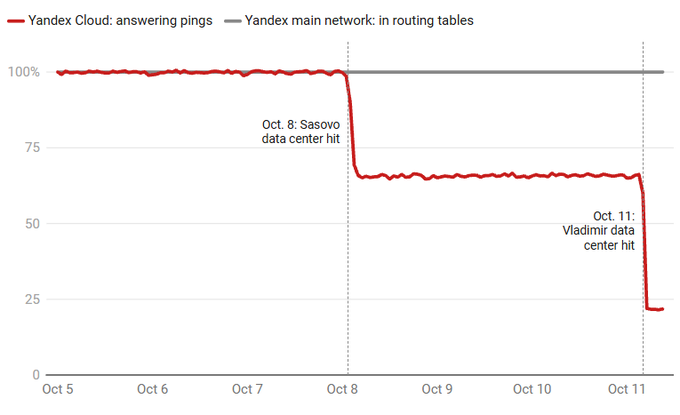
Share of Yandex Cloud addresses answering pings, October 5-11, 2026, falling after the Sasovo and Vladimir data-centre strikes. Chart posted by OSINTtechnical, citing IODA internet-outage data; not independently verified.

Neither Ukraine's Air Force nor Russia's defence ministry had published a tally for the night of October 11-12 at the time of writing, and the Russian side of last night is not yet fully reported at the time of writing.

Refinery strikes

Nationwide: no new Ukrainian strike on a Russian refinery was reported for October 11 or the night of October 11-12 at the time of writing. Plants reported halted or cut so far in October account for about 14.8mn tonnes a year, or 5% of Russia's 327mn tonnes nameplate capacity, by IntelliNews' refinery ledger, and up to 162.9mn tonnes, or 50%, if halts reported earlier still hold. Deputy Prime Minister Alexander Novak put capacity under repair at about 10% in early September.

Ukraine: Zelenskiy's offer ties any pause in the refinery campaign to an end to Russian strikes on Ukraine's grid. "Ukraine will be ready to stop strikes on Russian oil refineries if Russia stops attacking our energy infrastructure. Any de-escalation measures must be reciprocal and backed by real guarantees," he said, UNITED24 reported. AFP, via Malay Mail, quoted a slightly different translation of the same post.

Metal plants hit

Dnipropetrovsk region: Russia attacked four districts more than 50 times on October 11 with drones and artillery, damaging infrastructure and a gas station in the Kryvyi Rih district, a warehouse in Samar and businesses in the Nikopol district, with no casualties, regional military administration head Oleksandr Hanzha said, Ukrinform reported. No strike on a named steel, iron ore, coke, ferroalloy, pipe or non-ferrous plant was reported for October 11 or the night of October 11-12 at the time of writing.

Oil depots, factories and military targets in Russia

Vladimir region: Yandex Cloud said the platform was in emergency mode and told customers to activate disaster-recovery plans, Al Jazeera reported. The Kyiv Post said more than 80 services were disrupted, from the Alice voice assistant and Yandex Music to banking apps and the Magnit and Fix Price retail chains, and that Yandex had removed its data-centre locations in four regions from its maps. Governor Alexander Avdeyev said heat and water had been restored, and about 80% of power, by the morning of October 11, the paper said.

Zelenskiy had said after the first strike, on Sasovo, that Ukraine responds "in mirror-like fashion" because Russia has been hitting Ukrainian data centres, Al Jazeera reported.

Moscow: Mayor Sergei Sobyanin said 16 drones heading for the capital were destroyed overnight on October 12, with no damage or casualties reported, Interfax reported.

Kaluga region: Governor Vladislav Shapsha said 37 drones were destroyed over the evening and night, with preliminarily no casualties or damage, Interfax reported.

Krasnodar region: drone debris fell on the grounds of Sochi airport overnight on October 11 and set fire to an administrative building, which was quickly put out, with no casualties, the regional operational headquarters said, AiF reported.

Samara region: in an update, Ukraine's General Staff said it struck Transneft's Samara oil pumping station near Prosvet again on the night of October 9-10, after strikes on October 2 and October 7, and that the damage was being clarified, Espreso reported. There was no Russian confirmation.

Occupied Donbas: the General Staff said it hit supply depots near Horodyshche and Makiivka, a repair unit near Chystiakove and troop concentrations near Irmino, Purdivka and Lysychansk on the night of October 10-11, Interfax-Ukraine reported.

Nationwide: Russia's defence ministry claimed 479 Ukrainian drones were destroyed between 20:00 on October 10 and 08:00 on October 11, and 112 more between 08:00 and 20:00, Ukraina.ru reported. Both are defence ministry claims.

Ukraine under fire

Nationwide: Russia launched 116 strike drones from 18:00 on October 10, 95 of them jet-powered Shahed types, and 94 were downed or suppressed by 08:30, with 10 hitting seven locations, the Air Force said, Ukrinform reported. Over the past week Russia launched about 1,450 guided bombs, 75 missiles and more than 1,640 attack drones, about 60% of them jet-powered, Zelenskiy said, UNITED24 reported.

Zelenskiy also counted more than 200 Russian strikes on power generation and transmission and 17 on gas and oil facilities over the week, the Kyiv Independent reported.

Kyiv: Mayor Vitali Klitschko said a high-voltage line was damaged on October 11 and water pressure fell on both banks of the Dnipro, and DTEK reported short outages across the city, the Kyiv Independent reported. The city administration told residents to stock at least three days of food and water, three litres of drinking water and 10 to 12 litres of technical water per adult a day, after strikes on October 10 halted all three metro lines and knocked out water pumping, the Kyiv Post reported.

Kharkiv region: a missile strike on a residential area of Pisochyn at about 19:25 on October 11 killed three people, a 16-year-old boy and women aged 19 and 51. Governor Oleh Syniehubov said 22 people were injured, Ukrinform reported, while the National Police put the figure at 25, the Kyiv Independent reported.

Kharkiv: a guided bomb on the Nemyshlianskyi district on October 11 killed a 36-year-old woman and injured nine people, including a seven-year-old boy, the State Emergency Service said, Ukrinform reported. The Kyiv Post earlier gave her age as 35 and the injured as 10, with 35 houses damaged.

Zaporizhzhia: in an update on the October 10 guided-bomb strike, the State Emergency Service said the search was over, with 20 dead, including four children, and 17 injured, including three children, Ukrinform reported. UNITED24 put the toll at 23, including four children, citing Ukrainian authorities.

Ivano-Frankivsk: a drone strike on the evening of October 11 killed three service members and injured three, Mayor Ruslan Martsinkiv said, the Kyiv Independent reported.

Donetsk region: three FAB-250 bombs with guidance kits hit a residential area of Sloviansk at about 09:45 on October 11, injuring seven people and damaging nine apartment buildings and a shop, and two people were injured in Yasnohirka, regional prosecutors said, Ukrinform reported. The mandatory evacuation zone for children was widened in Kramatorsk.

Dnipropetrovsk region: a child was killed and at least nine people were injured on October 11, including two eight-year-old girls, regional authorities said, the Kyiv Independent reported.

Sumy region: a drone hit an ambulance on a call, and both medical workers survived, the Kyiv Post reported. Two men were injured by drones in the region, the Kyiv Independent said.

Kyiv region: four people were injured as drones hit housing, civilian facilities and energy infrastructure, the regional military administration said, the paper reported.

Data centres, telecoms, media and R&D

Ukraine: no new Russian strike on a Ukrainian data centre, telecoms operator, broadcaster or research site was reported for October 11 or the night of October 11-12 at the time of writing. The last was the October 10 strike on TeNet's technical site in Odesa.

Weapons and technology

United States: Lockheed Martin unveiled the PAC-3 Edge interceptor on October 9 for the US Army's Future Interceptor programme, saying it is designed to engage air, missile and hypersonic threats at higher altitudes and longer ranges than current systems. It gave no range or speed figures. Testing is due to start in 2027, with rapid deployment targeted for 2031.

Russia: jet-powered Shaheds made up 95 of the 116 drones Russia launched on the night of October 10-11, the Air Force said. The Kharkiv prosecutors' identification of Banderol-type missiles in the attack outside Kharkiv is preliminary.

Arson and sabotage in the EU and the UK

Europe: Russia is stepping up plans to kill defence-industry executives and key staff in Europe, including at smaller drone and component makers, the Financial Times reported on October 11, citing intelligence officials from five European countries, according to UNITED24 and spotmedia.ro. European officials said the GRU military intelligence agency coordinates the main operations, increasingly through organised crime networks, and that several had been disrupted. No company other than Rheinmetall was named, and no new incident was described.

Poland: the security services reported a suspected plot to assassinate Prime Minister Donald Tusk and Defence Minister Wladyslaw Kosiniak-Kamysz, and Interior Minister Marcin Kierwinski said police had detained a man who allegedly planned an attack on Tusk, Notes from Poland reported. Officials named no perpetrator and no foreign link, and the case is not in the sabotage ledger.

Montenegro: in an update on the October 9 expulsion of Rybar founder Mikhail Zvinchuk, OCCRP named five people expelled, against four in earlier reports, and said police seized a drone, cameras and phones.

Tit for tat

Within hours of Trump declaring an energy ceasefire, Russia hit power plants in Kharkiv and Kyiv, Zelenskiy said, and Moscow said nothing about the truce. Kyiv says it will stop hitting refineries only when Russia stops hitting its grid.

Ukraine's drones have meanwhile moved on to Russia's computing backbone, shutting three Yandex data centres in four days, which Zelenskiy presents as a mirror of Russian strikes on Ukrainian data centres. On the night of October 11-12 Russia reported drones over Moscow and Kaluga, and Ukraine had not yet published its own count.

The ledgers

The running ledgers are kept as six public spreadsheets at permanent addresses. The first three are non-exhaustive, every row is sourced, and where only one side has spoken the row says so. Defence ministry figures are recorded as claims, and in the sabotage ledger attribution is given exactly as the authorities state it and no further. The fourth tracks what has happened to Ukraine's steel, iron ore, coke, ferroalloy and non-ferrous plants since 2021, grouped by owner. The fifth tracks strikes on data centres, telecoms, media and research sites; the sixth tracks refinery strikes.

RUSSIA STRIKES LEDGER: Russian strikes on Ukraine's economic infrastructure, 415 rows

UKRAINE STRIKES LEDGER: Ukrainian strikes on economic infrastructure in Russia and occupied territory, 257 rows

ARSON & SABOTAGE LEDGER: Arson, sabotage and drone incursions in the EU and the UK, 80 rows

METAL STRIKES LEDGER: Ukraine's metals and mining assets: 2021 baseline against status in September 2026, 38 plants and mines

DATA CENTRE & TELECOM STRIKES LEDGER: Data centres, telecoms, media and research sites hit in Ukraine, 38 rows

REFINERY STRIKES LEDGER: Russian oil refineries hit, and how badly, 27 refineries

RefineryRegionCapacity (mn t/yr)StrikesLatest hitWorst damage (0-4)Status now
RyazanRyazan region17.115September 6, 20264Halted (September 10, 2026)
Moscow (Kapotnya)Moscow125September 20, 20264Halted (September 22, 2026)
Kirishi (KINEF)Leningrad region20.18August 30, 20264Halted (September 15, 2026)
Yaroslavl (Slavneft-YANOS)Yaroslavl region1515September 17, 20264Halted (September 17, 2026)
Nizhny Novgorod (Lukoil NORSI, Kstovo)Nizhny Novgorod region1710August 26, 20264Partly operating (~25%) (September 15, 2026)
VolgogradVolgograd region14.812October 2, 20264Halted (October 6, 2026)
SaratovSaratov region710September 11, 20264Halted (September 16, 2026)
SyzranSamara region8.510September 15, 20264Halted (September 16, 2026)
NovokuibyshevskSamara region8.37August 22, 20264Unknown after 22 Aug 2026 fire (August 22, 2026)
Kuibyshev (Samara)Samara region76September 23, 20264Unknown after 22 Sep 2026 strike (September 23, 2026)
TuapseKrasnodar region1211May 27, 20264Halted (no restart reported) (April 21, 2026)
AfipskyKrasnodar region6.215August 25, 20261No halt reported (August 27, 2026)
IlskyKrasnodar region6.614September 26, 20263Halt claimed by Ukraine's Fire Point, not confirmed (September 26, 2026)
Slavyansk ECOKrasnodar region5.29September 13, 20264No halt reported after 13 Sep 2026 (September 17, 2026)
KrasnodarKrasnodar region32August 30, 20251No halt reported (August 30, 2025)
NovoshakhtinskRostov region57September 25, 20264Halted (temporarily suspended) (September 25, 2026)
Ufa group (Bashneft: Ufaneftekhim, Novoil, UNPZ)Bashkortostan23.415September 23, 20262Operating, units under repair (September 22, 2026)
SalavatBashkortostan106October 8, 20264Halted (no restart reported) (August 14, 2026)
Nizhnekamsk (TANECO)Tatarstan167September 13, 20264Unclear / partly operating (September 18, 2026)
Nizhnekamsk (TAIF-NK)Tatarstan7.31July 8, 20260Operating (July 27, 2026)
Perm (Lukoil)Perm region13.16September 25, 20264Halted (September 25, 2026)
OrskOrenburg region6.64August 11, 20264Halted (repairs up to six months) (August 13, 2026)
OmskOmsk region212October 8, 20264Unclear (restarted late July; later reported stopped) (September 15, 2026)
Tyumen (Antipinsky)Tyumen region93July 25, 20264Halted (no restart reported) (July 28, 2026)
Ukhta (Lukoil)Komi Republic4.23October 9, 20261Unknown (February 12, 2026)
Pervyi Zavod (Kaluga mini-refinery)Kaluga region1.22May 10, 20241Operating (November 19, 2025)
Nevsky Mazut (St Petersburg)St Petersburg 1January 31, 20241Unknown (January 31, 2024)

Russian oil refineries hit by Ukrainian strikes, as of October 12, 2026. Non-exhaustive; strike counts are floors. Damage: 0 claimed, no damage confirmed; 1 fire or minor damage; 2 secondary unit damaged, output reduced; 3 primary distillation unit damaged; 4 refinery halted. Plants reported halted or cut in Oct 2026 account for about 14.8 mn t/yr, about 5% of the 327 mn t/yr nameplate total; up to 162.9 mn t/yr (50%) if earlier halts still hold. Russian officials put capacity under repair at about 10% (Deputy Prime Minister Alexander Novak, early September). Status mostly from unnamed industry sources cited by Reuters. Full sourced ledger: https://docs.google.com/spreadsheets/d/1AHjZvX9Hf-6jdKxcTE8Dw7f6O2_svY0kX54sqKPyU_s

Production note

This article was produced with the help of IntelliNews Lambda analytical tool

'News to me': Zelenskyy blindsided by Trump's surprise warfare announcement

Alexander Willis
October 11, 2026 
RAW STORY


FILE PHOTO: Republican presidential nominee and former U.S. President Donald Trump and Ukraine's President Volodymyr Zelensky meet at Trump Tower in New York City, U.S., September 27, 2024. REUTERS/Shannon Stapleton/File Photo

President Donald Trump raced to Truth Social Sunday to announce the brokering of a new ceasefire between Russia and Ukraine — an announcement that stood for mere minutes before it was contradicted by Ukrainian President Volodymyr Zelenskyy, according to Axios’ Barak Ravid.

Trump claimed that “effective immediately,” a ceasefire had been agreed to by Russia and Ukraine to halt strikes on energy infrastructure. Moments later, however, Ravid claimed to receive conflicting information after speaking with Zelenskyy by phone.

“The announcement about the ceasefire was news to me,” Zelenskyy said, according to Ravid.

Trump has made similar claims before. In September, he announced that Russia and Ukraine had agreed to stop striking energy targets, only for Ukraine to hit a major Moscow-area oil refinery days later.

Nevertheless, Zelenskyy said that if Russia did agree to pause striking energy targets, Ukraine would follow suit.

“But if the Russians agree to a ceasefire in the energy sector, Ukraine will also agree,” he said, according to Ravid. “If President Trump agreed to this with Putin — please let us know when the ceasefire begins. We are ready and will agree to it.”


Disbelief as Trump’s ceasefire crumbles within hours: ‘What can you even say’

Alexander Willis
October 11, 2026
RAW STORY

President Donald Trump was ridiculed en masse Sunday after the purported ceasefire he claimed had been brokered between Russia and Ukraine fell apart within hours.

“What can you even say,” wrote investigative journalist and writer Ilya Lozovsky in a social media post on X.

Sunday morning, Trump took to social media to claim that an agreement had been reached between Russia and Ukraine to halt attacks on energy infrastructure.

“Effective immediately, there is an ENERGY CEASEFIRE in the War between Russia and Ukraine,” he wrote. “Both parties have agreed. Do not break it!”

Moments later, Ukrainian President Volodymyr Zelenskyy said of the purported agreement, “the ceasefire was news to me,” but said he would agree to halt attacks on Russian energy targets if Moscow followed suit.

Hours later, Zelenskyy said that Russian strikes on Ukrainian energy sites had continued despite Trump’s claim.

“There were strikes, unfortunately, with aerial bombs,” Zelenskyy said during his nightly video address, according to Reuters. “There were strikes on our energy infrastructure. Just now, there was a strike on the joint power and heating plant in the city of Kharkiv — hitting Kharkiv’s energy system.”

Former Republican congressman Adam Kinzinger sarcastically expressed shock that Trump’s purported agreement had proven to be false.

“What??? Trump lied???” Kinzinger wrote.

And Anne Applebaum, Pulitzer Prize-winning historian and journalist, issued Trump an especially harsh condemnation.

“Trump announces an energy ceasefire. Ukrainians learn about it from social media. Immediately, there are more Russian strikes on Ukrainian energy infrastructure,” Applebaum wrote. “The president lives in a fantasy world of his own construction.”


'Compromised': Trump torched for blaming foreign leader for his own crisis


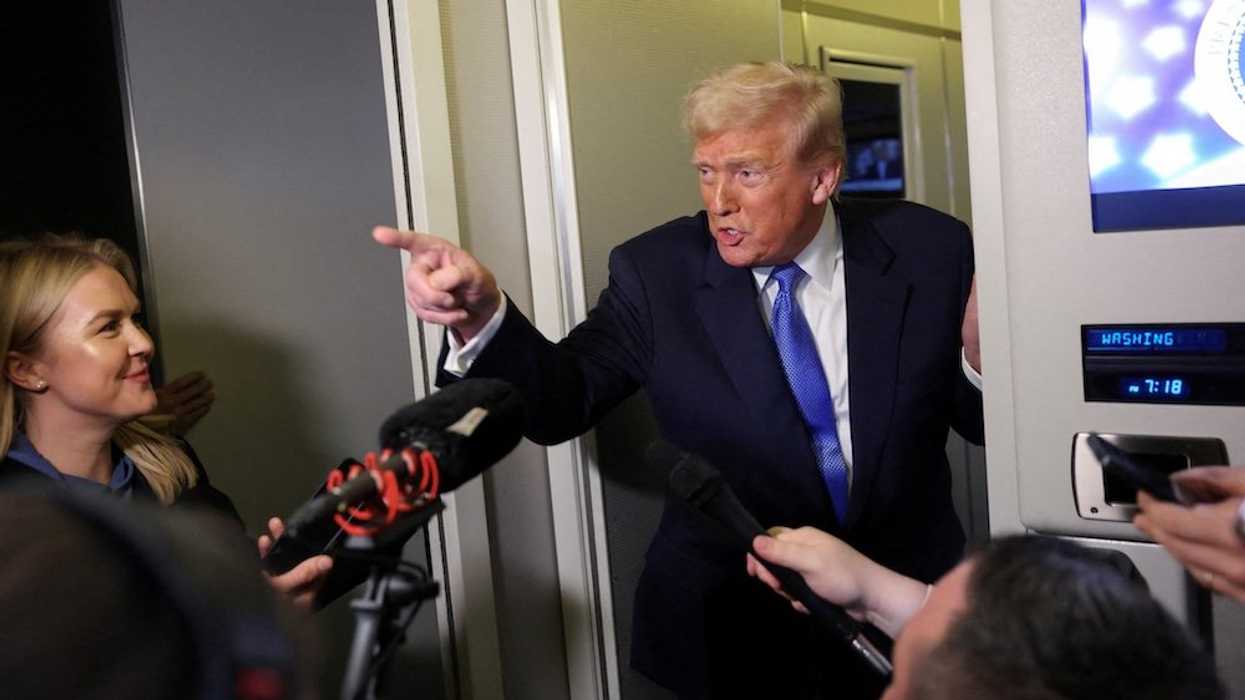
President Donald Trump speaks to reporters aboard Air Force One on his return to Washington, D.C., March 9, 2025. REUTERS/Kevin Lamarque

October 10, 2026 
ALTERNET

President Donald Trump once again lashed out and blamed a foreign leader for his own soaring inflation issue, prompting observers and commentators to rip into him for the slight and accuse him of being "compromised."

As Trump stares down major GOP midterm losses thanks in large part to the ongoing cost-of-living crisis, and in recent weeks, his war with Iran has begun making the issue much worse. As the conflict spirals on with no real end in sight, diesel prices have begun to reach historic average highs, putting a tight financial squeeze on farmers and the transportation industries, creating a ripple effect as higher fuel costs are passed on to consumers for nearly every product in the economy.

With no meaningful solution in sight, Trump has recently taken to blaming Ukrainian President Volodymyr Zelensky and his nation's ongoing war with Russia for the issue, given the Ukrainian military's many strikes on Russian oil refineries. In a press conference outside the White House on Saturday, Trump once again ripped into Zelensky over the issue and argued that Ukraine should get a new leader.

"He wants to make problems for the world. He wants to make problems for our farmers, our ranchers, with diesel fuel," Trump said.

As clips from the press conference began to circulate on social media, numerous observers took aim at Trump, lambasting him for appearing to take Russian President Vladimir Putin's side in the conflict and comparing his own approval ratings to Zelensky's.

"Your daily reminder that there is a non-zero chance our President is compromised by Putin," moderate anti-Trump conservative commentator Brian Mistrot wrote in a post reacting to the president's remarks.

In a post reacting to Trump claiming Ukraine needs a new leader, independent political commentator Adam Schwarz noted that Trump's approval rating currently sits around 32 percent, while Zelensky's sits at 54 percent. With that in mind, many observers turned Trump's words around on him, insisting that the U.S. needed a new leader instead.

"Let's do that here instead," anti-Trump conservative commentator Rick Wilson wrote.

"I suggest that [Americans] should get a new leader who is not such a vacuous, venal fool," historian Roger Moorhouse posted.

"There will be considerable satisfaction in Moscow tonight," Russia-based reporter Brian McDonald explained. "Trump has now openly progressed from urging Ukraine to accept a peace deal to suggesting it find another president... willing to do so. Trump’s frustration with Zelensky is no longer a matter for diplomatic interpretation, particularly after renewed Ukrainian attacks on Russian oil facilities (in Rostov last night), despite Washington’s requests to stop them, he's announcing it to the world now."

"I thought he said HE could end the war on 'day one' though," popular liberal commentator Joanne Carducci posted.

"This is absolutely unacceptable. The President of the United States is now openly siding with the murderous dictator of Russia," Fred Wellman, a Democratic candidate for Congress in Missouri, posted.

"I see he is playing the game 'how appalling can I be' again," journalist Luke McGee posted.

Trump Strikes ‘Deal With the Devil’ for Russian Diesel as High Prices Hinder GOP in Midterms

“He’s helping fund Russia’s war machine, while our allies pay the price,” said one congressional Democrat.


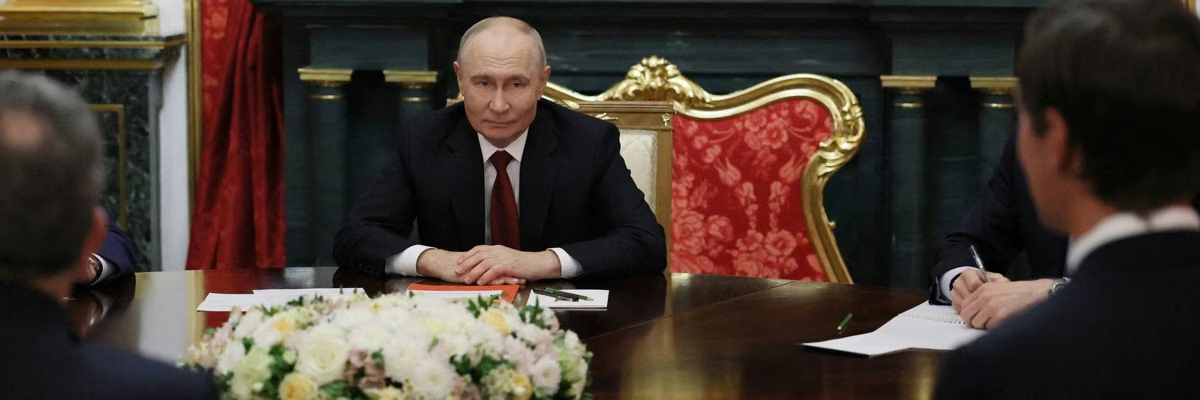
Russian President Vladimir Putin attends a meeting with US President Donald Trump’s special envoy Steve Witkoff and son-in-law Jared Kushner in Moscow on September 5, 2026.
(Photo by Mikhail Metzel /Pool/AFP via Getty Images)

Jessica Corbett
Oct 09, 2026
COMMON DREAMS

Democrats in Congress and Ukrainian President Volodymyr Zelenskyy on Friday swiftly condemned US President Donald Trump’s plan to secure diesel from Russia in hopes of combating fuel prices that have skyrocketed due to his illegal war on Iran.

“I have just concluded a highly successful discussion with President Vladimir Putin, of Russia, wherein it was agreed that Russia will immediately supply over 300,000 Tons of Diesel Fuel to the American and Global Marketplace, another 500,000 Tons during the month of November, and 1,000,000 Tons immediately thereafter,” Trump wrote on his Truth Social platform, with the US midterm elections just weeks away, and voters frustrated by the country’s affordability crisis.

“Additionally, based on the condition of their Diesel Refineries, Russia will then deliver, within a short period of time, 3,000,000 Tons of Diesel Fuel,” Trump said. “Between our TOTAL CONTROL of the Strait of Hormuz, and this great announcement on Russian Energy, Diesel Prices for Americans and, indeed, the World, will be COMING DOWN, IN RECORD NUMBERS, AND FAST! Lower prices for Americans, especially our Great Farmers, Ranchers, and Truckers, is my Greatest Priority. This is a very big and important announcement. Additionally, it must be understood, that Iran will not have a Nuclear Weapon!”


After Trump’s post, the Department of the Treasury’s Office of Foreign Assets Control issued a general license “authorizing transactions related to the sale, delivery, offloading, and importation of diesel” from Russia—which launched a full-scale invasion of neighboring Ukraine in 2022. In response, Congress has appropriated over $170 billion to help Ukraine.

The Associated Press pointed out that Trump announced the deal with Putin after “he signed a sweeping Russia sanctions law last month that aimed at clamping down on Russia’s energy revenues,” and as “his envoy Steve Witkoff and son-in-law Jared Kushner were meeting with Ukrainian officials in Miami to discuss a proposal to try to end the Russia-Ukraine war.”

In a lengthy statement, the Ukrainian president warned Friday that “any easing of sanctions against Russia without a clear and lasting de-escalation agreement with Russia is an obvious weakness. It plays into Russia’s hands—allowing it to kill more, wage war for longer, have even less respect for America, and inflict even greater losses and damage on the world.”


US Senate Minority Leader Chuck Schumer (D-NY) declared that “Trump is doing a deal with the devil to try to help his flailing political fortunes from the shockingly high diesel prices caused by his own reckless, illegal war in the Middle East. This filthy deal will only aid and abet the same Putin who is helping the Iranians to target and try to kill American troops in the Middle East and who illegally and viciously invaded our ally Ukraine.”

According to an online tracker launched by Brown University’s Costs of War Project, since Trump started bombing Iran without congressional authorization in February, Americans have paid over $130 billion more for fuel—$71.74 billion for gasoline and $58.56 billion for diesel—or nearly $1,000 per household.


Several other Democratic lawmakers from both chambers of Congress—which Democrats hope to reclaim from Trump’s Republican Party in November—were also critical, including Sen. Richard Blumenthal (D-Conn.), who said that striking a deal “with a murdering dictator” to lift sanctions “is an embarrassment and makes us complicit in Putin’s war against Ukraine.”

“This poorly concealed attempt to mitigate the havoc caused by Trump’s illegal war in Iran will only benefit the Chinese and Russian economies, and lead to the slaughter of more innocents in Ukraine,” he argued. “The president should rescind this agreement immediately. To the American companies considering taking Putin’s blood money: Congress is watching.”


Denouncing Trump’s announcement as “a disgrace,” Sen. Elizabeth Warren (D-Mass.) said: “You know how Trump could bring down gas and diesel prices? By ending his illegal war with Iran. Instead, he’s going to help fund Putin’s war machine.”

Sen. Andy Kim (D-NJ) described Trump’s approach as “desperate and shortsighted,” adding: “Trump ran on America First but has no idea how to actually deliver for the American people. We wouldn’t be in this mess without his wasteful war with Iran. We need to build opportunity for Americans with our foreign policy, not Putin. End this war and not a single dime to Russia.”


House Foreign Affairs Committee Ranking Member Gregory Meeks (D-NY) also slammed the president’s reversal on sanctions against Russia, stressing that “instead of putting economic pressure on Putin for his invasion of Ukraine, Trump continues to appease him. His disastrous Iran War has sent gas and diesel costs soaring, and Americans are paying the price.”

Congresswoman Madeleine Dean (D-Pa.) similarly said: “Desperate to escape the consequences of his failed Iran war, Trump is preparing to stab Ukraine in the back and buy diesel from Putin. He’s helping fund Russia’s war machine, while our allies pay the price.”


LATAM BLOG: Bolsonaro will strip the B from BRICS

LATAM BLOG: Bolsonaro will strip the B from BRICS
Brazil, Latin America's largest economy, would be the biggest catch in the region’s run of right-wing victories. / X


By IntelliNews Latam desk October 11, 2026

When Goldman Sachs’ Jim O’Neill coined the BRICS acronym in 2001, Brazil stood at the front of it. A quarter of a century later, it may be the first founding member to walk away from the burgeoning trading bloc.

Flávio Bolsonaro’s narrow first-round win on October 4, with 47.03% of valid votes against 45.16% for President Luiz Inácio Lula da Silva, is hardening into a lead. The first post-ballot survey by PoderData/Aya puts the senator on 53% and the seasoned leftist leader on 47% ahead of the October 25 runoff, a three-point swing each way since its last pre-vote poll. Lula, 80 and seeking a fourth term, is fighting a rival 35 years his junior who carries his imprisoned father’s name and his father’s grievances.

Most commentary on the race has focused on crime, the dire fiscal outlook and the fate of Brazil’s Supreme Court, embroiled in a sprawling scandal linked to a failed bank. The bigger consequences, however, may lie abroad. Flávio Bolsonaro said in June that on his first day in office he would reassess whether Brazil should remain in a bloc he called “highly ideological”, accusing it of baiting Washington over the dollar, and that leaving was on the table. His foreign policy programme runs to two pages. It does not mention BRICS, prioritising OECD accession and closer ties with the US, Israel and Argentina.

History suggests he may not follow through. After all, his father kept Brazil in the group, trade with China hit records on his watch and Brasília resisted US pressure to exclude Huawei from its 5G rollout. Analysts argue that export interests and institutional inertia would constrain the son just as they constrained the father. “China’s weight in Brazil’s trade and investment relationships would impose substantial limits on any effort to privilege Washington at Beijing’s expense,” Brookings scholars Diana Paz García and Bruce Jones wrote in a short essay.

That reading underestimates how much has changed. In 2019, BRICS was a low-cost talking shop of five. Today it includes Iran, Egypt, Ethiopia, the UAE and Indonesia, and its agenda leans openly towards dedollarisation. Washington no longer tolerates hedging either. President Donald Trump has threatened extra tariffs on any country aligning with what he calls the bloc’s anti-American policies, and he slapped heavy duties on Brazilian goods in 2025 partly in retaliation for the prosecution of former president Jair Bolsonaro, a close ideological ally. A Bolsonaro 2.0 government indebted to Washington for an overt campaign of interference on its behalf would find a BRICS exit a cheap way to settle the debt.

And cheap is the operative word, because BRICS is not China. Brazil exported $99.9bn of goods to China last year, nearly three times the $37.7bn it sold to the US, and almost 80% of its soybean exports went to Chinese buyers. None of that trade runs through BRICS. Beijing buys soybeans and iron ore because it needs them, not because Brazilian diplomats attend summits. A president can leave the club and keep the customer. The only real tie is Brazil’s nearly 20% stake in the New Development Bank, and that is a balance-sheet question rather than a strategic one.

For Washington, meanwhile, the prize is considerable. The so-called Donroe Doctrine, Trump’s revival of the Monroe Doctrine, has moved from slogan to practice this year. US forces seized Nicolás Maduro in January and left his deputy, Delcy Rodríguez, running Venezuela under US tutelage. In March, Trump gathered a dozen friendly governments at his Doral resort to launch the Shield of the Americas, a flagship counter-cartel security coalition. Brazil, Mexico and Colombia were not invited. Flávio Bolsonaro, by contrast, used a White House meeting in May to ask Trump to designate two Brazilian criminal groups as foreign terrorist organisations, and Washington promptly obliged.

Brazil, Latin America's largest economy, would be the biggest catch in the region’s run of right-wing victories, from Chile last December to Colombia and Peru this year, all of them cheered on openly by the Trump administration. Once it falls, Mexico will be the only large nation in the region still governed by the left, and Claudia Sheinbaum has proved far more pliable to US demands than Lula. Argentina, which set the pace for the region’s swing to the right, was the proof of concept. Javier Milei turned down the country’s BRICS invitation on taking office in 2023 to pursue closer US ties, yet kept its trade and financial links with Beijing intact. Brazil would be the consolidation.

It would also be the richer haul: Brazil offers almost everything the US wants to stop buying from China. It holds nearly a quarter of global rare earth reserves yet produced less than 1% of world output last year. The test case came in September, when USA Rare Earth completed its roughly $2.8bn takeover of Serra Verde, Brazil’s only commercial rare earth producer. The deal was backed by a $565mn loan from the US International Development Finance Corporation and $750mn from the Department of War. Lula criticised the deal but did not block it. He did sign a critical minerals law that creates an interministerial council with power to approve and prioritise projects. Talks on a federal minerals accord with Washington have stalled over a clause Brazilian officials read as granting the US preferential access.

Under Lula, that council is a gatekeeper. Under a Bolsonaro, it becomes a turnstile. Flávio raised rare earths with Trump in May and has backed closer cooperation on processing. Add oil exports heading for a record this year, and Brazil starts to look like the resource anchor of an American hemisphere rather than the swing state of a multipolar one.

That is the blow to Beijing and Moscow. BRICS’ claim to speak for the Global South rests on geography as much as on economics. It needs a democratic, non-aligned Latin American heavyweight to rebut the charge that it is a front for Russian and, most importantly, Chinese ambitions. Lula supplied exactly that. He pushed local-currency settlement with China, planned a yuan-denominated sovereign bond and installed former president Dilma Rousseff at the helm of the New Development Bank in Shanghai. He also co-founded the Partners for Multilateralism initiative with Canada, the EU and India last month, a project Brookings' García and Jones expect a Bolsonaro victory would interrupt.

The bloc’s champions insist the loss would not matter. Pepe Escobar, a Brazilian commentator and longtime advocate of the Sino-Russian project, told Brazil’s TV 247 that Moscow and Beijing are building a multipolar architecture “with or without Brazil”. He warned that the country risks reverting to “a mere backyard of the empire”. The first claim undercuts itself. A multipolar order built without Brazil, and with Argentina already gone, has no foothold in the Americas. It shrinks to a coalition of Eurasian and Gulf powers plus South Africa and an India that hedges as carefully as Brazil once did. That is a concession of the hemisphere, which is exactly what the Donroe Doctrine demands.

Even a formal exit may prove unnecessary, and the bloc’s defenders know it. Escobar’s real fear is not a clean break. He expects the White House to push a Bolsonaro government to “start destroying BRICS from within”, leaving Brazil a “pro forma” member. Flávio Bolsonaro has already shown his hand, reportedly assuring the US Trade Representative in July that he would keep Brazil’s homegrown Pix instant payments system, which Washington has targeted in a trade investigation, out of non-Western cross-border settlement schemes.

A Brazil that stays nominally inside BRICS while vetoing its financial plumbing would do the project more damage than one that slams the door. The next pressure point is likely to be Chinese industrial investment rather than soybeans. Escobar predicts Washington will press Brasília to erect barriers to Chinese electric vehicle and technology groups, whose weight in Brazil is growing fast. BYD’s plant in Bahia, opened last year, would be the first target.

Latin American politics moves in waves, and the region is currently following a rightward tide that has swept much of the democratic world. The left may return in time and reverse summit communiqués overnight, but rare earth concessions, US-financed processing plants and ironclad security pacts would prove far harder to unpick. If the polls hold, the multipolar order will lose more than a letter on October 25. It will lose the hemisphere.

India faces fresh protests over alleged disenfranchisement

India faces fresh protests over alleged disenfranchisement
/ Cockroach Janta Party homepageFacebook
By IntelliNews - Chennai Bureau October 12, 2026

India's Supreme Court on October 11 ordered authorities to restore metro, rail and internet services in New Delhi, a day after police detained thousands of people during a protest by the Cockroach Janta Party (CJP), the BBC citing local media reported.

Estimates of people present at protests held on October 10 2026 ranged from 3,000 to 7,000 as police sealed off the centre of the capital.

The CJP had previously secured a major concession from the Indian government over irregularities in India’s medical education entrance exam NEET, after a months-long protest briefly turned violent and then ended with the resignation of India’s then Minister of Education Dharmendra Pradhan in July.

The renewed protest centres on the Special Intensive Revision (SIR) of India's electoral rolls. The CJP and many civil society groups in India allege the exercise has wrongly struck off more than 130mn voters, mostly from marginalised and minority groups, and want it frozen.

The CJP is also demanding the resignation of India’s Chief Election Commissioner Gyanesh Kumar. The Election Commission of India rejects the accusations and says the revision only deletes duplicate or ineligible entries. In a special sitting, the Supreme Court ruled that police could not illegally detain protesters who were peaceful and unarmed. It told officers to scale back barricading it considered disproportionate.

Authorities had moved to block the gathering days in advance, on October 8 and 9, Delhi Police refused permission for a rally at the central Delhi site Jantar Mantar and deployed 23,000 personnel. They also curbed mobile internet within a 4km radius, asked for 57 metro stations to be shut, cancelled incoming trains and served notices on activists travelling from other states.

On October 10, police stopped CJP founder Abhijeet Dipke and co-convenors Saurav Das and Ashutosh Ranka on board their plane at Delhi Airport after a flight from Mumbai. Opposition figures Arvind Kejriwal, Mamata Banerjee and Pinarayi Vijayan were briefly held before being freed. YouTuber Dhruv Rathee and student leader Neha Bora, both critics of the Indian Prime Minister Narendra Modi, were also detained, according to a report by NDTV.

A magistrate court freed Dipke, Das and Ranka on October 11 after roughly 24 hours in preventive detention, on condition they sign a good behaviour bond lasting one year. The party's leaders said the bond did not bar them from assembling peacefully. They accused police of hacking their phones and of holding back news that Dipke's grandmother had died while he was in custody.

As of the morning of October 12, CJP leaders intended to ask Delhi Police to set an official date for a peaceful sit-in at Jantar Mantar, and vowed to keep the nationwide campaign going.