Sunday, October 04, 2026


Latin America mining risks carry $54B price tag


Las Bambas copper mine has endured over 700 days of blockades since starting production in 2016.(Image: Screenshot from Latina Noticias | YouTube.)

Above-ground risks have cost or stalled more than $54 billion in Latin American mining since 2018, highlighting how permitting, community conflict and security can determine whether the region’s mineral wealth becomes producing mines.

Americas Market Intelligence (AMI) estimates about $38 billion stems from write-offs, legal settlements, fines and other documented losses, while another $16 billion represents capital frozen in delayed or halted projects. The latter includes about $7 billion in Peruvian copper projects and $4 billion across three projects stalled by permitting problems in Mexico, Sebastián Pérez-Ferreiro, co-director of AMI’s mining and risk practice, said during a webinar Thursday.

“The figure is broadly consistent with the scale of disruption we see across Latin America, although we have not independently verified AMI’s calculation,” Juan Carlos Guajardo, executive director of Chile-based Plusmining Consulting, told MINING.COM. “It is important to distinguish losses already incurred from capital tied up in delayed projects.”

Geopolitical mining specialists Eduardo Zamanillo and Marta Rivera also cautioned against treating the $54-billion estimate as a measure of the region’s overall investment appeal. Latin American countries differ substantially in the maturity of their mining industries, infrastructure, institutions, security and regulatory trajectories, they said.

“We see a region entering a potentially important new mining cycle rather than one becoming uniformly less attractive,” Zamanillo and Rivera told MINING.COM.

The distinction matters as Latin America seeks investment to expand copper, gold, lithium and other mineral production. The Mining Conflicts Observatory, a non-profit tracking extractive projects, currently lists 284 conflicts involving 301 projects across the region, according to AMI.

Guajardo cautioned that the cumulative $54-billion figure does not by itself show that risk is rising each year. What has changed is the weight investors assign to those risks when assessing whether projects can be built economically and on schedule.

Juan Ignacio Guzmán, CEO of GEM Mining Consulting, said delays can matter more than direct legal or security expenses because they push cash flows further into the future and can erode a project’s value.

Execution certainty

The largest single loss in AMI’s calculation comes from resolving the long-term
environmental, social, and legal impacts of the 2015 Mariana tailings dam disaster in Brazil.

BHP (NYSE, LON, ASX: BHP), Vale (NYSE: VALE) and Samarco agreed with Brazilian authorities to a settlement valued by AMI at $31.7 billion to address the disaster’s environmental, social and legal consequencesg

Regulatory disputes are also tying up billions in planned investment. AMI identifies about $7 billion in Peruvian copper projects stalled by social opposition, regulatory uncertainty and illegal mining. In Mexico, El Arco in Baja California, San Nicolás in Zacatecas and Cordero in Chihuahua represent about $4 billion in investment held up by permitting issues, according to AMI.

Zamanillo and Rivera identified “execution certainty” as the broadest regional constraint, particularly the predictability and duration of permitting, although security and illegal mining have become equally significant in some jurisdictions.

Execution certainty goes beyond administrative timelines, they said. Projects also need institutional and social legitimacy that can be sustained over decades.

“A technically sound and economically attractive project can remain structurally vulnerable if that legitimacy cannot be built and sustained.”

That assessment echoes concerns raised by Guajardo and Guzmán, who both identified permitting uncertainty as a major barrier to investment. Investors can price demanding environmental standards and known obligations, Guajardo said, but struggle with approval processes whose duration or outcome remains uncertain after substantial capital has been committed.

The challenge differs by jurisdiction. Chile’s lengthy and complex approvals weigh on new mines and expansions, while community relations, territorial disputes and illegal mining can rival formal permitting as obstacles in Peru, Guajardo noted.

AMI cites Chile’s Collahuasi expansion as one example of how regulatory decisions can affect large investments. The country’s Second Environmental Court annulled a key permit for the $3.2-billion expansion of the world’s sixth largest copper mine in May, after finding shortcomings in the treatment of community observations, requiring additional review of certain environmental and social issues.

First Quantum Minerals’ (TSX: FM) Cobre Panamá provides a more extreme example of political, legal and social pressures converging. The $6.8-billion copper mine was ordered closed after Panama’s Supreme Court ruled in late 2023 that the law approving its concession contract was unconstitutional. The operation had represented about 5% of Panama’s gross domestic product and 75% of its mineral exports and supported about 54,000 direct and indirect jobs, according to figures cited by AMI.

In Colombia, AngloGold Ashanti (NYSE: AU)(JSE: ANG)(ASX: AGG) has written off $98 million on its Quebradona copper-gold project, stalled since 2021, and is targeting 2027 for a new environmental impact assessment.

Security presents another challenge. Zijin Mining said in 2024 that it had lost control of 60% of the tunnels at its Buriticá gold mine in Colombia to illegal miners backed by the Gulf Clan.

Zamanillo and Rivera said weakening legitimate formal mining where state capacity is limited can create space for illegal or “anomic” extraction, making security part of a wider structural challenge rather than an isolated operating risk.

Investment shifts

Above-ground risk is not necessarily driving miners out of Latin America. Instead, companies are becoming more selective about where and when they commit capital as governments worldwide compete to build mineral supply chains.

Guajardo said miners increasingly favour expansions around existing operations, where infrastructure and community relationships are already established, over large greenfield projects with longer and less predictable routes to production.

Zamanillo and Rivera see the trend less as capital retreating from Latin America than as an intensifying global competition for mineral investment. Several countries are trying to improve their position, including Argentina through its incentive regime for large investments (RIGI) and Chile through permitting reform, while Brazil has pursued a critical-minerals strategy and Ecuador has moved to reopen access to mining concessions.

Argentina has continued integrating mining projects with its Large Investment Incentive Regime (RIGI), which is designed to provide greater investment certainty and incentives for large projects. The government approved the Vicuña copper-gold-silver project for the regime this year and has updated mining investment rules aimed at simplifying procedures and strengthening predictability.

Peru encapsulates the trade-off. Its copper geology and development pipeline remain attractive, but social conflict and security conditions can alter project timing and risk. Chile remains a major destination for copper capital, though approval timelines can influence development priorities.

Community disputes demonstrate how those risks become operating costs. Peru’s Las Bambas copper mine has faced more than 700 days of blockades along its transport corridor since commercial production began in 2016, according to AMI. Stoppages have cost about $9.5 million a day based on estimates cited by the consultancy from Peru’s mining union.

John Price, co-director of AMI’s mining and risk practice, traced part of the conflict to an early plan to transport copper concentrate by pipeline to Cusco. The pipeline was abandoned after MMG (HKEX: 1208) acquired Las Bambas, with concentrate instead transported by truck through communities along the route.

“If you do not take the time to really engage with the community, and if you do not fulfil the promises that you make, it will come back to bite you,” Price said.

AMI argues earlier monitoring of community, political, regulatory and security threats can reduce costs because those risks increasingly overlap and cannot easily be managed in isolation.

Zamanillo and Rivera remain positive about the region’s longer-term prospects, but said geology alone will not determine which jurisdictions capture the next wave of investment. Infrastructure, execution certainty, security, financing and legitimacy will increasingly determine whether mineral resources become operating mines and processing capacity.

“The region has no shortage of mineral resources,” Guajardo said. “Its challenge is to provide a credible route for developing them.”


Latin America has been at the centre of a growing global power struggle this year, as governments and investors focus on who controls critical minerals and the supply chains behind them.
If the region matters to you, don’t miss
MINING.COM’s regional series tracking the geopolitical forces reshaping it and why markets are increasingly driven by global alliances as much as local politics.

Countries in the series:


London gold body’s legal fight exposes threat to bullion market

Stock image.

The industry body that sets the rules for the world’s biggest gold market faces an existential legal battle in a London courtroom next week, in a case that could have far-reaching implications for how the industry polices its supply chain.

The London Bullion Market Association is being sued by the families of two men who died at a Tanzanian gold mine in 2019. The start of the trial on Wednesday will cast a spotlight on the outsized role that the relatively small organization plays in overseeing the $1-trillion-a-week gold market in London.

The LBMA says the claim has no merit, and is confident it will successfully defend it. But if the court orders it to pay out significant sums to the claimants, there’s a risk it could leave the industry body insolvent, according to people familiar with its thinking, who asked not to be identified discussing legal proceedings. 

As a contingency for an adverse ruling, there have been internal discussions within the LBMA about setting up a successor body to maintain some core operations critical to the functioning of the bullion market, the people said, although no steps have been taken yet. 

“LBMA disputes that it bears legal responsibility for these tragic deaths, and their profound human impact,” the organization said in a statement. “The claim misconstrues LBMA’s role in the supply chain, and we deny that LBMA owed the duty of care alleged in these proceedings.”

That threat hanging over the LBMA is a cause for unease among traders and executives in the broader gold industry, who will be descending on the idyllic Italian resort town of Sorrento this weekend for the organization’s annual conference. 

Several insiders including traders, refiners and experts in responsible sourcing have told Bloomberg privately they expect the LBMA to prevail, but they’re also not ruling out the possibility that the case could have seismic consequences for the underlying gold market in London and beyond.

Standards Watchdog

London’s role as the standard-setter for the global gold market has evolved over centuries, starting in 1750 with the Bank of England’s creation of the Good Delivery List, which ensured bullion was of a consistent purity as it began pouring in from all corners of the globe. 

The LBMA took responsibility for that list when it was founded in 1987, and in recent years it’s expanded its scope by demanding refiners follow responsible-sourcing rules when procuring their gold.

The court case will test whether the association can be held partly accountable for the men’s deaths at North Mara in Tanzania, given that some of the mine’s output was sold to one of those Good Delivery List refiners. 

“The LBMA holds itself out as the ‘global authority for precious metals’ and acts as a quasi-regulator of the global gold market,” lawyers for Leigh Day, the firm bringing the claim, said in a statement. The alleged human rights abuses at the mine could be avoided if the association’s rules were “properly and fearlessly applied,” they said.

The claimants allege that one man, 23, was fatally shot after police dispersed a group of small-scale miners who were trespassing on the site in July 2019, while another, also 23, was shot in the back as he fled police in December that year. 

The Tanzanian police didn’t respond to a request for comment, while Barrick Mining Corp., the majority owner of North Mara, declined to comment. In an earlier statement, the miner said that it was proud of its human rights record around the world, and that it did not direct or control the Tanzanian police.

Acacia Mining — in which Barrick had a majority stake and then fully acquired in 2019 — and its Tanzanian operating subsidiary have previously faced lawsuits over alleged killings and injuries involving police and security forces at the site. A UK case brought by Tanzanian villagers represented by Leigh Day was settled in 2015 without an admission of liability.

A ruling that effectively made the LBMA responsible for abuses at mines supplying accredited refiners would make its Good Delivery system unworkable, the people familiar with the organization’s thinking said. 

The association lacks the resources to monitor mines around the world directly, the people said, and it could be forced to retreat from enforcing responsible-sourcing standards altogether if the ruling imposed a broad duty of care.

Any successor would have to pay to recover intellectual property underpinning the LBMA’s market functions, including its Good Delivery List of refiners, the people said. 

“The claimants do not contend that the LBMA’s system is unworkable,” Leigh Day said. Instead, the LBMA’s system was “rendered meaningless by conflicts of interest and negligence,” they said.

A ruling against the LBMA could also open the door to similar claims elsewhere, potentially including the London Metal Exchange, which has a similar system requiring producers of listed brands to meet responsible-sourcing standards. The Good Delivery List is also relied on by market participants and futures exchanges like the US-based CME Group Inc., making accreditation almost a necessity for many of the biggest refiners.

The case creates particular jeopardy for the LBMA because its finances are modest compared to the scale of the market it oversees. And despite counting some of the world’s largest banks among its members, none of them are obligated to backstop it financially. 

Its latest accounts show the organization had about £1.4 million ($1.9 million) of reserves at the end of 2025. It disclosed that it could face £3 million of the claimants’ legal costs if it loses the North Mara case, before accounting for any damages awarded to the families.

Replacing the LBMA with another system to enforce responsible-sourcing standards “wouldn’t necessarily solve the problem” of ensuring gold is responsibly sourced, said Joanne Lebert, executive director of Canadian nonprofit organization IMPACT. “I think it might actually set us back.”

‘Stronger Action’

Leigh Day argues that the LBMA should have taken stronger action after reports of alleged violence at the North Mara site became public. RAID, a corporate watchdog, published a number of reports from 2014 onwards alleging that shootings, torture and severe beatings were carried out by Tanzanian police officers who provided security at the mine. 

MMTC-PAMP India Pvt, a Good Delivery List refiner, continued processing gold from North Mara after some of those allegations emerged. The claimants’ lawyers say the LBMA should have suspended MMTC-PAMP from the Good Delivery List, or threatened to do so, if it did not stop sourcing gold from the mine. They argue that the threat of losing access to Good Delivery List refiners could have forced changes at the site and prevented the deaths of the two miners.

“At the moment these industry certification schemes are weak, can’t be trusted, and far too often put a clean label on tainted commodities, in this case tainted gold,” said Anneke Van Woudenberg, executive director at RAID. “If a scheme like this can’t be held to account when it gets it wrong, it’s clear legislation will be required.”

MMTC-PAMP said it rigorously follows the LBMA responsible sourcing rules, and is audited annually for its compliance by an independent third party. 

In its defense of the case, the LBMA will argue that responsibility for alleged violence rests with those who perpetrated it, and that it neither certifies nor controls mines, has no personnel in Tanzania and cannot police the conduct of police or mine security. 

(By Jack Ryan and Jack Farchy)


Panama panel backs path to Cobre Panama restart


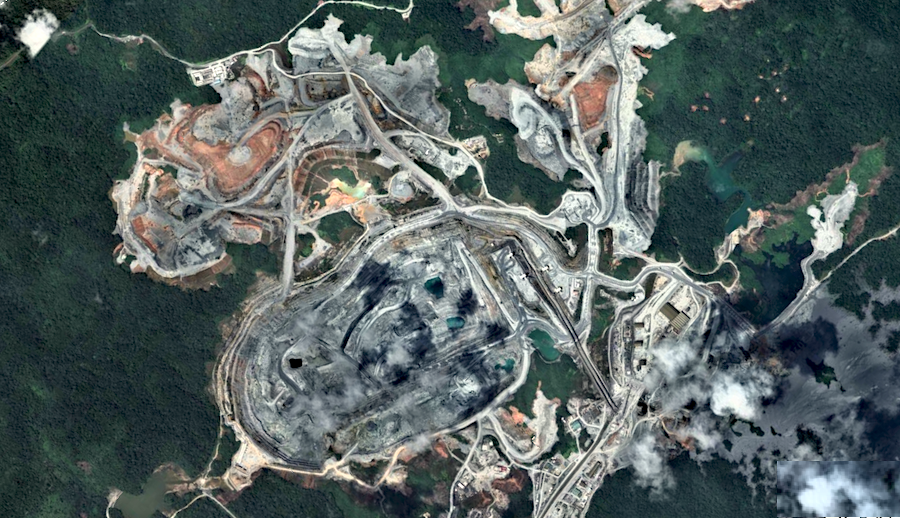
Bird’s-eye view of Cobre Panama mine. (Image: Google Earth.)

Panama should negotiate a restart of First Quantum Minerals’ (TSX: FM) Cobre Panama mine to fund its eventual orderly closure without burdening the state, a ministerial committee has recommended President José Raúl Mulino.

The three-minister commission recommendation — part of a list of 17 — follows an audit conducted by independent Swiss consultants, along with an assessment of the mine’s economic, environmental and legal implications. The commission stressed that its proposal was not a final decision, which rests with the president.

The recommendations point toward negotiations that could allow Cobre Panama to operate long enough to meet Panama’s objectives, rather than an imminent shutdown, BMO analyst Matthew Murphy said. The commission’s report cites a 25-year active mine life as an illustrative example, he noted.

“We believe Cobre Panama likely needs to run for decades to satisfy these objectives,” Murphy said in a note. “Risks are elevated but mutually agreeable solutions that preserve value remain possible.”

The document offers a potential route through the economic, legal and environmental problems surrounding Cobre Panama: generate revenue from renewed operations to finance a controlled shutdown rather than leave Panama responsible for the cost. The mine produced about 1.5% of global copper before mining stopped and was one of the country’s largest private investments.

Panama’s Supreme Court ruled in 2023 that First Quantum Minerals’ contract to operate Cobre Panama, the only mining operation in the Central American country, was unconstitutional. Challenges against the contract piled up in court following public protests against the deal signed that year by the government and First Quantum’s local subsidiary, Minera Panama.

Murphy highlighted a potentially important distinction in the commission’s report: the 2023 court decision declared the mining contract unconstitutional but, according to the report, did not prohibit mining activity itself. That could leave room for the government and First Quantum to negotiate a new legal framework for operations.

Any agreement should prevent an extension of the mine’s operating period and resolve outstanding international arbitration proceedings, according to the committee. Mulino has not made a final decision on the mine’s future.

Resolving those proceedings is central to the commission’s recommendations, Murphy said. Claimants are seeking a combined $27 billion through arbitration, while the proposed framework would establish conditions for a restart capable of financing what the commission calls an “orderly, self-funded closure.”

First Quantum said late on Wednesday it would engage “constructively and in good faith” with Panama on a new legal framework for Cobre Panama that is fair, transparent and consistent with the country’s Constitution and laws.

The miner also noted that the commission makes termination of the pending international arbitrations a mandatory condition of any agreement.

Eight guiding principles

The commission laid out eight principles for any new arrangement. It said Panama, as owner of the mineral deposit, should act as more than a state collecting royalties from a mining concession. The government should independently verify financial flows from the operation rather than rely solely on figures reported by the operator, while exercising effective oversight and requiring transparency over both the mine and the use of revenue it generates.

The framework also calls for a definitive closure date with no renewal or extension, prohibits further expansion of the mine site and requires operations to adapt to a progressive shutdown. A clear mechanism would also have to be established to restore and rehabilitate the site, while the use of mining revenues would be subject to transparent mechanisms open to public scrutiny.

“A closure isn’t done in one year, nor in five years,” Commerce and Industries Minister Julio Moltó said in a press conference.

Moltó said the committee’s proposals were based on visits to communities surrounding the mine rather than assessments conducted solely from government offices. He and his team toured Donoso, Omar Torrijos Herrera and La Pintada, where they met mine workers, local authorities and suppliers before presenting their findings as part of the government’s review of Cobre Panama’s future.

First Quantum noted that a sustainable path forward should provide long-term stability and tangible economic benefits for Panama through employment, workforce development, local procurement, community investment and broader economic contributions.

Closure costs

Economy and Finance Minister Felipe Chapman backed an orderly closure while arguing that Panama should not bear its financial cost. The abrupt shutdown inflicted a substantial economic blow to the nation, he said, eliminating thousands of direct and indirect jobs while cutting government tax and royalty revenue.

The recommendation is in line with President Mulino’s previous statements framing a mine reactivation as an “open to close” plan. The giant Cobre Panama mine, which produced as much as 1.5% of global copper before mining stopped in 2023, accounted for about 5% of Panama’s gross domestic product that year, according to First Quantum.

First Quantum shares plunged as much as 36% in early trading in Toronto as the market reacted to the government’s framing of renewed operations as a mechanism for eventually shutting Cobre Panama. They were last changing hands at C$31.1 apiece, leaving the miner with a market value of C$25.9 billion ($18.2 billion).

“We think the market got it wrong,” Scotia Capital mining analyst Orest Wowkodaw said in a note to investors. 

“While additional clarity is required based on today’s public comments from the Committee of Ministers, we see the massive sell-off in First Quantum shares as a buying opportunity for investors,” he added. “We do not think anything has changed with respect to an inevitable permanent restart of the operation under renegotiated terms.” 

BMO’s Murphy shared the view. He said investors might have put too much weight on the closure language and not enough on the potential duration and economics of renewed operations.

“The immediate market response to this report has been to focus on the risk of closure,” Murphy said. “However, we believe the full report details offer a more promising frame of reference and believe a mutually agreeable negotiated outcome is possible that would preserve substantial asset value for First Quantum and satisfy all of Panama’s objectives.”

What comes next

The commission’s deliberations follow months of study into the consequences of shutting one of Panama’s largest private investments. A government study published in September found the closure eliminated close to 36,000 jobs and reduced taxes and royalties flowing to the state by nearly $1.4 billion.

Environment Minister Juan Carlos Navarro argued the mine should never have been built and characterized the problem of closing it as one inherited from the previous administration.

Cobre Panama was First Quantum’s largest revenue generator before its shutdown, accounting for about 40% of company revenue. Its closure followed nationwide protests over environmental concerns and the terms of the mining concession.

First Quantum resumed processing in July previously mined stockpiled ore with government authorization, an activity that does not amount to reopening the mine for new extraction. The company restarted one of three milling circuits during the second quarter and continues to forecast production of 30,000 to 40,000 tonnes of copper from stockpiles this year.

The stockpile program forms part of the government-approved preservation and safe-management plan. Panamanian authorities have said processing the material can reduce environmental risks associated with leaving mineralized ore exposed to rainfall.

President Mulino must now determine whether negotiations with First Quantum can produce an arrangement that addresses the commission’s recommendations while generating enough economic value to cover a permanent closure plan.

First Quantum said it is awaiting guidance from Panama’s government on the next steps for negotiations following the commission’s recommendations.

Murphy’s reading of the report suggests that could mean years or even decades of renewed mining before closure, provided First Quantum and Panama can settle the legal disputes and agree on terms that meet the government’s economic and environmental objectives.


Op-Ed: The energy transition is starting to feed itself


Electric car lithium battery pack and power connections. (Stock image by xiaoliangge.)

(The opinions expressed here are those of Gavin Maguire, a columnist for Reuters.)

The shift toward electric vehicles, renewables, battery storage and expanded power grids is driving a surge in demand for copper, rare earths, silver and other materials. But the electrification push is starting to create its own supply, too.

According to the International Energy Agency (IEA), clean energy technologies require far larger quantities of minerals than conventional energy systems, and demand linked to the energy transition is only set to grow over the coming decades.

That accelerating demand contrasts with a supply outlook for key materials which is constrained by new mines, refining capacity and processing infrastructure that can take years to develop.

That conundrum is forcing governments and companies to rethink where future supplies will come from.

An increasingly viable source of new supply is coming from an unexpected source: energy-transition infrastructure itself.

Around the world, breakthroughs in recycling are turning old batteries, retired solar panels, decommissioned wind turbines and aging grid equipment into increasingly valuable sources of the same materials needed to sustain energy-transition momentum.

What began as a waste-management challenge is evolving into a strategic industrial opportunity, as legacy energy-transition components become a resource base in their own right.

Battery base

Batteries offer the clearest example of the growing importance of recycling to the supply picture.

For years, concerns about future battery supply focused on the availability of lithium, nickel, cobalt and graphite from mines.

But attention is now shifting toward recovering those same materials from batteries already in circulation.

US company Redwood Materials says it recovers more than 95% of lithium, nickel, cobalt and copper from spent batteries and manufacturing scrap.

The company processes more than 20 gigawatt-hours of lithium-ion batteries annually and produces more than 60,000 metric tons of critical materials each year.

It describes those recovered materials as a growing domestic source of supply that can reduce dependence on new mining and imports.

With the first generation of large-scale EV batteries now reaching maturity, the volume of available batteries should continue to climb. This, in turn, may encourage more widespread recycling that can reduce demand for fresh battery components.

The impact on global supply could be meaningful. Between 20% and 30% of global lithium, nickel and cobalt demand could come from stepped-up recycling efforts by 2050, according to the IEA.

In Europe, which has some of the world’s most ambitious materials recycling policies, researchers have estimated that roughly 15% of lithium, nickel and manganese and around 25% of cobalt supplies could come from recycling sources by 2030.

Solar’s own waste stream

Solar energy faces a similar opportunity.

The industry is adding generating capacity at record rates, but is also consuming large quantities of silver, silicon and other materials to manufacture arrays.

Recycling efforts have so far focused mainly on recovering glass and aluminium from retired panels; other materials have often remained difficult or uneconomic to recover.

But a series of recent technological breakthroughs is improving the economics of solar-panel recycling, allowing valuable materials such as silver and silicon to be recovered more efficiently.

Researchers at the Netherlands Organisation for Applied Scientific Research (TNO) recently demonstrated a laser-assisted recycling process capable of recovering silicon with purity levels of up to 99.998% and silver with purity of 99.7%, while achieving recovery yields of roughly 97%.

In Australia, researchers at the University of Newcastle have demonstrated nearly 100% silver recovery from end-of-life solar panels using flotation techniques already familiar to the mining industry that are commercially scalable.

Such high recovery rates of some of the most sought-after components of solar arrays have the potential to elevate solar recycling from a side hustle into a lucrative industry.

Indeed, energy consultants at Rystad Energy estimate that the total value of recyclable materials from solar panels could rise from around $2 billion currently to roughly $80 billion by 2050 given the scale of global deployment of solar systems and the expected increase in materials prices.

By 2035, as much as 8% of the polysilicon, 11% of the aluminum, 2% of the copper and 21% of the silver needed for solar panel production could come from recycling panels installed in 2020, according to Rystad research.

Future solar deployment may therefore increasingly not need to draw on newly produced silver and silicon but instead look to materials harvested from earlier generations of solar farms.

Wind turbines feeding the cement sector

Wind power is experiencing its own recycling breakthrough.

A wind turbine can already be substantially recycled, but the blades have long represented a technical challenge because of the composite materials used in their construction.

However, recent advances suggest a solution is coming into view that could emerge as a boon for cement makers and construction firms looking to reduce their own carbon footprints.

French multinational Veolia VIE.PAhas developed a process that shreds previously unrecyclable fibreglass blades into pellets that can replace coal, silica and limestone in cement kilns.

US company REGEN Fiber applies a similar process to create reinforcement fibers for the concrete, asphalt and composite industries.

While the output of these processes does not produce inputs for the renewable energy industry itself, the recycled materials can displace significant volumes of virgin raw materials in the cement and construction sectors.

An analysis by Quantis US, an environmental consulting firm, found that feeding a shredded 7-metric-ton blade into a cement kiln reduces coal use by 5 tons while avoiding 2.7 tons of silica, 1.9 tons of limestone and nearly 1 ton of additional minerals.

In turn, recycled turbine blades can reduce demand for energy-intensive mining, quarrying and materials processing, lowering the overall resource and emissions footprint of the energy transition.

Grid mining

One of the least discussed recycling opportunities lies within the power grid itself.

Countries are embarking on massive grid-expansion programs to accelerate renewables generation, electrify transportation and support rising electricity demand. Those investments require enormous quantities of copper, aluminium and steel.

Much of the discussion around these plans focuses on where those materials will come from, overlooking the vast stocks already embedded within aging infrastructure.

Utilities are replacing transformers, substations and transmission equipment that in many cases contain large volumes of high-quality copper, aluminium, steel and other key components.

Recycling programs are increasingly recovering these materials and returning them to industrial supply chains.

US steelmaker Nucor (NYSE: NUE) operates specialized recovery facilities that process retired equipment to double their volume of reclaimed copper and non-ferrous metals, which are used in the construction of new transmission components.

That opportunity will grow as grid modernization accelerates. Every retired transformer and transmission asset represents a concentrated source of refined materials that can be redeployed into the next generation of electricity infrastructure.

Feeding itself

The common theme across batteries, solar panels, wind turbines and grid equipment is that the energy transition is creating its own expanding inventory of recoverable materials.

Mining will remain indispensable, of course. Global demand growth remains too large for recycling alone to meet.

But the industry is increasingly discovering that future supply does not depend exclusively on what can be extracted from the ground.

As concerns grow over critical-mineral shortages and supply-chain security, the most important new mine of the energy-transition era may prove to be the one that has already been built.

(Reporting by Gavin Maguire; Editing by Marguerita Choy and Anna Szymanski)


Pension funds use gold as bond hedge weakens


Stock image.

Gold is finding a durable place in some pension-fund portfolios as investors look for protection from inflation, market shocks and the weakening diversification benefits of bonds, according to the World Gold Council.

The examples aren’t new investments. Funds in the Netherlands, United States, Britain and Australia established positions mostly between 2020 and 2021, but have maintained gold exposure of about 2% to 5% through physical metal or futures, according to a report issued Thursday.

“Gold has received increased attention from some pension funds as they reassess portfolio construction against a backdrop of geopolitical tensions, inflation shocks and a less reliable equity-bond correlation,” the council said.

For pension funds wary of mining equities because of commodity-price swings, permitting, operational and geopolitical risks, bullion provides exposure to the gold sector without taking on the company-specific risks of owning miners.

Bond break

Government bonds have traditionally provided diversification when risk assets came under pressure, but the correlation between bonds and equities has increased significantly in recent years, the Council said. U.S. Treasuries have remained positively correlated with equities since 2022, while gold has shown a more stable correlation profile.

That shift echoes gold’s recent bond break, with bullion more than doubling since early 2022 even as U.S. bond yields climbed, a divergence investors at the recent Precious Metals Summit in Beaver Creek said may signal gold is regaining a monetary role.

Gold has also tended to become more negatively correlated with equities during severe stock-market selloffs, strengthening the argument for holding it as a portfolio diversifier rather than simply as a bet on a rising bullion price, the council said.

Netherlands

The €7.7-billion ($8.67-billion) Pensioenfonds PDN in the Netherlands began buying gold in October 2020 and completed the purchases in April 2021 to reach a 5% allocation.

The investment followed a 2020 asset-liability study that identified diversification benefits and the potential to lower portfolio risk without reducing expected returns. The study came when German government bond yields had fallen below zero and pandemic-era monetary and fiscal measures were raising concerns about inflation, the council said.

PDN funded the investment by cutting its government-bond exposure by 10%. Half of the proceeds went into physical gold and the remainder into equities, real estate and infrastructure.

In the U.S., Fairfax County Retirement Systems holds about 3% of its $6.2-billion portfolio in gold through futures. The Virginia funds began investing in gold in 2020 in response to the pandemic and associated monetary stimulus, which heightened concerns about inflation.

Fairfax continues to regard gold as an inflation hedge while also valuing its tendency to move inversely to risk assets during periods of market stress, the council said. Its use of futures allows the remainder of the portfolio to remain invested in growth assets.

Britain

Britain’s Now: Pensions Master Trust, with more than 2.5 million members and over £8 billion ($10.6 billion) under management, made its first investment in gold in April 2021.

It now has about 2% of total assets in gold futures within an alternatives portfolio that also includes industrial metals, carbon credits and high-yield investments. The fund uses gold mainly to diversify a portfolio dominated by listed equities and fixed income, the council said.

Australia’s NGS Super has maintained an allocation to gold since June 2020 and currently holds about 3%. The fund uses gold alongside government bonds and other defensive assets as part of a strategy aimed at making its portfolio more resilient during heightened volatility and equity downturns.

NGS also considers gold useful during periods of inflation and currency debasement, the council said.

The case studies don’t point to a common target for pension-fund gold holdings. Funds use the metal differently depending on their funding position, governance, risk budgets and investment philosophy.

The four cases don’t point to a standard pension-fund allocation. Their common feature is persistence: positions opened during the pandemic remain in place five or six years later.


Half a million miners stand between Bolivia and a critical minerals rush

Salt flat in Bolivia. Stock image by gaelj.

Rodrigo Paz, Bolivia’s first investor-friendly president in more than 20 years, wants global miners to extract the nation’s copper, gold, silver and other critical mineral deposits. Almost half a million local miners stand in his way.

The cooperatives that represent those miners are one of the country’s most formidable political forces, representing as much as 8% of the workforce and half of Bolivia’s mineral extraction. They have exploited the country’s mineral riches with little oversight and regulation for decades, and repeatedly brought governments to heel through protests that effectively shut the country down.

But Paz is undeterred. “Why do we want to be poor if we have everything we need to become a highly developed country?” he said, referring to the mineral potential of Bolivia, whose export revenues pale in comparison with those of neighboring Peru and Chile.

His challenge was laid bare in May, when thousands of cooperative miners barreled toward the presidential palace in La Paz, some hurling sticks of dynamite. Eventually, the first non-socialist government in decades had largely yielded to the miners’ demands for greater access to fuel, explosives and new areas to dig. Tensions resurfaced in July, when infighting among rival cooperatives forced officials to abandon plans for a rare summit bringing together local and state miners with private firms to chart the industry’s future. 

“You can’t just rub them out,” said Tom Larsen, chairman and CEO of Eloro Resources Ltd., a Toronto-based explorer looking to develop a large silver-tin discovery in Bolivia. “They’re a big contingent in the Bolivian fabric.”

A full-blown overhaul of Bolivia’s nationalistic mining laws would erode many privileges enjoyed by cooperatives. So Paz’s government, already reeling after unrest earlier this year, is instead pursuing more incremental changes. It plans to submit targeted amendments to Congress, including allowing private firms to partner with cooperatives, strengthening development rights for explorers and easing taxes, an official said. In parallel, it’s working on a broader rewrite of the mining code to modernize the industry and improve legal certainty.

“The transition toward making Bolivia a safe place for investment must come through rules and laws, but it also has to involve inclusion of different social sectors,” Paz told Bloomberg’s Wall Street Week in May.

There are signs that Bolivia’s reputation as a destination for only the most risk-tolerant investors is starting to change. Existing private operators are weighing expansions and say they’ve been approached by prospective new entrants. Dozens of junior explorers are considering investments if the government follows through on the planned reforms, the official said. Bringing back global mining heavyweights will be much harder, requiring Paz — less than a year into his five-year term and eligible to seek re-election — to unwind decades of legal and political risk without provoking the powerful cooperatives.

“There are companies quietly looking at things right now,” said Quinton Hennigh, a veteran geologist who heads the Canadian firm that acquired Bolivia’s San Cristobal open-pit from Sumitomo Corp. in 2023. “But it’s predicated on these fundamental changes.”

Success would bring desperately needed export revenue for an economy mired in its deepest crisis in decades while creating a new source of minerals from antimony to zinc as governments around the world race to diversify critical supply chains.

The miners

It’s people like Óscar Chavarría who have the power to make these changes happen.

From his office in Potosi, home to Cerro Rico — the mountain whose silver financed the Spanish Empire — Chavarría leads one of Bolivia’s largest cooperative mining federations. The movement expanded dramatically after the collapse of the state mining industry in the 1980s, and today ranges from subsistence miners to sprawling, loosely regulated commercial operations.

“Potosi should be like Dubai,” Chavarría said. “It should be a marvel, but the wealth that comes out of here just leaves,” referring to the widely held belief among Bolivians that politicians allow foreign companies to strip the country of its natural resources.

Chavarría, like Paz, is right to think there’s much more money to be made. Bolivia shares the same mineral-rich Andean belt as Chile and Peru, hosts the world’s second-largest identified lithium resources and remains a top-10 producer of silver, tin, zinc and lead. Its reserves recognized by the US Geological Survey alone have a gross in-situ value of roughly $75 billion at current prices.

Decades of under-investment and limited exploration have left much of its geological potential underdeveloped or untouched. Economic geologist Osvaldo Arce estimates mineralized areas cover roughly three-quarters of the country and says resources could ultimately prove at least twice current estimates. He calculates projects already at advanced stages could attract about $3 billion in investment while adding more than $1 billion a year in exports.

But the spread of informal mining, community unrest and weak legal protections have deterred foreign investment. Major miners including Glencore Plc and Newmont Corp. have exited the country, while state intervention has at times been more direct: In 2012, Bolivia revoked concessions held by Canada’s South American Silver Corp. No major mine has entered production since 2007, leaving output increasingly reliant on aging operations. Exploration spending lags regional peers, while mineral exports of roughly $5 billion remain a fraction of neighboring Chile’s.  

The government hopes to revive a model largely abandoned under former President Evo Morales, allowing cooperatives that hold mining rights to partner with companies capable of providing financing, exploration, technology and modern processing. Such arrangements could unlock deposits that cooperatives cannot develop alone while giving miners access to better equipment, higher productivity and stronger environmental and safety standards.

“The state has the challenge of taking cooperatives toward greater production, sophistication and sustainability,” said Pablo Ordóñez, a Bolivian lawyer who advises mining companies.

The need for change is visible inside Cerro Rico itself.

After nearly five centuries of mining, the mountain is honeycombed with thousands of tunnels and scarred by roughly 150 sinkholes. Authorities have closed sections of the UNESCO World Heritage site as engineers struggle to preserve its iconic conical shape while cooperative miners continue chasing the remaining silver veins.

Deymar Silvestre, now in his mid-30s, has worked inside Cerro Rico since he was 16. At the end of a shift, he gathers with fellow miners deep underground, chewing coca leaves, drinking shots of liquor and making offerings to El Tío — the horned figure miners believe both protects them from danger and guards the mountain’s mineral wealth.

“Sometimes I want to look for a different job, but there’s nothing else,” Silvestre said. Months earlier, his younger brother was killed in a mining accident.

Hundreds of meters above, Freddy Llanos surveys the mountain from a different perspective.

A former cooperative miner who now heads the Cerro Rico preservation commission at Tomas Frias Autonomous University, Llanos says generations of short-term extraction and limited reinvestment have left Bolivia consuming its mining inheritance instead of building the next generation of mines.

“That’s why we remain poor,” he said. “After 500 years, we’ve grown in a disordered way.”

Mining has shaped Bolivia since before the Spanish conquest, evolving from pre-Hispanic metalworking to the silver boom centered on Cerro Rico before tin became its dominant industry in the 20th century. 

Bolivia nationalized its largest mines after a 1952 revolution, putting them under state-owned Comibol. When tin prices collapsed in the 1980s, thousands of laid-off miners occupied abandoned tunnels, giving rise to today’s cooperative movement. A 1990s exploration boom produced discoveries including San Cristobal before resource nationalism under Morales sharply curtailed exploration.

Budding partnerships

About an hour south of Potosi, the Porco district offers a glimpse of what the government hopes the future of Bolivian mining could look like.

Each morning, hundreds of miners climb onto trucks and motorcycles bound for the mountain. Some work for cooperatives. Others descend into the underground workings of Sinchi Wayra, the Bolivian unit of Santacruz Silver Mining Ltd.

When Vancouver-based Santacruz bought Glencore’s Bolivian mines in 2022, it inherited a relationship with local cooperatives that has become central to its strategy. At Porco, the company allows two cooperatives to mine parts of the mountain it no longer operates while its own employees work deeper underground.

“Our relationship with the cooperatives is essential,” said Wáscar Enríquez, the head of social management at Sinchi Wayra’s Porco mine, overlooking a mountainside riddled with cooperative tunnels.

The arrangement illustrates both the promises and pitfalls of the government’s strategy: Cooperatives gain access to employment and infrastructure, while the company reduces conflict over ground it no longer considers economic. 

Yet higher metal prices can quickly reignite disputes over mining rights, and companies say invasions of concessions remain one of the industry’s biggest deterrents to investment.

“The nature of the cooperatives has been distorted,” said Sinchi Wayra Corporate Affairs Vice President Alfredo Sallés. “They’ve become like private firms run by a few shareholders who hire workers under illegal conditions and avoid taxes through loopholes. That discourages legitimate investment.”

Weak oversight and poor traceability allow ore from informal and potentially illegal sources to be mixed with legitimate production, making the system difficult to police. 

There are similar dynamics elsewhere in the region. Peru’s illegal gold trade has surged, with illicit exports overtaking legal shipments for the first time.

Reform in Bolivia will require compromises, with some cooperatives voicing concerns that deeper partnerships with private companies may see them become little more than contract labor. 

Instead, some cooperative leaders want the state to reclaim underused concessions from private firms and reallocate them to local miners.

“It’s not that we just go in and make money — we take risks,” said Omar Choquetilla, who heads the Potosi Kory Mayu cooperative. “People think we don’t contribute, that we don’t pay taxes. But there are deductions by law, including royalties. We do contribute.”

Renewed attention

Some companies are already positioning themselves for a potential opening.

Santacruz is accelerating one project in Bolivia and scouting for acquisitions, while also helping a handful of explorers navigate a possible Bolivian entry, said Executive Chairman Arturo Préstamo.

The government’s efforts to strengthen legal certainty and engage with cooperatives have reinforced his optimism about Bolivia, Préstamo said, while recognizing that Paz has lost some of the political capital needed to push through reforms.

Industry groups are pressing the government to strengthen protections against concession invasions, speed permitting and provide the legal certainty needed to attract larger investments.

That task is being made more difficult by soaring metal prices, said Ilse Beltran, who heads the association representing private mining companies in Bolivia. “When prices rise, informality tends to grow.”

Even if cooperatives embrace partnerships with private companies, Bolivia’s largest deposits are too capital-intensive and technically complex for their miners and will require experienced international operators capable of investing billions of dollars over decades.

Still, advisers say Bolivia is attracting renewed attention after years on the sidelines. Officials have promoted projects to packed audiences at international mining conferences, signed a critical minerals agreement with the US and stepped up engagement with Canada, Australia and South Korea. The Toronto Stock Exchange held its first investor event in Bolivia this year. While the country continued to rank near the bottom for mining investment attractiveness in the Fraser Institute’s latest survey, it recorded one of the biggest improvements in policy perception.

San Cristobal Mining Inc. is looking into an expansion in Bolivia that could more than double silver output over the next several years. At the same time, CEO Hennigh said it’s in talks with other mining companies about potentially helping them enter the country, with most of that interest emerging since Paz’s election last year.

Still, major miners are likely to wait for evidence that Bolivia can deliver stronger legal protections and a competitive tax regime, rein in informal miners, and show that reforms can withstand the country’s volatile politics. But the change in sentiment is already tangible.

“The honeymoon period has ended, but I believe he is on the right path,” Préstamo said of President Paz. “If these legal and political changes happen, we will see the major mining companies return.”

(By James Attwood and Sergio Mendoza)