Tuesday, October 06, 2026

CRYPTOZOOLOGY
A Fish Hidden in a Museum Drawer for 150 Years Just Filled a 50-Million-Year Gap

Ashley Driggs
Mon, October 5, 2026


 Canva.com


Key takeaways

A fossil of a new coelacanth species, Macropoma gombessae, was discovered in a London museum drawer after being overlooked for over 150 years, filling a 50-million-year gap in the evolutionary history of coelacanths.

A single fossil, overlooked in a London museum for over a century, has upended what scientists thought they knew about an enduring creature of the deep. For more than 150 years, this specimen sat undisturbed amid countless other relics, its true value hidden until researchers took a closer look, armed with cutting-edge technology.

The fish in question is a coelacanth, a species so ancient and enigmatic that it earned the nickname "living fossil." Coelacanths are rare survivors, once believed wiped out alongside the dinosaurs. Yet the fossil in the Natural History Museum contained secrets that would illuminate a 50-million-year stretch of evolutionary history no one had expected to fill.


coelacanth


A Discovery Hiding in Plain Sight

The story began in the fossil halls of London, home to specimens collected before the light bulb was invented. When researchers revisited one coelacanth fossil from the Lower Cretaceous Gault Formation, using high-resolution scans and X-ray computed tomography, they found it wasn't just another ancient fish. The results revealed a new species: Macropoma gombessae.

This species is now the oldest known member of its genus. Its discovery addresses a crucial gap in the family tree of coelacanths, offering insight into how these prehistoric fish evolved into the creatures found near Africa's Comoros Islands today. For decades, evolutionary biologists puzzled over missing links in the coelacanth lineage. Here was one, hiding in a museum drawer all along.

The name "gombessae" reverberates with cultural memory. It pays tribute to the "Gombessa," which local Malagasy and Comorian communities have long used to describe coelacanths. The term means "inedible fish" or "worthless fish," a striking reminder that today's scientific treasures were once dismissed by those who lived alongside them.


Coelacanth on black background


Peering Inside with Modern Eyes

None of this would have come to light without the new imaging techniques now at paleontology's disposal. Instead of risking damage by cutting or drilling into the precious fossil, scientists used digital scans to reconstruct its bones down to the finest details.

X-ray computed tomography made it possible to see the inner structure of this ancient fish as never before, revealing features that connect it to both its Cretaceous relatives and modern coelacanths. For the researcher who first recognized the fossil's significance, the ability to digitally manipulate an object of such age and rarity was remarkable and transformative for the study of evolutionary history.

This approach is revolutionizing how museums operate. Once viewed as static storage rooms, natural history collections are being reimagined as research powerhouses, places where even centuries-old specimens can yield new discoveries as technology advances. Old fossils, it seems, still have new stories to tell.
Reshaping a Story of Survival

Perhaps no animal embodies resilience like the coelacanth. After disappearing from the fossil record more than 60 million years ago, its presumed extinction was upended in 1938, when a living specimen was hauled up off South Africa. The fish became a symbol of evolutionary stasis, seemingly unchanged by the passage of time and catastrophe


Latimeria or Coelacanth (Latimeria chalumnae Smith), A living fossil, the oldest known living lineage of Sarcopterygii (lobe-finned fish and tetrapods).

But the identification of Macropoma gombessae reshapes this narrative. Rather than a tale frozen in evolutionary amber, the coelacanth's story is richer and more complex. The new fossil reveals subtle shifts and adaptations that bridge ancient and extant forms, showing that even so-called "living fossils" defy our expectations of biological change, or the lack thereof.

For those maintaining museum collections, the find highlights the ongoing value of these institutions. Generations may pass before a specimen's true importance emerges. But as research tools evolve, so too does our understanding of the living world's history, waiting quietly in the dark, dusty drawers of the past.


Beyond the Fossil Cabinet

The rediscovery of a single coelacanth fossil, hidden for so long, demonstrates how much is left that we do not know. As scientists revisit collections with new eyes and new tools, the boundaries of evolutionary history shift. Each specimen, old or new, offers another opportunity to see the natural world in greater detail and to appreciate the winding, unexpected paths life takes across millions of years.

A-Z Animals.


Fishing for Dinosaurs: This Ancient Species Is One of Our Most Underrated Gamefish

Joe Cermele
Mon, October 5, 2026


Jimmy Fee with a bowfin that sucked up a fresh shad chunk.

Key takeaways

Bowfins, also known as choupique, mudfish, or grinnel, are gaining popularity among anglers due to their unique appearance and aggressive feeding behavior.


IF YOU DIDN'T know better, you may have assumed the fish was dead. You could have easily walked by it, a passing glance convincing you it was just a rotten log. Its dull gray back is the same color as the mud. It camouflages beautifully with the detritus on the bottom of a shallow swamp in early spring before the lilies bloom and inject it with fresh greenery. Look closer, though, and the fish takes shape. It's lying perfectly still save for the dorsal fin that runs nearly the length of its back. Like the lines on a heartbeat monitor, the fin ripples in undulating waves that start near the head and flow back to the tail. I cast a white tube a few feet past the fish and let it settle. The target doesn't flinch. I hop the lure a little closer. No movement. Closer still, but there's no reaction. The next hop will drop the tube right on its nose and I brace myself to swing. When it lands, the seemingly comatose fish erupts like a bullet, sucking up the bait with such force and violence that I swear you can hear the vacuum and snap of its jaws coming together on dry land. It's that reaction, that moment, that made me fall in love with bowfins, a historically maligned species that's creeping its way into the limelight.

Chasing Dino DNA


Bowfin are a fish of many names. In the deep South, they're called choupique (pronounced shoe pick). In Middle America, they're mudfish. In the North and into Canada, they're grinnel. Dogfish, mud pike, swamp trout: The list goes on and on, but while the names might vary by region, what these fish have always shared across their vast range is a lack of respect and general disinterest as a rod-and-reel target. If anything, they are merely by-catch to be tossed up on a bank and left to die. In many regions, in fact, it is widely believed and accepted that a bowfin's sole purpose is to kill mass quantities of more desirable species like bass and crappies.


Bowfin have a reputation for living in nasty water, but a healthy bowfin population actually points to a healthy ecosystem. Joe Cermele

Except within a few niche groups and cultures, bowfins have little value as table fare. Their flesh, so I've been told, turns mushy very quickly after the fish dies, and even when cooked quickly it often has an overwhelmingly muddy flavor. Still, anglers aren't inclined to dispose of other by-catch species, so why bowfins? It's difficult to deny that they have a reputation for being nasty. They evoke a bit of fear, much like spiders, which many people instinctually squish under their shoe without knowing what kind it is, or if it can cause any harm. The reality is that bowfins, like spiders, do more good than harm to an ecosystem. They may be a little mean. But they've had to be to survive this long, and it's their meanness that makes them such worthy opponents

In 2021, a research team from Harvard University made a fascinating discovery. By studying bowfins from around the country, they determined that there are actually two lineages of these fish swimming in our waters. Previously, scientists had believed that all bowfins were genetically identical and had remained relatively unchanged since they first appeared during the Triassic period nearly 250 million years ago. While the differences between the two species may not be easily recognizable to the untrained eye, the discovery of the two lines has been a catalyst for more research, which brings with it more protections for the fish. And make no mistake, that research is the equivalent of studying living dinosaurs à la Jurassic Park because bowfins are, indeed, dinosaurs.


The author with a native bowfin. Courtesy of Joe Cermele

They have immense jaw power, arguably making them stronger than all other freshwater fish in North America. Rows of conical teeth angle backward toward the throat to ensure nothing they clamp down on gets away. A bowfin's skull is as thick and hard as granite. They can extract oxygen from the water through their gills or let their tubular nostrils protrude above the surface and breathe air. Combine that ability with their tough exterior and tenacity and it helps explain why come hell, high water, drought, or even pollution, bowfins have endured. It's also that engineering and resilience that makes these fish more interesting to me than many other nonnative glam species. I'm certainly not the only one who feels this way.
Clever Girls

According to Drew Price, a veteran guide on Lake Champlain who specializes in targeting trophy bowfins, these fish have also survived for millions of years because they're smart—much smarter, in fact, than many fish we routinely put on a pedestal for their alleged brain power.

"I love brown trout," Price tells me. "I love to fish for them, but while they're selective and spooky, they're not smart. But bowfin have a natural curiosity, and animals that have that are exhibiting intelligence. A fish that will swim up to a boat to see what it is, or swim over when it hears something splashing, is intelligent. I've had bowfins look me straight in the eyes."


That curiosity is what led Price to develop what he calls his "splash-bang" technique. While plying Champlain's coves and shallows in his skiff or canoe, he'll splash the water with his pushpole and even tap the sides of the hull. Quite often the bowfins will swarm. Though Price will use conventional tackle on occasion, his true passion and specialty is fly fishing. He's even led clients to tippet-class record fish, since Champlain, because of its size, depth, and cold winters, grows bigger bowfin than many other waters.


Although bowfins are commonly mistaken for snakeheads by the uninitiated, there are several key differences. The lack of scales on this bowfin's head is one clue to its identify. Joe Cermele

Price has been singing the praises of bowfin for nearly 20 years, though it's been only within the last 10 that people have started to listen. His reputation as one of the leading bowfin advocates in the country was made when he guided Jeremy Wade on River Monsters in 2013. That led to a slew of other show appearances, including on the Orvis podcast, after famed fly angler and instructor Tom Rosenbauer developed a bowfin jones after hanging out with Price. Although Price has been a guide for hire since 2008, he's seen a noticeable uptick in bowfin bookings over the past few years.


Price attributes the spark in interest to several factors. We've seen that angler obsession with sight-fishing grows when social media is flooded with sexy drone shots of rising trout, pike trashing poppers, and giant trevallies charging across flats to smoke a streamer. Bowfin, however, provide that sight-fishing rush for far less money and a lot less time in the air. It also doesn't hurt that they're challenging. Sticking a hook in their rock-hard jaws takes skill. When you do stick it, buckle up, because bowfins don't quit. They will snap rods. They will bend hooks. And even in the net, a bowfin will look at you "with malice in its eyes," as Price puts it. Ultimately, though, Price believes it's the gradual reckoning with the importance of preserving heritage in nature that is flipping the tide in the bowfin's favor.

"Bowfins are probably the most American fish out there," he says. "They have been here longer than any other species. They have remained unchanged since the Cretaceous period. I think people are beginning to appreciate native species and what they have to offer."


I wholeheartedly agree with Price, but I believe it's only one aspect of the bowfin's unfolding success story. The other is rooted, for better or worse, in increased angling pressure.
Hidden in Plain View

The cover of the February-March 2021 issue of Fly Fisherman magazine featured a shot of renowned fly angler and tier Blane Chocklett lifting a massive bowfin out of the water. The main text on the cover read, "Exotic Species in Your Backyard." At a time when media seems to push us to drool over far-flung destinations we'll likely never visit, I found this sentiment poignant. I've always preached that you can't call yourself a true angler if you only travel to fish and snub your nose at what's right down the street. The angling opportunities in your backyard, whether they're world class or mediocre at best, should be what defines you, not the fancy places you've traveled to. The funny thing is, bowfin live in a lot of backyards, including my own, but it took me about 30 years to find them.


Although he's fished all his life, the author didn't truly discover bowfins until adulthood. Courtesy of Joe Cermele

As a kid growing up in the '80s and '90s, bowfins weren't on my radar. The only recollection I have of seeing any media devoted to them during those formative years was on a TNN fishing show shot on Lake Champlain. It didn't particularly resonate with me because I viewed them as something I couldn't catch. But they were. And they were right under my nose.

In many parts of the country, bowfins live on the fringes. To use my home water, the Delaware River, as an example, the state fishing compendium has always listed them as an available species, but in all my years wading for smallmouths with my dad and fishing for shad with my grandfather, we never saw or caught a bowfin. The listing seemed to me to be honorary, or historical—yes, bowfin were recorded here at some point, but there were probably only a few kicking around. The truth was there were plenty of them, but the odds of catching one in the main river were slim. They existed in pockets far up tributary arms and in vast tidally influenced swamps and floodplains that were difficult to access. Even if you could, why would you? Mucky, skinny, weed-choked water isn't exactly prime for bass, or catfish, or crappies. I had no reason to trudge around in the mire while I was growing up. Then along came the dreaded invasive snakehead and suddenly I did.
Snake Charmed

Steve Cahn is the owner of High Octane Custom Lures, a Maryland–based company that got off the ground in 2019. Recognizing a growing interest in snakeheads among anglers in the Delmarva region, Cahn decided the timing was right to launch a line of lures aimed specifically at this market. The overriding theme of his products is toughness. His version of the Chatterbait, as an example, features stronger hooks, thicker wire, and more durable skirt material than the Chatterbaits already hanging on pegs in tackle shops. Business was slow at first, and then along came the Covid pandemic and everything changed.


Male bowfins can be identified by a black spot at the base of the tail fin. During breeding season, a ring of bright-orange or yellow-green surrounds the spot. Joe Cermele

For the next two years government entities prodded people to get outside. Don't go to a party or social gathering, go out alone and explore nature. And explore they did. The bump in recreational fishing interest during that time was unprecedented, and many anglers living in the Mid-Atlantic and lower Northeast who previously may have been lukewarm to or uninterested in snakeheads saw the light. As pressure increased during the pandemic at local fishing holes, grabbing a kayak or trudging through the mud to get away from people suddenly became extremely appealing. The byproduct of this vigor for the swamp life was that more and more anglers were ending up in bowfin territory, and these fish were happy to hit the same frogs and spinnerbaits intended for snakeheads. Cahn's business spiked so quickly that at one point he had to shut down his website to catch up on orders.

"I have absolutely seen an increase in bowfin interest over the past few years," says Cahn. "I've personally developed a greater love for bowfins since I started seriously snakehead fishing. I'd even say they fight harder than snakeheads, and once people started to figure that out, bowfin just sort of went hand in hand with snakeheads. Anglers were equally happy to stick either one."

That's how it broke down for me, too—it's just that it happened years before the pandemic. I fell in love with snakeheads, and as soon as the first bowfin blasted my frog, I fell in love with them, too. At the time, chasing these fish felt very underground. It was almost too easy at times because pressure was minimal. The irony is that had I known about my local bowfin population as kid, I might have experienced near-zero pressure Shangri-La. Now, I can't help but notice that it's getting tougher and tougher to consistently catch bowfins in spots that were fire on the regular just four or five years ago. Such is the case up and down the East Coast, and it turned out that snakeheads were both a blessing and a curse for bowfins.

Identity Crisis

When snakeheads were first discovered in Maryland in the early 2000s, it created a media firestorm. The destructiveness of the fish was so overhyped, so much fear was created around them, that anglers felt they had to do their part in the snakehead war. The problem was that bowfins and snakeheads looked similar. In time, mistaken identity became a legitimate problem. It wasn't uncommon to see forum and social media posts of bowfins from captors who were looking to confirm if what they'd caught was a snakehead. In some cases, they cut the head off the fish first and asked questions later. For folks like me who went all-in on targeting snakeheads and bowfins, the idea of confusing the two species seemed ludicrous, because while their body types are similar, their fin structure, head shape, and coloration are very different. Still, to be blunt, there were enough anglers out there unwilling to educate themselves that over time, state wildlife agencies began posting signs at public accesses pointing out the differences between the two fish. The silver lining was that despite it taking an invasive species to cast some light on native bowfins, for the first time in many years they were creeping back into the conservation forefront.


As anglers began to confuse native bowfin with invasive snakeheads, state agencies posted signs like this one at boat ramps and other access points. Joe Cermele

The most critical conservation measure in the future of bowfin was already in place in most of the states posting the signs. In New Jersey and Pennsylvania specifically, it was illegal to shoot bowfins with arrows. They were afforded this protection prior to the snakehead influx because they were a native species. In the dark, however, in the heat of the moment, parsing out what's a bowfin and what's a snakehead when you've got an arrow nocked and a second to fire proved challenging for some shooters. Meanwhile, on Lake Champlain and elsewhere throughout the bowfin's range, they are fair game for bowfishermen.

Nothing worries Drew Price more about the future of Champlain's bowfin population than the local bowfishing community, which is why he and many other defenders of "trash fish" throughout the country share data, attend meetings, and do whatever they can to profess the importance of these fish within the ecosystem.

It's ironic that bowfins have come to be associated with dirty, mucky water, since it only fuels the notion that they're worthless fish living in squalor. The reality is that a healthy bowfin population points to a healthy ecosystem. These fish, like many gamefish we love, need fertile vegetation to spawn. They need an abundance of small prey to survive. They need weed cover to rear their young. Bowfins are so tough and can withstand so much that if a population naturally declines, a much worse picture for the watershed emerges than if they're thriving.


With a scaleless head, short anal fin, and small black eyespot near the top of the tail fin, this South Jersey fish is easily identifiable as a bowfin. Joe Cermele

Luckily, the champions for these fish continue to grow. Price, Cahn, and I are just a few. Dr. Solomon David, a biologist at Louisiana's Nicholls State University, has worked tirelessly for years to get a better understanding of the role these fish play in ecosystems in the Midwest. David Graham, host of the Boundless Pursuit podcast, has been chasing bowfins across the Carolinas and Florida for decades, penning countless articles on the species and sharing his knowledge of their behavior. Even YouTube, as much as we love to rag on it for spot burning and calling too much attention to certain fisheries, is generating positive vibes about a largely overlooked and underregulated species. Years ago, when largemouth bass ruled the television airwaves, an inadvertent bowfin catch likely wouldn't even make it on the show. Today, between dedicated backwater enthusiasts and even bass-focused content creators willing to break the mold, the bowfin is finally getting a lot more media respect.
The truth, however, is that you don't need to become enamored with targeting bowfins to help these fish thrive. More than anything, you just need to recognize that they've been here longer than any other fish, and that alone—that ability to survive—should garner enough reverence to at least not want to kill them for no reason.

But if you do want to challenge yourself against these dinosaurs, the beauty of them is you can make that pursuit as hardcore or relaxed as you like. A simple piece of shrimp or shad or even hotdog (I've been told) will be sniffed out in short order. I'd recommend a 30-pound leader and a saltwater-grade hook, though. Take the hardest fight you remember with a bass that ate your live shiner, or the toughest battle you ever had with a big channel catfish, and multiply it times five. That's the bowfin. And whether you become obsessed with catching them or just want to say you gave it a shot, you won't forget that first one.


Monday, October 05, 2026

Lawyer lays out Trump scheme to grab a third term with 'realistic chance' of success

Robert Davis
October 4, 2026 
RAW STORY


FILE PHOTO: U.S. President Donald Trump shakes hands with U.S. Supreme Court Chief Justice John Roberts (R) as Melania Trump, Donald Trump Jr. and Ivanka Trump look on after being sworn in during inauguration ceremonies in the Rotunda of the U.S. Capitol on January 20, 2025 in Washington, DC. Chip Somodevilla/Pool via REUTERS/File Photo

President Donald Trump's claim that he could seek a third presidential term has met significant pushback from political analysts, but one lawyer has spotted a scheme that could deliver Trump to the White House again in 2028.

Trump has floated the idea of running for a third term throughout his second administration, even though the U.S. Constitution strictly limits presidential terms. Even some of the president's allies, like MAGA figurehead Steve Bannon, have said Trump can evade the Constitutional limitation.

Dmitri Mehlhorn, an attorney and Democratic strategist, laid out the plot that could prove Trump's allies right on a new episode of "The David Pakman Show."

The first step of the plot, according to Mehlhorn, is for the Republican Party to nominate Trump during the 2028 convention. He argued that it is hard to see a world in which the Republicans don't simply say "Yes, sir" in response to Trump's demand.

"The Republican Party can nominate him, and once they do, it becomes very difficult for anyone to force him off the ballot, or for someone to invalidate [him]," Mehlhorn said. "Then, you have a realistic chance that he could be president yet again."

After he's nominated, Mehlhorn argued that Trump can use the viscous legal system against itself to force the Supreme Court to declare his candidacy illegal. Mehlhorn argued that the current Supreme Court has been incredibly deferential to Trump, which raises the stakes for such a case, if it comes to that.

"What you have to imagine is that five current justices would issue a ruling that he cannot be president. And then, how would that be enforced? What would that mean?" Mehlhorn said. "Would the electors not get sent to Congress? And then, de facto, what that would mean is that whoever is the Democrat would be the president. I believe this Supreme Court, at least five justices, would say, 'That's not our job. Our job is not to decide."

"No Supreme Court is going to step in late in the game and decide a presidential election like that," he continued. "Theoretically, they could, but they would use the 'political question' doctrine to say, 'That's not our job; it's the job of the voters."

Under this scenario, Mehlhorn argued that the Supreme Court wouldn't have to actually rule on the case. Instead, they could punt and allow the proceedings to stand.


‘This is big’: Trump admin deals 'damning' blow to 75-year partnership with rushed retreat

Alexander Willis
October 5, 2026 
RAW STORY


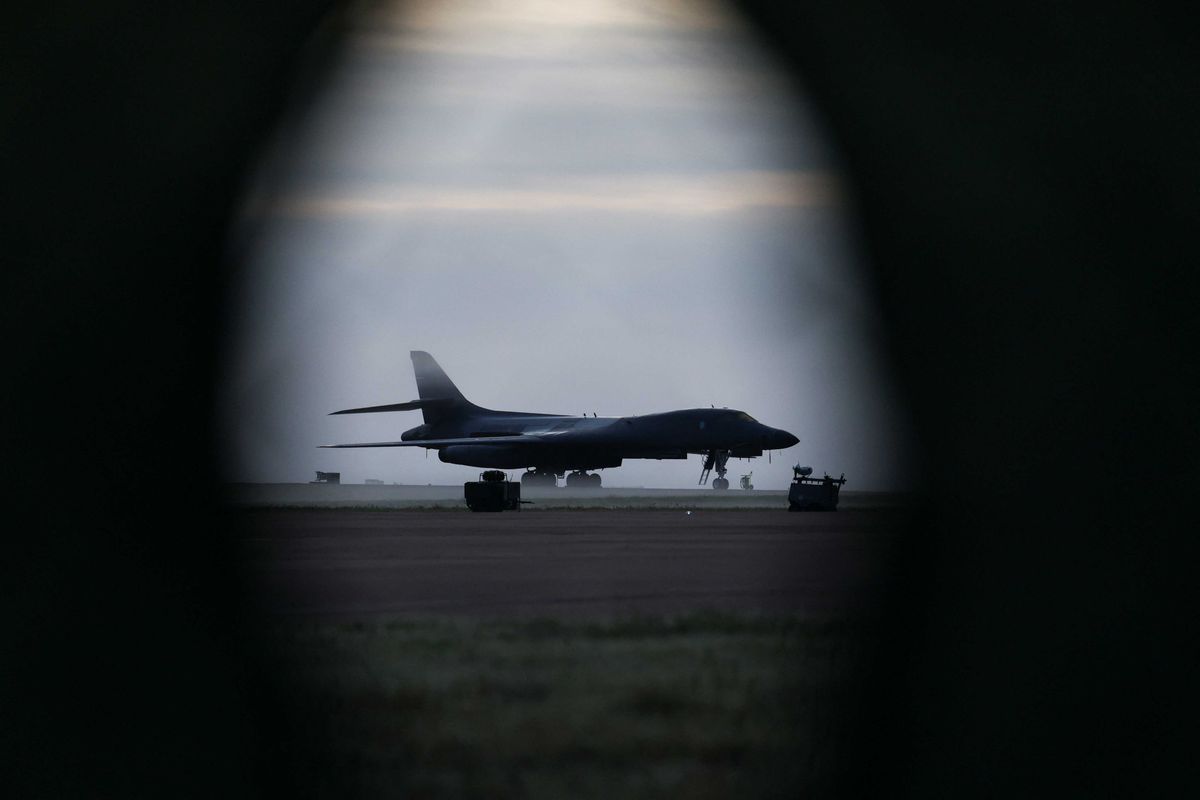
B‑1B Lancer bomber at the RAF Fairford airbase, after police declared a major incident at the base after several men were arrested on suspicion of offences under the Explosives Act, in Fairford, Gloucestershire, Britain, September 28, 2026. REUTERS/Toby Shepheard

In what NBC News described Sunday morning as a “rushed withdrawal,” the Trump administration appears to have ended a U.S.-British military partnership that dates back to 1950 after authorities foiled a suspected terror plot.

Last month, local residents near Royal Air Force Fairford — a British air base used by the United States for more than 75 years — were evacuated after a “major incident” initially believed to involve explosives was declared by local law enforcement. Five men were arrested in connection with the incident and remain under investigation.

On Sunday, the Trump administration confirmed that “all U.S. bombers” deployed to RAF Fairford “have been re-deployed to their home stations in the United States” in what NBC News called a “hasty” process, a development that left countless journalists in shock.


“B1, B2 and B52 bombers will now operate from the USA while airmen and their families have returned home to America,” wrote British journalist Ben Leo in a social media post on X.

“The United States has basically said ‘enough’ in a damning indictment of its military alliance with Britain. This is big.”

In a follow-up post, Leo added, “What’s interesting (and damning) about this is the Americans likely feel the UK can’t guarantee the safety of its aircraft and personnel at a MILITARY BASE.”

Rep. Randy Fine (R-FL), a vocal supporter of President Donald Trump who’s suggested dogs were superior to Muslims, suggested the U.S. withdrawal was due to Britain’s Muslim population, despite Muslims making up around 6% of England and Wales’ population. Fine has frequently referred to Muslim migration as an “invasion.”

“Britain has fallen. The United Islamic Kingdom is no longer a reliable ally of the United States,” Fine wrote in a social media post on X.


Republican unease with Trump spreads to places it was never supposed to reach: report


Travis Gettys
October 5, 2026
RAW STORY


U.S. President Donald Trump dances during a campaign rally for U.S. Senator Darline Graham (R-SC) at the Myrtle Beach Convention Center in Myrtle Beach, South Carolina, U.S., August 21, 2026. REUTERS/Evan Vucci

Republican unease with President Donald Trump has spread beyond swing-district lawmakers fighting for their political lives.

Senators from some of the country's most reliably red states are now openly challenging him on the economy, the Iran war and more, according to a new report from The Washington Sun.

Trump's approval rating keeps sliding, and now the 80-year-old president is preparing to hold rallies in solidly Republican Oklahoma and Alabama in the coming weeks, possibly a sign the White House may be nervous about his own turf.

Sen. John Kennedy (R-LA), whose state Trump carried by 22 points in 2024, said he won't spin voters about rising prices.

"I'm not going to tell the voters, 'Oh, it's President Biden's fault, and it's not that bad, you shouldn't believe your checkbooks,'" Kennedy told reporters. He later told the Sun that "the main reason for the resurgence in inflation is the Iran war."

Sen. Jim Justice (R-WV) represents a state Trump won by more than 40 points and isn't up for re-election until 2031, and he pointed to soaring fuel and grocery costs and said Republicans have fumbled their message on the war.

"We knew that there was a real chance that it would drive gasoline and diesel and fertilizer and all that kind of stuff," Justice said. "We knew that and everything, but we never really dreamed we'd be there this long."

Senate Majority Leader John Thune (R-SD) objected to a series of Trump ads that appear to have been funded by taxpayers, while fellow South Dakotan Sen. Mike Rounds also criticized the TV spots, and he went on to criticize a clawback of nearly $1 billion in congressionally approved funds and Trump's order temporarily expanding foreign beef imports.

Sen. John Curtis (R-UT) asked the Senate Judiciary Committee to look into a Russian oligarch's payment for part of Donald Trump Jr.'s wedding festivities.

"To me, it just stinks. It's corruption. I don't like it," Curtis said in a video.

The GOP and its allies are also spending heavily to hold Senate seats in Alaska, Ohio and Texas – all states Trump won by double digits.

"The trend downwards is very clear," University of Maryland government professor David Karol told the Sun. He said Trump's weakening position makes Republicans "feel more free to separate themselves" from his least popular moves.

Retiring Sen. Thom Tillis (R-NC) cautioned that most Republicans still vote with Trump, but he welcomed the independent streak. He told the Sun that "having that image of independence going into this election is critically important to getting Republicans reelected."
Suspected Trump election interference sparks police raids in Brazil: report

Alexander Willis
October 5, 2026 
RAW STORY


Supporters of Brazilian presidential candidate Flavio Bolsonaro of the Liberal Party (PL) hold an inflatable of U.S. President Donald Trump, as they attend a rally on Independence Day, in Sao Paulo, Brazil September 7, 2026. REUTERS/Alexandre Meneghini


Computer equipment and communications were seized in Brazil’s largest city as part of a new Brazilian investigation announced Sunday into “possible external interference by the United States” in the nation’s presidential election, Agencia EFE reported.

On Sunday, Brazil held its first-round presidential election, which pitted Flávio Bolsonaro — a far-right politician supported by President Donald Trump — against Luiz Inácio Lula da Silva, Brazil’s progressive incumbent president and frequent Trump critic. Bolsonaro “outperformed expectations” Sunday after receiving 47% of the vote to Lula’s 45.1%, forcing the two into a runoff.

Brazil’s Federal Police, however, launched an investigation into whether the United States had unlawfully interfered in Brazil’s election, executing two search and seizure warrants in São Paulo on Friday.

At the heart of the investigation is a report from The Guardian that revealed the Trump administration planned to divert taxpayer dollars to fund groups opposing what it called “judicial overreach and censorship” by Brazil’s judicial system. Brazil’s Federal Police argued the Trump administration’s plan was designed to "destabilize and undermine the institutionality of the Brazilian Judiciary," Agencia EFE reported.

“Brazil's Federal Police is now officially investigating the US intervention in the election,” wrote journalist and analyst Benjamin Norton in response to Agencia EFE’s report. “The Trump admin openly supported far-right US puppet candidate Bolsonaro.”

Fears mounted ahead of Brazil’s first-round presidential election on Sunday after the Trump administration suspended all U.S. consular services in Brazil just two days before the election, a move critics described as “unprecedented.”

Bolsonaro is a lawyer, politician, and son of Trump ally Jair Bolsonaro, Brazil’s former president who’s currently serving a 27-year sentence on charges related to an attempted coup after his election loss in 2022. Trump imposed a 50% tariff on Brazil last year in response to Jair Bolsonaro’s prosecution, which he called a “Witch Hunt that should end IMMEDIATELY.”

“The way that Brazil has treated former President Bolsonaro, a Highly Respected Leader throughout the World during his Term, including by the United States, is an international disgrace,” Trump wrote in a July 2025 letter to Lula. “This Trial should not be taking place.”
CHUCKLES SAY'S ALL IS WELL.

'Wow, that was bad': Trump's top economic advisor ridiculed after faceplanting on CNN

Robert Davis
October 4, 2026 
AW STORY


White House National Economic Adviser Kevin Hassett speaks with reporters about recently released jobs numbers, on the driveway outside of the West Wing at the White House in Washington, D.C., U.S., September 4, 2026. REUTERS/Jonathan Ernst

President Donald Trump's top economic advisor got more than he bargained for in an interview with CNN's Jake Tapper on Sunday

Kevin Hassett, director of the National Economic Council, joined CNN's "State of the Union" on Sunday to try to defend the Trump administration's economic accomplishments. The interview happened about a month out from the 2026 midterm elections, and voters have said the cost of living and the economy are two of their top issues as the election approaches.

Hassett claimed during the interview that Americans seem "optimistic" about their economic future, citing their spending levels. He also made a series of puzzling claims about Trump's failure to lower mortgage rates, as he promised during the 2024 campaign, and the poor job numbers that the administration reported last week.

The interview left political analysts and critics floored, many of whom shared their reactions on social media.

"Wow, that was bad. He had zero answers. About the economy. And the midterms are in 29 days," Rose Benson, a comic and critic of the Trump administration, posted on X.

"So, Kevin Hassett is the kind of guy who would pretend he didn’t walk in on his wife getting plowed by his best friend for the rest of his life. That much I know," Dean Blundell, a Canadian radio personality, posted on X.

Steven M. Durlauf, a professor at the Stone Center for Research on Wealth Inequality and Mobility, posted a quote from Thomas Wolfe's "You Can't Go Home Again" on X about the corrosive consequences of growing wealth on American society.

"Suddenly we realize that America has turned into something ugly--and vicious--and corroded at the heart of its power with easy wealth and graft and special privilege...And the worst of it is the intellectual dishonesty which all this corruption has bred," Durlauf posted.


Nurse Educators Shape The Future Of Surgical Care


On World Teachers’ Day, Mercy Ships celebrates a Ghanaian lecturer and volunteer Valerie Source: Mercy Ships

October 5, 2026

By Eurasia Review


Key Takeaways:


Ghanaian lecturer Valerie, formerly an operating-room nurse, trains peri-operative staff in Accra and at the Medical Simulation Skills Institute, and volunteered on Mercy Ships’ Africa Mercy in Madagascar and Global Mercy in Sierra Leone.

The piece ties her work to World Teachers’ Day on Oct. 5 and the 60th anniversary of the UNESCO/ILO Recommendation on the Status of Teachers, as the Global Mercy starts a 10-month Ghana mission with free specialized surgery and support for the national surgical plan.

Training with the Ghana colleges of physicians and surgeons and of nurses and midwives includes ship placements; student Gabriel is cited as planning to become a nurse educator after clinical work.


After nearly a decade working as a nurse, Valerie moved from the operating room to the classroom. Now a lecturer at the School of Peri-operative and Critical Care Nursing in Accra, Ghana, she draws on her clinical experience to prepare other Ghanaian healthcare professionals to care for surgical patients.

Valerie also facilitates training through the Medical Simulation Skills Institute in Accra. In her curriculum, she uses illustrations and practical scenarios to help students understand and adapt to whatever happens in the operating room.

“I won’t have this energy and strength all the days of my life, so I need to impact others,” Valerie said. “Surgery is already a stressful experience, and we need to have people ready to facilitate that experience so that, even though it’s difficult for patients and their families, we alleviate this burden by offering them the best care they deserve.”


Valerie has continued to seek opportunities to learn alongside her teaching. During an academic leave, she returned to the operating room as a Mercy Ships volunteer on board the Africa Mercy® in Madagascar and later served twice on board the Global Mercy™ in Sierra Leone.

On board the floating hospitals, she observed how teams coordinated patient care before, during, and after surgery.

Valerie planned to share this knowledge with her students in Ghana.

Investing Educators Behind Safe Surgery

Observed annually on 5 October, World Teachers’ Day recognizes educators and their role in shaping society. This year also marks the 60th anniversary of the adoption of the UNESCO/International Labour Organization Recommendation concerning the Status of Teachers, a standard-setting instrument that establishes guidelines for initial training, continuing professional development and classroom teaching-learning conditions.

Healthcare educators such as Valerie help develop the skilled workforce needed to provide safe surgery. Their influence extends beyond individual students to patients, families, and healthcare systems.

Valerie’s story comes as the Global Mercy begins a 10-month field service mission in Ghana . Working in partnership with the Ghanaian government, Mercy Ships is providing free specialized surgery and helping to support the country’s National Surgical, Obstetric, and Anesthesia Plan (NSOAP).

Education, mentoring, and workforce development are all part of the field service in Ghana. Mercy Ships is working with the Ghana College of Physicians and Surgeons and the Ghana College of Nurses and Midwives to support postgraduate training through placements aboard the ship. These education and training programs are being developed to strengthen healthcare professionals’ skills and support Ghana’s surgical priorities.

One Teacher, Many Lives Impacted

Among the students influenced by Valerie is Gabriel, who was completing his Bachelor of Science degree in Accra. Gabriel described her as one of his favorite lecturers, and praising her clear and thorough teaching.

Her influence has deeply shaped his ambitions. Gabriel hopes that, after gaining sufficient clinical experience, he can become a nurse educator himself.

Gabriel will care for many patients throughout his career. If he becomes an educator, he will prepare others to do the same, just as Valerie did for him.

“You are helping save a life because you train those who are going to work,” he said.
The Illusion Of Hard Power: Reflection On How Democratized Technology And Strategic Geography Broke The Superpower Monopoly On War


A former infantry officer argues that Vietnam, Iraq, and African interventions show firepower does not buy compliance when a population treats the fight as existential, and that external backing or neglect left long instability from Congo and Somalia to Libya and the Sahel.

The 2026 Iran war and Ukraine are presented as a cost inversion: cheap mass drones and missiles force million-dollar interceptors, and Hormuz pressure moved the contest into shipping, insurance, and energy; Ukraine’s sea drones against the Black Sea Fleet are cited as the same pattern.

The conclusion is that total destruction is politically and strategically unavailable, so China’s caution on Taiwan and future stability depend on defensive sustainability and compromise rather than regime change—an argument, not a demonstrated law.


Written from the unique perspective of a former infantry officer of the late sixties, this paper examines the paradigm shift in 21st-century geopolitics, in which conventional military dominance no longer guarantees political control. Tracing an evolutionary line from the ideological endurance of Vietnam to the urban insurgencies of Iraq, the paper argues that contemporary conflicts involving Iran and Ukraine mark a watershed in modern warfare. By pairing fierce nationalist resolve with cheap, mass-produced asymmetric technology, weaker states have triggered a severe industrial-economic inversion, bankrupting expensive Western defensive systems through supply-chain attrition. Crucially, the paper highlights how Iran successfully weaponized its strategic geography—specifically the Strait of Hormuz—shifting the center of military gravity into global shipping, insurance, and energy networks and holding global markets hostage. Confronted with the reality that victory against an existential defense would require total destruction, superpowers such as the United States, Russia, and an island-facing China are hitting a structural wall. The paper concludes that absolute military coercion is obsolete; future global stability depends on balancing defensive sustainability with soft power, diplomatic tolerance, and mutual compromise.

The Illusion of Hard Power

In 1967, I was a young officer training at the Advanced Infantry School at Fort Benning, Georgia, alongside American officers. The ghost of the Vietnam War hung heavy over every field exercise, tactical briefing, and grueling march we endured. We were trained by men who had just returned from those jungles, and the lesson they drilled into us had nothing to do with a lack of American firepower. Instead, they forced us to confront the limits of willpower. We learned the hard way that you cannot militarily break an indigenous population when they are fighting for their own dirt. Fifty years have passed since my time in uniform, and as I get older, I watch the news and realize that our strategic leaders are still trapped in the same fallacy. We continue to assume that an overwhelming accumulation of military might can force a weaker nation to surrender its independence and existence. History has shattered that illusion across my lifetime, from Southeast Asia to the deserts of Iraq, and now to the tech-driven battlefields of Ukraine, the proxy conflicts of Africa, and the waters of the Persian Gulf. The basic reality of modern conflict is that military dominance no longer equals political control. When a nation views a conflict as existential, hard power can only achieve two things: death and destruction. It cannot buy compliance. Today, because the means of resistance have been cheapened and widely democratized, the pursuit of absolute control is a path toward mutual ruin. True strength for the future lies not in our capacity to destroy, but in our willingness to tolerate, compromise, and engage the world through mutual respect.

To understand why US military dominance is broken, we must look closely at how resistance has changed since my time. In the 1960s and 70s, US conventional doctrine was pushed to its limits. The United States dropped millions of tons of ordnance on Vietnam yet failed to achieve its political objectives. The failure was not a lack of tactical skill on the ground; it was a fundamental strategic failure to recognize that a population defending its homeland measures victory purely by its willingness to keep dying. Against deeply rooted nationalism, conventional bombing campaigns could not break the enemy’s resolve. As my generation learned through immense trauma, a democracy simply cannot sustain a war of indefinite casualties for non-existential goals. Decades later, I watched the next generation of American soldiers march into Iraq. While the initial conventional phase of that war was won in a matter of weeks through “Shock and Awe,” the secondary phase of controlling and governing the country was completely lost. Our political leaders were blindsided by the raw willpower of a population that flatly rejected a foreign occupation. The battlefield quickly evolved into a decentralized, borderless insurgency fueled by improvised explosive devices and urban terror. Iraq demonstrated what any seasoned infantryman fears in his bones: demolishing a state’s conventional armor and infantry is the easy part. Holding and controlling a hostile nation is politically, morally, and economically unsustainable. The sheer friction of trying to enforce compliance against an unwilling population eventually drains a superpower’s resources and erodes its domestic political capital.


Yet this failure to understand the limits of hard power is not confined to the Middle East or Southeast Asia. When evaluated against my twenty-eight years as a UN peacemaking consultant across Africa’s most volatile war zones, the limits of conventional military coercion become even more starkly apparent. In all the wars I have witnessed on the African continent, there was always a degree of heavy-handed, unbalanced, or indifferent Western and global involvement that excluded local populations and created a legacy of perpetual instability. Cold War logic led to American support for the dictator Mobutu Sese Seko in the Democratic Republic of Congo. For Washington, this was a low-cost transactional alignment; for the DRC, it left behind a legacy of systemic fracture and a perpetual war that refuses to heal. Similarly, American indifference during the Rwandan genocide left a scar on America’s declared role as an advocate for genocide and crimes against humanity, and its unwise, heavy-handed intervention followed by a disgraceful exit in Somalia fundamentally altered the regional landscape, leaving Somalia trapped in a cycle of warlordism from which it cannot recover. In Libya, a relatively low-cost NATO aerial intervention to overthrow Gaddafi resulted in a fractured state that became a breeding ground for human trafficking, weapon proliferation, and militia warfare that spilled across the Sahel. Historical alignments like the American-supported Charles Taylor created havoc and civil war across both Liberia and Sierra Leone, proving that short-sighted external backing yields catastrophic regional consequences on the back end.


Today, this cycle continues as global superpowers and regional actors treat the continent as a theater for cheap geopolitical disruption. In Central and West Africa, Russia uses its mercenary arm, formerly Wagner and now Africa Corps, as a low-cost tool to loot mineral resources and displace Western influence. Meanwhile, in the Horn of Africa, the absence of a clear, balanced US policy has allowed its allies, the UAE and Saudi Arabia, to wage destructive proxy wars to secure their strategic and mineral interests. This echoes the historic “Françafrique” policies of control in West and Central Africa, where foreign dictation systematically excludes local people from the economic value chain. When war is supported, sponsored, or neglected by global powers, it becomes a negative-sum game where everyone loses. Because of these heavy-handed or neglectful policies, Africa’s true potential is suppressed, making it impossible to establish equitable, win-win trade or security architectures. Instead of being a robust global partner, these destabilized regions are forced into a state where they become involuntary exporters of instability through migration crises, piracy, and transnational terrorism. The West is then forced to spend trillions on reactive border security and counter-terrorism operations—a massive, unsustainable defense expenditure triggered by the long-tail consequences of original policy failures. Africa is left unable to heal itself, the West remains trapped in a cycle of reactive containment, and the global rules-based order faces an asymmetric threat to peace that cannot be solved by expensive weapons alone.


This structural failure of global foreign policy mirrors the tactical crisis we see on the modern battlefield, driven by the brutal mathematics of the Cost-Imbalance Doctrine. Modern warfare is no longer dictated by platform sophistication but by logistics, replacement speed, and lopsided economic exchange ratios. The collapse in the cost of commercial electronics, additive manufacturing, and open-source autonomous systems has shattered the traditional cost curve, tilting the strategic advantage sharply toward mass-produced, low-cost offense. The 2026 war involving Iran represents the ultimate, terrifying evolution of this trajectory, presenting a style of warfare that my peers in the seventies could scarcely have imagined. If Vietnam required dense jungles and Iraq required complex urban networks, modern asymmetric warfare requires only three things: basic, a determined population, universally manufacturable technology, and the strategic weaponization of geography. Iran effectively rewrote the global rules of engagement by manufacturing mass-produced, low-cost weapons—primarily twenty-thousand-dollar kamikaze drones and standard ballistic missiles. This has created a catastrophic economic and industrial imbalance for Western forces. Today, advanced militaries are forced to defend multi-billion-dollar assets like aircraft carriers by firing two-million-dollar air-defense interceptors at targets that cost less than a used car. When a five-hundred-dollar FPV drone or a thirty-thousand-dollar Shahed loitering munition forces a defender to fire a multi-million-dollar Patriot, THAAD, or SM-3 interceptor, the exchange ratio becomes unsustainable. This is no longer a war of tactical maneuver; it is a war of supply chain attrition, and the mathematics favor the cheap.


Furthermore, Iran’s true stroke of strategic genius was recognizing that its geographic position is a more powerful weapon than any nuclear arsenal. By sitting directly astride the Strait of Hormuz—the narrow maritime bottleneck through which twenty percent of the world’s petroleum flows—Iran shifted the center of military gravity entirely out of the mud and into global financial markets. By deploying its low-cost sea-denial arsenal to menace commercial shipping, it effectively nationalized a global commons. This strategy weaponized marine insurance networks, sent global energy prices soaring, and proved that controlling a geographic bottleneck allows a weaker state to hold the entire global economic system hostage. This is why Iran marks a watershed moment: it demonstrated that geography, activated by cheap tech, can completely bypass a superpower’s military superiority to strike directly at its domestic and economic vulnerabilities. We see proof that this shift is a universal law, not an American exception, in the stagnation of the Russian war machine in Ukraine. When Russia launched its full-scale invasion, conventional military wisdom predicted a rapid collapse of the Ukrainian state within days. Instead, the world witnessed the brutal stagnation of a traditional military giant. Ukraine countered massive armored columns and superior air power by leveraging the same formula: boundless national will paired with asymmetric technology. Armed with relatively inexpensive, mass-produced anti-tank missiles, first-person-view kamikaze drones, and decentralized digital command networks, Ukraine transformed the battlefield into a meat grinder for conventional assets. Ukraine’s ability to completely neutralize Russia’s Black Sea Fleet—not with a rival navy, but with low-cost, domestically manufactured explosive sea drones—perfectly mirrors how the vulnerability of multi-billion-dollar warships has been exposed globally.


This new reality explains the profound caution we see in East Asia regarding the Taiwan Strait. Objectively, China possesses the overwhelming conventional means—the world’s largest navy, advanced missile arsenals, and proximity—to launch an invasion of Taiwan. Yet Beijing hesitates. This caution stems from a clear-eyed analysis of these new rules of engagement. The Chinese leadership understands that invading Taiwan would mean wading directly into an asymmetric trap. Taiwan has spent decades preparing a “porcupine strategy” centered on cost-imbalance warfare. Crossing a hundred miles of open sea leaves Chinese transport ships highly vulnerable to swarms of low-cost, domestically produced anti-ship missiles and autonomous sea drones. Even if Chinese forces landed successfully, controlling a highly urbanized island of twenty-three million people against a deeply nationalist insurgency would mirror our catastrophic occupation failures in Iraq, multiplied tenfold, while inflicting an estimated two-and-a-half-trillion-dollar hit on the global economy. China’s hesitation proves the thesis: they recognize that while they have the hard power to cause immense death and destruction, they cannot guarantee surrender or control.

When a superpower faces a determined populace armed with universally manufacturable denial weapons and backed by strategic geography, it hits a wall. Because economic sanctions and localized strikes fail to break a deeply nationalist population, a superpower is left with only one military option to force an unconditional win: total destruction. Forcing a sovereign nation to abandon its existential interest today would require sustained, uninhibited bombardment or the use of nuclear weapons. However, as any strategist knows, this is a dead end. If the resisting nation or its allies possess even primitive nuclear or chemical deterrents, any escalation toward total destruction guarantees mutually assured destruction(MAD). Furthermore, neither the domestic population of a democracy nor the international community will tolerate the absolute annihilation of a country. Because total destruction is morally, politically, and strategically impossible, unconditional surrender is a relic of the past. Hard power has reached its absolute limit. If the accumulation of military might can no longer buy security or compliance, the global architecture must undergo a pragmatic revolution. This is not an appeal to utopian idealism; it is hardheaded realism from someone who has spent a lifetime reflecting on the cost of war. When conflict becomes too expensive for the strong and resistance too cheap for the weak, coexistence is the only affordable strategy left on the table.

Conclusion

True national security must be built on a balanced matrix of defensive sustainability and soft power. Superpowers must pivot away from a doctrine of regime change, containment, and forced compliance and toward policies of tolerance, compromise, and mutual respect. If a powerful nation needs resources, stable trade routes, or geopolitical cooperation, it can no longer acquire them bythe barrel of a gun or the threat of a carrier strike group. It must acquire them through diplomatic reciprocity. By recognizing the sovereignty and existential interests of smaller nations, superpowers can foster partnerships built on mutual benefit rather than perpetual, exhausting hostility. The lessons of my lifetime are clear. The world will never know peace, and superpowers will never achieve stability, until they accept that hard power is a blunt instrument capable only of wreckage. True strength lies in the capacity to compromise, to tolerate difference, and to engage the world through the sustainable lens of mutual respect.

Bibliography

Angell, Norman. The Great Illusion: A Study of the Relation of Military Power to National Advantage.London: William Heinemann, 1910.

Batmanghelidj, Esfandyar. “Drones Like Bicycles: The Real Economics of the Shahed Fleet.” Phenomenal World, March 11, 2026. Phenomenal World.

Boyle, Michael J., and Anthony H. Cordesman. Regime Change Revisited: The Intersecting Failures of Post-Conflict Governance and Hard Power. Washington, D.C.: Center for Strategic and International Studies, 2016.

Brown, Seyom. The Illusion of Control: Force and Foreign Policy in the Twenty-First Century. Washington, D.C.: Brookings Institution Press, 2003.

Brookings Institution.
Center for Strategic and International Studies. Assessing the Air Campaign After Three Weeks: Iran War By the Numbers. CSIS Missile Defense Project Report, March 25, 2026.

Cordesman, Anthony H. The Lessons of Ukraine and the Changing Nature of Asymmetric Attrition.Washington, D.C.: Center for Strategic and International Studies, 2024.

Fard, Erfan. “Iran Didn’t Need to Win the War. It Needed to Outlast It: AI Targeting and Strategic Geography in t
he 2026 Conflict.” Small Wars Journal, July 8, 2026. Small Wars Journal.

Malahila, Letsema. “The Contradictory Logics of International Intervention in Africa: Structural Fragility from Mobutu to Françafrique.” GIGA Focus Africa, no. 4 (2022): 1–9. GIGA Hamburg.

O’Hanlon, Michael E. The Porcupine Strategy: Asymmetric Sea Denial and Taiwan’s Defense Dilemma.Brookings Institution Policy Brief, 2025.

United Nations Department of Peace Operations. The Intervention Dilemma: 28 Years of Multilateral Peacekeeping and Political Vacuums in War-Torn States. New York: United Nations Blue Book Series, 2024.

Zenodo Research Repository. Iran’s New Grand Strategy, the Strait of Hormuz, and the Search for a Regional Security Order. Open-Access Strategy Paper, Archive ID 21707611, July 2026. Zenodo Records.


About Dawit W. Giorgis
Dawit W. Giorgis is originally from Ethiopia, US citizen, permanent resident of Namibia; served as P.S of Ministry of Foreign Affairs, Governor of Eritrea (prior to independence) and Relief and Rehabilitation Commissioner during one of the most publicised famine relief operations. He later served as UN consultant in 11 African conflict and post conflict countries; was a visiting fellow at Princeton University, University of Cape Town and Foundation for Defense of Democracies in Wash, D.C. at different times.
View all posts by Dawit W. Giorgis →
From Prototypes To Mass Production: DARPA’s Gamble On Next-Gen Hypersonics – OpEd


Illustration of a hypersonic Next Heneration Glide Body (NXGB). Credit: Lockheed Martin


The piece says DARPA’s Aug. 7 request for information on a Next Generation Hypersonic Cruise Missile seeks industry views before any funded program, after HAWC proved scramjet flight but only incremental gains and HACM cut tests from seven to five.

It dates China’s DF-17 as operational around 2019–20 and cites a September 2025 YJ-19 scramjet anti-ship missile, against the U.S. Army Dark Eagle reaching initial capability in April 2026 and appearing at Valiant Shield with a stated range of about 2,175 miles.

The author’s test is production, not physics: design-for-manufacture and non-traditional contractors, or another HACM-style delay that widens a gap the U.S. has not led.
Introduction


Hypersonic missiles do something that conventional cruise and ballistic missiles cannot do; they combine speed (more than Mach 5) with sustained maneuverability mid-flight. This denies the adversary’s air defenses, which seek predictable flight patterns, the ability to intercept the incoming projectile. This combination of speed and maneuverability is the reason why the Pentagon views hypersonic weapons as a potential answer to overcome the increasingly capable air defense networks China and Russia have built along their borders. Whichever state holds a survivable and affordable hypersonic missile can hit time-sensitive targets in heavily defended airspace. The outcome of the hypersonic race, however, will be decided by execution: whether the Defense Advanced Research Projects Agency (DARPA) can convert its Next Generation Hypersonic Cruise Missile program from a Request for Information (RFI) into a fielded system faster than its peers can extend their current lead.

On 7 August, DARPA posted a request for information seeking industry feedback on the new Next Generation Hypersonic Cruise Missile (NGHCM). DARPA is not seeking a missile just yet; it is seeking information from industry professionals on what is possible before deciding whether an actual program is feasible. What is evident is that DARPA is not seeking small upgrades. It already mentions that the basic technology works but delivered small and predictable results, but not the kind that would be a breakthrough in future wars. According to the same RFI, states like China and Russia are fielding improved air defense systems, and in the future U.S. missiles may not be effective enough to punch through anymore. The U.S. is already behind when it comes to hypersonic systems; the U.S.’s Dark Eagle reached Initial Operational Capability (IOC) for the first time in April 2026. Compare that with China, whose DF-17 has been operational since around 2019-2020, and the U.S. capability gap is evident.

Evolutionary, Not Disruptive

DARPA’s admission of failure is that in more than a decade of testing hypersonic technology, there have been marginal gains, which is not enough to win the next-generation war. The RFI itself admits that the scale of the problem is definite; it says that prior scramjet demonstrations “successfully proved the fundamental viability of scramjet-powered flight,” but those programs “achieved predictable and incremental gains in isolated performance metrics” rather than a “revolutionary leap” in range, cruise speed or altitude. The admission is notable for an agency to put in a public procurement document that a decade-long effort of hypersonic testing could not achieve results that could have helped the U.S. with future warfighting. China is now moving past the first generation of hypersonic technologies, hypersonic glide technologies, to the next generation of hypersonic missiles: air-breathing scramjet engines. In September 2025, China unveiled the YJ-19, an advanced scramjet-powered hypersonic anti-ship cruise missile capable of reaching hypersonic speeds. The missile is small enough to fit in standard submarine torpedo tubes.

Hypersonic Air-Breathing Weapon Concept (HAWC) Legacy


HAWC, a joint DARPA/Air Force program, demonstrated that the hypersonic air-breathing system is effective. However, the U.S. is still unable to draw anything concrete out of this program. Its successor, the Hypersonic Attack Cruise Missile (HACM), has faced design delays, testing delays, and a reduction from seven tests to five to save money.

DARPA’s RFI for NGHCM is a tacit admission that HACM and HAWC were built and invested in to prove that missiles could fly, not that these missiles could be mass-produced. As DARPA plainly states, it expects a “design for manufacturing and assembly” (DEMA) philosophy to be embraced from the onset, and this time with a realistic path to affordable and high-rate production. China, on the other hand, appears to have prioritized fielding and mass-producing first-generation hypersonic systems over waiting for a technically optimal one, which the U.S. now seeks. This claim is corroborated by independent assessments of China’s faster testing and fielding pace.

This supports the above proposition that although the system works, it may not be able to give any meaningful advantage to the U.S. during the war. Another point to note is that DARPA seeks systems that can be produced cheaply in large numbers; the document notes that older manufacturing methods are making the missile too expensive and too complicated to produce. DARPA’s concern is valid that, in case of conflict, if the missiles are too complicated 
and expensive to produce, the U.S. wouldn’t be able to mass-produce them.


The Frontrunners?

The U.S. actually has a deeper technical pedigree, with testing of hypersonic systems starting back in the 1950s–60s, with Pershing-II reaching hypersonic speeds (Mach 8); however, it was classified as a maneuvering reentry vehicle (MaRV) rather than a modern hypersonic missile, as it had limited maneuverability in the terminal phase. It used active radar terminal guidance for pinpoint accuracy rather than sustained aerodynamic cruising or gliding. Nevertheless, the U.S. has a much older hypersonic missile program compared to China, whose dedicated hypersonic program started in the 2000s, and the DF-17 was unveiled in 2019.

China, however, moved much faster than the U.S. in testing and operationalizing the hypersonic missile program and is considered ahead in the hypersonic race. China has deployed its DF-17 across multiple People’s Liberation Army (PLA) rocket force brigades with Pacific-focused density while the U.S. has just reached its initial operational capability. Chinese missiles are now reportedly expanding into multiple generations of hypersonic weapons across land, sea, and potentially air. At the same time, the U.S. program faced multiple delays, technical challenges, and cost growth, with the U.S. still seeking a quantum leap in hypersonic technology. China accepted early, less sophisticated hypersonic systems into service rather than waiting for more advanced designs, giving its rocket force years of operational experience and production infrastructure before the U.S. had either.

Is the U.S. Catching Up?


As of mid-2026, the U.S. finally deployed the hypersonic missile “Dark Eagle,” with the U.S. Army in the Valiant Shield 2026 exercise in the Western Pacific, which could potentially hit targets around 2,175 miles away. The U.S. is narrowing the gap, but whether it closes it fully remains an open question, since technology-wise the U.S. is still a few years behind. DARPA’s request for industry feedback also supports the proposition that the U.S. has yet to find what it is looking for, but that does not imply that the U.S. is still at the baseline and may need to start from scratch. The U.S. understands the technology; it just seeks the correct tools to implement it effectively.

This, however, is just phase 0: the RFI does not commit any funding to a contractor. Rather, it is gathering information from industry to shape a future program’s technical requirements before any formal solicitation is issued. The U.S. is yet to find a good enough recipe to make a missile that will be a “quantum leap” in overall performance.

Conclusion

Whether the gap narrows depends upon the execution of DARPA rather than physics. Within the document, DARPA is explicitly courting non-traditional contractors to inject the kind of speed which the traditional defense-industrial base has not delivered. If NGHCM moves from phase 0 to a real program on schedule, the U.S. could produce a next-generation hypersonic cruise missile for testing within a few years. If this program also faces delays as HACM did, the U.S. will lag further behind in a race it has yet to lead.


About Shamil Abdullah Saleh
Shamil Abdullah Saleh is a Research Assistant at Strategic Vision Institute (SVI), Islamabad.
View all posts by Shamil Abdullah Saleh →