Monday, October 19, 2026


The Nuclear Power Shortcut That Could Add Gigawatts to the U.S. Grid

  • U.S. nuclear operators could add gigawatts of power by upgrading existing reactors instead of building new facilities.

  • Google, Amazon, and other tech companies are supporting major nuclear uprate projects to meet growing AI electricity demand.

  • Nuclear uprates could deliver additional reliable electricity years before new reactors can be constructed.

The process of increasing the maximum power level at which a commercial nuclear power plant may operate is called a power uprate. Several nuclear plants are now considering applying for permission to uprate operations to produce more power in the mid-term to bridge the gap while more nuclear capacity is being developed.

The United States Nuclear Regulatory Commission (NRC) regulates the maximum power level at which a commercial nuclear power plant may operate. The permitted power level is stated in the license and technical specifications for the plant and cannot be altered unless approved by the NRC. U.S. nuclear plants can request permission from the NRC to increase their power output, or “uprate”.

The NRC will determine whether to grant a plant uprate permission depending on whether it can be achieved safely. To increase power output, nuclear operators must modify the nuclear reactor’s instrumentation, controls, and power-generation systems. Over the past two decades, the NRC has approved uprates that have provided an extra 6 GW of power to the U.S. electricity grid, which is equivalent to six large reactors. The agency is considering uprate requests from various operators that massively boost the country’s nuclear power capacity.

To safely uprate operations, plant operators must upgrade components such as controls, turbines, and pumps within their nuclear facilities to generate more electricity. While these upgrades can cost billions of dollars to implement, they can allow operators to produce more power much more quickly than it takes to build a new facility. Many upgrades can be completed in five years or less. Analysts estimated that increasing electricity output from existing nuclear plants could add a massive 6-8 GW of clean power to the grid.

In October, the largest nuclear power plant operator in the United States, Constellation Energy, announced plans to invest over $4.3 billion to refurbish 11 reactors at six plants in Illinois, Pennsylvania, and New Jersey, enabling them to produce more power. The investment is expected to help Constellation add 890 MW of power to the grid, enough to supply 700,000 homes. Google has agreed to buy electricity from those plants at an undisclosed price.

This is just one of several projects that are expected to support the massive increase in U.S. power demand driven by the rapid rollout of new artificial intelligence (AI) data centres. Also this month, the U.S. Department of Energy (DoE) announced it would conditionally loan the energy company Vistra $4.2 billion to uprate three nuclear plants in Pennsylvania and Ohio, adding another 430 MW of capacity. Amazon also completed an agreement to uprate Constellation’s Calvert Cliffs Nuclear Power Plant in Maryland, while Google announced plans to increase power production from four reactors in Georgia.

The Trump administration, which has announced plans to quadruple the U.S. nuclear power capacity by 2050, is highly supportive of these new projects. Energy Secretary Chris Wright said in a statement, “By getting more power out of the nuclear plants we already have, we can deliver more affordable, reliable, around-the-clock energy.”

Several nuclear plant operators have struggled to secure the funds to upgrade their plants as U.S. power demand plateaued in the 2000s and public perception of nuclear power was poor. However, the rising demand for power driven by data centres and the improved public perception of nuclear power has encouraged tech companies to invest heavily in a wide range of energy projects, from nuclear power to gas plants and renewable sources. Several tech companies are now willing to pump vast amounts of capital into uprating projects to rapidly increase their access to the clean power needed to run massive data centres.

The NRC expects a total of 31 power uprate applications totalling 7.3 GW thermal and 2.4 GW electric between 2026 and 2032. The organisation is expected to approve several of these projects, as many of the operators requesting uprate permissions have decades of experience in nuclear power development in the United States, making them well-versed in managing safety concerns.

Some operators are wary of conducting uprate work because the necessary upgrades would require them to stop producing power for several months. However, as tech companies demonstrate their willingness to invest heavily in nuclear energy projects, more companies may be convinced in the coming years. 

Uprating operations is unlikely to detract from plans to develop new nuclear plants in the United States, given the projected rise in power demand over the coming decades. However, it could provide an alternative way to rapidly expand the country’s nuclear power capacity to fill the gap while new facilities are being designed, licensed, and constructed.

By Felicity Bradstock for Oilprice.com


Record Shipping Costs Force Oil Producers to Slash Prices

  • Soaring freight is forcing oil producers into discounts, pushing delivered prices towards $140/bbl in China and prompting producers to absorb more transport costs to secure buyers.

  • India is attracting more Brazilian and West African barrels as shorter voyages improve sellers’ returns, while Chinese refiners hold out for cheaper deliveries.

  • War-risk premiums and mounting delays are strengthening demand for crude that avoids the Middle East’s troubled shipping routes.

Freight is reshaping global oil trade and the prices producers can command for their crude. Soaring shipping costs are pushing delivered prices beyond what refiners are willing to pay, forcing sellers to cut differentials or find buyers closer to home. With Chinese refiners inclined to wait for transport costs to ease, some producers are committing barrels for future loading at prices that leave little room for today’s freight bill. Their returns increasingly depend on shipping becoming cheaper before those cargoes sail.

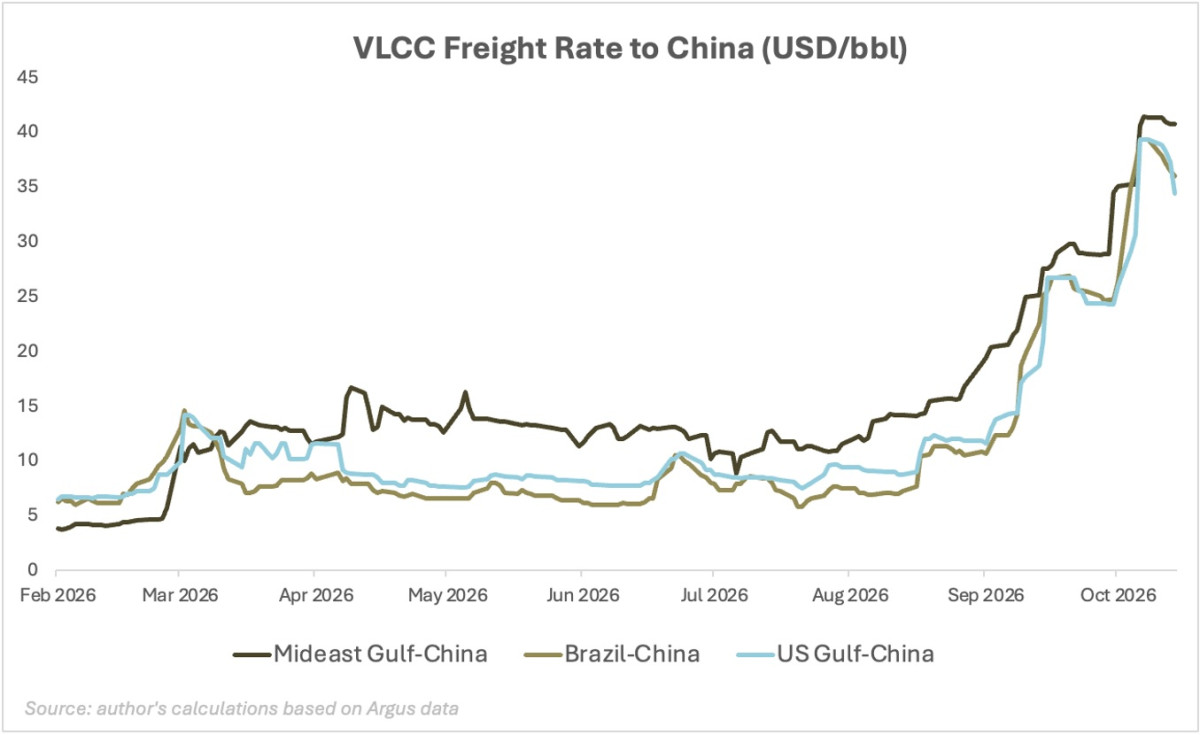
The pressure is most pronounced in the Middle East, where crude freight has surged in two waves since the war began in March. VLCC rates from the Gulf to China initially jumped from around $4/bbl to $17/bbl, before easing to $11–12/bbl through April–July. The expiry of the US-Iran ceasefire in August triggered another steep increase, taking freight to $33/bbl by late September and pushing current landed costs from the Middle Eastern Gulf to around $140/bbl in China. For Japan and South Korean freight, lifted landed costs were even higher, to around $145/bbl.

Alternative loading points have offered uneven relief. Freight from Saudi Arabia’s Yanbu terminal to China trended within the $6–7/bbl bandwidth after the initial wartime spike, but Houthi restrictions on Saudi cargoes through Bab el-Mandeb drove it to $28/bbl by mid-October, bringing landed costs to around$140/bbl. Saudi loadings at Yanbu have since slowed down to 1.6-1.8 million b/d (half the March-July average) following intensified Houthi attacks on energy infrastructure along the Red Sea coast, with the Gulf handling the bulk of exports.

That has put Aramco under intense pressure to absorb part of the cost of moving barrels through Hormuz. The November OSP for Saudi Aramco’s flagship Arab Light grade has been set at a $5/bbl discount to Oman/Dubai, helping at least partially offset the $10–15/bbl cost of shipping them outside the strait. However, very few Asian refiners feel inclined to charter their own vessels and send them to the Gulf to load. From Sohar, where most of Saudi Aramco’s STS transactions take place, Saudi barrels are being sold on a spot basis rather than through official selling prices, at reported Dubai plus $5/bbl. Yet onward freight still pushes their landed cost in China above $130/bbl, exceeding what Chinese refiners are willing to pay.

However, Saudi sellers still need to move oil, while Chinese refiners have an incentive to wait till the shipping costs decrease. So, Aramco’s strategy is to fix a differential now for loading roughly two months later, this way securing a buyer, but leaving the eventual netback exposed to freight. Persistently high rates could limit or even erase the seller’s margin, potentially leaving a netback that’s below its nominal OSP price. That said, in case shipping costs decrease in future, the same differential could make the deal attractive in the end.

The use of tankers owned by Saudi Arabia’s national shipping company Bahri (in which Aramco holds a 20% stake) illustrates how producers can cushion that exposure by retaining part of the shipping income within an affiliated business. Freight still needs to be charged at market rates, but some of the pressure on crude sales at least can be offset by shipping earnings.

By September, the freight surge had spread beyond the Middle East. Brazil-China VLCC freight reached around $36/bbl by mid-October, taking landed Tupi prices to roughly $140/bbl, even FOB netbacks for Petrobras and other Brazilian producers continue to indicate single-digit discounts to ICE Brent. With Chinese buyers seeking delivered prices closer to $130/bbl, Brazilian offers into China have notably slowed down in recent weeks, making India a more attractive destination for Brazilian sellers.

West African producers face the same pressure. Djeno is trading at a FOB discount of around $10/bbl to ICE Brent, but VLCC freight from West Africa to China costs roughly $34/bbl – $9/bbl more than shipping to India. That advantage is redirecting cargoes historically dedicated to Chinese buyers towards Indian refiners. Even now, the change of patterns is visible in current loadings: India’s imports from Angola are estimated to rise from 35,000 b/d in September to 315,000 b/d in October, with additional cargoes from Gabon and Congo also on their way to India’s West Coast.

These shifts show why deeper crude discounts no longer guarantee competitive delivered prices. Producers that price against Dated Brent, which reflects the North Sea’s (extremely tight) physical crude market, are cutting FOB differentials to accommodate higher shipping costs; however, the same grades appear to have double-digit premia when compared against other benchmarks. Russia’s deliveries of Urals to India have been generally linked to Dated Brent – as Dated is now almost $20 per barrel above ICE Brent, Russian suppliers need to reflect these changing pricing dynamics. Thus, Urals was assessed at a +$8/bbl premium to Dated a month ago; by now, it is essentially trading Dated flat, with further downside looming down the road.

However, freight comparisons alone do not capture the full expense of buying crude in today’s wildly disrupted markets. Loading reliability has become another factor in Asian purchasing decisions. STS transfers outside Hormuz are routinely delayed, particularly in recent days as Iranian drone strikes have intensified to unprecedented levels. Demurrage rates for cargoes moving out of the Gulf have soared to $1 million/day, equivalent to about $0.50/bbl for a fully laden VLCC for each day of delay. War-risk premiums have climbed to 7–8% of hull and machinery value (roughly $9–10 million, or $4–5/bbl), for an average VLCC.

Those additional costs strengthen the appeal of Latin American barrels, whose routes to Asia avoid the restricted waterways that affect Gulf exports. Their loading schedules also offer an advantage over US supplies exposed to hurricane and fog disruptions. Avoiding Gulf-related war-risk premiums and prolonged demurrage can save refiners millions of dollars beyond the costs routinely captured in standard arbitrage calculations.

The result is a gradual redistribution of trade, according to both transport costs and delivery certainty. India is about to absorb more Latin American and West African crude because shipping those barrels to its coast costs less than carrying them onward to China. Chinese buyers, meanwhile, are likely to remain focused on Russian and Saudi oil, and even Canadian heavy sour supplies from Vancouver. That said, Canadian TMX exports – delivered on smaller Aframax tankers due to shallow waters in and around the Westridge terminal – have seen their freight rate spiral up to $30/bbl this week, suggesting there’s virtually no difference between chartering Aframax, Suezmax or VLCC tankers, freight is exorbitantly expensive on all of those options.

The premium on predictable arrivals is particularly evident in Russia’s ESPO trade, a staple of Chinese refining. Elbowing their way past oil-deprived Shandong independents, Chinese state-owned companies had already bought all November-loading ESPO cargoes by early September, clearing the schedule much earlier than usual. This goes on to show that record-high freight is reconfiguring the way Asia traded historically – refiners buying up all short-haul voyages and taking their time with long-haul ones, forgoing term purchases and instead relying on Middle Eastern suppliers to deliver spot cargoes, looking towards West Africa and Latin America to optimize their slates. After all, for refiners, the most attractive barrel is increasingly the one whose final cost (and arrival date) they can trust.

By Natalia Katona for Oilprice.com


America Needs 48,000 Tons of Rare Earth Magnets. It Only Makes 300

Last year, America needed roughly 48,000 metric tons of the most common rare earth magnet, and domestic sources supplied just 300 tons.

The rest had to come from somewhere else, and China makes more than 90% of the world's supply. To make matters worse, in January, that supply gets cut from both directions. 

On January 1, the Pentagon's ban on Chinese magnets in its supply chain takes effect, and just nine days later, China's toughest rare earth rules could snap right back into place.

That’s exactly the problem REalloys (NASDAQ: ALOY) has been working to help solve. The company is building a heavy rare earth supply chain outside of China, from processing in Saskatchewan to metal-making in Ohio.

To understand why that's such a problem for America's defense contractors, you have to start with what the Pentagon is actually seeking.

The Pentagon’s Changes Start January 1

For years, the Pentagon has had a rule that keeps Chinese magnets out of the weapons it buys, known as DFARS. But that rule only covered the last few steps of making a magnet. 

Starting January 1, 2027, it covers the entire supply chain, from mining the ore all the way to the finished magnet.

That means if any step along the way happens in China, Russia, Iran, or North Korea, a defense contractor can’t deliver that magnet to the Pentagon. So if you’re building missile guidance systems, drone motors, or fighter jets, you now have to know where every magnet came from, all the way back to the ore inside the magnets.

And Washington isn’t leaving contractors much room to get around it.

In July, the White House signed an executive order telling the Pentagon to stop handing out routine waivers once the deadline hits. The order also says that failing to qualify a domestic source isn’t enough, by itself, to prove that none is available.

In other words, contractors can’t just point to a slow approval process and keep buying from China. They’re going to need somebody outside of China to actually buy from.

That’s exactly why REalloys started its process back in June, months before the deadline.

“With the DFARS January 1, 2027 deadline […], we want to begin qualifying North American dysprosium, terbium, and other rare earth materials for defense and industrial permanent magnets,” said REalloys CEO Lipi Sternheim.

The company expects its first high-purity material from Saskatchewan as early as the fourth quarter of 2026. But the Pentagon’s deadline is only half of the story.

China's Rare Earth Truce Is Set to Expire Nine Days Later

In October 2025, China announced a new set of rare earth export rules that went much further than anything it had tried before. 

Under those rules, companies with ties to foreign militaries, including America’s, would be largely denied export licenses, and any request to use rare earths for military purposes would be automatically rejected.

And the rules don’t stop at China’s border either. Even magnets made in other countries would need Beijing’s approval before they could be exported if they contain trace amounts of Chinese rare earths.

Those rules have been on hold under a trade truce between Washington and Beijing. 

But when President Xi visited Washington in late September, the two sides only agreed to extend that truce until January 10. Many had expected an extension of six months or longer, and they only extended it two.

China’s Commerce Ministry says both sides will keep working toward another extension. But if you’re a defense contractor, that type of assurance isn’t enough to build a supply chain on.

On January 1, you need magnets made entirely of supply that never touched China. And nine days later, China could start turning away companies tied to the U.S. military anyway.

Either way, those contractors end up needing the same thing, which is a supplier outside of China whose material has already been tested and approved. 

That's the supplier REalloys (NASDAQ: ALOY) has been working to become, and we’ve already seen what happens to the companies that don’t have a supplier like that.

The Last Time China Cut Off Supply

In April 2025, China put export licenses on a group of rare earths that included dysprosium and terbium, the two elements that keep a magnet working under extreme heat. 

At the same time, it added 16 American companies to its export control list, and nearly all of them were in defense and aerospace.

Within weeks, auto parts suppliers in Europe were reporting that several production lines have been shut down while they waited on licenses from Beijing.

And those April rules never went away. They’re still in place, even under the truce, and you can see it in this year’s numbers.

China’s exports of dysprosium and terbium were down roughly 83% in January 2026 compared with a year earlier. And by late August, dysprosium oxide was selling in Rotterdam for nearly five times what it cost inside China.

Which means that for any buyer who can’t afford to wait on Beijing’s approval, buyers are now paying a steep premium for anything that comes from outside of China. And that’s exactly why REalloys has been lining up supply starting in Saskatchewan.

Why Money Alone Can’t Fix This

Washington knows all of this, and the administration has been pouring tens of billions of dollars into minerals companies to fix it.

The problem is that you can’t buy your way out of a shortage overnight. 

Even with all of that investment, U.S. magnet capacity is only on track to reach about 5,000 tons by the end of 2026, against roughly 48,000 tons of demand.

And the hardest part isn’t even the magnets themselves. It’s separation, the step where each rare earth gets pulled apart from the others and purified, and China handles about 99% of it for heavy rare earths.

That’s what makes REalloys’ most recent hire so important.

In September, Dr. Muhammad Imran took over as Chief Operating Officer. Imran ran the rare earth division at the Saskatchewan Research Council (SRC), where his teams designed and built more than 400 custom separation cells and a complete rare earth ore to metal processing infrastructure.

In other words, REalloys now has an operator who has already built that equipment outside of China, at the same facility its supply is coming from.

What REalloys Has Lined Up

REalloys (NASDAQ: ALOY) supply starts at that facility. SRC’s first rare earth material for qualification is expected as early as the fourth quarter of 2026, with commercial deliveries set to follow in the third quarter of 2027.

SRC is also adding the capacity to turn neodymium and praseodymium (NdPr) into metal, with commissioning targeted for the first quarter of 2027.

Then there’s Ohio, where REalloys’ plant already makes rare earth metals and magnet materials for customers that include the Defense Logistics Agency.

And they have the money to keep building. REalloys had $122.4 million in cash as of June 30, after closing a $100 million private placement that same month.

Even the U.S. Army has taken notice. In June, it picked REalloys to negotiate a lease for a dysprosium and terbium processing site at Utah’s Tooele Army Depot. The award is still conditional on a final lease, but a deal would put the company’s processing on a U.S. military installation.

And the stakes extend well beyond the companies building America's rare earth supply chain. Some of the country's largest aerospace and defense manufacturers depend on the specialized materials that Washington is now racing to secure, and four industry giants stand out.

RTX Corporation (NYSE: RTX) is one of America's most important defense contractors, producing Patriot air defense systems, advanced missiles, radars and critical aircraft technologies. Through its Raytheon and Collins Aerospace divisions, the company manufactures systems that use high-performance magnets in applications such as precision motors, actuators, sensors and electronic components. Rare earth elements including neodymium, dysprosium and terbium are particularly valuable where compact, powerful magnets must operate under demanding conditions. With global demand for missile defense systems rising, securing reliable supplies of these materials is becoming increasingly important. RTX reported second-quarter 2026 sales of $24.7 billion, up 14% year-over-year, while its backlog reached $289 billion, including $119 billion in defense orders. The Pentagon's January 2027 sourcing restrictions add another challenge for a company managing one of America's largest defense supply chains.

Northrop Grumman (NYSE: NOC) develops some of the Pentagon's most sophisticated weapons systems, including the B-21 Raider stealth bomber, the Sentinel intercontinental ballistic missile program and advanced missile defense technologies. These platforms incorporate complex electronics, guidance systems, precision actuators and electric motors, all applications in which specialized magnetic materials can play an important role. For defense contractors building systems expected to remain operational for decades, the ability to source qualified components without relying on Chinese processing is a strategic concern. Northrop reported second-quarter 2026 revenue of $10.9 billion, up 5% year-over-year, while securing approximately $20 billion in new awards. Its backlog climbed to a record $105 billion. As these major defense programs advance, the January 2027 rules will require particular attention to the origins of rare earth magnets used in covered procurement.

Lockheed Martin (NYSE: LMT) sits at the center of America's military aviation and missile defense industries. The company builds the F-35 Lightning II fighter jet, THAAD missile defense systems and a wide range of precision weapons and advanced military technologies. Modern fighter aircraft and missile systems rely on sophisticated electronics, electric motors, sensors and actuators, creating demand for specialized magnetic materials throughout their supply chains. Rare earth magnets are especially useful where high performance, compact size and resistance to extreme operating conditions are essential. With production extending across thousands of suppliers and multiple allied countries, ensuring that covered components meet the Pentagon's sourcing rules is no small task. Lockheed reported second-quarter 2026 sales of $20.1 billion, up 11% year-over-year, with net earnings of $1.8 billion. Its backlog reached a record $230 billion, underscoring the scale of future production that depends on secure and reliable supply chains.

GE Aerospace (NYSE: GE) plays a different but equally important role in America's aerospace and defense industry. The company manufactures propulsion systems for military aircraft, including engines used by the F-15 and F-16 fighter jets, while also supplying commercial aviation with some of the world's most widely used jet engines. Although rare earth permanent magnets are not essential to every jet engine, they are used in certain aerospace electrical systems, sensors, generators and actuators, making the security of specialized magnetic materials relevant to GE's broader supply chain. As military aviation incorporates increasingly sophisticated electronic and electrical technologies, reliable access to qualified components remains important. GE Aerospace reported second-quarter 2026 revenue of $13.3 billion, up 21% year-over-year, while orders rose 17% to $16.5 billion. Its defense and propulsion business generated $3.4 billion in quarterly revenue, an increase of 16%. The Pentagon's sourcing restrictions add to the importance of supply chain traceability across GE's covered military programs.

REalloys Has a Head Start Heading Into 2027

Nobody knows yet what Beijing will decide on January 10. The truce could get extended again, or China’s toughest rules could come right back.

But the Pentagon’s January 1 deadline isn’t moving either way. From that day on, defense contractors will need magnets that have been tested, approved, and kept clear of China at every step.

That kind of supply can’t be built overnight. It takes years of work in separation, metal-making, and qualification, and in a country that covered just 300 tons of a 48,000-ton need last year, there aren’t many companies that have already started.

REalloys is one of them. Its material is expected to head into testing as early as the fourth quarter of 2026, its supply runs through Saskatchewan and Ohio instead of China, and it has the cash to keep building.

When that day comes, those contractors will need their magnets to come from somewhere other than China. REalloys is building that supply chain right now, and it got started well before the deadline forced anyone’s hand.

By. Josh Owens


Greenpeace Protest Forces Shutdown at Woodside’s $12.5 Billion Gas Project

Two Greenpeace activists were arrested in Australia after they caused a halt in operations at Woodside Energy’s Scarborough LNG platform, off the coast of Western Australia. The two were charged with “interfering with offshore petroleum installations or operations”, the local authorities said in a statement as cited by ABC. The maximum penalty for that charge is 10 years in prison.

The two activists boarded the platform on Saturday and spent the night there, Reuters reported, citing a Greenpeace statement that the activists would “occupy the platform for as long as possible” in expression of protest against a new project led by Woodside that, according to the group, would damage a coral reef system that is inhabited by an endangered species of whale. The company disagrees, saying there will be no contact between its production facilities and the coral ecosystem.

The Browse project is estimated to cost around $34 billion to develop, tapping into the largest undeveloped natural gas deposit in Australia, according to ABC.

The Scarborough LNG facility is 98% complete. With a price tag of $12.5 billion, the facility is planned to produce some 8 million tons of liquefied natural gas annually, plus 6 million cum of natural gas, to be supplied to the domestic market. Per schedule, Scarborough was supposed to go into operation before the end of this year, but the two activists’ actions this last weekend may prompt a postponement, based on Woodside’s comments on the events and the fact that operations at the facility remained on pause.

“Greenpeace’s actions have triggered a significant, potentially costly and entirely avoidable response, requiring Western Australian resources to be mobilised to manage the safety, security and operational consequences of their actions. Contrary to Greenpeace’s claimed mission, the behaviour of its representatives… has endangered the surrounding environment, in addition to people and the facility itself,” a spokesperson for the energy major told Upstream.

By Irina Slav for Oilprice.com