Showing posts sorted by relevance for query PENSIONS. Sort by date Show all posts

Tuesday, September 05, 2023

UK

‘Real risk of new generation of pension inequality if action not taken’


Vicky Shaw, PA Personal Finance Correspondent
Fri, 1 September 2023 



There is a “real risk” of a new generation of pension inequality emerging if further action is not taken, according to new research.

Government, employers and the pensions industry need to act, the report from consultants LCP (Lane Clark & Peacock) said.

The Government should take further steps to reduce the inequalities which arise following the birth of a child, including effective policies on shared parenting and greater provision of support for childcare for the youngest children, the report said.


Employers should also do more to tackle the wide range of underlying causes behind pay gaps and review the support given to new parents, it added.

Firms should also support workers with caring responsibilities in later life, with a focus on flexible working and allowing employees to undertake a period of intensive caring without losing their ability to return to paid work at a later stage, researchers said.

Pension schemes and providers should also equip women and men to better understand their pensions and be empowered to make more informed choices, they urged.

Laura Myers, a partner at LCP and one of the report’s authors, said: “Our research suggests that there has been welcome progress in some aspects of the gender pension gap, notably the reduction in inequality in state pensions.

“But there is a real risk of a new generation of pension inequality if action is not taken.”

Kim Brown, chair of the industry-wide Pensions Equity Group, said: “It is vital that government, employers and the pensions industry work together to tackle the multiple causes of pensions inequality. Only in this way can we make sure that all people can look forward to retirement with confidence.”

The report cautioned: “Given that pension outcomes may be determined by labour market experiences over a period of 40-50 years, even improvements in gender pay equality in the last decade or so would only have a limited impact on those retiring in the next 10 to 20 years.

“It is likely therefore that historic inequalities in the labour market experiences of men and women are likely to have a persistent impact on pension outcomes at retirement for many years to come, even if progress is made going forward.”

In June, Pensions Minister Laura Trott said there was “no easy solution” to the pensions gender gap.

Speaking about the pensions gender gap, she said previously: “It’s something that I’ve always been committed to… and I think that the things the Government have done recently in terms of childcare support will help address it because the pensions gap is largely a function of the pay gap at times.

“It’s a multi-faceted problem, there’s no easy solution, but when you measure something I do think you tend to focus on it more.”

Figures recently released by the Department for Work and Pensions (DWP) showed that between 2018 and 2020, a median average woman aged 55 to 59 had £94,000 on average built up in private pension wealth, while an equivalent male had £145,000.

The new state pension was introduced in 2016, with the aim of providing a clearer, simpler and more sustainable system for the future.

The Government has said it is supporting proposals to expand automatic enrolment, which has already brought millions of people into workplace pensions.

A Department for Work and Pensions (DWP) spokesperson said: “The success of automatic enrolment has transformed the UK pensions landscape and brought millions of women into pension saving for the very first time.

“We recently published the first official measure of the gender pensions gap, which will help track the collective efforts of government, industry and employers to close it and ensure women can look forward to the retirements they’ve worked so hard for.”

Phil Brown, director of policy at People’s Partnership, provider of the People’s Pension, said: “This latest report is a reminder of how closing the gender pensions gap is the responsibility of government, employers and the pensions industry.

“This is largely a labour market problem, rather than solely a pensions problem and the gap will only be closed if labour market inequalities are adequately resolved.

“Barriers to auto-enrolment play a role in the gap, as does the high cost of childcare, which causes women to reduce their working hours, hitting their pension pot.”

Hetty Hughes, manager, long-term savings policy at the Association of British Insurers (ABI), said: “It’s crucial that efforts to address the gender pension gap are prioritised and, alongside our members, we’ve been driving efforts to bridge the gap. This research reinforces our view that far more needs to be done, and more urgently, if we’re going to level-up women’s pensions.

“Planned changes to automatic enrolment and the Law Commission’s review into pension sharing on divorce are both welcome developments, but more support is needed.

“The report rightly highlights the multifaceted causes of the gender pensions gap, all of which require different solutions. One such solution is improving people’s understanding and engagement with their pensions, which is why we are working with providers on the ‘pension attention’ campaign which launches its second year this September.”

Wednesday, September 27, 2023

Auto Workers Aren't Striking Only For Higher Wages. They Want Their Pensions Back, Too
WAGE THEFT BY ANY OTHER NAME

Jo Constantz and Josh Eidelson
Wed, September 27, 2023 

(Bloomberg) -- On picket lines around the country, auto workers aren’t just demanding higher wages. They want to get back their once-sacred retirement pensions.

While United Auto Workers members who were hired prior to the 2008 financial crisis have pensions, those brought on since have received 401(k) plans instead. The union is demanding the auto companies provide pensions for new employees and those who currently lack them.

“We need to do something, because right now, if you came in after ’07, you don’t have a pension,” said Ryan Ashley, a Ford engine plant worker in Cleveland. “You could retire, and the economy tanks. Whereas at least a pension is guaranteed money.”

Ford Motor Co., General Motors Co. and Stellantis NV are determined to consign pensions to the past even as striking UAW members are just as keen to revive them. The fight has resonance well beyond the auto industry: With inflation persisting as the US enters another fraught presidential election cycle, the plight of the middle class — and the financial condition of millions of retirees — is front and center.

Labor experts don’t see a return to a system of full-fledged pensions happening anytime soon, if ever, because of the massive cost associated with them. Even so, demanding pensions is a smart strategy, some say, because it reminds both sides how far behind auto workers have fallen since their heyday.

“The UAW jobs used to be seen as the best jobs and working for the auto company, you’re making big money — buy boats, buy houses, do whatever you want to do,” said Arthur Wheaton, director of Labor Studies at Cornell University’s School of Industrial and Labor Relations who teaches contract negotiations. “If you’re a new hire hired in the last four years, you’re not buying anything, you may be renting and you may be working two jobs. It’s a very different scenario.”

Using pension demands as a bargaining chip could lead to other sweeteners, such as more generous matching contributions to 401(k) funds.

“The UAW might end up settling for something less, but they might say, ‘We’re not giving up on these issues, we’re going to push harder,’” said John Logan, chair of the Labor and Employment Studies department at San Francisco State University.

Up until the 1980s, the most common retirement plans were defined-benefit pensions, under which employees typically get a guaranteed set monthly income in retirement and employers took on the cost and the risk. Nowadays traditional pensions are rare in the US outside of the public sector.

A full-scale shift in almost every industry in the US began in the 1980s, as companies undergoing a wave of restructuring moved from pensions to so-called defined contribution plans, like 401(k)s, where employees decide how much to contribute and companies often match funds up to a set amount. Under this model, the employee assumes most of the cost and all of the risk: There are no guarantees for what an individual’s monthly income will look like in retirement, since that depends on how much money they contribute and how their investments perform.

Now that the major Detroit auto companies are raking in record profits and CEO pay is soaring, striking workers say they deserve to get back the benefits they sacrificed to help the auto companies skirt financial collapse in the 2008 financial crisis.

“The pension part, members who don't have that, they want to be able to retire with dignity,” said Jay Makled, financial secretary of UAW Local 600. For new employees who want to build a career, he said, “it’s top priority.”

What’s at Stake as US Autoworkers’ Strike Drags On: QuickTake

This isn’t the first time autoworkers have tried to get pensions back. A return to pensions was among the demands put forth in 2019, but the debate was sidelined and pensions were left out of a final deal following a 40-day strike against GM. Under current financial accounting standards, the cost of offering a defined benefit plan is prohibitive.

GM’s pension liability could more than double to $129 billion if the automaker were to agree to reinstate a defined benefit pension plan for hourly employees, according to Bloomberg Intelligence analyst Steve Man.

According to people familiar with the companies’ estimates, restoring pensions and granting the UAW’s other original demands — including a more than 40% wage increase, cost-of-living increases, a four-day work week and a boost to retiree benefits — would add more than $80 billion to each of the biggest US automakers’ labor costs. Ford Chief Executive Jim Farley said that proposal, which has since been revised downward slightly by the union, could bankrupt the company.

Perhaps the biggest challenge to bringing back pensions is how they’re baked into financial accounting standards as a cost without any consideration given to the value of human capital, according to Peter Cappelli, director of the Center for Human Resources at the Wharton School of the University of Pennsylvania. Since pensions and other benefits and costs associated with employees, like training, are considered liabilities rather than investments, workers are more often seen as costs to be cut rather than valuable assets. Save any major rewrite of the financial accounting standards and reporting rules, it’s unlikely pensions will be seen as anything other than a huge liability for companies.

Freezing and offloading pensions, for instance offering a lump-sum payout, has allowed companies to jettison what is sometimes their largest expense. When GM froze pensions for salaried workers in 2006, for example, the company reportedly slashed its pension costs that year by $1.6 billion.

“You eliminate those liabilities on your books and suddenly you're much more valuable,” says Cappelli. “The way that game is played, I just can't imagine them wanting to bring it back.”

Still, the UAW’s pension demand, or some version of it, may spread to other unions, reigniting a conversation about a benefit that many thought was long gone, Logan said. From United Parcel Service Inc. to Hollywood, “what you’ve seen in the last year or so, especially,” he said, “is unions are definitely feeling emboldened in many industries right now.”


Bloomberg Businessweek


Sunday, July 25, 2021

BACKGROUNDER
Chile’s famed pensions system faces an existential crisis

Investor fears intensify that the model is disintegrating after congress approves second round of saver withdrawals

A woman holds a sign that calls for ‘Decent Pensions’. Pensions were at the heart of protests that roiled the country last year © AFP via Getty Images

Benedict Mander in Buenos Aires
 and Michael Stott in London 
NOVEMBER 15 2020

Chile’s celebrated $200bn private pensions system has served as a model for dozens of emerging markets since it was introduced in the 1980s. Now, it faces an existential crisis as public support for the model fades and populist politicians allow savers to withdraw funds during the coronavirus crisis.

The lower house of congress voted to allow Chileans to withdraw another 10 per cent of their pension funds last week, following a similar measure in July that saw withdrawals of some $17bn.

Congress could yet approve a third withdrawal next year, putting at risk a pool of savings that has driven the growth of Chile's capital markets and jeopardising future returns. 

Investors are increasingly concerned that the country’s famed economic model that has driven decades of steady growth is disintegrating. 

“Chile is a country in Latin America but it is not a Latin American country because there [have been] no attacks on investors or crazy economic policies. This is exactly what is at risk now,” said a senior pensions industry executive familiar with the Chilean market.

Since the outbreak of violent protests late last year demanding greater equality in Chile — with inadequate pension payouts a particular bone of contention — the pro-business government of President Sebastián Piñera “has presided over a degradation of institutional quality of such magnitude that we wonder what the future will be”, added the executive.

No one thinks that it is optimal to confront the crisis with money from pensions. Even so, Chilean families still need money to get to the end of the month . . . We have no other option
Maite Orsini, a leftist opposition legislator

Few would deny that Chile’s pension system needs reform.

Established almost 40 years ago during General Augusto Pinochet’s military dictatorship, Chile’s defined contribution model was the first fully private pensions system in the world. It was widely praised by institutions such as the World Bank and seen as a key part of the Chilean economic success story.

But problems with the model have become more apparent in recent years. The 10 per cent contribution rate is low, and paid fully by employees with nothing from employers except disability insurance. While the number of years of contributions varies between people, it is generally considered to be not long enough. The result is that about 80 per cent of pensioners receive less than the minimum wage.

The private pensions industry believes it is being made the scapegoat for a government failure to make employers contribute their fair share.

In a referendum last month, Chileans voted to replace the country’s dictatorship-era constitution with a new charter, which is likely to lead to a greater role for the state in the economy. The government has put together generous fiscal spending packages amounting to about 12 per cent of GDP since the outbreak of the pandemic, but critics say this is still not enough to heal the economic damage and stop people from making early withdrawals.

“No one thinks that it is optimal to confront the crisis with money from pensions,” said Maite Orsini, a leftist opposition legislator. “Even so, Chilean families still need money to get to the end of the month . . . We have no other option.”

“There are two ways of looking at this,” said Andras Uthoff, a pensions expert in Santiago. “If you look at the people most in need who can't support themselves, given that the government has been very mean in terms of social protection policy [during the coronavirus crisis], it would be reasonable to accept the withdrawal. But in terms of the pension system, it's a very bad idea.” 

Many are worried that by draining resources from pension funds now, the state will eventually be forced to pick up the slack and pour more resources into Chile’s pension system. That could raise the spectre of a permanent deterioration in public finances, as has happened in Brazil. Some believe that this is the covert agenda of Chile's left: to replace the private system with a fully state-funded model.

Chile’s government spends less than 3 per cent of GDP on pensions, compared with an average of 8 per cent in the OECD. But critics of the new withdrawals argue that taking out up to a fifth of the system’s assets to be spent now will only further weaken it. 

“Effectively what they are doing today means lower pensions in future,” said Fernando Larrain, director-general of the association of pension administrators. He said he was worried that the second pension withdrawal will put more than 4m people — or nearly half of the system’s 10-11m contributors — in a critical situation.

“These people will have zero funds and they are predominantly young and female,” he added.

One of the greatest problems is that there is little consensus over how to reform Chile’s pension system, according to Andrés Solimano, an economist and former World Bank country director in Santiago. He said this was compounded by a crisis of legitimacy of the political system reflected in the push for a new constitution.

“It doesn't make sense to decide today on a new pension system for the next 30 years. Now is not the time to embark on structural reform,” he said, suggesting that a question about pensions reform could be included in elections to draw up a constitutional assembly next April.

Hanging in the balance is a hefty pension pot that some fear is an attractive prize for populist politicians that have their eyes set on presidential elections next year.

“There is a lack of leadership by the government,” warned another industry executive. “They are not protecting what made the Chilean economy successful, and they are being led by populism. They are mortgaging the future of Chile.”


Sunday, January 09, 2022

USA
Pensions May Actually Be Cheaper For Employers Than 401(k) Plans


Ben Geier, CEPF®
Fri, January 7, 2022

pensions 401(k)

With a few notable exceptions, the age of pensions is largely over in the U.S., with traditional defined benefit plans mostly being replaced by defined contribution retirement vehicles like 401(k) plans. 

A new study from the National Institute on Retirement Security, though, seems to suggest that the end of pensions may not actually be as beneficial to companies as once thought. In fact, a giving employees a traditional pension plan may actually be less costly than operating a 401(k) or other defined contribution plan.

Why Are 401(k) Plans Costlier Than Pensions?


The logic behind why companies wanted to switch to defined contribution plans is pretty simple. In a traditional pension plan, the company is on the hook for a predetermined payment every year until a worker dies. If they live particularly long, that can get expensive. With a defined contribution plan like a 401(k), however, the payment is entirely determined by how much an employee saved during their working years — and of they run out, it doesn’t impact the employer.

The group nature of a pension plan, though, may actually result in lower costs for the employers, though, according to the new NIRS study.

“Pensions have economies of scale and risk pooling that just can’t be replicated by individual savings accounts,” said Dan Doonan, the NIRS’ executive director, in a statement. “This means pensions can provide retirement benefits at a much lower cost.”

The study found that in order to replace 54% of income for employees after retirement, a DB plan required contributions of 16.5% of total payroll. A DC plan, meanwhile, required 32.3% of payroll to get to the same endpoint.

“These cost differences are a key consideration for employers and policymakers given that most Americans are deeply worried about retirement and retirement savings levels are dangerously low for the typical U.S. household,” Doonan notes. “Policymakers are wise to protect existing pensions while also fostering innovation in DC plans to improve the financial security of those relying on 401(k) accounts.”

Pension Plan Basics


pensions 401(k)

A pension plan works by having money contributed to a pool by both the company and employees who are enrolled in the plan. There may be a cliff at which point a person becomes vested in the plan — meaning that you become eligible for benefits after working at the firm for a certain amount of time.

The money put into the pool is then invested in the market so that it grows. There will often be either an investing board or a financial advisor who makes investing choices. The money from the pool is then used to pay predetermined amounts of money to retired employees, often based on how long a person has worked at the company and what their salary was while they were there.

401(k) Plan Basics


A 401(k) plan is much more individualistic. Each person contributes money to their own account and choose from a menu of investment options. Once they retire, they can schedule their own drawdown plan to take money out as needed. Money contributed to a 401(k) is put in pre-tax, so participants will pay taxes when they take money out in retirement.

There is sometimes an employer element to 401(k) plans — an employer match. This is an option some employers use as a part of employees compensation package. Basically, a firm will match a certain amount of money the employee contributes. This could be a dollar-for-dollar match or a possible match, but generally the company only contributes based on how much each employee contributes.

The Bottom Line

pensions 401(k)

For the past several decades, pension plans have largely been phased out in favor of defined contribution plans, except in a few industries, notably the public sector. New research, though, shows that the conventional wisdom may be wrong and pension plans may actually cost employers less than offering a 401(k) plan.

Retirement Planning Tips


No matter what type of retirement plan your company offers, a financial advisor can help you plan for your golden years. Finding a qualified financial advisor doesn’t have to be hard. SmartAsset’s free tool matches you with up to three financial advisors in your area, and you can interview your advisor matches at no cost to decide which one is right for you. If you’re ready to find an advisor who can help you achieve your financial goals, get started now.

Photo credit: ©iStock.com/insta_photos, ©iStock.com/pinkomelet, ©iStock.com/SrdjanPav

Wednesday, July 08, 2020


AMERICAN MYTH OF SOCIAL SECURITY 

WHATEVER HAPPENED TO THE PENSION?

On the one hand, we have less financial security in retirement. On the other, we’re less trapped in our jobs than we used to be.

Once upon a time — like, until the 1980s — lots of employees could spend their lives working for a company, then enjoy a cushy, well-funded retirement beginning around age 60. That’s because they had pensions waiting for them at the end of the rainbow — which was once a pretty common company benefit.

So, what happened to it? What was it actually like? How’d it work? Will it ever come back? Alongside Geoffrey Sanzenbacher, associate professor of economics and research fellow at Boston College’s Center for Retirement Research, we drew some answers.
HOW COME NOBODY IN THE PRIVATE SECTOR GETS OFFERED A PENSION ANYMORE?

There are two views of what happened, according to Sanzenbacher, though it’s hard to tell what’s more true. One is that the tax code changed in 1978, allowing for the existence of 401(k)s, in which the employee pays into their own retirement fund (with contributions from their employer). As you can imagine, 401(k)s handed more risk and responsibility to the employee and took a lot off the hands of the employer, so it was better for the companies to offer this rather than a pension.

The other view, Sanzenbacher says, is that employees gradually became more mobile, and therefore a pension — which takes decades to accrue serious benefits that only really build up toward the end — was becoming sort of obsolete. In other words, earning a decent retirement meant you had to work somewhere for a very long time (more or less your whole working life), which is something people have wanted to do less, and thus the 401(k) is better for an employee, too.

“Those are the two different stories that are out there, and we’ve never really been able to figure out through research which one it is, because those two things were happening simultaneously,” Sanzenbacher says. “My guess is it’s probably a little bit of both, but that employers really valued the opportunity to take risk off their book.”
SO PENSIONS ARE PRETTY MUCH ALL GONE?

They’re around for public employees — usually city, county and state workers. Federal employees have a hybrid system, according to Sanzenbacher, that includes a pension but also a 401(k)-type plan called a Thrift Savings Plan (TSP). Employees hired before 1987 got a pretty generous pension. After 1987, they got a less-generous pension but also the TSP, which is quite generous, he says — together it adds up to something roughly equal to the old days.
IN THESE OLD DAYS, DID EMPLOYEES HAVE TO PAY ANYTHING INTO IT, LIKE PEOPLE HAVE TO WITH THEIR 401(K)S?

Generally, no! At least not directly — they may have been earning less in wages to make up for it, but they didn’t have to put in their own money. How much you earned in retirement each month was a function of your salary, your retirement age and how long you were with the company. In public sector pensions, employees typically do pay into them now.
HOW RARE ARE PENSIONS NOWADAYS?

Check out this graph from the Center for Retirement Research and see for yourself (“Defined Benefits” means pensions and “Defined Contribution” means a 401(k)-type plan). They’ve basically inverted since 1983. Only 12 percent of all workers with retirement plans had a pension in 2016.
HOW MANY PEOPLE HAD A PENSION IN YE OLDEN DAYS?

Sanzenbacher says it wasn’t like everyone had one — about half of all workers did, which holds kinda true today: about half of all employees have a 401(k) plan.
WERE PEOPLE REALLY ABLE TO RETIRE COMFORTABLY ON A PENSION?

With a pension and Social Security checks, generally, yeah. It’s tough to say because, to get a good pension payout, you had to stay at the same job for a long time and work till your 60s, and Sanzenbacher says there’s not much data on how many people were able to pull that off. But if you did? Yeah, your golden years were pretty cush.

“It’s always important to remember that, that wasn’t everybody even back then,” Sanzenbacher says. “Like everything, it was unequal, and the people with better benefits would typically be higher-income to start with. But in general, the people who stayed at their job a long time would be in good shape.”
WHAT’S THE CURRENT STATE OF PUBLIC EMPLOYEE PENSIONS?

Not great! They vary widely from decent to terrible shape, though right now, on average, they’re vastly underfunded. This sort of thing tends to correlate with the economy (until recently). So for example, in 2007, about when the economy got shitty, they were, on average, funded at 86.5 percent. But back in 2000, at the crest of an expanding economy, they were funded at 102.7 percent.

Here’s the bad news: Right before COVID, at the end of a long, red-hot economic expansion, when you’d expect pensions to be well-funded, they weren’t: They were at 72.8 percent. “We had a 10-year expansion before 2000 and everything looked great,” Sanzenbacher says. “We just had a 10-year expansion and everything looks bad! So that’s not exactly encouraging for the future.”
HOW DID THAT HAPPEN?

Maybe because the Trump Administration and Congress gave corporate Amer- whoops, I mean “the middle class,” one of history’s largest tax cuts in the middle of an economic expansion in 2017, for some deeply mysterious, forever-unknown reason.
UGH. SO LIKE, WITH A PENSION, YOU’D BASICALLY GET A PAYCHECK TILL YOU DIED?

Yes! And possibly also survivor’s benefits for your spouse. This is another reason pensions dried up: People’s life expectancy has soared. It’s one thing to live a few years after you stop working; it’s another to keep on keeping on for decades, getting paid every 30 days and draining your old company’s pension fund.
SOUNDS AMAZING, THOUGH.

It probably was — Sanzenbacher would like to see 401(k)s have more of an annuitized structure like pensions, as most people suffer from a bit of paralysis in retirement: They’ve saved and contributed to their 401(k) for so long that they become emotionally attached to it and hesitate to spend it. We get conditioned to receiving a paycheck every month for decades and spend/saving accordingly, but then, when we need to ration out a chunk of money for an unknown amount of time, with unknown expenses on the horizon, that’s a totally different skill!
ARE PENSIONS EVER GONNA COME BACK?

Nah, probably not. Sanzenbacher points out that they used to serve a couple purposes for employers that no longer apply so much. One thing they did was retain employees, encouraging people with company-specific knowledge to stick around. That’s one reason pensions are so heavily back-loaded, accumulating value toward the end, in a nonlinear fashion. But then, since many jobs used to be more physical and involved manual labor, employers didn’t want workers sticking around forever, past the peak of their productivity. So the value of one’s pension also stopped accruing at some point; that allowed workers to retire and claim their full benefit without the need to work anymore. All of which is to say that pensions retained employees for the right amount of time, and also got them to leave at the right time.

But now that dynamic has changed: Employees don’t want to necessarily stick around for that long (nor, perhaps, should they), and companies realized that pensions are both a risky and expensive way to retain employees (in its place, helloooo ping-pong tables, all-you-can-eat snack bars and relaxed dress codes!). Instead companies realize they can still seem generous enough by offering a 401(k) — which is nice indeed! But it’s not quite a pension.

So while, on the one hand, you’re more on your own than ever when it comes to your retirement someday, at least you no longer have to dedicate the only life you have to a job you freaking hate in order to live the last of it in comfort.


Adam Elder is a writer in San Diego. He hates author bios, so this is all you get.

Tuesday, June 11, 2024


The Overlooked Truths of US Retirement Accounts

Nearly half a century ago, on Labor Day 1974, President Gerald Ford signed the Employee Retirement Income Security Act. The bill created Individual Retirement Accounts (IRAs) and essentially paved the way for 401(k)s, 403(b)s, and a host of imitations.

Retirement experts have been beating up on the accounts ever since. Two fresh examples aim specifically at 401(k)s, easily the most common of the type.

One was an in-depth article asking a serious question, “Was the 401(k) a Mistake?” The answer, equally serious, was an emphatic “yes”. By coincidence, the second critique also asked a serious question and delivered a “yes” answer: “Should Your 401(k) Be Eliminated to Save Social Security Benefits?”

The primary fault of 401(k)s and all comparable accounts—undeniable fifty years ago and undeniable today—is that they simply can’t compare to pensions. Employers put up the money for pensions, investing it on behalf of their workers. The workers collect when they retire, getting fixed monthly amounts (and often cost-of-living increases as well) for the rest of their lives.

At some point those workers will also be drawing Social Security, so they’ll be savoring financial double-dips for all of their later years.

Retirement plans are almost the exact opposite of pensions. Workers put up their own money (though employers, especially in more recent years, have kicked in something as well).  There are no guaranteed monthly returns down the road. There’s actually no guaranteed anything: the value of the accounts goes up one day and down the next, and where it ends nobody knows.

No wonder, then, that retirement experts have never been fans of IRAs, 401(k)s and the like. And yet, and yet: maybe the picture isn’t quite as bleak as it’s long been painted.

Maybe the bill that President Ford signed 50 years ago deserves to be called “the most important piece of retirement legislation” in American history.

Just for a change, let’s look at the bright side (and maybe the right side?) of retirement accounts. How they perform will hugely impact the coming decades for tens of millions of workers—and their spouses, children and grandchildren as well.

To begin at the beginning, President Ford and Congress had their heads and their hearts in the right place when they first created retirement accounts. It’s true that what they created would never provide the security of pensions—but most workers didn’t have pensions, and never would have.

Retirement accounts, though, gave them a vehicle they never had before: an easy way to invest, an easy way to create their own personal supplement to Social Security.

The accounts also came with a tax break that pensions never offered to workers. Account holders pay no taxes on any of the money they put into the accounts, or on any of the gains, until they begin withdrawals. The timetable for withdrawals would later get bonus tax breaks as well. The starting age has always been 59 ½, but the age for mandatory withdrawals has been pushed back twice. It’s now 73, headed toward 75 in 2033.

(Roth accounts are an outlier: contributions are taxed, but withdrawals are tax-free and there’s no mandatory withdrawal during the owner’s lifetime.)

From a modest beginning, retirement tax breaks have grown to become the biggest tax favor of all. According to the Joint Committee on Taxation, they’ll cost $251.4 billion in fiscal year 2024. That’s $251.4 billion that doesn’t go to the Treasury, that stays instead in the pockets of taxpayers. Admittedly, those breaks heavily favor America’s high-, higher- and highest-income workers. (So do pensions, government and private industry alike.)

The fate of retirement accounts is directly linked to the stock market, and the link could hardly have been more rewarding. Of course, there are bad times; as recently as 2022, all the major indexes suffered huge losses.

But the market has always come back. This May 17th, for the first time in its 139-year history, the Dow Jones Industrial Average topped 40,000. There’s a pass-along plus too; unlike pensions, retirement accounts can be left to any generation.

Wall Street’s performance underlines a notable about-face by Alicia H. Munnell, a prominent retirement expert. Ms. Munnell heads the Center for Retirement Research at Boston College. She once believed that pensions outperformed 401(k)s—until the Center’s own research proved otherwise.

Asset accumulation, though, is just one measure of retirement plans. Ms. Munnell remains a critic: she co-authored the paper, mentioned earlier, that proposes scrapping 401(k)s to save Social Security.

For the final words on America’s 50-year-old retirement plans, let’s go back roughly 250 years to the French philosopher Voltaire. To paraphrase, never let the perfect (pensions) be the enemy of the good (IRAs and all their brethren).

• This article originally appeared in The New York Daily NewsFacebookTwitter

Gerald E. Scorse helped pass a bill that tightens the rules for reporting capital gains. He usually writes on taxes. Gerald can be reached at: scorse@gmail.com. Read other articles by Gerald.

Friday, September 30, 2022

WORKERS CAPITAL

UK pension funds sell assets and tap employers in rush for cash

UK pension schemes are dumping stocks and bonds to raise cash and seeking bailouts from their corporate backers as the crisis in the industry continues to rage a week after the government’s “mini” Budget.

Most of the UK’s 5,200 defined benefit schemes use derivatives to hedge against moves in interest rates and inflation, which require cash collateral to be added depending on market moves.

The sharp fall in the price of 30-year government bonds, triggered by last week’s tax cut announcement, led to unprecedented margin calls, or demands for more cash.

To raise the funds, pension funds sold assets — including government bonds, or gilts — causing prices to fall further. The Bank of England stepped in to buy gilts on Wednesday, stabilising the market, but the pension funds are continuing to sell assets to meet cash calls.

“There’s a lot of pain out there, a lot of forced selling,” said Ariel Bezalel, fund manager at Jupiter. “People who are getting margin called are having to sell what they can rather than what they would like to.”

He said the BoE’s intervention had helped to bring down yields in longer-dated bonds but other assets remained “under pressure” because pension schemes were “having to liquidate paper”. He added: “We’re seeing really quality investment grade paper coming up for grabs . . . names like Heathrow, John Lewis, Gatwick, BT — solid fundamentals — to raise cash.”

High-grade corporate bonds denominated in sterling have come under severe selling pressure, with yields soaring 1 percentage point since the UK fiscal package was announced to 6.58 per cent, according to an Ice Data Services index. Yields have jumped 1.63 percentage points this month in the biggest rise on record.

Ross Mitchinson, co-chief executive of UK broker Numis, said: “There has been the forced selling of everything — equities as well as bonds.”

The UK’s domestically focused FTSE 250 has fallen more than 5 per cent this week.

Simeon Willis, partner at XPS Pensions Group, said: “Pension schemes are selling equities and corporate bonds and using those assets to top up their hedges.”

Some managers of the so-called liability-driven investing strategies are demanding more cash to fund the same derivatives position in a dash for safety. The largest managers include Legal and General Investment Management, BlackRock and Insight Investment.

 Hardly a Surprise: Pension Funds Stoked the UK Rout


Analysis by Allison Schrager | Bloomberg
September 30, 2022

The UK’s economic troubles appear to be a story of fiscal recklessness that’s forced the nation’s central bank to step in to stabilize crashing financial markets by buying up government bonds. Are we talking about the UK or Argentina? The real story is actually more complicated. It all comes down to pensions, furthering my pet theory that everything in life comes down to pension accounting.

The market for long-term government debt in the UK has always been a little funky. Their yield curve is normally concave, instead of upward sloping like most countries, because pension funds are big buyers of the debt. British pensions have £1.5 trillion ($1.65 trillion) in assets, and about 20% of the assets are held in direct gilts. As of the first quarter this spring, pensions owned 28% of outstanding UK debt, with an especially heavy presence in the long end of the curve. Private-sector pensions hold just under £100 million in gilts with maturities over 25 years.

Rising interest rates should all be good news for pensions. On paper, pensions have never been in better shape. A pension liability is based on the benefits owed, which is a function of the worker’s salary and years at firm. But pension funds must put a market value on their liabilities for regulatory reasons and to assess their progress meeting their liabilities. Pensions are valued by discounting their future liabilities using the yield curve. The higher interest rates are, the smaller their liabilities. This means that in spite of all the turmoil, pension funding ratios are up. Funds need fewer assets to be fully funded

So what’s the problem? In the last 15 years pension funds turned to Liability Driven Investment (LDI) to manage their risk. This is when pension fund managers calculate the duration of their future obligations (valuing it like it’s a bond) and then hold fixed-income assets that have the same duration. Imagine you owe someone $100 a year for the next 10 years; If you buy a bond that pays out $100 a year for 10 years, you won’t face any risk of not making your payments.

So why all the market turmoil if they were so well-hedged and rates went down? The problem with LDI in the last 15 years was that it was very expensive. When interest rates got very low, that meant two things that are bad for pensions: liabilities got larger; and all those gilts they held as part of LDI earned a low, or even negative return. So pension funds did what everyone does when they want something they can’t afford. They turned to debt.

Pension funds did not go with straight LDI (if they did, they’d be fine today), they did leveraged LDI; they bought bonds and interest-rate derivatives. With the extra leverage, the funds could have 30% of their portfolios in fixed income and the rest in growth assets (like stocks, real estate and private equity) and claim to be fully hedged, explained Dan Mikulskis , a partner at Lane Clarke & Peacock, a London-based consulting firm to major pension and institutional investors. The sales pitch was that you could still get growth without taking any risk. What could go wrong?

But there was risk. If interest rates increased, the pension funds would have to post collateral to maintain their position. And no one anticipated such a large increase in interest rates happening so fast. Pension funds had a buffer to finance rates going up 1.25 percentage points or so, but they were not prepared for what happened this year. The 25-year gilt was 1.52% in January, early this week it was 4.16% up from 3.1% the week before!

Two things went wrong, Mikulskis said: There was already a margin call earlier this year when rates rose, which depleted the pensions’ collateral buffer. But then after Prime Minister Liz Truss’s budget with its tax cuts and energy subsidies came out, adding to the Bank of England’s plan to increase its policy rate, so long-term interest rates spiked 100 basis points and funds had to post more collateral immediately. The logistical challenges of coming up with enough collateral so fast made it impossible. Some funds lost their hedge and the bonds underlying their position were sold, flooding the market with more bonds and pushing rates up further making the problem even worse. That’s why the central bank had to step in.

What does it all mean? The UK has always had a weird long-term debt market because of pensions, and many years of low rates made it even weirder and more fragile. It turns out the British government had much less fiscal space than it realized because of the pensions. But this is not an Argentina situation where reckless spending it the problem, it is the fact that low rates over a long period created a big vulnerability in the pension fund market. (It also doesn’t mean LDI is a risky strategy, unless you lever it up seven-fold.

Some economists are arguing that such a thing can’t happen in the US because rates won’t rise as fast or as much as they did in the UK since America is the world’s reserve currency. Perhaps, but this experience shows why piling on risk and illiquid assets leaves you vulnerable, and very low interest rates for a very long time creates risks many regulators and pension fund managers never anticipated.

This column does not necessarily reflect the opinion of the editorial board or Bloomberg LP and its owners.

Allison Schrager is a Bloomberg Opinion columnist covering economics. A senior fellow at the Manhattan Institute, she is author of “An Economist Walks Into a Brothel: And Other Unexpected Places to Understand Risk.”


More stories like this are available on bloomberg.com/opinion

©2022 Bloomberg L.P.

BlackRock says cutting leverage in some funds

in UK pensions crisis

Carolyn Cohn
Fri, September 30, 2022 

Traders work on the floor of the NYSE in New York

LONDON (Reuters) -U.S. asset management group BlackRock said on Friday it was reducing leverage in so-called liability-driven investment (LDI) funds - which have been at the centre of chaotic market conditions for British pension funds this week.

British government bond prices slumped by their most in decades following finance minister Kwasi Kwarteng's first fiscal statement last Friday, threatening the stability of the country's pension funds and forcing the Bank of England to intervene on Wednesday.

"As a result of the extreme volatility in the gilts market this week, we have been working expediently over recent days to support our clients' interests," a BlackRock spokesperson said in an emailed statement.

"We have been reducing leverage in some of our LDI funds, acting prudently to preserve our clients' capital in extraordinary market conditions. Trading in BlackRock funds has not been halted, nor has BlackRock ceased trading in gilts."

LDI funds can be leveraged up to four times, industry consultants say.

In a note to clients on its LDI liability matching funds, dated Sept. 28 and seen by Reuters, BlackRock said at the time that it would not be proceeding with further recapitalization events until further notice.

It also said in that update that it was "closely monitoring leverage levels across the range" with a focus on those at risk of assets being exhausted.

"For such funds, we will fully unwind exposure to rates and inflation and initially hold the asset in cash before looking to reinstate unleveraged exposure in a controlled manner should future market conditions accommodate," the note added.

(Reporting by Carolyn Cohn, writing by Iain Withers, editing by Elaine Hardcastle and Emelia Sithole-Matarise)

Sunday, February 05, 2023

Europe grapples with raising the retirement age as life expectancy rises and birth rates plummet


Melissa Rossi
·Contributor
Sat, February 4, 2023 

Pensioners march during a general strike called by trade unions in Bilbao, Spain, in January 2020. (Vincent West/Reuters)

BARCELONA, Spain — Chanting “Retirement before arthritis,” more than a million people poured into the streets in cities across France on Tuesday in protest of government plans to boost the country’s retirement age from 62 to 64.

“It’s unfair to make people work until 64 — nobody is going to hire them,” former public transportation director Anne Brunner, 62, told Yahoo News, adding that, in her experience, after age 55 many French workers are shown the door and few are rehired. “Employers think older workers have too much experience, are too critical and too expensive,” she said.

But the volatile issue of raising the retirement age, which a recent poll showed 66% of the French opposed — as well as ageism in the workplace — are Europe-wide problems as governments grapple with how to fund state pensions when people are living far longer. When many of today’s French retirees entered the workforce in 1980, for example, the typical person in France lived to be 74; now they are living a decade longer.


Union leaders leading a demonstration in Paris on Tuesday. (Christophe Ena/AP)

“The majority of European countries have raised retirement ages,” Mika Vidlund, liaison manager at the Finnish Center for Pensions, told Yahoo News, “and many countries are linking that age to life expectancies.” Due to recent changes in pension policies in Europe, “age 67 is the new 65,” he said. “And some countries are going further.”

In 2010, France saw similar protests when it raised the retirement age from 60 to 62. But those changes are minor compared with the increases in several other European countries. Denmark, for instance, instituted a policy that requires the government to raise the retirement age in concert with increases in average life expectancy, and today its retirement age is 68. Other countries, such as the Netherlands, have a different ratio: For each year of increased life expectancy, another eight months is added to the retirement age.

“What they're essentially doing is fixing the number of years people on average can spend in retirement,” Paris-based Wouter De Tavernier, an economist at the Organization for Economic Cooperation and Development (OECD), told Yahoo News.

An elderly barquillero, or wafer seller, waits for customers during the festivities of San Cayetano, the patron saint of labor and bread, in Madrid. 
(Manu Fernandez/AP)

The U.S. Congress is also considering bumping up the age at which one can start receiving Social Security, with some Republican members of Congress debating whether benefits should start at age 70.

But as painful as that could be to many Americans, the situation in Europe is much more extreme due to differences in pension systems. For American retirees, pensions from the government — i.e., Social Security — make up, on average, about 30% of a retiree's income, according to the Social Security Administration. In Europe, however, 401(k)s are not as common and government pensions often provide 80% to 90% of a retiree’s pension payments. In France, Spain, Italy, Austria and Poland, state payments on average make up 100% of received pensions, according to OECD data.

Another factor that weighs heavily on the need to raise the retirement age in Europe: declining birth rates.

“This whole issue of increasing public pension expenditures in Europe is the result, on the one hand, of people living longer, and on the other hand, of fewer people being born,” said De Tavernier. “And what matters for pensions is how many retirees there are compared to people of working age.” According to OECD figures, Italy had 24 retirees per 100 people in the job market in 1990, when the retirement age was 60. Now, with retirement at 67, the figure is nearly 40 retirees to that 100.

And while the U.S. government pays about 7% of GDP for pensions, many European governments pay much more, with 16% of Italy’s GDP, for example, going toward retiree payments.


Italian pensioners in a protest on Dec. 16 in Rome against the government's 2023 draft budget and demanding pension revaluation. 
(Filippo Monteforte/AFP via Getty Images)

“There are three things you can do when pension expenditures increase,” said De Tavernier. “The first is to cut the amounts of pensions, which is not popular by any means.” The second option, he said, “is to increase taxes or contributions paid by employers and employees, which means people at working age will not be happy — or to siphon money from other programs to pensions,” but that requires cutting spending elsewhere. “And that leaves the third option, which is to increase the retirement age, which is not popular either.” However, he added, “of all the three options, it may be the least painful."

But simply trying to solve the problem by raising the retirement age faces its own challenges.

“On one hand,” sociologist Moritz Hess, a professor of gerontology at the University of Applied Sciences Niederrhein in Germany, told Yahoo News, “the state is telling the older workers, we need you and you need to work longer, because you need to finance the pensions, and then on the other hand, older workers are still facing a lot of ageism at the workplace. And this is a societal contradiction.”

While some older workers are loudly balking at the prospect of being forced to put in more years before being able to retire with full benefits, some younger workers don’t mind working many more years than their parents or grandparents.

“I think it’s only fair for professionals who start working in their mid- to late 20s to work until they are 70, unless they have serious health issues,” Lucie Astill, 42, an administrative assistant at a law firm in Barcelona, told Yahoo News. “I have a mortgage until I am 70, so I have no plans to retire before then. People are healthier now, and it is just unfair to expect the state to support you financially for 30-plus years if you retire at 60.”


A senior worker adjusts equipment at an electrical dispatching station.
(Getty Images)

Modern European workers also have a plethora of benefits that make the idea of working for five decades far more tolerable. Last year, Astill and her husband both took 16 weeks of paid maternity leave, for instance, and when their child turns 2 and a half, day care in Spain is free of charge. And across most of Europe, workers get four weeks of vacation each year, typically taken in August, compared with just two for the average American. On the downside, Europeans on average pay higher taxes than U.S. citizens.

Astill, for one, questions the model of lumping the majority of a person’s free time at the end of their life, pointing to recently retired relatives who she said are bored out of their minds.

De Tavernier, who is 34, agrees that today’s younger workers in Europe have perks unknown to their parents and grandparents. “One thing that may be overlooked is that we are one of the first generations for whom all kinds of care policies and care-leave schemes, including decent maternity leave, are available,” he said, citing paid time off given workers for child care and even elder care. “Those were not options for previous generations. You could argue that we already are using some [of the retirement] time now, and that we would then have to compensate by working longer.”

Saturday, June 15, 2024

WORKERS CAPITAL
US Pensions Vie With Gulf Funds for First Shot at PE Deals


Marion Halftermeyer
Fri, Jun 14, 2024

(Bloomberg) -- It took Scott Chan two years to convince his bosses at the California State Teachers’ Retirement System to free up more cash for lucrative investments alongside the world’s biggest private equity firms.

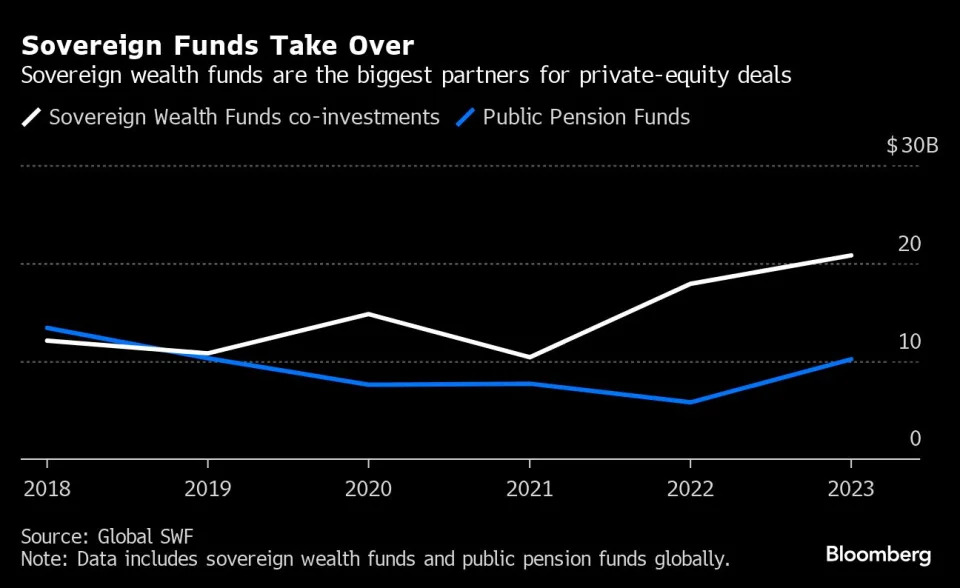
In the time it took the Calstrs deputy chief investment officer to build his case, faster and nimbler investors — mostly Middle Eastern sovereign wealth funds — snapped up more than $38 billion of such deals.

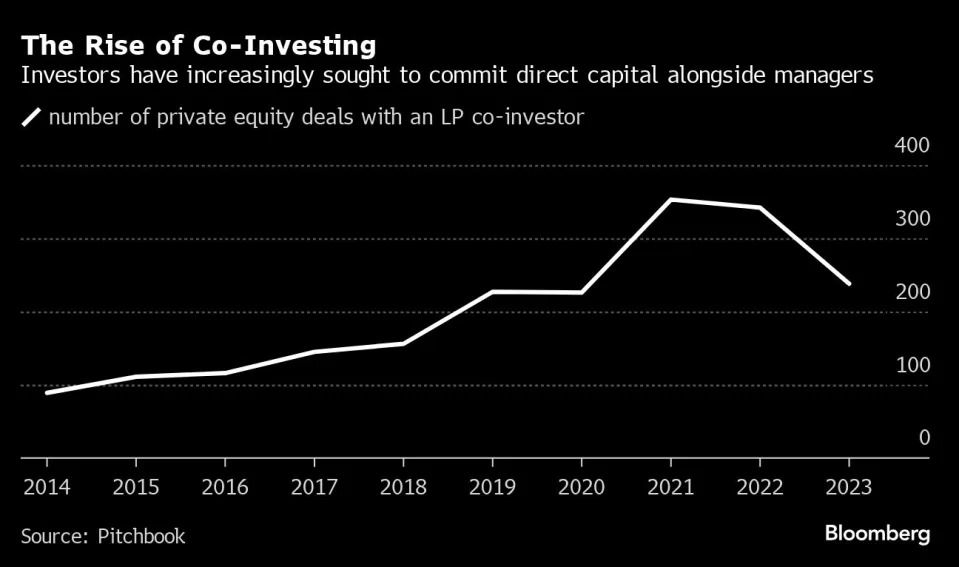
US pension funds, long among the most coveted clients for buyout firms, are rapidly losing ground to deep-pocketed Middle Eastern sovereign wealth funds. That’s especially true in deals known as co-investments, where private equity managers tap favored investors to put more money into individual purchases — without the hefty fees. Sovereign wealth funds such as the Abu Dhabi Investment Authority and Mubadala Investment Co. have been seizing on such opportunities, deploying billions to help get private equity deals over the line in recent years.

The increased competition for such deals comes just as they’re becoming a more important tool for US pensions to save on management fees and bet on higher returns. That’s changing the dynamics of how US pensions invest, public fund executives say. The largest US pensions are cranking into gear, revamping decision-making processes that made them slow to evaluate new investments and increasing allocations to capture more of these deals.

The board of the largest US pension fund, the California Public Employees’ Retirement System, or Calpers, has given its investment team permission to make decisions in 48 hours if they need to. At Calstrs, which manages approximately $338 billion, Chan persuaded the fund’s board this year to tweak an existing co-investment program to be more flexible and put more money to work.

“Pensions are trying to move a lot faster now that the big sovereign wealth funds are in the picture,” said Marcus Frampton, the chief investment officer for the $78 billion Alaska Permanent Fund. The fund made 50 co-investments in the past decade and last year decided to expand its private equity team to do more of such deals.

US public pensions, managed on behalf of teachers, firefighters and other public-sector workers, have for years invested in private equity funds as a means of generating strong returns with less volatility than in the public equity markets. The aim is to close a funding gap that has left many of them tens of billions short of covering expected retirement benefits.

But the asset class is expensive. Some US pensions spend roughly a half-billion dollars on private equity management fees per year.

In recent years, US pensions have ramped up co-investments to gain exposure to attractive companies in a fund’s underlying portfolio, with zero fees to pay. Calpers, which manages about $490 billion, increased its private equity target allocation to 17%, in part to shift more money into such co-investments. The pension made its biggest yet just last year, investing $750 million in an undisclosed US buyout deal.

Access to these deals often goes hand in hand with commitments to a private equity firm’s next fundraise. Meanwhile, private equity firms benefit from having a partner who can shoulder some of the risk at the outset, rather than fronting it all themselves.

The entry of giant sovereign wealth funds from the Middle East has introduced a complication. US pensions have historically taken weeks or even months to make an investment decision, hamstrung by a cumbersome process involving investment committees, consultant reviews and political battles over the stewardship of retirees’ money. By contrast, the likes of ADIA and Saudi Arabia’s Public Investment Fund can commit large sums quickly — sometimes in hours.

“We needed to streamline the entire organization’s operations to become nimble so that we could compete in the marketplace at anyone’s speed and scale,” Chan said in an interview with Markets Group in March about the fund’s efforts to improve its co-investment strategy. “If we’re going to do a co-investment, we have to make sure we respond the same day.”

Calstrs saved $185.5 million in fees in 2022, helping to bolster Chan’s case. It now aims to do a co-investment for every fund investment it makes.

Calstrs can provide “quick turnarounds in making co-investment decisions and the ability to take down sizable amounts,” said Mindy Tirapelle, a spokesperson for Calstrs in an emailed response to Bloomberg’s questions about the pension fund’s co-investments.

Calpers declined to comment.

While US pensions aren’t new to co-investing, they’ve typically committed capital at a slower pace and in much smaller amounts than their sovereign wealth peers, which have grown at breakneck speed in recent years.

The 10 largest Middle Eastern sovereign wealth funds manage a collective $4.5 trillion in assets, edging closer to the amount the 10 biggest public investors in the US, Australia and Canada manage combined. That means they have large investment targets to fulfill, which in turn is pushing some deals into the multibillion-dollar range.

KKR, EQT, and Brookfield all turned to Middle East sovereign wealth funds last year to help fund big-ticket deals. And Apollo Global Management Inc. Chief Executive Officer Marc Rowan said in February that the best investors are now in places such as Singapore and the United Arab Emirates.

“The first people that get phone calls for some of these deals, especially the bigger deals, are the people that can write a billion-dollar check into one deal,” said Michael Lazorik, the director for private equity principal investments at the roughly $200 million Teacher Retirement System of Texas. “That’s a small number of people.”

That means over the past eight years, Lazorik said, investors — also known as limited partners — who could commit to backstopping a deal with 10-figure sums carved out a new tier for themselves. In that time, Gulf countries have pushed through reforms on business policies and made other efforts to diversify their economies away from oil.

Saudi Arabia’s Vision 2030 program, launched in 2016, has fueled the kingdom’s aggressive investment strategy in companies abroad. Crown Prince Mohammed bin Salman has said he wants to make investments the source of the government’s revenue, not oil. Instead of stashing a large share of their oil wealth in safe assets like cash, bank deposits and US debt, the sovereign funds are increasingly funneling money into investments in stocks, real estate, infrastructure and private equity.

The largest now underwrite deals alongside private equity firms and are involved much earlier in the investment process than historically was the case. Canadian and Australian public pension funds, as well as Singapore’s sovereign wealth funds GIC and Temasek, have been at the forefront of this type of investing and can keep up with the Middle Eastern players — and in some cases, when a deal gets too big, partner with them.

This has pushed some US pension funds into a so-called second tier. They get phone calls later, after a deal is signed, so that they buy sell-downs, portions of the investments that the larger limited-partners don’t want to keep.

Not every buyout firm has relegated US pensions to second place. Some have responded by creating an alternating system for who they offer deal access to first. More often than not, however, it’s about finding the money fast and avoiding having too many investors to negotiate deal terms with.

One large pension investor said that some money managers prefer a limited partner that has strict governance, as it forces more questions about a transaction and thereby adds a level of comfort to the viability of the deal itself. Many of the Middle East players are organized to write large tickets, but the speed of such deals leaves less time for due diligence compared to the approach of established limited partners, this person said, citing conversations with investment firms and experiences partnering with those players.

Still, US public pensions, which collectively manage several trillion, have started to tout that they, too, can be nimble and move quickly, and that they’re reliable long-term partners. Some of the more sizable ones still compete neck-in-neck with sovereigns on some deals.

“It’s very hard to attain a position in a private equity industry as an LP, and it’s even more important to maintain that position,” Lazorik said. To keep access to co-investments, limited partners often need to make promises of fat commitments in a private equity firm’s next fund raise. As both sovereign wealth funds and investment firm fund sizes grow larger, few US players can keep up.

Calstrs says its new policy makes them more competitive against rivals, letting the fund commit to very large deals that other US investors wouldn’t be able to do because of allocation constraints. Their eventual goal is to co-lead deals, taking as much as 49% ownership in companies and snagging observer board seats.

The largest US pension funds acknowledge privately that they’ve been eyeing the growth of sovereign wealth funds for the past decade, and watching how that has influenced their access to investment managers, according to people familiar with their thinking, who asked to remain anonymous discussing strategy that isn’t public.

Some of them even see trying to compete with the Middle East funds as a futile exercise.

Calpers invests $7.5 billion to $8 billion per year in co-investments, up from just $3 billion in 2022. This year it decided that it’s no longer planning to invest that money with the big-name private equity shops that run the blockbuster deals and garner steep competition with sovereign wealth funds.

Instead, Calpers is shifting its money to smaller managers and deals that can be less competitive. While the pension made that decision primarily to diversify its portfolio, getting meaningful traction with those funds is another benefit. As one person familiar said, Calpers wants to put its money where its tickets mean something.

 Bloomberg Businessweek