It’s possible that I shall make an ass of myself. But in that case one can always get out of it with a little dialectic. I have, of course, so worded my proposition as to be right either way (K.Marx, Letter to F.Engels on the Indian Mutiny)
Saturday, March 08, 2025
In the Know 66: Montreal Port Authority's Julie Gascon on Tariffs & Trade
Tariff uncertainties are a top concern for port authorities in North America, given the potential effects on trade flows with the United States. To get a Canadian perspective on the impact of tariffs and the broader picture of trade in the Seaway-Great Lakes region, TME spoke with Julie Gascon, who recently completed her first year as the President and CEO of the Montreal Port Authority. She is a master mariner and spent most of her career on Canadian Coast Guard ships on the West Coast fleet. She also sailed on VLCC crude carriers and large passenger vessels.
Ms. Gascon was a regulator, including a Senior Marine Safety Inspector, and became the Executive Director of Domestic Vessels and Regulatory Oversight with Transport Canada. Gascon was appointed to regional and national roles with the Canadian Coast Guard, and served as Assistant Commissioner for its Central and Arctic regional operations.
Gascon became the Montreal Port Authority's President and Chief Executive Officer in February 2024. She holds a Bachelor’s degree in Business Administration from the University of Montreal and a Bachelor’s degree in Technology in Nautical Sciences from the University College of Cape Breton.
For all the details, listen in on the conversation below.
The opinions expressed herein are the author's and not necessarily those of The Maritime Executive.
Canada Places Order with Seaspan for Construction of Heavy Polar Icebreaker
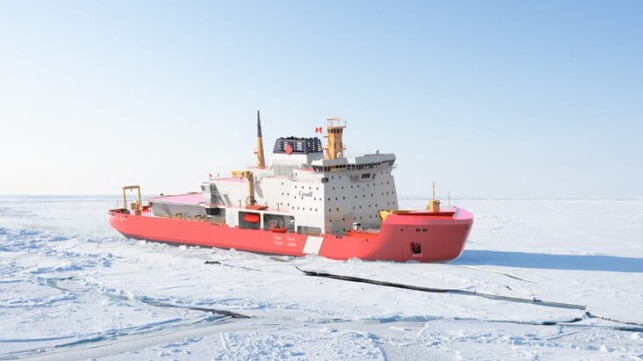
Canada placed the order with Seaspan for a new heavy heavy polar icebreaker (Seaspan)
The Canadian government today, March 7, marked the contract signing for a new polar icebreaker to be built at Seaspan Shipyard making official an order first announced in 2021. Under the National Shipbuilding Strategy, the government is renewing the fleets of the Royal Canadian Navy and the Canadian Coast Guard including two heavy polar icebreakers providing the Canadian Coast Guard the ability to operate self-sufficiently year-round in the high Arctic down to temperatures at -50° C.
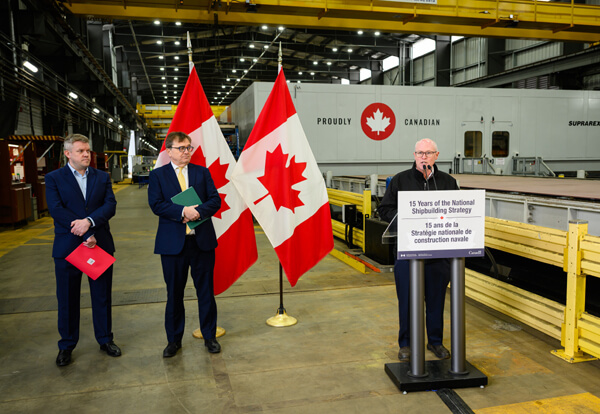
The contract ceremony was led by the Jonathan Wilkinson, Minister of Energy and Natural Resources, on behalf of the Jean-Yves Duclos, Minister of Public Services and Procurement and Quebec Lieutenant. The government of Canada reported the value of the contract at C$ 3.15 billion (before tax) (US$2.2 billion) with the vessel to be built at Seaspan’s Vancouver Shipyards in British Columbia.
“The contract awarded to Seaspan's Vancouver Shipyards for the build of a new polar icebreaker underscores our dedication to ensuring safe and efficient navigation in Arctic regions,” said Wilkinson. “This state-of-the-art vessel will not only strengthen our icebreaking fleet, but will also support critical scientific research and environmental protection efforts, and ensure national security in the Arctic."
John McCarthy, CEO of Seaspan, along with Minster Wilkinson at the contract ceremony (Seaspan)
With the contract now in place, Seaspan reports it is ready to cut steel on this ship and begin full-rate construction. It has scheduled the official start of construction for April 2025. The other polar icebreaker is being built by Chantier Davie Canada located in Quebec. That shipyard was awarded a contract valued at C$16.47 million (including taxes) (US$11.5 million) in September 2024 to advance work on a Polar-class icebreaker.
Seaspan highlights it will mark the first time a polar icebreaker has been built in Canada in more than 60 years. Building the complex and densely-outfitted multi-mission ship they report represents a significant challenge for the shipbuilders and when completed the vessels will have more advanced capabilities than the Canadian Coast Guard’s current heavy icebreakers.
The polar icebreakers will be 158 meters (518 feet) with a design displacement of 26,00 tons. They will have more than 40 MW of power with an ice-class azimuthing propulsion system. Functional design of the polar icebreaker was completed in 2024 by Seaspan working alongside established Finnish companies who have extensive experience in designing Arctic-going vessels.
Canada in November 2024 signed the ICE Pact Memorandum of Understanding with the United States and Finland to deepen existing cooperation, strengthen their shipbuilding industries, and allow new equipment and capabilities to be produced more quickly. The three countries committed to working more closely together to engage to help meet future global demand for Arctic and polar vessels.
The United States approved the contract for the construction of its first heavy polar icebreaker, Polar Sentinal, in December. It is the first of three heavy Polar icebreakers the U.S. ordered from VT Halter, which was later acquired by Bollinger. After long delays in the design phase, the U.S. expects to complete its first polar icebreaker in 2029.
Weather Continues to Delay Salvage Efforts for MSC Baltic III
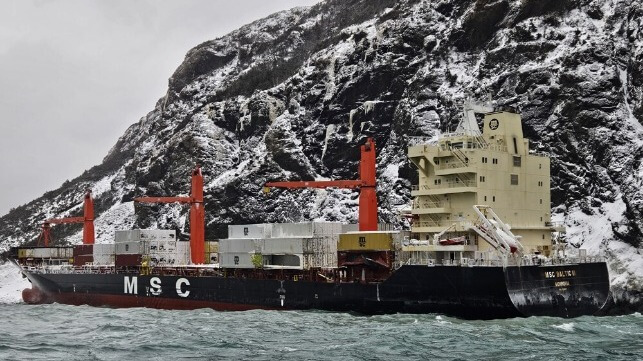
Operations are focusing on removing oils from the grounded containership MSC Baltic III (Canadian Coast Guard)
The Canadian Coast Guard provided an update on the ongoing operations to salvage the grounded containership MSC Baltic III saying the focus remains on the fuel aboard the ship and the prevention of environmental damage. While there is daily activity, the Coast Guard reports weather and ice conditions are impacting the operations about 50 percent of the time and many days teams are not able to get aboard the vessel.
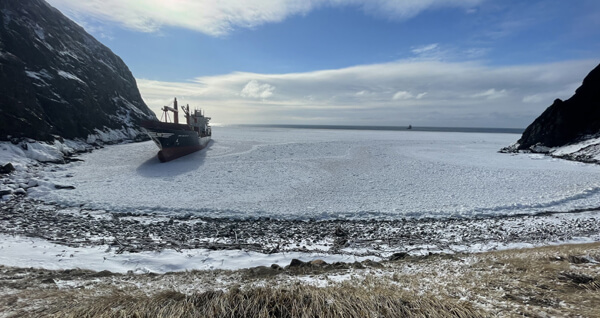
The 37,636 dwt containership blacked out on February 15 while approximately 12 nautical miles outside the entrance to Bay of Islands, Newfoundland. The crew was removed uninjured in a challenging operation involving a Canadian rescue helicopter while the vessel was driven ashore in a remote cove on the western side of the island.
Based on the current conditions, Bruce English, Senior Response Officer, Marine Environmental and Hazards Response, for the Canadian Coast Guard, said their focus is not on speed but on minimizing the impact of the incident. He was unable to provide a timeline while speculating the operation would involve a combination of overland and a barge alongside first to remove the fuel oil and then the cargo.
Lose ice has clogged the remote cove where the vessel is located with temperatures and winds challenging the operation (Canadian Coast Guard)
MSC Mediterranean Shipping Company as the operator of the vessel has appointed T&T Salvage and the Eastern Canada Response Corporation to develop the salvage plan and manage the environmental dangers. English reports those companies have brought in resources from around the world and are staging equipment on Newfoundland for the response. An ice class tug and barge arrived in Corner Brook carrying tanks some of which will be put onshore for eventual use as they remove the approximately 1.7 million liters of heavy fuel and marine gas oil onboard. The Coast Guard believes the majority of the required equipment is now onsite for the operation.
Accessing the vessel from the shoreside with heavy equipment requires upgrades to a road into the area. The operation is in the final approval stages from Canada for the roadwork and English reports a draft plan showed that it would take approximately two weeks of work to make the road usable for the trucks and other equipment. Previously they had said the salvage operation might also build a walkway to the bow of the vessel to increase access.
The salvage teams have been aboard and they confirmed to the Canadian Coast Guard that the vessel has significant hull and structural damage although it is now resting solidly on the seabed. English said that they have been advised there is flooding in the three of the holds, the tanks, and the engine room. The vessel can not be safely refloated at this stage.
When the operation can commence, the fuel oil in the tanks will need to be heated before it can be pumped off the ship. However, the salvage teams have determined the cranes aboard the ship are operational which will be helpful for the cargo operations.
MSC in a statement reported that “we have secured the hazardous containers still aboard to avoid any risk of marine pollution and have a plan for their removal.” The Canadian Coast Guard said that MSC had informed it that two empty containers were damaged but posed no risks. The vessel has approximately 470 containers, over half of which are empty, aboard.
Under Canadian law, the vessel owner is responsible for the costs. The Canadian Coast Guard declined to speculate on the cost of the operation.
Lauritzen Bulkers Buys Canadian Breakbulk Firm and Looks to Positive 2025
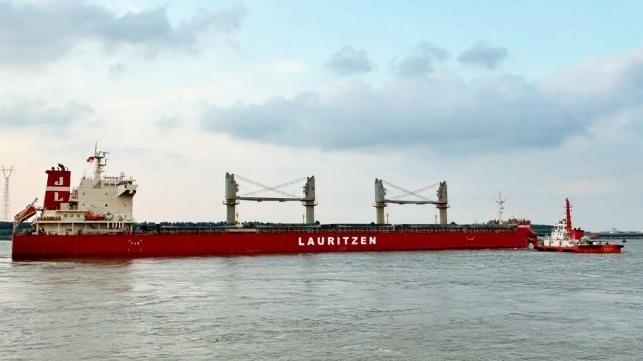
Lauritzen acquired a Canadian breakbulk firm as it expects positive net results in 2025 (Lauritzen)
Denmark’s Lauritzen Bulkers, one of the oldest operators tracing its roots back 140 years, reports it has acquired Alexander & Blake, a Canadian breakbulk and parcel shipping company. The deal comes as the company looks to rebound from what it called “unpredictable and complex market conditions,” in 2024.
Alexander & Blake is a Canadian-owned and operated shipping company. Its main activities are in the breakbulk and parcel service segments, with clients and core trades in the North and South American markets. The company was started in 1990 to focus both on breakbulk and dry cargo.
“The discussions we have in the past months with the Alexander & Blake team have confirmed to us their excellent competencies and how they will add value to Lauritzen Bulkers' global shipping services from day one,“ says Rasmus Francis Jensen, Vice President, Chartering and Lauritzen Bulkers Parcel Service.
David Linden, founder and CEO of Alexander & Blake cited a very good fit between the Alexander & Blake values and the corporate culture, commercial mindset, and customer focus of Lauritzen Bulkers. The company will continue as Alexander & Blake - by Lauritzen Bulkers with Lauritzen Bulkers continuing the breakbulk and parcel service offering under the future brand name Lauritzen Bulkers Parcel Service.
Lauritzen Bulkers said during its year-end financial report at the end of February that it expects a positive net result for 2025 after seeing earnings decline dramatically to $17.9 million in 2024. It cited numerous underlying challenges commercially and operationally in 2024 including the draft restrictions at the Panama Canal and the de facto closure of the Red Sea due to the Houthi attacks. The company said it looks to increase business activity across its segments, regions, and trades.


No comments:
Post a Comment