Navantia Accelerates Investments in Harland & Wolff and UK Shipbuilding

Three months after completing the acquisition of the bankrupt Harland & Wolff shipyard in Belfast and the other yards of the group, Spain’s Navantia outlined its plans for increased investment to create what it is calling one of the “UK’s most advanced shipyards.” The investments that are intended to improve productivity, provide faster delivery, and more sustainable manufacturing processes as designed to position the UK group as the UK and European governments are increasing defense spending.
Navantia partnered with Harland & Wolff in 2023 to win a UK contract to build three naval support ships for the Royal Navy Auxiliary. As part of that program, the companies committed to an investment of £77 million ($100 million) to modernize the yards and increase capabilities for the Fleet Solid Support (FSS) contract. The Spanish group stepped in in late 2024 to save the UK shipyard group from liquidation and maintain the FSS program reporting that it would increase the planned investment in the yards.
“The modernization program will significantly enhance the Belfast yard’s ability to build the FSS vessels and support future programs,” said Navantia UK detailing its plans. “The investment is designed to deliver a comprehensive regeneration of UK shipbuilding capabilities, leveraging the opportunity presented by the FSS program.”
Assembly work and outfitting for the three FSS vessels is slated to take place at the yard in Belfast. The Appledore shipyard is producing the bow sections for the vessels. Work on the upgrades had begun in 2024, but was suspended due to the group’s financial troubles. Navantia UK reports that work resumed in March.
According to the group, the modernization focuses on maximizing productivity, creating jobs, and implementing sustainable manufacturing. Phase one focuses on enhancing capabilities for building vessel hulls, with improvements to delivery systems, stockyard management, and cutting technologies. It includes a comprehensive upgrade both for infrastructure development and advanced equipment installation. It will feature new lifting cranes, robotic plasma cutting systems, and automated quality control processes. A fully mechanized panel line for flat panel units will be installed, while the Belfast shipyard’s iconic Samson and Goliath gantry cranes will continue to play a vital role in operations.
The investment program extends beyond Belfast, with significant upgrades at the Appledore shipyard in Devon. The company has already committed to purchasing an advanced plasma cutter with expanded bed dimensions and sophisticated bevel-cutting capabilities, replacing machinery that has served the facility for more than 20 years.
Navantia UK’s investment strategy also encompasses the Scottish facilities at Arnish and Methil, which specialize in the energy industries. At Arnish, investment has begun including on skills development infrastructure, featuring a new welfare facility, dedicated training center establishment, office space improvements, and enhanced security and parking provisions.
Juan de la Cueva, CEO of Navantia UK, called the investments a “watershed moment” for UK shipbuilding. He said it was part of a long-term commitment to UK shipbuilding. Harland & Wolff they said will be transformed into a cutting-edge facility capable of delivering the highest quality vessels. The Belfast yard was once an industry leader but entered a long decline delivering its last new build in 2009 and saved from a prior bankruptcy in 2019. Similarly, the Appledore shipyard went into receivership in 2003 and finally closed in 2019 before being acquired by Harland & Wolff Group in 2020. The group acquired the two smaller yards in Scotland in 2021.
UK and Eni to Start Construction of Liverpool Bay Carbon Storage Project
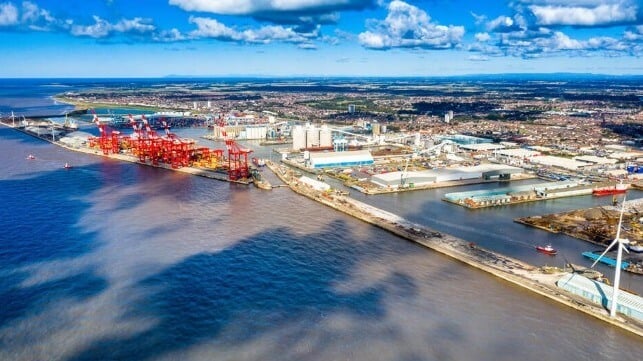
The Liverpool Bay CCS project which is a key element of the UK’s HyNet Cluster designed to support industry in the North West of England and North Wales cleared its financial hurdles and will move into construction. The project is a partnership between Italian energy major Eni and the UK Government to support what is being called one of the world’s most advanced CCS clusters.
The UK Secretary of State for Energy Security and Net Zero, Ed Miliband, and Eni CEO, Claudio Descalzi, announced that they have reached the financial close for the project. The UK Government had previously announced its funding allocation of £21.7 billion ($29 billion) to be invested over 25 years across the first two CCS Clusters in the country. Eni will be the operator of the CO2 transport and storage system of the HyNet Industrial Cluster.
UK Secretary of State for Energy Security and Net Zero, Ed Miliband called this the “launch of a whole new clean energy industry for our country,” citing the job creation and support for the industrial sectors of the UK. He said it would kickstart growth and support the UK’s industrial competitiveness for the long term.
The Liverpool Bay CCS project will operate as the backbone of the HyNet Cluster to transport carbon dioxide from capture plants across the North West of England and North Wales through new and repurposed infrastructure to permanent storage in Eni’s depleted natural gas reservoirs, located under the seabed in Liverpool Bay. The project foresees the repurposing of part of the offshore platforms as well as 149 km of onshore and offshore pipelines, and the construction of 35 km of new pipelines to connect industrial emitters to the Liverpool Bay CCS network.
It is designed to support industrial operations including companies involved in cement manufacturing, and energy from waste plants, as well as supporting the growth of low-carbon hydrogen production in the region. The HyNet Consortium aims to become one of the first low-carbon clusters in the world.
The project will have a storage capacity of 4.5 million tonnes of CO2?per year in the first phase, and the potential to increase to 10 million tonnes of CO2?per year in the 2030s. It will be used to address the needs of industries that currently do not have efficient and effective solutions for their carbon emissions.
Construction of the project is expected to commence this year, ready for planned start-up in 2028, in line with industrial emitters in the HyNet Cluster.
Kpler Closes Spire Maritime Acquisition as UK Proceeds with Investigation

The on-again-off-again acquisition of the maritime business from Spire Global by Kpler closed on Friday, April 25, the agreed date in a settlement between the two sides, but not without a new wrinkle to the contentious combination. The UK Competition and Markets Authority (CMA) confirmed it has opened an investigation into the proposed business combination requiring the companies to be independently operated.
Kpler confirmed in the closing announcement that it is working closely with the relevant regulatory authorities and in particular with the UK Competition and Markets Authority “in light of their review of the transaction.” Both sides had to enter into a compliance statement with CMA promising to operate the business units separately, not sharing technology or confidential business data. In addition to not moving forward with an integration, they committed to ensure that sufficient resources are made available for the development of both businesses, on the basis of their respective pre-merger business plans and maintain their current product offerings.
Despite the latest glitch, Kpler called the closing a “strategic move that bolsters Kpler's capabilities in maritime data and analytics.” Mark Cunningham, CEO of Kpler, said "The addition of this high-quality data will unlock greater value for our customers and partners by providing increasingly comprehensive and timely insights into global trade flows. It's about helping them navigate complexity, uncover opportunities, and make better decisions every day."
Spire reported the completion of the sale for approximately $233.5 million, before adjustments, plus a $7.5 million agreement for services over a twelve-month period, post-close. Spire reports it used the proceeds of the sale to retire all outstanding debt and that the remaining proceeds will be used to invest in near-term growth opportunities. It followed the terms first announced for the deal in November 2024.
Spire Global reported in February it had filed a lawsuit against Kpler for a failure to close the acquisition of its maritime group while also warning shareholders of potential debt problems if the deal is not completed. At the time, it said it believed all the conditions to closing contained in the purchase agreement had been satisfied, but that Kpler had not moved forward with the closing. Three weeks ago, Spire reported an agreement had been reached to resolve the litigation and mutually release claims, if the closing occurred by April 25.
In the CMA filing, it came out that Kpler had communicated with the regulator on February 25, March 11, March 12, March 24, March 31, and April 10, requesting that the CMA consent to derogations to the Initial Enforcement Order. CMA agreed on April 16 to permit Kpler to have a level of oversight of the acquired company while requiring that they be kept independent and Spire’s business continue as a going concern so as not to prejudice the investigation. CMA reports it is continuing to consider if the combination may be expected to result in a substantial lessening of competition in any market or markets in the United Kingdom.
Spire Maritime built its niche with real-time capabilities by designing, building, and deploying nanosatellites, each the size of a wine bottle, in a constant earth orbit collecting data from all the ships. Kpler said when the deal was announced it would expand its data reach, offering comprehensive visibility across open oceans. Management said the acquisition would further strengthen Kpler’s commitment to delivering superior real-time data and analytics to its clients, supporting informed, data-driven decision-making across the global supply chain.
Kpler in 2023 acquired MarineTraffic a portal for AIS data, mapping, and visualization along with FleetMon, a vessel database. Access to Spire Global’s proprietary satellites and analytics would enhance the portfolio.
Under the terms of the agreement, Spire Global retains its satellite network, technology, and infrastructure. It said it would focus its business on its customers in aviation, weather, and the space services sectors.

No comments:
Post a Comment