RWE is Latest to Stop U.S. Offshore Wind Activities
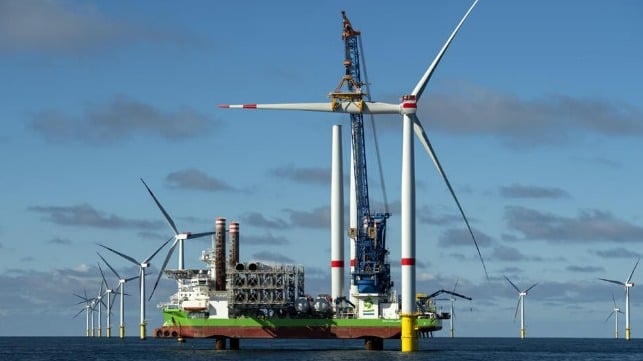
German renewable energy giant RWE is set to announce that it has stopped its offshore activities in the United States and setting higher requirements for future investments because of the “political developments.” The company follows TotalEnergies, Shell, and BP which previously announced they were backing away from projects in the U.S., and Equinor which last week said it is considering “legal remedies” after Trump’s Department of Energy suspending offshore work on a full-permitted wind farm off New York.
RWE released a manuscript of the speech Dr. Markus Krebber, CEO of RWE, will deliver next week, April 30, during the company’s annual meeting. In the speech, he will highlight the company’s many successes in 2024 and the progress being made on the Sofia wind farm for the UK and with the Danish wind farm Thor. He notes RWE has a combined offshore wind farm capacity currently of 3.3 GW and a further four projects with a capacity of 4.4 GW under construction.
Turning to the U.S. market environment, Krebber will tell shareholders, “We have stopped our offshore activities for the time being,” while the company has also introduced “higher requirements for future investments in the U.S.” He says despite the company’s success with onshore wind, solar energy, and battery storage, “Nevertheless, we remain cautious given the political developments.”
RWE became the largest leaseholder in the New York Bight with a potential 3-gigawatt area it won in the hotly contested 2022 offshore auction. At the end of the same year, RWE won a lease area to develop up to 1.6 GW off the coast of Northern California, which it projected would be one of the first commercial-scale floating wind farms in the country. It is also working with Greater New Orleans and GNOwind Alliance for regional opportunities. It launched site investigations off California in 2024 and proposed the Community Wind project with 1.3 GW of capacity to New York State.
The company in November 2024 warned it was delaying investments citing higher risks for offshore wind in the U.S. and a slower ramp-up of the European hydrogen economy. Krebber will tell shareholders next week the company has raised its threshold expectations for new investments. For future projects, he says they will increase the average return requirement from 8 percent to more than 8.5 percent.
For the U.S., he notes while the company surpassed 10 GW of generation capacity from renewable energy at the start of 2025, RWE will enforce higher requirements for future investments. This includes having all necessary federal permits in place, tax credits being safe harbored, and all relevant tariff risks mitigated. Only if these conditions are met for future investments, for the time being in onshore wind and solar, will it “be possible given the political environment.”
Developers of U.S. offshore wind projects remain concerned after the moves by the Trump administration including launching a review of the leasing process, pulling permits for projects in New York and New Jersey, and stopping funding on a research project in Maine. At the beginning of the month, four offshore projects were reported to be proposing to delay their state-level regulatory reviews. Shell reported in November 2024 that it would take a $1 billion charge as it moved away from U.S. offshore wind projects and Equinor said if a full-stop ensues for its Empire Wind project, it would have to repay $1.5 billion in financing and would be exposed to termination fees from its suppliers.
Trump Administration Suspends Funding for UMaine Floating Wind Research
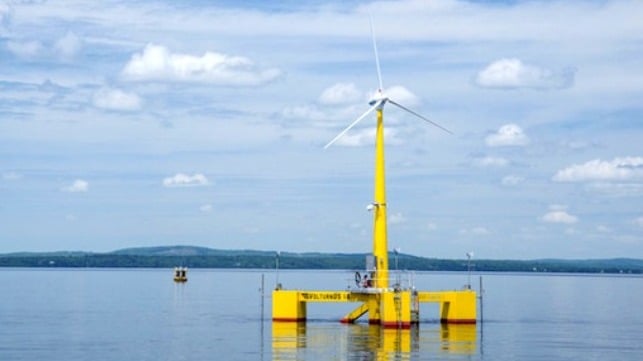
In its latest move against the offshore wind energy sector, the Trump administration suspended funding for a research project developing prototypes for floating offshore wind turbines. The move came days after the research project being undertaken by the University of Maine launched the base for its test system which was due to begin operations this summer.
In a letter released online by Maine State Representative Reagan Paul, the U.S. Department of Energy’s Advanced Research Projects Agency (ARPA-E) accuses the university of “failure to comply with one or more of the National Policy Assurances” in its ongoing grants. It is informed that ARPA-E “is suspending all activity” effective this date (April 11) for a period of up to 90 days. The suspension could be canceled or extended by ARPA-E and the university has the right to object and provide information and documentation challenging this suspension.
A university spokesperson told the media in Maine they had not been aware of any issues or investigations. It is being pointed out that the letter does not make specific allegations of the nature of failures or violations of rules.
The state of Maine and the Trump administration have been feuding since February. State Governor Janet Mills openly rejected Trump policies including on transgender rights during a White House event. The governor cited state law to which Donald Trump said “You better comply,” and later “See you in court.” Maine Public Radio is saying that two other grants were also suspended and that the university has had several pools of federal aid suspended, cut, and reinstated since February.
The university’s Advanced Structures and Composites Center has been leading the research into floating offshore wind turbines for more than a decade and in 2024 won grants which are reportedly valued at $12.5 million. The project was to build and test a prototype in the Gulf of Maine.
The researchers successfully floated a 375-ton concrete base on March 30 as the first step in the prototype project. The base was towed to Searsport, Maine where it was docked. The work called for the installation of the tower, turbines, and blades in the coming week. The prototype is a 56-foot square base that stands 32 feet high. It is a quarter-size research prototype for the tests.
By the end of May, the prototype was to be towed into position in Penobscot Bay near Castine, Maine. It was scheduled to undergo 18 months of testing and data collection from more than 200 sensors.
Maine proposed a research site for floating offshore wind in 2021 and won approval from the Bureau of Offshore Energy Management (BOEM) in 2023. A research lease was awarded in August 2024 for a project that ultimately proposes to place up to 12 floating turbines that would have a capacity based on current designs for up to 144 MW of electricity.

No comments:
Post a Comment