It’s possible that I shall make an ass of myself. But in that case one can always get out of it with a little dialectic. I have, of course, so worded my proposition as to be right either way (K.Marx, Letter to F.Engels on the Indian Mutiny)
Tuesday, April 29, 2025
Lull in Houthi Attacks on Shipping as Air War Pressure Builds
Data captured by the United Kingdom Maritime Trade Operations in Dubai suggests that Houthi attacks on shipping have largely ceased, the last incident recorded being an attempted attack on a ship by suspected pirates on April 15. The Houthis claim to have attacked the USS Harry S. Truman (CVN-75) in the Red Sea, but the US Navy doesn’t appear to have noticed. Occasional Houthi ballistic missile attacks on Israel have however continued. The only safe conclusion to draw at present is that the Houthi missile and drone capability is degraded, but that a resumption of attacks on shipping could still resume.
The conventional expert wisdom is that an air campaign against the Houthis will not dent their tenacious will to fight, the Houthis being stubbornly resistant to casualties and damage inflicted. Such impressions are reinforced by the large crowds that the Houthis are able to mobilize for political demonstrations, such as occurred in Sana’a on April 18.
But Houthi attempts to characterize the American strikes as an indiscriminate assault on civilians, copying the Hamas narrative in Gaza, have largely fallen on deaf ears. One of the largest civilian death counts occurred on April 20, when the Furwa Market in Old Sanaa was struck not by CENTCOM but by a defective Houthi anti-aircraft missile. An attempt to label a strike on a weapons store in a building under construction in Saada as an attack on a cancer clinic was disproven by the Houthis’ own images of the scene.
A spokesperson for the Houthi Health Ministry reported on April 19 that 198 people had been killed since March, without indicating how many were civilians. There clearly was a large death toll following US attacks on port infrastructure both in Hodeida and the Ras Isa fuel terminal around April 24, but elsewhere attacks appear to have been relatively well calibrated and precise. On April 28, the Houthis claimed that 68 African migrants being held in a detention center were killed by an American airstrike.
On balance, the American airstrikes are causing neither an upsurge of support for the Houthi leadership, nor yet a revolt. Their Yemeni opponents think pressure is building on the Houthis, but that a tipping point has not yet been reached. On April 24, the head of Yemen’s Presidential Leadership Council, Rashad al-Alimi, was still speaking of ‘promising signs of a shift in the balance of power’ and ‘growing unity among anti-Houthi factions’.
This appraisal appears to be shared by CENTCOM campaign planners. For the moment, strikes are focused on the Houthi leadership, missile and drone infrastructure, sources of revenue and on technical cadres. Strike data from ISW and compiled by @VleckieHond do not yet show a focus on Houthi front line positions, particularly in the Marib and around Hodeida, where government forces would need to break through if they were to recapture key territory taken over by the Houthis.
I plan to update this map every few days with newly located strikes. For now downloads of the source file will only be considered through requests over DMs
But in the meantime, cumulative damage continues to be inflicted. While this pressure on the Houthis continues and builds, CENTCOM gives no indication of any intent to scale back its assault, despite attrition of munitions stocks and MQ-9 Reapers.
Hence the campaign is settling in as a battle of wills, and the Houthis appear to have the weaker hand. Notwithstanding their reputation for resilience, the Houthis have in the past succumbed to pressure - but only when threatened by a loss of territory to their Yemeni opponents. As for Houthi political obduracy, it should be remembered that the Royalist faction under Imam Muhammad al-Badr in Yemen’s civil war of the 1960s came from the Shi’a stronghold in Saada which is now the Houthi heartland - and in those days they accepted military support both from the British and the occasional paradrop of weapons from the Israelis. If the threat to shipping is to be definitively brought to an end, reflected in the risk assessments and responses of the maritime community, then a significant political change in Houthi thinking will still be necessary.
Report: USS Truman Lost Fighter While Maneuvering to Avoid Houthi Attack
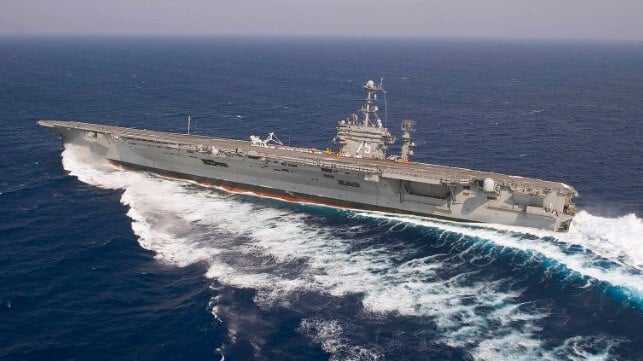
File image: USS Harry S. Truman slides into a hard port turn at full power during sea trials, 2012 (USN file image)
The crew of the carrier USS Harry S. Truman lost a strike fighter over the side while repositioning it belowdecks, the Navy confirmed Monday. Two officials told Politico that at the time of the casualty, the carrier maneuvering to avoid a Houthi attack; separately, CNN reports that Truman was making a hard turn to dodge Houthi fire. Nimitz-class carriers are capable of (and tested for) hard maneuvering at high speed. The Navy has not officially confirmed these accounts.
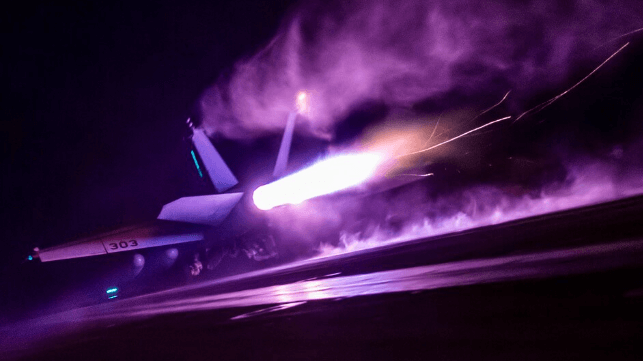
Truman is on an extended deployment in the Red Sea, and her crew is running an around-the-clock bombing campaign against Houthi targets in Yemen. They have worked continuously to keep strike sorties moving since March 15, launching and recovering fighters day and night.
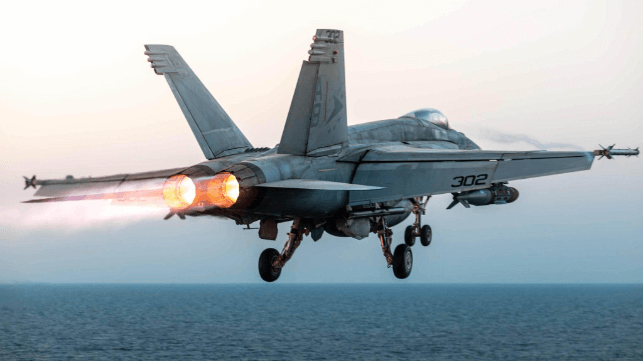
On Monday, an F/A-18E Super Hornet of fighter squadron VFA 136 was under tow in the hangar bay, attached to a tow tractor. The crew lost control of the aircraft, and the aircraft and tractor went over the side. The sailors involved in the evolution took cover and got out of the way before it went over, and only one individual sustained a minor injury.
The Truman and her air wing remain fully mission capable, the Navy confirmed. In addition, the Truman Carrier Strike Group is operating alongside sister ship USS Carl Vinson and Vinson's escorts, forming a powerful dual carrier task force.
One Super Hornet costs about $70 million, or roughly three percent of the $2.3 billion cost overrun on carrier USS Gerald R. Ford. An investigation into the cause of the casualty is under way.
Since March 15, the Truman and Vinson strike groups - aided by shore-based elements - have launched 800 separate airstrikes on Houthi positions in Yemen. The frequency of Houthi attacks has declined under the weight of U.S. bombardment of the group's storehouses, workshops and launch positions, but the group remains capable of launching missiles and drones at a slower pace.
Truman has had two other mishaps this deployment: she collided with a merchant ship on February 12, damaging her hull above the waterline; and her escort USS Gettysburg accidentally shot down an F/A-18 fighter in a friendly-fire incident in December.
Three Product Tankers Sanctioned by U.S. for Deliveries to Houthis
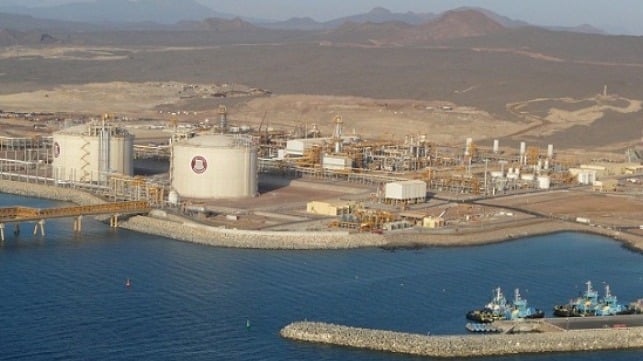
U.S. sanctioned vessels for delivering petroleum products to the Houthi-controlled ports (file photo)
The United States is continuing its pressure campaign against the Houthis in Yemen and Iran as the sponsors of the militants with a new round of sanctions. The Department of the Treasury and the Office of Foreign Assets Control sanctioned three product tankers and their shipping companies for offloading products in Yemen after the expiration of U.S. licenses at the beginning of April.
The U.S. previously had authorized the offloading of refined petroleum products in Yemen as part of humanitarian aid, but the licenses ended as of April 4, 2025, after the Trump administration on March 4, re-designated the Houthis as a Foreign Terrorist Organization. The U.S. is linking the products to Iran’s oil sanctions evasion and says the Houthis are profiting from the shipment of goods through ports they control in Yemen. In particular, the U.S. is citing the discharge of refined petroleum products.
Treasury highlights that the Houthis control the Red Sea ports of Hudaydah, Ras Isa, and Al-Salif, and assets the group is funneling millions of dollars derived from port revenue and the seizure of refined petroleum products imported through these ports to fund the attack campaign against U.S. interests and those of our allies in the region. Deputy Treasury Secretary Michael Faulkender says the group sells refined petroleum products delivered through these ports at exorbitant prices on Yemen’s black market, which enables Houthi operatives to purchase military materials, creates an artificial shortage of essential goods for average Yemenis, and fuels rampant corruption among Houthi leaders.
One of the product tankers that was listed is the San Marino-flagged Tulip BZ (25,926 dwt) which was built in 1993 and is now owned by interests in Lebanon. The U.S. says the vessel finished discharging its cargo in Ras Isa on April 10 and that in the past it has been used to transport petroleum products for Iran. Previously as the Gas Line (operating between 2012 and 2021), the U.S. says the vessel transported products for the Iranian Islamic Revolutionary Guards Corps. The Marshall Islands-registered Zaas Shipping & Trading Co, which facilitated the delivery of liquid petroleum gas (LPG) to Ras Isa is also being listed.
The second vessel, the product tanker Maisan (73,741 dwt), registered in Panama, completed offloading gas oil in Ras Isa on April 8. The vessel, built in 2005, is managed by the Mauritius-registered Bagsak Shipping and according to the U.S. has also been linked since February 2023 with the export of Russian crude oil and petroleum products. The U.S. says the Maisan was previously managed by a company that was one of the top players in the shadow tanker fleet involved in the export of Russian crude oil and petroleum products defying Western sanctions.
The White Whale (37,263 dwt) was built in 2001 and is also linked to ownership interests in Lebanon. The U.S. reports the vessel finished offloading gas oil in Ras Isa on April 17. It is managed by the Marshall Islands-registered Great Success Shipping Company.
Treasury is also reporting that two other previously sanctioned vessels are still delivering products to the Houthis. It identified an LPG tanker now named Clipper (29,458 dwt) for a recent shipment of Butane and propane to Yemen. The ship is now showing a false flag of Guyana according to the Equasis database and unknown management. The U.S. says in December 2022 the vessel then known as Queen Luca was listed for its ties to Iran’s Islamic Revolutionary Guard Corps-Qods Force.
The Akoya Gas, an LPG tanker built in 1997, registered in Tanzania in mid-April was at a berth in Yemen. The U.S. says it was blocked in September 2022 when it was operating as Gas Allure for its involvement in Iranian petrochemical and petroleum sales.
U.S. Central Command announced on April 17 that it had attacked the Houthi-operated fuel port at Ras Isa. The port handled fuel imports critical for the Houthis' military operations while commercial operations also made it a major source of tax revenue for the Houthis. CENTCOM reported yesterday, April 27, that since the bombing operation began on March 15, U.S. forces have carried out more than 800 strikes on Houthi targets greatly degrading their capabilities.
U.S. Forces Have Carried Out More Than 800 Strikes on Houthis
On Sunday, U.S. Central Command said that its multiweek campaign of airstrikes against Yemen's Houthi militant group is having an effect, and the number of Houthi missile and drone attacks on U.S. Navy warships is beginning to come down.
Since the operation began on March 15, U.S. forces have carried out more than 800 strikes on Houthi targets, CENTCOM said, killing hundreds of the group's fighters and multiple members of its leadership. The casualties include "senior Houthi and UAV officials," and the command said that it is using intelligence to reduce civilian harm.
CENTCOM declined to divulge the specifics of past or future targets for reasons of operational security. It has had serious issues with leaks in the recent past: at the outset of the campaign, a group of senior U.S. leaders accidentally gave a reporter the details of imminent strike force launch times, target sequencing and time on target - sensitive advance information about when U.S. pilots would be arriving over Yemen.
CENTCOM has declined to discuss any details of the time or location of its strikes, but it has released a list of the types of installations it is targeting. The target list includes command centers, air defense systems, weapons factories, and weapons storage locations. The command is prioritizing the advanced weapons that the Houthis have used against shipping - anti-ship ballistic missiles, cruise missiles, UAVs and drone boats.
The destruction of the Houthi-operated fuel port at Ras Isa will begin to have a broader effect on the group, too, the command said. The port handled fuel imports critical for the Houthis' military operations; its commercial traffic also made it a major source of tax revenue for its Houthi overseers.
Two carriers remain on station in the Red Sea to carry out ongoing strikes, supported by B-2 strategic bombers operating out of Diego Garcia. "We will continue to increase the pressure and further disintegrate Houthi capabilities as long as they continue to impede freedom of navigation," CENTCOM said.
The Houthis still retain the ability to launch attacks on shipping and continue to target U.S. warships. However, the militant group now operates at a much reduced tempo, the command said. The number of ballistic missile launches has dropped by nearly 70 percent, and suicide drone attacks are down by 55 percent. The fact that the Houthis retain an ability to launch attacks suggests continued Iranian support. "The Houthis can only continue to attack our forces with the backing of the Iranian regime," CENTCOM concluded.

No comments:
Post a Comment