ALT.FUEL
HD Hyundai and Maersk Cooperate on Researching Decarbonization Technology
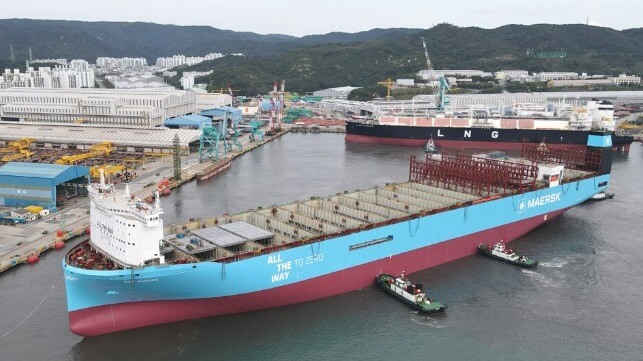
HD Hyundai and A.P. Moller – Maersk have agreed to expand their long-term working relationship to jointly develop future decarbonization solutions for vessels while HD Hyundai will expand its use of Maersk’s integrated logistics services across its affiliates. The companies plan to explore technology for vessel efficiency and route optimization as well as research on Solid Oxide Fuel Cell systems.
Maersk has long worked with Hyundai as a shipbuilder for its containerships. The companies starting in 2021 worked closely on the development and construction of the first methanol dual-fuel containerships. HD Hyundai’s Mipo Shipyard in South Korea built the Laura Maersk, the company’s 2,100 TEU feeder ship that was the first to use methanol. It was delivered in 2023 and was followed with the order for 18 large 16,000 TEU methanol dual-fuel containerships. The first was christened in January 2024 and the company has continued the integration of the ships into its fleet.
Discussing the new agreement, Chung Kisun, Vice Chairman & CEO of HD Hyundai said, “We will rapidly advance the world’s best shipbuilding technologies with the goal of building a sustainable maritime logistics network that ensures safety, low-emissions, and optimal efficiency.”
Initially, the two companies will conduct a six-month trial of new technologies on a Maersk container vessel built by HD Hyundai Heavy Industries. They will test applying Avikus’ HiNAS, an advanced navigation solution for energy-efficient vessel operations, and HD Hyundai Marine Solution's OCEANWISE route optimization to the operations of the boxship. The purpose of this trial is to validate the fuel-saving and greenhouse gas emission-reduction impacts of optimized navigation systems.
Robert Maersk Uggla, Chairman of A.P. Moller – Maersk, called the Memorandum of Understanding signed between the company on May 6 at the HD Hyundai Global R&D Center in Seongnam, “an important milestone, reinforcing the strong relationship we have developed.” He said it would pave the way for even greater collaboration in the future.
The companies also plan to explore cooperation in the field of ship retrofitting for decarbonization, including optimizing engine efficiency, increasing container ship cargo capacity, and retrofitting dual-fuel propulsion systems, Maersk has previously worked with China’s Zhoushan Yatai Ship Engineering and Repair Co. for the first conversion of a conventional containership to dual-fuel methanol.
Maersk and Hyundai report they will also collaborate on joint research to examine the feasibility of the Solid Oxide Fuel Cell (SOFC) system. Testing of hydrogen-based systems is in an early phase as multiple companies look at fuel cells as a source of electric power in the future.
HD Hyundai reports it will also strengthen its global supply chain by leveraging Maersk’s integrated logistics services. This includes expanding ocean freight volumes supported by Maersk’s East-West network and utilizing Maersk’s capabilities across airfreight services and land transportation, as well as warehousing infrastructure. The initial phase of the partnership will focus on providing tailored logistics solutions for HD Hyundai’s affiliates including HD Hyundai XiteSolution, and HD Hyundai Marine Solution, and will be gradually rolled out across other affiliates.
Damen Completes Green Retrofit Project for BAM Shipping
[By: Damen Shipyards Group]
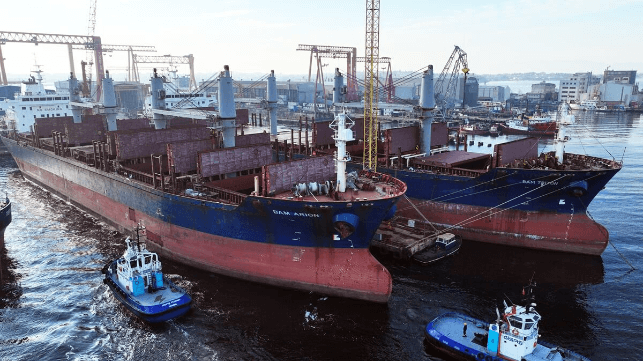
Damen Shipyards Group, together with partners including Atal Solutions has completed its retrofit of four bulk carriers for BAM Shipping. The project has involved the integration of a series of efficiency boosting technologies and is expected to lower the vessels’ fuel consumption and emissions significantly.
The retrofit is the first time that all of the various solutions have been used in a single retrofit project. In aiming to reduce fuel consumption, the project has maintained five main focal points: resistance in the water, optimising power usage, enhancing propulsion, cutting emissions and lubrication systems.
Efficiency boost
Initially, the plan was to install solutions including the Damen Air Cavity System (DACS) marine lubrication system, the Damen Triton IoT solution, low friction anti-fouling paint, variable frequency drives, shore power connectivity, LED lamps, a wake equalising pre- and post swirl duct, CO2 capture systems and DEX QM lubrication technology.
Collectively, the project partners anticipated that these measures would reduce fuel consumption by 20- 25%, with a reduction in emissions of around 90%. However, during the project, the scope was broadened yet further with the inclusion of four more efficiency boosting solutions.
Growing scope
These were the inclusion of fuel additives, oil lubricant additives, a Hempel propeller coating, and use of nano EFX. This spray solution is applied to the engine’s air intake, ionizing humidity and ensuring optimal fuel combustion, minimising consumption, emissions and carbon deposits. In the coming weeks, the vessels will be verified by classification society RINA, at which point the total volume of fuel savings will be confirmed. However, two of the vessels have already been in operation following the initial retrofit measures and show signs of meeting their anticipated efficiency goals. The fuel savings will additionally reduce the vessels’ OPEX considerably.
Lifetime extension
The project prepares the four bulk carriers for operations in compliance with recent regulations including Carbon Intensity Indicator (CII), and Energy Efficiency Existing Ship Index (EEXI). The work undertaken will also extend the lifetime of the vessels by an expected twelve years. While Damen performed the retrofit of the vessels, Atal Solutions arranged the 123.7 million USD funding for the project. Atal provided a supplier’s credit amounting to 105.2 million USD, requiring the vessel owners to provide just 15% equity, and having a 12 year repayment period with competitive interest rates.
Open and flexible approach
Damen Business Development Manager Rutger van Dam said, “This has been a very exciting project. What we have done here, with the integration of so many different solutions to achieve a combined result, is unprecedented. Of course, there have been challenges along the way, but the outcome has been successful and just goes to show that, with the right people, and the right mindset, you can go a long way. The lessons we have learned on this project will be invaluable as we continue to work towards our goal to become the most sustainable maritime solutions provider.”
Edwin Sieswerda CEO/Founder of Atal Solutions said, “We are very pleased with the preliminary results of this project, and are looking forward to the class verification in the coming weeks. At that point, we will gain a clear picture of how significant the fuel savings resulting from these measures have been. Judging by the performance of the vessels operating already, we expect a positive result. This is in no small part due to Damen’s approach. On a number of occasions during the retrofit we approached Damen with new ideas and suggestions. Each time, they listened to what we had to say and found a way to make it happen.
“At the current time, there are so many unknowns surrounding the maritime energy transition. If we are to succeed in preparing our industry for a cleaner, more sustainable future, an openness to ideas and flexibility such as that shown by Damen will be of vital importance.”
The products and services herein described in this press release are not endorsed by The Maritime Executive.

No comments:
Post a Comment