Wärtsilä Launches Onboard Carbon Capture System, Key to Cutting CO2
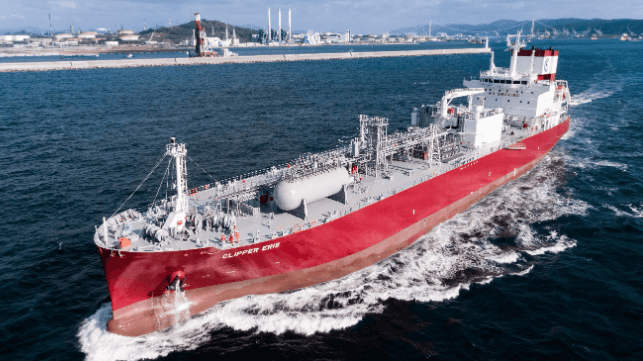
In a development Wärtsilä calls a breakthrough in decarbonization, the company has announced the commercial launch of its much-anticipated onboard carbon capture system. Wärtsilä reports successful trials at sea and at its plant in Norway, and says the ability to capture CO2 from ship exhaust systems will have a major impact on the industry’s efforts to reduce GHG emissions.
"CCS is a game-changer for the maritime industry, and we are already seeing huge interest in the market for this solution," said Håkan Agnevall, President and CEO of Wärtsilä.
According to the company's tests, the new Wärtsilä system can reduce vessel CO2 emissions by up to 70 percent - providing shipowners with an immediate way to meet carbon regulations, without waiting for costlier and less readily available green fuels. Based on testing, Wärtsilä estimates that the total cost comes to about $54-76 per tonne of CO2, including capital and operating costs. Any carbon-based fuel can work, and it's straightforward for the crew to operate and maintain, says Wärtsilä President of Marine Solutions Roger Holm.
Wärtsilä has been developing this technology since 2019, but the commercial launch follows the retrofit of the first shipboard system onboard Solvang ASA’s Clipper Eris (18,000 dwt). The system has been in operation since the Clipper Eris set sail from Singapore in February 2025.
Wärtsilä is among the biggest suppliers of engineered solutions in the maritime industry, and Holm says that the company is becoming a strategic partner for shipowners rather than a vendor of individual systems. That is especially true as owners look for guidance on how to make the green transition.
"We have the broadest offering portfolio in the maritime industry. We can do green fuel engines, we can do carbon capture, and we can do other efficiency improvements, like voyage optimization. So thanks to that total picture, we can have a different discussion than if you only have one tool in the toolbox," Holm says. "It's really rewarding to talk to our customers from this strategic angle, more than being just an equipment provider."
Costs and regulatory requirements are critical to picking the best options for owners, Holm says. Each shipowner will use CO2-saving tools like CCS to meet their own objectives, and each use case is unique. "This is what we discuss with every customer we meet. How do you decarbonize in a way that you also optimize the financial feasibility? How do you decarbonize at the right speed? This is a key discussion we have with every single customer," Holm says.
Since decarbonization is a long road, it often starts by building ships today that can be upgraded later when the market conditions are right. Solvang ASA, Clipper Eris' owner, is working with Wärtsilä on making its next generation of ships ready for later installation of CCS. This includes CCS-ready scrubber systems for HFO operation, as well as space and utility requirements for an eventual upgrade.
Berge Bulk Begins Pilot for Onboard Carbon Capture System on Bulker
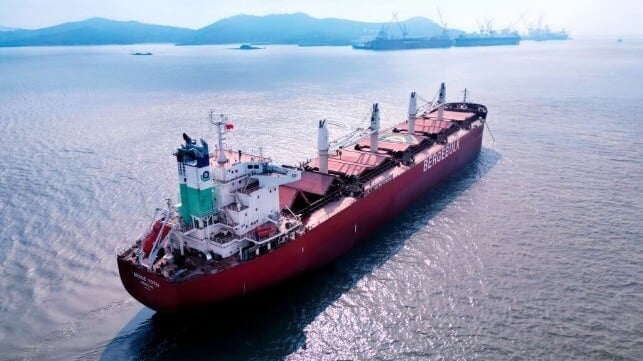
Berge Bulk has become the latest ship owner to begin to test an onboard carbon capture system. Interest continues to grow in the technology as a means of maintaining the economic life of in-service vessels as the new emissions regulations emerge, as well as a possible approach for newbuilds during the period of uncertainty and lack of supply for alternative fuels.
“Carbon capture is a key pillar of our decarbonization strategy,” said James Marshall, CEO of Berge Bulk. “While we remain committed to optimizing fleet efficiency, installing decarbonization technology, and switching to new fuels, we must also capture carbon at the same time. We’ve been actively capturing carbon through nature-based solutions on shore for many years, now it’s time to also start capturing carbon on board.”
The pilot project is taking place aboard the company’s 63,000 dwt Ultramax bulker, Berge Yotei. Delivered in 2020 and in the Isle of Man registry, the ship was built at the Imabari Shipyard in Japan.
The system being used in the pilot was developed by Value Maritime and integrates carbon capture into an exhaust gas cleaning system known as the Filtree System. It is designed to capture up to 15 tonnes of CO2 per day, representing a potential 30 percent reduction in emissions during operations.
Unlike conventional scrubbers, the Filtree System removes both sulfur oxides and CO? from a vessel’s exhaust. CO? is absorbed into a reusable amine solution, which can be offloaded in port for regeneration or reuse. Potential applications include use in greenhouses, beverage production, and other industrial processes.
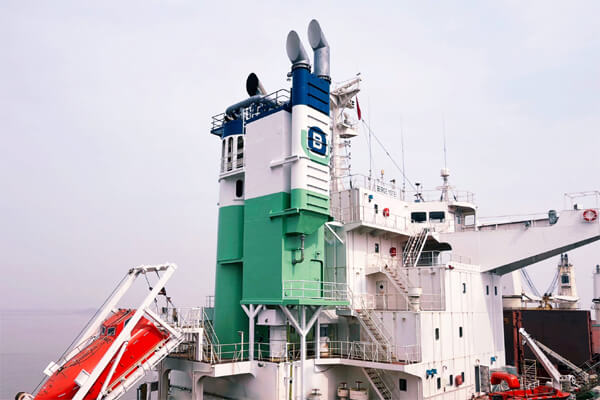
Carbon capture system was integrated with the scrubber and easily installed on the vessel's funnel (Berge Bulk)
Berge notes that while regulatory frameworks such as MARPOL and the EU ETS are still evolving, it is already contributing practical insights into how onboard carbon capture systems can be implemented, monitored, and scaled. The company, which owns, operates, and manages a fleet of over 100 vessels with a carrying capacity of more than 15 million dwt, emphasizes the need for collaboration across governments, ports, technology providers, and regulators to develop the infrastructure, protocols, and commercial models needed to support carbon capture at scale.
Value Maritime was established in 2017 and began installing its system in 2021. It has recently completed installations on other large vessels. Eastern Pacific’s chemical tanker Pacific Cobalt (49,886 dwt) installed the system in 2023. Mitsui O.S.K. Lines also recently installed the system on its tanker Nexus Victoria (75,000 dwt).
After some initial skepticism due to the need for storage and offloading CO2, the technology is gaining interest in the maritime sector expanding on the shore applications are large emitters. Wärtsilä just announced the commercial launch of its onboard carbon capture system calling it a breakthrough in decarbonization for in-service and new build vessels.
Design Work Awarded for First U.S. LCO2 Terminal Serving Florida’s Emitters
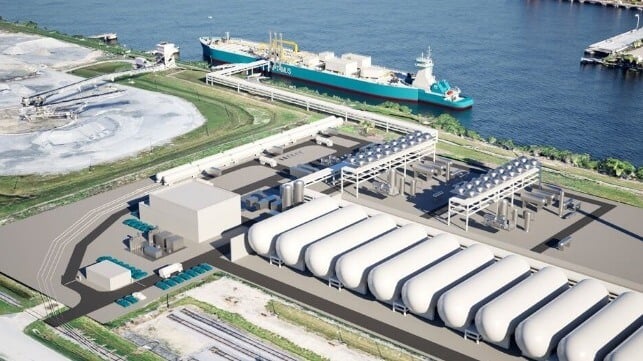
A contract has been awarded for the front-end engineering and design of the first U.S. temporary storage and liquefaction processing terminals for captured CO2. Known as COAST20 (Carbon Ocean and Storage Transport 20), it is an ambitious project that would provide a solution for the transport and storage of carbon emissions captured from Florida’s industry and be the kickoff for an industry that is also emerging in Europe.
The project is being developed by Aptamus Carbon Solutions, a subsidiary of Overseas Shipholding Group, and has identified a 15-acre parcel with access to an existing deep-water berth in Port Tampa Bay for T-RICH (Tampa Regional Intermodal Carbon Hub) for the handling of the captured CO2.
It would be connected to a discharge and regassification terminal at LBC Tank Terminals, Baton Rouge, Louisiana. Transport of the CO2 would employ a 20,000-ton liquified CO2 tank vessel, which will be the first to be built in the U.S. The design calls for the first liquefied CO2 articulated tug-barge to be built in the U.S.
Aptamus has entered into an agreement with Entr, the consultancy arm of Aker Solutions, to conduct the front-end engineering and design for the COAST 20 project’s terminals. The concept for the Tampa Bay terminal calls for two 50 percent capacity liquefaction trains with a total throughput of 2 million tons per year and 30,000 cbm of LCO2 storage. The CO2 would be delivered to the facility from pipelines, rail, or truck, and exit on the LCO2 barge. The company’s website says the potential future throughput of the plant is as much as 8 million metric tons per year.
“We are excited to bring our pioneering expertise in designing and building CO 2 terminals, and other first-of-their-kind carbon removal projects around the globe, to Florida,” said Knut Egil Pedersen, Vice President of hydrogen and CO 2 at Aker Solutions.
The receiving terminal would be located on the Mississippi River near Baton Rouge, adjacent to an existing dedicated CO 2 pipeline system for delivery to permanent underground storage sites.
“Florida is the third highest CO2 emitting state in the nation,” explains Aptamus President, Jeffrey Ross Williams. “Entr’s development of the Port Tampa Bay hub and the LBC Tank Terminals site on the Mississippi River offers the ideal solution for managing captured CO2 in Florida, and we are delighted to partner with them for this critical project. COAST20 will also allow power generation companies to meet the increasing demand for electricity in Florida while managing their carbon output.”
COAST20 was selected in 2024 for an award to be partially funded by the U.S. Department of Energy and includes the design of the Port Tampa Bay intermodal hub site to collect captured CO2 from emitters across the state of Florida. Port Tampa Bay and LBC are also partners in the Aptamus COAST20 project.
The project is based on the determination that the Tampa Bay region is home to a high concentration of power-generating facilities and large industrial CO2 emitters. They believe that there are major operations that will become stranded emitters that require a solution for handling CO2 emissions. COAST20 is presented as a cost-effective solution.

No comments:
Post a Comment