Foundation in place for new Dutch research reactor
The construction pit and foundation have been completed for the reactor building of the Pallas research reactor in Petten, the Netherlands. Preparations are now under way for the start of construction of the reactor building itself.
_88766.jpg)
NRG-Pallas applied in June 2022 to the Dutch regulator, the Authority for Nuclear Safety and Radiation Protection, for a permit to construct and operate the Pallas reactor. ANVS granted a construction licence in mid-February 2023. Preparatory work on the foundation began in May 2023. This work was carried out by Belgian construction firm Besix, which was awarded a contract in November 2022.
The building of the construction pit - a hole of about 50 metres by 50 metres and 17.5 metres deep - and the foundation has now been completed. This has involved digging 30 trenches measuring one-and-a-half metres wide, into which concrete was poured to create the so-called "diaphragm walls". The diaphragm walls are anchored with 380 bored piles placed within them. An underwater concrete floor 1.5 metres thick has also been constructed, and on top of this, a reinforced foundation slab measuring 50 metres by 50 metres and also 1.5 metres thick.
"This unique construction project has brought together all of our expertise and innovative capabilities. Both in terms of technical aspects and the stringent security requirements of a nuclear site, as well as the construction site surrounded by the dune area," said Nic De Roeck, managing director of Besix Nederland. "All of this introduced additional considerations for how we had to execute the work. I look back with satisfaction on how we carried out this challenging work together with NRG-Pallas and our partners; this was work at a Champions League level."
Peter Dijk, programme director and member of the Executive Board at NRG-Pallas said completion of the pit and foundation was "a significant step forward on the path to realising the Pallas reactor". He added: "This has laid the foundation for the next phase of construction. The arrival of the Pallas reactor is crucial for the production of medical isotopes."
Currently, NRG-Pallas, together with main contractor Spanish construction firm FCC Construcción and designer ICHOS, is preparing the next phase of the project.
Last month, FCC Construcción signed an agreement with NRG-Pallas to move the project forward through its successive phases. To this end, an agreement was formalised on the scope, schedule, budget and technical solutions for the construction of the first part of the Pallas reactor building.
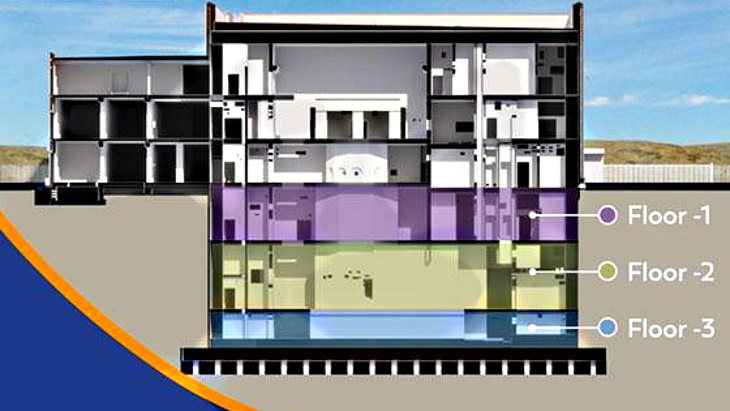
A cross-section of the Pallas reactor building (Image: FCC Construcción)
The construction site is now being restructured so that work on the lower section of the reactor can begin later this year. Additionally, preparations are underway for the installation of the cooling water pipeline. The pipeline will extract water from the North Holland Canal and discharge it into the sea.
Although funding has been allocated in the coming years for the construction of the Pallas reactor, the Dutch government has yet to make a final decision on its construction. The European Commission has already approved, under EU state aid rules, the Dutch government's plan to invest EUR2 billion (USD2.2 billion) in the construction of Pallas.
Former Minister of Health, Welfare and Sport Ernst Kuipers instructed the NRG-Pallas not to take any irreversible steps, but to continue with the preparations for the project in the meantime to avoid unnecessary delays.
The Pallas research reactor is to be built at Petten to replace the existing High Flux Reactor (HFR). The 45 MW HFR started operating in September 1960, since when its use has largely been shifted from nuclear materials testing to fundamental research and the production of medical radioisotopes. The reactor - operated by NRG on behalf of the European Union's Joint Research Centre - has for a long time supplied about 60% of Europe's and 30% of the world's medical radioactive sources.
Pallas will be of the "tank-in-pool" type, with a thermal power of around 55 MW, and able to deploy its neutron flux more efficiently and effectively than the HFR.
Article researched and written by WNN's Warwick Pipe
EU seeks to end all energy imports from Russia
The European Commission has published a roadmap for the European Union to end its dependency on Russian energy by stopping the import of Russian gas and oil and phasing out Russian nuclear energy. The commission said it will make legislative proposals next month.
_41039.jpg)
In May 2022, in response to Russia's invasion of Ukraine three months earlier, the European Commission (EC) formally adopted the REPowerEU Plan, which aimed to rapidly reduce EU dependence on Russian fossil fuels. The plan recognised that nuclear will have a role to play in ensuring security of EU energy supplies, and highlighted the importance of coordinated action to reduce dependence on Russian nuclear materials and fuel cycle services.
"Despite the significant progress achieved under the REPowerEU Plan and via sanctions since Russia's invasion of Ukraine, in 2024 the EU saw a rebound in Russian gas imports," the EC said. "More coordinated actions are therefore needed, as the EU's overdependency on Russian energy imports is a security threat."
Measures taken so far have reduced the volumes of imported Russian gas from 150 billion cubic metres (bcm) in 2021 to 52 bcm in 2024 – with the share of Russian gas imports dropping from 45% to 19%, it noted. All imports of Russian coal have been banned by sanctions; oil imports have shrunk from 27% at the beginning of 2022 to 3% now.
In nuclear, more than 14% of uranium was sourced in the EU from Russia in 2024, while around 23% of the whole EU demand for uranium conversion services was satisfied from Russia and in uranium enrichment services Russia covered almost 24% of EU needs. Member States that are still using Russian-designed VVER reactors have made progress in replacing Russian nuclear fuel with fuel from other producers.
The EC has now published the REPowerEU Roadmap, which it says "paves the way to ensure the EU's full energy independence from Russia". The roadmap sets out a gradual removal of Russian oil, gas and nuclear energy from the EU markets "which will take place in a coordinated and secure manner as we advance our energy transition".
"The European Commission will seek to make Russian imports of enriched uranium economically less viable by presenting, next month, trade measures on the import of enriched uranium," the roadmap says. "This will level the playing field and encourage political and business decisions in the relevant Member States to accelerate investment and capacity-building, develop an EU value chain and diversify away from Russia in a gradual manner, while allowing for supplies from other international partners. Next month the Commission intends also to restrict new supply contracts co-signed by the Euratom Supply Agency for uranium, enriched uranium and other nuclear materials with Russian suppliers as of a certain date."
The EC also said the development of alternative nuclear fuels for Russian-designed VVER reactors operating in Member States and their licensing needed to be accelerated. It said contracting with alternative suppliers should progress quickly towards a complete replacement of Russian supplies.
The Commission is proposing to stop all remaining imports of Russian gas by the end of 2027.
EU Member States will be asked to prepare national plans by the end of this year setting out how they will contribute to phasing out imports of Russian gas, nuclear energy and oil.
Hungarian Foreign Minister Peter Szijjarto said that Hungary opposes the EC's proposal. He said that cutting Russian gas and nuclear fuel imports threatens Hungary's energy security.
Slovak Prime Minister Robert Fico said he respected attempts to reduce energy dependence on third countries but the Commission's proposals would harm the EU, raising prices in the bloc and damaging its competitiveness. "This is simply economic suicide to go to the point where neither gas, nor nuclear, nor oil, everything, must end just because some new Iron Curtain is being built between the Western world and perhaps Russia and other countries," he was quoted as saying by Reuters.
Article researched and written by WNN's Warwick Pipe
Construction of second Shidaowan Hualong One begins
China Huaneng has announced the pouring of first concrete for the second Hualong One reactor of Phase I (units 1 and 2) at the Shidaowan nuclear power plant site in China's Shandong Province.
_92104.jpg)
The company plans to construct four Hualong One reactors, in two phases, at Shidaowan with a total installed capacity of 4.8 GWe.
China's State Council approved the construction of units 1 and 2 of the Shidaowan plant on 31 July 2023. First concrete for unit 1 was poured on 28 July 2024.
Once all four Hualong One units are completed, each unit will generate more than 10 billion kilowatt-hours of electricity annually, which can reduce standard coal consumption by 3.12 million tonnes and reduce carbon dioxide emissions by 8.16 million tonnes, according to China Huaneng.
The first of two demonstration Guohe One (CAP1400) reactors at the Shidaowan site was connected to the grid in November last year. The CAP1400 is an enlarged version of the CAP1000 pressurised water reactor developed from the Westinghouse AP1000, with consulting input from the USA-based company. The design is intended to be deployed in large numbers across the country, as well as for export.
The Shidaowan site is already home to the demonstration High Temperature Gas-Cooled Reactor-Pebble-bed Module (HTR-PM), which entered commercial operation in early December 2023. The HTR-PM features two small reactors that drive a single 210 MWe turbine. It is owned by a consortium led by China Huaneng (47.5%), with China National Nuclear Corporation (CNNC) subsidiary China Nuclear Engineering Corporation (32.5%) and Tsinghua University's Institute of Nuclear and New Energy Technology (20%), which is the research and development leader.
China Huaneng said that with the start of construction of the Shidaowan unit 2 Hualong One "the Phase I expansion project of Huaneng Shidao Bay Nuclear Power entered the full construction stage, and the construction of China's first comprehensive nuclear power base integrating third-generation and fourth-generation nuclear power technologies was further accelerated".
Article researched and written by WNN's Warwick Pipe
First BRICS expert session on nuclear energy held in China
The first expert session within the framework of the BRICS Nuclear Energy Platform has been held in China, with leading experts discussing best practices for implementing modern solutions in the energy sector.
_75865.jpg)
The BRICS Nuclear Energy Platform was created in October 2024 and is intended to share experience and support the development of nuclear technologies among BRICS+ member countries. One of the platform's aims is to help companies, if required, with persuading their governments to see nuclear as a clean energy source, and also share assistance for dealing with other issues which may be hampering nuclear energy projects.
Held on the sidelines of the 16th China International Exhibition on Nuclear Power Industry in Beijing on 29 April, the first expert session was held within the framework of the BRICS Nuclear Energy Platform.
The event - with the theme 'Key factors influencing the development of nuclear energy' - brought together representatives of government agencies and specialised organisations of the BRICS countries and partner countries of the association, including China, Russia, Brazil, South Africa, Iran and others, as well as representatives from the ASEAN Energy Center and World Nuclear Association.
The discussion focused on new approaches to the efficient distribution of nuclear energy resources, current industry trends and prospects for cooperation between participating countries for balanced global development and energy security.
The welcoming speech was given by the Platform's Chief Coordinator Elsie Pule of South Africa and Celso Cunha, president of the Brazilian Association for the Development of the Nuclear Industry. Rosatom said that for representatives of countries new to the nuclear industry, the session "became an opportunity to adopt best practices in the energy and non-energy application of nuclear developments to address environmental and social challenges facing society".
"Young specialists in the nuclear industry need the help of experienced experts from countries with advanced technologies," said Chen Xin, deputy director of the Uranium Resources Department of China's State Nuclear Uranium Resource Development Company. "The session provided an opportunity for representatives of nuclear organisations of the BRICS countries to establish interaction for the implementation of joint projects."
Artem Goncharuk, director general of Rosatom East Asia, added: "The session once again confirmed the existence of a large and as yet untapped potential for joint work between BRICS organisations and partners. We will continue to move forward and will 'take a step, leaving a mark'. Work on preparations for the next expert session has already begun."
During 2025, the Platform plans to hold special expert-level events at major industry venues. The next session is due to be held on 21 May on the sidelines of the Nuclear Trade & Technology Exchange conference and exhibition in Brazil.
The intergovernmental BRICS organisation's members are currently Brazil, Russia, India, China, South Africa, Iran, Egypt, Ethiopia and the UAE, with more than 20 other countries also expressing an interest in joining the organisation which is widely seen as a counterbalance to the G7 grouping of industrialised nations.
BRICS member countries currently have about 390 GWe of operable nuclear power units with a further 66 MWe under construction.
Czech state takes 80% stake in new nuclear project
The Czech government has announced plans for a state loan to finance construction of two new units at the Dukovany nuclear power plant, with a contract scheduled to be signed with Korea Hydro & Nuclear Power next week.
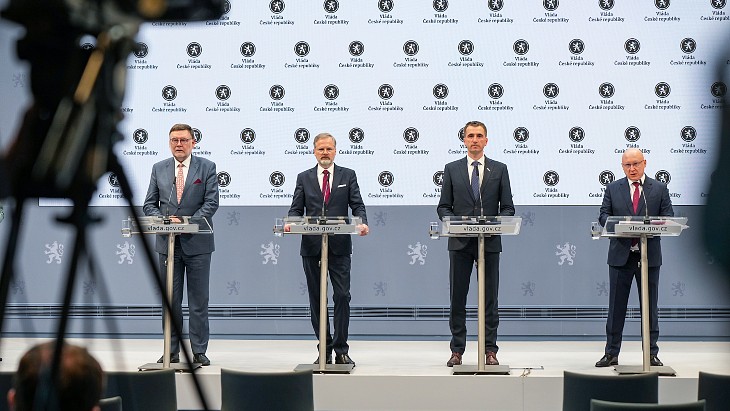
At a cabinet meeting on Wednesday the government decided to purchase 80% of shares in the Elektrárna Dukovany II project, with CEZ retaining a 20% stake. The 80% stake was valued at CZK3.6 billion (USD163 million).
It also approved a state loan to cover the construction, which will be repaid over a period of 30 years beginning from the issuing of a permit to operate the first of the new units.
The Czech Government will require European Commission approval of the financing method and investor model "which we expect to happen around 2026. Until then, the company Elektrárna Dukovany II will be financed by a bridging commercial loan".
Prime Minister Petr Fiala said: "Since the beginning of our government, we have been working to ensure the energy security and self-sufficiency of the Czech Republic for future generations. Nuclear energy, especially the construction of new nuclear sources, is strategically important for the future of the Czech Republic. The state's takeover of an 80% stake in EDU II will enable the implementation and financing of this project."
Finance Minister Zbyněk Stanjura said: "The state's majority stake will ensure control over the entire project and will probably simplify the process of approving state aid by the European Commission, the so-called notification. The minority stake of ČEZ then guarantees support from the professional capacities of the ČEZ Group."
Minister of Industry and Trade Lukáš Vlček said: "The construction of new nuclear units represents a huge opportunity for our economy and the renaissance of the nuclear industry. The share of Czech industry in the order is approaching 60%, and when the contract is signed with the preferred supplier, the Korean company KHNP, contracts and agreements with Czech companies in the volume of approximately 30% will be concluded. Exactly as we agreed with KHNP during our February meeting in Seoul."
CEZ CEO Daniel Beneš said: "This step will also enable CEZ Group to implement additional investment projects focused on long-term competitiveness, sustainability and safety. Thanks to its unique experience with the construction and subsequent almost 40 years of safe operation of two nuclear power plants, CEZ is ready to provide its capacities and know-how for the preparation and construction of new sources."
Fiala, posting on social media, said that thanks to the decisions taken on financing, contracts with KHNP could be signed on 7 May.
The background
The Czech Republic currently gets about one-third of its electricity from the four VVER-440 units at Dukovany, which began operating between 1985 and 1987, and the two VVER-1000 units in operation at Temelín, which came into operation in 2000 and 2002.
In October 2023, Westinghouse, EDF and KHNP submitted binding bids for a fifth unit at the Dukovany nuclear power plant, and non-binding offers for up to three more units - another one at Dukovany and two at the Temelin nuclear power plant. Westinghouse was proposing its AP1000, EDF was proposing its EPR1200 reactor, KHNP was proposing its APR1000. But in February 2024 the Czech government announced it was changing the tender to be binding offers for four new units, with Westinghouse not included because it "did not meet the necessary conditions".
Prime Minister Petr Fiala explained at the time that the decision to switch to binding offers for all four units was the result of the original tender suggesting that contracting for four units, rather than having separate processes, could have a 25% benefit in terms of costs.
In July last year, he announced KHNP as the preferred bidder, with contract negotiations to begin with the aim of signing contracts for the initial unit by the end of March 2025 - the target for test operation of the first new unit is 2036 with commercial operation in 2038. He said the winning tender "based on the evaluation of experts, offered better conditions in most of the evaluated criteria, including the price". The KHNP bid was for a cost of around CZK200 billion (USD8.6 billion) per unit, if two units were contracted.
Both EDF and Westinghouse appealed to the Czech Republic's competition authorities about the selection process - Westinghouse later withdrew its appeal and EDF's was rejected by the competition office last week.

No comments:
Post a Comment