How to Win the Nation’s Highest Minimum Wage

Photo by James Bruce
Tourism workers in Southern California just won a historic battle for the highest minimum wage in the nation—a perfect counterpoint to the Republican-led tax bill that rewards billionaires at the expense of low-income Medicaid recipients. The union-backed campaign is a powerful lesson in creative, proactive, and long-term mobilizing for economic justice.
Southern California’s tourism industry has been salivating at the prospect of an influx of visitors during the upcoming 2026 FIFA World Cup and the 2028 Olympics, both of which Los Angeles will host. Why shouldn’t low-wage workers exploit the opportunity as well?
In April 2023, unions, faith groups, and advocacy organizations formed into a coalition called Tourism Workers Rising and cleverly labeled their demand for an “Olympic/Paralympic wage.” They proposed that the Los Angeles City Council pass an ordinance raising the minimum wage for all workers in the tourism industry to $30 an hour. This includes airport workers and workers at all hotels with more than 60 rooms.
Reverend Jennifer Gutierrez, an elder in the United Methodist Church and the executive director of CLUE (Clergy and Laity United for Economic Justice), who worked closely with campaign organizers, explained that “some of the more conservative council members requested a study to see how this [$30 an hour minimum wage] would affect the economy in the area, and of course a study came back saying it would be good for the economy.”
Gutierrez was referencing an economic impact study commissioned by the City Council, which found that a wage hike would be good for the local economy and benefit individual workers, small businesses, and local government. The study concluded that the “estimated 23,000 workers directly and indirectly impacted by the proposed increases are expected to spend a large portion of their new earnings stimulating the local economy by purchasing goods and other services.”
Two unions, Unite HERE Local 11, which represents hotel and hospitality workers, and SEIU USWW, whose members work at the Los Angeles International Airport as janitors, security guards, and other workers, joined forces to win the measure. “Any time unions can collaborate together, it makes a big impact,” said Gutierrez.
The coalition used social media to showcase how workers struggle to pay their bills on time in an economy where the cost of living continues to rise while wages stagnate. “I need to pay my electric bill on time,” said Maria Romero, an airport worker and member of SEIU-USWW, in an Instagram post shared by Tourism Workers Rising. Maria Gonzales, an airline catering worker, said she needs higher wages just to be able to pay rent on time. Laura Banuet, an airport worker, maintained that “we need a raise to have a dignified living wage.”
The fight took place at the intersection of economic and racial justice, with Los Angeles Council member Curren Price estimating that “nearly 9 out [of] 10 tourism workers are people of color.” The multiracial campaign, reflecting the city’s racially diverse populations, was relentless in pushing and
In a letter to the International Olympic Committee (IOC) and the president of FIFA, Unite HERE Local 11 leaders urged them to support the fight for a higher minimum wage, and called out the hypocrisy of global institutions that claim their massive sporting events are good for the economy. Signatories pointed out that “Both FIFA and the IOC have committed themselves to promoting sustainable economic development and humanitarian values… Yet to date, actors like the IOC, LA28, and FIFA have done far too little to ensure that our communities will actually benefit.”
More than two years after launching the campaign, on May 14, 2025, workers testified to the LA City Council about the need for an “Olympic wage” ahead of a full vote on the ordinance. Councilors passed the vote 12 to 3, and, according to the Los Angeles Times, this “translates to a 48 percent hike in the minimum wage for hotel employees over three years. Airport workers would see a 56 percent increase.”
There was no recourse for the City Council, no good reasoning to hinge a “no” vote on, and nowhere to hide from the hundreds of people who gathered regularly to hold them accountable. While local politicians faced tremendous pressure from the hotel and tourism industry, they had to contend with 25 months of grassroots campaigning, fueled by the wrath of workers and their allies. Ultimately, they gave in to the greater pressure—a reminder that political organizing is well-summarized by the adage, “the squeaky wheel gets the grease.”
But moneyed interests will not back down. Hotel chains are enraged at the ordinance and have threatened to withdraw from agreements to offer blocks of rooms at discounts during the 2028 Olympics. Mark Beccaria of Hotel Angeleno told a local channel KTLA, “Common sense says you cannot raise wages over 30 percent in less than a year when revenue is flat.” What he didn’t add is that when revenues spike, shareholders generally pocket the profits—this is by design—rather than voluntarily giving workers increased wages.
If profitable years for hotels translated into higher wages for workers, there would be no worker struggles to pay rent or electric bills. Common sense is precisely what workers are driven by when their unions campaign for higher wages.
Local business leaders are also urging the council, ahead of a final vote, to hold off on the wage increase because of the federal government’s tariffs championed by President Donald Trump. And while it’s true that tariffs have impacted Los Angeles’s local economy, that’s not the fault of tourism workers. Why should workers pay the price of Trump’s tariff-related damage?
The Tourism Workers Rising campaign offers an “Organizing 101” course on how to effect change. The dynamics between politicians and their constituents is one of push and pull, of requests, gratitude, public pressure, and uncompromising demands. And, although $30 an hour is the nation’s highest minimum wage, “it is still not enough for a family to live on in Los Angeles,” said Gutierrez. “It is not a living wage. One job should be enough, and it’s still not enough.” For as long as there is predatory capitalism, there needs to be worker pushback.
This article was produced by Economy for All, a project of the Independent Media Institute.
Hiding Worker Exploitation Behind an App
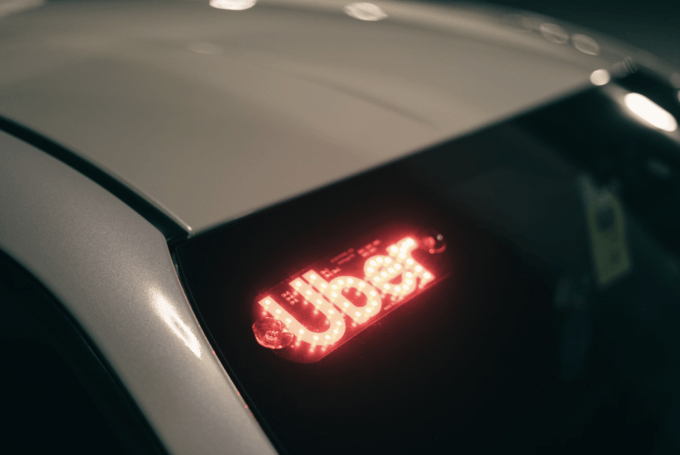
Photo by Erik Mclean
Alejandro thought that driving full-time for Uber offered freedom — flexible hours, quick cash, and time to care for his young son. But that promise faded fast.
“There are hours when I make $20,” he told me. “And there are hours when I make $2.” As his pay dropped, he pawned his computer and camera, began rationing his insulin, and started driving seven days a week just to break even.
Alejandro, whose real name is withheld for his privacy, is one of millions of workers powering a billion-dollar labor model built on legal loopholes.
Companies like Uber insist they are “tech platforms,” not employers, and that their workers are “independent contractors,” not employees. This sleight of hand allows them to sidestep minimum wage laws, paid sick leave, and other workplace protections while shifting risks onto workers. It also lets them avoid employer taxes, draining funds from public coffers.
A new Human Rights Watch report looks at seven major platform companies — Amazon Flex, DoorDash, Favor, Instacart, Lyft, Shipt, and Uber — and finds that their labor model violates international human rights standards.
These companies promise flexibility and opportunity, but the reality for many workers is far more precarious. In a survey of 127 platform workers in Texas, we found that after subtracting expenses and benefits, the median hourly pay was just $5.12, including tips — well below the already paltry federal minimum wage.
Seventy-five percent of workers we surveyed said they struggled to pay for housing. Thirty-five percent said they couldn’t cover a $400 emergency expense. Over a third had been in a work-related car accident. Many said they sold possessions, relied on food stamps, or borrowed from family and friends to get by.
Their labor keeps the system running — but the system isn’t built to work for them.
By classifying workers as contractors, platform companies avoid paying core employment obligations while retaining tight control over how the work is done. The platforms often use algorithms and automated systems to assign jobs, set pay rates, monitor performance, and deactivate workers without warning.
One Uber driver in Houston said, “They are like puppet masters. They psychologically manipulate you.”
One Shipt worker in Michigan said her pay plummeted immediately after she received two four-star reviews, down from her usual five. Ratings are hard to challenge, and recovering from a low score can take weeks. Workers feel forced to accept every job and appease every customer, reinforcing a system that rewards compliance over fairness.
These aren’t the conditions of self-employment. They’re the conditions of control.
This labor model also drains public resources. In Texas alone, Human Rights Watch estimates that misclassification of platform workers cost the state over $111 million in unemployment insurance contributions between 2020 and 2022 — a quiet transfer of public wealth into private hands.
But workers are pushing back, and policymakers are starting to listen. At this June’s UN-backed International Labour Conference, for example, a binding treaty on platform work is under discussion.
The message is clear: workers are demanding rules that protect their rights.
The U.S. can start by updating employment classification standards and adopting clear criteria to determine whether a platform worker is truly independent. We also need greater transparency. If gig workers were properly classified, public companies would have to disclose pay data, showing just how far below the median these workers earn — and how high executive compensation soars above them.
This isn’t about rejecting technology. It’s about making sure companies don’t hide exploitation behind an app. Alejandro has a right to a wage he can live on, protections he can count on, and a system that doesn’t punish him for getting sick, injured, or speaking up.
He and millions like him built the platform economy. It’s time they shared more than the burden.
June 4, 2025
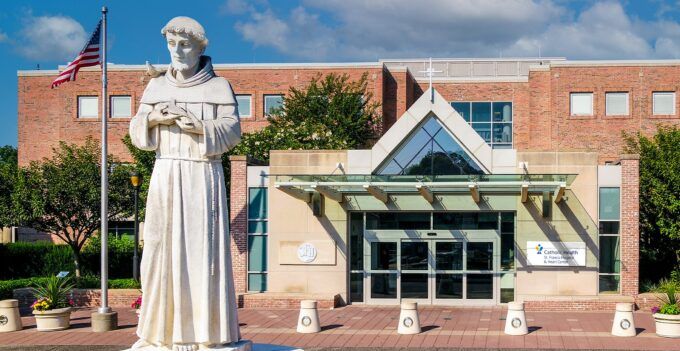
A statue of St. Francis outside a Catholic hospital on Long Island — image via X
Like nearly a third of U.S. adults, I was raised Catholic. So when Pope Leo XIV was elected, I took note.
What stood out to me was not just our shared nationality, but the legacy of his chosen name.
His predecessor, Leo XIII, issued Rerum Novarum, an 1891 encyclical that supported labor unions and championed workers’ rights. But in the United States today, those rights are under threat — often by Catholic institutions themselves, which are increasingly using claims of “religious liberty” to sidestep labor protections.
One case currently before the Supreme Court makes the danger clear.
Subsidiaries of Catholic Charities Bureau, a religious nonprofit, are challenging Wisconsin over whether they should be required to pay into the state’s unemployment insurance system. They argue that because Catholic Charities’ mission is religious, the subsidiaries — which perform secular social services and employ non-Catholics — shouldn’t have to follow the same rules that apply to all other secular organizations.
If the Court agrees, any church-affiliated employer who claims a religious motivation could opt out of contributing to this worker safety net.
Another tactic some religious organizations are using is to claim a “ministerial exception.” Ostensibly intended to protect a church’s autonomy in choosing its spiritual leaders, the exception has since been stretched into a catch-all excuse to deny employees of religious schools all kinds of legal recourse.
For instance, a teacher at St. James School in Torrance, California, was let go after being diagnosed with breast cancer and requesting time off for treatment. She believed her termination violated the Amercians with Disabilities Act and sued. But in a 2020 ruling, the Supreme Court found her role fell under the ministerial exception. (Tragically, the teacher died before her case was ever resolved.)
Last year, another federal court upheld the firing of a teacher at Charlotte Catholic High School in North Carolina after he announced his marriage to a same-sex partner on social media. Despite teaching secular subjects, the court deemed his role sufficiently religious to fall under the ministerial exception, barring his discrimination claim under the 1964 Civil Rights Act.
Five years ago, the National Labor Relations board established a broad standard for religious exemptions to the 1935 National Labor Relations Act, which grants employees the right to unionize. Following this, Saint Xavier University in Chicago and Florida’s Saint Leo University dissolved faculty unions that had weathered over 40 years of collective bargaining. Marquette University in Milwaukee is currently relying on the same exception to block their faculty from unionizing.
These legal maneuvers distort the true meaning of religious freedom. The First Amendment was meant to shield houses of worship from state interference, not to provide religious organizations with a sword to cut down the rights of others whenever it suits their interests.
If left unchallenged, this string of rulings will create a two-tiered system of worker protections: one set of rights for people working for secular employers, and another — far weaker — set of rights for those working in religious settings.
The consequences are far-reaching. Religious organizations employ an estimated 1.2 million people nationwide. Nearly 20 percent of hospital beds in the U.S. are in religiously affiliated facilities. Catholic schools alone employ tens of thousands of teachers and staff members.
If these employers are allowed to claim broad exceptions to labor laws, millions of workers could find themselves without protections. And if secular employers are allowed to claim religious motivation and take advantage of religious exemptions, the number of workers denied civil rights protections could increase exponentially.
There is a long tradition in Catholicism — from Pope Leo XIII to Dorothy Day — of standing with workers. That legacy deserves better than to be contorted into a legal loophole for skirting labor protections. When an employer invokes faith to duck accountability, it’s not practicing religion — it’s exploiting it.

No comments:
Post a Comment