Freighter Loaded with Turkish Weapons Released by Puntland
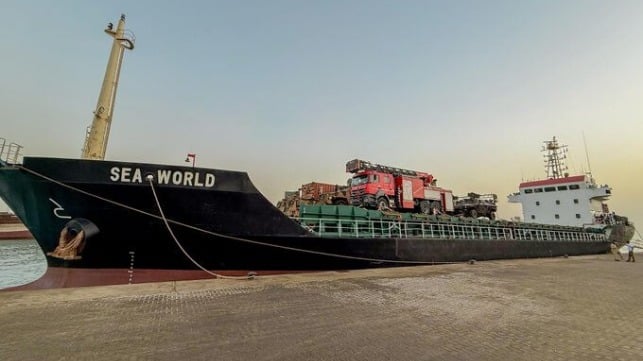

The government of Puntland, a semi-autonomous region in Somalia, announced on Monday, August 4, that it has decided to release the cargo ship Sea World, which it has been detaining for two weeks. The vessel was found to be loaded with weaponry from Turkey and became the center of the latest standoff between the federal government in Somalia and the independent government of Puntland.
The Sea World (13,000 dwt registered in Comoros) is a rather shadowy cargo ship with Equasis listing the current managers and owners as unknown. The Puntland government reported it took control of the vessel after it spent two days loitering off the coast, in part, it contended to control access to the weapons onboard. Videos circulated online showed the vessel carrying armored vehicles, military equipment, and arms, all bearing Turkish markings. Reports said that fishermen and other locals had boarded the ship and showed pictures of some of the small arms reportedly being taken ashore.
Puntland contended in its statements that the ownership of the equipment was unclear and that it was investigating. The federal government called the actions “unlawful” and demanded the immediate release of the vessel. Observers pointed out it was part of the larger disputes over territory and control between the two governments, and fears that the arms would be used against Puntland.
Puntland said there had been ongoing discussions between its officials and representatives of Turkey. It reported on Monday that Turkey has shared evidence proving the cargo’s ownership.
“Having reviewed the evidentiary documents and completing investigations, the Puntland Government has decided to officially hand over the responsibility of MV Sea World vessel and the cargo to the Government of Turkey,” the government said in a statement. It said it considered the matter closed.
The release has been met with public anger in the ongoing disputes between the government in Mogadishu and Puntland. The central government recently said it was redistricting the region, ceding some parts of Puntland to its rivals.
Turkish has a long-standing relationship with the Mogadishu government and operates a military training base outside the city. It has contended since the beginning of the incident that the military equipment belongs to Turkey and was headed for the Turksom Military Training Center. According to the media reports, the Turkish ambassador met with the president of Puntland and presented documents saying it was a legitimate military cargo as part of the agreement with Mogadishu. '

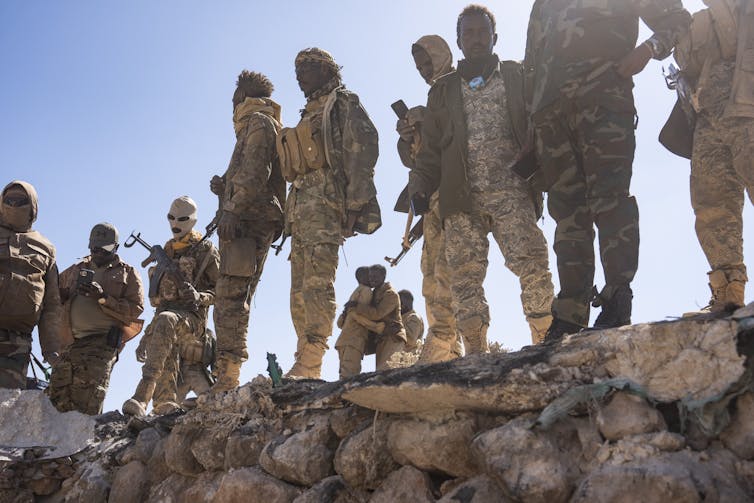
Soldiers with the Puntland Defense Forces. Photo by Carolyn Van Houten/The Washington Post via Getty Images
On Feb. 24, 2025, members of the Puntland Defense Forces posed next to a sign in Arabic that proclaimed the mountain town of Sheebaab as a “province” of the Islamic State group. The town, located in Somalia’s autonomous northeastern region of Puntland, was one of numerous areas that soldiers from the regional government have taken back during Operation Hilaac, an ongoing campaign against fighters from the Islamic State in Somalia – the local branch of the terrorist network – which began in late November 2024.
Puntland’s success in combating a growing Islamic State group presence in the northeastern region is particularly notable given the relative lack of success of the central Somali government’s confrontation with the al-Qaida-affiliated group Harakat al-Shabaab al-Mujahidin – more commonly known as al-Shabab – which for about two decades has waged war against federal forces.
In contrast, security forces in the self-declared autonomous region of Puntland have, with some key support from international partners, united to repel the Islamic State group’s advance.
The Islamic State group’s rise in Somalia
Islamist groups have been part of Somalia’s fractured political landscape since the country’s descent into civil war in the 1980s.
They tapped into profound local dissatisfaction with warlordism, tribalism and corruption, as well as a reaction to foreign intervention by Ethiopia, the United States and other international actors.
Al-Shabab and later the Islamic State in Somalia are the most extreme manifestations of this trend.
Islamic State in Somalia emerged in 2015 when a small group of al-Shabab members led by Abdulqadir Mumin – an extremist Somali preacher who previously lived in Sweden and the United Kingdom, where he acquired citizenship – pledged allegiance to then-Islamic State group leader Abu Bakr al-Baghdadi. Having formed as a local branch – or “province” in the group’s self conception as a global entity intent on expanding territory – Islamic State in Somalia launched its first major operation in October 2016, briefly seizing the port town of Qandala in Puntland.
Thereafter, the group retreated to its strongholds in the mountain regions inside Puntland amid pressure from both the regional government and al-Shabab, which has cracked down on Islamic State supporters in its ranks.
Yet from the Puntland mountains, Islamic State in Somalia grew into a key node of the terrorist group’s global network. It is now a hub for transferring funds and drawing recruits from across Africa and elsewhere via the regional coordination office it operates known as al-Karrar.
One notable Sudan-born operative killed in a 2023 U.S. raid in Puntland, Bilal al-Sudani, was known as a key foreign fighter, facilitator and financier who developed Islamic State funding networks in South Africa and helped fund the group’s branch in Afghanistan.
An NBC News report from mid-2024 cited U.S. officials who believed Mumin, head of Islamic State in Somalia, was acting as the network’s overall leader, or caliph, though other analysts have suggested he holds a top role close to caliph.
In any case, Islamic State in Somalia’s ranks have increased steadily, from an estimated 200-300 fighters in 2016 to about 1,000 as of February 2025, according to reports.
Puntland pushes back
Puntland declared itself an autonomous region of Somalia in 1998 amid the ongoing Somali civil war and has since achieved relative stability compared with the other parts of the country, which have generally been marked by decades of sectarian division and weak central governance.
Puntland is no stranger to divisions in a country that often hinges on clan loyalties, but it has achieved a greater degree of unity and has regularly raised security forces to defeat external threats, often with considerable foreign support.
The dominance of a single clan, the Majeerteen, has in part likely helped facilitate this unity. In the current operations against Islamic State in Somalia, the autonomous Puntland government under President Said Abdullahi Deni has gathered several disparate regional forces under the “Puntland Defense Forces” banner, including clan militias, the Puntland Darawish – a regional paramilitary unit – and the Puntland Maritime Police Force.
The U.S. and UAE have supported the Puntland government’s campaign. In February 2025, the U.S. launched two airstrikes on Islamic State fighters, with one on Feb. 1, 2025, killing Omani-born Ahmed Maeleninine, a key recruiter, financier and facilitator. The United States claimed another airstrike on March 25.
The UAE has conducted airstrikes too, likely from the large UAE-funded Puntland Maritime Police Force headquarters base in the major port city of Bosaso.
The Puntland government has claimed that through its latest operation it has advanced through 315 kilometers, clearing numerous villages and outposts in the mountains.
On Feb. 11, 2025, The Washington Post reported that regional security forces had killed more than 150 Islamic State members, mostly foreign fighters from countries including Morocco, Ethiopia, Saudi Arabia and Yemen, illustrating the group’s significance as a global hub for the network. In fact, one analyst counted 118 dead fighters from a single encounter in early February, indicating a possibly higher death toll. In any case, it represents heavy losses for Islamic State in Somalia, though it is not defeated yet and still numbers fighters in the hundreds.
The risk of outside interference
All in all, Puntland has leveraged past success fighting jihadist groups in making remarkable progress in its fight against Islamic State in Somalia.
It shows how local and substate forces can be more effective at fighting armed nonstate groups than the federal authorities, despite limited resources.
No doubt, support from the United States and UAE has aided Puntland’s anti-Islamic State push. But reliance on outside sources risks creating dependence on them when local forces must ultimately take ownership of the fight themselves.
And less patient foreign supporters have been known to spoil the elite units they build. This occurred with the Puntland Security Force, a U.S.-created special forces unit that splintered during a brief withdrawal of U.S. forces from Somalia in 2021 and 2022.
There are also risks that partner forces will behave badly. While the Emirati mission in Puntland – as well as in Afghanistan and Yemen – has proven effective in fighting jihadists, in Sudan it has been arguably disastrous. There, the UAE-backed Rapid Support Forces paramilitary unit helped to ignite an ongoing civil war in 2023 during which its members perpetrated alleged atrocities.
Ultimately, it will be up to Puntlanders themselves to keep fighting. Indeed, foreign support would have little impact without effective local forces on the ground with the political will to sustain the campaign. Just as Puntland has done before, so too is it now demonstrating that it is determined to fight the threat posed by jihadist groups like Islamic State in Somalia.

PhD Candidate, School of International Service, American University School of International Service

No comments:
Post a Comment