Maritime Industry Must Act if it is to Achieve a Sustainable Blue Economy
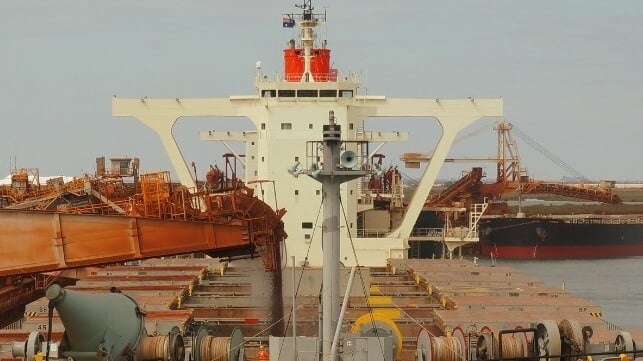
 Bureau Veritas Marine & Offshore’s Executive Vice President, Matthieu de Tugny, addresses what is required of class societies if the maritime industry is to achieve a sustainable blue economy.
The maritime industry is currently experiencing a sustained period of growth, with shipping and port industries representing 40% of the ocean economy’s total worth, which today stands at $2.2 trillion. This growth is reflected in the current global orderbook, which – according to the Clarksons newbuilding price index – has seen a 45% increase in newbuild orders since 2021. However, this economic strength is tempered by mounting challenges that cannot be ignored.
Geopolitical instability continues to disrupt maritime operations on a day-to-day basis, whilst elevating the safety risks for seafarers operating within the affected regions. Simultaneously, an unpredictable policy environment is reshaping global trade routes, while shipowners and operators face significant regulatory demands in an effort to cut carbon emissions, pressures that are only expected to increase over the coming years.
Following the outcomes of MEPC 83, the maritime industry awaits the likely introduction of the IMO’s Net Zero Framework (NZF) in October. If enacted, these measures will establish mandatory marine fuel standards and GHG emissions pricing for shipping. The NZF will join a complex regulatory environment such as FuelEU Maritime and the EU Emissions Trading System (EU ETS), creating escalating compliance costs for shipowners. Recent reports highlight the scale of this requirement, stating that the EU ETS alone will cost the industry approximately $6 billion in 2025, rising to an estimated $51 billion by 2030. Furthermore, it is clear that shipowners are struggling to manage the evolving complexity of the newly introduced regulations. According to recent reports, less than 40% of shipping companies met the deadline for their first year of verified emissions reporting under EU ETS.
In response to this dynamic yet uncertain environment, it is understandable that owners may be choosing a “wait-and-see” approach when it comes to engaging with emerging clean technologies. Although first movers may gain a reputational advantage that may attract end customers that are committed to specifying zero-carbon fuel in their tender requirements, for the majority of vessels, the safest financial option is to wait for greater certainty within the current landscape.
However, if the maritime industry is to meet the IMO’s net-zero GHG target by 2050 – not to mention the 20% GHG emissions reduction checkpoints in 2030 – systemic transformation is required in terms of how we finance, fuel and operate the global fleet. Financial institutions that underpin the shipping industry must embrace green financing models that link capital with climate performance. Furthermore, if the current alternative fuels deadlock is to be overcome, the industry must focus on continuing to establish more green corridors as a viable means of synchronizing the development of ships, ports, fuels, and regulatory policies to support zero-emission trade.
As a leading classification society, Bureau Veritas Marine & Offshore (BV) has been working in a risk capacity alongside industry partners, including Fortescue, K Line, and the Australian Renewable Energy Agency, to support the development of the Australia–Japan iron ore corridor. This route is centered around the development of green ammonia, with fuel production in Pilbara, bunkering facilities in Port Hedland, and end-use in Kobe.
This fundamental change also involves the need to address the historic inefficiencies that the industry has operated under for centuries. Practices such as “sail fast, then wait” (SFTW), which denotes the practice of vessels speeding to their destination and then idling at anchor whilst they wait for an available berth at port. However, new initiatives such as the Blue Visby Solution seek to address this ineffective practice. Developed by the Blue Visby Consortium, this multilateral platform utilizes a unique algorithm to provide participating vessels with optimized arrival times that allow them to slow steam. This can reduce shipping emissions by approximately 15% and, based on 2019 figures, has the potential to remove approximately 45 million tonnes of CO2 across the tanker and bulker fleets.
The role of classification societies is central to the success of the industry’s transition. However, whilst maintaining the traditional role of class as custodians of change within the industry, BV is increasingly acting as an enabler of enhanced collaboration throughout the maritime value chain. By utilizing its extensive industry expertise, BV represents a trusted and impartial advisor that facilitates the integration of energy-saving devices and operational measures to cut fuel consumption, whilst providing modeling scenarios and detailed data insight to support evolving financing schemes that will accelerate the development of advanced zero-carbon fueled vessels.
The industry has certainly made crucial progress in its pursuit of Net Zero, but this momentum must be sustained. This can only be achieved through pragmatic, decisive action that works in tandem with global supply chain partners. Only through this consolidated effort will we unlock the potential of a truly sustainable blue economy.
To learn more about what is required to achieve and sustain the ocean economy you can now read Towards a Sustainable Blue Economy, written by Bureau Veritas Marine & Offshore’s Executive Vice President, Matthieu de Tugny.
The opinions expressed herein are the author's and not necessarily those of The Maritime Executive.
Samskip Joins DCSA+ to Champion Standardization
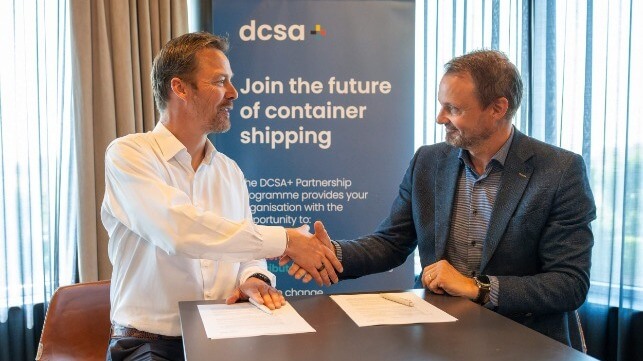
[By: Samskip]
Samskip, one of Europe’s leading logistics service providers, has officially joined the DCSA+ partnership program, reinforcing its commitment to digital innovation, interoperability, and the evolution of global logistics standards.
By becoming part of this influential network, Samskip takes a leading role in shaping the digital frameworks that will power tomorrow’s logistics, frameworks built on openness, collaboration, and efficiency.
“We believe the future of logistics relies not just on smart systems, but on a shared digital language,” said Ragnar Thor Ragnarsson, Chief Information Officer at Samskip. “By joining the DCSA+ Partner Program, we have the opportunity to help shape future industry standards that enhance not only our own multimodal operations but also the entire logistics ecosystem. Stronger standards lead to greater reliability, efficiency, and service quality for everyone.”
As a multimodal pioneer operating across shortsea, rail, road, and inland waterways, Samskip brings a unique perspective to the DCSA+ community. Its participation bridges the gap between ocean container carriers and inland transport operators, contributing critical insight into aligning systems, reducing fragmentation, and streamlining data flow across complex supply chains.
The DCSA+ program was launched to accelerate the adoption of open digital standards by including all key logistics stakeholders from ports and tech providers to shortsea operators and forwarders. It aims to:
- Connect industry partners with proven standards,
- Accelerate real-world implementation,
- and Contribute to the evolution of new, practical solutions.
Samskip’s involvement ensures that multimodal inland transport, often overlooked in ocean-focused frameworks, has a seat at the table in shaping a truly end-to-end digital transformation. Through the collaboration, Samskip gains early access to API (application programming interface) and messaging standards, increased interoperability with customers and partners, and the opportunity to streamline internal processes while helping push the entire industry forward. This initiative complements Samskip’s ongoing collaboration with SMDG, further reinforcing its dedication to modernizing digital communication through both traditional EDIFACT formats and cutting-edge APIs.
“Through DCSA+ and SMDG, we are doubling down on our commitment to reliable, visible, and simplified transport while showing what’s possible when we listen, align, and innovate together,” added Ragnarsson.
The products and services herein described in this press release are not endorsed by The Maritime Executive.

No comments:
Post a Comment