EU decision on 2040 climate target to be delayed, diplomats say

At stake is the review of the EU’s Climate Law, which sets course for theEU to become climate neutral by 2050, but also called for a 2040 climate target to be set in stone.
A controversial 2040 EU climate emissions target decision will not come at ministerial level next week — as originally planned — since countries claim they need more time to mull the issue, according to EU officials.
The Danish EU Presidency — currently helming the European Council — wanted ministers to vote on the target on 18 September, during an environment Council.
But the EU official said that member states weren't yet ready and the issue will be pushed back to be discussed and agreed by EU heads of state during an October summit.
The Commission proposed a 90% emissions reduction target for 2040, compared to 1990 levels, in July this year.
The 2040 intermediary target is meant to follow on from the EU’s 2030 target, of at least 55% reduction by 2030 compared to 1990 levels.
“We cannot support the text as it stands right now. It is not an ideal geopolitical timing. Also, the text was put on the table quite late,” a second EU official told Euronews, adding that countries need to see more balance between targets and competitiveness.
The first EU diplomat said the aim at the Council level in October is to have a “decisive” discussion, rejecting the possibility of an unanimity vote which would “reward the lowest bidders”. However, the diplomat didn’t close the door to the possibility that no decision would come even in the October summit.
The 2040 climate target will impact the EU’s national climate action plans under the Paris Agreement, expected to be presented at the COP30 in Belém, Brazil.
Countries like Slovakia and Hungary have openly opposed to the Commission’s proposal to cut 90% of CO2 emissions by 2040, arguing the law is a death sentence to the country’s industry. France has said the decision should be taken by EU leaders rather ministers.
“These ideological proposals [2040 climate target] are more proof that Brussels bureaucrats have already lost basic contact with reality. They have no idea what economic danger the European and unfortunately the Slovak industry is in,” Tomas Taraba, Slovakia’s environment minister, said shortly after the proposal was announced.
Carbon credits
Some of the key aspects under discussion by EU diplomats include the contribution of international carbon credits — tradable certificates enabling the emission of a certain amount of CO2 — to reach the 2040 target, but also the clarification that such global credits would not interfere with the EU’s carbon market, the Emissions Trading System (ETS), according to an official document. The ability to store CO2 outside the bloc is also under consideration.
“We are not against this thought [carbon credits], but we would need more clarity on that,” the second EU diplomat added.
Austrian Lena Schilling, the Green/EFA lawmaker responsible for the 2040 climate target in the European Parliament, said consideration of carbon credits is “irresponsible towards taxpayers” and a “betrayal” of youth.
“Diluting the EU climate target with carbon credits will only mean spending billions on pollution rights abroad instead of delivering real climate action here in Europe. We need at least a 90% reduction by 2040 within the EU,” said Schilling.
Sven Harmeling, head of climate at Climate Action Network (CAN) Europe, urged caution in relation to the use of international carbon credits: “It would severely undermine the ambition and environmental integrity of the EU contribution, while only delaying and increasing the cost of the transition.”
“The EU would have to transfer outside of its borders up to tens of billions of euros that would have otherwise been invested in domestic decarbonisation," Harmeling said.
By AFP
September 11, 2025

European automakers say the EU's push for electric vehicles 'is too rigid to produce success' - Copyright AFP Jonathan NACKSTRAND
Umberto BACCHI
Europe’s biggest carmakers are to hold talks with EU chief Ursula von der Leyen on Friday as the industry pressures the bloc to revise plans to end combustion-engine vehicle sales by 2035.
Suffering from fierce Chinese competition and a stuttering transition towards electric vehicles (EVs), embattled European automakers are pushing for Brussels to reconsider its ambitious climate goals.
“The regulation that is applicable to us is too rigid to produce success, and really we believe must be adapted to reality,” said Sigrid de Vries, director of the European auto lobby ACEA. “We need to be more pragmatic.”
Friday’s meeting in Brussels is the third under an EU initiative launched in January to help a sector that employs 13 million people and accounts for about seven percent of Europe’s GDP.
The first gathering resulted in a reprieve for automakers, with the European Commission allowing them more time to meet the first carbon emissions target under plans to phase out sales of new combustion-engine vehicles by 2035.
But companies are now pushing for more systemic change.
– ‘Hands tied’ –
In an August letter to von der Leyen, carmakers and their suppliers lamented a series of challenges including dependency on Asia for batteries, high manufacturing costs and US tariffs, which have been upped to 15 percent under a deal struck with Brussels.
Paired with an uneven distribution of charging infrastructure, they said those obstacles are holding back sales of EVs, which account for about 15 percent of new cars sold across Europe.
“We are being asked to transform with our hands tied behind our backs,” Mercedes-Benz chief Ola Kaellenius and Matthias Zink, of the automotive parts supplier Schaeffler, wrote on behalf of their industries.
Describing the 2035 target as “no longer feasible”, they called for incentives such as tax breaks to boost demand for EVs.
They also want more room for plug-in hybrids, highly efficient combustion-engine vehicles and other low- but not zero-emission vehicles.
That is opposed by green groups and EV sector businesses, more than 150 of which wrote a letter to von der Leyen this week urging her to “stand firm”.
Road transport accounts for about 20 percent of total planet-warming emissions in Europe, and 61 percent of those come from cars’ exhaust pipes, according to the EU.
Michael Lohscheller, chief executive of Swedish EV company Polestar, said the 2035 target gave “clarity to industry, direction to investors and certainty to consumers”.
Weakening it “would harm Europe’s ability to compete”, he said.
– Europe’s ‘E-car’ –
The range of new European EVs unveiled at the Munich auto show this week showed that the targets were working, said William Todts, director of the clean transport advocacy group T&E, who is to take part in Friday’s talks.
“For the first time in 10 years, Germans can say we are as good as the Chinese, almost. And the only reason they’re doing that is because of the CO2 standards,” he told AFP.
“They’ve had to invest more than they wanted, and this has an impact on dividends and short-term profits, but it does make them more competitive,” he said.
Yet in a sweeping speech on Wednesday, von der Leyen hinted that tweaks might be on the cards.
“With respect for technology neutrality, we are now preparing the 2035 review,” she said, referring to carmakers’ demand that not only EVs but other low-emission technologies be allowed on the market after 2035.
The German politician also announced plans for a “small affordable cars initiative” for Europe to “have its own E-car” — but provided no detail about what that entailed.
And she repeated a pledge to make available 1.8 billion euros ($2.1 billion) to boost battery production in the bloc.
The talks come at a hard time for European producers, whose sales are being eroded by Chinese competitors such as BYD and GAC.
In Germany, the auto sector has already shed more than 50,000 jobs over the past year, according to the consulting firm EY.
Volkswagen is planning thousands of layoffs in the coming years while its subsidiaries Porsche and Audi, as well as many German auto suppliers, are also cutting jobs.
EU auto summit confirms strategic focus on electric cars
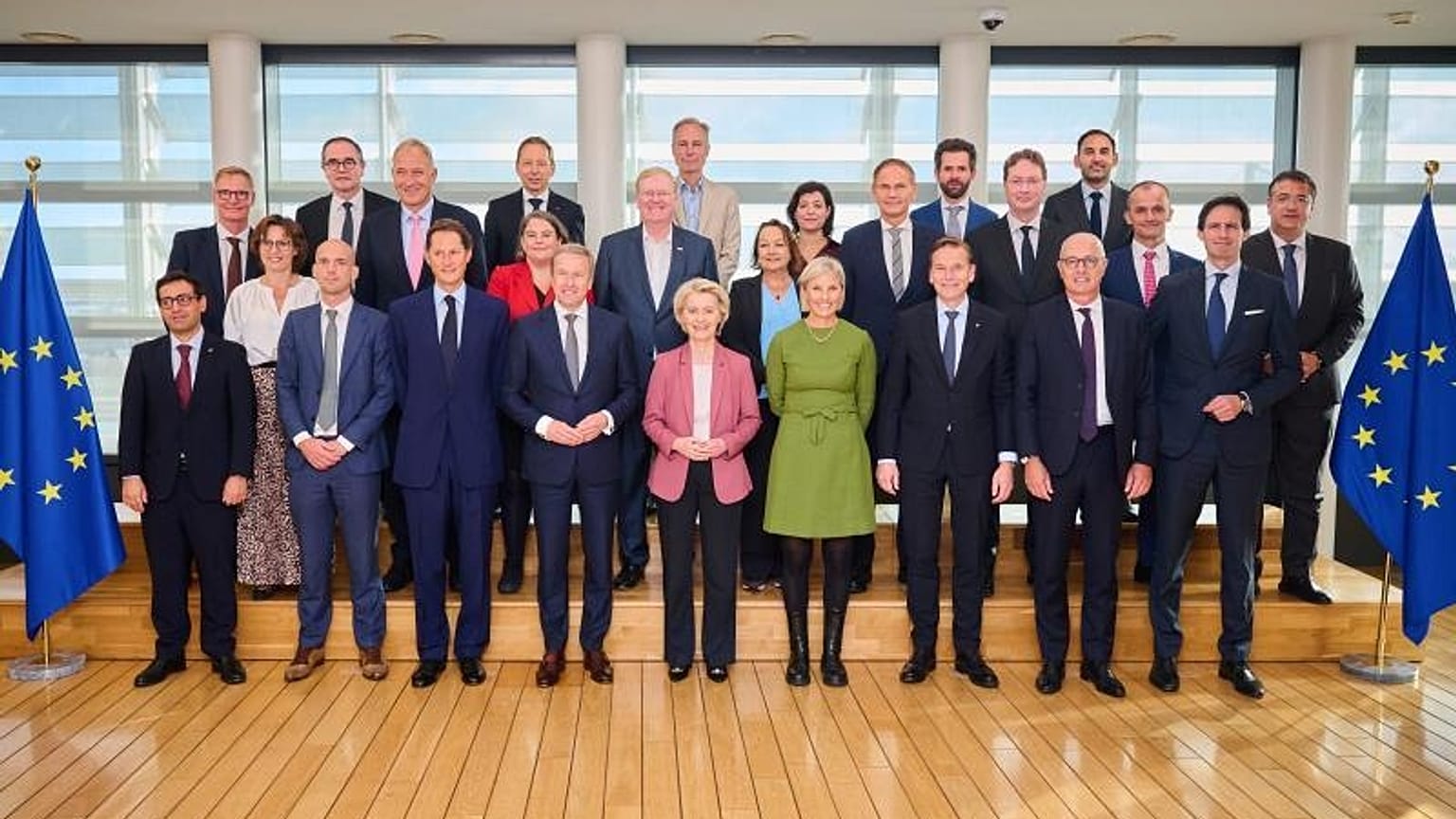
The meeting between the President of the EU Commission and top representatives of the automotive industry was highly anticipated. Brussels stood firm by its CO2 targets until 2035.
A high-level industry summit in Brussels on Friday has confirmed the clear strategic focus on electric cars in Europe.
“No matter what, the future is electric,” a person with knowledge of the talks between EU Commission president Ursula von der Leyen with top executives of the automotive sector told Euronews.
“The industry is extremely aware of the need to transition,” the person who asked not to be identified added.
Going into the meeting, European car manufacturers called for greater flexibility in the implementation of CO2 targets.
“But even if the Commission took down these targets, global competition would set them for the industry,” the person said.
Brussels is pursuing the goal of becoming climate neutral by 2050 and has, among other things, decided to phase out new vehicles with combustion engines by 2035.
In Friday’s talks the Commission seemed unwilling to move on the 2035 targets despite recent calls from business and politics for a departure from this goal.
"I know of no better technology than the electric car for advancing CO2 reduction in transportation in the coming years,” Audi CEO Gernot Döllner told German magazine Wirtschaftswoche.
Instead of emphasizing these advantages, new debates about preserving the combustion engine are constantly being kicked off – ”this is counterproductive and unsettles customers", he added.
A similar view was voiced by Michiel Langezaal, CEO of Fastned and president of ChargeUp Europe, who participated in the talks with von der Leyen.
"Ensuring that Europe can lead the e-mobility transformation globally requires more than standing robustly by a roadmap. It requires industry to have the courage to approach the challenges we face with a growth mindset and focus on the actions needed to make the transition towards e-mobility a success for people, industry and the environment," he told Euronews.
The Commission had convened the three-hour meeting as part of the “Strategic Dialogue” about the future of the car industry to address the current crisis. It was the third meeting of its kind since the beginning of the year.
The continent's car sector has taken a beating and is dealing with faltering sales, high energy prices, growing subsidised competition from China and a hostile trade environment due to US punitive tariffs.
Back in April, EU industry chief Stéphane Séjourné had described the sector as being “in mortal danger”.
"There is a risk that the future map of the global car industry will be drawn without Europe," Séjourné said then.
One of the biggest challenges remains the implementation of the European climate policy.
“The market share of battery electric passenger cars in EU-27 was at 15.6% and at 9% for vans. Widespread mass-market adoption has not happened yet. And it will not happen if we don’t speed up the infrastructure and bring down the total cost of ownership,” Sigrid de Vries, director general of the European Automobile Manufacturers' Association (ACEA) told Euronews.
“But governments and regulators have not invested in, nor demanded, sufficient levels of infrastructure and grid upgrades and incentives remain inconsistent. The consequence: the regulatory targets are no longer achievable,” she added.
For zero-emission vehicles to become an obvious choice for consumers and businesses, carmakers believe that purchasing or using these vehicles need to be more attractive than those with internal combustion engines.
That requires consistent purchase incentives, fairer taxation, lower charging costs and easier access to cities.
At the same time, Europe must accelerate charging and refuelling infrastructure, especially for heavy-duty vehicles, while modernising grids and reforming energy markets to bring down electricity prices – this is one of the key demands of the industry.
The automotive industry, a cornerstone of the European economy, employs over 13 million people (direct and indirect jobs) and contributes approximately 7% to the EU's GDP.


No comments:
Post a Comment