Australian critical minerals firms flock to US opportunities
Some of Australia’s most advanced critical minerals producers are moving forward on plans to build processing facilities in the United States, despite Australia’s strategic push to build up its own domestic industry.

An Australian delegation of critical minerals companies visited Washington and New York last week to meet senior administration officials and investors. ASX-listed firms including Australian Strategic Materials, Ionic Rare Earths, and International Graphite are looking to expand in the US, company executives told Reuters.
The scale of the US customer base is a major attraction, they said, given its rapidly developing electric vehicle, defence, and advanced manufacturing industries, as well as cheap energy and the hefty subsidies it is set to deploy.
“We’ve identified six states as ones that we’re looking at seriously,” said chief legal officer Annaliese Eames of ASM, which is seeking to expand beyond its rare earths metallization plant in Korea.
Of those states, ASM, an $85 million firm, is conducting detailed due diligence, including reviewing sites, in Oklahoma and South Carolina.
What drew ASM to the US was more than strong federal and state support and incentives. “It’s the commitment that they’re making to grow the entire ecosystem,” she said.
Some critical minerals firms that supply to customers in defence need to locate nearby for reasons of national security and the series of complex steps in turning raw materials into magnets used in everything from wind power to missiles.
That is the case for Ionic Rare Earths, which is planning to replicate the magnet recycling technology it has developed in Belfast in several US states, including Tennessee, where it is in advanced discussions, managing director Tim Harrison said.
“There are a number of other states that can provide very low cost of power… They also have a lower labour cost base and they have both federal and state governments that are willing to deploy immense funding,” he told Reuters.
International Graphite, which is building an advanced processing plant in Western Australia, is also looking at options to build in the US and Europe, to be more closely aligned to the specific requirements of its customers, CEO Andrew Worland said.
China’s restrictions on rare earths exports in April galvanized the US to supercharge its rare earths industry, and higher Western world prices that have emerged are attracting investors and greasing the wheels of project finance.
Even so, access to US funding is expected to be highly competitive. Australia’s Lynas Rare Earths, the biggest supplier outside China, warned last month that its heavy rare earths processing plant in Texas may not go ahead after the Trump administration provided multibillion dollar funding to its US rival.
Policy challenges
The trend highlights critical policy challenges in Australia that are impeding the government’s ambition to develop new export markets beyond its mainstay fossil fuels. That opportunity was worth A$170 billion ($112 billion) to its economy by 2040, according to a PwC report as recently as 2023.
“Australia has been struggling to set up the critical minerals industry beyond primary extraction,” PwC Australia chief economist Amy Lomas said.
Australia’s high power and labour costs, and a cumbersome approvals process, are dragging on growth and diminishing the country’s international competitiveness, major miners regularly complain. Meanwhile, advanced manufacturing is still a small sector, its development clipped by the closure of Australia’s car industry in the 2010s.
“For an Australian company to look at building it in Australia, where do we sell our materials? Where is the metals, alloys, magnet capacity being built? It’s not being built in Australia because our cost base is too expensive and we have minimal advanced manufacturing industry,” Ionic’s Harrison said.
Still, Australia passed a A$17 billion production tax credit in February that will provide a 10% offset for critical minerals processors from 2027. It is also building critical minerals partnerships with allies including Japan, India and Britain that could deepen its customer base, PwC’s Lomas added.
“Then that starts to set the foundations for Australia to be able to run a lot harder typically for midstream processing, and then ideally downstream processing,” she said.
($1 = 1.5177 Australian dollars)
(By Melanie Burton; Editing by Stephen Coates)
G7 mulls rare earth price floors, other measures to counter China

The Group of Seven (G7) nations and the European Union are said to be discussing the idea of imposing price floors on rare earths to counter China’s dominance in the supply chain, Reuters reported on Wednesday.
A price floor, if imposed, would provide greater incentives for producers of rare earths and related products in those regions, which for decades have relied on Chinese supply. Rare earths, which are difficult to extract and expensive to process, are key to many high-tech products, including cell phones, EVs and defense applications.
China currently dominates the global mine supply of rare earths and controls over 90% of their total processing capacity. This forces the G7 nations, with the exception of Japan, to their supply rare earths and related products such as permanent magnets, which are used in wind turbines and electric vehicles, exclusively from China.
According to Reuters, G7 leaders recently met in Chicago to address their over-reliance on Chinese supply. “The heart of the conversation was whether to raise the bar on regulation of foreign investment in critical materials in order to avoid companies going to China,” said one of its sources.
Another option would be to introduce geographical restrictions that limit sourcing from select countries like China, though not all G7 leaders were convinced, the source added.
During these talks, the idea of a price floor backed by government subsidies, which the US introduced in late July, was brought up. One of its sources said Canada responded “positively” to this approach. Australia, too, is separately considering setting a price floor.
Sources said the group also discussed a type of carbon tax or tariff on Chinese exports of rare earths based on the percentage of non-renewable energy used in their production.
The discussion comes months after China leveraged its near-monopoly status at the height of the global trade war by imposing export controls on rare earths and related magnets. While exports have since surged as trade tensions subsided, Western nations remain concerned over the security of supply, and many end-users in the EU have been choked off and face the risk of shutdown.
China rare earths issue remains unresolved, US lawmaker says
The US-China dispute over Beijing’s control of rare earth supplies has yet to be resolved, the head of a visiting US congressional delegation said after meeting Chinese officials, signaling a key irritant persists in bilateral relations.
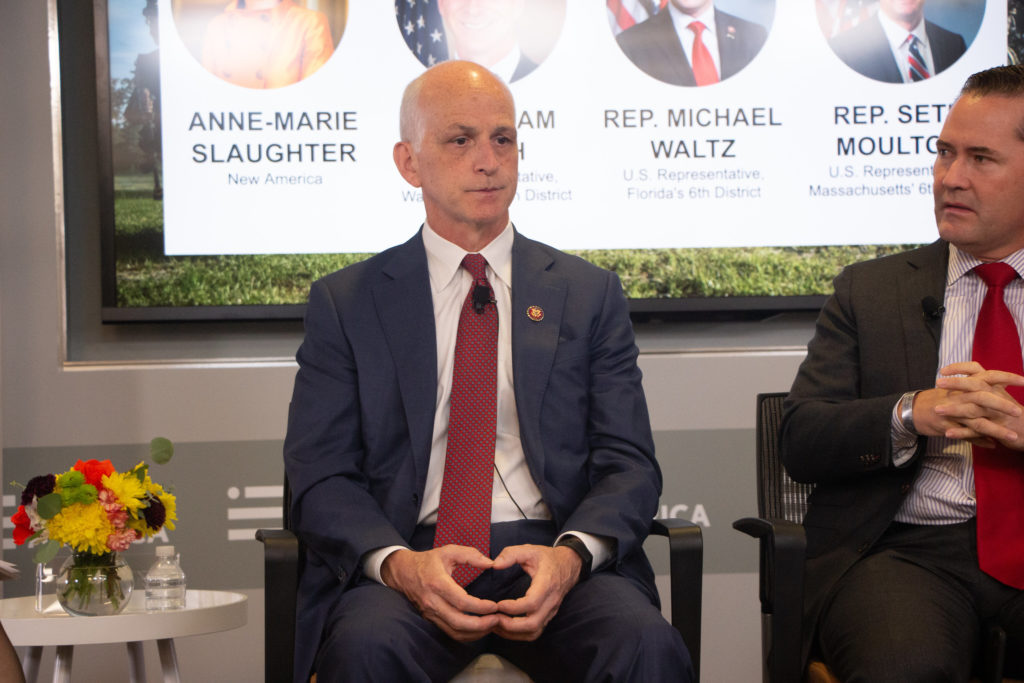
Representative Adam Smith described continuing challenges on the matter in a press briefing on Tuesday in the Chinese capital, where he’s leading the first official visit by US House lawmakers since 2019 as relations steady before a potential meeting between the countries’ presidents.
“I don’t think we resolved the rare earth question,” Smith said, without specifying what the sticking points are. “I think that that still needs to be worked on.”
China dominates the global supply and processing of the minerals, which are vital for everything from electric vehicles to advanced weaponry. Beijing has used its position as a strategic lever as trade tensions with the Trump administration escalated earlier this year.
The two governments reached a framework agreement in June that includes a Chinese commitment to review applications for shipping rare earth magnets, although few details of the deal have been disclosed. US Trade Representative Jamieson Greer last week said supplies to his country had “bounced back up significantly,” although European companies have complained about shortages that threaten to halt production.
Smith also struck a note of caution in response to a reporter’s question about whether Beijing-based ByteDance Ltd. will have any role in maintaining the app’s algorithm in the US. Citing privacy and security concerns, he said the matter has “not been 100% resolved,” while adding that he wasn’t privy to the negotiations.
The US and China are nearing an agreement to hive off the US operations of social media platform TikTok to a consortium that includes software giant Oracle Corp. Under the spin-off arrangement being discussed, TikTok will be majority-owned and controlled by Americans, according to White House Press Secretary Karoline Leavitt. Many of the finer details of the agreement have yet to be made public.
Joined by US Ambassador to China David Perdue, the delegation’s visit may build more goodwill ahead of a possible sitdown between US President Donald Trump and Chinese President Xi Jinping next month in South Korea. Throughout the trip, both sides expressed support for more engagements, with Beijing Mayor Yin Yong calling for more sub-national exchanges in a Wednesday meeting.
The world’s two largest economies are in the final stages of negotiations for a “huge” Boeing Co. aircraft order, Perdue said at the Tuesday briefing. Such a deal, which has been years in the making, would be the centerpiece of a trade agreement between the two nations but has been contingent on an easing in tensions.
On the security front, Smith, the top Democrat on the House Armed Services Committee, urged Beijing to engage in talks over its “rapidly growing nuclear arsenal” to prevent miscalculation.
“When you’re getting up into the hundreds, close to 1,000 on nuclear weapons, it’s time to start having a conversation about it to make sure that we understand each other,” Smith said. He stressed the need for better military-to-military dialogue, a message he delivered in meetings with Chinese officials including Premier Li Qiang since the delegation arrived on Sunday.
During the trip, the US delegation has also discussed the flow of fentanyl and called for fair access to China’s market for US firms.
The group met with National People’s Congress Chairman Zhao Leji and Foreign Minister Wang Yi later on Tuesday.
Wang praised the exchanges between the two heads of state for steadying relations and called on both sides to uphold them.
“Their conversations have set the tone and chartered the course for the bilateral relationship. In the recent period, this relationship has stabilized,” Wang said in his opening remarks. “This is not easy. We need to preserve this.”

No comments:
Post a Comment