It’s possible that I shall make an ass of myself. But in that case one can always get out of it with a little dialectic. I have, of course, so worded my proposition as to be right either way (K.Marx, Letter to F.Engels on the Indian Mutiny)
Twenty-year renewal sees Darlington become longest-licensed Canadian plant
As the refurbishment of the Darlington nuclear power plant nears completion, the Canadian nuclear regulator has announced it is authorising the plant to continue operating until 2045.
(Image: OPG)
The Canadian Nuclear Safety Commission (CNSC) said it made its decision to renew the licence for the four-unit Candu plant after considering submissions from Ontario Power Generation (OPG), CNSC staff and 79 intervenors during a two-part public hearing held earlier this year, saying it concluded that "OPG remains qualified to carry on the activities that the renewed licence will authorise".
There are no changes to OPG's licensed activities under the renewed licence, the CNSC said, although the decision includes a requirement for OPG to provide two comprehensive performance updates to the Commission on the conduct of its licensed activities, as well as a new licence condition that requires OPG to continue its engagement with Indigenous Nations and communities throughout the licence period.
Candu units are pressurised heavy water reactors designed to operate for 30 years before refurbishment. Refurbishment is a major undertaking: it includes the replacement of key reactor components such as steam generators, pressure tubes, calandria tubes and feeder tubes, and involves removing all the reactor's fuel and heavy water and isolating it from the rest of the power station before it is dismantled. Thousands of components are inspected before the plant is rebuilt and is ready for another 30 years of operation.
Three of the four units at Darlington are currently in operation, having undergone refurbishment. The fourth unit is due to return to service in 2026, completing a 10-year execution phase which OPG says has exceeded all safety, quality, schedule, and financial forecasts.
"The longest-ever licence term for a Canadian nuclear station reflects the strong performance of the Darlington station, the proficiency of our highly skilled workers, and OPG's continued commitment to safety and operational excellence," OPG President and CEO Nicolle Butcher said. "Under this licence, Darlington will continue to safely and reliably produce electricity to help meet Ontario’s energy needs for decades to come."
The plant's current licence expires on 30 November.
Study confirms feasibility of Xe-100 SMR for Alberta
The study by X-energy Canada has confirmed the feasibility and benefits of repurposing an existing thermal generation site in Alberta with X-energy's small modular reactors, and establishes a foundation for further planning and regulatory engagement to support future deployment.
TransAlta's Keephills thermal plant in Alberta has been converted from coal to natural gas (Image: TransAlta)
The study was funded by Emissions Reduction Alberta through the Government of Alberta's TIER fund, and conducted with TransAlta, Hatch, PCL, and Kinectrics. It found "significant alignment between the province's unique energy and industrial profile and the attributes of the Xe-100" and identified areas where X-energy's technology can directly support the province's energy economy and long-term competitiveness.
It found that the Xe-100 high-temperature gas-cooled reactor is uniquely suited to Alberta's energy needs. As well as producing electricity, it is specifically designed to provide 565°C heat and steam for industrial applications, unlocking a broad range of use cases for Alberta's industrial and oil and gas sectors, the company said. The province's established supply chain capabilities are well-positioned to support the manufacturing and construction of the technology, while the Xe-100's design means it can use air-cooling systems, significantly reducing overall water usage, and offering greater siting flexibility over conventional light-water reactors.
Canada gets about 15% of its electricity from nuclear power with 17 reactors, mostly in Ontaria, providing 12.7 GWe of power capacity. Alberta does not have any nuclear power capacity, but in 2021 the province signed a memorandum of understanding with Ontario, New Brunswick and Saskatchewan to collaborate on small modular reactor (SMR) development, and has signed MoUs with several SMR developers. Energy Alberta has proposed building a nuclear power plant based on large-scale Candu Monark reactors at a site in the Peace River area of Northern Alberta.
In August, the province launched a public engagement initiative and public survey about nuclear energy's potential to meet future energy needs, with Alberta Premier Danielle Smith saying the government sees "tremendous potential" for nuclear in the province.
"Alberta is uniquely suited to leverage the benefits of the Xe-100 with a strong industrial base, skilled workforce, and unmatched energy expertise,". X-energy's Senior Vice President and Deputy Chief Commercial Officer Ben Reinke said. "We look forward to working with provincial and community leaders to explore Xe-100 applications in the province, and its potential to support critical Canadian industries with clean, reliable, and safe energy."
X-energy Canada is a subsidiary of X-energy Reactor Company, LLC. X-energy is advancing the Xe-100 as a grid-scale energy solution for utilities, industrial customers, and hyperscalers. Its first proposed plant at Dow's Seadrift site in Texas will provide the site with both power and high-temperature steam. Following that project, X-energy and Amazon have committed to deploy 5 GW by 2039, beginning in Washington state with Energy Northwest. X-energy has also recently announced an agreement with Centrica to deploy 6 GW in the UK.
TransAlta Corporation is one of Canada's largest publicly traded power generators, owning and operating a diverse fleet across Canada, the United States and Western Australia. The company completed the phaseout of all of its Canadian coal-fired generating capacity in 2021, when it converted the third unit of its Keephills power plant in Alberta from thermal coal to natural gas. The company retired some 3,794 MW of coal-fired generation capacity in Canada between 2018 and 2021.
IAEA issues fresh warning over drones near nuclear plants
The International Atomic Energy Agency has said drones flew within a few hundred metres of the South Ukraine Nuclear Power Plant, underlining the continued risks to nuclear safety from the on-going war. Meanwhile Zaporizhzhia Nuclear Power Plant continues to have to rely on emergency diesel generators after a loss of off-site power.
A file photo of the South Ukraine NPP (Image: Energoatom)
International Atomic Energy Agency (IAEA) experts stationed at the three-unit South Ukraine nuclear power plant were told that 22 unmanned aerial vehicles were observed on Wednesday night and Thursday morning within its monitoring zone, "some coming as close as half a kilometre from the site", the agency said.
"From their accommodation near the plant, IAEA team members heard gunfire and explosions around 01:00 am local time and today (Thursday) they visited the location where one of the drones had come down, observing a crater measuring four square metres at the surface and with a depth of around one metre," the agency's statement said.
"Once again drones are flying far too close to nuclear power plants, putting nuclear safety at risk. Fortunately, last night’s incident did not result in any damage to the South Ukraine Nuclear Power Plant itself. Next time we may not be so lucky. I continue to urge both sides to show maximum military restraint around all important nuclear facilities," IAEA Director General Rafael Mariano Grossi said.
"For more than three and a half years, the IAEA has been doing everything in its power to help prevent a nuclear accident during this devastating war. We will only be able to say that our mission was successful if the war ends without a serious nuclear accident. Our indispensable work is far from finished."
Meanwhile Zaporizhzhia Nuclear Power Plant has been without external power for more than 48 hours and has been relying on its fleet of emergency diesel generators. The IAEA said "the plant said it has the necessary spare parts and personnel to repair the line once the military situation permits. Ukraine has informed the Agency that it is also prepared to repair damages to a backup power line, when the military situation permits".
Following the loss of off-site power all 18 available emergency generators started operating, with the number reduced to those required to provide power to the site - seven - helping to preserve the diesel fuel. The IAEA has been told previously that 20 days' worth of fuel was stored at the site.
Zaporizhzhia Nuclear Power Plant has been under Russian military control since early March 2022 and is on the frontline of Russian and Ukrainian forces.
New nuclear financing models need to be developed, says Putin
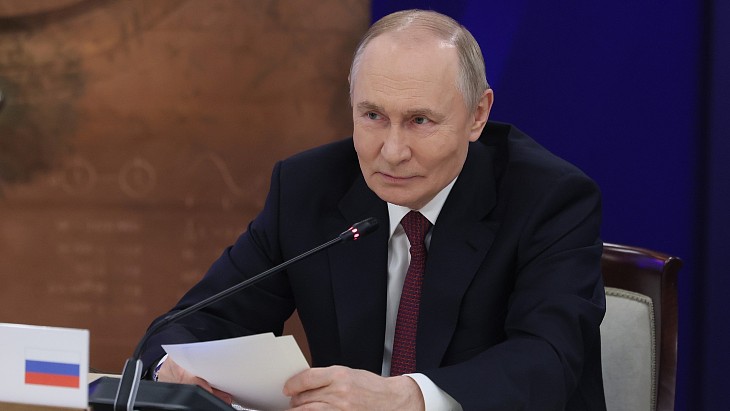
Russia’s President Vladimir Putin has told World Atomic Week in Moscow that he sees peaceful nuclear technologies "as the basis for international cooperation and bringing states closer together".
(Image: Kremlin)
Speaking on the first day of the event, the president noted the projected increase in demand for new nuclear capacity in the coming decades and said "the growth in demand for peaceful nuclear energy will be driven largely by countries in the Global South and East, which are strengthening their technological and industrial potential".
He said that Russia supported these countries' ambitions, and said Russia rejected "so-called technological colonialism. We don't make our partners dependent on Russian technical solutions. Instead, we help them create their own sovereign national nuclear industry, including training personnel and establishing centers of excellence".
He said that it was "equal access to technology, including in the peaceful nuclear sector, that can ensure dynamic, yet equitable, and sustainable global development ... we view peaceful nuclear technologies as a foundation for broad international cooperation and for bringing states closer together".
The president also talked about finance, saying: "It is clear that the construction of nuclear power plants requires significant resources, which means the risks and benefits must be balanced among the main participants in such projects - states, investors, and consumers. I believe it is essential to develop modern models for financing the construction of nuclear power plants and to involve international financial institutions and development banks in such projects.
"I would like to add in this regard that earlier this year, the New Development Bank, created by the BRICS countries, confirmed its readiness to finance nuclear projects." (BRICS is a multilateral organisation of emerging economies with current members being Brazil, Russia, India, China, South Africa, Egypt, Ethiopia, Iran, Indonesia, Saudi Arabia and the United Arab Emirates).
He referred to estimates that, in the very long term, uranium resources were finite, and said Russia aimed to "launch the world's first nuclear energy system with a closed fuel cycle" in Tomsk, which would see 95% of used fuel reused repeatedly in reactors, thus helping solve the issues of radioactive waste and also of uranium resources.
The World Atomic Week International Forum, marking the 80th anniversary of the Russian nuclear industry, is taking place in Moscow from 25-28 September. A series of deals and announcements were made on the first day including:
Rosatom and the Beijing Research Institute of Uranium Geology signed an agreement providing access to, and exchange, of information on field testing at the Beishan Underground Research Laboratory, relating to the final disposal of high-level radioactive waste in underground repositories.
Rosatom and the Ethiopian Electric Power Corporation signed an action plan for developing a nuclear power plant project in Ethiopia. It creates a working group to prepare a roadmap for a feasibility study and intergovernmental agreement.
A contract was signed between Rosatom and the Belarusian Nuclear Power Plant Unitary Enterprise to cover the 'blanaced nuclear fuel cycle' at the Belarus plant - with Russian companies taking and reprocessing used fuel and Belarusian companies then accepting the reprocessed fuel.
Rosatom Technical Academy signed a memorandum of understanding with Myanmar's Yangon Technological University, which provides for the development of "joint educational programmes, the exchange of curriculum and teaching materials, as well as joint research on advanced nuclear facilities and participation in international projects".
Altynbek Rysbekov, Deputy Minister of Energy of Kyrgyzstan, said the country was working with Rosatom "to determine which areas could [be] suitable for a nuclear power plant and what capacity it should have", according to the in-house Strana Rosatom publication.
Russia's Rosatom and Iran's Atomic Energy Organisation signed a memorandum of understanding for cooperation in the building of small modular reactors in Iran.
International Atomic Energy Agency Director General Rafael Mariano Grossi was among those attending World Atomic Week, and he also held talks with President Putin at the Kremlin, focusing on a range of issues including on-going safety concerns about the Zaporizhzhia and other nuclear power plants amid the war between Russia and Ukraine.
On financing, the IAEA leader proposed a memorandum of understanding between the agency and the BRICS' New Development Bank. The organisation has arranged a similar partnership with the World Bank since it ended its longstanding ban on investing in nuclear energy-related projects.
Centrus announces plans for Piketon expansion
The major expansion of Centrus Energy's uranium enrichment plant in Ohio is expected to boost production of both low-enriched and high-assay low-enriched uranium.
(Image: Centrus)
The plan was unveiled by Centrus Energy alongside Ohio Governor Mike DeWine, Senator Jon Husted, Congressman Dave Taylor, JobsOhio, Ohio Southeast Economic Development (OhioSE), and Pike County Economic Development. The expansion is expected to create 1,000 construction jobs and 300 new operations jobs at the site: JobsOhio and OhioSE will be long-term partners to Centrus as the company ramps up recruiting and hiring to fill those positions.
The size and scope of the expansion will depend on federal funding decisions for low-enriched uranium (LEU) and high-assay low-enriched uranium (HALEU), Centrus said, but noted that a large-scale expansion "would represent a multi-billion-dollar private and public investment into Ohio."
Centrus said it has already raised more than USD2 billion over the past 12 months through convertible note transactions and secured more than USD2 billion in contingent purchase commitments from utility customers in the USA and around the world in anticipation of the expansion. It has also announced collaborations with Korea Hydro & Nuclear Power and POSCO International to potentially invest in the project.
The company has submitted proposals to the US Department of Energy as part of a competitive selection process for potential awards to expand domestic production of LEU for existing reactors and HALEU for advanced reactors. Subject to being selected for the federal funding, Centrus's expansion plans call for a multi-billion-dollar public and private investment to add thousands of additional centrifuges at its American Centrifuge Plant to deliver large-scale production of both LEU and HALEU, it said.
The company will manufacture its centrifuges in Oak Ridge, Tennessee. The centrifuges and supporting equipment will then be sent to Piketon for final assembly, installation and operation.
"The time has come to restore America's ability to enrich uranium at scale," said Centrus CEO Amir Vexler. "We are planning a historic, multi-billion-dollar investment right here in Ohio - supported by a nationwide supply chain to do just that. When it comes to powering our energy future, it's time to stop relying on foreign, state-owned corporations and start investing in American technology, built by American workers."
"Centrus's commitment to expand and upgrade its Piketon facility underscores Ohio's importance in supporting our nation's economic and national security," Ohio Governor Mike DeWine said. "Uranium enrichment operations in Piketon have played a critical role in US national defence since the earliest days of the Cold War, and Centrus' facility provides the only technology available today capable of building out domestic enrichment at an industrial scale."
Centrus has already begun hiring in anticipation of the expansion.
PM Modi inaugurates Mahi Banswara nuclear project
The four-unit Mahi Banswara plant is one of a host of central and state governmental projects ceremonially inaugurated by India's Prime Minister Narendra Modi in Rajasthan.
PM Modi at the ceremony (Image taken from PM India Youtube)
The Mahi Banswara Rajasthan Atomic Power Project will comprise four 700 MWe pressurised heavy water reactors (PHWRs) designed by Nuclear Power Corporation of India Ltd (NPCIL), and is part of India's fleet mode initiative to build ten identical 700 MWe reactors at various locations across India under uniform design and procurement plans, an approach the Indian government says will bring in cost efficiencies and speed deployment, while consolidating operational expertise.
The Mahi Banswara units are to be developed under Anushakti Vidhyut Nigam Ltd (Ashvini), a joint venture between NPCIL and National Thermal Power Corporation (NTPC). Formation of the 51% NPCIL:49% NTPC joint venture set up to construct, own and operate nuclear power plants in India received approval from the government last year.
Earlier this year, India's Atomic Energy Regulatory Board (AERB) gave its consent to NPCIL for the siting of the reactors, near the village of Napla, the first major stage in its licensing process for a nuclear facility. That consent was transferred to Ashvini earlier this month.
The other reactors that make up the ten planned units are Kaiga units 5 and 6 (in Karnataka), Gorakhpur units 3 and 4 (Haryana), and Chutka units 1 and 2 (Madhyar Pradesh). Two 700 MWe PHWR units at Kakrapar, in Gujurat, are already in commercial operation. Another, Rajasthan unit 7, was connected to the grid in March, and construction is ongoing on Rajasthan unit 8.
The foundation stone laying ceremony in Banswara saw the Prime Minister inaugurate some INR1,22,100 crore (USD18.8 billion - 1 crore is 10 million) of projects. As well as the nuclear power plant, these included INR19,210 crore of solar projects and three power transmission projects worth over INR13,180 crore, as well as substations and other infrastructure projects.
"In today's era of technology and industry, development runs on the power of electricity; electricity brings light, speed, progress, connectivity, and global access," Modi said at the ceremony. For any nation to achieve rapid development in the 21st century, it must scale up its electricity generation, he said - and the most successful countries will be those leading in clean energy. "Our government is transforming the clean energy mission into a people's movement", he added.
Fermi America Secures Siemens Energy Deal for 1.1 GW Gas and Nuclear Tech
Fermi America, in partnership with the Texas Tech University System, has signed two letters of intent with Siemens Energy to secure 1.1 gigawatts of gas-fired generation equipment and collaborate on advanced nuclear steam turbine technology, marking a major step in the company’s plan to develop an 11 GW energy campus tailored to artificial intelligence (AI) demand.
The agreements, signed in New York, call for Siemens Energy to deliver three F-class SGT6-5000F gas turbines—capable of producing up to 1.1 GW in combined cycle mode—for delivery in 2026. These machines are designed for round-the-clock, base-load power, and add to Fermi’s total of 2 GW of secured or contracted natural gas generation capacity for its site.
The second agreement expands collaboration on Siemens’ nuclear steam turbines, generators, and control systems. These would be integrated into Fermi’s nuclear portfolio, which is expected to include four Westinghouse AP1000 reactors. Siemens Energy has previously modernized turbine systems at several U.S. nuclear plants, underscoring its role in supporting new nuclear deployment.
Fermi America’s 11 GW campus is being positioned as a flagship energy hub to meet surging demand from AI and high-performance computing. The company is pairing quickly deployable natural gas plants with long-term nuclear generation, aiming to provide highly reliable, always-on power without burdening the broader U.S. grid.
The project is being promoted as central to the Trump administration’s energy dominance agenda, which prioritizes expanding domestic natural gas generation, accelerating nuclear licensing, and securing strategic energy infrastructure for the AI economy.
“Winning the AI arms race doesn’t just take software developers. It takes more electricity,” said Doug Burgum, chairman of the National Energy Dominance Council. Former U.S. Secretary of Energy and Fermi co-founder Rick Perry added that the federal government is working closely with private-sector partners to ensure the U.S. leads in both AI and energy capacity.
Fermi America CEO Toby Neugebauer said the company is delivering on President Trump’s directive to build “highly reliable, unshakable base load energy” through its gas-nuclear buildout.
The Siemens Energy agreements reinforce a broader push to revive the U.S. nuclear industrial base, expand natural gas capacity, and ensure energy reliability for the data-driven economy. If completed, the 11 GW campus would be one of the largest integrated gas and nuclear power projects in the U.S.
By Charles Kennedy for Oilprice.com
Giant Oil Trader Begins Physical Trading In Uranium
Switzerland-based Mercuria has been increasingly investing in the metals business in recent years, using profits it raked in from high oil prices a couple of years ago.
The World Nuclear Association has predicted that demand for nuclear fuel will double by 2040 as technology companies scramble for energy to support AI and governments pursue zero-carbon targets.
Giant oil and gas trader Mercuria reportedly has begun physical trading in uranium, becoming the first major commodity company to do so.
Giant oil and gas trader Mercuria reportedly has begun physical trading in uranium, becoming the first major commodity company to do so, according to Reuters. If officially confirmed, which it has not been, it will mean that Mercuria joins the ranks of Wall Street banker Citibank, Natixis (part of French financial group BPCE) and other deep-pocketed traders who are betting on a nuclear energy boom driven by surging global electricity demand.
The World Nuclear Association has predicted that demand for nuclear fuel will double by 2040 as technology companies scramble for energy to support AI and governments pursue zero-carbon targets.
Switzerland-based Mercuria has been increasingly investing in the metals business in recent years, using profits it raked in from high oil prices a couple of years ago. The uranium market is still small compared to commodities like oil, natural gas, copper, and aluminium, which are the fortéof Mercuria, Trafigura, Glencore, and other large commodity traders.
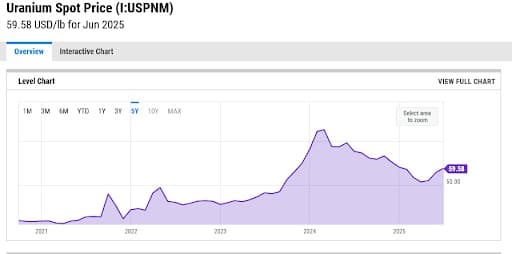
According to UxC, global utility demand for Uranium Oxide Concentrate (U3O8) clocked in at 175 million pounds in 2024, with 47 million pounds traded on the spot markets. Uranium prices have surged in recent years thanks to the global energy crisis. Citi analyst Arkady Gvorkyan has predicted that spot prices will hit $100 per pound in 2026 as miners struggle to keep up with the demand. Prices have pulled back from the all-time high of $106 reached in February 2024.
Source: Y-Charts
The uranium market is experiencing a structural supply deficit, creating potential challenges for nuclear operators. Unlike many commodities, uranium trading usually involves small volumes with specialized participants, making the nuclear fuel susceptible to significanturanium market volatility. Meanwhile, governments across the globe are repositioning nuclear as critical infrastructure rather than transitional tech.
These developments have forced uranium equities to re-rate sharply, with investors now recalibrating exposure to a sector long dismissed as too volatile, too political, or having an uncertain future. While uranium and nuclear stocks have pulled back from recent highs, the sector remains red-hot: the sector's popular benchmark, VanEck Uranium and Nuclear ETF (NYSEARCA:NLR) has returned 68.3% YTD, more than triple the 19.8% gain by the usually high-flying Technology Select Sector SPDR Fund (NYSEARCA:XLK), 6.4% by the Energy Select Sector SPDR Fund (NYSEARCA:XLE) and 12.5% by the S&P 500.
Uranium and nuclear stocks have easily outpaced the market : shares of advanced fission power plant developer, Oklo Inc. (NYSE:OKLO), have rocketed 459.4% in the year-to-date; Centrus Energy (NYSE:LEU) 357.1%, Energy Fuels Inc. (NYSE:UUUU) 235.9.4%, NuScale Power Corp. (NYSE:SMR) 112.0%, Uranium Energy Corp. (NYSE:UEC) 98.8%, Cameco Corp. (NYSE:CCJ) 66.8%, NANO Nuclear Energy (NASDAQ:NNE) 66.6%, BWX Technologies (NYSE:BWXT) 58.9%, VistraCorp. (NYSE:VST) 47.4% and NexGen Energy (NYSE:NXE) 34.0%.
Shares of California-based Oklo have been on a tear, gaining 1,340% over the past 52 weeks after the company announced a flurry of data center deals. Back in July, Oklo unveiled a partnership with Liberty Energy (NYSE:LBRT)wherein they will develop an integrated power solution for data center applications incorporating Oklo's Aurora powerhouse with Liberty's natural gas generation. The power plan will start with Liberty’s natural gas systems delivering quick energy. before shifting to Oklo’s clean nuclear generation over the long-term.
Around the same time, Oklo announced a partnershipwith Vertiv (NYSE:VRT) that will see them join forces to revolutionize data center operations. “This agreement is about delivering clean power, energy-efficient cooling, and infrastructure solutions purpose-built for AI factories, data centers, and high-density computers,” said Oklo CEO and co-founder Jacob DeWitte. Oklo later revealed that it was selected for three of the U.S. Department of Energy’s reactor pilot projects, part of the DoE’s initiative to modernize and streamline nuclear licensing.
Bank of America has downgraded Centrus' shares to Neutral from Buy but raised its price target to $285 from $210, citing valuation concerns after the huge runup. Centrus achieved the 900-kilogram production milestone of HALEU for Phase 2, and confirmed a contract extension with the DOE through June 2026. HALEU, or High-Assay Low-Enriched Uranium, is a type of nuclear fuel enriched to between 5% and 20% Uranium-235. This is a higher concentration than the low-enriched uranium (LEU) used in most current reactors (3-5%), but lower than the highly enriched uranium (HEU) used in naval reactors and weapons. HALEU is crucial for the development of advanced nuclear reactors, particularly small modular reactors (SMRs) and microreactors, due to its potential for increased efficiency, smaller reactor designs, and longer refueling intervals. By Alex Kimani for Oilprice.com
_48329.jpg)
_42938.jpg)
_66089.jpg)
_18572.jpg)
_10448.jpg)


No comments:
Post a Comment