Copyright AP Photo
By Gavin Blackburn
Published on 25/09/2025 - EURONEWS
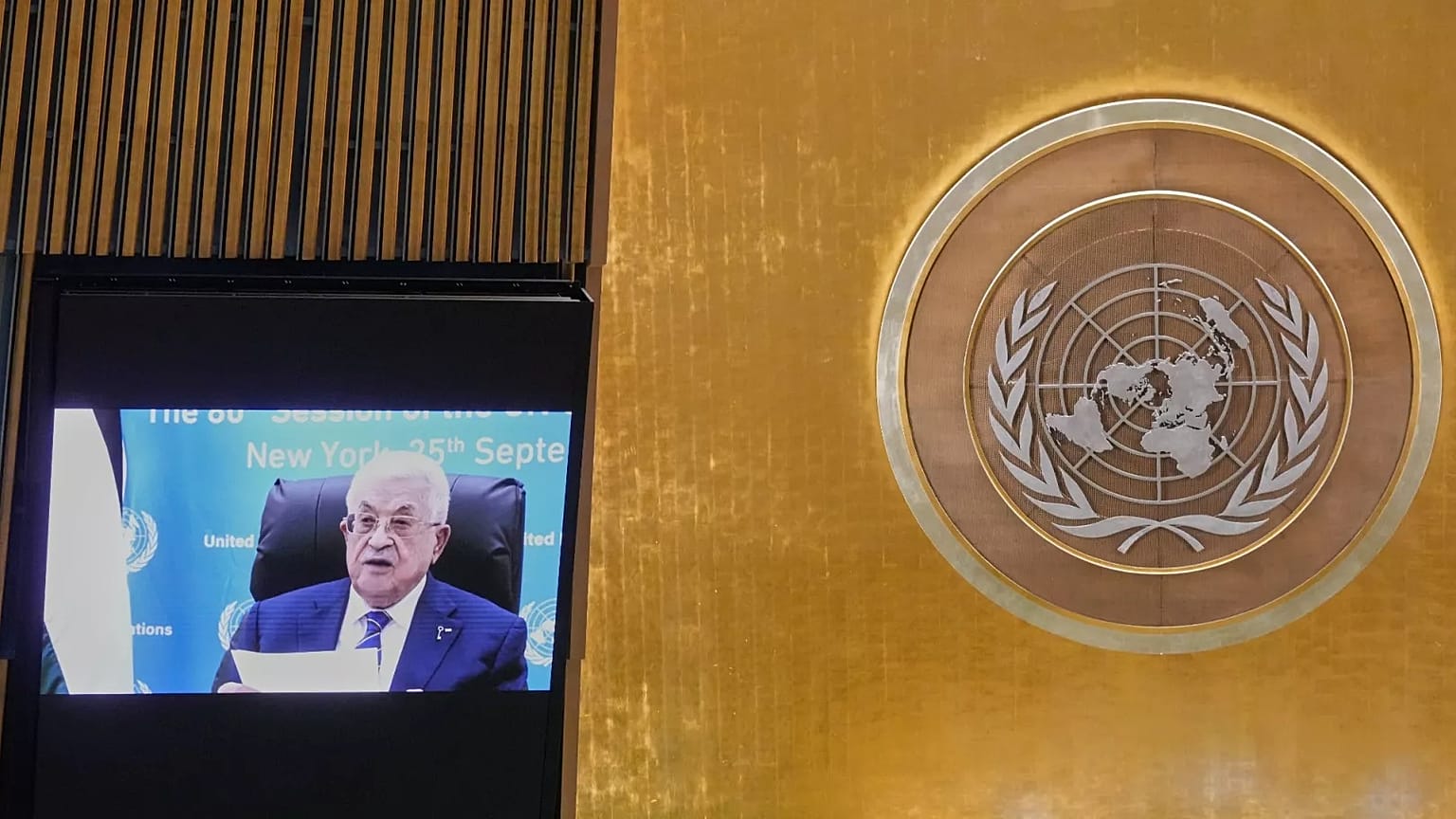
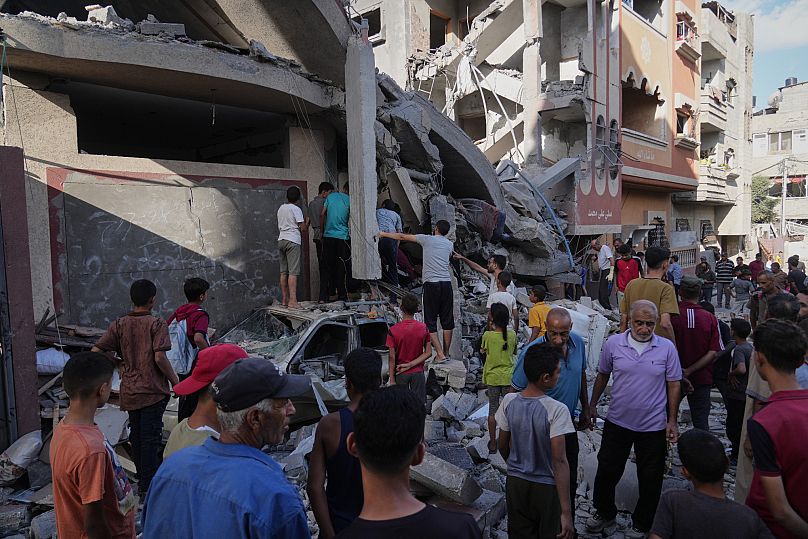
Speaking via video after the United States revoked his visa, Mahmoud Abbas told the UN General Assembly that Palestinians in Gaza "have been facing a war of genocide, destruction, starvation and displacement" by Israel.
His speech came as Israeli Prime Minister Benjamin Netanyahu heads to New York to give his own address in person on Friday.
After laying out in detail the death and destruction in Gaza, Abbas said the Palestinian Authority (PA) — which he presides over — rejects the incursion Hamas carried out on 7 October 2023 and that it does not represent their people.
In that attack, Hamas and other militant groups killed around 1,200 people, most of them civilians. A further 251 people were taken as hostages back to Gaza, where 48 are still being held, 20 of whom Israel believes are alive.
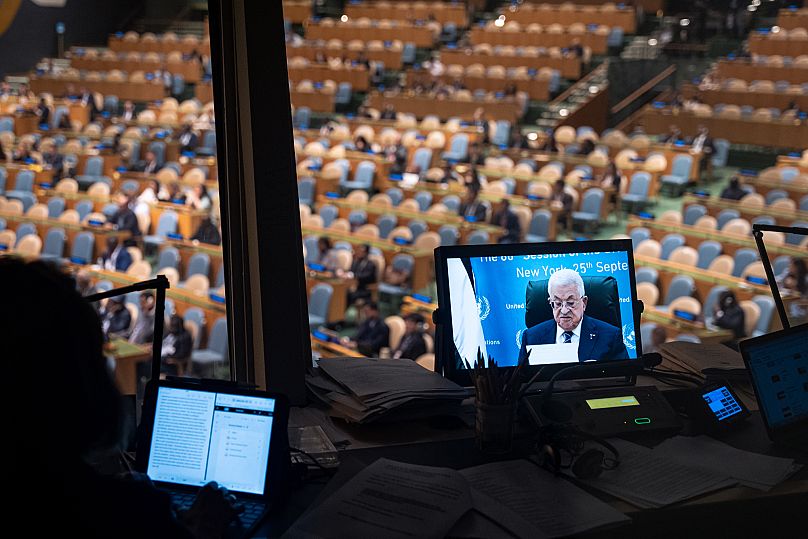
Abbas also laid out his vision for what government would look like in territories once the war is over, saying that the PA is "ready to bear full responsibility for governance and security."
He added that "Hamas will have no role to play in governance," and that it will have to hand over all weapons to the PA.
"There can be no justice if Palestine is not freed," Abbas said.
In a short but resolute speech, Abbas thanked the world leaders who have stood up for Palestinians throughout the Gaza war, saying that the recent recognition of Palestinian statehood has presented his people with hope for peace and an end to the conflict.
He welcomed recent announcements from France, the UK and Canada to recognise Palestine as an independent state and called on the remaining countries to do the same.
But, he added, that symbolic recognition is not enough to address the present moment.
"The time has come for the international community to do right by the Palestinian people, so that they may obtain their rights for their legitimate rights to be rid of the occupation and to not remain a hostage to the temperament of Israeli politics, which denies our rights and continue in their injustice, oppression and aggression," Abbas said.
Before concluding, he sent a message of hope to the Palestinian people, saying that no matter how long the suffering continues, "its results will not break our will to live and survive."
"The dawn of freedom will emerge, and the flag of Palestine will fly high in our skies as a symbol of dignity, steadfastness and being free from the occupation," Abbas said. "We will not leave our homeland. We will not leave our lands."
Abbas heads the PA, the government body run by the Fatah party which has partial civil control over areas in the occupied West Bank.
The PA also governed Gaza until elections in 2006 saw Hamas win the most seats but not enough for a clear majority.
A proposed power-sharing deal between Fatah and Hamas proved impossible to reach and in 2007, Hamas seized power, taking de facto control of the Strip and effectively splitting the Palestinian territories into two separate entities.
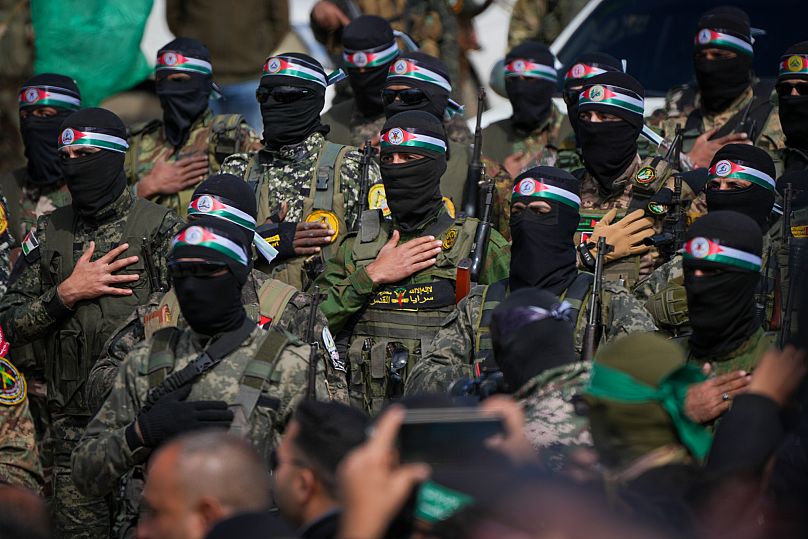
Since then there has been little in the way of collaboration between the two groups, and their political positions diverge significantly.
Fatah recognises Israel and is in favour of dialogue to resolve issues, while Hamas' ideology calls for the destruction of Israel and the restoration of traditional Palestinian lands.
Hamas, which describes itself as armed resistance, also sees Fatah as complicit in the Israeli occupation of the West Bank as both sides coordinate on security issues.
The rift between Fatah and Hamas has also led to the repeated postponement of legislative elections in Gaza, making the 2006 vote the last time to date that Palestininans in Gaza were able to choose their leaders.
Israel's FM Gideon Sa'ar says Abbas 'continues to encourage terrorism' after UNGA speech
Mahmoud Abbas heads the Palestinian Authority, the government body run by the Fatah party which has partial civil control over areas in the occupied West Bank.
Israel's Foreign Minister Gideon Sa’ar has said the Palestinian President Mahmoud Abbas "continues to encourage terrorism" following his speech on Thursday to the UN General Assembly.
"Mahmoud Abbas, in his Zoom speech to the UN General Assembly, said that he is ready to receive the Gaza Strip, which he so easily lost to Hamas in 2007. How nice of him," Sa’ar said in a post on X.
"Not only does he not fulfill the commitment — on the basis of which the Palestinian Authority was established — to fight terrorism. He also continues to encourage terrorism by paying salaries to terrorists and their families."
Abbas told world leaders on Thursday that his people "reject" the 2023 Hamas-led attack on Israel and pledged that the militant group would have no role in governing Gaza after the ongoing Israel-Hamas war ends.
Speaking via video after the United States revoked his visa, Mahmoud Abbas told the UN General Assembly that Palestinians in Gaza "have been facing a war of genocide, destruction, starvation and displacement" by Israel.
His speech came as Israeli Prime Minister Benjamin Netanyahu heads to New York to give his own address in person on Friday.
After laying out in detail the death and destruction in Gaza, Abbas said the Palestinian Authority (PA) — which he presides over — rejects the incursion Hamas carried out on 7 October 2023 and that it does not represent their people.
In that attack, Hamas and other militant groups killed around 1,200 people, most of them civilians. A further 251 people were taken as hostages back to Gaza, where 48 are still being held, 20 of whom Israel believes are alive.
Abbas also laid out his vision for what government would look like in territories once the war is over, saying that the PA is "ready to bear full responsibility for governance and security.
He added that "Hamas will have no role to play in governance," and that it will have to hand over all weapons to the PA.
"There can be no justice if Palestine is not freed," Abbas said.
In a short but resolute speech, Abbas thanked the world leaders who have stood up for Palestinians throughout the Gaza war, saying that the recent recognition of Palestinian statehood has presented his people with hope for peace and an end to the conflict.
He welcomed recent announcements from France, the UK and Canada to recognise Palestine as an independent state and called on the remaining countries to do the same.
But, he added, that symbolic recognition is not enough to address the present moment.
"The time has come for the international community to do right by the Palestinian people, so that they may obtain their rights for their legitimate rights to be rid of the occupation and to not remain a hostage to the temperament of Israeli politics, which denies our rights and continue in their injustice, oppression and aggression," Abbas said.
Before concluding, he sent a message of hope to the Palestinian people, saying that no matter how long the suffering continues, "its results will not break our will to live and survive."
"The dawn of freedom will emerge, and the flag of Palestine will fly high in our skies as a symbol of dignity, steadfastness and being free from the occupation," Abbas said. "We will not leave our homeland. We will not leave our lands."
Fatah and Hamas
Abbas heads the PA, the government body run by the Fatah party which has partial civil control over areas in the occupied West Bank.
The PA also governed Gaza until elections in 2006 saw Hamas win the most seats but not enough for a clear majority.
A proposed power-sharing deal between Fatah and Hamas proved impossible to reach and in 2007, Hamas seized power, taking de facto control of the Strip and effectively splitting the Palestinian territories into two separate entities.
Since then there has been little in the way of collaboration between the two groups, and their political positions diverge significantly.
Fatah recognises Israel and is in favour of dialogue to resolve issues, while Hamas' ideology calls for the destruction of Israel and the restoration of traditional Palestinian lands.
Hamas, which describes itself as armed resistance, also sees Fatah as complicit in the Israeli occupation of the West Bank as both sides coordinate on security issues.
The rift between Fatah and Hamas has also led to the repeated postponement of legislative elections in Gaza, making the 2006 vote the last time to date that Palestininans in Gaza were able to choose their leaders.
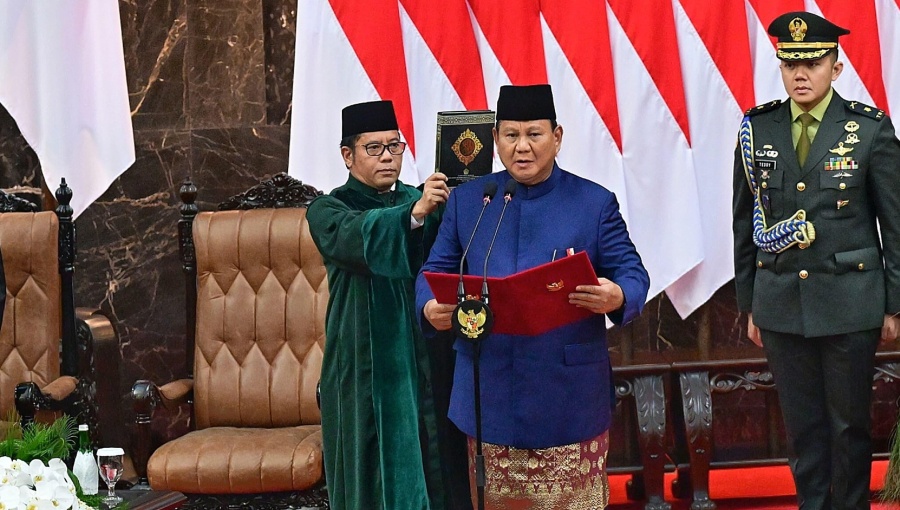
President Prabowo Subianto’s first speech at the United Nations was not a cautious introduction but a bold intervention, as Antaranews extensively reports. Addressing the High-Level Conference on 'Palestine and the Two-State Solution' in New York, he delivered a stark condemnation of the violence in Gaza, framing Israel’s military campaign as genocidal. His words underscored the scale of the humanitarian catastrophe: tens of thousands of Palestinians killed, the majority women and children.
Yet Prabowo did more than condemn. He laid out a political and diplomatic roadmap that sought to move beyond rhetoric, combining Indonesia’s moral voice with concrete offers to help shape peace on the ground.
Endorsing the two-state solution
Central to his address was the unequivocal endorsement of the two-state solution as “the only path to lasting peace.” Prabowo pressed UN member states to act decisively, urging immediate recognition of Palestine’s sovereignty. Recognition, he argued, is not merely symbolic but the foundation for meaningful peace. The message was clear: history does not stand still, and delaying recognition only prolongs suffering and instability.
The timing of this declaration was deliberate. Only days earlier, the UN General Assembly had adopted the New York Declaration, endorsed by 142 states, setting out commitments to ceasefire, humanitarian access, and a pathway to Palestinian statehood. Prabowo’s speech aligned Indonesia squarely with this momentum, reinforcing the sense of urgency.
Perhaps the most striking element of Prabowo’s intervention was Indonesia’s readiness to send peacekeepers under a UN mandate. By signalling willingness to commit forces, Jakarta moved from advocacy to actionable diplomacy. Indonesia is already one of the largest contributors to UN peacekeeping missions, but a Gaza deployment would carry vastly higher stakes, given the volatility and political sensitivities of the conflict.
Operational hurdles remain significant. A mission would require Security Council authorisation, agreement on rules of engagement, and cooperation from parties on the ground. Nonetheless, the pledge is a powerful statement of intent: Indonesia is not only condemning violence but offering to shoulder responsibility for stabilisation.
Prabowo also introduced a new element into Indonesia’s long-standing Palestine policy: a conditional pathway to recognising Israel. He declared that Indonesia would recognise Israel immediately if Israel first recognised Palestine as an independent and sovereign state. In effect, he positioned recognition as a reciprocal bargain that could unlock normalisation.
This is a rare move for a major Muslim-majority nation and could reframe regional diplomacy. For countries seeking leverage to bring Israel to negotiations, Indonesia’s conditional recognition offers both incentive and political cover. Yet it also carries risks: without reciprocal gestures from Israel, the proposal could harden positions or invite criticism from constituencies opposed to any recognition.
Diplomatic calculus
Prabowo’s approach blends moral leadership with pragmatic statecraft. By calling out atrocities in Gaza, he consolidates domestic and regional support for Indonesia’s long-standing pro-Palestine stance. By pledging peacekeepers and signalling conditional recognition of Israel, he casts Indonesia as a responsible international actor prepared to transform words into commitments.
This dual posture strengthens Indonesia’s credibility as a bridge-builder. It appeals simultaneously to domestic audiences demanding solidarity with Palestine and to international partners searching for workable solutions. In this sense, the speech was as much about Indonesia’s global positioning as it was about Palestine.
The effectiveness of Prabowo’s gambit depends on several factors. First, the politics of the UN Security Council: authorising a mission for Gaza will be contentious, with the risk of vetoes from permanent members. Second, the feasibility of deploying troops into such a volatile environment: logistics, mandate clarity, and casualty risks will be daunting. Third, the reception of Indonesia’s conditional recognition proposal: while applauded at the UN, it requires careful diplomacy to avoid alienating allies or being dismissed as unrealistic.
A turning point for Indonesia
Prabowo’s UN debut demonstrates Indonesia’s willingness to take on greater responsibility in shaping international peace and security. It marks a pivot from being a consistent moral advocate for Palestine to becoming a strategic actor offering concrete pathways to resolution. Whether these proposals translate into action will depend on global diplomacy, but the speech itself was significant: it repositioned Indonesia as more than a bystander and elevated its influence in the Palestinian question.
The closing words of Prabowo’s speech: “Peace now. PeacPrabowo at the UN: Indonesia’s pivot from moral outcry to strategic diplomacy immediately. We need peace”, were met with applause in New York. Beyond the applause, however, lies the test of whether Indonesia’s blend of moral clarity and pragmatic offers can help shift a decades-old conflict toward a more just and peaceful horizon.

No comments:
Post a Comment