Slicing The Sky: Russia’s Grey-Zone Gambit Against NATO – Analysis
By Scott N. Romaniuk and László Csicsmann
Corvinus University of Budapest, Hungary
Russia’s Airspace Gambit
Russian incursions into NATO airspace are neither random nor accidental—they are deliberate, calculated manoeuvres within a broader strategy of salami slicing.
Each flight, drone sortie, or radar probe serves multiple purposes: testing NATO’s political and military resolve, exposing fissures within the alliance, and incrementally reshaping Europe’s security landscape in Moscow’s favour. By staying below the threshold of war, Russia advances strategic objectives while minimising the risk of a coordinated or forceful Western response.
Airspace violations form a key component of Moscow’s broader hybrid warfare strategy, which also encompasses maritime harassment, cyber operations, and disinformation campaigns. The aerial domain is especially potent: highly visible, fast-moving, and capable of provoking immediate military responses. Russian aircraft routinely enter or skirt the airspace of NATO states on Europe’s eastern flank—including Estonia, Latvia, Lithuania, Norway, Poland, and Romania—often with transponders off and without notifying civilian air traffic control. These incursions endanger civilian aviation, trigger costly scramble operations, and send a deliberate signal that NATO’s limits are being tested.
Each flight functions as both a probe and a pressure point—a low-cost, high-impact tool advancing Moscow’s objectives while forcing the alliance to confront the challenges of deterrence, cohesion, and credible response. China mirrors these tactics in the Indo-Pacific, applying similarly incremental, assertive actions across air, sea, and information domains. Together, Moscow and Beijing are reshaping the rules of strategic competition, demonstrating how sustained, deniable pressure can shift norms without triggering full-scale war.
Airspace as a Weapon: Low-Cost, High-Impact Pressure
The pattern is clear. In 2025, NATO members across Northern and Eastern Europe reported a surge in Russian incursions. Norway has faced multiple short violations over the Barents Sea and Finnmark region in recent years, with a notable increase in 2025. Whether navigational errors or deliberate provocations, the sudden rise in flights rattled Oslo. Norwegian defence officials emphasised a broader pattern: Russian aircraft regularly trigger NATO intercepts, strain resources, and probe alliance readiness.
Poland and Romania face similar pressure along NATO’s eastern flank. Russian drones and aircraft frequently cross their airspace, often in connection with ongoing operations in Ukraine. For example, on the night of September 9–10, more than 20 Russian drones entered Polish airspace, underscoring the persistent threat. Even brief incursions raise concerns about border security, civilian safety, and escalation risks. Estonia experienced a more severe breach when three Russian MiG-31 fighter jets entered its airspace over the Gulf of Finland for more than ten minutes. NATO jets from Italy, Finland, and Sweden scrambled in response. Tallinn condemned the violation as a serious breach of sovereignty, highlighting both the vulnerability of the northeastern flank and the importance of collective defence.
Moscow’s approach is deliberate and selective. Hungary, despite its proximity to Ukraine, reported no violations—suggesting Russia targets states perceived as resistant while avoiding specific members. Sweden’s response underscores NATO’s seriousness: since joining in March 2024, it has signalled it will defend its airspace ‘by force if necessary’, reflecting national resolve and alignment with NATO deterrence objectives. Collectively, these incidents show that Russian airspace violations are far more than nuisance flights—they are precision tools for signalling, testing alliance cohesion, and projecting power.
Small Moves, Big Gains: Russia’s Gradual Expansion
Airspace incursions are part of a broader pattern of incremental coercion. The 2014 annexation of Crimea provides the clearest example: so-called ‘little green men’—unmarked Russian troops—seized government buildings, a referendum was staged under military oversight, and Moscow claimed the territory—all within weeks. Western protests and sanctions failed to reverse the occupation, allowing Russia to permanently reshape the facts on the ground.
In Eastern Ukraine, Moscow replicated this model through covert military support to separatists, disinformation campaigns, and hybrid operations. Even after the 2022 full-scale invasion, incremental tactics remain central to Russia’s territorial strategy.
Maritime confrontations reflect the same playbook. In June 2021, Russia intercepted the British Royal Navy’s HMS Defender during a freedom-of-navigation patrol near Crimea, flying aircraft dangerously close and reportedly firing warning shots in an effort to challenge international norms and intimidate Western forces.
In the Arctic, Russia is reopening Soviet-era bases, militarising islands, and asserting control over the Northern Sea Route. These incremental moves—often framed as defensive or economic—shift the strategic balance and extend Moscow’s influence across increasingly strategic regions.
Ambiguity as Strategy: China’s Incremental Expansion
China applies similar incremental, deniable tactics in the South China Sea, East China Sea, and along the India–China Line of Actual Control. Beijing relies on low-intensity, ambiguous actions that steadily shift territorial and strategic realities without triggering war.
In the South China Sea, China militarised artificial islands in the Spratly and Paracel archipelagos using coast guard and maritime militia units. Presented as civilian or scientific projects, these actions nonetheless altered the regional military balance without a single shot fired. Along the India–China border, incremental incursions, road-building, and infrastructure projects steadily advanced Beijing’s claims, culminating in clashes such as the 2020 Galwan Valley incident.
Both Moscow and Beijing exploit slow democratic decision-making and the West’s legalistic approach to sovereignty. They operate in the grey zone, betting that fear of escalation will prevent decisive responses—and often, they have been correct.
Two Theatres, One Strategy: The Logic of Salami Slicing
Russian and Chinese salami slicing share the same underlying logic: both assume the liberal international order is weakening and that the West lacks unity or the appetite to respond decisively to incremental provocations. They exploit ambiguity, legal grey areas, and information campaigns to gradually normalise their actions and reshape the strategic environment.
Both powers employ assertive, multi-domain measures. Russia penetrates NATO airspace and conducts overt disinformation campaigns; China combines airspace incursions with maritime militias, coast guard provocations, and staged exercises. Despite differences in method or theatre, the result is identical: a cumulative shift in acceptable behaviour and systematic erosion of deterrence.
Crucially, these strategies reinforce one another. Observing each other, Moscow and Beijing validate the effectiveness of incremental, deniable aggression, creating a feedback loop that strengthens both operational logics. Weak or inconsistent responses in Europe embolden Chinese manoeuvres in the Indo-Pacific, while muted reactions in Asia encourage further Russian provocations in Europe. Their coordinated—but not formally allied—approach amplifies pressure on democratic alliances, complicating deterrence, and undermining global stability.
High-Leverage, Low-Cost Pressure
In the grey zone, small moves yield outsized effects. Each violation—whether airspace incursion, maritime harassment, cyber operation, or disinformation campaign—may seem minor in isolation. But cumulatively, they reshape the strategic environment, degrade deterrence, and normalise aggression. Over time, what was once considered unacceptable becomes tacitly tolerated, lowering the bar for further coercion.
NATO’s consensus-driven decision-making and political diversity complicate rapid, coordinated responses. States on the eastern flank—such as Poland and the Baltic countries—face immediate pressure and demand swift action, while more distant members often hesitate, creating uneven engagement. France has gone further, with President Emmanuel Macron rejecting calls to shoot down Russian aircraft, warning that such measures risk dangerous escalation.
This divergence underscores the alliance’s internal fault lines: while frontline states seek tougher deterrence, others prioritise restraint. Moscow and Beijing exploit this inertia and disunity, calibrating provocations to expand the zone of permissible behaviour without provoking unified countermeasures. Their multi-domain pressure—air, sea, cyber, and information—applies cumulative strain, maximising strategic leverage at minimal cost.
Mixed Messages, Bold Adversaries
President Trump’s call for NATO to ‘shoot down’ Russian planes exposes the dangerous gap between rhetoric and credible deterrence. The problem is not abstract. In March 2020, two Russian Tu-142 maritime reconnaissance aircraft entered the Alaskan Air Defence Identification Zone (ADIZ), remaining in international airspace over the Beaufort Sea but flying as close as 50 nautical miles to the Alaskan coast, according to NORAD. They avoided US and Canadian sovereign airspace but demonstrated Moscow’s readiness to press right up to the line.
Such incidents were frequent throughout Trump’s presidency: Russian bombers and reconnaissance aircraft repeatedly approached Alaska’s ADIZ with little consequence. These manoeuvres, though technically lawful, were calculated tests of US resolve and exposed the limits of deterrence. Military capability alone does not deter; when red lines are vague or messaging inconsistent, adversaries read restraint as weakness. Moscow and Beijing have learned to exploit this gap, treating the absence of unified, credible responses as tacit permission to continue incremental provocations.
NATO’s Internal Fault Lines
NATO’s political and geographic diversity is both a strength and a vulnerability. Member states on Russia’s immediate borders or in close proximity—Estonia, Latvia, Lithuania, Poland, Finland, Sweden, Romania, and Hungary—face sustained pressure and require rapid-response capabilities. States farther afield, such as Canada, are less directly exposed, leading to uneven engagement across the alliance. Russia’s salami-slicing strategy exploits these differences, testing decision-making processes, exposing political fault lines, and highlighting divergent threat perceptions. Any disunity or hesitation weakens deterrence, creating low-cost opportunities for Moscow to push the boundaries of acceptable behaviour.
Reinforcing Deterrence in the Grey Zone Era
Russian and Chinese incremental actions function as strategic probes rather than mere nuisances. Traditional deterrence models encounter difficulties in the grey zone, where salami slicing exploits political pluralism and democratic constraints. Effective deterrence relies on the combination of political will, alliance cohesion, and credible signalling. Institutionalising transparent communication and rapid decision-making, along with clarifying thresholds and demonstrating collective resolve, contributes to strengthening deterrence. Enhancing posture across all theatres—including Europe’s northern and eastern flanks and the Arctic—appears critical for maintaining credible deterrence.
Closing the Gaps
Russia and China are redefining strategic competition through incremental, deniable aggression. Airspace incursions, maritime coercion, hybrid operations, and information manipulation exploit ambiguity and institutional inertia, gradually shifting the baseline of acceptable behaviour. By observing each other, Moscow and Beijing reinforce these strategies, creating a cross-regional feedback loop that challenges European and Indo-Pacific security alike.
NATO faces a stark choice: without coordinated, politically unified, multi-domain strategies, incremental aggression will continue to erode alliance credibility. Deterrence requires consistent messaging, clear red lines, and the political will to act decisively. Proactive adaptation—codifying thresholds, integrating intelligence, strengthening forward deployments, and crafting a unified narrative—is central to safeguarding the transatlantic order and global stability in an era where the line between peace and war is increasingly blurred.
About the authors:
- Dr. Scott N. Romaniuk is Research Fellow, Centre for Contemporary Asia Studies, Corvinus Institute for Advanced Studies (CIAS), Corvinus University of Budapest, Hungary
- László Csicsmann is Full Professor and Head of the Centre for Contemporary Asia Studies, Corvinus Institute for Advanced Studies (CIAS), Corvinus University of Budapest, Hungary; Senior Research Fellow, Hungarian Institute of International Affairs (HIIA)
Denmark alerts NATO and EU after coordinated drone attacks at its airports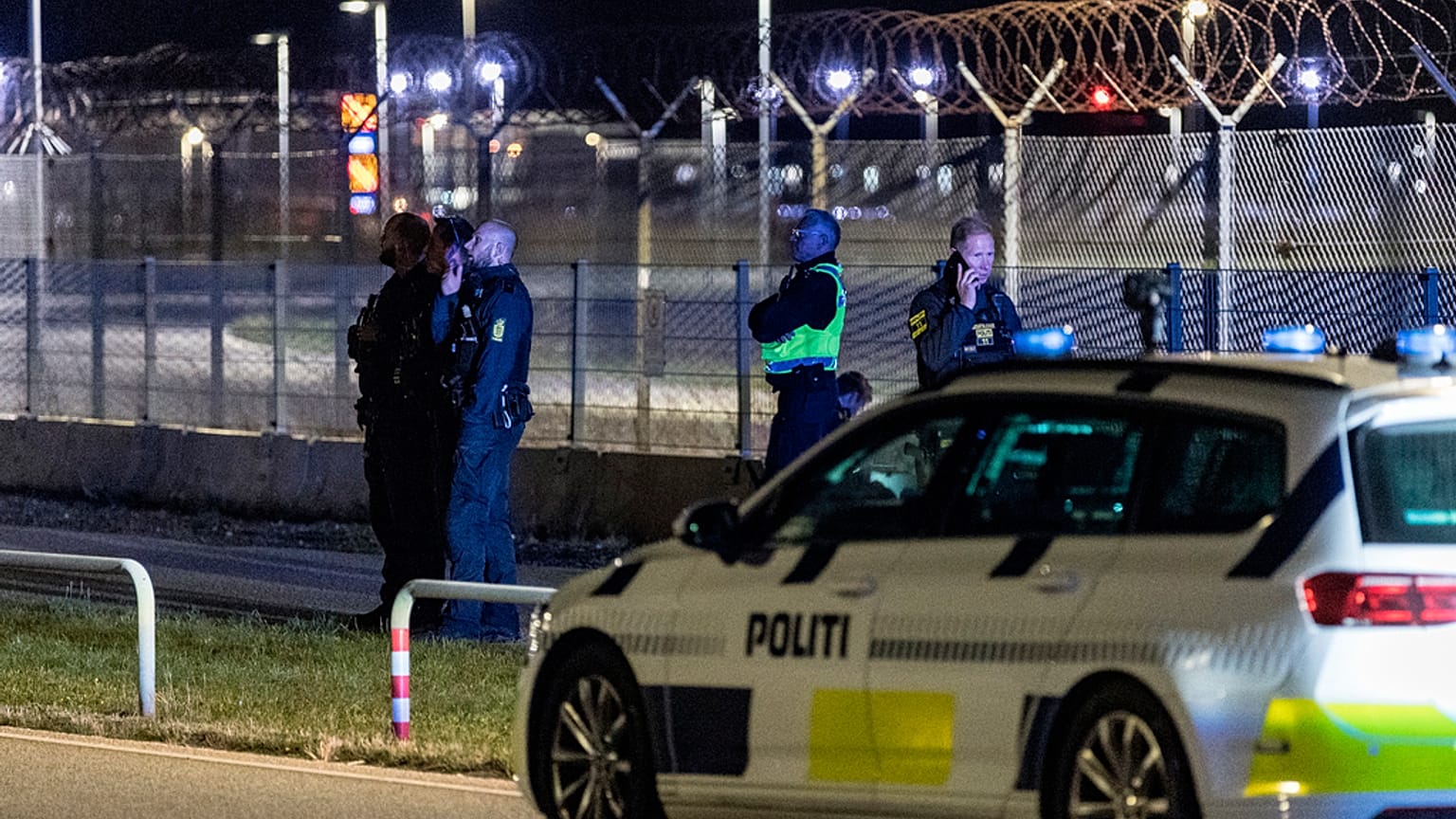
Copyright Steven Knap/Steven Knap
By Euronews
Published on 25/09/2025 -
Denmark is on high alert after unauthorised drones targeted airports, leading to the closure of Aalborg airport. Authorities suspect Russian involvement.
Denmark has reached out to NATO and the EU after it was forced to close Aalborg airport and placed three other airports on alert on Thursday as unauthorised drones conducted what authorities described as coordinated attacks.
Copenhagen was considering whether to trigger the alliance's Article 4, in what was a hybrid attack involving a "systematic approach" carried out by professionals in flying drones near critical infrastructure, Danish Deputy Prime Minister and Defence Minister Troels Lund Poulsen said at a press conference on Thursday.
Authorisation was given to shoot down the drones in case of future incidents, authorities said.
"We are going to find the people who are behind this," Lund Poulsen said.
"We have various military capabilities that can help defend Denmark, F-35 and our frigates," he added.
However, Lund Poulsen further stated that Denmark is lacking in tools needed to address the threat that is "here to stay" and it does not have a ground-based air defence system, which the government decided to purchase this month.
It would still not be fully effective in fighting the type of drone that appeared above Denmark on Thursday, he added.
"There is no single capacity that will make this go away."
"We need to have a wide range of tools to combat what comes our way, whether it's missiles or drones," said Lund Poulsen.
Aalborg, Esbjerg, Sonderborg and Skrydstrup airports were all affected overnight on Thursday.
The Aalborg airport, located in northern Denmark and one of the country’s largest, was closed, the Danish police announced. The drones disrupting its operations left the area after about three hours, according to reports.
The North Jutland Police released a statement saying they were closely monitoring the situation at Aalborg, but could not indicate the number of drones involved.
The unauthorised drone incursion over Denmark follows similar incidents at Copenhagen and Oslo airports that officials suspect may involve Russian interference.
Copenhagen and Oslo airports also targeted
On Monday evening, the Copenhagen airport was affected by a similar incident, which raised security concerns about possible Russian involvement.
Authorities said the drones at Aalborg followed a similar pattern to the ones that had halted flights at Copenhagen.
The drone attack affected the Danish armed forces and was categorised as "the most serious attack yet on Denmark's infrastructure" by the Danish Prime Minister Mette Frederiksen.
Authorities in Norway also shut the airspace at Oslo airport for three hours on Monday evening due to possible danger from unauthorised drone activity.
"The drones that halted flights at Copenhagen airport were part of a pattern of persistent contestation at our borders," European Commission President Ursula von der Leyen said on Tuesday.
Although Norwegian and Danish authorities are working together on the Copenhagen and Oslo incidents, their investigation has not yet established a connection, Norway's Foreign Minister said on Wednesday.
Commercial drones are generally not capable of taking off and flying near airports, as these areas are designated as "no-fly zones" in their GPS software.
Europe is on high alert
Europe has been on high alert after several NATO members reported airspace violations by Russia.
Last week, Estonia and Poland triggered Article 4 to request consultations with other NATO allies regarding such incursions in separate incidents.
Romania, another NATO member, also reported a breach by Russian drones in its airspace.
Russia denied violating Estonia's airspace, while it insisted the Polish incursion was not deliberate. However, it did not comment on the Romania incident.
After meeting on Tuesday, NATO issued a statement condemning Russia's actions and warned that it would use "all necessary military and non-military tools" to defend itself.
"Russia bears full responsibility for these actions, which are escalatory, risk miscalculation, and endanger lives. They must stop," the statement said.
"We are a defensive alliance, yes, but we are not naive, so we see what is happening," NATO's Secretary General Mark Rutte noted.
After his speech to the UN, Donald Trump suggested that NATO member states should shoot down Russian planes breaching their airspace.
Kremlin spokesperson Dmitry Peskov called the allegations of Russia being behind recent drone incidents above European airports "unfounded".
Russian Warship Was Loitering Off Denmark During Drone Attacks
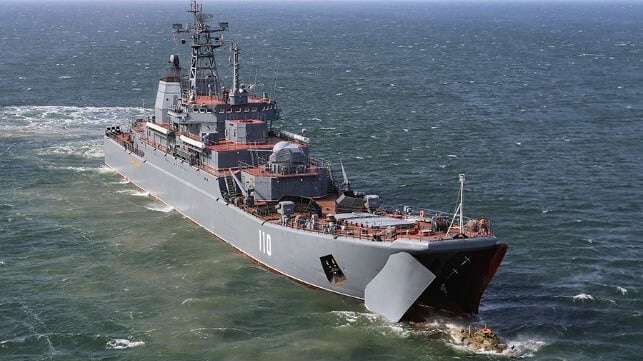
After a coordinated drone raid shut down Copenhagen Airport and grounded dozens of flights, investigators' attention quickly turned to possible maritime launch pads. Three Russia-linked vessels were in the general vicinity during or just after the attacks, and one of them appeared to have slowed down in order to time its arrival in the Oresund, just a few cables away from the airport. But a fourth vessel has also attracted attention: a Russian amphib, which has been loitering at the edge of Danish territorial seas for days.
Danish tabloid Ekstra Bladet first broke the news of the vessel's presence on Thursday. Using a chartered helicopter, the outlet's reporter flew out to observe the Ropucha-class landing ship Aleksandr Shabalin at a position off the coast of Langeland, an island at the southern entrance to the Great Belt. Shabalin was navigating with her AIS off, as is common for warships.
According to the outlet, Shabalin has been in the area for days, during a time period of intense drone activity at Danish airports and military sites. Jacob Kaarsbo, former head analyst of Denmark's military intelligence service, told Ekstra Bladet that the ship could have served a few roles - as a diversionary measure, an observational platform, or as a backstop for Russia-linked merchant vessels involved in launching drones.
Authorities in Denmark have confirmed that the Shabalin is part of the ongoing investigation into drone activity.
As to the source of the drone raid, Danish authorities are for now holding back their opinions. But Prime Minister Mette Frederiksen said Thursday that there would likely be more attacks, and warned that "what we are experiencing in Denmark at the moment is a hybrid war," similar to incidents seen elsewhere in Europe.
The current head of Denmark's defense intelligence agency, Thomas Ahrenkiel, used a similar term Thursday in describing Russian methods. "Since 2022 they have shown greater risk-taking in carrying out hybrid attacks," he said.
EU Defence Chief Says ‘Drone Wall’ Could Be Ready In A Year
By EurActiv
By Aurélie Pugnet, Charles Cohen, Chris Powers and Kjeld Neubert
(EurActiv) — The EU could significantly improve its drone detection capabilities within a year but it will take much longer to develop a full network across land and sea able to track and destroy targets, Defence Commissioner Andrius Kubilius told Euractiv.
The idea of a so-called “drone wall” quickly gained traction after a wave of airspace incursions into EU countries by Russia over recent weeks, with Commission President Ursula von der Leyen making it one of her main announcements in her State of the EU speech in September.
“We need to understand [that] we lack capabilities to detect drones,” said Kubilius at Euractiv’s launch event for its daily defence newsletter FIREPOWER on Tuesday. “Maybe we have good capability to detect air fighters and missiles, but drones have specificity – they are flying very low, they are small.”
The first step is to “quickly” get detection systems, which he said can be done.
Experts say such a system could be ready in “somewhere around a year” to be ready to fend off Russian attacks and “provocations”, he said.
Kubilius added that Europe needs to copy Ukraine’s military which has deployed acoustic sensors to detect incoming unmanned aerial vehicles that may otherwise not show up on radars.
Lasers are another option for shooting down drones at a minimal cost, he said, with such a defensive network also needing to cover the bloc’s extensive maritime boundaries given Monday night’s drone incursions into Norway and Denmark, Kubilius said during the event’s Q&A discussion.
Investigations into those latest incursions have not yet revealed a perpetrator, with the Danish police saying only that they must have been carried out by a “capable actor”.
Even so, Copenhagen has been added to the Commissioner’s call list alongside eastern frontier states to be consulted on the Commission’s drone defence plan.
A proper detection system could be done quite quickly: “somewhere around a year”. But it will take much longer to develop a system that can track and destroy targets on the ground, he said.
Also speaking at the event, Robert de Groot, vice president at the European Investment Bank in charge of defence and security, said there were discussions over how to funnel financing to the bloc’s eastern states as a priority.
He said it’s important to channel cash to build military bases and infrastructure, as well as to increase military mobility for movement of tanks and troops.
“We need to get the stuff from one side of Europe to the other side of Europe, mostly from west to east but also from north to south”, De Groot highlighted.
Ukraine Called In To Help Brussels Build ‘Drone Wall’ Along Eastern Flank
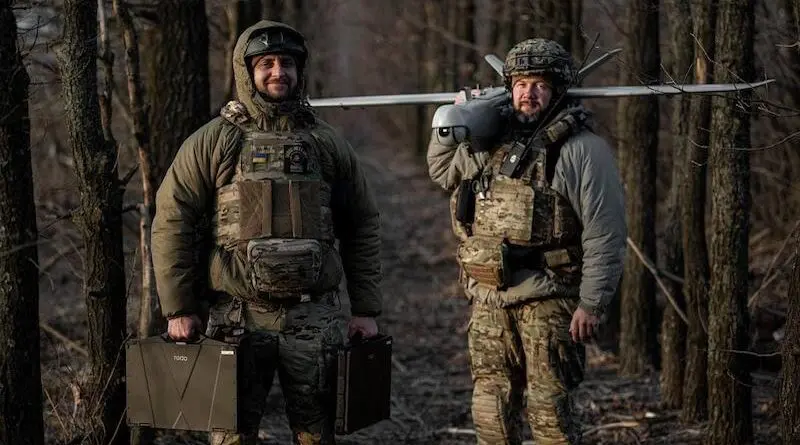
Ukrainian soldiers pose with a drone. Photo Credit: Anton Sheveliov, Ukraine Ministry of Defence
By EurActiv
By Charles Cohen
(EurActiv) — Ukraine’s defence minister will tell the EU’s top defence official and key governments all about deploying a system to hold off waves of drone attacks from Russia at a meeting on Friday morning.
Kyiv has been pioneering drone innovation since the start of Russia’s invasion, with unmanned aerial vehicles now a key asset in responding to Russian attacks. That’s why Ukraine’s perspective is critical when Defence Commissioner Andrius Kubilius convenes a call between the representatives of 10 countries along Europe’s eastern flank on Friday.
The Commission has invited Ukraine’s defence minister, Denys Shmyhal, to join a call with “frontline countries” to hear “what its capabilities are, and (…) whether to take inspiration from that or not”, a spokesperson for the EU executive said on Thursday.
The call will include Bulgaria, Denmark, Estonia, Finland, Latvia, Lithuania, Poland, Romania, Ukraine as well as Slovakia, the Commission said. Slovakia was not expected to join earlier this week. And it remains unclear whether Hungary, another country with external borders to this east, will be part of the discussion.
NATO technical officials will also join the discussion, the EU executive added on Thursday.
“We need to understand [that] we lack capabilities to detect drones,” Kubilius said at Euractiv’s launch event for its daily defence newsletter FIREPOWER on Tuesday, promising rapid progress on building out a drone defensive wall.
Drone defence
In March, Ukrainian presidential advisor Alexander Kamyshin said the country’s manufacturers can produce over 5 million first-person-view drones, which deliver detailed video coverage to operators, per year.
“Ukraine is far ahead of all European NATO countries in terms of drone and especially anti-drone technology,” said Carlo Masala, head of the Center for Intelligence and Security Studies at the German Armed Forces University in Munich.
For Masala, Ukraine drone manufacturers can provide know-how to mitigate jamming and spoofing technologies from Russia, he added.
The Commission said this week that capitals could support the drone wall through the €150 billion SAFE loans allocated to 19 countries, and tap into the €1.5 billion EDIP programme, still subject to negotiations.
Masala said that Ukraine ought to receive direct EU contributions to increase their production and contribute to a drone wall.
Another way for Kyiv to participate in the financing initiative would be to set up production in the EU. In June, Denmark signed a deal with Kyiv for Ukrainian defence companies to open production lines in the country, starting with a €1.4 billion investment. President Volodymyr Zelenskyy also announced at the UN General Assembly in New York on Wednesday that the country will lift its arm exports ban introduced after Russia’s invasion, which could allow for exports of Ukraine-made drones.
“You would have production lines which are out of the reach of Russia in the southern front (…) the possibility that Russian themselves hit a drone production facility in Romania or Germany is quite unlikely”.
Europe wants to build a drone wall to protect its eastern flank from Russia. Is it feasible?
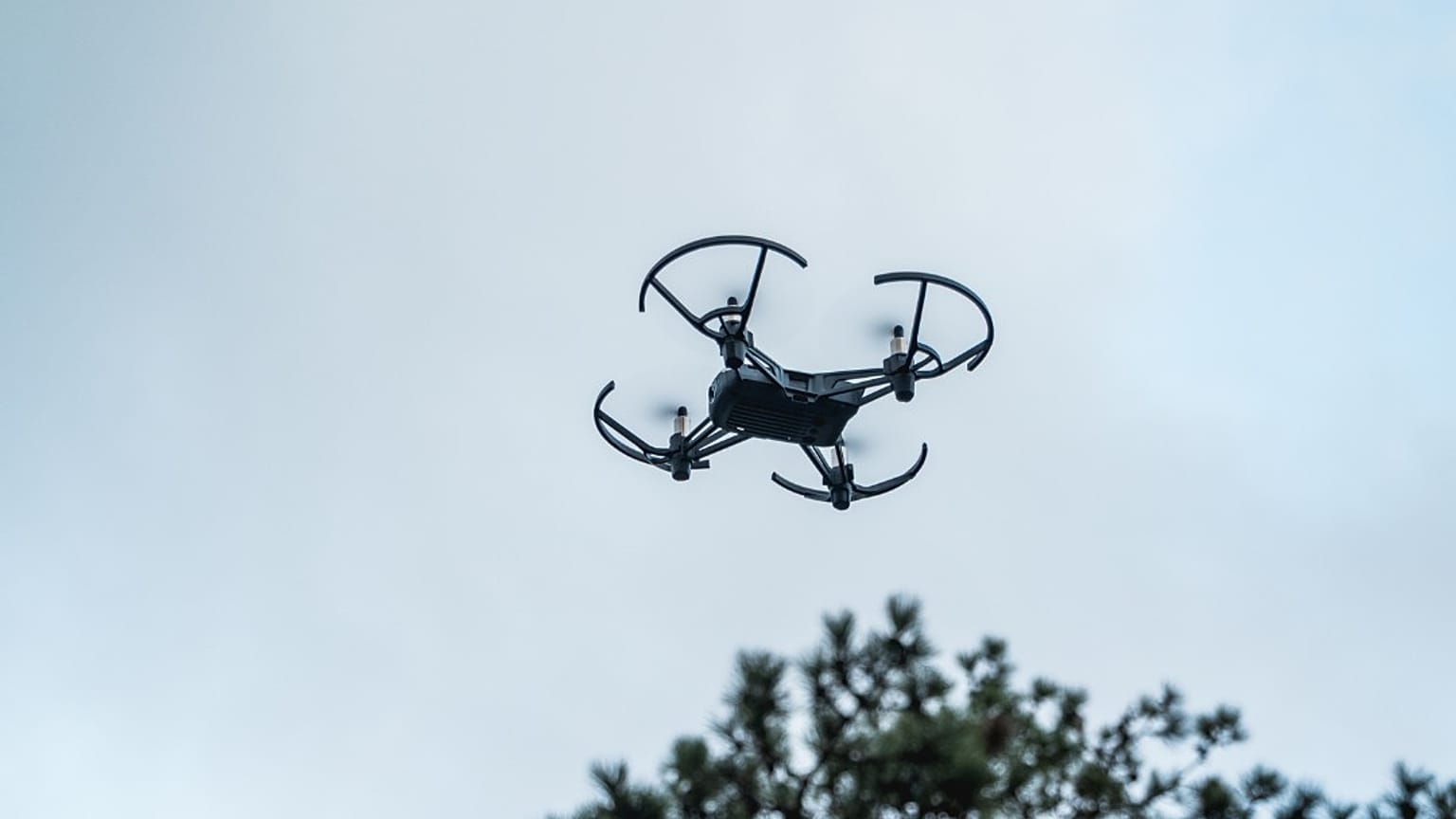
Two companies involved with a drone wall in the Baltics say their technology is ready to be deployed.
European Commission President Ursula Von Der Leyen said in her September 10 State of the Union address that Europe “must heed the call” of the Baltic states to “build a drone wall”.
“This is not an abstract ambition, it is the bedrock of credible defence,” she said earlier this month.
Since then, EU defence commissioner Andrius Kubilius told Reuters last week that he plans to call together the EU’s defence ministers for talks on creating a “drone wall” along the EU’s eastern border after Russian drones were shot down over Polish airspace.
Both Von Der Leyen and Kubilius are referring to the Baltic Drone Wall, a cooperative effort between Poland, Finland, Estonia, Latvia and Lithuania to strengthen the EU and NATO’s eastern border.
Two companies of at least eight involved with the project say parts of the drone wall technology are already deployed but they are waiting to see whether other European governments will want to integrate their technology into their defence systems.
“What we are expecting [from Kubilius’ meeting] … is confirmation that this problem is serious and they want to act,” said Jaanus Tamm, president and CEO of Estonian defence company DefSecIntel.
“What are the next steps for the actions? Not just ‘let’s meet again and … make another declaration, but [we’re hoping for] … a very concrete plan,” he told Euronews Next.
What do we know about the ‘Drone Wall’ project?
At the heart of the drone wall project is a “multilayered drone defence system” called Eirshield, an anti-drone platform developed through a joint partnership between DefSecIntel and Latvian company Origin Robotics.
It uses radars, cameras, radio frequency detectors, the drone’s direction and its threat level to decide whether a hostile drone should have its signal jammed or blocked or whether it should be hit with another drone, Tamm said.
Agris Kipurs, co-founder and CEO of Origin Robots, said the system is “fully automatic,” making the strikes possible with the help of artificial intelligence (AI) so there’s “no flying required,” meaning everything from drone detection to interception is automated.
Eirshield is designed to work on “fast-flying unmanned” targets carrying warheads that can fly upwards of 200 kilometres per hour, Kipurs said. The system will also have some parts that are portable, he added.
The system can be equipped with several types of drones, including some that DefSecIntel has already developed, which Tamm said is key to responding to the capacities of different types of drones.
The cost-per-use of the Eirshield system is in the “tens of thousands” of euros, Kipurs said, compared to the “couple of millions” that older, conventional air strike systems use.
“The systems which are currently in place were designed for a lot more expensive threats [such as ] neutralising missiles and manned aviation,” Kipurs said. “It was not designed to intercept … strike drones … that threat is very new, so we are just now designing for it”.
Tamm said the system has been deployed in Ukraine and is equipped there with a “third-party gun system” that lets Ukrainian forces hit low-flying drones like Shahed drones.
Kipurs said there are planned demonstrations of the system in the coming weeks but could not specify which governments were interested in the drone wall technology for security reasons.
Technology to be adapted to NATO standards
Tamm said there will likely have to be some changes to the Eirshield system used in Ukraine to meet NATO standards and for “peacetime” in the Baltics.
“You can imagine that when you have an active war going on, everything [that] is flying is bad so [the targets identified by the system] are most likely hostile,” Tamm said.
“In peacetime, you have to be sure that what’s coming … is actually a bad drone and you need to track it quite carefully”.
Some of these peacetime changes could include equipping the system to take down drones with a net or using a small drone to hit the incoming drone without making it explode, he added.
Kipurs said it’s up to national militaries to decide what the tactics are and what combination of detection and interception they want to use.
When the drone wall is up and running, Tamm said it will not replace more traditional types of air defence systems, like other anti-missile systems.
Euronews Next reached out to the Estonian, Latvian and Lithuanian governments to find out how the drones will be used by their militaries but did not receive an immediate reply.
Drone wall funding denied by Commission in August
There’s renewed interest now in the drone wall project, but as recently as last month, the EU Commission rejected a drone wall funding proposal from Estonia and Lithuania worth €12 million.
Euronews Next reached out to the Commission to find out why the initial project funding was rejected but did not receive an immediate reply.
Kipurs implied the drone wall project wasn’t an exact match for what the Commission was looking to fund at the time.
Still, all three national governments dedicated part of their national budgets to the drone wall.
In Estonia, the government has already allocated €12 million over the next three years to the drone wall programme that will be built by various national defence companies and others from neighbouring Latvia and Lithuania.
Latvia awarded €10 million in three research contracts to Origin Robotics and other defence cluster members, SAF Tehnika and Frankenburg Technologies for counter-drone solutions.
Lithuanian officials told local media they had previously received €11 million from the EU to buy drones, with 3 million of those funds dedicated to anti-drone equipment.

No comments:
Post a Comment