ALT.FUEL
Oman Pioneers Green Hydrogen Maritime Corridor to Europe
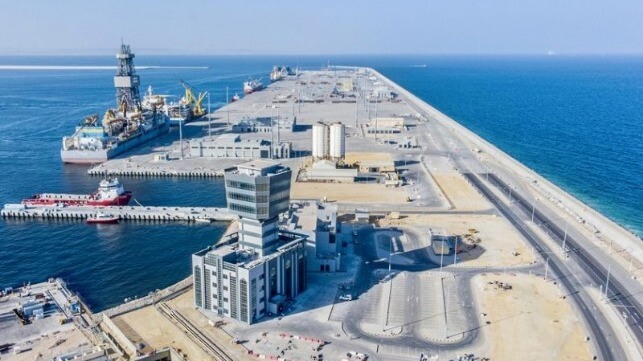
Oman is promoting the adoption of a green hydrogen maritime corridor from a loading terminal in Duqm through to the port of Amsterdam as an initiative to support the International Maritime Organisation achieve its Net Zero greenhouse gas targets by 2050. Green hydrogen is to be produced on a net-zero basis using energy from solar and wind farms in the hinterland of Duqm, and processed in the port area.
Development of a pioneering transmission corridor to take the fuel through to Europe will necessitate the solution of a number of regulatory and technical problems associated with the adoption of hydrogen for bunkering. It is anticipated that it will, in turn, prepare the way for the rollout of hydrogen supply chains as an integral element of critical maritime infrastructure.
The green hydrogen maritime corridor initiative was the subject of an agreement between the Netherlands and the Sultanate of Oman made in May, when Sultan Haitham visited the Netherlands on a state visit. Sultan Haitham made a similar agreement when visiting Belgium last year, and the corridor concept thus also embraces offload points in the Port of Antwerp, with an onward shipment network to the Port of Duisburg on the Rhine. A similar green hydrogen maritime corridor is under development to link Algeciras in Spain with Rotterdam.
For the concept to be realized, and then utilized across the whole of the global maritime community, the project will need to create a harmonized safety regulation regime for hydrogen bunkering. Technical standards and solutions also need to be developed to support hydrogen-fueled ship operations, and the handling of hydrogen terminal operations in port. These issues, and the current lack of international standards, are already being considered by the Maritime Technologies Forum. A project management framework also needs to be developed to support the launch of port infrastructure development projects, the lack of which, from a financial and engineering perspective, is a hindrance to efficient progress.
In August, BP upped its stake in one of the green hydrogen consortia awarded contracts to operate through Duqm, increasing its share in the Hyport Duqm green hydrogen project to 49 percent, with Belgium’s DEME and the Omani sovereign wealth fund OQ each retaining a 25.5 percent stake.
The Hydrom Duqm project is in the pre-engineering design phase, and commercial operations utilizing the green hydrogen maritime corridor to Europe are scheduled to commence in 2030. It is too early to estimate which of the consortia awarded green hydrogen mandates will be the first into production, but BP’s move underlines the oil major’s confidence in Oman’s overall green hydrogen strategy.
Molgas Completes Full Acquisition of Titan Clean Fuels
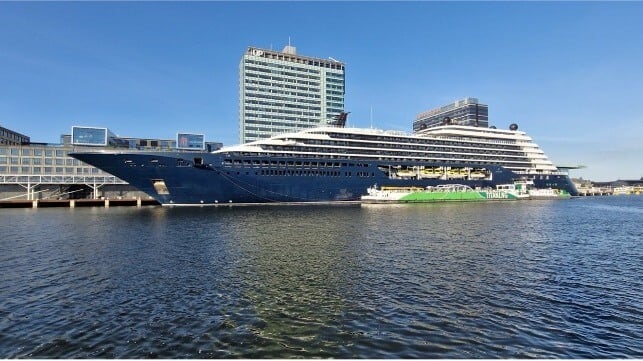
[By: Titan Clean Fuels]
Molgas Energy Group (“Molgas”), backed by infrastructure investor InfraVia, has finalized the full acquisition of Titan Energy Holding, parent company of Titan Clean Fuels (“Titan”). The transaction, which follows Molgas’ initial 45% minority stake, marks a major step forward in the Group’s strategic growth in the clean marine fuels sector.
Titan is a leading independent supplier of liquefied biomethane (LBM/bio-LNG) and LNG, serving both maritime and industrial customers. Its fleet of small-scale bunkering vessels operates across key global markets, with a strong base in the Northwest European region. Titan’s LNG bunkering operations will merge with Molgas’ existing operations in Norway and all truck-to-ship supply across Norway and continental Europe will now be combined.
With the integration of Titan, the Molgas Energy Group now operates a fleet of seven LNG bunkering vessels and manages a proprietary network of over 70 road-fuelling stations, with more than 200 points of sale including associated partner stations. This expanded footprint positions Molgas as a pan-European leader in downstream LNG and bio-LNG solutions for industrial, road transport, and marine customers.
The acquisition comes at a time of accelerating momentum for clean fuels. LNG and bio-LNG are increasingly recognized as scalable, low-emission alternatives that can play a vital role in decarbonizing both shipping and heavy-duty road transport. With tightening regulations, like EU ETS and FuelEU Maritime, and therefore growing demand for sustainable energy, Molgas and Titan are well-positioned to lead the transition toward cleaner mobility and logistics.
Following the transaction, Niels den Nijs will lead Molgas’ Marine Business as Executive Vice President, Marine. He will oversee all marine activities, delivering integrated end-to-end ship-to-ship and truck-to-ship bunkering services across Europe.
Sofoklis Papanikolaou, CEO of Molgas, commented: “Niels and the Titan team started as true pioneers, showing remarkable innovation and have grown Titan into one of the sector’s most reliable LNG bunkering operators. The success of our initial collaboration laid the groundwork for this acquisition, which significantly extends our reach and capabilities. We are welcoming to the group a very experienced team, with leading specific expertise in marine fuels and decarbonisation. Together, we will build a robust platform to deliver LNG and bio-LNG solutions across Europe and beyond.”
Niels den Nijs, CEO of Titan, added: “From the start, our partnership with Molgas was a strong strategic fit and I’m very happy to join their board. By joining forces fully, we substantially strengthen our balance sheet and joint commercial reach. Together, we will scale our clean fuel solutions for the maritime sector at a time of accelerating demand and regulatory tail winds. This integration allows us to better serve our long-term customers with an unrelenting focus on our mission: to deliver economical fuel at scale to help decarbonize shipping.”
Athanasios Zoulovits, Partner at InfraVia Capital Partners, said: “As the maritime industry undergoes a major transformation, Titan’s expertise positions Molgas to lead in delivering scalable clean marine fuel solutions. We are proud to support Molgas in its mission to accelerate the energy transition across industrial, mobility, and maritime markets.”
Jogchum Brinksma, Chairman of the board, Titan concluded: “It has been a pleasure to oversee the steep growth of Titan as chairman of the board and I am extremely pleased with these partners for Titan. This move will help propel the company towards a globally important strategic position, rising to the scale needed to lead the alternative fuels transition.”
While Titan is open to supplying customers with any alternative fuels that can realistically deliver towards decarbonization today, it recognises the practical route to net-zero shipping emissions that LNG, LBM and e-methane offer right now. It collaborates with shipowners and operators to create clean fuel delivery programs that are flexible, safe, and cost-effective today.
The products and services herein described in this press release are not endorsed by The Maritime Executive.
Maersk Tests Adding Ethanol to Methanol to Enlarge Fuel Availability
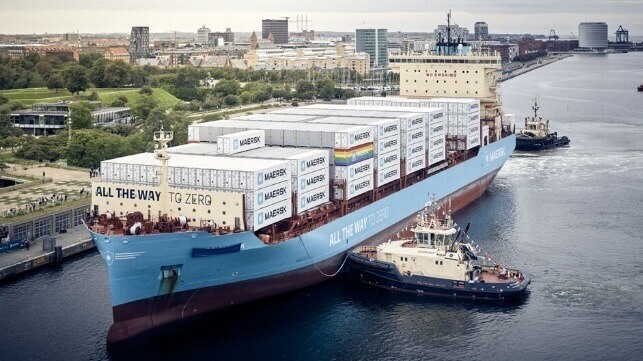
Maersk reports it is continuing to test new steps that it can use to address issues within the supply of alternative fuels. The latest trial is using a blend called E10 (10 percent ethanol mixed into the methanol supplied to its dual-fuel vessel) as a possible means of enlarging the availability and sourcing pool of methanol for its dual-fuel fleet.
The company reports the test has recently begun on the Laura Maersk, its smaller (2,100 TEU) methanol dual-fuel feeder ship operating in the Baltic region. The company says that for three years the vessel has operated on methanol with no problems. The smaller ship provides them a test ground to explore new concepts that might be applied to the larger 16,000 TEU dual-fuel vessels in the future.
The trial of E10 involves mixing 10 percent ethanol into the fuel being loaded onto the Laura Maersk with 90 percent methanol. The current bunkering with E10 they report will provide a month to a month and a half of operating data.
They will be looking at a range of issues to see if the ethanol mix creates differences versus the operating experience over the past three years. Specifically, they will look at ignition quality, the way the fuel is burning, and if there are issues or differences in corrosion and lubricity (friction).
A critical area they will also be looking at is the emissions. Are there differences versus pure methanol combustion? The impact of the E10 on NOx emissions, the company also says, is critical.
Maersk and others in the industry have confirmed that the availability of methanol remains one of the key challenges in the adoption of the alternative fuel. Operating a shorter route within the Baltic and Scandinavia has permitted Maersk to use the Laura Maersk for tests.
The company will study the data from the E10 trial. They will consider how it might impact the operation of the larger vessels as Maersk continues the introduction of the big dual-fuel methanol containerships. It completed the introduction of the first series in May 2025 with a dozen large vessels, and it has also converted one large vessel to methanol capabilities.

No comments:
Post a Comment