BIMCO Calculates a Third of Ships Could Have to Pay Fees Under USTR Program
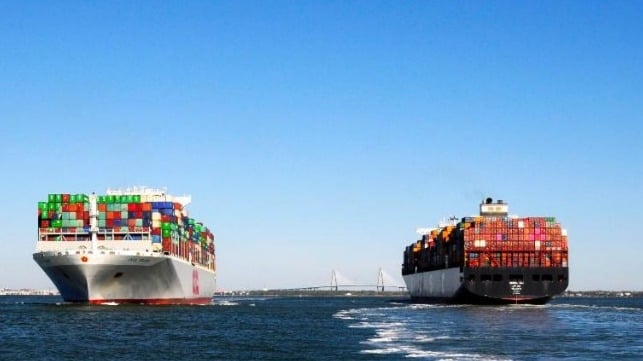
The U.S. Trade Representative’s port fee program is due to go into effect in less than a week, and with no more guidance having been issued, speculation remains rampant on the full impact of the program. The industry trade group BIMCO issued its analysis, pointing to the greatest impact on bulkers and segments of the tanker market, which it expects will leave the U.S. trade, but overall, it expects that freight rates should not increase for U.S. importers and exporters at this juncture.
The fee program was designed to combat Chinese dominance of the maritime sector. After U.S. trade unions filed a complaint, the Biden administration initiated the investigation and found unfair business practices and Chinese government support for its shipbuilding industry and targeting the maritime sector. The plan put forth by the Trump administration imposes fees on Chinese-owned, operated, or built ships.
The fees are due to begin on October 14, with previous estimates having said it could result in more than $3.2 billion in new costs for the top 10 containership companies in 2026. Carriers have undertaken the redeployment of vessels and swapping of routes in an effort to reduce their exposure to the program. BIMCO concludes, however, that containerships will not be the hardest hit segment.
“Bulk carriers are more exposed to the increasing costs, as 45 percent of the ships could be subject to the USTR fees. Because more ships are exempt, or because fewer ships are Chinese-owned or operated, only 30 percent of crude tanker and container ships, and 19 percent of product tankers, could be subject to the fees when arriving at a U.S. port,” says Niels Rasmussen, Chief Shipping Analyst for BIMCO.
BIMCO’s analysis of the program and deployments concludes that overall, a third of ships (35 percent) could be subject to the fees when calling at a U.S. port. BIMCO calculates that these ships provide nearly half (44 percent) of the combined capacity when including bulkers, crude and product tankers, and the container fleet.
The industry is still seeking clarification from the USTR on terms such as Chinese-owned and operated, but based on the current interpretation, BIMCO says 70 percent of the ships paying the fees will be Chinese-owned or operated. Only about a third (30 percent) will be Chinese-built ships. BIMCO notes that more than half of Chinese-built ships are exempt from the program due to size or U.S. ownership.
Other factors that could impact the final number of ships subject to the fees include efforts at refinancing or changing vessel ownership structures. One potentially significant category is the vessels in Chinese leasing programs run by banks and other institutions.
BIMCO believes the global impact on the bulker and tanker segments may be minimal despite 45 percent of bulkers and 19 percent of tankers likely falling into the definitions of the program. It points out that these vessels are a small part (9 to 19 percent) of global ship demand. Only 16 to 24 percent of U.S. imports and exports travel on vessels subject to the fees. Ships arriving in ballast for U.S. exports are also exempt.
“In the bulker and tanker sectors, we expect that most ships subject to USTR fees will leave U.S. trades as they cannot remain competitive. Freight rate increases will therefore likely be avoided in these sectors as well. Implementation confusion could, however, cause rate increases in the short-term,” says Rasmussen.
BIMCO writes that among the top 10 container carriers, less than 20 percent of the ships calling at the U.S. would be subject to the fees. Alphaliner previously reported that half of the fees would be incurred by Chinese carriers COSCO and its subsidiary OOCL (Orient Overseas Container Line). The carrier has previously admitted that it could incur large fees, but as said, it remains committed to its service.
Not addressed in the current outlook is the potential impact on the car and vehicle carrier segment. The USTR program imposes a fee of $14 per net ton on this segment for all foreign-owned vessels. This would be in addition to the tariffs the Trump administration has said it is imposing on foreign-built cars.
Customs & Border Protection warned this week that determining which vessels are required to pay the fees is the responsibility of the operators. It further said that ships should pay the fees online in advance, or could face denials when arriving at U.S. ports.
The potential remains high for confusion and delays as the program starts on October 14. Shippers might be attempting at the same time to rush imports into the U.S. from China before the current November 10th deadline, when the Trump administration’s delay on tariffs for goods from China is due to expire. Retailers have forecast that the combination of these factors is likely to contribute to steady, monthly declines in container import volumes over the next few months into the United States.
Retailers Forecast Accelerating Declines for US Imports Due to Tariffs
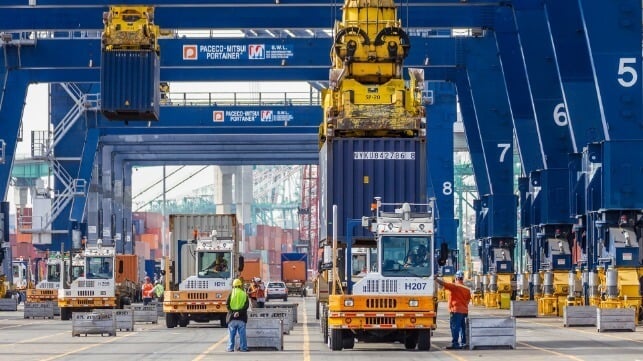
The National Retail Federation is predicting that U.S. imports will see accelerating year-over-year declines in volumes for the remainder of 2025 and into 2026. The trade group for the U.S. retail industry cites the continuing rise in tariffs as well as retailers' efforts to build inventory early due to the timing of the introduction of tariffs.
With most holiday merchandise already on hand and continued uncertainty over tariffs, the forecast from the retailers says that monthly import cargo volume at the nation’s major container ports is expected to fall below the two million TEU mark for the remainder of the year, and into 2026. The NRF forecasts a nearly three percent decline in TEU volume for the full year in 2025.
“This year’s peak season has come and gone, largely due to retailers front loading imports ahead of reciprocal tariffs taking effect,” said Jonathan Gold, the NRF Vice President for Supply Chain and Customs Policy.
The NRF’s monthly Global Port Tracker report, prepared by Hackett Associates, shows that import volumes peaked at 2.39 million TEU in July and have begun a steady monthly decline versus year-ago levels. August levels were basically flat with a year ago, but at 2.32 million TEU, were down nearly three percent from the previous month.
Ports have not yet reported numbers for September, but Global Port Tracker projects the month at 2.12 million TEU, which would be a month-over-month decline of 8.6 percent and a 6.8 percent year-over-year decline.
The retail trade group points to the latest tariffs, 25 percent on upholstered furniture regardless of country, and the same rate on kitchen cabinets and bathroom vanities, which take effect next week and increase in January, as a further negative impact on imports. It also notes that the current deadline for an agreement with China is November 10, and unless extended, could see the introduction of more tariffs.
The NRF is projecting continuing monthly declines in import volumes, noting that the monthly TEU figure will be consistently below two million for the remainder of 2025 and at least the first two months of 2026. On a year-over-year basis, they forecast a decline of 12.3 percent in October, 19.2 percent in November, and 19.4 percent for December. At 1.72 million TEU, December is forecast to be the slowest month since 1.62 million TEU in March 2023.
While the falling monthly totals the NRF reports are related to tariffs, it notes the year-over-year percentage declines are both because of this year’s early peak season and because imports in late 2024 were elevated by concerns over port strikes. The first half of 2025 was up 3.7 percent, while the forecast projects an 8.7 percent decline for the second half of 2025.
The group believes the declines will carry forward into the start of 2026. January 2026 is forecast at 1.87 million TEU, down 16.1 percent year-over-year, and February 2026 is forecast at 1.77 million TEU, down 12.8 percent.
The NRF has not yet issued its forecast for holiday sales in 2025, but it has cautioned that the current government shutdown is another negative factor. It cites the economic uncertainty caused by a government shutdown, which it said is both unnecessary and damaging, as further eroding consumer confidence ahead of the pivotal holiday retail season.

No comments:
Post a Comment