Suez Canal Calls on Maersk to Gradually Resume Transits
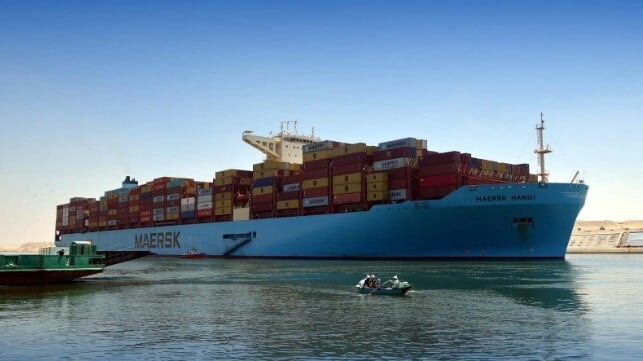
The Suez Canal Authority continues to seek the rebuilding of transits through its waterway after the continuing declines in its revenues and contribution to the country. During a recent meeting with the Danish Ambassador and a high-level delegation, the Chairman of the Suez Canal Authority reportedly highlighted the long relationship with Maerk and called for the shipping company “to take the initiative to gradually resume transiting through the Suez Canal once again.”
According to the readout on the meeting, the Chairman of the Suez Canal Authority, Lieutenant General Osama Rabie, emphasized his pride in the close relationship between the Suez Canal Authority and Maersk. He reportedly also discussed the latest developments in the Red Sea region.
Danish Ambassador Lars Bo Møller reportedly was making his first visit to the authority to discuss future cooperation prospects. According to the report, the ambassador called the return to the Suez Canal “inevitable,” while recognizing that it is a fundamental gateway for global trade.
The shipping company and its APM Terminals have long-standing relationships with the region. APM operates a container terminal at the northern terminus of the Suez Canal and has committed to the expansion of the operation. The meeting emphasized that the ongoing expansion of the terminal will significantly enhance the competitiveness of the East Port Said Port.
Maersk had first instructed its vessels to pause their transits through the Bab al-Mandab Strait on December 15, 2023, the day after a near-miss incident involving the Maersk Gibraltar and another attack on a container vessel the following day. With the start of the international security operation, Maersk briefly resumed some transits, but then on December 30, the Maersk Hangzhou was hit by an unknown object after passing through the Bab al-Mandab Strait en route from Singapore to Port Suez, Egypt. The company also reported that four boats approached Maersk Hangzhou and opened fire in what it believed was an attempt to board the vessel. The Maersk Hangzhou’s security team, along with a helicopter deployed from a nearby navy vessel, successfully thwarted the attempt, but after that, Maersk directed all vessels to reroute around Africa.
The company has continued to monitor the security situation, but ships of Maersk Line, Limited, which operate under charter to transport U.S. government cargoes, continued to be targeted by the Houthis. The company confirmed, for example, on July 9, 2024, that the Maersk Sentosa, operated by Maersk Line, Limited, reported being targeted by a flying object in the northernmost part of the Gulf of Aden.
Other carriers have continued or resumed some transits through the Suez Canal and the Bab al-Mandeb. EUNAVFOR Aspides has highlighted its protection mission for vessels, including CMA CGM, but Maersk has said that it would wait until it was confident of the increased stability in the region.
The Suez Canal Authority has hosted several meetings with the representatives of the major shipping companies as it seeks to restore transits through the Suez Canal. However, with the Houthis having sunk two bulkers in July and damaging a cargo ship recently in the Gulf of Aden, the major carriers have continued to defer returning to the route.
Data released this week by the Central Bank of Egypt on the country’s finances showed that the operations of the Suez Canal were mostly stable in the first half of 2025. Revenues were down just 1.4 percent compared to 2024, with a total of $1.8 billion between January and June. However, for the full fiscal year 2024/2025, the canal’s revenues were down 45.5 percent to $3.6 billion. The report highlights a 55 percent drop in net tonnage to 482.8 million tons and a 38.5 percent decrease in transits to around 12,400 vessels during FY 2024-2025.
Maersk shares hit three-month low on prospect of Gaza deal reopening Red Sea route
By Reuters
October 09, 2025

COPENHAGEN -- Maersk shares fell on Thursday on expectations a Gaza ceasefire deal could eventually restore container shipping routes through the Red Sea and Suez Canal, easing a capacity crunch that has supported freight rates.
Israel and Hamas agreed on Wednesday to the first phase of U.S. President Donald Trump’s plan for Gaza, raising hopes Yemen’s Iran-aligned Houthi forces might halt attacks on commercial shipping in the Red Sea. Such attacks have forced shippers to reroute south of Africa since late 2023.
However, the Houthis have yet to comment on the ceasefire deal or signal any policy change. The group claimed responsibility for attacking a Dutch-operated vessel last week.
Shares in the Danish shipping company were down 2 per cent at 1025 GMT, touching their lowest since July 8.
“Maersk is falling due to the expectation of further drops in the freight rates in connection with a higher probability of safe passage through the Red Sea,” Sydbank analyst Mikkel Emil Jensen said.
Analysts warned that even if the ceasefire holds, shipping companies were likely to wait months for assurances that attacks will not resume.
A Maersk spokesperson reiterated the group will consider resuming transit through the Red Sea only once a long-term and viable security solution had been established.
“There is a clear link between the security risks in the Bab al-Mandab Strait and the conflict in Gaza, though it remains too early to assess how progress in Gaza will influence the situation in the Red Sea,” it said.
“We hope this agreement marks the first step toward ending the conflict and achieving lasting peace.”
A return to Suez would increase available shipping capacity and put further pressure on freight rates, which have already declined from peaks earlier this year, according to analysts at Sydbank and ABG Sundal Collier.
Reporting by Vera Dvorakova. Writing by Stine Jacobsen and Anna Ringstrom, Editing by Jacob Gronholt-Pedersen, Mark Potter and Susan Fenton, Reuters

No comments:
Post a Comment