Fierce Fighting, High Number Of Casualties Reported Along Pakistan-Afghanistan Border
October 13, 2025
By RFE RL
Fierce fighting broke out in several locations on the Afghan-Pakistani border overnight, killing and wounding a large number of soldiers from both sides and prompting Islamabad to close two major border crossings, officials in the two countries said on October 12.
The Pakistani military claimed that its forces killed more than 200 Afghan soldiers, adding that the number of wounded from the Afghan side was “much higher.”
The military said in a statement that 23 Pakistani soldiers were killed, and 29 others were wounded in the latest flare-up of violence between the two countries.
In Kabul, Zabihullah Mujahid, the spokesperson for the Taliban-led government, claimed that at least 58 Pakistani soldiers were killed and about 30 others were wounded in the exchange of fire.
Mujahid said in a press conference that nine Afghan soldiers were also killed and about 18 others injured in the clashes that erupted late on October 11.
Both sides accused each other of stirring violence, while describing their own operations as retaliatory actions.
The Pakistani army statement said the “Afghan Taliban” launched an “unprovoked attack on Pakistan,” prompting Islamabad to “repel the assault” to defend itself.
The army claimed that groups sponsored by India, Pakistan’s regional rival, supported the Taliban forces in the clashes.
The military said Pakistan has “noted with concern” that the latest violence coincided with a trip to New Delhi by Taliban Foreign Minister Amir Khan Muttaqi starting on October 9. Muttaqi is expected to be in India for a week of talks.
Pakistani army said several Taliban border posts had been destroyed inside Afghanistan during its attacks. The Taliban said it captured more than 20 Pakistani military posts. The claims cannot be independently verified.
Some civilians on the Pakistani side of the border were leaving the region for safer locations, according to local security sources.
Pakistani Prime Minister Shebaz Sharif and President Asif Ali Zardari condemned the violence, which they blamed on Afghanistan.
“There will be no compromise on Pakistan’s defense, and every provocation will be met with a strong and effective response,” Sharif said in a statement, accusing Taliban authorities in Afghanistan of allowing their land to be used by “terrorist elements.”
Afghanistan’s Taliban rulers claimed that their forces carried out “successful retaliatory operations along the Durand Line against the centers of Pakistani security forces, in response to repeated violations of Afghanistan’s airspace and territory. “
The 2,600-kilometer Afghan-Pakistani border is often referred to as the colonial-era Durand Line, which set the international border in 1893.
Zabihullah Mujahid told reporters “the retaliatory operations were halted last night at the request of Qatar and Saudi Arabia.”
But he added that fighting was still “ongoing in several areas, including Bahramcha in Helmand Province, due to continued attacks from the Pakistani side.”
Worsening Relations
Reports from the border region cannot immediately be verified.
Once allies, the sides have fallen out over the Afghan Taliban’s alleged sheltering of the Tehrik-e Taliban Pakistan (TTP), an extremist group that has waged a deadly insurgency against Islamabad for years.
The Taliban, which returned to power in August 2021 as international troops left Afghanistan, denies it is protecting the TTP inside the country.
On October 9, two senior members of the extremist group were killed in unprecedented Pakistani drone strikes in the Afghan capital, sources told RFE/RL’s Radio Mashaal, marking a major escalation of tensions between the two side.
The target of the strikes in Kabul late on October 9 was Noor Wali Mehsud, the leader of the TTP, which is also known as the Pakistani Taliban, a Pakistani security official and a member of the TTP said.
It was not clear if Mehsud was killed in the strikes. A TTP source said the militant leader was alive but two “important” members of the group were killed, without disclosing their names.
Following the reported strike, Pakistani media quoted Foreign Ministry spokesman Shafqat Ali Khan as saying Islamabad respects Afghanistan’s territorial integrity and sovereignty and is ready to discuss and cooperate on terrorism-related challenges.
But he added that Pakistan was committed to taking every step to ensure the safety and well-being of its citizens.
The spokesman did not directly confirm Pakistan’s attack on Afghanistan but said the country was protecting its citizens through counterterrorism measures based on intelligence information.
Islamabad also called on Kabul “to stop harboring the Pakistani Taliban on its soil.”
Officials from Iran, Saudi Arabia, and Qatar issued calls for “restraint” following the latest outbreak of violence.
Pakistan, with a population of 247 million and a powerful military, also has a tense relationship with fellow nuclear power and neighboring India.
Pakistan forces were put on high alert near the Indian border, raising concerns of a wider conflict involving the two bitter rivals.
Ishaq Atmar, a German-based expert on Afghan affairs, told RFE/RL’s Radio Azadithat the timing of the attack — which occurred during the groundbreaking visit by the Taliban Foreign Minister to India — “could not be a coincidence.”
“After Mr. Muttaqi was warmly welcomed by Indian officials, signed agreements, and upgraded diplomatic relations to the embassy level, Pakistan saw this as an opportune time to send a clear message to India, the Taliban government, and other countries” observing regional affairs, he said.
Poverty-stricken Afghanistan, with some 44 million people, has been isolated on the global stage, with only Russia officially recognizing the Taliban as the country’s legitimate rulers. The government has been accused of multiple human rights violations, especially against women.
RFE/RL journalists report the news in 21 countries where a free press is banned by the government or not fully established.
October 13, 2025
By RFE RL
Fierce fighting broke out in several locations on the Afghan-Pakistani border overnight, killing and wounding a large number of soldiers from both sides and prompting Islamabad to close two major border crossings, officials in the two countries said on October 12.
The Pakistani military claimed that its forces killed more than 200 Afghan soldiers, adding that the number of wounded from the Afghan side was “much higher.”
The military said in a statement that 23 Pakistani soldiers were killed, and 29 others were wounded in the latest flare-up of violence between the two countries.
In Kabul, Zabihullah Mujahid, the spokesperson for the Taliban-led government, claimed that at least 58 Pakistani soldiers were killed and about 30 others were wounded in the exchange of fire.
Mujahid said in a press conference that nine Afghan soldiers were also killed and about 18 others injured in the clashes that erupted late on October 11.
Both sides accused each other of stirring violence, while describing their own operations as retaliatory actions.
The Pakistani army statement said the “Afghan Taliban” launched an “unprovoked attack on Pakistan,” prompting Islamabad to “repel the assault” to defend itself.
The army claimed that groups sponsored by India, Pakistan’s regional rival, supported the Taliban forces in the clashes.
The military said Pakistan has “noted with concern” that the latest violence coincided with a trip to New Delhi by Taliban Foreign Minister Amir Khan Muttaqi starting on October 9. Muttaqi is expected to be in India for a week of talks.
Pakistani army said several Taliban border posts had been destroyed inside Afghanistan during its attacks. The Taliban said it captured more than 20 Pakistani military posts. The claims cannot be independently verified.
Some civilians on the Pakistani side of the border were leaving the region for safer locations, according to local security sources.
Pakistani Prime Minister Shebaz Sharif and President Asif Ali Zardari condemned the violence, which they blamed on Afghanistan.
“There will be no compromise on Pakistan’s defense, and every provocation will be met with a strong and effective response,” Sharif said in a statement, accusing Taliban authorities in Afghanistan of allowing their land to be used by “terrorist elements.”
Afghanistan’s Taliban rulers claimed that their forces carried out “successful retaliatory operations along the Durand Line against the centers of Pakistani security forces, in response to repeated violations of Afghanistan’s airspace and territory. “
The 2,600-kilometer Afghan-Pakistani border is often referred to as the colonial-era Durand Line, which set the international border in 1893.
Zabihullah Mujahid told reporters “the retaliatory operations were halted last night at the request of Qatar and Saudi Arabia.”
But he added that fighting was still “ongoing in several areas, including Bahramcha in Helmand Province, due to continued attacks from the Pakistani side.”
Worsening Relations
Reports from the border region cannot immediately be verified.
Once allies, the sides have fallen out over the Afghan Taliban’s alleged sheltering of the Tehrik-e Taliban Pakistan (TTP), an extremist group that has waged a deadly insurgency against Islamabad for years.
The Taliban, which returned to power in August 2021 as international troops left Afghanistan, denies it is protecting the TTP inside the country.
On October 9, two senior members of the extremist group were killed in unprecedented Pakistani drone strikes in the Afghan capital, sources told RFE/RL’s Radio Mashaal, marking a major escalation of tensions between the two side.
The target of the strikes in Kabul late on October 9 was Noor Wali Mehsud, the leader of the TTP, which is also known as the Pakistani Taliban, a Pakistani security official and a member of the TTP said.
It was not clear if Mehsud was killed in the strikes. A TTP source said the militant leader was alive but two “important” members of the group were killed, without disclosing their names.
Following the reported strike, Pakistani media quoted Foreign Ministry spokesman Shafqat Ali Khan as saying Islamabad respects Afghanistan’s territorial integrity and sovereignty and is ready to discuss and cooperate on terrorism-related challenges.
But he added that Pakistan was committed to taking every step to ensure the safety and well-being of its citizens.
The spokesman did not directly confirm Pakistan’s attack on Afghanistan but said the country was protecting its citizens through counterterrorism measures based on intelligence information.
Islamabad also called on Kabul “to stop harboring the Pakistani Taliban on its soil.”
Officials from Iran, Saudi Arabia, and Qatar issued calls for “restraint” following the latest outbreak of violence.
Pakistan, with a population of 247 million and a powerful military, also has a tense relationship with fellow nuclear power and neighboring India.
Pakistan forces were put on high alert near the Indian border, raising concerns of a wider conflict involving the two bitter rivals.
Ishaq Atmar, a German-based expert on Afghan affairs, told RFE/RL’s Radio Azadithat the timing of the attack — which occurred during the groundbreaking visit by the Taliban Foreign Minister to India — “could not be a coincidence.”
“After Mr. Muttaqi was warmly welcomed by Indian officials, signed agreements, and upgraded diplomatic relations to the embassy level, Pakistan saw this as an opportune time to send a clear message to India, the Taliban government, and other countries” observing regional affairs, he said.
Poverty-stricken Afghanistan, with some 44 million people, has been isolated on the global stage, with only Russia officially recognizing the Taliban as the country’s legitimate rulers. The government has been accused of multiple human rights violations, especially against women.
RFE/RL journalists report the news in 21 countries where a free press is banned by the government or not fully established.
Pakistani Taliban militants have claimed responsibility for separate attacks that killed 20 security officers and three civilians in the northwestern Khyber Pakhtunkhwa province that borders Afghanistan. Friday's attacks came hours after the Afghan Taliban government accused Pakistan of "violating Kabul's sovereign territory".
Issued on: 11/10/2025
By: FRANCE 24
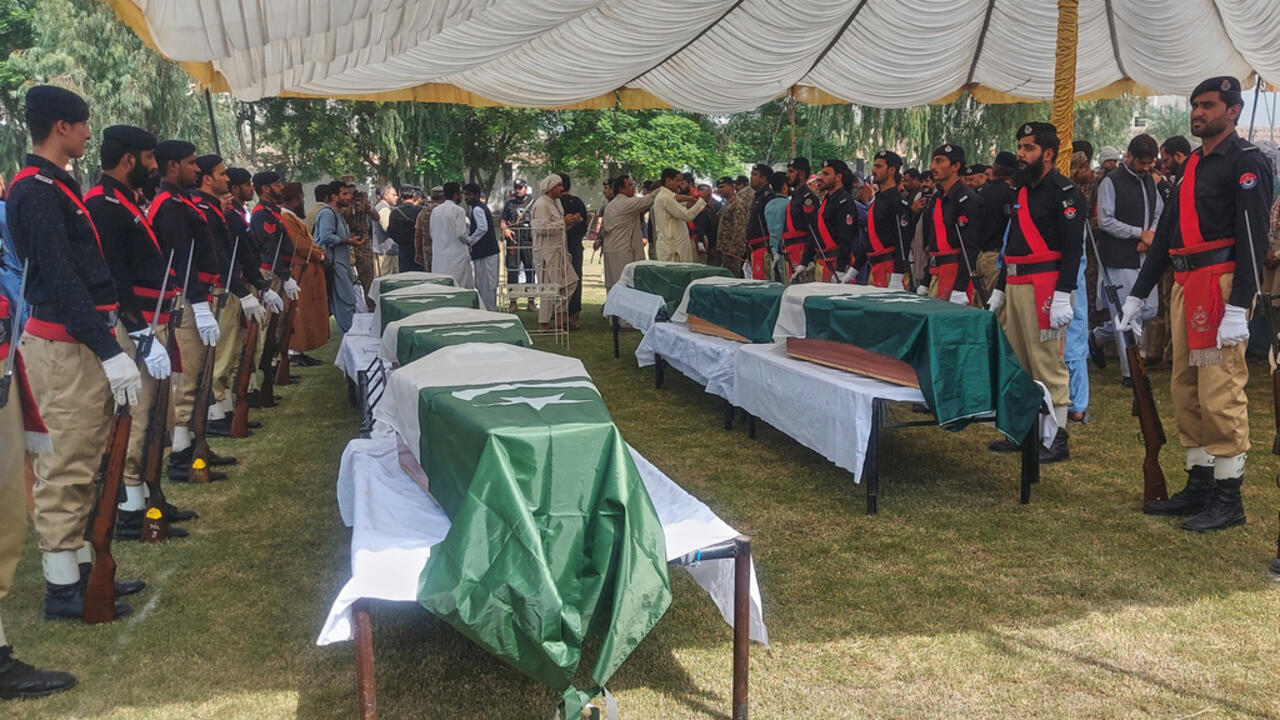
Officials and others attend funeral prayers for officers killed in an attack on a police training centre in northwestern Pakistan, on October 11, 2025. © Muhammad Kashif, AP
The Pakistani Taliban on Saturday claimed responsibility for deadly attacks in several northwestern districts that killed 20 security officials and three civilians.
The attacks, which included a suicide bombing on a police training school, were carried out on Friday in several districts of Khyber Pakhtunkhwa province that borders Afghanistan.
Militancy has surged in Khyber Pakhtunkhwa since the withdrawal of US-led troops from neighbouring Afghanistan in 2021 and the return of the Taliban government in Kabul.
Eleven paramilitary troops were killed in the border Khyber district, while seven policemen were killed after a suicide bomber rammed an explosives-laden car into the gate of a police training school, which was followed by a gun attack.
Five people, including three civilians, were killed in a separate clash in Bajaur district, security officials told AFP on Saturday.
The Pakistani Taliban, the Tehreek-e-Taliban (TTP), claimed responsibility for the attacks in messages on social media. The group is separate to but closely linked with the Afghan Taliban.
The attacks came hours after Afghanistan's Taliban government accused Pakistan of "violating Kabul's sovereign territory", a day after two explosions were heard in the capital.
Pakistan did not say if it was behind the blasts in Kabul but said it had the right to defend itself against surging border militancy.
Islamabad accuses Afghanistan of failing to expel militants using Afghan territory to launch attacks on Pakistan, an accusation that authorities in Kabul deny.
The TTP and its affiliates are behind most of the violence – largely directed at security forces.
Including Friday's attacks at least 32 Pakistani troops and three civilans have been killed this week alone in the border regions.
(FRANCE 24 with AFP)
The Pakistani Taliban on Saturday claimed responsibility for deadly attacks in several northwestern districts that killed 20 security officials and three civilians.
The attacks, which included a suicide bombing on a police training school, were carried out on Friday in several districts of Khyber Pakhtunkhwa province that borders Afghanistan.
Militancy has surged in Khyber Pakhtunkhwa since the withdrawal of US-led troops from neighbouring Afghanistan in 2021 and the return of the Taliban government in Kabul.
Eleven paramilitary troops were killed in the border Khyber district, while seven policemen were killed after a suicide bomber rammed an explosives-laden car into the gate of a police training school, which was followed by a gun attack.
Five people, including three civilians, were killed in a separate clash in Bajaur district, security officials told AFP on Saturday.
The Pakistani Taliban, the Tehreek-e-Taliban (TTP), claimed responsibility for the attacks in messages on social media. The group is separate to but closely linked with the Afghan Taliban.
The attacks came hours after Afghanistan's Taliban government accused Pakistan of "violating Kabul's sovereign territory", a day after two explosions were heard in the capital.
Pakistan did not say if it was behind the blasts in Kabul but said it had the right to defend itself against surging border militancy.
Islamabad accuses Afghanistan of failing to expel militants using Afghan territory to launch attacks on Pakistan, an accusation that authorities in Kabul deny.
The TTP and its affiliates are behind most of the violence – largely directed at security forces.
Including Friday's attacks at least 32 Pakistani troops and three civilans have been killed this week alone in the border regions.
(FRANCE 24 with AFP)

No comments:
Post a Comment