Independent leftwing candidate Catherine Connolly wins Irish presidential elections
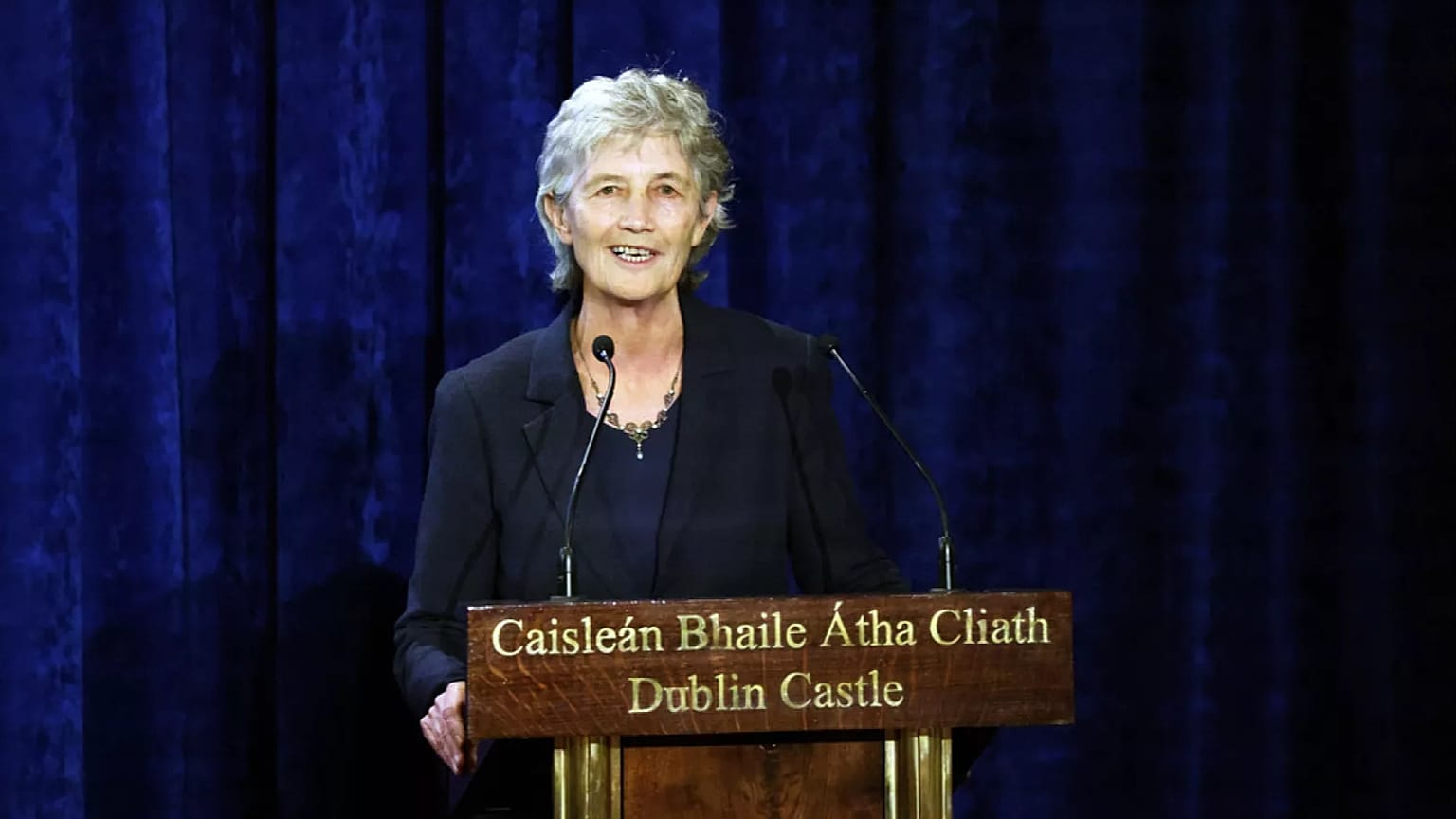
Connolly, 68, is a fluent Irish speaker from Galway in the west of Ireland, and has promised to be a voice for all the people of Ireland and for peace.
Left-wing independent candidate Catherine Connolly will become the 10th president of Ireland after winning elections by a landslide victory.
Official results showed strong voter support for Connolly as president, a largely ceremonial role in Ireland. She won 63% of first-preference votes once spoiled votes were excluded, compared to 29% of her rival Heather Humphreys, of the centre-right party Fine Gael.
Connolly, 68, said Saturday evening at Dublin Castle that she would champion diversity and be a voice for peace and one that “builds on our policy of neutrality.”
“I would be an inclusive president for all of you, and I regard it as an absolute honour," she said.
Humphreys conceded she had lost earlier Saturday before vote counting had finished.
Connolly, a former barrister who has served as a lawmaker since 2016, has been outspoken in criticizing Israel over the war in Gaza. She has also warned against the European Union's growing “militarization" following Russia's full-scale invasion of Ukraine.
Ireland has a tradition of military neutrality, but her critics have said she risks alienating the country's allies.
Connolly will succeed Michael D. Higgins, who has been president since 2011, having served the maximum two seven-year terms. She will be Ireland’s 10th president and the third woman to hold the post.
The politician has garnered the backing of a range of left-leaning parties, including Sinn Féin, the Labour Party and the Social Democrats.
Prime Minister Micheál Martin on Saturday congratulated Connolly on her “very comprehensive election victory." He said he was looking forward to working with the new president as “Ireland continues to play a significant role on the global stage, and as we look forward to hosting the EU presidency in the second half of 2026."
Irish presidents represent the country on the world stage, host visiting heads of state and play an important constitutional role, but they do not have executive powers such as shaping laws or policies.
Nonetheless, parties on the left celebrated the results as a significant shift in Irish politics.
“We have seen a real appetite for the change that Catherine represents,” said Labour Party leader Ivana Bacik. “We believe this really does mean a new sort of politics is possible, that we can now realize the ambition that I talked about a year ago: The real prospect of a center-left-led government after the next general election.”
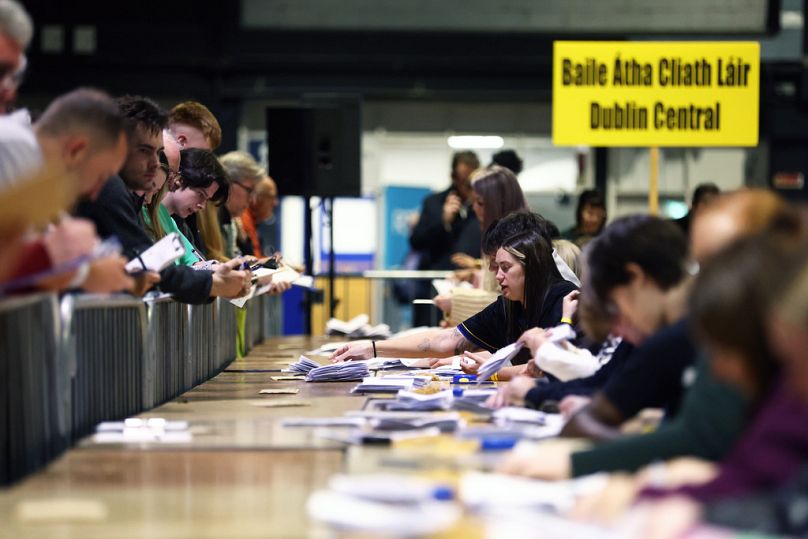
Connolly and Humphreys were the only contenders after Jim Gavin, the candidate for Martin’s Fianna Fail party, quit the race three weeks before the election over a long-ago financial dispute.
Martin, who heads Ireland’s government, had personally backed Gavin as a presidential candidate. Though Gavin had stopped campaigning, his name remained on the ballot paper because of his late withdrawal from the race. He won 7% of first preference votes.
Others — including musician Bob Geldof and the former mixed martial arts champion Conor McGregor — had indicated they wished to run for president but failed to receive enough backing for a nomination.
The electoral commission said Saturday that there was a “significantly higher than normal” number of spoiled ballots, and that there will “clearly be a need for deeper and further reflection” about voter dissatisfaction.
Simon Harris, the deputy premier, said the spoiled ballots showed “the number of people in Ireland now who are clearly feeling disaffected or disconnected with politics." He said officials will be looking at the possibility of changing the threshold needed to secure a nomination in future presidential elections.
About 46% of the 3.6 million eligible voters turned out to vote. There were nearly 214,000 invalid ballots nationwide, representing a tenfold increase on the last presidential election in 2018.
Ireland Elects Hard-Left EU Critic Catherine Connolly As Next President
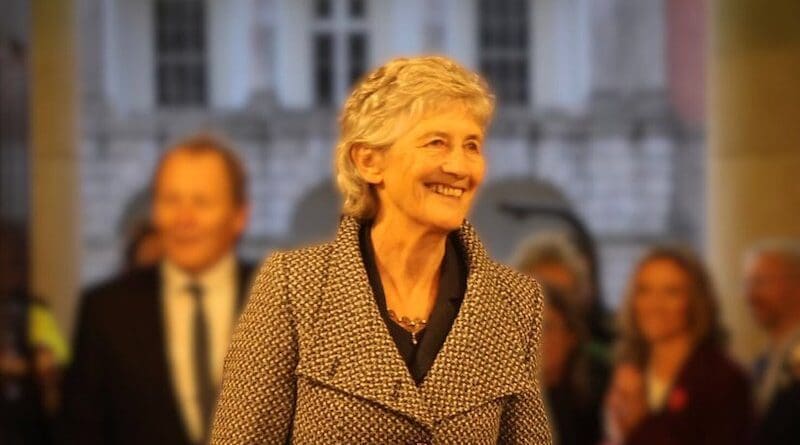
Ireland's Catherine Connolly. Photo Credit: Catherine Connolly, X
By EurActiv
By Maria Simon Arboleas
(EurActiv) — Early results from Ireland’s presidential election point to a clear victory for independent Catherine Connolly, a staunch defender of military neutrality and outspoken critic of EU policy.
Connolly, a 68-year-old barrister and member of Ireland’s parliament since 2016, is far ahead of her centre-right rival Heather Humphreys, from the governing party Fine Gael party.
With around half the votes counted, Connolly was above 60%, with Humphreys trailing at just below 30%.
The presidential role, which is mostly ceremonial, has been held by left-wing Michael D Higgins since 2011.
Connolly had the backing of several Irish left-wing parties, notable among which was Sinn Féin, which sits with The Left in the European Parliament.
Still, the two-horse presidential race has been marred by a very low turnout, with half of voters not showing up. The limited choice sparked discontent over the nomination process and led to a historically high rate of spoilt votes.
A third candidate, centrist Jim Gavin, quit the race weeks ago after reports he owed rent to a former tenant, yet his name remained on the ballot paper and still drew some votes.
The count began on Saturday morning and the final result is expected later in the evening.
Humphreys conceded in the afternoon, wishing her competitor all the best.
Prime Minister Micheál Martin was quick to congratulate Connolly. “It is clear she will be the next President of Ireland,” he posted on social media, expressing “no doubt” she would serve the country well.
Martin also pointed to Dublin’s upcoming EU presidency in the second half of 2026 and said he would cooperate with Connolly “as Ireland continues to play a significant role on the global stage.”
Meanwhile, Sinn Féin’s leader Mary Lou McDonald went further and said Connolly’s win was a victory for “equality, fairness, young people and reunification.”
A controversial, committed European
Connolly has long described the EU as neoliberal and undemocratic and has opposed Ireland’s ratification of several EU treaties.
Still, she insists that she is “a committed European”.
The president-elect mostly targets what she calls the EU’s growing militarisation, denouncing the “military-industrial complex in Germany” and even drawing parallels with the 1930s.
She said there were “many things to be worried about with Frau von der Leyen” and accused the Commissioner of standing “shoulder to shoulder” with Israeli Prime Minister Benjamin Netanyahu.
While she “utterly condemned” Hamas as a terrorist organisation, Connolly drew criticism after saying that the group is still part of Palestinian civil society.
Asked about Russia’s war against Ukraine, Connolly called for a peace agreement and backed the EU’s sanctions against Moscow.
In her new role, Connolly will be tasked with hosting other heads of state and confirming that legislation complies with the Irish constitution.
Still, some predict her strong left-wing views on foreign policy, social justice and housing could cause friction with the conservative leaning coalition government.
Sunday 26 October 2025, by Paul Murphy
Catherine Connolly’s resounding victory in the Presidential election in Ireland is a watershed moment. It is the first time that the left has won a majority of votes in a national election. This was not a narrow victory either; Catherine won the largest percentage and largest total vote of any Presidential candidate in history.
The combined forces of the political and media establishment threw everything they could at Connolly to try to stop the momentum behind her campaign. “Smear the bejaysus out of her”, as Ivan Yates [1] suggested, was the strategy deployed. Her trip to Syria, her employment of a Republican convicted of a gun crime, her comments in opposition to US, French and British imperialism, as well as her previous work as a barrister, were all endlessly scrutinised and picked over.
The red thread running through the majority of the smears was the fact that she is out of touch with the political and media establishment in her defence of neutrality and opposition to aligning more and more openly with NATO. While Fine Gael’s Heather Humphreys pointedly refused to criticise what she termed “our allies” and their arming of genocide, Catherine Connolly openly criticised US funding of Israeli war crimes and the drive for rearmament in Europe, to the horror of most political commentators.
Despite this, her campaign, backed by all the ‘left’ parties and a movement from below, continued to gain support in successive polls and handily beat the establishment candidate. There will be attempts to minimise the extent of the victory by pointing to the calamities that struck the establishment parties - from the dropping out of the preferred Fine Gael candidate, Mairead McGuinness, due to illness, and the dramatic withdrawal of Fianna Fáil’s candidate mid-contest, to the unconvincing media performances of Heather Humphreys. But these calamities were mostly an expression of the declining social bases of Fianna Fáil and Fine Gael.
The fact that Fianna Fáil, the historically largest party in the state, could not find a credible candidate within its own ranks and the leadership felt compelled to go with a celebrity candidate in order to stop the corrupt former Taoiseach, Bertie Ahern, from being nominated, is itself instructive. That Jim Gavin was undone by a scandal of being a landlord who robbed money from a tenant was poetic justice for Fianna Fáil.
Similarly, the fact that Heather Humphreys proved to be such a poor candidate exemplifies f how deeply out of touch Fine Gael is with the majority of people. They were convinced that Humphreys would prove a popular figure with a down-to-earth manner. In practice, she appeared uncomfortable with any questioning that went beyond soundbites. Despite her previous position as a Minister, she had never been faced with much challenging questioning. Might Mairead McGuinness have been a better candidate for FG? She would have been a more capable debater, undoubtedly. But in that case, the debate would have focused more on the direction of the European Union, and her close relationship with Israel-supporting European Commission President Ursula von der Leyen, the majority are still with Connolly.
Why did she win?
We should not forget that mainstream journalists largely missed the boat. They were busy telling us over and over how this presidential election was “dull” and “uninspiring”, while a movement was rapidly developing behind Connolly. For those who think real politics only takes place within the four walls of Leinster House, this was a boring campaign. But out in the real world, Catherine was motivating 1,500 young people to attend a fundraising gig at Vicar St., which was sold out in less than an hour, and rallies and meetings across the country were packed out on every occasion.
Much ink will now be spilt to avoid the most basic and simple conclusion: she won because the majority of people agree with her values, the values of the left, rather than those of Fianna Fáil and Fine Gael. A big majority support neutrality, support the right to housing, and aspire towards a more equal and just society. They’re horrified by the genocide in Gaza and want a president who is unambiguous about Palestinian freedom. Connolly’s message of a movement working to build what she termed ‘a new Republic’ resonated deeply.
Young people were the energy and vitality of the campaign. In the final Red C poll, she polled 57% amongst 18-34 year olds compared to Humphreys’ 17%. Amongst 35-54 year olds, she had 49%, and for over 55s, she was at 43%. The Irish Times interviewed 35 first-time voters, 29 were voting for Connolly, five were spoiling their vote, with only one voting for Humphreys! She also polled higher amongst women than men, and that was evident on the ground. Many in the campaign remarked on the similarities to the Repeal campaign for abortion rights - with young women as a driving force. Young people rejected the conservative parties and voted for someone who offered hope and an alternative.
The smear campaign was utterly ineffective and ultimately counterproductive for FG for a number of reasons. One is that Connolly never wavered in the face of the attacks. She didn’t give an inch and made no apologies for her criticisms of European rearmament, nor for hiring a convict. The notion that her outspokenness would work against her made no sense considering our current, much-beloved President, Michael D. Higgins, is also a critic of US imperialism and government policy. The nature of the Presidency itself also created a terrain more favourable for the left. The President’s lack of real power means people were free to vote for the progressive values they aspire to, without the establishment being able to credibly threaten dire economic implications.
Catherine’s personal qualities also came to the fore in the campaign. ‘Authentic’ was the word that many ordinary people used to describe her. All the videos of her playing with kids and adults alike, from the keepie uppies and dribbling a basketball, to clips of her dancing a ceili and playing the piano, revealed a human side to her that people found immensely appealing.
Another reason Catherine won by such a large margin is that a movement was energised around her. There is no precedent in recent history for a Presidential campaign to become a movement in this way. While Michael D. Higgins has proven to be an effective President, his 2018 campaign was actually supported by Fianna Fáil and Fine Gael, while he won in 2011 as a result of the collapse of support for Sean Gallagher after the final debate. The closest is the victory of Mary Robinson in 1990, backed by a coalition of Labour, the Workers Party and the Greens.
This was an insurgent, oppositional campaign organised by capable activists from the independent and party left. Over 15,000 people volunteered - the vast majority of whom were not members of any political party. Over half of those donated or became active in the campaign. This energy, combined with smart digital organising and social media messaging, meant that the Connolly campaign was far more effective than the Fine Gael campaign at meeting and discussing with voters. In every constituency, there was a significant amount of organised canvassing, on a level for a Presidential election that certainly hasn’t been seen in decades.
Spoil the vote?
With the ultra-conservative Catholic right narrowly failing to get sufficient nominations from TDs or Senators to get on the ballot paper, the far-right ran an active ‘Spoil The Vote’ campaign. This is again a first for Irish politics.
The over 12% they scored in spoils is another warning - the far-right have their claws and influence in working class communities. Yet, experience of canvassing more hard-pressed working class areas proves that this is not a lost battle, but one to be engaged with. Most of those considering spoiling their ballot were open to being convinced that the best protest was to defeat the political establishment. Deep community organising and trying to mobilise people in action on issues like the cost of living crisis will be essential in order not to cede these communities to the far-right.
Although the far-right wasn’t directly on the ballot, their rise and the increase in racist attacks and reactionary sentiment were undoubtedly a factor in the campaign. Many rightly saw supporting Connolly as a way of opposing the rightward political turn, which Fine Gael and Fianna Fáil have both leaned into. Her victory is part of a counter-current to the rise of the far-right.
Connolly also stood out as a long-time campaigner for investment in the Gaeltacht and support for the Irish language. That she learned to speak fluent Irish well into her 40s underscored her commitment to the language and Gaeltacht communities. So, we should see her campaign as part of a new revival of the Irish language, seen in the popularity of Kneecap and other artists. This is part of forming a progressive identity of what it is to be Irish today, relating to our anti-colonial history, and in opposition to the narrow white nationalism of the far-right, who misuse the tricolour.
Socialist left - a key backbone of the campaign
The socialist left, in particular People Before Profit and independent left activists, were a crucial part of the Connolly campaign. Many of the key activists playing central roles nationally were veterans of previous successful left-led campaigns.
The decision of People Before Profit to throw itself into this campaign, despite the limitations of the position of Presidency, was vindicated by the dynamism of the campaign, the result and the opportunities that open up now. While the level of activism on the ground was less than what might have been possible with a longer campaign, it nonetheless represents a crucial victory after a challenging general election and opens new opportunities.
Independent activists who may have been previously sceptical about PBP have noted the constructive and non-sectarian approach taken by PBP. They should consider joining PBP to work together to build it into a mass pluralist and ecosocialist party.
Those sections of the socialist left who gave grudging endorsements for Catherine while criticising PBP’s engagement in the campaign will hopefully reflect on what happened and what they stood aside from. A left-right polarisation took place, and the left won. Thousands of new activists were mobilised for the first time and gained organising experience. Momentum that had slipped to the right has been regained by the left.
Other parties in the Connolly camp
The Connolly campaign also had a dynamic within the other parties that supported her. The Social Democrats were with PBP from the beginning in supporting Catherine Connolly. They helped to create a momentum amongst the left, which effectively left Labour and the Greens with a choice between supporting Connolly or not having any candidate. Social Democrat party members enthusiastically engaged at a local and national level.
Sinn Féin came on board the campaign relatively late, after considering running its own candidate. They qualitatively added to the campaign at a central and local level, working constructively, while also using it as an opportunity to re-popularise Mary Lou McDonald as a future alternative Taoiseach. This was the first serious attempt to implement the strategy of a “progressive left republican bloc which respects the independence and autonomy of cooperating political parties”, first floated after the last general election by the Sinn Féin national chairperson, Declan Kearney.
By any standard, it has been a success, not just with the victory of Catherine Connolly, but with a 5% jump in the polls for Sinn Féin. Working with others has proven effective at boosting support for SF. For Sinn Féin members and the leadership, the key question is whether they are now willing to rule out coalition with Fianna Fáil and Fine Gael and put all their energy into a campaign for a left government.
For the Labour Party and the Greens, Connolly’s campaign was polarising. It exposed and undermined their most right-wing sections. Former Labour leader Alan Kelly was wheeled out almost weekly by the media to declare his opposition to Catherine Connolly and his support for Fine Gael. The media reported wider disquiet amongst the parliamentary party, although it did not publicly materialise. With Connolly having won so decisively, Kelly’s position is now weakened.
The same happened in the Green Party, with former TD Brian Leddin, resigning from the party in opposition to supporting Catherine Connolly, mostly it seems because of her opposition to war and imperialism. A smattering of others followed him out the door.
The diminishing of opposition to left co-operation in Labour and the Greens should make it easier for their leaderships to pursue this further if they wish. A major obstacle there, though, is that up until now, the progressive alliance proposed by both Labour and the Greens (overwhelmingly directed at the Social Democrats) has been to maximise the negotiating leverage of these parties in a future coalition with either Fianna Fáil or Fine Gael. That is not what those involved in the Connolly campaign are looking for - they rightly want to clear FF and FG out.
What next?
For the thousands of people who actively engaged in the Catherine Connolly campaign and for many more who passively supported it, the big question is: what next? Nobody believes that winning the Presidency is enough to change the country, given the very limited powers associated with it. Catherine Connolly will represent our values in the Presidency well and will prove to be a thorn in the side of the political establishment. Undoubtedly, the columns from commentators tut-tutting about the President overstepping the limits of the role, which became so common under Michael D. Higgins, will continue.
But people understand that to effect the change we need, we need to win much more than the Presidency. The big lesson is that if the left unites and seeks to mobilise people, it can win. The dynamic of unity can create confidence and enthuse others to get involved. The question of a Left government once again comes increasingly centre stage.
However, any attempt to develop an initiative which focuses only on the next general election is doomed to failure by allowing the energy and activism to dissipate. Playing the role of responsible government in waiting between 2020 and 2024 proved calamitous for Sinn Féin,
People who are suffering under the impact of repeated hikes in energy and grocery prices cannot wait. Those who are facing eviction or massive rent hikes under the government’s new plans cannot wait. Those who want meaningful action for Palestine and defence of our neutrality cannot wait. Joint initiatives must be organised, together with unions and social movements - to defend the Triple Lock; to demand the full implementation of the Occupied Territories Bill before Christmas; to end the cost of living crisis through price controls and an end to profiteering; and to implement an eviction ban alongside meaningful rent controls and public house building.
However, defensive struggles alone are insufficient. We need to raise people’s sights for the possibility of a Left government for the first time in the history of the state. People Before Profit is proposing to other parties and individuals the organisation of a major conference of the Left in the New Year to discuss how left co-operation can be deepened with a view to presenting a clear choice in the next general election: Fianna Fáil and Fine Gael, and those who would prop them up, versus a Left government.
All of this poses complicated questions to the socialist left. We understand that the capitalist system, where profit dominates, simply cannot deliver what people demand and need - the right to a home and a good life, a world without war and oppression, the right to a sustainable and liveable future for our children. We therefore will only enter a government that commits to a people-power strategy of mobilising from below to overcome the opposition of the powerful capitalist class and deliver ecosocialist change. That is far from the programme of the other major parties supporting Connolly.
Nonetheless, we actively want the rule of Fianna Fáil and Fine Gael to end. We want a left government, even on a programme far weaker than the ecosocialist one we would advocate. We want this government and the approach of reforming capitalism to be tested before the masses. We are therefore open to participating in this dynamic towards a left government, including committing to vote to allow this government to be formed, despite the very significant limitations of the likely programme. The key condition for us is that we retain our right to independence, to put forward our own ecosocialist position, and continue strengthening our connections with communities to mobilise the power of people from below.
In 1843, Karl Marx provided useful guidance for socialists approaching complicated situations:
”we do not confront the world in a doctrinaire way with a new principle: Here is the truth, kneel down before it! We develop new principles for the world out of the world’s own principles. We do not say to the world: Cease your struggles, they are foolish; we will give you the true slogan of struggle. We merely show the world what it is really fighting for, and consciousness is something that it has to acquire, even if it does not want to.”
Significant numbers of people are now anxious to take the next steps after the Connolly campaign to work towards getting rid of Fianna Fáil and Fine Gael and electing a left government. We should be right there, alongside them, organising and taking steps together, while using it as an opportunity to win people to the argument put forward by James Connolly in 1897:
“If you remove the English Army tomorrow and hoist the green flag over Dublin Castle, unless you set about the organization of the Socialist Republic your efforts will be in vain.”
To win a truly new Republic, it will not be enough to replace the government or even to write a new Constitution. A socialist Republic with working people and the oppressed in power is needed.
25 October 2025
Source: Rupture.
Attached documentscatherine-connolly-wins-an-historic-victory-for-the-left-in_a9234.pdf (PDF - 929.5 KiB)
Extraction PDF [->article9234]
Footnotes
[1] Former Fine Gael MP, now a political commentator.
Paul Murphy is a member of RISE in Ireland. He was re-elected to the Irish parliament in 2019, having been first elected in 2014. He was previously an MEP for the Socialist Party (2011-14).
International Viewpoint is published under the responsibility of the Bureau of the Fourth International. Signed articles do not necessarily reflect editorial policy. Articles can be reprinted with acknowledgement, and a live link if possible.
A President for all of Ireland – the Irish left finally unites

As the left in Ireland unites to support Catherine Connolly’s campaign for the Irish presidency, we reproduce Joseph Healy’s report at Anti-capitalist Resistance.
Some weeks ago, I went to a Zoom call organised by RISE and People Before Profit, an Irish left-wing political party. I was the only one on the call not in Ireland, but did introduce myself as a member of the large Irish diaspora, many of whom were forced to leave the country over the last 5 decades because of the actions of the Fianna Fail-Fine Gael duopoly who have ruled Ireland for the last century. The meeting was called about the Irish presidential election and the support of several Left parties for the radical candidate, Catherine Connolly.
Much was made of the fact that the President, while being the head of state, does not hold much political power but the fact remains that the outgoing President, the leftwing poet, Michael D Higgins (who is hugely popular and has served two seven year terms) became an outspoken critic of Israel and a critical voice on the government’s disastrous housing policy. Higgins has been attacked on a number of occasions by the press allied with the government parties, proving himself a real thorn in their side. The meeting made the point that for them, the central issue was Irish neutrality, which is being heavily debated at present and that Connolly is the Pro Neutrality candidate. This is in the light of the government’s desperate efforts to push Ireland away from its traditional stance of neutrality to being closer to NATO and possible future involvement in the war in Ukraine.
I raised the issue at the meeting about what would happen if Sinn Féin (the largest Leftwing party) put forward a candidate, thus splitting the Left vote. The People Before Profit T.D (MP) Paul Murphy, who was chairing the meeting, suggested that this would be no major threat to Connolly’s chances as it was a PR election and there would be transfers between the two. Connolly had been backed by most of the parties of the Left apart from People Before Profit – the Social Democrats, the Irish Labour Party and later the Greens. The other main argument at the meeting was that Connolly winning the presidency would be a major victory for the Left and one in the eye for the right-wing Fianna Fáil-Fine Gael government and a stepping stone towards the Left winning the next general election. I also raised the fact that many Irish citizens (those living in the North of Ireland and abroad) are disenfranchised in this election and that the Irish government had promised after the last presidential election (7 years ago) that it would be the last election where these groups would be excluded.
Government candidates
Shortly after this, the two government parties selected their candidates. Fine Gael chose the experienced politician and ex minister, Heather Humphries, about whom more later. Fianna Fail went for the populist choice of Jim Gavin, the former manager of the Dublin Gaelic football team and someone with no political background whatsoever. He has already shown himself to be out of his depth in the first presidential debate but unsurprisingly is ahead in the polls among older men, many of whom have an abiding interest in football. Gavin was also an air force officer and thus carries a macho aura as a sports figure and soldier.
Humphreys hails from the border county of Monaghan and is unusual in being a Protestant. However, two Irish presidents, including the first President (Douglas Hyde) were Protestants and it has never been an issue. Much more problematic is her role in the earlier Fine Gael government, where she pushed for a very harsh policy on benefits for disabled people, which became very controversial.
The proposals in the green paper included a tiered allowance which would link the level of payments to a determination on capacity to work and the nature of the disability. Disability activists said the plans were a “degrading and humiliating” value judgment that would give the impression that some people were falsifying the extent of their impairment or illness. Her Green Paper on disability benefits was described as a “cut and paste” of a “very discredited austerity measure” in the UK called the workplace capacity assessment.
These are the calibre of candidates which the government parties are putting up against Catherine Connolly.
Radical change
The situation changed radically last week in Connolly’s favour when Sinn Féin announced that instead of standing a candidate themselves, which they have usually done, they were giving their full support to Connolly. This was further enhanced last weekend when she appeared at a Sinn Féin conference to rapturous applause and stated that she had always supported a united Ireland. So, for the first time in decades, the entire Irish Left is united behind one candidate, and this has transformed the election. It has also led to a bitter attack on Connolly by the government-aligned press and much of the Irish media, particularly on the issue of Palestine.
Connolly has a long political pedigree, having originally been a Labour TD for Galway but later standing as an Independent. For this and several other reasons, she is despised by the right-wing section of the Labour Party, who were outvoted in giving her the party’s backing. Connolly held the position of Leas Ceann Comhairle (Deputy Speaker) of the Dáil, a position which earned her a lot of respect. She is also unique in being the only candidate who speaks fluent Irish. This could become significant in the election campaign with a strong and growing Irish language movement, and as the Irish historian Diarmaid Ferriter recently pointed out, the President is expected to carry out some duties in the Irish language, which is the official first language of the state and to have a good knowledge of it. Connolly uses this to her advantage, often beginning and ending her speeches in Irish and used it effectively in the first presidential debate with the other candidates, where they were left looking speechless!
The nomination process for candidates in the Irish presidential election is quite Byzantine and means that a candidate must either be nominated by a select number of TDs or by several local authorities. With the government parties controlling most local authorities, it has proven impossible for any independent candidates (other than Connolly) to stand this time, and this election has the smallest number of candidates (three) in many years of presidential elections. The Far Right had hoped that Conor McGregor, the Irish boxer and Trump adjacent pub owner, would be their candidate, but he failed to get nominated. Another ultra-conservative candidate also failed to be nominated.
Polls
Opinion polls suggest that at present Humphreys is the favourite, but Connolly leads among youth and many women. There is a feeling that the supporters of the Far Right may well abstain in this election, though they are a relatively small demographic. The main attacks on Connolly so far have been over Gaza and, in particular, her criticism of Starmer’s view that Hamas can play no role in the governing of Gaza. Connolly, quite rightly, stated that it was not the right of a British Prime Minister or anyone else to tell a colonised people who should be their government. The right-wing media and government parties predictably, in tones of shock and horror, accused her of being a Hamas apologist, but she stood her ground. In Ireland, where the Israeli embassy closed because of the pro-Palestine stance of the Irish people and identification with a group who are also victims of British imperialism, this may well stand Connolly in good stead.
Connolly has already performed well in the first televised debate, but political minefields lie ahead, particularly her defence of Irish neutrality, where the war in Ukraine will be used against her and the government candidates will likely argue for more involvement with NATO. This is particularly likely to come from Gavin with his military background. However, with a young, enthusiastic team of supporters and the combined forces of Sinn Féin, PBP and other parties, she stands a good chance of upsetting the applecart and following in the footsteps of poet politician Michael D Higgins.
A victory for Connolly would be a huge shot in the arm for the parties of the Left and progressive forces in Ireland. She is also likely to be the Irish President who would argue most forcefully for the ending of partition and the reunification, after a century of British occupation, of Ireland.
- This article originally appeared on Anti-capitalist Resistance on 1 October 2025.

No comments:
Post a Comment