CHINESE IMPERIALISM
With backing from China, Myanmar's military junta has managed to recapture a string of key towns and highways and put rebels on the back foot.

After losing control of over half of Myanmar, the military is retaking strategic points
Myanmar is preparing to start a national election in December — at least to the extent that such polls are possible in a country officially ruled by a military junta and partly controlled by rebels after nearly five years of civil war.
UN experts have dismissed the coming polls as a "sham," engineered to maintain the generals' grip on power through proxy parties.
And yet, the junta seems to be in a hurry to create conditions for voting in as many places as it can. The military has scored a string of victories against rebels since June, recapturing towns and trade routes on several fronts in the east and either pushing resistance forces back or stalling them in place.
These victories are also likely to reinforce the government's position ahead of the vote, which is due to start on December 28 and continue into January.
"It seems like kind of a deadline for them," said security analyst Kyaw Htet Aung with the Institute for Strategy and Policy – Myanmar.
Military taking over gem mines
The junta is engaged in its most consequential counteroffensive in years, possibly since the civil war started in 2021, analysts told DW.
The military is "reopening trade routes, it's reopening logistics routes, it has a major surge in troop numbers, it's made significant reforms to the way it fights, it's on the offensive on the diplomatic and political front with this upcoming election, and it's got plenty of new equipment," said Morgan Michaels, a research fellow at the International Institute for Strategic Studies.
Even after recent victories, the junta is believed to fully control well under half the country. But analysts say the towns and roads it has recaptured are of high strategic value.
They include key trade corridors with both China and Thailand and gem and mineral mines that had been controlled by different resistance groups since the coup.
Rebels on the defensive
Resistance groups are not on the wane everywhere. In the west, the Arakan Army is still advancing towards the center of the country. The Kachin Independence Army continues bearing down on the military from the north and is mostly holding its ground.
But many of the other armed groups arrayed against the junta have moved from offense to defense since last year, said Su Mon, a senior analyst for Armed Conflict Location and Event Data, an independent research group that tracks conflicts around the world.
"That's the major shift. They've [gone] from an offensive position to a defense position in their controlled areas. And since then they are not able to defend those areas and [are] losing one town after another," she told DW.
China throttles trade and supplies for rebels
Since the Myanmar military seized power from a democratically elected government in February 2021, tens of thousands have been killed on all sides, and over 3.3 million civilians have been displaced.
UN investigators have accused the junta of committing war crimes, including rape, torture and murder, at an "alarming rate." But despite its brutality, the military has mostly been retreating before rebel groups, losing control of vast swaths of the country, including most of Myanmar's borders with Thailand, China and Bangladesh.
Analysts say the military's recent successes are partly due to the renewed support from China, which has billions of dollars invested in energy and infrastructure projects across Myanmar that it is keen to protect and expand.
Beijing had been engaging with both the junta and resistance groups in the first few years of the civil war. More recently, however, China has been gradually ratcheting up its diplomatic, economic and military support for the Myanmar regime.
Chinese officials brokered a ceasefire in January between the military and a powerful armed group that had routed the junta's battalions in the northeast, and another ceasefire last month with a second group that had been threatening the junta's powerbase in the center of the country.
At the same time, China has throttled vital border trade with resistance groups in order to keep them from attacking the junta forces. It has also used its connections with the powerful rebel group called the United Wa State Army (UWSA) to expand the embargo.
"The UWSA is the main source of military and finance support for many other groups…. and they've been cut off now," said Su Mon.
Smarter use of drones and planes on the battlefield
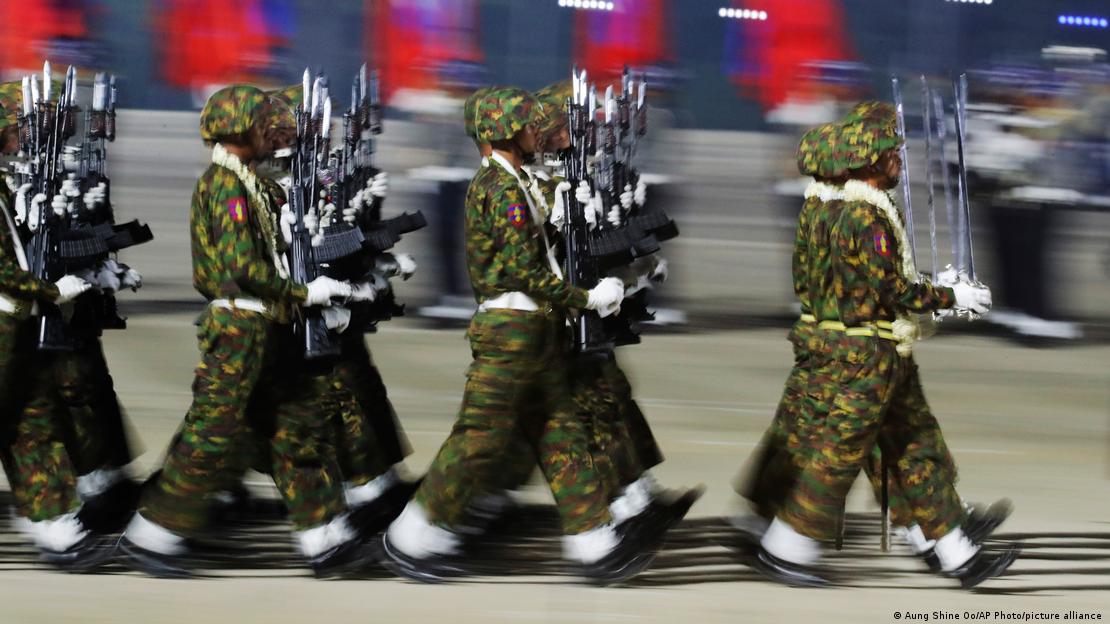
Another reason for the military's surge is the regime's renewed conscription drive. At least 60,000 soldiers are estimated to have joined the military's ranks since the junta started the draft last spring.
The drive has reinvigorated the junta battalions, which had been whittled down by casualties, desertions and defections, allowing the military to throw far more troops into battle than before.
"There is no military solution to Myanmar's conflict; there never has been. There can only be a political solution," said Michaels.
"I think we have to see what happens after the elections — if there's a new leadership dynamic, if the military makes more compromises or not, and if there's more ceasefires," Michaels added.
The likeliest path ahead, he said, is that the regime continues to divide the armed resistance groups, which were only loosely aligned to begin with, and make deals with them one by one.
At least for now, said Michaels, the outlook for the resistance and for Myanmar "is pretty grim."
Edited by: Darko Janjevic
Zsombor Peter
DW
07/11/2025
07/11/2025
With backing from China, Myanmar's military junta has managed to recapture a string of key towns and highways and put rebels on the back foot.

After losing control of over half of Myanmar, the military is retaking strategic points
Image: Soe Zeya Tun/REUTERS
Myanmar is preparing to start a national election in December — at least to the extent that such polls are possible in a country officially ruled by a military junta and partly controlled by rebels after nearly five years of civil war.
UN experts have dismissed the coming polls as a "sham," engineered to maintain the generals' grip on power through proxy parties.
And yet, the junta seems to be in a hurry to create conditions for voting in as many places as it can. The military has scored a string of victories against rebels since June, recapturing towns and trade routes on several fronts in the east and either pushing resistance forces back or stalling them in place.
These victories are also likely to reinforce the government's position ahead of the vote, which is due to start on December 28 and continue into January.
"It seems like kind of a deadline for them," said security analyst Kyaw Htet Aung with the Institute for Strategy and Policy – Myanmar.
Military taking over gem mines
The junta is engaged in its most consequential counteroffensive in years, possibly since the civil war started in 2021, analysts told DW.
The military is "reopening trade routes, it's reopening logistics routes, it has a major surge in troop numbers, it's made significant reforms to the way it fights, it's on the offensive on the diplomatic and political front with this upcoming election, and it's got plenty of new equipment," said Morgan Michaels, a research fellow at the International Institute for Strategic Studies.
Even after recent victories, the junta is believed to fully control well under half the country. But analysts say the towns and roads it has recaptured are of high strategic value.
They include key trade corridors with both China and Thailand and gem and mineral mines that had been controlled by different resistance groups since the coup.
Rebels on the defensive
Resistance groups are not on the wane everywhere. In the west, the Arakan Army is still advancing towards the center of the country. The Kachin Independence Army continues bearing down on the military from the north and is mostly holding its ground.
But many of the other armed groups arrayed against the junta have moved from offense to defense since last year, said Su Mon, a senior analyst for Armed Conflict Location and Event Data, an independent research group that tracks conflicts around the world.
"That's the major shift. They've [gone] from an offensive position to a defense position in their controlled areas. And since then they are not able to defend those areas and [are] losing one town after another," she told DW.
China throttles trade and supplies for rebels
Since the Myanmar military seized power from a democratically elected government in February 2021, tens of thousands have been killed on all sides, and over 3.3 million civilians have been displaced.
UN investigators have accused the junta of committing war crimes, including rape, torture and murder, at an "alarming rate." But despite its brutality, the military has mostly been retreating before rebel groups, losing control of vast swaths of the country, including most of Myanmar's borders with Thailand, China and Bangladesh.
Analysts say the military's recent successes are partly due to the renewed support from China, which has billions of dollars invested in energy and infrastructure projects across Myanmar that it is keen to protect and expand.
Beijing had been engaging with both the junta and resistance groups in the first few years of the civil war. More recently, however, China has been gradually ratcheting up its diplomatic, economic and military support for the Myanmar regime.
Chinese officials brokered a ceasefire in January between the military and a powerful armed group that had routed the junta's battalions in the northeast, and another ceasefire last month with a second group that had been threatening the junta's powerbase in the center of the country.
At the same time, China has throttled vital border trade with resistance groups in order to keep them from attacking the junta forces. It has also used its connections with the powerful rebel group called the United Wa State Army (UWSA) to expand the embargo.
"The UWSA is the main source of military and finance support for many other groups…. and they've been cut off now," said Su Mon.
Smarter use of drones and planes on the battlefield
Another reason for the military's surge is the regime's renewed conscription drive. At least 60,000 soldiers are estimated to have joined the military's ranks since the junta started the draft last spring.
The drive has reinvigorated the junta battalions, which had been whittled down by casualties, desertions and defections, allowing the military to throw far more troops into battle than before.
A new recruitment drive has filled out the Myanmar military's ranksImage: Aung Shine Oo/AP Photo/picture alliance
Analysts also say the military is learning from its mistakes and getting better at fighting the battles at hand.
This includes vast improvements to its drone fleet and its use of air strikes. Su Mon said the military is now using it's the air force at the very start of engagements rather than after they've begun fighting the rebels.
Michaels said the regime has also passed greater control of the military from Min Aung Hlaing, who heads the regime, to Soe Win — believed to be a more competent general — and is now promoting more frontline commanders with battlefield experience.
Outlook for rebels 'pretty grim'
For all that, the analysts believe the military is still not poised for victory, nor are resistance groups poised for defeat.
Analysts also say the military is learning from its mistakes and getting better at fighting the battles at hand.
This includes vast improvements to its drone fleet and its use of air strikes. Su Mon said the military is now using it's the air force at the very start of engagements rather than after they've begun fighting the rebels.
Michaels said the regime has also passed greater control of the military from Min Aung Hlaing, who heads the regime, to Soe Win — believed to be a more competent general — and is now promoting more frontline commanders with battlefield experience.
Outlook for rebels 'pretty grim'
For all that, the analysts believe the military is still not poised for victory, nor are resistance groups poised for defeat.
"There is no military solution to Myanmar's conflict; there never has been. There can only be a political solution," said Michaels.
"I think we have to see what happens after the elections — if there's a new leadership dynamic, if the military makes more compromises or not, and if there's more ceasefires," Michaels added.
The likeliest path ahead, he said, is that the regime continues to divide the armed resistance groups, which were only loosely aligned to begin with, and make deals with them one by one.
At least for now, said Michaels, the outlook for the resistance and for Myanmar "is pretty grim."
Edited by: Darko Janjevic
Myanmar scam hub sweep triggers fraudster recruitment rush
By AFP
November 3, 2025

Late October raids roiled Myanmar fraud factory KK Park, sending more than 1,500 people fleeing over the border to Thailand - Copyright THAI NEWS PIX/AFP Sarot Meksophawannakul
Sally JENSEN
Recent raids on one of Myanmar’s most notorious internet scam hubs sparked a recruitment rush as fleeing workers scrambled to enlist at nearby fraud factories, experts and insiders told AFP.
Online scam hubs have mushroomed across Southeast Asia, draining unsuspecting victims of billions of dollars annually in elaborate romance and crypto cons.
Many workers are trafficked into the internet sweatshops, analysts say, but others go willingly to secure attractive salaries.
Late October raids roiled Myanmar fraud factory KK Park, sending more than 1,500 people fleeing over the border to Thailand — but many stayed behind to pursue new opportunities in the black market.
A Chinese voluntary scam worker told AFP that a few hundred people who left KK Park arrived at his own compound three kilometres (two miles) away on October 23 — lured by monthly salaries of up to $1,400.
The man spoke on condition of anonymity for security reasons, but shared with AFP a live location on a messaging app showing he was in Myanmar, near the Thai border.
“Some people will be picked up by unscrupulous bosses, while others will be picked up by good companies,” he said. “It all depends on your luck.”
Jason Tower, senior expert at the Global Initiative against Transnational Organized Crime, told AFP many KK Park scammers have simply been “re-recruited” by other gangs.
“There are some people looking for a new location to engage in scamming from,” he said. “They might see this as a job.”
– ‘Our chance to escape’ –
Webs of anonymous crypto payments and chronic under-reporting by embarrassed victims make losses to scam centres hard to quantify.
But victims in Southeast and East Asia alone were conned out of up to $37 billion in 2023, according to a UN report, which said global losses were likely “much larger”.
War-torn Myanmar’s loosely governed border regions have proven particularly fertile ground for the hubs.
The embattled junta — which seized power in a 2021 coup — has been accused of turning a blind eye to scam centres enriching its domestic militia allies.
But it has also faced pressure to curb the black market by its international backer China, galled at hubs recruiting as well as targeting its citizens.
Last month, the junta said its troops had occupied around 200 buildings in KK Park and found more than 2,000 scammers.
Analysts say the raid was likely limited and heavily choreographed — designed to vent pressure to take action without too badly denting profits.
But it nonetheless prompted an exodus of 1,500 people from 28 nationalities into Thailand, according to provincial Thai authorities.
Among them were around 500 Indian nationals and around 200 Filipinos.
Authorities face the daunting task of discerning trafficking victims from willing scammers.
Speaking to AFP on condition of anonymity, one Filipino man described fleeing KK Park on October 22 with around 30 compatriots as a pro-junta militia arrived to aid the crackdown.
“Everyone ran outside,” he said. “This was our chance to escape.”
Grabbing what few possessions he could, the man fled the compound he says he was trafficked into and crossed by boat to western Thailand.
– Sold for scamming –
With one expert estimating around 20,000 people had been working in KK Park — the vast majority believed to be Chinese nationals — those who fled to Thailand likely made up less than 10 percent.
But those who stayed behind are not necessarily willing participants.
After the KK Park exodus, the Chinese scammer at the nearby compound told AFP local armed groups scrambled to cash in — with unemployed scammers “sold” to other operations for up to $70,000.
Whether they are willing workers being headhunted or human trafficking victims is unclear.
The scammer who spoke to AFP reported hearing “booms every evening” after the raids, but dismissed it as “all for show” rather than a meaningful crackdown by Myanmar authorities.
And with the continuing flow of scam workers — willing or coerced — rights advocates say the problem can only be solved by targeting the Chinese bosses running the show.
“(They) must be arrested, prosecuted, and have all their assets seized,” Jay Kritiya from the Civil Society Network for Human Trafficking Victims Assistance told AFP.
“That’s the real crackdown.”
By AFP
November 3, 2025
Late October raids roiled Myanmar fraud factory KK Park, sending more than 1,500 people fleeing over the border to Thailand - Copyright THAI NEWS PIX/AFP Sarot Meksophawannakul
Sally JENSEN
Recent raids on one of Myanmar’s most notorious internet scam hubs sparked a recruitment rush as fleeing workers scrambled to enlist at nearby fraud factories, experts and insiders told AFP.
Online scam hubs have mushroomed across Southeast Asia, draining unsuspecting victims of billions of dollars annually in elaborate romance and crypto cons.
Many workers are trafficked into the internet sweatshops, analysts say, but others go willingly to secure attractive salaries.
Late October raids roiled Myanmar fraud factory KK Park, sending more than 1,500 people fleeing over the border to Thailand — but many stayed behind to pursue new opportunities in the black market.
A Chinese voluntary scam worker told AFP that a few hundred people who left KK Park arrived at his own compound three kilometres (two miles) away on October 23 — lured by monthly salaries of up to $1,400.
The man spoke on condition of anonymity for security reasons, but shared with AFP a live location on a messaging app showing he was in Myanmar, near the Thai border.
“Some people will be picked up by unscrupulous bosses, while others will be picked up by good companies,” he said. “It all depends on your luck.”
Jason Tower, senior expert at the Global Initiative against Transnational Organized Crime, told AFP many KK Park scammers have simply been “re-recruited” by other gangs.
“There are some people looking for a new location to engage in scamming from,” he said. “They might see this as a job.”
– ‘Our chance to escape’ –
Webs of anonymous crypto payments and chronic under-reporting by embarrassed victims make losses to scam centres hard to quantify.
But victims in Southeast and East Asia alone were conned out of up to $37 billion in 2023, according to a UN report, which said global losses were likely “much larger”.
War-torn Myanmar’s loosely governed border regions have proven particularly fertile ground for the hubs.
The embattled junta — which seized power in a 2021 coup — has been accused of turning a blind eye to scam centres enriching its domestic militia allies.
But it has also faced pressure to curb the black market by its international backer China, galled at hubs recruiting as well as targeting its citizens.
Last month, the junta said its troops had occupied around 200 buildings in KK Park and found more than 2,000 scammers.
Analysts say the raid was likely limited and heavily choreographed — designed to vent pressure to take action without too badly denting profits.
But it nonetheless prompted an exodus of 1,500 people from 28 nationalities into Thailand, according to provincial Thai authorities.
Among them were around 500 Indian nationals and around 200 Filipinos.
Authorities face the daunting task of discerning trafficking victims from willing scammers.
Speaking to AFP on condition of anonymity, one Filipino man described fleeing KK Park on October 22 with around 30 compatriots as a pro-junta militia arrived to aid the crackdown.
“Everyone ran outside,” he said. “This was our chance to escape.”
Grabbing what few possessions he could, the man fled the compound he says he was trafficked into and crossed by boat to western Thailand.
– Sold for scamming –
With one expert estimating around 20,000 people had been working in KK Park — the vast majority believed to be Chinese nationals — those who fled to Thailand likely made up less than 10 percent.
But those who stayed behind are not necessarily willing participants.
After the KK Park exodus, the Chinese scammer at the nearby compound told AFP local armed groups scrambled to cash in — with unemployed scammers “sold” to other operations for up to $70,000.
Whether they are willing workers being headhunted or human trafficking victims is unclear.
The scammer who spoke to AFP reported hearing “booms every evening” after the raids, but dismissed it as “all for show” rather than a meaningful crackdown by Myanmar authorities.
And with the continuing flow of scam workers — willing or coerced — rights advocates say the problem can only be solved by targeting the Chinese bosses running the show.
“(They) must be arrested, prosecuted, and have all their assets seized,” Jay Kritiya from the Civil Society Network for Human Trafficking Victims Assistance told AFP.
“That’s the real crackdown.”

No comments:
Post a Comment