Netanyahu to float Iran attack plan to Trump amid nuclear 'concerns'
Israel is reportedly 'concerned' that Iran is revitalising its missile and nuclear programme, and is seeking to attack should this be the case.
The New Arab Staff
20 December, 2025

The US and Israel both engaged in strikes against Iran in June, amid the 12-Day War targeting several nuclear sites [Getty/file photo]
Israeli officials will brief US President Donald Trump on "concerns" they have over a potentially renewed Iranian ballistic missile programme, US media reported on Saturday, as Prime Minister Benjamin Netanyahu is set to meet with Trump in Florida later this month.
The Israeli officials are seeking to prepare attacks on Tehran should this be the case, US officials and a person familiar with the matter told the NBC network.
Israel and Iran were engaged in a 12-day-long war in June, with Tel Aviv striking Iranian nuclear facilities in a surprise attack on 13 June, and assassinating several military personnel and nuclear scientists. The US also struck Iran, claiming it had "obliterated" key nuclear sites, including Fordow and Natanz. Some assessments, however, concluded that the damage was exaggerated.
Over 1,000 people were killed in Iran by Israel in the strikes, including civilians. Tehran also retaliated with several missile and drone attacks.
Israel is also allegedly "concerned" that Iran is rebuilding the nuclear enrichment sites bombed by Washington.
A correspondent in Iran
"The nuclear weapons programme is very concerning. There’s an attempt to reconstitute. It’s not that immediate," one person with knowledge of the matter told NBC.
Trump and Netanyahu are due to meet in Miami, Florida, on 29 December at the President's Mar-a-Lago estate, where he is set to raise these concerns and make a case for swift action on Iran.
The Israeli premier will present a plan which would give the option for the US to join the potential action, the sources added.
The meeting, however, isn’t "formally set up," Trump told reporters on Thursday.
This comes as uncertainties hover over Iran’s nuclear deal talks with the US, which have stalled massively since Washington’s strikes in June. Tehran said it would consider a US proposal so long as it is "fair and balanced". Though Iran's Supreme Leader Ayatollah Ali Khamenei said in November that Trump’s administration was "not worthy" of any contact or cooperation with the Islamic Republic.
Trump hinted last week that he might be "open" to resuming dialogue with Iran on the matter, but threatened to "wipe out" Iranian missiles if they were to rebuild without a deal.
In July, weeks after the US’ Midnight Hammer Operation on Iran, Trump echoed these sentiments concerning the targeted nuclear sites if Tehran sought to pursue nuclear enrichment activities.
Israel’s 12-day war with Iran, involving the US, came amid the wider Middle East crisis, triggered by Israel’s military campaign in Gaza, which has killed nearly 71,000 Palestinians since 7 October 2023, as well as the decades-long proxy war between the two foes.
A ceasefire brokered by Trump is currently being observed in the Palestinian enclave, though it has been violated hundreds of times by Israel, which has killed more than 380 Palestinians.
The US is seeking to move towards the ceasefire’s second phase, which will likely be discussed with Netanyahu.
Israel is reportedly 'concerned' that Iran is revitalising its missile and nuclear programme, and is seeking to attack should this be the case.
The New Arab Staff
20 December, 2025

The US and Israel both engaged in strikes against Iran in June, amid the 12-Day War targeting several nuclear sites [Getty/file photo]
Israeli officials will brief US President Donald Trump on "concerns" they have over a potentially renewed Iranian ballistic missile programme, US media reported on Saturday, as Prime Minister Benjamin Netanyahu is set to meet with Trump in Florida later this month.
The Israeli officials are seeking to prepare attacks on Tehran should this be the case, US officials and a person familiar with the matter told the NBC network.
Israel and Iran were engaged in a 12-day-long war in June, with Tel Aviv striking Iranian nuclear facilities in a surprise attack on 13 June, and assassinating several military personnel and nuclear scientists. The US also struck Iran, claiming it had "obliterated" key nuclear sites, including Fordow and Natanz. Some assessments, however, concluded that the damage was exaggerated.
Over 1,000 people were killed in Iran by Israel in the strikes, including civilians. Tehran also retaliated with several missile and drone attacks.
Israel is also allegedly "concerned" that Iran is rebuilding the nuclear enrichment sites bombed by Washington.
A correspondent in Iran
"The nuclear weapons programme is very concerning. There’s an attempt to reconstitute. It’s not that immediate," one person with knowledge of the matter told NBC.
Trump and Netanyahu are due to meet in Miami, Florida, on 29 December at the President's Mar-a-Lago estate, where he is set to raise these concerns and make a case for swift action on Iran.
The Israeli premier will present a plan which would give the option for the US to join the potential action, the sources added.
The meeting, however, isn’t "formally set up," Trump told reporters on Thursday.
This comes as uncertainties hover over Iran’s nuclear deal talks with the US, which have stalled massively since Washington’s strikes in June. Tehran said it would consider a US proposal so long as it is "fair and balanced". Though Iran's Supreme Leader Ayatollah Ali Khamenei said in November that Trump’s administration was "not worthy" of any contact or cooperation with the Islamic Republic.
Trump hinted last week that he might be "open" to resuming dialogue with Iran on the matter, but threatened to "wipe out" Iranian missiles if they were to rebuild without a deal.
In July, weeks after the US’ Midnight Hammer Operation on Iran, Trump echoed these sentiments concerning the targeted nuclear sites if Tehran sought to pursue nuclear enrichment activities.
Israel’s 12-day war with Iran, involving the US, came amid the wider Middle East crisis, triggered by Israel’s military campaign in Gaza, which has killed nearly 71,000 Palestinians since 7 October 2023, as well as the decades-long proxy war between the two foes.
A ceasefire brokered by Trump is currently being observed in the Palestinian enclave, though it has been violated hundreds of times by Israel, which has killed more than 380 Palestinians.
The US is seeking to move towards the ceasefire’s second phase, which will likely be discussed with Netanyahu.
Inside the 5,000-day war on Iran
Israel's attack on Iran was the latest campaign in a longer war to subdue the region.
By Nargol Aran
December 19, 2025
MONDOWEISS
MONDOWEISS
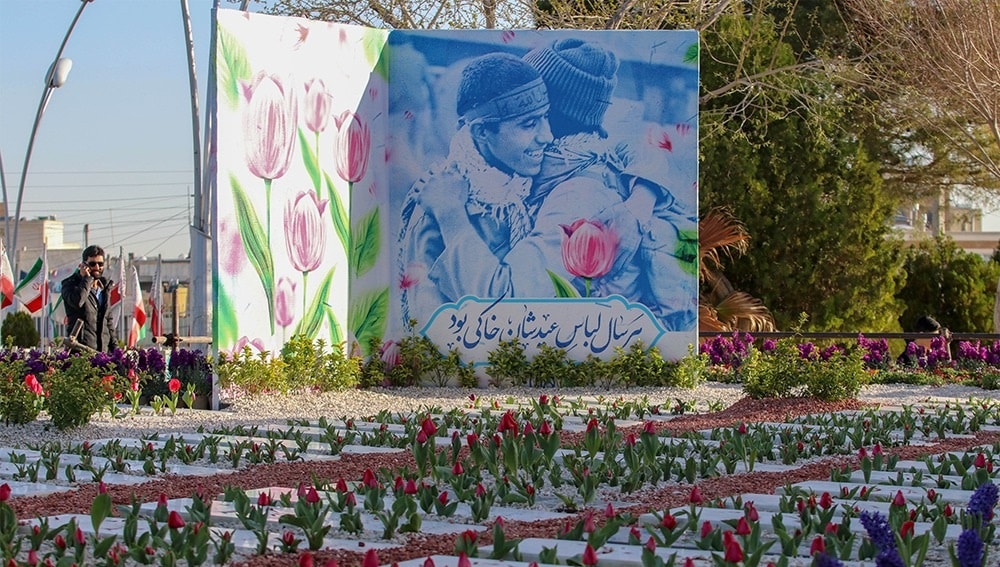
Martyrs cemetery in Isfahan.
(Photo: Wikimedia Commons/Mojtaba Jahanbakhsh)
I come back to the clip of Hamideh in a long fuchsia coat passing the Quran over her daughter’s head for the first day of school. It is September 2023. Her seven-year-old kisses the Book and walks beneath it.
Almost two years later, in the early hours of June 13, 2025, Hamideh’s building was hit as Israel hunted down Iran’s military-scientific establishment. Sixty lives were taken in that one blast, including Hamideh’s two daughters and husband.
We sit in a small room at her sister’s house. The power is out, but the afternoon sun slants in, casting a lattice of light and shadow. Hamideh wears a black dress and a long black shawl. The warmth in her brown eyes that I’d seen in all her photos has gone cold. “I had the most beautiful family,” she says, squeezing her eyes shut. Tears come in quick jets. Our weeping leaves a damp hush that settles us. She sits upright, touches my hand, and begins to speak again.
Hamideh and Alireza met as undergrads in engineering school in Isfahan. They married four years later in 2010.
“I loved you from the very first day,” he confessed. He was a teacher’s son, she a shopkeeper’s daughter. Classmates went abroad, but Alireza, who was born in the aftermath of the Imposed War — the war between Iraq and Iran from 1980 to 1988 — believed in staying to build the nation that had endured eight years of onslaught. Defense work carried prestige and honor. He began as a contractor with Parchin, the company known for its role in Iran’s missile program, and later took on a full-time position.
On Thursday, June 12, 2025, Hamideh cooked Alireza’s favorite meal: pilaf with braised shank. Ayma and Hida took turns doing Hamideh’s hair after lunch as they filled their backpacks. Ayma was more boisterous, while Hida walked with an air of mystery.
They had a routine of placing mats on the carpet in the living room and sleeping as “mother and girls.” But that night, they asked to sleep “father and girls.”
She kissed them goodnight and went into the bedroom at 1 a.m. At 3:30, she was awakened “with a shrieking red light.” She knew it was Israel.
“And then I was falling,” she says, gasping for air. She landed on the mattress with the frame of the bed protecting most of her body except her neck — there, she felt intense stabbing. “My mind was racing between the fear of paralysis and what had happened to Alireza and the kids.”
She heard sirens. A hand came to her through the crack in the wall. “My name is Omid,” a man told her. The name means hope. “I will help you get out.” She begged him not to leave.
The rescuer stayed and passed her a bottle of water. “It soothed but also awakened me. I was ready to jump out of my life,” she says.
She was in a black haze — and then she was in an ambulance. She was fully awake in the hospital. But no one knew who else had survived. “I prayed to see them alive, and if that wasn’t meant for us, to have God grant me patience.”
By nightfall, she was told Alireza’s body was found next to the girls. She was in the hospital with a treatable spinal injury, but they were gone, their flesh in pieces.
I come back to the clip of Hamideh in a long fuchsia coat passing the Quran over her daughter’s head for the first day of school. It is September 2023. Her seven-year-old kisses the Book and walks beneath it.
Almost two years later, in the early hours of June 13, 2025, Hamideh’s building was hit as Israel hunted down Iran’s military-scientific establishment. Sixty lives were taken in that one blast, including Hamideh’s two daughters and husband.
We sit in a small room at her sister’s house. The power is out, but the afternoon sun slants in, casting a lattice of light and shadow. Hamideh wears a black dress and a long black shawl. The warmth in her brown eyes that I’d seen in all her photos has gone cold. “I had the most beautiful family,” she says, squeezing her eyes shut. Tears come in quick jets. Our weeping leaves a damp hush that settles us. She sits upright, touches my hand, and begins to speak again.
Hamideh and Alireza met as undergrads in engineering school in Isfahan. They married four years later in 2010.
“I loved you from the very first day,” he confessed. He was a teacher’s son, she a shopkeeper’s daughter. Classmates went abroad, but Alireza, who was born in the aftermath of the Imposed War — the war between Iraq and Iran from 1980 to 1988 — believed in staying to build the nation that had endured eight years of onslaught. Defense work carried prestige and honor. He began as a contractor with Parchin, the company known for its role in Iran’s missile program, and later took on a full-time position.
On Thursday, June 12, 2025, Hamideh cooked Alireza’s favorite meal: pilaf with braised shank. Ayma and Hida took turns doing Hamideh’s hair after lunch as they filled their backpacks. Ayma was more boisterous, while Hida walked with an air of mystery.
They had a routine of placing mats on the carpet in the living room and sleeping as “mother and girls.” But that night, they asked to sleep “father and girls.”
She kissed them goodnight and went into the bedroom at 1 a.m. At 3:30, she was awakened “with a shrieking red light.” She knew it was Israel.
“And then I was falling,” she says, gasping for air. She landed on the mattress with the frame of the bed protecting most of her body except her neck — there, she felt intense stabbing. “My mind was racing between the fear of paralysis and what had happened to Alireza and the kids.”
She heard sirens. A hand came to her through the crack in the wall. “My name is Omid,” a man told her. The name means hope. “I will help you get out.” She begged him not to leave.
The rescuer stayed and passed her a bottle of water. “It soothed but also awakened me. I was ready to jump out of my life,” she says.
She was in a black haze — and then she was in an ambulance. She was fully awake in the hospital. But no one knew who else had survived. “I prayed to see them alive, and if that wasn’t meant for us, to have God grant me patience.”
By nightfall, she was told Alireza’s body was found next to the girls. She was in the hospital with a treatable spinal injury, but they were gone, their flesh in pieces.
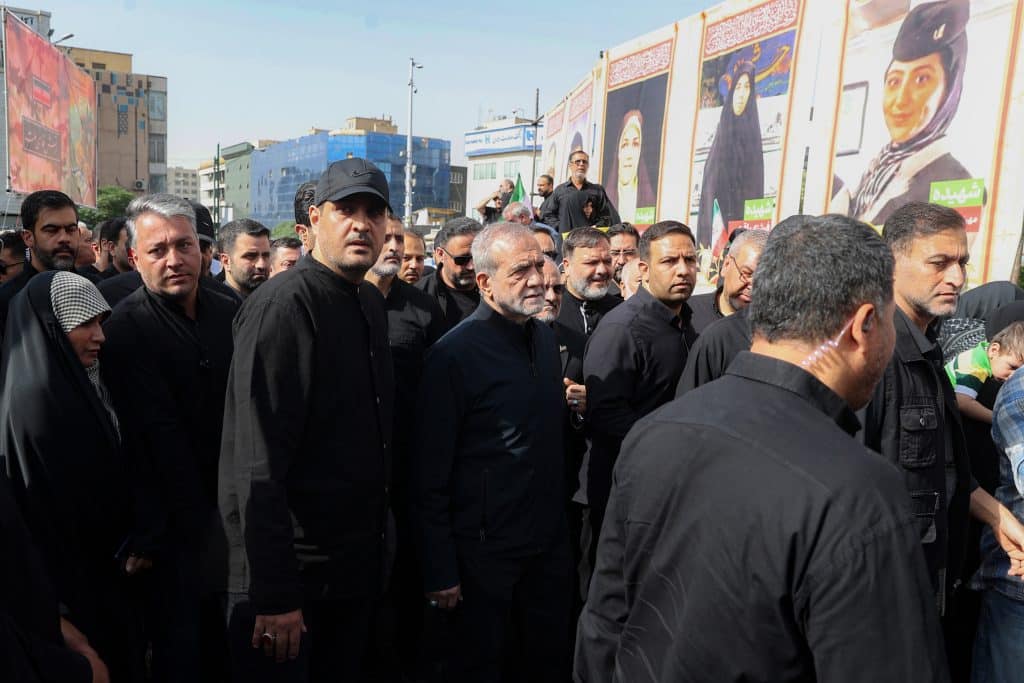
Iranian President Masoud Pezeshkian attends the funeral of Iranians slain in Israel’s war on Iran, Tehran, June 28, 2025. (Photo: Office of the Iranian Presidency)
Hamideh doesn’t think she can rewrite the aftermath; it feels like it has been written. For
months, they had arranged to be away that week but abruptly postponed their plans at the last minute. She was supposed to be the one who slept with the girls in the living room. Then, suddenly, a great terror uprooted their lives, and she was on her own.
What does she think this force is? I ask.
Israel is targeting our societies by hitting our backbone, she explains.
That night, commanders, scientists, and engineers were killed alongside their families and neighbors. They were targeted in their homes, not in a battlefield.
The world is enabling Israel to murder our elders in their work and our children in their sleep, or as they fetch food and water. “What I saw people suffer in Gaza, which I couldn’t bear to look at (may I be forgiven), is now mine,” Hamideh says softly.
Does she have any clue how one survives? “I know I was granted the minimum I prayed for. I was given patience,” she answers.
In the garden of martyrs
I am at Rasoul Mosque, high on a hill. It is the chehelom — the fortieth day of mourning — for Sardar Gholam Ali Rashid, one of our armed forces’ most senior commanders, and his son, a young seminary student. Both were murdered by Israel in airstrikes on June 13. In the mosque courtyard, photos of Ayma, Hida, and the other children surround the pool, scented with sweet tuberose.
I climb to the women’s gallery and lean on the rail, watching the men gather directly under the dome. Sardar Rashid stares back at me from a banner that hangs beneath a blue-tile frieze the color of his eyes, inscribed with Aya 5 of Sura al-Jumu’ah: “The example of those who were entrusted with ˹observing˺ the Torah but failed to do so, is that of a donkey carrying books.”
Hamideh doesn’t think she can rewrite the aftermath; it feels like it has been written. For
months, they had arranged to be away that week but abruptly postponed their plans at the last minute. She was supposed to be the one who slept with the girls in the living room. Then, suddenly, a great terror uprooted their lives, and she was on her own.
What does she think this force is? I ask.
Israel is targeting our societies by hitting our backbone, she explains.
That night, commanders, scientists, and engineers were killed alongside their families and neighbors. They were targeted in their homes, not in a battlefield.
The world is enabling Israel to murder our elders in their work and our children in their sleep, or as they fetch food and water. “What I saw people suffer in Gaza, which I couldn’t bear to look at (may I be forgiven), is now mine,” Hamideh says softly.
Does she have any clue how one survives? “I know I was granted the minimum I prayed for. I was given patience,” she answers.
In the garden of martyrs
I am at Rasoul Mosque, high on a hill. It is the chehelom — the fortieth day of mourning — for Sardar Gholam Ali Rashid, one of our armed forces’ most senior commanders, and his son, a young seminary student. Both were murdered by Israel in airstrikes on June 13. In the mosque courtyard, photos of Ayma, Hida, and the other children surround the pool, scented with sweet tuberose.
I climb to the women’s gallery and lean on the rail, watching the men gather directly under the dome. Sardar Rashid stares back at me from a banner that hangs beneath a blue-tile frieze the color of his eyes, inscribed with Aya 5 of Sura al-Jumu’ah: “The example of those who were entrusted with ˹observing˺ the Torah but failed to do so, is that of a donkey carrying books.”
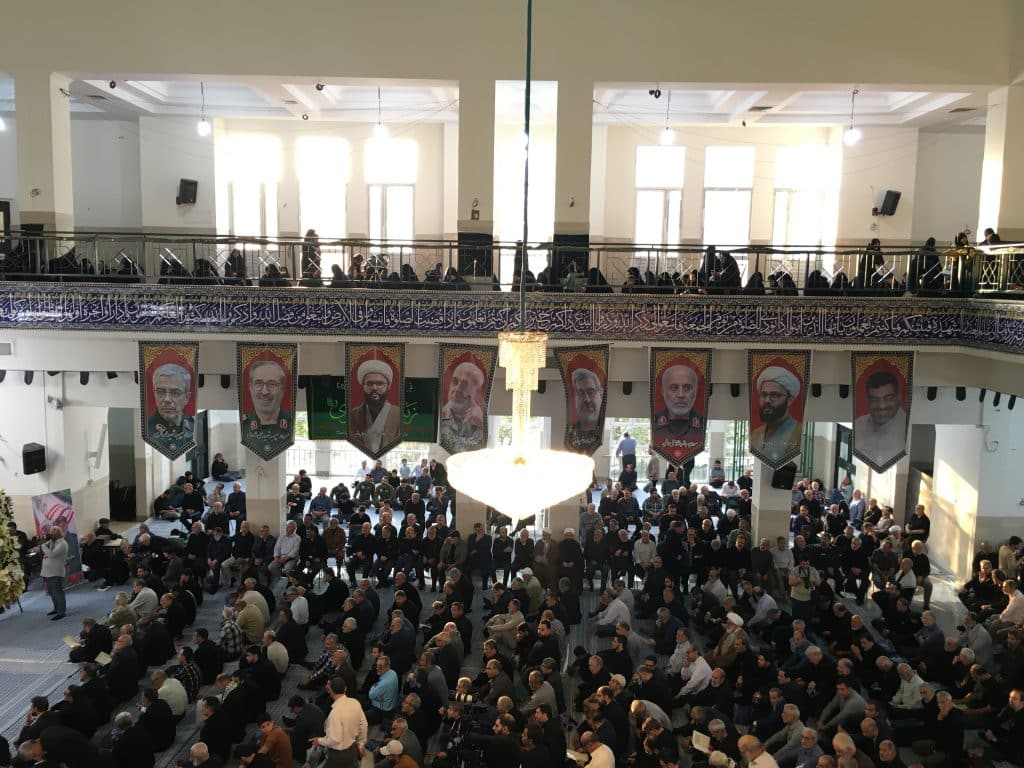
“Chehelom,” or the fortieth day of mourning for Sardar Gholam Ali Rashid, senior commander of Iranian armed forces. (Photo courtesy of author)
A nuclear-armed U.S. outpost on the Eastern Mediterranean is usurping Judaism to annihilate our societies. The crimes it commits, like the “state” itself, know no boundaries. The order that preached “Human Rights” to us and that also enables Israel meant its right to commit genocide and crucify those willing to defy it.
I look downstairs. A veteran of the Imposed War, the war when Sardar Rashid first entered battle, removes his prosthetic leg and settles on the blue-and-white flatweave mat with diamond lattice. Children play tag behind me. A woman hands down laminated Quran pages rimmed with orange flowers. By each of us reading one, we contribute to the whole.
Sadeq Ahangaran steps to the podium. He is the war elegist, carrying the snowy mantle of old age. He once went to our soldiers on the front, which is now the city, where victims have no age limit. “Our beloved is gone. Our tulip is in the Garden of Martyrs,” he recites in an embered voice, the flickers of a fire settling.
A soft response begins to gather around him. We answer in a half-voice — a chorus shadowing him while hitting our chests in rhythm. The silence between the thuds is the terror we now own.
Our protectors have been taken. Tears burn my face and spot the green of my shawl. Ahangaran leaves an intentional pause, and the cadenced blows of sineh-zani — our collective expressions of grief — rise as the percussion of vibrating bodies breaks the quiet. The Martyr’s promise — to save — echoes up to the dome.
A nuclear-armed U.S. outpost on the Eastern Mediterranean is usurping Judaism to annihilate our societies. The crimes it commits, like the “state” itself, know no boundaries. The order that preached “Human Rights” to us and that also enables Israel meant its right to commit genocide and crucify those willing to defy it.
I look downstairs. A veteran of the Imposed War, the war when Sardar Rashid first entered battle, removes his prosthetic leg and settles on the blue-and-white flatweave mat with diamond lattice. Children play tag behind me. A woman hands down laminated Quran pages rimmed with orange flowers. By each of us reading one, we contribute to the whole.
Sadeq Ahangaran steps to the podium. He is the war elegist, carrying the snowy mantle of old age. He once went to our soldiers on the front, which is now the city, where victims have no age limit. “Our beloved is gone. Our tulip is in the Garden of Martyrs,” he recites in an embered voice, the flickers of a fire settling.
A soft response begins to gather around him. We answer in a half-voice — a chorus shadowing him while hitting our chests in rhythm. The silence between the thuds is the terror we now own.
Our protectors have been taken. Tears burn my face and spot the green of my shawl. Ahangaran leaves an intentional pause, and the cadenced blows of sineh-zani — our collective expressions of grief — rise as the percussion of vibrating bodies breaks the quiet. The Martyr’s promise — to save — echoes up to the dome.
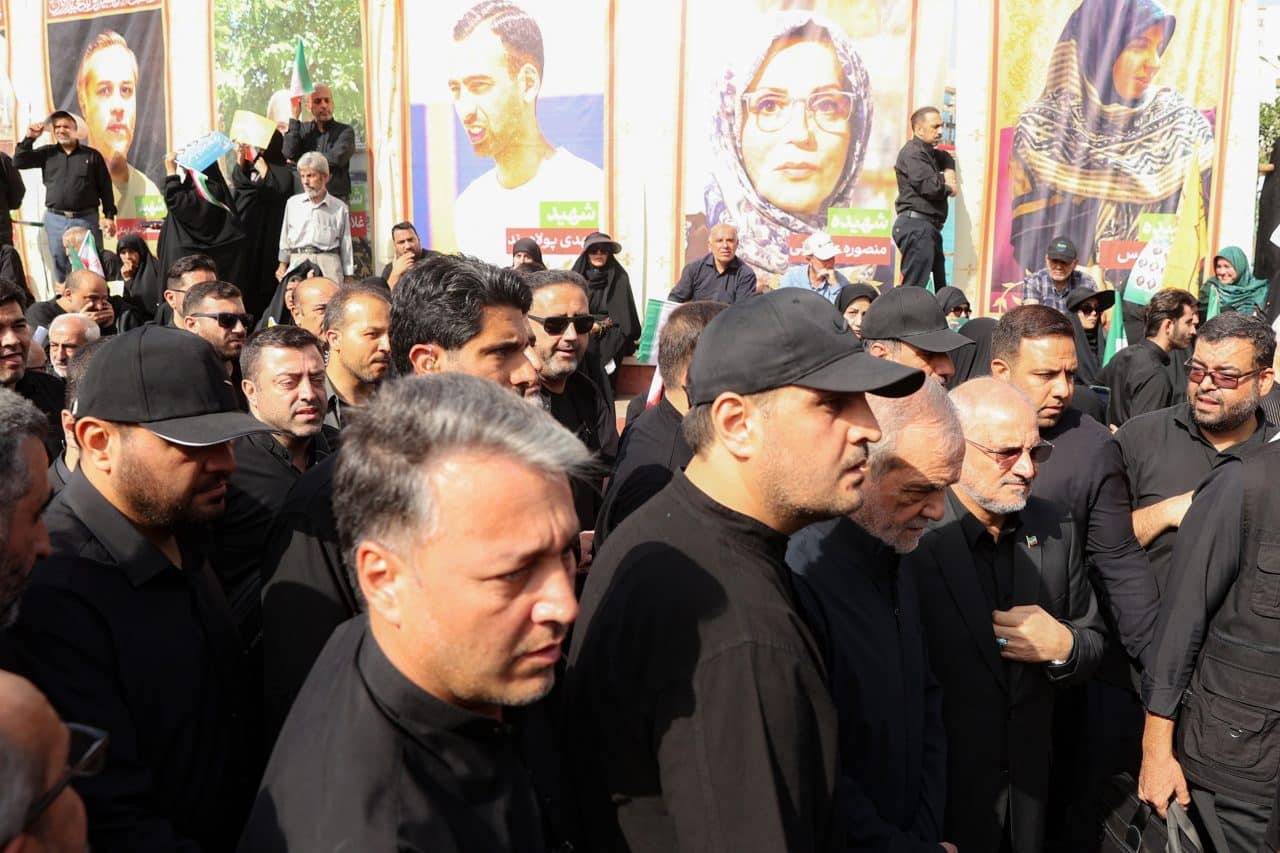
Iranian President Masoud Pezeshkian attends the funeral of Iranians slain in Israel’s war on Iran, Tehran, June 28, 2025. (Photo: Office of the Iranian Presidency)
A river of names
It is August. We are still in a “ceasefire.”
“We cease; Israel fires,” the martyred Refaat Alareer said.
I’m at the office of Agahiyeh Nō magazine to meet 43-year-old journalist Sergei Barseghian. For the past few years, I’ve read him tear apart the “absolutely bonkers” opposition being tailored for Iran by the U.S. and Israel, “to bring democracy if they succeed in destroying us.”
He woke to the sound of explosions on June 13. “I wanted it to be the construction next door, but I knew what it was,” he says, running his hands over his silver quiff before saying, “Israel.”
What did he feel most of all? “It had already been clear in Gaza and Lebanon, but still, rage that they could commit such atrocities so openly,” he said. A political editor for Khabaronline, he went straight to his phone and laptop with his team. Neighbors and extended family were wiped out as entire apartment blocks like Hamideh’s were brought down: “a river of names…”
The target set — armed forces, defense industry, and later, broadcasting — was “to force capitulation by making it impossible to respond,” Barseghian says.
“On day three, Israel killed more than a dozen people waiting at a busy intersection. On day twelve, a hundred were massacred at a prison.”
But Barseghian had no intention of leaving the city. “I wasn’t afraid of death.”
He says Israel functions as a concentrated Western power, backed by diplomatic cover and missile defenses; for the attack on Iran alone, it received an IAEA endorsement and a quarter of America’s THAAD interceptors. The German foreign minister who defended attacks on hospitals in Gaza is presiding over the UNGA. “They gave up everything they had made for Israel,” Barseghian says.
However, he adds, unlike the past two Iranian dynasties that faced colonial Europe, the Islamic Republic of Iran has proven capable of defending its borders, despite claims that it would prove little more than a paper tiger that could be taken out with one swift blow.
Barseghian recalls watching Iranian air defenses from the rooftop as a child when Iraq, also backed by the United States, bombed Tehran. But he adds that as destruction intensifies, so does the distortion of language.
In Gaza, they said, “Hamas is under hospitals.” That, Barseghian argues, was how the bombings were normalized. In Iran, the euphemism shifts: “regime commanders,” “regime airspace” — as if our commanders and skies were not us.
The aim, he thinks, is to make a population numb to its own defense while legitimizing war crimes. But Iranians didn’t fall for it. Barseghian emphasizes that Iran has never accepted Israel as legitimate, “even during the Shah’s time when Israel worked with SAVAK,” the Shah’s notorious secret police.

A Palestine mural in Tehran. (Photo courtesy of author)
The wholeness Israel seeks to break
Judaism, Christianity, and Islam are from this region and have lived together since their beginnings. People can’t be forced to accept an exclusively Jewish state, as is clear to Barseghian. He himself is an Iranian Christian, born in Tehran to Armenian parents from Isfahan. This longstanding coexistence undercuts Israel’s claim of a European right to Palestine — the wholeness itself is what Israel seeks to break.
“Look at Iraq, then Syria,” he says. “Now, they come after us.” Does he believe our nation can hold? I ask him.
So long as Iran has defenders, he responds, this country will continue to baffle its adversaries — and Israel will keep exposing itself.
The June Onslaught, to him, was proof. The commanders were loved by the nation for safeguarding our territorial integrity. But when they were taken, the continuity plan held; Iran did not fold, but forced Israel to retreat and seek a ceasefire. The martyrs were honored because they held the nation intact.
In July, Armita Rezaienejad — whose father was gunned down by Mossad in front of her eyes when she was five — asked an audience of journalists, “How can you call it a twelve-day war when my father was killed over five thousand days ago?”
We stand after one campaign in a longer war to subdue this region and “take out the head of the octopus” — Israel’s description of Iran — cast as the nerve center of resistance. Our elders foresaw the expansion of Israel and warned and prepared us. For daring to oppose it, our backs have been broken, our children turned to mangled flesh before our eyes. Still, our survival feels miraculous.
“Sardar Rashid loved Aya 47 of Surah al-Hajj,” his wife recalls in a sermon weeks after June 13, referring to a verse of the Holy Quran. In it, God promises justice, but “a day with your Lord is indeed like a thousand years by your counting.” He had conviction that it would come, she explains, but not according to a timeline we determine, and the only way to endure as a people was to bear witness.
Nargol Aran
Nargol writes from Tehran, Iran.


No comments:
Post a Comment