Friday, January 15, 2021

A climate in crisis calls for investment in direct air capture, new research finds

Wartime-level funding for a fleet of CO2 scrubbers could slow warming, but stopping climate change still requires deep cuts in emissions

UNIVERSITY OF CALIFORNIA - SAN DIEGO

Research News

IMAGE

IMAGE: MASSIVE DEPLOYMENT OF DIRECT AIR CAPTURE COULD REVERSE THE RISE IN GLOBAL TEMPERATURE WELL BEFORE 2100, BUT ONLY WITH IMMEDIATE AND SUSTAINED INVESTMENTS FROM GOVERNMENTS AND FIRMS TO SCALE UP... view more 

CREDIT: CREDIT: ACILO/ISTOCK

There is a growing consensus among scientists as well as national and local governments representing hundreds of millions of people, that humanity faces a climate crisis that demands a crisis response. New research from the University of California San Diego explores one possible mode of response: a massively funded program to deploy direct air capture (DAC) systems that remove CO2 directly from the ambient air and sequester it safely underground.

The findings reveal such a program could reverse the rise in global temperature well before 2100, but only with immediate and sustained investments from governments and firms to scale up the new technology.

Despite the enormous undertaking explored in the study, the research also reveals the need for governments, at the same time, to adopt policies that would achieve deep cuts in CO2 emissions. The scale of the effort needed just to achieve the Paris Agreement goals of holding average global temperature rise below 2 degrees Celsius is massive.

The study, published in Nature Communications, assesses how crisis-level government funding on direct air capture--on par with government spending on wars or pandemics--would lead to deployment of a fleet of DAC plants that would collectively remove CO2 from the atmosphere.

"DAC is substantially more expensive than many conventional mitigation measures, but costs could fall as firms gain experience with the technology," said first-author Ryan Hanna, assistant research scientist at UC San Diego. "If that happens, politicians could turn to the technology in response to public pressure if conventional mitigation proves politically or economically difficult."

Co-author David G. Victor, professor of industrial innovation at UC San Diego's School of Global Policy and Strategy, added that atmospheric CO2 concentrations are such that meeting climate goals requires not just preventing new emissions through extensive decarbonization of the energy system, but also finding ways to remove historical emissions already in the atmosphere.

"Current pledges to cut global emissions put us on track for about 3 degrees C of warming," Victor said. "This reality calls for research and action around the politics of emergency response. In times of crisis, such as war or pandemics, many barriers to policy expenditure and implementation are eclipsed by the need to mobilize aggressively."

CAPTION

Rendering showing 'first look' of what will be the world's largest DAC plant.

CREDIT

Courtesy of Carbon Engineering

Emergency deployment of direct air capture

The study calculates the funding, net CO2 removal, and climate impacts of a large and sustained program to deploy direct air capture technology.

The authors find that if an emergency direct air capture program were to commence in 2025 and receive investment of 1.2-1.9% of global GDP annually it would remove 2.2-2.3 gigatons of CO2 by the year 2050 and 13-20 gigatons of CO2 by 2075. Cumulatively, the program would remove 570-840 gigatons of CO2 from 2025-2100, which falls within the range of CO2 removals that IPCC scenarios suggest will be needed to meet Paris targets.

Even with such a massive program, the globe would see temperature rise of 2.4-2.5ÂșC in the year 2100 without further cuts in global emissions below current trajectories.

Exploring the reality of a fleet of CO2 scrubbers in the sky

According to the authors, DAC has attributes that could prove attractive to policymakers if political pressures continue to mount to act on climate change, yet cutting emissions remains insurmountable.

"Policymakers might see value in the installation of a fleet of CO2 scrubbers: deployments would be highly controllable by the governments and firms that invest in them, their carbon removals are verifiable, and they do not threaten the economic competitiveness of existing industries," said Hanna.

From the Civil War to Operation Warp Speed, the authors estimate the financial resources that might be available for emergency deployment of direct air capture--in excess of one trillion dollars per year--based on previous spending the U.S. has made in times of crisis.

The authors then built a bottom-up deployment model that constructs, operates and retires successive vintages of DAC scrubbers, given available funds and the rates at which direct air capture technologies might improve with time. They link the technological and economic modeling to climate models that calculate the effects of these deployments on atmospheric CO2 concentration level and global mean surface temperature.

With massive financial resources committed to DAC, the study finds that the ability of the DAC industry to scale up is the main factor limiting CO2 removal from the atmosphere. The authors point to the ongoing pandemic as an analog: even though the FDA has authorized use of coronavirus vaccines, there is still a huge logistical challenge to scaling up production, transporting, and distributing the new therapies quickly and efficiently to vast segments of the public.

Conventional mitigation is still needed, even with wartime spending combating climate change

"Crisis deployment of direct air capture, even at the extreme of what is technically feasible, is not a substitute for conventional mitigation," the authors write.

Nevertheless, they note that the long-term vision for combating climate requires taking negative emissions seriously.

"For policymakers, one implication of this finding is the high value of near-term direct air capture deployments--even if societies today are not yet treating climate change as a crisis--because near term deployments enhance future scalability," they write. "Rather than avoiding direct air capture deployments because of high near-term costs, the right policy approach is the opposite."

Additionally, they note that such a large program would grow a new economic sector, producing a substantial number of new jobs.

The authors conclude it is time to extend research on direct air capture systems to real-world conditions and constraints that accompany deployment--especially in the context of acute political pressures that will arise as climate change becomes viewed as a crisis.

###

Human-induced climate change caused the northwestern Pacific warming record in August 2020

A once-in-1000-year warming event has been already altered to occur once per 15 years because of past human activities

NATIONAL INSTITUTE FOR ENVIRONMENTAL STUDIES

Research News

August 2020 set new record high sea surface temperatures (SSTs) in the northwestern Pacific Ocean and around the Japan coasts. A new study led by National Institute for Environmental Studies (NIES) researchers revealed that this warming record could not happen without human-induced climate changes.

The northwestern Pacific sea surface becomes warm seasonally around August every year. However, it was unprecedentedly high in August 2020, according to the Japan Meteorological Agency and the National Oceanic and Atmospheric Administration. The extremely high SSTs exceeding 30°C, which lasted until mid-September, may have intensified tropical cyclones such as Typhoon Haisheng, causing severe damages to the East Asian countries. Although human-induced greenhouse gas emissions such as carbon dioxide have gradually warmed the northwestern Pacific Ocean since the mid-20th century, it remains unclear yet how much past human activities may increase the occurrence likelihood of such regional record-warm SSTs.

"Understanding the tropical warm water expansion in the Indo-Pacific and Atlantic Oceans is essential for projecting changes in the characteristics of tropical cyclones and other weather events in the future," said Hideo Shiogama, a co-author and the head of Climate Risk Assessment Section at the Center for Global Environmental Research, NIES. "A quantitative evaluation of what drives regional extreme temperatures happening recently is necessary to take appropriate measures to reduce greenhouse gas emissions and the impacts of global warming."

The paper published in Geophysical Research Letters illustrates the quantitative impact of greenhouse gases emitted by human activities on the unprecedentedly high SSTs in the northwestern Pacific Ocean in August 2020. By analyzing multiple observational datasets from 1901 to 2020 and a large number of experimental outputs from the state-of-the-art numerical climate models, a climate research group at NIES statistically estimated changes in the occurrence probability of the northwestern Pacific Ocean (120°E-180° and 20°N-35°N) condition exceeding the record-warm SST in August 2020 from the past to future. The scientists revealed that its probability in the present climate was increased from once-in-1000 years to once-in-15 years because of human-induced climate changes.


CAPTION

Time series of the northwestern Pacific sea surface temperature in August. Showings are the observational datasets and the simulation results from the climate model (CMIP6) ensemble: the global warming signal (solid black line) and the ranges of 'once-in-20-year' events (95% probability range) in the historical and future experiments (gray shading) and pre-industrial experiments (dashed lines).

Time series of the northwestern Pacific sea surface temperature in August. Showings are the observational datasets and the simulation results from the climate model (CMIP6) ensemble: the global warming signal (solid black line) and the ranges of 'once-in-20-year' events (95% probability range) in the historical and future experiments (gray shading) and pre-industrial experiments (dashed lines).

Detecting human-induced climate changes

"The numerical climate model ensembles are powerful tools to quantitatively distinguish between natural variability of the Earth system and climate changes caused by human activities," said corresponding lead author Michiya Hayashi, a research associate at NIES. The ensemble of 31 climate models participating in the sixth phase of the Coupled Model Intercomparison Project (CMIP6) consists of a series of historical experiments and future scenario experiments forced by greenhouse gas- and aerosol emissions from human activities and natural volcanic and solar variations from 1850 to 2100. "We can compare the historical and future experiments with a sub-ensemble of the CMIP6 climate models forced only by the natural volcanic and solar activities to estimate to what extent human-caused climate changes have altered the northwestern Pacific Ocean condition until today."

"The northwestern Pacific warming has proceeded clearly since the 1980s," stated Shiogama. "The warming speed has been accelerated in the last four decades as the reduced aerosol emissions do not cancel the warming signal forced by increasing greenhouse gas concentration anymore." The results show that the CMIP6 ensemble well reproduces the observed long-term change in the northwestern Pacific August SST within the range of 'once-in-20-year' events in the historical simulations. "The SSTs that exceed the pre-industrial range are rarely observed during the 20th century but have occurred frequently since 2010, indicating that human influences on the northwestern Pacific Ocean are already detectable in observations," noted a co-author Seita Emori, deputy director of the Center for Global Environmental Research at NIES.

This new study estimates that the occurrence frequency of high northwestern Pacific SSTs exceeding the August 2020 level has been increased from once-in-600 years in the 20th century (1901-2000) to once-in-15 years in the present climate (2001-2020) using the CMIP6 ensemble. On the other hand, in the sub-ensemble forced only by natural volcanic and solar activities, the frequency for 2001-2020 is estimated to be once-in-1000 years or less. "The record high level of the northwestern Pacific SST in August could have occurred approximately once per 15 years in 2001-2020, as observed, but it never likely occurred without human-induced greenhouse gases or in the 20th century," said Hayashi.

Importantly, the scientists also imply from the future scenario experiments that the 2020 record high SST is becoming a new normal climate condition in August at the northwestern Pacific region by 2031-2050 when the globally averaged air temperature relative to pre-industrial levels would exceed 1.5°C. In this case, the tropical warm sea surface water, exceeding 28°C, may reach Japan, the Korean Peninsula, the west coast of India, the east coast of the U.S. mainland, and the west of the Hawaiian Islands. "We might need to prepare for living with such warm ocean conditions even if we humans could achieve the 1.5°C goal of the Paris Agreement," said Hayashi.

"The human-induced ocean warming may have impacted tropical cyclones, heavy rainfall, and marine life from the past to present and will continue in the future unless tremendous mitigation measures would be implemented," added Emori. "It is time to take prompt actions to transform our society for reducing the greenhouse gas emissions and for adapting to a changing climate."

CAPTION

Probability distributions for the northwestern Pacific sea surface temperature in August. For 1901-2000, the climate model (CMIP6) ensemble (solid black line) reproduces the observational values (gray shading). For 2001-2020, the observed values (red triangles) are well covered by the CMIP6 ensemble (solid red line) but not by the sub-ensemble forced by natural variations only (thin blue line). For 2031-2050, the most likely level of the projected probability (solid yellow line) exceeds the 2020 level (dashed red line

Indonesia death toll climbs after Sulawesi hit by earthquake, landslides

17 MINUTES AGO

A strong earthquake shook Indonesia's Sulawesi island just after midnight, causing landslides and sending people fleeing from their homes in the nighttime darkness.
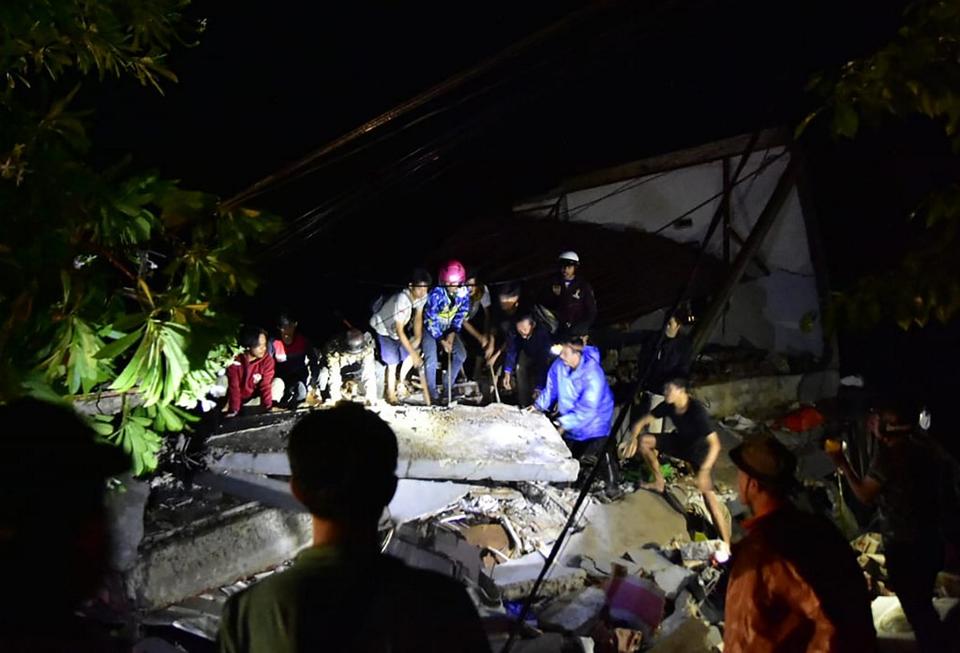
Rescuers search for survivors at the Mitra Manakarra hospital in Mamuju city on January 15, 2021. (AFP)

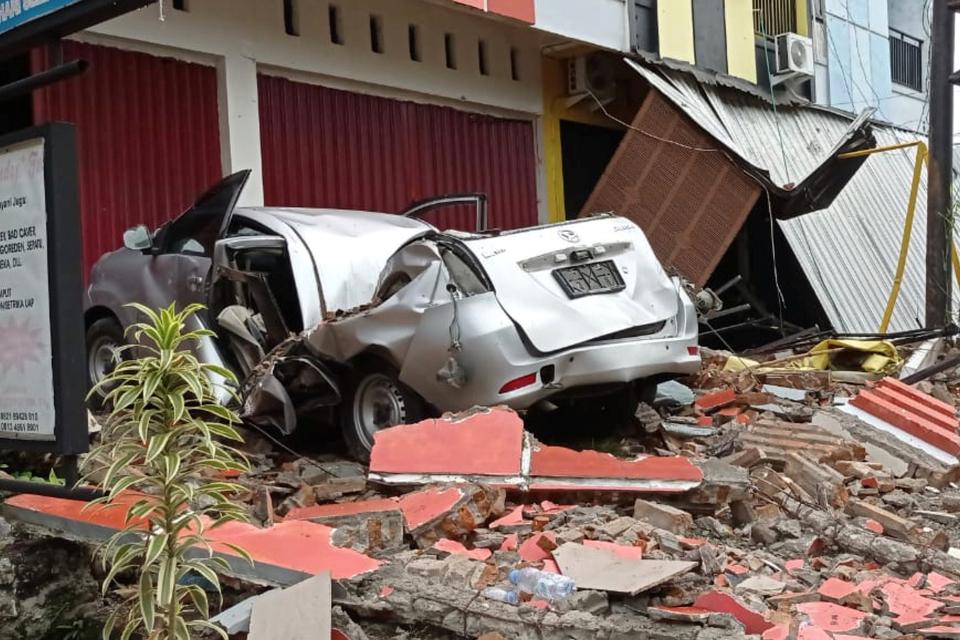
A strong, shallow earthquake shook Indonesia's Sulawesi island, causing landslides, levelling a hospital, severely damaging other buildings and sending people fleeing from their homes in the nighttime darkness.

At least 34 people were confirmed dead and more than 200 injured but authorities were still collecting information from devastated areas.

"The latest information we have is that 26 people are dead... in Mamuju city," said Ali Rahman, head of the local disaster mitigation agency, adding "that number could grow".

"Many of the dead are buried under rubble," he said.

Separately, the national disaster agency said at least eight people had died in an area south of Mamuju, a city of some 110,000 in West Sulawesi province, bringing the total death toll to 34.

The magnitude 6.2 quake early Friday was centered 36 kilometres (22 miles) south of West Sulawesi province’s Mamuju district, at a depth of 18 kilometres (11 miles), the US Geological Survey said.

Strong aftershocks could follow a 6.2 magnitude earthquake that struck Indonesia's Sulawesi island early on Friday, the chief of Indonesia's Meteorology and Geophysics agency (BMKG) said.

Dwikorita Karnawati told a news conference there had been at least 26 aftershocks after two strong quakes had rocked the area since Thursday afternoon.

Several buildings in Majene were severely damaged, including 62 homes, a health unit centre and a military office.

The strong quake also caused power and phone service outages and landslides along roads.
Rescuers search for survivors at a collapsed building in Mamuju city on January 15, 2021, after a 6.2-magnitude earthquake rocked Indonesia's Sulawesi island. (AFP)

A hospital in Mamuju, a city of some 110,000 in West Sulawesi province, was levelled.

"The hospital is flat tened, it collapsed," said Arianto from the rescue agency in Mamuju city, who goes by one name.

"There are patients and hospital employees trapped under the rubble and we're now trying to reach them," he added, without giving a specific figure.


Death toll could rise

Rescuers were also trying to reach a family of eight trapped under the rubble of their destroyed home, he added.

The country's search-and-rescue agency earlier said at least one hotel had collapsed after the quake struck at 2:18 am local time Friday (1818 GMT Thursday).

It later clarified that the hotel had partially caved in, while the regional governor's office also suffered extensive damage.

A Mamuju resident said damage across the city was severe, but the full extent of the disaster and casualties was not immediately clear.

"Roads are cracked and many buildings collapsed," said 28-year-old Hendra, who also goes by one name.

"The quake was very strong... I woke up and ran away with my wife."

National Disaster Mitigation Agency spokesman Raditya Jati said three people had been killed and 24 injured.

The death toll could rise.

In a video released by the National Disaster Mitigation Agency, a girl trapped in the wreckage of a house cried out for help and said her mother was alive but unable to move out. "Please help me, it's hurt," the girl told rescuers, who replied that they desperately wanted to help her.

In the video, the rescuers said an excavator was needed to save them. Other images in the video showed a severed bridge and damaged and even flattened houses. TV stations reported the earthquake damaged part of a hospital and patients were moved to an emergency tent outside
.
A damaged car and buildings are seen following an earthquake in Mamuju, West Sulawesi province, Indonesia, January 15, 2021. (Reuters)

Another video showed a father cried hopeless, asking help from people to save his children buried under tons of his house rubble. "My children there... they are trapped inside, please help," he cried in panic.

At least 62 houses, a public health centre and a military office were damaged in Mamuju and landslides were set off in three locations and blocked a main road connecting Mamuju to the Majene district, said Raditya Jati, the disaster agency's spokesperson.

Hours earlier, a 5.9 magnitude earthquake struck in the same district on Thursday damaging several houses

Straddling the so-called Pacific 'ring of fire', Indonesia, a nation of high tectonic activity, is regularly hit by earthquakes.

In 2018, a devastating 6.2 magnitude quake and subsequent tsunami struck the city of Palu, in Sulawesi, killing thousands of people.

Hard to crack research reveals how crop roots penetrate hard soils

UNIVERSITY OF NOTTINGHAM

Research News


Scientists have discovered a signal that causes roots to stop growing in hard soils which can be 'switched off' to allow them to punch through compacted soil - a discovery that could help plants to grow in even the most damaged soils.

An international research team, led by scientists from the University of Nottingham's Future Food Beacon and Shanghai Jiao Tong University has discovered how the plant signal 'ethylene' causes roots to stop growing in hard soils, but after this signal is disabled, roots are able to push through compacted soil. The research has been published in Science.

Hard (compacted) soils represent a major challenge facing modern agriculture that can reduce crop yields over 50% by reducing root growth, causing significant losses annually. Europe has over 33-million-hectares of soil prone to compaction which represents the highest in the world. Soil compaction triggers a reduction in root penetration and uptake of water and nutrients. Despite its clear importance for agriculture and global food security, the mechanism underpinning root compaction responses has been unclear until now.

Professor Malcolm Bennett from the University of Nottingham School of Biosciences, said: "Understanding how roots penetrate hard soils has huge implications for agriculture, as this knowledge will be crucial for breeding crops more resilient to soil compaction. Our team's identification that the plant signal ethylene controls root responses to hard soil opens up new opportunities to select novel compaction resistant crops."

The research utilised X-ray Computed Tomography scanners available at the Hounsfield Facility at the University of Nottingham to visualise in situ how plant roots responded to compacted soil. Professor Sacha Mooney from the University of Nottingham and Director of the Hounsfield Facility explained: "Prior to this research we assumed that the hardness of the soil prevented roots growing deeper. By using our imaging approach, we were able to see that roots continued growing in very hard soils when the ethylene signal was switched off. The potential for new crops that can now go deeper in soils and capture previously unavailable resources is really exciting!"

The international team involved in this new Science paper includes researchers drawn from nine universities based in Europe, China and USA, integrating expertise spanning plant and soil sciences, bioimaging and mathematics. The team involves several early career researchers including Dr. Bipin Pandey and Dr. Rahul Bhosale who are funded by Royal Society Challenge Grant, BBSRC Discovery Fellowship and University of Nottingham Future Food Beacon awards.

How plants produce defensive toxins without harming themselves

Defense and autotoxicity: Researchers elucidate the biosynthesis and mode of action of diterpene glycosides in wild tobacco

MAX PLANCK INSTITUTE FOR CHEMICAL ECOLOGY

Research News

IMAGE

IMAGE: THE LARVA OF A TOBACCO HAWKMOTH MANDUCA SEXTA ON A WILD TOBACCO LEAF: A DETAILED CHEMICAL ANALYSIS OF LARVAL FRASS (SMALL BLACK BALL) REVEALED HOW TOXINS ARE ACTIVATED IN THE... view more 

CREDIT: ANNA SCHROLL

Plants produce toxic substances to defend themselves against herbivores. In a new study, scientists from the Max Planck Institute for Chemical Ecology in Jena and the University of MĂŒnster, Germany, were able to describe in detail the biosynthesis and exact mode of action of an important group of defensive substances, the diterpene glycosides, in wild tobacco plants. Diterpene glycosides allow plants to fend off herbivores. The study shows that these plant chemicals attack certain parts of the cell membrane. To protect themselves from their own toxins and to prevent their cell membranes from being damaged, tobacco plants store these substances in a non-toxic form, which is synthesized in a very particular way. Autotoxicity and the protection against it seem to play a greater role in the evolution of plant defenses than previously thought (Science, doi: 10.1126/science.abe4713, January 2021).

Many plants produce chemical defenses to protect themselves against being eaten. Still little is known about what makes these substances toxic to their consumers. Researchers at the Max Planck Institute for Chemical Ecology and the University of MĂŒnster have now investigated how plants produce toxins and store them in their tissues without harming themselves. In particular, they wanted to know whether the mechanisms of autotoxicity and its prevention share similar mechanisms as the toxic characteristics that provide defense against herbivores.

Autotoxicity and defense

For their experiments, they chose diterpene glycosides from Nicotiana attenuata plants, a wild tobacco species. "These substances occur at very high concentrations in the leaves of tobacco plants. But we had no idea why they were such effective defenses or why they could be so toxic to produce. So the situation was completely different from the other very abundant toxin that this plant produces, namely, nicotine. Nicotine is a specific neurotoxin. Since plants lack nerves and muscles, they offer no target for the toxin. So producing and storing nicotine does not harm plants," says Ian Baldwin from the Department of Molecular Ecology at the Jena Max Planck Institute, where the study was carried out.

To their surprise, the researchers found that tobacco plants which had been transformed so they could no longer produced two proteins involved in the biosynthesis of the diterpene glycosides and thus also not form the defensive substances otherwise stored in the leaves in large amounts, showed conspicuous symptoms of self-poisoning: they were sick, unable to grow normally, and could no longer reproduce. Further experiments revealed that certain components of the cell membrane, so-called sphingolipids, had been attacked.

Targeting the cell membrane

Sphingolipids are substances found in all animals and plants, including the enemies of wild tobacco, the larvae of the tobacco hawkmoth Manduca sexta. The researchers therefore asked whether the sphingolipid metabolism could be the target of the diterpene glycosides. In fact, Manduca sexta caterpillars, which had fed on plants without diterpene glycosides, grew significantly better than larvae, which had fed on controls that contained the defensive chemicals. Analyses of the frass of Manduca sexta larvae, which had ingested diterpene glycosides with their food, provided further insights, as the degradation of the plant toxins during larval digestion is more or less in reverse order to the synthesis of the substances in the plant. Plants prevent self-harm by storing the defensive substances in a non-toxic form. However, when insects feed on the plant, a part of the non-toxic molecule is cleaved off and the chemical becomes activated or "armed". "Interestingly, in both cases, in plants with incomplete diterpene glycoside biosynthesis and in feeding caterpillars, the target of the toxins is the sphingolipid metabolism," says first author Jiancai Li.

Sphingolipids are mediators in many physiological processes. This makes the effect of diterpene glycosides on sphingolipid metabolism so intriguing. "Diterpene glycosides and their derivatives can have broad defensive functions against many agricultural pests and pathogenic fungi. At the same time, many human diseases, such as diabetes, cancers and some neurodegenerative diseases are also associated with elevated sphingolipid metabolisms," says Shuqing Xu from the Institute for Evolution and Biodiversity at the University of MĂŒnster, who is one of the senior authors of the study. Physicians have been searching for effective substances to treat these diseases by inhibiting the sphingolipid metabolism. The diterpene glycosides studied here could be potential candidates for further investigations.

"Frassomics" - a new powerful tool to study interactions between organisms

The analysis of larval frass proved to be the key to success in this study. The scientists call this new approach "frassomics": a combination of frass (larval droppings) and metabolomics - the analysis of all metabolites in an organism. "From this work, we realized that frassomics can be a very powerful research tool. The analysis of larval frass can provide metabolic clues about how what one organism produces is metabolized by consumer organisms," says Ian Baldwin.

The scientists plan to gain more insights into the "digestive duets" that occur between plants and insects, in order to better understand ecological interactions between plants, insects and microorganisms.

###

Original Publication: Li, J., Halitschke, R., Li, D., Paetz, C., Su, H., Heiling, S., Xu, S., Baldwin, I. T. (2021). Controlled hydroxylations of diterpenoids allow for plant chemical defense without autotoxicity, Science, DOI: 10.1126/science.abe4713 https://doi.org/10.1126/science.abe4713

Further Information:

Prof. Dr. Ian T. Baldwin, Tel. +49 3641 57 1100, E-Mail: baldwin@ice.mpg.de, Max Planck Institute for Chemical Ecology, Hans-Knöll-Straße 8, 07745 Jena, Germany

Prof. Dr. Shuqing Xu, Tel. +49 251 83 21090, E-Mail: shuqing.xu@uni-muenster.de, Institute for Evolution & Biodiversity, University of MĂŒnster, HĂŒfferstraße 1, 48143 MĂŒnster, Germany

Contact and Picture Requests:

Angela Overmeyer M.A., Max Planck Institute for Chemical Ecology, Hans-Knöll-Str. 8, 07743 Jena, Germany, Tel. +49 3641 57-2110, E-Mail overmeyer@ice.mpg.de

Download of videos and high-resolution images via http://www.ice.mpg.de/ext/downloads2021.html

Researchers show Irish soil can offer more hope in fight against antibiotic resistance

Scientists make exciting discovery in the quest to discover new antibiotics.

SWANSEA UNIVERSITY

Research News

IMAGE

IMAGE: RESEARCHERS HAVE DISCOVERED SOIL IN THE WEST FERMANAGH SCARPLANDS CONTAINS SEVERAL SPECIES OF THESE ANTIBIOTIC PRODUCING ORGANISMS. view more 

CREDIT: TRADITIONAL MEDICINE GROUP

Scientists who highlighted the bug-busting properties of bacteria in Northern Irish soil have made another exciting discovery in the quest to discover new antibiotics.

The Traditional Medicine Group, an international collaboration of scientists from Swansea University, Brazil and Northern Ireland, have discovered more antibiotic-producing species and believe they may even have identified new varieties of antibiotics with potentially life-saving consequences.

Antibiotic resistant superbugs could kill up to 1.3 million people in Europe by 2050 - the World Health Organisation (WHO) describes the problem as "one of the biggest threats to global health, food security, and development today".

The search for replacement antibiotics to combat multi-resistance has prompted researchers to explore new sources, including folk medicines focusing on environments where well-known antibiotic producers like Streptomyces can be found.

The Traditional Medicine Group discovered that soil used in ancient Irish folk medicine in the West Fermanagh scarplands contains several species of these antibiotic producing organisms. This area of caves, alkaline grassland and bog is scattered with many remnants of previous Neolithic habitation.

One of the research team, Dr Gerry Quinn, a previous resident of Boho, County Fermanagh, has been aware of the healing traditions of the area for many years. Several years ago, an analysis of the soil there led to the team discovering a previously unknown strain of bacteria effective against four of the top six hospital superbugs that are resistant to antibiotics, including MRSA.

Since then, their research has continued but given local religious sensitivities and the self-limiting nature of the original site, the group relocated their search to another area of the West Fermanagh scarplands that retained the essential alkaline nature of the grasslands whilst also providing a link to traditional folk medicine.

Dr Paul Facey, one of the lead researchers from Swansea University said: "The fact that traditional medicine is incorporated in many local folk tales led us to believe that there was a good possibility of finding strong antibiotic producing organisms in other locations in these limestone hills."

The group discovered that their latest finding was able to express an even wider range of antimicrobial activity than their previous discovery.

The results of this study have now been published in MDPI Applied Microbiology and the DNA sequence has been deposited in the American national collection.

Antibiotic tests performed by Dr Quinn, Simms Adu, from Ulster University, and Swansea University's Nada Alharbi reveal that Streptomyces sp. CJ13 inhibits the growth of multi-resistant organisms such as:

  • Gram negative Pseudomonas aeruginosa, a common opportunistic pathogen associated with chronic lung infections in cystic fibrosis patients;
  • MRSA, a common opportunistic pathogen often resistant to many antibiotics;
  • Anaerobic bacteria, usually found in deep wounds, which cause serious infections; and
  • Candida, a yeast species often overlooked in mixed bacterial infections.

The group has yet to chemically identify the compounds responsible for antibiotic activity but preliminary analysis indicates there are genetic similarities to other known antibiotic production genes.

Even though the antibiotic genes found in Streptomyces sp. CJ13 are not identical to template antimicrobials, it raises the interesting possibility that these could be new varieties of antibiotics.

Given the significant contributions made by Streptomyces to the fields of cancer and anti-viral therapies, team member Hamid Bakshi added: "We are confident in the great potential of our most recent discovery to provide many interesting discoveries."

###


Rare lichen unique to Florida discovered in museum collections, may be extinct

FLORIDA MUSEUM OF NATURAL HISTORY

Research News

IMAGE

IMAGE: THE ONLY RECORDS OF THE NEWLY-IDENTIFIED LICHEN CORA TIMUCUA ARE 32 SPECIMENS IN MUSEUM COLLECTIONS COLLECTED IN FLORIDA BETWEEN 1885 AND 1985. UP TO 90% OF ITS NATIVE PINE SCRUB... view more 

CREDIT: ROBERT LÜCKING

GAINESVILLE, Fla. --- Scientists have found a new species of fleshy verdigris lichen, thanks to DNA analysis of museum specimens. Misidentified by its original collectors, the lichen is only known from 32 specimens collected in North and Central Florida scrubland between 1885 and 1985. Now the hunt is on to find it in the wild - if it still exists.

The lichen, named Cora timucua in honor of Florida's Timucua people, is critically endangered, even more so than the federally protected Florida perforate reindeer lichen, and possibly extinct. Researchers are holding out hope that C. timucua may persist in undisturbed pockets of the state's dwindling pine scrub habitat, though recent searches came up empty.

"The million-dollar question is 'Where is this lichen?'" said Laurel Kaminsky, a digitization manager at the Florida Museum of Natural History and co-author of the study. "The optimist in me says it's still out there."

Kaminsky said the sparse information recorded by the lichen's collectors makes it difficult to retrace their steps. More widespread in the early 20th century, C. timucua was collected only from the Ocala National Forest and O'Leno State Park after 1968, two of Florida's last remaining scrub ecosystems. Citrus groves and urban developments have replaced up to 90% of the state's sand pine scrub.

"If it's anywhere, it's going to take a lot of looking in very specific habitats to find it," Kaminsky said.

Affectionately dubbed "Timucua heart lichen," the new species resembles a shelf fungus and is about the size of a sand dollar with scalloped edges. It can be distinguished from wood-rotting fungi by its texture: felty and papery, with curved lobes and a cracked underside.

But its color is an enigma. The lichen is light gray when dry, but specimens turn a deep blue-green and bleed a reddish-brown pigment when wet in a laboratory setting. Without photos and detailed descriptions of the lichen in nature, scientists don't yet know how it reacts to moisture in the wild.

"In general, people take nature for granted, and the Timucua heart lichen story might tell us sometimes we are too late," said Manuela Dal Forno, senior author of the study and a lichenologist at the Botanical Research Institute of Texas. "Right now, we need everybody's help in trying to locate this lichen in Florida."

Kaminsky said Timucua heart lichen likely prefers old-growth pine scrub habitat, which has taller trees and established populations of native Florida plants, such as rusty lyonia, a shrub characterized by reddish fibers lining its leaves. But hikers should avoid collecting any potential specimens they find: Instead, they can photograph the lichen and upload images to the Timucua Heart Lichen Project on the community science platform iNaturalist for identification.

Florida's hidden lichen life

Lichens are partnerships between fungi and photosynthesizing organisms and play a key role in their ecosystems by enriching soils and cycling nutrients. But much of the world's lichen diversity remains hidden. A chronic shortage of lichen experts led to the delay in Timucua heart lichen's discovery, Kaminsky said. She added that Florida could harbor as many as 1,000 lichen species, many of which remain undescribed and whose populations could also be imperiled.

A previous survey of South Florida's Fackahatchee Strand Preserve led by Robert LĂŒcking, a curator at Berlin's Botanical Garden and Botanical Museum and lead author of the C. timucua study, found more than 400 lichen species in about 250 acres. Of the 400 species, 18 were new to science and 100 had yet to be recorded in North America.

"This emphasizes how little we know about lichen diversity and their genetic information, as well as the importance of digitization projects," said Dal Forno, also a research associate at the Smithsonian's National Museum of Natural History. "There are so many lichens out there, but not enough lichenologists to study them."

Timucua heart lichen belongs to the genus Cora, a group of nearly 200 tropical lichens - once thought to be a single species - typically found in mountain habitats. Its discovery in Florida is the northernmost record of a Cora species, and the new species is the sole representative of its genus in the U.S.

Even if the species is extinct, studying its DNA could help scientists understand how the species arrived in Florida. Timucua heart lichen's closest known relatives are in Colombia and Brazil, raising questions about how C. timucua was able to grow in a habitat so different from its sister species, Dal Forno said.

Digital museum specimens led to discovery

Increasingly, researchers need not pack a tent and head into the field to find new species. Instead, they can search online databases of specimen data from museums around the world. In 2012, a National Science Foundation grant helped scientists digitize lichens from the Florida Museum's fungal herbarium, uploading basic specimen information and images to two international data networks, the Global Biodiversity Information Facility and the Consortium of North American Lichen Herbaria.

It was on the web that LĂŒcking and Gary Perlmutter, acting curator of lichens at the University of North Carolina at Chapel Hill herbarium and a study co-author, spotted clusters of Florida Cora specimens, far outside the genus's known range. They contacted Kaminsky, suspecting DNA analysis would uncover misidentified specimens.

"I knew we had these specimens, but I just thought everybody else knew," Kaminsky said. "The digitization just opened it up for other people to find it and do cool things with it."

###

James Lawrey of George Mason University also co-authored the study.