Friday, August 27, 2021


Video of Mountie ordering journalist to 'be silent' at Fairy Creek protest raises press freedom concerns

Interaction filmed at B.C.'s Fairy Creek 'inappropriate,' observer says, but others say context is key

In a video shared on Twitter, a B.C. RCMP officer, shown here second from left, tells journalist Ora Cogan, at right, to be 'silent' during police action at Fairy Creek on Vancouver Island. (Ora Cogan/Twitter)

Legal experts say they're concerned about a widely shared video showing an RCMP officer telling a journalist to be "silent" while she covered protests against old-growth logging on Vancouver Island "or you're gone."

Ora Cogan, who is reporting on the protests for Teen Vogue, posted the video on Twitter earlier this week. It shows her speaking with a Mountie as he appears to move a group of protesters along a gravel road in the Fairy Creek watershed.

In her tweet, she says she had asked the officer why media access was being restricted.

The video shows him telling her, "You've already been told the rules. You are to be silent while doing your job, or you're gone. You are not to talk to us or engage with us. You are to be independent and quiet."

That interaction is unacceptable to Veronica Martisius, staff counsel for policy at the B.C. Civil Liberties Association, who said reporters have a right to do their jobs without police interference.

"For an officer to order a journalist not to engage … and to threaten that journalist, that if you do engage, I'm going to remove you, that's totally inappropriate," she told CBC News.

"That officer has a choice whether or not he wants to answer questions, but you can't order a journalist around and tell that journalist how to do their job."

The Canadian Association of Journalists also said it was "very concerned" about the content of the video and was gathering information about the situation.

"Journalists are not meant to be silent," the national organization said in a tweet on Wednesday.

The video is just the latest example of police actions at the Fairy Creek blockades that have raised concerns about press freedom.

RCMP officers have been on the scene since May, enforcing a court injunction against blockades preventing lumber company Teal Jones from logging its 595-square-kilometre tenure on southwestern Vancouver Island.

In that time, some of the RCMP's actions to restrict reporters' activities at protest sites have already been declared unlawful in court. Earlier this month, a B.C. Supreme Court judge ruled that police had no legal authority to refuse entry to the Fairy Creek watershed to either journalists or members of the public.

'Police officers have a right to not be obstructed'

When it comes to Cogan's video, however, another legal observer is urging viewers not to jump to conclusions.

Kevin Westell, a criminal defence lawyer in Vancouver, agreed there are reasons to be concerned about the officer's actions.

"Anytime you see a member of the press being treated so tersely and being given a command of that nature, the hair stands up on the back of your neck," he said.

But he hesitated to give a definitive opinion on whether the officer's actions were appropriate, saying context is important.

"Police officers have a right to not be obstructed at work when they're trying to carry out their duty," Westell said.

Police use a jackhammer to remove a person secured to a logging road near Port Renfrew, B.C., during a protest against old-growth logging in the area on May 26, 2021. (Michael Mcarthur/CBC News)

He argued that if an officer legitimately felt that a journalist asking questions was obstructing his ability to maintain public safety, the officer might be justified in saying they needed to be quiet — but only in that moment.

"At the same time, if that police officer is setting up broad ground rules over the entirety of the situation, saying that a police officer is entitled to order a member of the press to never speak, that's an entirely different thing. That would be completely inappropriate," Westell said.

The Mounties are also asking people to consider possible missing context.

RCMP spokesperson Sgt. Chris Manseau told CBC News that he couldn't comment on an individual officer's actions based on a short video.

"Anticipating that more videos will continue to surface, I caution anyone viewing them and reading comments to keep in mind that they do not fully capture the events leading up to or following the interactions," he wrote in an email.

Officer refuses to identify himself

Meanwhile, another aspect of Cogan's video has also raised some questions about police conduct.

The video shows her asking the officer for his name, but he refuses to give it.

That doesn't sit right with Martisius.

"They have to identify themselves. How else would people be able to follow up with a complaint if they're not able to identify the officer that they're complaining against?" she asked.

As for Manseau, he argued that Mounties could be putting themselves at risk when they give out identifying information.

"Members have, in previous operations and in this current one, experienced being targeted online, doxxed and harassed when generally asked for their names," he said.

Ex-fracker at Walmart reveals one risk to U.S. oil supply growth


David Wethe, Sheela Tobben and Josyana Joshua, Bloomberg News


Fundamentals still indicate oil demand will outweigh supply in an economic recovery: Energy economist


For more than a year, Kristopher Guidry crisscrossed the Texas oil patch, fixing up electrical equipment on drilling rigs. Today, he's studying to become a home appraiser. Abhinav Mishra was an oil engineer in some of the same fields. In January, he started an internship in Silicon Valley. And Andrew Crum, who ran digital operations for fracking outfits, headed to Kansas City, Missouri, where he joined Walmart Inc.'s supply-chain management team.

All three men say they’ve probably left the industry for good.

After three oil busts in the past seven years alone, they're fed up with the stomach-churning volatility of it all. The boom years may be wonderful, but the trips to the unemployment line that follow are devastating. Besides, some workers say, the industry is on the decline now as the government and corporate America pivot to a greener future. Who wants to be part of a dying business?

"I would have to be pretty desperate to consider going back," said Crum, who had followed three earlier generations of his family into the oil fields.

Of all the labor shortages that are wreaking havoc on the U.S. economy -- from cashiers to chefs -- few are as thorny or potentially as permanent as the one that has a grip on the oil sector. Thousands of roughnecks and engineers are, like Guidry, Mishra and Crum, wary of returning to jobs like the ones they lost when the pandemic sent the price of crude oil crashing last year.


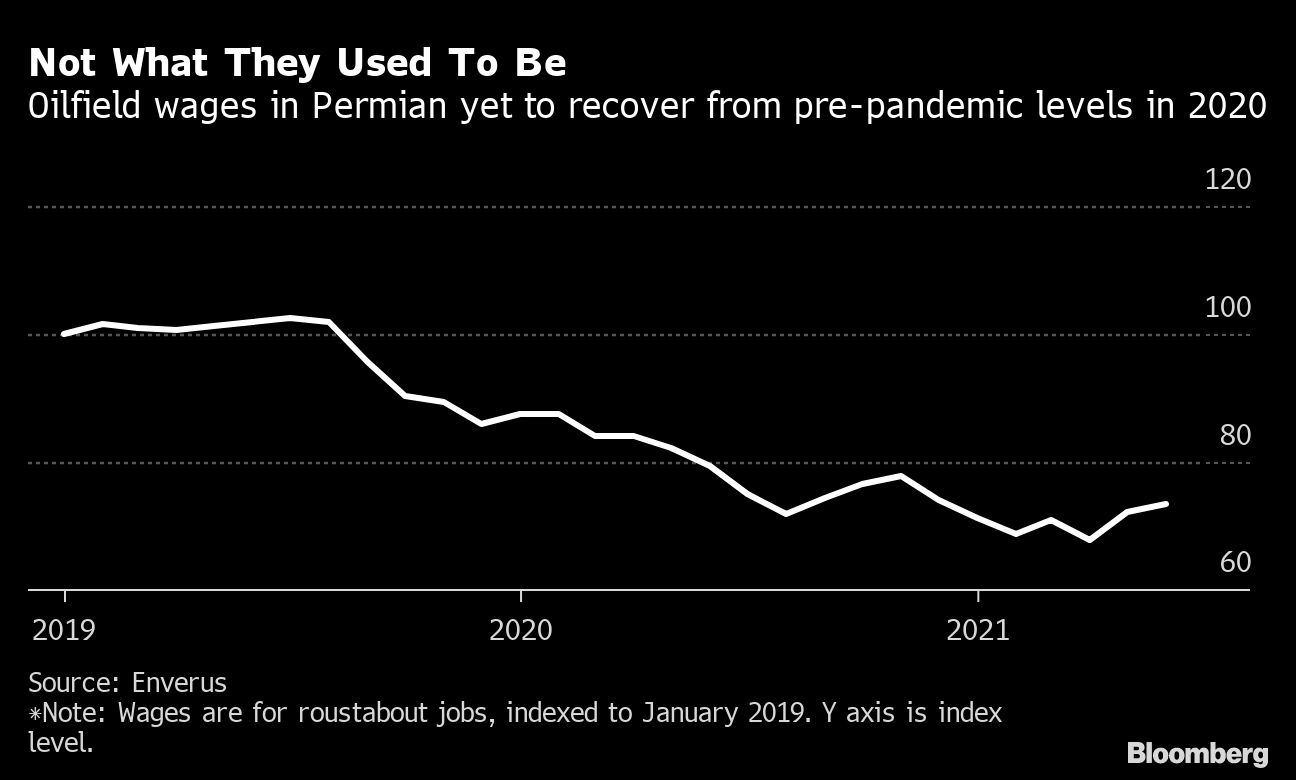
It doesn't help that oil producers, trying to display a newfound financial discipline to their frustrated Wall Street backers, are hesitant to offer the signing bonuses and double-digit pay hikes that have become commonplace in other industries. Average pay in the Permian shale basin of West Texas and New Mexico remains below pre-COVID levels. All of which, analysts say, could add up to a cap on production in the Permian and other shale formations that collectively pump out more than two-thirds of all U.S. oil. Drillers may be promising to avoid rushing back into expansion mode -- as part of that same pledge to Wall Street -- but the lack of workers frankly gives them no choice.“If reported labor shortages continue, it would be impossible to grow production,” said Elisabeth Murphy, an analyst at research firm ESAI Energy.


Spending in the oil basins of U.S. and Canada will drop 7 per cent in 2021 from a year earlier, according to Evercore ISI, even though crude prices have surged by more than a third this year to trade above US$65 a barrel. That’s after U.S. oilfield service workers lost an estimated US$8.7 billion in annual wages to COVID-19, according to the Energy Workforce & Technology Council trade group.

“I am just waiting on better offers at the moment,” said Tremayne Tryels, who has worked in the Permian since oil prices were US$100 a barrel in 2014. Though Tryels has held jobs ranging from roustabout -- an all-purpose oilfield maintenance worker -- to chemical specialist, “most of the salary offers for jobs are way too low for someone that has the experience level I have.”

While oilfield pay is growing at about 3 per cent month-over-month, the median salary for a roustabout remains roughly 10 per cent below pre-COVID levels, according to energy data and consulting firm Enverus.

Canadian rig contractor Precision Drilling Corp. estimates it managed to recruit roughly half of the 1,000 or so former workers on its call-back list, a drop from previous recoveries when it could rehire as many as two-thirds.

“They found jobs that have a more stable lifestyle,” said Kevin Neveu, Precision’s chief executive officer. “I really can’t recall a period where it was this tricky and this challenging to attract people to the industry.”

Chris Wright, CEO of Liberty Oilfield Services Inc., has encountered similar hiring challenges. America’s second-biggest provider of frack work has amassed a larger army of recruiters to fill open posts.

“We laid off about a thousand people last year in April,” he said. “We’ve hired back maybe two-thirds of those people. And I would say the other third have left the industry.”

Worker shortages could imperil North American oil production growth, which has already been muted as producers stick to their promises of financial discipline. Though oil prices stumbled earlier this month on concern that the virus’s delta variant would dent consumption, the market has since rebounded and traders are trying to gauge whether shale explorers can ratchet up output as demand recovers. Oil companies are also coming under increasing pressure from investors to tackle climate change, and the transition to renewable energy is raising questions about fossil-fuel demand in the long term. In some cases, it’s shale workers themselves who are voicing concerns.

"Climate change is a reason why I would also never go back because they are actively pushing efforts to not clean up” their operations, said Mishra, the former oilfield engineer. 

Oil Workers Lack Job Security as Industry Recovers, Survey Says

Automation is already replacing some of the jobs that were slashed last year. Halliburton Co., the biggest provider of fracking services, has made permanent cuts to its workforce and is using digital and remote operations to slash the number of engineers it needs.

A third of the 115,000 oilfield service jobs lost to the pandemic have been restored, according to the Energy Workforce & Technology Council. An estimated 6,082 jobs were added in July, marking the fifth straight month of growth.

“The oilfield took a big hit,” said Guidry, who lost his electrical job with NexTier Oilfield Solutions Inc. last year. “They laid off pretty much everybody and went to bare-bones crews out there.”

Simeon Adda was hired by Baker Hughes when oil prices approached an all-time high in June 2014 and lost his job 15 months later. He’s now a business development manager for commercial printing company R.R. Donnelley & Sons in Houston. Adda remembers checking the price of oil every day while working as a field engineer.

“That is a habit I’m glad I don’t have anymore,” he said. “Knowing how fickle the economy can be, it’s just a tough way to bank your lifestyle and to bank your family’s future on something like, ‘Is OPEC going to release more oil?’”


Ultrafast electron microscopy leads to pivotal discovery

Ultrafast electron microscopy leads to pivotal discovery
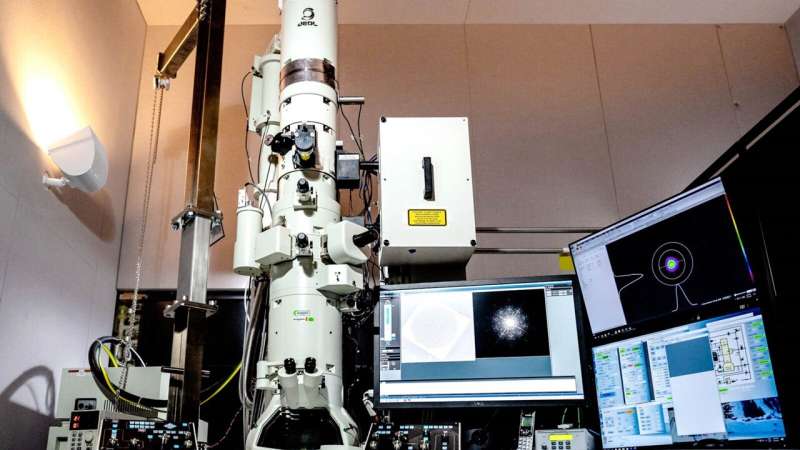
Ultrafast electron microscope in Argonne’s Center for Nanoscale Materials
. Credit: Argonne National Laboratory.

Everyone who has ever been to the Grand Canyon can relate to having strong feelings from being close to one of nature's edges. Similarly, scientists at the U.S. Department of Energy's (DOE) Argonne National Laboratory have discovered that nanoparticles of gold act unusually when close to the edge of a one-atom thick sheet of carbon, called graphene. This could have big implications for the development of new sensors and quantum devices.

This discovery was made possible with a newly established ultrafast electron microscope (UEM) at Argonne's Center for Nanoscale Materials (CNM), a DOE Office of Science User Facility. The UEM enables the visualization and investigation of phenomena at the nanoscale and on time frames of less than a trillionth of a second. This discovery could make a splash in the growing field of plasmonics, which involves light striking a material surface and triggering waves of electrons, known as  fields.

For years, scientists have been pursuing development of plasmonic devices with a wide range of applications—from quantum information processing to optoelectronics (which combine light-based and electronic components) to sensors for biological and medical purposes. To do so, they couple two-dimensional materials with atomic-level thickness, such as graphene, with nanosized metal particles. Understanding the combined plasmonic behavior of these two different types of materials requires understanding exactly how they are coupled.

In a recent study from Argonne, researchers used ultrafast electron microscopy to look directly at the coupling between gold nanoparticles and graphene.

"Surface plasmons are light-induced electron oscillations on the surface of a nanoparticle or at an interface of a nanoparticle and another material," said Argonne nanoscientist Haihua Liu. "When we shine a light on the nanoparticle, it creates a short-lived plasmonic field. The pulsed electrons in our UEM interact with this short-lived field when the two overlap, and the electrons either gain or lose energy. Then, we collect those electrons that gain energy using an energy filter to map the plasmonic field distributions around the nanoparticle."

In studying the gold , Liu and his colleagues discovered an unusual phenomenon. When the nanoparticle sat on a flat sheet of graphene, the plasmonic field was symmetric. But when the nanoparticle was positioned close to a graphene edge, the plasmonic field concentrated much more strongly near the edge region.

"It's a remarkable new way of thinking about how we can manipulate charge in the form of a plasmonic field and other phenomena using light at the nanoscale," Liu said. "With ultrafast capabilities, there's no telling what we might see as we tweak different materials and their properties."

This whole experimental process, from the stimulation of the nanoparticle to the detection of the plasmonic field, occurs in less than a few hundred quadrillionths of a second.

"The CNM is unique in housing a UEM that is open for user access and capable of taking measurements with nanometer spatial resolution and sub-picosecond time resolution," said CNM Director Ilke Arslan. "Having the ability to take measurements like this in such a short time window opens up the examination of a vast array of new phenomena in non-equilibrium states that we haven't had the ability to probe before. We are excited to provide this capability to the international user community."

The understanding gained with regard to the coupling mechanism of this nanoparticle-graphene system should be key to the future development of exciting new plasmonic devices.

A paper based on the study, "Visualization of plasmonic couplings using ultrafast electron microscopy," appeared in the June 21 edition of Nano Letters. In addition to Liu and Arslan, additional authors include Argonne's Thomas Gage, Richard Schaller and Stephen Gray. Prem Singh and Amit Jaiswal of the Indian Institute of Technology also contributed, as did Jau Tang of Wuhan University and Sang Tae Park of IDES, Inc.A catalyst that controls chemical reactions with light\

More information: Haihua Liu et al, Visualization of Plasmonic Couplings Using Ultrafast Electron Microscopy, Nano Letters (2021). DOI: 10.1021/acs.nanolett.1c01824

Journal information: Nano Letters 

Provided by Argonne National Laboratory 


Reducing sugar in packaged foods can prevent disease in millions

packaged food
Credit: CC0 Public Domain

Cutting 20% of sugar from packaged foods and 40% from beverages could prevent 2.48 million cardiovascular disease events (such as strokes, heart attacks, cardiac arrests), 490,000 cardiovascular deaths, and 750,000 diabetes cases in the U.S. over the lifetime of the adult population, reports a study published in Circulation.

A team of researchers from Massachusetts General Hospital (MGH), the Friedman School of Nutrition Science & Policy at Tufts University, Harvard T.H. Chan School of Public Health and New York City Department of Health and Mental Hygiene (NYC DOH) created a model to simulate and quantify the health, economic, and equity impacts of a pragmatic -reduction policy proposed by the U.S. National Salt and Sugar Reduction Initiative (NSSRI). A partnership of more than 100 local, state and national health organizations convened by the NYC DOH, the NSSRI released draft sugar-reduction targets for packaged foods and beverages in 15 categories in 2018. This February, NSSRI finalized the policy with the goal of industry voluntarily committing to gradually reformulate their sugary products.

Implementing a national policy, however, will require government support to monitor companies as they work toward the targets and to publicly report on their progress. The researchers hope their model will build consensus on the need for a national-sugar reformulation policy in the US. "We hope that this study will help push the reformulation initiative forward in the next few years," says Siyi Shangguan, MD, MPH, lead author and attending physician at MGH. "Reducing the  of commercially prepared foods and beverages will have a larger impact on the health of Americans than other initiatives to cut sugar, such as imposing a sugar tax, labeling added sugar content, or banning sugary drinks in schools."

Ten years after the NSSRI policy goes into effect, the U.S. could expect to save $4.28 billion in total net healthcare costs, and $118.04 billion over the lifetime of the current adult population (ages 35 to 79), according to the model. Adding the societal costs of lost productivity of Americans developing diseases from excessive sugar consumption, the total cost savings of the NSSRI policy rises to $160.88 billion over the adult population's lifetime. These benefits are likely to be an underestimation since the calculations were conservative. The study also demonstrated that even partial industry compliance with the policy could generate significant health and .

The researchers found that the NSSRI policy became cost-effective at six years and cost-saving at nine years. The policy could also reduce disparities, with the greatest estimated health gains among Black and Hispanic adults, and Americans with  and less education—populations that consume the most sugar as a historical consequence of inequitable systems.

Product reformulation efforts have been shown to be successful in reducing other harmful nutrients, such as trans fats and sodium. The U.S., however, lags other countries in implementing strong sugar-reduction policies, with countries such as the UK, Norway, and Singapore taking the lead on sugar-reformulation efforts. The US may yet become a leader in protecting its people from the dangers of excessive sugar consumption if the NSSRI's proposed sugar-reduction targets are achieved. "The NSSRI  is by far the most carefully designed and comprehensive, yet achievable, sugar-reformulation initiative in the world," says Shangguan.

Consuming sugary foods and beverages is strongly linked to obesity and diseases such as type 2 diabetes and cardiovascular disease, the leading cause of mortality in the U.S. More than two in five American adults are obese, one in two have diabetes or prediabetes, and nearly one in two have cardiovascular disease, with those from lower-income groups being disproportionately burdened.

"Sugar is one of the most obvious additives in the food supply to reduce to reasonable amounts," says Dariush Mozaffarian, MD, DrPH, co-senior author and dean of the Friedman School of Nutrition Science and Policy at Tufts University. "Our findings suggest it's time to implement a national program with voluntary sugar reduction targets, which can generate major improvements in health, health disparities, and healthcare spending in less than a decade."

Nutritional value of foods static despite targets on calories, salt and sugar
Journal information: Circulation 
Provided by Massachusetts General Hospital 
Major damage reported after building explosion in Wheatley, Ont.
The incident came nearly three months after a state of emergency was declared in the same area after officials said a naturally occurring hydrogen sulphide gas leak was detected.
NOTHING NATURAL ABOUT H2SO4
IT'S A GAS UNDER PRESSURE
Nick Westoll 8 hrs ago
© Handout / Greg Hetherington A heavily damaged building can be seen in Wheatley, Ont.

Multiple buildings have been damaged after an explosion in Wheatley, Ont. Thursday evening, officials say.

According to a post on the Chatham-Kent Fire Department Twitter account just before 7:20 p.m. on Thursday, crews were called to the intersection of Erie Street and Talbot Road.

Chatham--Kent--Leamington MPP Rick Nicholls posted a message on his personal Facebook page Thursday evening saying there were "multiple injuries" and seven paramedic crews were sent to the scene.

"Buildings destroyed on main [street]," he wrote.

"Cause not yet determined. I’ve reached out to the Minister of Natural [Resources] and Forestry and forwarded pics just in case the determination is a gas leak."

However, paramedics or other officials didn't release any further information on injuries as of Wednesday night.

Photos posted on social media Thursday evening appeared to show damage to multiple properties.

Fire department officials said residents near the scene who haven't been evacuated should be prepared to leave.

An update issued by Ontario Provincial Police said the Wheatley Area Arena was being opened for people who were displaced by the explosion.

Crews with the Ontario government's hazardous materials and urban search and rescue teams were called to assist.

Read more: State of emergency declared in Wheatley, Ont., after hydrogen sulphide leak

Wheatley is located just north of Point Pelee National Park and approximately 35 minutes southwest of Chatham.

Global News contacted fire and police officials to get additional information on the situation and further details about the circumstances leading up to the explosion, but representatives weren't immediately available for comment.

The incident came nearly three months after a state of emergency was declared in the same area after officials said a naturally occurring hydrogen sulphide gas leak was detected


Titan-in-a-glass experiments hint at mineral makeup of Saturn moon

by American Chemical Society
True-color image of layers of haze in Titan's atmosphere. Credit: NASA

Titan, Saturn's largest moon, is a natural laboratory to study the origins of life. Like Earth, Titan has a dense atmosphere and seasonal weather cycles, but the chemical and mineralogical makeup are significantly different. Now, earthbound researchers have recreated the moon's conditions in small glass cylinders, revealing fundamental properties of two organic molecules that are believed to exist as minerals on Titan.


The researchers will present their results today at the fall meeting of the American Chemical Society (ACS).

"Simple organic molecules that are liquid on Earth are typically solid icy mineral crystals on Titan because of its extremely low temperatures, down to -290 F," says Tomče Runčevski, Ph.D., the project's principal investigator. "We found that two of the molecules likely to be abundant on Titan—acetonitrile (ACN) and propionitrile (PCN)—occur predominantly in one crystalline form that creates highly polar nano surfaces, which could serve as templates for the self-assembly of other molecules of prebiotic interest."

Most of what we know now about this icy world is thanks to the 1997-2017 Cassini-Huygens mission to Saturn and its moons. From that mission, scientists know that Titan is a compelling place to study how life came about. Like Earth, Titan has a dense atmosphere, but it is mostly made up of nitrogen, with a touch of methane. It is the only known body in space, other than Earth, where clear evidence of stable pools of surface liquid has been found. Fueled by the sun's energy, Saturn's magnetic field and cosmic rays, both nitrogen and methane react on Titan to produce organic molecules of various sizes and complexities. ACN and PCN are believed to be present in the moon's characteristic yellow haze as aerosols, and they rain down on the surface, settling as solid chunks of minerals.

The properties of these molecules on Earth are well known, but their characteristics under Titan-like conditions have not been studied until now. "In the lab, we recreated conditions on Titan in tiny glass cylinders," Runčevski says. "Typically, we introduce water, which freezes into ice as we lower the temperature to simulate the Titan atmosphere. We top that with ethane, which becomes a liquid, mimicking the hydrocarbon lakes that Cassini-Huygens found." Nitrogen is added to the cylinder, and ACN and PCN are introduced to simulate the atmospheric rainfall. The researchers then raise and lower the temperatures slightly to imitate the temperature swings on the surface of the moon.

The crystals that formed were analyzed using synchrotron and neutron diffraction instrumentation, spectroscopic experiments and calorimetric measurements. The work, supported by calculations and simulations, involved Runčevski's team from Southern Methodist University, as well as scientists from Argonne National Laboratory, the National Institute of Standards and Technology, and New York University.

"Our research revealed a lot about the structures of planetary ices that was previously unknown," Runčevski says. "For example, we found that one crystalline form of PCN does not expand uniformly along its three dimensions. Titan goes through temperature swings, and if the thermal expansion of the crystals is not uniform in all directions, it may cause the moon's surface to crack." Such detailed knowledge of these minerals could help the team better understand what the surface of Titan is like.

Runčevski is now preparing crystals of ACN, PCN, and ACN and PCN mixtures to obtain detailed spectra. "Scientists will then be able to compare these known spectra to the spectral library collected by Cassini-Huygens and assign unidentified bands," he says. The studies will help confirm the mineral makeup on Titan and will likely provide insights for researchers working on an upcoming NASA mission to Titan, launching in 2027.


Explore further'Titans in a jar' could answer key questions ahead of NASA's space exploration
More information: Simple nitriles as putative cryominerals on Titan, Saturn's moon, ACS Fall 2021.
Provided by American Chemical Society

Moon-in-a-jar recreates the hazy atmosphere of Titan, Saturn's largest moon


By Nicoletta Lanese
SPACE.COM


Beneath Titan's dense yellow atmosphere, rivers of methane and ethane run over the moon's surface. (Image credit: Getty / MARK GARLICK / SCIENCE PHOTO LIBRARY)

Scientists recreated the unique chemical conditions found on Titan, Saturn's largest moon, in tiny glass cylinders here on Earth, and the experiment revealed previously unknown features of the moon's mineral makeup.

Titan is the second-largest moon in the solar system, behind Jupiter's Ganymede, and sports a dense atmosphere of mostly nitrogen with a dash of methane, according to Space.com. This yellowish haze hovers around minus 290 degrees Fahrenheit (minus 180 degrees Celsius). Below the atmosphere, lakes, seas and rivers of liquid methane and ethane cover Titan's icy crust, particularly near the poles. And similar to liquid water on Earth, these natural gases take part in a cycle in which they evaporate, form clouds and then rain down on the moon's surface.

Titan's dense atmosphere, surface liquid and seasonal weather cycles make the frigid moon somewhat similar to Earth, and like our planet, the moon is known to have organic molecules that contain carbon, hydrogen and oxygen, according to NASA. Because of this organic chemistry taking place on Titan, scientists think the moon could serve as a massive laboratory to study chemical reactions that occurred on Earth before the emergence of life on the planet, Space.com previously reported.

Related: Moon birth and methane weather: Cassini's 7 oddest Saturn finds

But only one spacecraft, Cassini, has observed Saturn and its moons in detail, making it tough to do Earthbound research on the wacky chemistry found on Titan. So recently, a team of scientists set out to simulate Titan in a test tube.

The team first placed liquid water in small glass cylinders and cranked down the temperature to Titan-like conditions, the researchers said in a statement. This water froze to mimic Titan's icy crust. The team then introduced ethane to the tube, which became liquid like the lakes on Titan's surface. Finally, they added nitrogen to stand in for Titan's atmosphere and then varied the temperature of the tube ever so slightly, to simulate the variations in temperature on Titan's surface and in different layers of its atmosphere.

In their recent study, presented Thursday (Aug. 26) at the fall meeting of the American Chemical Society, the team then added two compounds, called acetonitrile (ACN) and propionitrile (PCN). Data from the Cassini mission suggest that these compounds are abundant on Titan, principal investigator Tomče Runčevski, an assistant professor in the Department of Chemistry at Southern Methodist University in Dallas, told Live Science.

Most previous studies examined these two compounds separately, in their pure forms, but Runčevski's team wanted to see what would occur when the compounds mixed and mingled, as they might on Titan. As opposed to working with each compound separately, "if you mix them together ... there might be a completely different outcome in structure, so how the molecules will organize, and how the molecules will crystallize," or phase into a solid form, Runčevski said.


And the team found that, when both present in Titan-like conditions, ACN and PCN behave quite differently than either compound in isolation. Namely, the temperatures at which the compounds melted or crystallized shifted drastically, on the order of tens of kelvins (hundreds of degrees Fahrenheit or Celsius).


Related: 6 most likely places for alien life in the solar system


These melting and crystallization points would be relevant in Titan's hazy yellow atmosphere. The various layers of the atmosphere differ in temperature depending on their altitude above the moon's surface, so to understand how chemicals behave throughout the haze, the new study suggests that these temperature variations need to be taken into account, Runčevski said.


In addition, the team found that, when ACN and PCN crystallize, they adopt different crystal structures depending on whether they're alone or in the presence of the other compound. Crystals form when the individual molecules within a compound snap into a highly organized structure. While the building blocks of that structure — the molecules — remain the same, depending on factors such as temperature, they can end up snapping together in slightly different configurations, Runčevski said.

RELATED CONTENT


Top 10 amazing moon facts

Voyager to Mars rover: NASA's 10 greatest innovations

The 7 strangest asteroids: Weird space rocks in our solar system

These variations in crystal structure are known as "polymorphs," and when on their own, ACN and PCN adopt one polymorph at high temperatures and another at low temperatures. But "what we notice is that if we have a mixture, the stability of the high-temperature and low-temperature [polymorphs] can be, in a way, switched," Runčevski said.

These fine details of when and how the compounds achieve a stabilized structure "can really change our understanding of what kind of minerals we might encounter on Titan," in terms of what polymorphs they likely adopt on the moon, he said. This in turn can shape what chemical reactions take place between these and other compounds on Titan.

The new study is limited in that it doesn't account for all of the chemicals present on Titan, and so can capture only a simplified picture of what actually happens on the moon, Runčevski said.

"It's important for us as scientists on Earth ... to create these models with increasing complexity, and one day to reach models that are really significant and can really help us further understand the surface of Titan," he said.

NASA's Dragonfly mission, set to launch in 2026 and arrive at Saturn in 2034, may provide more on-the-ground information about the mineral makeup of Titan. However, Runčevski suspects that the crystals his team has observed likely form around the edge of Titan's lakes, cropping up as the liquid ethane in the lakes evaporates and leaves those compounds behind on the shoreline. At this point, it's unclear whether the Dragonfly mission might focus on this specific aspect of the Titanian environment, but "nonetheless, [the mission] is super exciting, and we will learn so much more about Titan," he said.

Originally published on Live Science.


This Fast Radio Burst Repeats in a Strict Pattern, And We Still Can't Figure Out Why


Visualization of the blue short-wavelength and red long-wavelength bursts. (Joeri van Leeuwen)
SPACE
26 AUGUST 2021

After taking new radio observations, astronomers have ruled out a leading explanation for the cyclic nature of a particularly curious repeating space signal.

The signal in question is FRB 20180916B, which repeats with a 16.35-day periodicity. According to existing models, this could result from interactions between closely orbiting stars; however, the new detections - which include fast radio burst (FRB) observations at the lowest frequencies yet - do not make sense for such a binary system.

"Strong stellar winds from the companion of the fast radio burst source were expected to let most blue, short-wavelength radio light escape the system. But the redder long-wavelength radio should be blocked more, or even completely," said astrophysicist Inés Pastor-Marazuela of the University of Amsterdam and ASTRON in the Netherlands.

"Existing binary-wind models predicted the bursts should shine only in blue, or at least last much longer there. But we saw two days of bluer radio bursts, followed by three days of redder radio bursts. We rule out the original models now - something else must be going on."

Fast radio bursts are one of the most fascinating mysteries in the cosmos. They're extremely short bursts of very powerful short-wavelength radio waves - as in, just milliseconds in duration, and discharging as much energy as 500 million Suns in that time. Most of the FRB sources we've detected have only been seen once; this makes them unpredictable and hard to study.

A few FRB sources have been detected repeating, although most have done so erratically. FRB 20180916B is one of the two exceptions found repeating on a cycle, which makes it an excellent case for learning more about these mysterious events.

Last year, we also got a major lead on what could be causing FRBs - the first such signal detected coming from within the Milky Way. It was spat out by a magnetar, a type of neutron star with an insanely powerful magnetic field.

But that doesn't mean the case is entirely solved. We don't know why some FRBs repeat, and others don't, for instance - and why, for the repeating FRBs, periodicity has only been detected rarely.

When FRB 20180916B was found to repeat on a cycle, one of the leading explanations was that the neutron star emitting the burst was in a binary system with a 16.35-day orbit. If this were the case, then lower-frequency, longer radio wavelengths should be altered by the charged wind of particles surrounding the binary.

Pastor-Marazuela and her colleagues used two telescopes to make simultaneous observations of the FRB - the Low Frequency Array (LOFAR) radio telescope, and the Westerbork Synthesis Radio Telescope, both headquartered in the Netherlands. When they analyzed the data, they found redder wavelengths in the LOFAR data - meaning that binary winds could not be present to block them.

Nor, for that matter, could other low-frequency absorbing or scattering mechanisms, such as dense electron clouds.

"The fact that some fast radio bursts live in clean environments, relatively unobscured by any dense electron mist in the host galaxy, is very exciting," said astronomer Liam Connor of the University of Amsterdam and ASTRON.

"Such bare fast radio bursts will allow us to hunt down the elusive baryonic matter that remains unaccounted for in the Universe."

So if the binary explanation is ruled out, what could be causing the periodicity? Well, it's still not aliens, sorry.

One explanation suggested last year involves a single object, such as a rotating magnetar or pulsar. This was thought to be a poorer fit for the data than binary wind of charged particles, since those objects have a wobbling rotation that produces periodicity, and none are known to wobble that slowly.

But with the binary wind off the table, thanks to the LOFAR and Westerbork observations, a slowly wobbling magnetar is back on it. And this suggests we still have quite a bit to learn about both magnetars and FRBs.

"An isolated, slowly rotating magnetar best explains the behavior we discovered," Pastor-Marazuela said.

"It feels a lot like being a detective - our observations have considerably narrowed down which fast radio burst models can work."

The research has been published in Nature.


Advanced civilizations could be using Dyson spheres to collect energy from black holes

Advanced civilizations could be using Dyson spheres to collect energy from black holes
Example of a partial Dyson sphere around a star. Credit: Kevin Gill

Black holes are more than just massive objects that swallow everything around them—they're also one of the universe's biggest and most stable energy sources. That would make them invaluable to the type of civilization that needs huge amounts of power, such as a Type II Kardashev civilization. But to harness all of that power, the civilization would have to encircle the entire black hole with something that could capture the power it is emitting.

One potential solution would be a Dyson —a type of stellar mega-engineering project that encapsulates an entire star (or, in this case, a black hole) in an artificial sheath that captures all of the energy the object at its center emits. But even if it was able to capture all of the energy the black hole emits, the sphere itself would still suffer from heat loss. And that  would make it visible to us, according to new research published by an international team led by researchers at the National Tsing Hua University in Taiwan.

Obviously, no such structure has yet been detected. Still, the paper proves that it is possible to do so, despite no  making it past the sphere's surface and a black hole's reputation for being light sinks rather than light sources. To understand how we would detect such a system, first, it would be helpful to understand what that system would be designed to do.

The authors study six different energy sources that a potential Dyson sphere could collect around a black hole. They are the omnipresent cosmic microwave background radiation (which would be washing over the sphere no matter where it was placed), the black hole's Hawking radiation, its , its Bondi accretion, its corona, and its relativistic jets.

Credit: Universe Today

Some of these energy sources are much more high-powered than others, with the energy from the black hole's accretion disk leading the pack in terms of potential energy captures. Other types of energy would require completely different engineering challenges, such as capturing the kinetic energy of the relativistic jets that shoot out from the black hole's poles. Size obviously plays a large factor in how much energy these black holes emit. The authors primarily focus on stellar-mass  as a good point of comparison against other potential energy sources. At that size, the accretion disk alone would provide hundreds of times the energy output of a main-sequence star.

It would be impossible to build a Dyson sphere around any object that size with current known materials. But the type of civilization that would be interested in taking on such an engineering challenge would most likely have much stronger materials than we do today. Alternatively, they could work with known materials to create a Dyson swarm or Dyson bubble, which doesn't require as much material strength but does lose some of the energy that a complete sphere would capture, and adds multiple layers of complexity when coordinating orbital paths and other factors. Any such structure would have to be outside the accretion disk to get the full benefit from the  the black hole emits.

Advanced civilizations could be using Dyson spheres to collect energy from black holes
Composite image of Centaurus A, our galaxy’s central supermassive black hole, showing the jets emerging together with the associated gamma radiation. Credit: ESO/WFI (Optical); MPIfR/ESO/APEX/A.Weiss et al. (Submillimetre); NASA/CXC/CfA/R.Kraft et al. (X-ray), H.E.S.S. collaboration (Gamma)

Even a single sphere around a single stellar-mass black hole would be enough to push any civilization that created it into Type II territory, giving it a level of power output unimaginable with current technology. But even such a potent civilization most likely won't be able to bend the laws of physics. No matter the power level, some of it will be lost to heat.

Credit: Universe Today

To astronomers, heat is simply another form of light—infrared, to be exact. And according to the researchers, the heat emitted by a Dyson sphere around a black hole should be detectable by our current crop of telescopes, such as the Wide Field Infrared Survey Explorer and the Sloan Digital Sky Survey, to a distance of about 10kpc at least. That's about 1/3 of the distance across the entire Milky Way. No matter how close they were, they wouldn't appear like traditional stars but could be detectable using the radial velocity method commonly used to find exoplanets.

While this is useful theoretical work, there certainly hasn't been any evidence of any such structure existing yet—Fermi's Paradox still holds. But given all the data that we're already collecting these telescopes, it might be interesting to scan through them one more time to check if there happens to be heat emanating from a place where it wouldn't be expected. It would be worth the time to at least look for what could be such a fundamentally ground-breaking discovery.

Astronomers see first hint of the silhouette of a spaghettified star

More information: Tiger Yu-Yang Hsiao et al, A Dyson sphere around a black hole, Monthly Notices of the Royal Astronomical Society (2021). DOI: 10.1093/mnras/stab1832

Journal information: Monthly Notices of the Royal Astronomical Society 

Provided by Universe Today