Thursday, September 23, 2021

Angola's 'traveling' beauty salons

Open-air beauty salons have been seen in Angolan streets and squares since the early 2000s. Young men become "unheiros," or manicurists, to pay for their studies and support their families.


Male manicurists, or "unheiros," are a common sight in Cuito, central Angola. Most of their clients are men aged 15 to 35. This male grooming is done by young people wanting to support families and pay for studies.

Most Germans find religion unimportant, survey shows

BUT NIETZSCHE IS PEACHY

A significant majority of Germans say religion plays no role in their life, a poll has shown. 

Fewer than one in eight adults believe that faith makes the world a fairer place, although younger people were more positive.


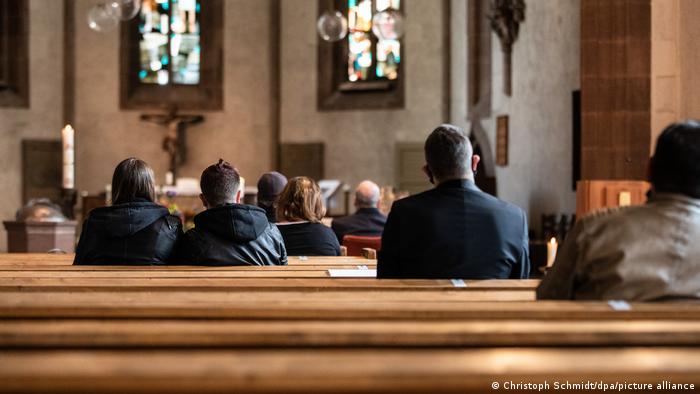
Fewer and fewer people in Germany are attending religious services


Most Germans say religion has no significance in their lives, according to a poll released Thursday — with just 33% saying it was important to them.


Only 12% said they thought religion could make the world a better place, with just a quarter saying it had any political significance.

Year after year, disillusioned congregation members have been leaving Germany's Catholic and Protestant churches in droves. The result is that only about half of all people belong to one of the country's big Christian faiths.
Eastern Germans less devout

Some 30% of respondents described themselves as "devout" or "very devout," while 35% said they were "not devout at all."

The eastern states of Germany, in particular, have a high proportion of people who describe themselves as "not at all religious," the foundation said.

Meanwhile, the regions with most people describing themselves as devout were the southern German states of Bavaria and Baden-Württemberg (35%) and western states (32%). Only about 21% of people in eastern states gave this description.

In contrast, some 61% of Germans said the religion was either "not important," or "not at all important."

Young less emphatic, more positive


Younger people were less likely to give a decisive statement about how important religion was to them.

About 15% of 18- to 29-year-olds gave no answer or said they didn't know. Only about 5% of 30- to 54-year-olds responded this way, with the figure falling to 3% among those over 55.

The survey suggested younger people were more upbeat than others in their assessment of the role of faith.

Some 16% of young people agreed with the thesis: "The religions of this world contribute to making the world more just."

That compared with about 12% of people across all age groups. Well over half disagreed, and 26% were undecided on the issues.


COVID and climate change

For most devout Germans (75%), the coronavirus pandemic has done nothing to change their faith, it was also reported.

Among younger Germans, some 12% said their faith had become stronger during the pandemic — about twice the number compared with older voters.

Only 14% of respondents see a positive role for religions in combating climate change. The age of the respondents was also dependent on age here, with the figure among under-30s as high as 20%.

The survey release coincides with a conference of the interreligious non-governmental organization "Religions for Peace" in the southern German town of Lindau.

It sees religious leaders and diplomats meet to discuss peace and security, environmental protection and humanitarian work.

The poll surveyed more than 2,000 people across all age ranges in all German states.

rc/sms (KNA, EPD, dpa)


'Yemen's Banksy': Murad Subay creates art against war in Berlin

Yemen remains the world's worst humanitarian crisis, say humanitarian organizations. At the Human Rights Film Festival in Berlin, street artist Murad Subay comments on the horrors of war.


'The Faces of War': Murad Subay working on his mural at the Berliner Union Film Ateliers

Seven black-and-white portraits line up against a red background. Huge black holes replace the figures' eyes. "Wars are one of the evil roots, turning humans into monsters, victims, and others watching and ignoring," writes artist Murad Subay in a caption next to his mural.

The Yemeni street artist has painted his latest work on the facade of one of the buildings of the Berliner Union Film Ateliers (BUFA), which serves as a film campus. Located next to the former Tempelhof Airport, the first film studios on the site were built in 1912; classics such as Marlene Dietrich's Blue Angel were partly shot there.

BUFA is also the main location of the Human Rights Film Festival Berlin, which comes to a close on September 25. Now in its fourth year, the festival's 2021 edition ran under the title "The Art of Change."

As one of these artists for change, Subay was invited to take part in a group exhibition during the festival and to create this piece.

The figures are part of his series "Faces of War," which express how "the horrors of war swallow everything," Subay told DW.
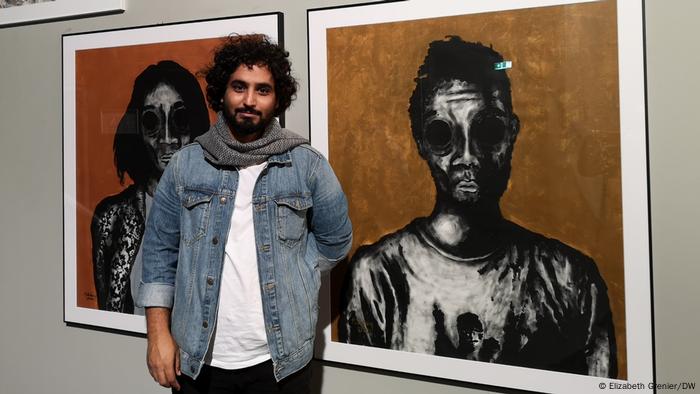

Subay's paintings are part of the group exhibition at the Human Rights Film Festival, titled 'Art of Change'

Street art as a symbol of hope

Born in 1987 in Dhamar, Yemen, Subay started painting on buildings after the Yemeni Revolution in 2011

Like many in the Arab Spring protests that erupted that year in the Middle East and North Africa, Yemeni demonstrators were initially calling for better economic conditions and reforms against corruption. 

But, within a few months, armed supporters joined the opposition, leading to heavy street fighting against the loyalist security forces in Yemen's capital, Sanaa.

The buildings scarred by missiles became Murad Subay's canvas. "I wanted to show that there is art in these places, that there's hope, that people are still fighting in a very depressing moment, when a country is deciding on its history," he explains.

Even though he's often been compared to fellow political street artist Banksy, Subay does not work alone and anonymously. He rather involves the local population in his series of artistic "campaigns," as he calls his street art projects.
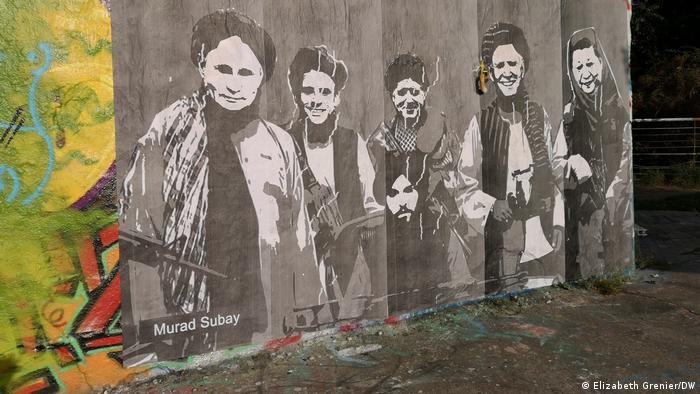

A comment on global powers and war: Subay also put up his work

 'The Supreme Council of Terrorism' in Berlin's Mauerpark

During his first campaign in 2012, called "Color the Walls of Your Street," he invited people passing by to join artists and friends to create a space of collaborative creation, allowing everyone to either pick up a paintbrush or simply meet and talk.

His goal was to ensure that "art is never far from the people," he says. "In Yemen, we don't have galleries or museums, so art has to go to the people in the street."

More campaigns followed, with the artist launching his fifth series, "Ruins," as conflict took over the country at the beginning of 2015.


This mural from 2014 depicts US, Saudi and Iranian currency banknotes as a

 comment against foreign interference in Yemen

World's worst humanitarian crisis

Yemen's ongoing multisided civil war began in late 2014, when Houthi insurgents — Shiite rebels with links to Iran and a complex history with Yemen's Sunni Muslims — took control of Sanaa. Shortly after, the rebels also seized the presidential palace, leading to the government's resignation. A coalition of Gulf states led by Saudi Arabia then got involved in the conflict.

The war's impact on the population is disastrous. "The world's worst humanitarian crisis continues to deteriorate with unprecedented levels of needs," states a press release from the Directorate-General for European Civil Protection and Humanitarian Aid Operations (DG ECHO), published on September 22.

According to the DG ECHO, there are 20.7 million people in Yemen who are in need of assistance, which amounts to 66% of the population; more than 16.1 million of them lack reliable access to food.

Human rights organizations also estimate that there are 4 million internally displaced people in the country, with more than 10,000 households having been displaced in 2021 alone because of active fighting.
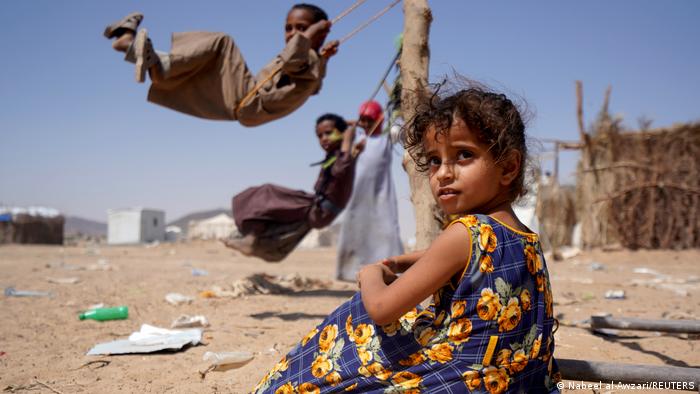

As fighting in Yemen's Marib governate forces more people to flee, shelter 

needs are soaring, says the UN Refugee Agency

Criticizing the international community

Amid the conflict, Subay had to leave Yemen. Activists and people with opinions were expected to take sides, says the artist. "But I criticized all the parties because they are all committing crimes."

One of his brothers, a journalist, was shot twice in the knees, and Murad was investigated on several occasions; he could no longer paint freely. They left for Egypt. Murad landed in Paris two years ago through the Artist Protection Fund, an international program to provide relief and safe haven to artists in danger. 
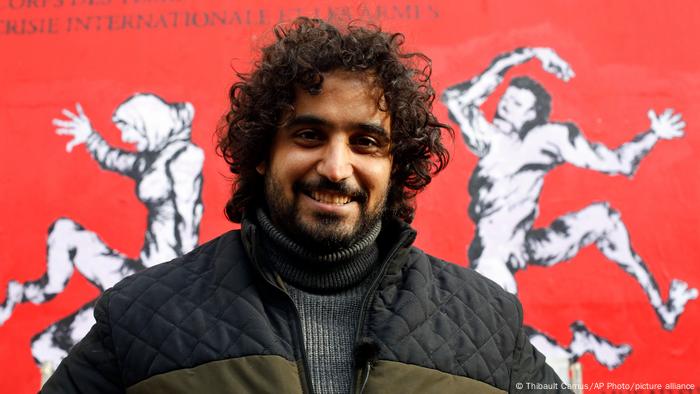

Subay in front of his street painting in Paris in November 2019

He remained active in France, creating for instance a mural denouncing the sale of  French arms to Saudi Arabia. Germany also contributes to the proxy conflict by exporting arms to countries fighting within the Saudi-led coalition.

"Unfortunately, the war is benefiting many companies in Europe," says Subay, who also deplores the silence of the international community. "The Yemenis are the ones paying the price."

Despite the bleak perspectives for his home country, the artist says that what matters most to him is to remain committed to activism: "My goal now is to focus on education," he says. "Because all evils come from ignorance."

The Spanish plantations facing drought

Europeans love Spanish produce, but monocultures damage the soil. Germans care about the climate when it comes to elections, but does their concern extend to the impact their consumption has in Spain?


UN: Climate change increases risk of violent conflict

A reliance on shrinking resources, such as water, could increase tensions on the ground, UN chief Antonio Guterres has warned. But problems could be mitigated through "climate adaptation."


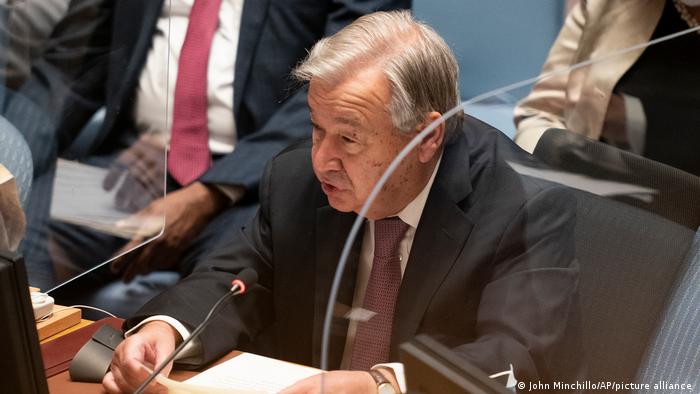
Climate change could heighten tensions on the ground in countries relying on shrinking natural resources, hiking up the risks of violent conflict, UN Secretary General Antonio Guterres warned on Thursday. 
"It is clear that climate change and environmental mismanagement are risk multipliers where coping capacities are limited," Guterres said in remarks to a high-level Security Council meeting on climate and security. 

The climate meeting convened on the sidelines of the annual gathering of world leaders at the United Nations in New York.

How do climate change and conflict overlap?

The likelihood of escalation is especially high in countries with poor coping mechanisms for the climate crisis, while being dependent on dwindling resources, such as water and arable land.

"The effects of climate change are particularly profound when they overlap with fragility and past or current conflicts," Guterres told the council. "In Somalia, more frequent and intense droughts and floods are undermining food security, increasing competition over scarce resources and exacerbating existing community tensions from which Shabab benefits."

He said 90% of refugees come from "countries that are among the most vulnerable and least able to adapt to the effects of climate change."

He urged Council members to consider peace-building efforts and climate adaptation to help mitigate the risks. 

"Climate adaptation and peace-building can and should reinforce each other," Guterres said.

UN warns: Time is running out on climate change

Guterres told the session that a recent report by UN scientists that showed dangerously intensifying levels of climate change was "a code red for humanity."

He said that at least 30 million people were displaced by climate-related disasters last year and that "no region is immune."

"Our window of opportunity to prevent the worst climate impacts is rapidly closing," he warned.

While various members of the powerful UN body have tried to tackle the issues of climate change and conflict in the past, there has so far not been enough support in the council.

UNGA

UN warns of 'human rights catastrophe' in Myanmar

UN rights chief Michelle Bachelet has called for urgent action to curb the "terrible and tragic" consequences of the conflict. 

She also cited an economic and political crisis made worse by the coronavirus pandemic.


Over 8,000 people have been detained since the February coup


United Nations High Commissioner for Human Rights Michelle Bachelet on Thursday warned of a "human rights catastrophe" in Myanmar, and called on international leaders to do more to prevent the conflict from becoming worse.

Her warning came in a new report issued by the UN Human Rights Office, detailing widespread violations made by the military, the Tatmadaw, against the people in Myanmar.


What the UN said about Myanmar


The report said Myanmar was facing a "human rights catastrophe that shows no sign of abating."

"The national consequences are terrible and tragic —the regional consequences could also be profound," Bachelet said in a statement. "The international community must redouble its efforts to restore democracy and prevent wider conflict before it is too late."

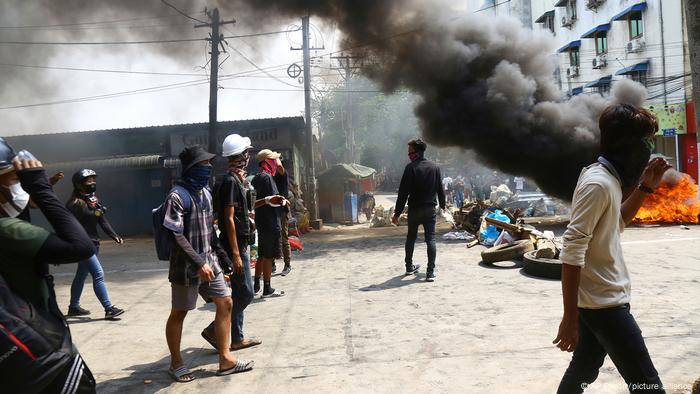
The UN scorned the use of lethal force and mass arrests of protesters since the military coup on February 1.

"Serious violations have been committed — of the rights to life, liberty and security of person, the prohibition against torture, the right to a fair trial, as well as the rights to freedom of expression and freedom of peaceful assembly," the statement said.

The UN chief also cited reports that indicate that security forces have used interrogation techniques amounting to torture, including beating detainees and depriving them of food, water and sleep.

"Military authorities have also arrested over 8,000 people, including elected officials, protesters and journalists during arrests and raids," the UN said. "At least 120 people have reportedly died in custody, and some have been denied access to medical treatment."

It also cited an increase in military activity, along with greater resistance by armed groups in the country in recent weeks. Over 800 people have been killed since the military coup, according to the Assistance Association for Political Prisoners.

"Fighting between the military and ethnic armed groups has also increased exponentially since the coup," the statement said.

Experts say that figure could be higher.


In addition to the crisis spurred by the military coup, Myanmar has also faced many challenges in managing the coronavirus pandemic.

The country has recorded more than 452,000 infections since the start of the pandemic and over 17,000 deaths. However, the real figures could be higher.
Facebook ordered to release anti-Rohingya posts for genocide case

Issued on: 24/09/2021 -
A US judge has ordered Facebook to release anti-Rohingya content shared on its platform 
OLIVIER DOULIERY AFP/File

Washington (AFP)

A US judge has ordered Facebook to release posts the social network removed over their role in inciting government-backed violence against the Rohingya people in Myanmar.

In his ruling on Wednesday, Washington DC district court Judge Zia Faruqui criticized the company for refusing to provide the records to countries pursuing a case against Myanmar in the International Court of Justice.


Facebook had resisted releasing the content on the grounds of US privacy law.

But the judge ruled that the deleted posts would not be covered under the protections for users' personal communications.


"Locking away the requested content would be throwing away the opportunity to understand how disinformation begat genocide," Faruqui wrote in his ruling, saying Facebook "taking up the mantle of privacy rights is rich with irony."


Facebook has been accused of being slow to respond to abusive posts portraying Myanmar's Rohingya Muslims in sub-human terms, helping to drum up support for a military crackdown that forced more than 740,000 members of the persecuted minority to flee the country in 2017.

In August 2018, United Nations investigators called for an international probe and prosecution of Myanmar's army chief and five other top military commanders for genocide, crimes against humanity and war crimes.

On the same day, Facebook banned the top generals from its platform.

The Gambia has taken majority-Buddhist Myanmar to the UN's top court in The Hague, accusing it of breaching the 1948 UN genocide convention.

Gambian authorities, in a statement titled "The Gambia beats Facebook," welcomed the judgement as a boost for its case against Myanmar.

Facebook said Thursday it was reviewing the judge's decision and stressed it had made voluntary disclosures to the UN Human Rights Council's Independent Investigative Mechanism for Myanmar (IIMM), which is collecting and analyzing evidence of serious international crimes in the Southeast Asian country.

"We're reviewing this decision. We remain appalled by the atrocities committed against the Rohingya people in Myanmar and support justice for international crimes," a Facebook spokesperson said in a statement.

"We've committed to disclose relevant information to authorities, and over the past year we've made voluntary, lawful disclosures to the IIMM and will continue to do so as the case against Myanmar proceeds."

burs-mtp-rma/jm/mlm

© 2021 AFP
'God Has a Dream': top seller for Tutu's 90th-birthday auction

Issued on: 23/09/2021 - 
In 'God Has a Dream', the anti-apartheid hero recounts how his spirituality guided him through his darkest times 
RODGER BOSCH AFP/File

Johannesburg (AFP)

A book authored by South African Nobel Peace Prize laureate and retired archbishop Desmond Tutu was a top seller at an auction to celebrate his 90th birthday, his representatives announced Thursday.

A signed first edition copy of Tutu's 2004 book "God Has a Dream" was part of paraphernalia auctioned to honour the anti-apartheid icon, who turns 90 on October 7.

"The leather-bound hardcover is accompanied by a certificate of authenticity, is signed by the Archbishop, and is number 525 of a small print run of 1,200," the Tutu foundation said in a statement.

In the book, Tutu recounts how his spirituality guided him through his darkest times.

The book was donated by South African filmmaker Anant Singh, who also gave a rare signed copy of the limited 1994 edition of Nelson Mandela's autobiography, "Long Walk to Freedom".

"Both books exceeded expectations at the auction," the foundation said, without divulging how much the books fetched at the auction, held Wednesday.

A painting by South African Charles Foley of Tutu's 2015 meeting with the Dalai Lama in India, inspired by the government's repeated refusal to grant the Tibetan spiritual leader a visa to visit the archbishop in Cape Town, also surpassed expectations.

Overall, the auction fetched 3.5 million rand ($237,000), which will be channelled to the Desmond & Leah Tutu Legacy Foundation.

© 2021 AFP
Ancient footprints re-write humanity's history in the Americas

Issued on: 24/09/2021 - 02:08
White Sands in New Mexico has offered up 23,000-year-old footprints that indicate humans were in North America much earlier than previously thought
 Handout NATIONAL PARK SERVICE/AFP/File

Los Angeles (AFP)

Footprints dating back 23,000 years have been discovered in the United States, suggesting humans settled North America long before the end of the last Ice Age, research published Thursday showed.

The findings push back the date at which the continent was colonized by its first inhabitants by thousands of years.

The footprints were left in mud on the banks of a long-since dried up lake, which is now part of a New Mexico desert.

Sediment filled the indentations and hardened into rock, protecting evidence of our ancient relatives, and giving scientists a detailed insight into their lives.

"Many tracks appear to be those of teenagers and children; large adult footprints are less frequent," write the authors of the study published in the American journal Science.

"One hypothesis for this is the division of labor, in which adults are involved in skilled tasks whereas 'fetching and carrying' are delegated to teenagers.

"Children accompany the teenagers, and collectively they leave a higher number of footprints."

Researchers also found tracks left by mammoths, prehistoric wolves, and even giant sloths, which appear to have been around at the same time as the humans visited the lake.

The Americas were the last continent to be reached by humanity.

For decades, the most commonly accepted theory has been that settlers came to North America from eastern Siberia across a land bridge -- the present-day Bering Strait.

From Alaska, they headed south to kinder climes.

Archaeological evidence, including spearheads used to kill mammoths, has long suggested a 13,500-year-old settlement associated with so-called Clovis culture -- named after a town in New Mexico.

This was considered the continent's first civilization, and the forerunner of groups that became known as Native Americans.

However, the notion of Clovis culture has been challenged over the past 20 years, with new discoveries that have pushed back the age of the first settlements.

Generally, even this pushed-back estimate of the age of the first settlements had not been more than 16,000 years, after the end of the so-called "last glacial maximum" -- the period when ice sheets were at their most widespread.

This episode, which lasted until about 20,000 years ago, is crucial because it is believed that with ice covering much of the northern parts of the continent, human migration from Asia into North America and beyond would have been very difficult.

© 2021 AFP
Oldest bone tools for clothesmaking found in Morocco


Issued on: 23/09/2021 - 
Archaeologists outside Morocco's Contrebandiers (Smugglers) Cave, where the oldest bone tools used to make clothing were found FADEL SENNA AFP

Rabat (AFP)

Archaeologists in Morocco have identified clothesmaking tools fashioned from bone dating back 120,000 years, the oldest ever found, one of the researchers said.

"It's a major discovery because while older bone tools have been found elsewhere, it's the first time we have identified bone tools (this old) that were used to make clothing," Moroccan archaeologist Abdeljalil El Hajraoui said.

The international team discovered more than 60 tools in Contrebandiers (Smugglers) Cave, less than 20 kilometres (12 miles) from the North African country's capital.

They had been "intentionally shaped for specific tasks that included leather and fur working", the team wrote in a study published in the journal iScience.

The discovery could help answer questions on the origins of modern human behaviour, said El Hajraoui, a researcher at the National Institute of Archaeology and Cultural Heritage (INSAP).

"Sewing is a behaviour that has lasted" since prehistory, he told AFP.

"Tools like those discovered in the cave were used for 30,000 years, which proves the emergence of collective memory."

The iScience paper predicted that "given the level of specialization of the bone tool material culture at Contrebandiers Cave, it is likely that earlier examples will be found."

Archeologists walk to enter the cave, scene of the latest significant archaeological finding in Morocco FADEL SENNA AFP

The team also discovered living spaces dug into the ground or built in the cave, as well as perforated seashells apparently used as ornaments.

"This was a cultural evolution that still needs study," El Hajraoui said.

Morocco has been the location of a number of significant archaeological findings, including on Wednesday when the country's culture ministry announced that researchers in a cave near Essaouira, about 400 kilometres southwest of Rabat, had discovered a collection of about 30 shaped marine snail shells dating back as much as 150,000 years.

In a statement, it said they were "the oldest ornaments ever discovered".

That followed an announcement in July when archaeologists revealed the discovery of North Africa's oldest Stone Age hand-axe manufacturing site, dating back 1.3 million years.

The find pushed back by hundreds of thousands of years the start date in North Africa of the Acheulian stone tool industry associated with a key human ancestor, Homo erectus, researchers on the team told journalists in Rabat.

In 2017, the discovery of five fossils at Jebel Irhoud in Morocco, estimated at 300,000 years old, overturned evolutionary science when they were designated Homo sapiens.

© 2021 AFP