Friday, December 03, 2021

“The Story of the Sikhs: 1469-1708” by Sarbpreet Singh
 
The Story of The Sikhs: 1469-1708, Sarbpreet Singh (India Viking, July 2021)

Sikhs, at least Sikh men, are conspicuous among Indians by their ever-present turbans and their less noticeable but similarly ever-present daggers. Mistaken for, and sometimes attached as Aghani Muslims after 9/11, they can also be misunderstood in their native India, mocked as dim-wits in the Sardarji jokes and, followingt the assassination of Indira Gandhi by her Sikh bodyguard, targeted by state-sponsored propaganda and violence. Sikhism itself is, to non-adherents, obscure relative to Hinduism or Buddhism.

As a result, the question whether religion is a birthright or a burden has serious social and political dimensions for the Sikh community. That it can be a means to the exploration of one’s spiritual identity as shaped by one’s ancestors finds beautiful expression in Sarbpreet Singh’s book The Story of the Sikhs: 1469-1708, based on his podcast of same name. He has produced an enchanting narrative about the origins of Sikhism in medieval India and its origins as intertwined with the presence of the Mughals, its institutions, and its message of fearlessness in the face of tyranny, intertwined with Singh’s own origins as well:

I distinctly remember my twenty-year-old self being beset by the jejune mockery of Sikhs — rampant in popular Indian culture — on the one hand, and the relentless anti-Sikh propaganda of Indian officialdom in the age of 1984 on the other! Small wonder then, that when I arrived in America in my early twenties, my connection to my faith and identity was, to put it mildly, tenuous…While this book has not been written for a specific readership, I would like to express a hope. Decades ago, as a young man seeking both my roots and a sense of identity, I started a journey that was to enrich my life immensely. I am hoping that this work will serve as an entry point for other seekers who might be in the early stages of their own journeys.

Singh movingly narrates “the story of the sikhs” as a storyteller rather than as a historian, albeit with generous references to archives from the medieval period including travellers’ accounts, the Janam Sakhis or the accounts of the lives of the saints, sacred and secular poetry and debates among scholars studying Sikh history. One major takeaway that transcends an interest in Sikhism per se is the presentation of Mughal history from the point of view of the ten Gurus of Sikhism; the Mughals and the Gurus were almost exact contemporaries. At a time when the Mughals are generally invoked in the context of animosity between the Hindus and the Muslims in South Asia, Singh provides a new lens, both beautiful and brutal, for this history.

The book opens with Guru Nanak, the first Guru and the founder of Sikhism, challenging the massacre engendered by Babur, the first Mughal Emperor, and his army at Sayyidpur, now known as Eminabad in what is today Pakistan:

Kings are hungry lions
Their servants rabid dogs
Foes of soothing restful sleep
The mindless servile cogs

The lackeys of the evil king,
Waving talone and claw
The prey on common gentlefolk;
Their tender flesh they gnaw

Babur was superstitious and didn’t want to be cursed by holy men. When he met Nanak, he received the Guru’s blessings and the prophecy that if his clan “shrinks from justice”, a blight would come upon its rule. Some Gurus paid with their lives as the prophecy of the blight began to come true.

Singh’s translations are evocative as are his narrations of different episodes from the period. Here is one that describes Mughal Emperor Akbar’s visit to the third Guru, Amar Das. Akbar walks barefoot towards the Guru:

When the Sikhs understood his intention, they hastened to lay down sheets of fine silk and velvet on the ground to ensure that the Emperor’s show of humility would be as comfortable as possible. Before the Emperor walked one of his attendants, carrying an ornate golden staff with which he periodically struck the ground. The Emperor looked at the silken sheets spread before him and then bent to move them aside with his own hands. He then started to walk barefoot on the rough path. The Emperor presented a resplendent sight in his regal attire… The mighty Emperor Akbar, before whom the entire world bowed, humbly saluted the Guru. Then, gathering his limbs about him, he sat on the ground before him. ‘Did you eat in the Langar?’ the Guru asked the Emperor. ‘Oh, what shall I eat?’ Akbar asked. ‘Today in the Langar we have unsalted porridge,’ said Guru Amar Das. ‘Then that is what I shall eat, too.’

With Akbar’s son Jahangir and great grandson Aurangzeb, the relationship between the House of Akbar and the House of Akbar, as Singh puts it, took a violent turn. With Jahangir’s execution of the Fifth Guru, Arjan Dev and Aurangzeb having the ninth Guru, Tegh Bahadur beheaded, the story in Singh’s narration acquires epic overtones. The two Mughals saw the following and the power the Gurus came to acquire as a threat to their existence. Also, they couldn’t grasp the new religion and its ethos—one can trace influences from both Hinduism and Islam—which was inclusive, challenged caste hierarchy, encouraged communal dining, fed people three times a day from a community kitchen supported by the funds from the community and run thanks to volunteer efforts, and encouraged honest labor, and sharing the fruits of that labor.

To be clear, there is a lot more than the presence of the Mughals to Singh’s story. The compilation of the holy book, the Guru Granth Sahib, and the acquisition of swords as weapons of self defence and as a means of defending the weak while refusing to bow down to tyranny find equal space in Singh’s narrative with their own interesting legends and debates.

True to the objective of writing a story that introduces seekers to the origins of their religion, Singh is at his best when discussing the metaphysics of the miracles performed by the Gurus. One story involves Nanak’s visit to Mecca—he sat with his feet towards the Kaaba. The indignant custodian of the mosque kicked Nanak’s feet away from the direction of the Kaaba. Those witnessing the scene gasped for they found the Kaaba had moved to the direction where Nanak’s feet now pointed! Nanak came to be revered by the Muslims of Mecca thanks to this “miracle” and the subsequent interactions with the Imam of Mecca. He came to be known as Nanak Pir Wali Hind, or the holy man from India. Indeed, as Sarbpreet Singh points out, a mosque dedicated to him was built about half a mile away from the Grand Mosque. Nanak left his staff and sandals behind when asked for a keepsake by the Muslims.

Early in the book, Singh talks about his rationale for including these apocryphal stories in his mega-story:

Some are wondrous tales of miracles that Nanak wrought, others are thinly disguised appropriations from Hindu mythology, and some based on historical fact documents and propagated through the generations. Nanak was, above all else, a very rational and practical man, who spent his whole life debunking ritualism and pouring scorn on superstition. It is ironic that the legacy of a man who mercilessly exposed charlatans claiming miraculous spiritual powers, now swirls with fantastic tales! … I have struggled with my approach to these stories. I have come to accept them as parables, because without doubt many of them illuminate important truths and principles.

Singh’s story about the medieval times is made more poignant by the ramifications it has for the present. The Rababis, the descendants of the earliest professional musicians who would sing of the Almighty for and with the Gurus, were Muslims. With the 1947 Partition, they left for Pakistan where their art died. Singh also refers to the act of kindness shown by Nawab Sher Muhammad Khan in attempting to stop Aurangzeb from killing Guru Gobind Singh’s sons. While Khan was ignored at that time, his:

… moment of honour and compassion was to pay great dividends, generations later. There is a strong belief among the residents of Malerkotla that the haa da naara or cry of protest of Nawab Sher Muhammad Khan in 1704, and Guru Gobind Singh’s subsequent blessing, was directly responsible for the peace that prevailed in teh town in 1947. It seems almost miraculous that while the rest of the Punjab was racked by the fury and bloodletting that accompanied the partition of India and Pakistan, the Muslim residents of Malerkotla emerged unscatheed, despite being hemmed in by a hostile Sikh and Hindu population.

Despite the author’s claim that it’s a story or a personal approach rather than a proper history, The Story of the Sikhs is a well-researched document and an inspiration to Sikhs as well as believers of other religions to find their own spiritual anchorings by examining their communities’ pasts and their relationships with the present times.

Soni Wadhwa lives in Mumbai.
Podcast with Timon Screech, author of “The Shogun’s Silver Telescope: God, Art, and Money in the English Quest for Japan, 1600-1625”
 
Timon Screech


An English mission to Japan arrives in 1613 with all the standard English commodities, including wool and cloth: which the English hope to trade for Japanese silver. But there’s a gift for the Shogun among them: a silver telescope.
The Shogun’s Silver Telescope: God, Art, and Money in the English Quest for Japan, 1600-1625, Timon Screech, (Oxford University Press, December 2020)

As Timon Screech explains in his latest book, The Shogun’s Silver Telescope: God, Art, and Money in the English Quest for Japan, 1600-1625, there was a lot of meaning behind that telescope. It represented an English state trying to chart its own part as a Protestant country, denoting their support for science and a more open culture in the face of a more backward Catholic Europe. Screech’s book charts the background behind this simple gift and what it meant for both Japan and England.

In this interview, Timon and I follow the English journeys to Japan, the reasons for these trips, and what the English encountered when they got there. And we’ll think about what we learn from this—ultimately failed—effort to start a trading relationship between these two islands.

Professor Timon Screech is Professor at Nichibunken or the International Research Center for Japanese Studies in Kyoto, after thirty years at SOAS. He is the author of at least a dozen books on the visual culture of the Edo period, including perhaps his best-known work Sex and the Floating World: Erotic Images in Japan, 1700-1820. His other most recent book (and previous interview subject) is Tokyo Before Tokyo: Power and Magic in the Shogun’s City of Edo. In 2019, he was elected as a Fellow of the British Academy.

Nicholas Gordon has an MPhil from Oxford in International Relations and a BA from Harvard. He is a writer, editor and occasional radio host based in Hong Kong.


The Dark Side of News Fixing: The Culture and Political Economy of Global Media in Pakistan and Afghanistan, by Syed Irfan Ashraf
 (Anthem, October 2021)

Editor 9 October 2021 Non-fiction

This book provides a local journalist’s perspective on a four-decade long regional contribution to global news production. Fixers are local journalists hired to help global media outlets in developing news stories on wars. The book shows how the fixers’ risky news pursuits made possible for global media to access distant regions and dangerous caves on Pakistan and Afghanistan borders, causing unprecedented deaths of the local reporters in the context of the US-led war on terror.

The book argues that the definition of a “fixer” emerges when local journalists are de-professionalized and their field expertise and connections are stripped away to produce a faceless, nameless, set of “eyes and ears” in service of the 24/7 media machine. The fact that we have the same news 24/7 across a range of news channels is an outcome of the simultaneous process of centralized decentralization—media conglomerates controlling news distribution and exhibition by hiring a scattering of fixers to do the groundwork of global news production. But working as a daily wager in journalism is not about risks taken or the self-exploitation endured. Rather, the role is an attack on the basics of the profession itself, the basic dignity of the journalist as an upholder of democracy. A fixer, who must be the eyes and ears of the people against forces of status quo, is reduced to a role and given as an instrument in regular journalists’ hands to be used as a resource. Challenging existing literature on the topic, the book reveals the tension between actual local reporters and the role (read fixer) they are hired to fill. The book argues that fixer as a role emerges in tandem with news practices that leads to decontextualizing local events, people and stories to fit the consumption patterns of market economy, a colonial practice resurging in contemporary capitalism.

The book holds not just the hierarchies in journalism responsible for feeding the dark underbelly of global news production, but also identifies the field inequality that produces violence against those local reporters. The issue is a quite serious challenge. Offering on-the-ground view of the situation from local perspectives, the book examines the consequences of the political economy of corporate media, and the price journalists pay for diminishing the life expectations as well as intellectual labor of journalists working as “fixers”.

The Dark Side of News Fixing: The Culture and Political Economy of Global Media in Pakistan and Afghanistan
by Syed Irfan Ashraf
Anthem Press, October 2021 (ISBN 9781839981371)
“War and Resistance in the Philippines, 1942–1944” by James Kelly Morningstar
 
Detail of poster by Manuel Rey Isip (via Wikimedia Commons)


War is messy. Guerrilla war is even messier. Most conventional histories of the Second World War’s Pacific theater detail Japan’s invasion and conquest of the Philippines in December 1941 and early 1942, and then jumping to US General Douglas MacArthur’s return in October 1944 and America’s retaking of the islands. James Kelly Morningstar’s new book War and Resistance in the Philippines, 1942-1944 fills an important historical gap by detailing the guerrilla war waged by Filipino insurgents and US soldiers who refused to surrender or avoided captivity during the Japanese occupation.

The author is a retired US army officer, decorated combat veteran, and a professor of military history at Georgetown University. His history of the guerrilla warfare in the Philippines during World War II is based mostly on archival records and memoirs, though he also makes good use of secondary sources to provide the relevant historical context. Morningstar covers the Filipino resistance and insurgency on every major island, and each chapter is divided into sections that describe the activity on those islands on specific days of the occupation.

The guerrilla war lasted more than a thousand days, involved somewhere between 260,000 and a million Filipinos organized into between 277 and one thousand guerrilla units, spread out over the huge archipelago. The guerrillas suffered over 33,000 dead during the fighting. Many more Filipinos lost their lives due to the brutality of the Japanese occupation. Manila, notes Morningstar, “suffered damage only comparable to that seen in Warsaw,” and more than 100,000 Filipino civilians were killed during the battle for the Philippine capital.

War and Resistance in the Philippines, 1942–1944, James Kelly Morningstar (Naval Institute Press, April 2021)

Some guerrilla units were led by Americans and others by Filipinos, and Morningstar brings to life these guerrilla leaders whose names are mostly lost to history: Lt Col Wendell Fertig, who led resistance efforts on Mindanao; Maj Robert Volckmann and Lt Robert Lapham, who led similar efforts on Northern Luzon; Capt James Cushing, a mining engineer who organized resistance activity on Cebu; Maj Claude Thorpe, who organized guerrilla bands in Central Luzon (and was captured and executed by the Japanese); Maj Salvadore Abcede on Negros; Capt Macario Peralta on Panay; Capt Esteban Beloncio on Mindoro; Col. Ruperto Kangleon on Leyte; Maj Charles Smith on Samar; Lt Ismael Ingenerio on Bohol; and several others.

The guerrillas used hit-and-run tactics, assassinations, and sabotage:unconventional warfare that resulted in more than 13,000 Japanese casualties. And it brought brutal reprisals against Filipino citizens and captured guerrillas—rapes, tortures, starvation, executions, all too typical of Japan’s occupation tactics during the war.

The occupation also produced Filipino collaborators, including Benigno Aquino, whose daughter-in-law Corazon Aquino later became President of the Philippines after the fall of Ferdinand Marcos in 1986. Morningstar writes that collaboration “came in shades of gray,” meaning that some collaborators were duped by Japan’s promise of independence, while others saw it as the only way to survive under the tyrannical Japanese. Some collaborators betrayed guerrillas to the Japanese, while others did not.

And sometimes rival guerrilla leaders clashed with each other, fueling mini-struggles for power. The Communist Huks, for example, fought the Japanese as well as other guerrilla forces with an eye toward establishing a revolutionary communist state after Japan’s defeat. One estimate noted by Morningstar attributes 5,000 Japanese deaths and 20,000 Filipino deaths to the Huks during the occupation.

When President Roosevelt ordered MacArthur to escape to Australia, the general reluctantly left the islands and after reaching Australia famously pledged to return to the Philippines. MacArthur and his intelligence units understood the value of guerrilla and resistance forces. As he recalled in his memoirs: “I had acquired a force behind the Japanese lines that would have a far-reaching effect on the war in the days to come.” Filipinos, he wrote, held “aloft the flaming torch of liberty.”

MacArthur’s headquarters established and maintained communications with several guerrilla groups. US submarines covertly provided supplies to resistance forces. MacArthur realized that such forces could create havoc and confusion that would assist his army when it landed to retake the Philippines. And the guerrilla forces, Morningstar notes, placed their hopes of liberation on MacArthur keeping his promise. “Filipinos asked one question: When would MacArthur return?” One American guerrilla leader recalled,

[MacArthur’s] name was like an invocation to them, a holy word that had special power and meaning. None of them doubted his promise to return, but they were anxious to learn when the invasion would come.

The invasion almost didn’t come. The US Navy suggested bypassing the Philippines and moving on to Taiwan as a stepping stone to the invasion of Japan’s home islands, and the Chiefs of Staff agreed. MacArthur at a meeting in Hawaii persuaded President Roosevelt to retake the Philippines. Morningstar believes that the fact of the Filipino resistance “proved decisive to MacArthur’s argument,” though other historians credit FDR’s political instincts (MacArthur mentioned that voters in November might turn against a president who abandoned American POWs and millions of Filipino Christians) as being the decisive factor.

When MacArthur finally returned, guerrilla forces ambushed Japanese patrols, destroyed bridges, cut communications, disabled military vehicles, and provided intelligence that helped the invasion succeed. Morningstar explains that although the guerrillas did not and could not defeat the Japanese by themselves, “they arguably denied them the fruits of victory.” A Japanese general who served in China, Singapore, Sumatra, the Dutch East Indies, and the Philippines, opined that the scope and ferocity of Filipino resistance to their Japanese occupiers exceeded that of any other territory conquered by Japan. James Kelly Morningstar’s book is a welcome recognition and tribute to the steadfastness and bravery of those Filipino patriots.


Francis P Sempa is the author of Geopolitics: From the Cold War to the 21st Century and America’s Global Role: Essays and Reviews on National Security, Geopolitics and War. His writings appear in The Diplomat, Joint Force Quarterly, the University Bookman and other publications. He is an attorney and an adjunct professor of political science at Wilkes University.
“Recollection of the Tartar Steppes and their Inhabitants” by Lucy Atkinson

Lucy Atkinson serving tea in a yurt

To appreciate Lucy Atkinson as the most intrepid of all Victorian women explorers one only has to read her discreet allusion to giving birth after 150 kms of horseback riding across a waterless steppe: “I was in expectation of a little stranger, whom I thought might arrive about the end of December or the beginning of January; expecting to return to civilisation, I had not thought of preparing anything for him, when, lo and behold, on the 4th November, at twenty minutes past four pm, he made his appearance.” No one ever maintained a stiffer upper lip.

Lucy Sherrard Finley, born in 1817, had adventure bred in her bones. From a merchant marine family, whose lives revolved around London’s docks, she had siblings emigrate to Australia; she herself found employment as a governess in Saint Petersburg; her son born on the steppe became a successful journalist in Hawaii. At the home of her employers, the well-connected Counts Muraiev, she met Thomas Witlam Atkinson, 18 years older than she, already a famous explorer and painter. After a year of diligent letter exchanging, she decided to marry him in 1848 and join him on a 5-year, 40,000 mile scientific and artistic journey across Kazakhstan and Siberia. She had never ridden a horse before.

Recollections of Tartar Steppes and Their Inhabitants, Lucy Atkinson, Nick Fielding (intro), Marianne Simpson (intro) (Signal Books, September 2021)

Thomas Atkinson came home to a lion’s welcome, invited to join various learned societies, and publishing his Travels in the Regions of the Upper and Lower Amoor and the Russian Acquisitions on the Confines of India and China to great success in 1860. He never once mentions his wife or son in the course of his narrative. The reason for this omission was especially galling to Lucy. Her husband was a bigamist. His first wife had eyes on his money, and after his untimely death in 1861, his estate. Lucy published her side of the story not out of pique at her husband’s passing over her in silence, but because she needed the money. As a result, we have one of the most lively, engaging and amusing descriptions of both Russia in the age of Nicolas I and the Kazakhs in the twilight of their independent lifestyle.

Mrs Atkinson’s book is a complement to Mr Atkinson’s. The husband describes the activities of the Kazakh herders, their hunts, their horse races, their interactions with the ever more intrusive imperial government. The wife describes how a little lamb is slaughtered, the curiosity of the Kazakh women for her elaborate toilette, and the outcomes of affairs of the heart on the steppe. It reminds one of other husband-wife ethnological teams like the Ferneas in Iraq and the Duprees in Afghanistan, though we will never know what Thomas Atkinson thought of Lucy Atkinson’s services to science.

Lucy Atkinson is condescending to the Kazakhs, but at the same time open-minded. She mocks her Kazakh minder for entreating her to sew for him a cap like the one she made for her baby son. Afterward he parades through the settlement wearing the cap. On another occasion, she cites a Muslim man of religion’s critique of Christianity, “You say God created the world in six days and on the seventh day he rested. Do you think God is a cobbler? He can create the world in an instant.” In face of this argument, which goes back to Al-Ghazali, Atkinson has no reply. Some of her interactions with the Kazakhs are very familiar to me. She asks her hosts why they do not eat the lovely wild berries along the way. “Our animals eat them and we eat the animals,” was the reply, which I heard verbatim 150 years later.

This welcome re-edition of the book issued in 1863 and again in 1972 has its strengths and weaknesses. The biographical notice of Lucy Atkinson is extremely complete, and paints an engrossing story about middle-class mettle and ambition among Victorians, who faced bankruptcy, childhood death and crushing legal fees with heroic equanimity. On the other hand, the notes to the text can be confusing. The editors don’t systematically correct Lucy’s idiomatic spelling of Russian or Kazakh words, and don’t always provide the modern names for the places she visited. Helpfully, they did change the 19th-century usage of the word “Kirghiz” to refer to the Kazakhs, or else many readers would have been confused. It’s annoying that they don’t explain Atkinson’s constant use of the word “dressing gown” as a reference to a “khalat”, or ceremonial robe. The Russians took to using the Turkish word for their informal house wear. As a result Lucy Atkinson’s proud Khazakh sultans parade around in their “dressing gowns”. Additional Russian and Kazakh cultural notes would have been useful.

Readers will enjoy Lucy Atkinson’s lively storytelling style, her arch observations on gender issues in English, Russian and Kazakh society, as well as her evocation of the natural wonders that she and her husband first brought to the world’s attention.


David Chaffetz is the author of Three Asian Divas: Women, Art and Culture in Shiraz, Delhi and Yangzhou (Abbreviated Press, November 2019). He is working on a new book about the horse in Asian history.
New Book Announcement: “Making Kin: Ecofeminist Essays from Singapore”, edited by Esther Vincent and Angelia Poon
Making Kin: Ecofeminist Essays from Singapore, Esther Vincent (ed), Angelia Poon (ed) (Ethos Books, November 2021)

Making Kin: Ecofeminist Essays from Singapore contemplates and re-centres Singapore women in the overlapping discourses of family, home, ecology and nation. For the first time, this collection of ecofeminist essays focuses on the crafts, minds, bodies and subjectivities of a diverse group of women making kin with the human and non-human world as they navigate their lives.

From ruminations on caregiving, to surreal interspecies encounters, to indigenous ways of knowing, these women writers chart a new path on the map of Singapore’s literary scene, writing urgently about gender, nature, climate change, reciprocity and other critical environmental issues.

In a climate-changed world where vital connections are lost, Making Kin is an essential collection that blurs boundaries between the personal and the political. It is a revolutionary approach towards intersectional environmentalism featuring the following voices: Andrea Yew, Angelia Poon, Ann Ang, ArunDitha, Choo Kah Ying, Constance Singam, Dawn-joy Leong, Diana Rahim, Esther Vincent, Grace Chia, Kanwaljit Soin, Matilda Gabrielpillai, nor, Nurul Fadiah Johari, Prasanthi Ram, Serina Rahman, Tania De Rozario and Tim Min Jie.

Making Kin: Ecofeminist Essays from Singapore
edited by Esther Vincent and Angelia Poon
Ethos Books, November 2021 (ISBN 9789811809279)


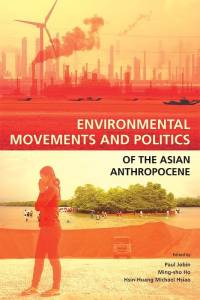
“Environmental Movements and Politics of the Asian Anthropocene”
edited by Paul Jobin, Ming-sho Ho and Hsin-Huang Michael Hsiao


Environmental Movements and Politics of the Asian Anthropocene is a collection of eleven academic essays, by multiple scholars, edited by Paul Jobin, Ming-sho Ho, and Hsin-Huang Michael Hsiao, that focus on the dynamic interplay between political systems and environmental movements in seven of the ten ASEAN regional economies, plus Taiwan and Hong Kong, over the past two decades.

The editors set the stage with an opening essay. They define the term Anthropocene as signifying the era (beginning at the time of the Industrial Revolution and continuing to the present) when anthropic (human) actions set in motion a whole host of mostly negative planetary changes, including global warming, loss of biodiversity, and the threat of mass extinction. Reprising a similar compilation published two decades earlier, the editors note this collection reveals environmental destruction on “a scale that was unknown, indeed unimaginable some twenty years ago.”

The editors also note this book addresses a gap in the literature of the Anthropocene, adding Asian voices where there previously have been few. This is in spite of the fact that, as the editors define it, Asia contains four of the top ten most vulnerable countries to climate change. These are the Philippines, Bangladesh, Pakistan and Vietnam. Asia is also the largest regional greenhouse gas emitter (at 40% of the world’s total in 2015, with 89% of that coming from China, India, and Indonesia).

Environmental Movements and Politics of the Asian Anthropocene, Paul Jobin (ed), Ming-Sho Ho (ed), Michael Hsin-Huang Hsiao (ed) (ISEAS – Yusof Ishak Institute, May 2021)

Comprised of country studies, the book resists the idea of sweeping, global solutions. It is interesting for anyone who wants to know more about the struggle for environmental justice in the regions studied, and it gives the reader a sense of the evolution or devolution of the specific political environments. Opportunities and limitations are often defined by political regimes, and Paul Jobin observes that democracy is clearly compatible with concern for the environment. The economies studied rank from freest—Taiwan—to least free—Thailand, Cambodia, and Vietnam—with Indonesia, the Philippines, Hong Kong, Singapore and Malaysia in the middle, when scored by Jobin using systems developed by Freedom House, the Economist, and V-Dem.

Environmental justice is probably harder to come by these days, as the earth’s resources become scarcer and its population swells. Perhaps not coincidentally, Taiwan is the country where environmental lawsuits have had the most success being heard, including multiple lawsuits against Formosa Plastics, a serial corporate offender. Although China is not given an essay of its own, its commercial interests extend into many of the countries studied.

Despite environmental challenges being country-specific, there are some commonalities, including editors’ observation that national governments “are likely to push unsustainable business as usual.” Indeed, the studies of Malaysia, Thailand, Indonesia, the Philippines, and Cambodia all chronicle socio-political movements that arose to combat profit-hungry government sanctioned resource extraction, such as mining, timbering, or hydro-electric damming. All too often, governments choose profits over people. As Stephan Ortmann recounts, in “Environmental Movements in Vietnam Under One Party Rule”, popular opposition was not enough to sway the government to block a deal for a controversial bauxite mine in 2009, when Chinese-owned Chinalco dangled the promise of US$15 billion in investments by 2025 for the right to open it.

One of the book’s most edifying (and bleaker) essays is James WY Wang’s “Cambodian Neopatrimonial State, Chinese Investments, and Anti-dam Movements”. Wang argues that the influence of China in Cambodia has been one of natural resource exploitation in collusion with Cambodia’s ruling elite. The single party regime under Hun Sen brooks little opposition and numerous community protests against human rights violations and destruction of livelihoods have been met with “lethal threats”. In Wang’s words, “state patronage based on land concessions and a brutal exploitation of natural resources remains the state’s largest political asset.” Wang asserts this client relationship with Cambodia has served China well, not only giving it access to resources it needs (like timber and hydroelectric power) but allowing it to buy influence inside ASEAN and military access to mainland Southeast Asia. Sweetheart deals undermine transparency and good governance, and each country turns a blind eye to the other’s human rights violations. Wang uses the example of the forced repatriation of 20 Uighurs to China from Cambodia on the eve of the signing of a US$1.2 billion soft loan accord to illustrate this point.

Most of the essays reveal varying degrees of government suppression and hostility in response to environmental demonstrations. In “State, NGOs and Villagers: How the Thai Environmental Movement Fell Silent”, Jakkrit Sangkhamanee describes how Thai NGOs “have become a group of organizations that strengthened and allied with the government in exchange for their own survival without contemplating the future of Thai society.” In “The Post-politics of Environmental Engagement in Singapore”, Harvey Neo argues that environmental movements have been “co-opted, discredited … or ignored” in what he characterizes as “neo-liberal” Singapore, where the government derives legitimacy from continued economic progress and development.

Other essays, including “Environmental Activism in Malaysia”, by Fadzilah Majid Cooke and Andnan A Hezri, and “Environmental NGOs in “Post-New Order” Indonesia” by Suharko Suharko explore the idea that, in addition to being a way for indigenous peoples to react to loss of land rights, environmentalism has been a vehicle for democratization and state accountability. James K Wong and Alvin Y So’s “Environmental Movements in Post-handover Hong Kong” has passed its “sell by” date. Sadly, their argument that “radical environmentalism”, by linking arms with Hong Kong’s pro-democracy movement, can affect structural and institutional change, has, at least for the near term, been the wrong strategy.

Jill Baker 9 October 2021 Non-Fiction
Jill Baker is an Adjunct Fellow at the Asia Business Council in Hong Kong and a contributor to Forbes.com.

“Shop Cats” of Hong Kong & China by Marcel Heijnen
 
Shop Cats of Hong Kong & Shop Cats of China, Marcel Heijnen
 (Thames & Hudson, April & September 2021)

Dutch photographer Marcel Heijnen lived in Hong Kong in the 1990s and left for Singapore around the Handover. When he returned in 2015, he was happy to see that some parts of the territory hadn’t changed much. Sai Ying Pun (“Western”), the area where he moved, still enjoyed small mom and pop shops, many of which housed a resident cat or two. Heijnen captured dozens of cats in the vibrant photos that make up Shop Cats of Hong Kong. A second book, Shop Cats of China, is the result of travels to ten cities in the Mainland.

In both books, many photos are accompanied by haiku by Ian Row, while Catharine Nicol provides historical background, which include such details as the different myths behind the absence of a cat in the Chinese zodiac and that cats were revered in Egypt and domesticated there around 940 BC.


The photos in both books feature crowded shops, many selling dry goods, including rice, noodles, and apothecary items. In an early photo in the Hong Kong book, an older man is sprawled over a folding chair, his arms and legs stretched out as he sleeps. He’s wearing a plain white t-shirt and dark work pants. On the floor next to him is a matching cat—white with black ears—resting with his head on the floor, peeking behind wrapped parcels of what seems to be dried pig bladder or fish maw. The accommodating haiku appropriately reads:

Too hot, too humid
Too hard to do anything
Too lazy to lunch

Also interspersed throughout the books are several profiles of shop cats. One in the Hong Kong book is Ah Dai, or Number One, a hefty white cat with spots of brown stripes splashed across his back and head. He works at a rice shop, sometimes guarding the front door, other times resting on top of more than a dozen large white rice bags piled up almost to the ceiling. In another photo, Ah Dai stretches as if just waking up while the human owner reclines in another folding chair, feet propped up on a little stool.

But not every human is sleeping in the Hong Kong book. In one, a man stands on his toes atop a wooden stool while his wife stands by. The cat in this dry goods shop is difficult to spot as it blends in with the items in the store. Other photos present similar issues: the cats are often difficult to spot as they camouflage into their surroundings.

As Catharine Nicol writes in the introduction of the Hong Kong book, shop owners like cats on their premises because they keep mice (and rats) away. Some owners have adopted cats, while some cats just showed up and stayed. The cats all seem to be well fed; some are even a little overweight. For one cat perched just in front of a shop’s entrance, Row writes:


Where did my youth go?
I once had style, grace and form
Now I’ve just got form


Heijnen explains in the introduction of the China book that he wondered if cities on the mainland also enjoyed the same shop cat phenomenon as in Hong Kong. He traveled first to Guangzhou and was pleased to see shop cats there. Over four years he went on to travel to nine more cities in China, “some with more shop cats than others”, although the photos don’t indicate which city is which. But the Hong Kong book also doesn’t show which shop is in Sai Ying Pun and which is in Sheung Wan or other districts; Heijnen evidently prefers to focus on the cats and the aura of the shops, rather than their physical locations.

Both books show shops that have yet to be destroyed by mass development and gentrification. Through his carefully curated photos, Heijnen records these traditional ways of life that have remained constant over the years. Should these cities be bulldozed in the name of progress, the shops will be gone and the owners and employees may need to seek other forms of employment. The cats will move on, but to where?

Susan Blumberg-Kason is the author of Good Chinese Wife: A Love Affair with China Gone Wrong.

“The Struggle for India’s Soul: Nationalism and the Fate of Democracy” by Shashi Tharoor


Shashi Tharoor

The Struggle for India’s Soul: Nationalism and the Fate of Democracy, Shashi Tharoor (Hurst, September 2021)

Since the 2014 election of the Bharatiya Janata Party (BJP), Hindu nationalists have dominated India’s political arena. What does this mean for those, like Congress MP Shashi Tharoor, who have a different idea of India? Tharoor’s vision of India as a pluralistic, secular society contrasts vividly with the ethno-religious nationalist state promulgated by the BJP. The clash between these two competing visions of India is the topic for his latest book.

The first part of the book outlines nationalism in general, with Tharoor discussing theories of nationalism, nationalist issues in Europe, Africa and elsewhere in Asia, debates around citizenship and making a case for civic nationalism. Then he turns his gaze to India itself. Tharoor expounds on the idea of India being a “magnificent experiment in pulling a vast, multi-lingual, multi-ethnic population out of poverty and misery through democracy and pluralism”. He details the pan-Indian affinity that Ambedkar, Tagore, and Nehru held at the birth of Indian independence and opines how India’s sheer breadth of diversity should make nativism and Hindutva not just unappealing but unworkable.

Yet his calls for a positive sense of pluralistic nationalism are not shared by the BJP. In great detail he outlines how an early civic nationalism has deteriorated from a shared force of liberation against colonialism to a bitter and divisive Hindu movement. The BJP and Hindutva he argues, threaten the very idea of a multicultural India and has created an “ongoing struggle for Indians soul”. Tharoor then offers a line-by-line dismissal of the BJP’s brand of manufactured Hindu nationalism countering the anachronistic myths and fabrications it has disseminated to its supporters. From the Babri Masjid, attacks on Muslims and beef eaters, revoking the special status of Indian-administered Jammu and Kashmir and whipping up fervor at any perceived anti-nationalist activity, the book provides a comprehensive description of the political and social implications of Narendra Modi’s rule and attempts to recast Indian identity as a Hindu identity.

This is not a new topic for Tharoor. Throughout the book there are repeated references to his discussions of such issues in greater detail in his previous books on Modi, Nehru, the British Empire, Hinduism and Indian history. At times all these references can make the book feel more a compendium of his previous writings. This isn’t necessarily a bad thing for those new to his work, but readers familiar with Tharoor may find little fresh insight here. Moreover, while his arguments are meticulously referenced, at times the weight of the litany of citations, quotations and references bogs down the prose. Perhaps the weight of references, and his occasional unnecessary rhetorical flourishes are to be expected with a sesquipedalian like Tharoor.

Tharoor has nevertheless succeeded in providing a useful summary of the arguments surrounding contemporary Indian identity, why these debates have become so contentious and a dire warning of how much further things could deteriorate.


Maximillian Morch is a researcher and author, formerly based in Yangon and Kathmandu, focused on regional refugee and migratory issues.
 Maximillian Morch 6 November 2021  Non-Fiction

Books, Arts & Culture (asianreviewofbooks.com)

New Book Announcement: “Frances Ya-Chu Cowhig’s China Trilogy: Three Parables of Global Capital”

Frances Ya-Chu Cowhig’s China Trilogy: Three Parables of Global Capital ( Methuen Drama, September 2021)
Frances Ya-Chu Cowhig’s China Trilogy: Three Parables of Global Capital ( Methuen Drama, September 2021)


Poetic and devastating, sensuous and politically acute, Frances Ya-Chu Cowhig’s China Plays explore the forces of global capital as they explode within the lives of everyday people in contemporary China.


This volume collects together the three plays in the series: Cowhig’s exploration of the human cost of development in China’s socialist market economy (The World of Extreme Happiness); of justice and revenge amidst ecological and economic catastrophe (Snow in Midsummer); and the tale of the trade in blood that brought the AIDS crisis to rural China (The King of Hell’s Palace).

In addition to Cowhig’s plays, the volume contains an editorial preface and essays responding to each play by the editor, Joshua Chambers-Letson; a new introduction by scholar and dramaturg Christine Mok that explores key themes in Cowhig’s work; and a discussion between Cowhig, Chambers-Letson, and Mok, on Cowhig’s process and the political and aesthetic currents animating her work.


Frances Ya-Chu Cowhig’s China Trilogy: Three Parables of Global Capital
Methuen Drama, September 2021 (ISBN 9781350234376)

Podcast with Thane Gustafson, author of “Klimat: Russia in the Age of Climate Change”


Nicholas Gordon 2 December 2021 Podcast

With COP26 and high fossil fuel prices, energy is back in the headlines. And Russia, as one of the world’s largest producers of hydrocarbons, is part of the conversation—most recently, in Putin’s refusal to expand oil production to ease global prices.

The world is coming up on three major transitions—peak use of fossil fuels, renewables competing with non-renewables, and a warming climate likely to surpass the 1.5 degree threshold set by the IPCC. What do those trends mean for Russia: a great power, a major oil and gas producer, an Arctic country covered in permafrost, and an economy with strong, but increasingly outdated, levels of technological development.
Klimat: Russia in the Age of Climate Change, Thane Gustafson (Harvard University Press, October 2021)

Thane Gustafson’s Klimat: Russia in the Age of Climate Change examines how Russia might react—or be forced to react—to a changing environment and energy market. We’re joined in this interview by Yvonne Lau, Asia Markets Reporter for Fortune Magazine, with a longtime interest in Russia, especially its post-Soviet economic development and its growing ties with China. In this interview, Thane, Yvonne and I talk about how Russia will have to change as the world warms. As the world shifts to renewables, will Russia be able to keep up? As Arctic ice melts, will Russia see shipping opportunities? And will climate change get greater salience among the Russian public?

Thane Gustafson is Professor of Government at Georgetown University. A widely recognized authority on Russian political economy and formerly a professor at Harvard University, he is the author of many books, notably The Bridge: Natural Gas in a Redivided Europe (Harvard University Press, 2020) and Wheel of Fortune: The Battle for Oil and Power in Russia (Harvard University Press, 2017), as well as Russia 2010: And What It Means for the World (Vintage, 1995), coauthored with Daniel Yergin.

Yvonne Lau can be followed at @yvonneylau.

Nicholas Gordon has an MPhil from Oxford in International Relations and a BA from Harvard. He is a writer, editor and occasional radio host based in Hong Kong.


“Klimat: Russia in the Age of Climate Change” by Thane Gustafson
Klimat: Russia in the Age of Climate Change, Thane Gustafson 
(Harvard University Press, October 2021)


Peter Gordon 9 November 2021 Non-Fiction

One doubts COP26 made much of an impression on Georgetown University’s Thane Gustafson; his recent book Klimat: Russia in the Age of Climate Change doesn’t even entertain the possibility that climate change can be stopped, to say nothing of being reversed.


Climate change … challenges the very foundation of the economic growth model on which the stability of our political and social systems depends … Not surprisingly, the effect is to divide us, not unite us… climate change is the ultimate collective action problem. The benefits of limiting greenhouse gas emissions accrue globally, but the costs are borne by individual countries and communities…The temptation to “free ride” will be irresistible.

By 2050, he reckons that
The world will have warmed, not by the 1.5 or 2 degrees Celsius that it has risen since the beginning of the Industrial Revolution, but perhaps by 3 to 5 degrees, particularly at earth’s northern latitudes…

This is not an optimistic book.

Gustafson’s purpose however is to examine how the expected changes will affect Russia, a country which is his speciality and one of geopolitical importance but which more broadly offers a case study in how, at the level of a single country and its policies, climate change is likely to play out over the next several decades. Russia has the advantage that it is far enough away to be able to be viewed relatively dispassionately and with an economy relatively simple enough that the analysis is not hopelessly complicated.

Klimat is admirably clinical: Gustafson goes through the country industry by industry and issue by issue. Some of the points are relatively obvious: Russia will not have much of a “rising sea levels” problem since its main population centers are, on the whole, well away from the coasts. Russia’s problems will lie—and already do—elsewhere. Although rising temperatures may help agriculture in the north, they are likely to harm grain production in the south, and the Russian soils are progressively worse the farther north one goes. No mangoes from Moscow, then. And while the rest of the world worries that melting permafrost will release methane, the main problem in Russia is that the infrastructure is collapsing as a result and will be increasingly difficult and expensive to maintain and replace.

But the main threat to Russia comes from a less than obvious source. Gustafson predicts that peak demand for fossil fuels may arrive somewhat later than some expect (or hope), but by the early 2030s … as the energy transition takes hold worldwide, Russia’s export revenues from oil, gas, and coal will decline sharply.

For the climate, this will be too little, too late, but (ironically perhaps) the bottom will drop out of the fossil fuel market well before mid-century. Climate change may bring Russia some economic benefits—increased opportunity for nuclear power exports, the opening of an Arctic sea route between East Asia and Europe, possible agricultural exports if it manages its cropland properly, opportunities in gas-derived chemicals—but these will not compensate for losses in Russia’s traditional energy exports. Other ironies abound: Russia has the technical nous to compete in zero-carbon energy, but the collapse in export demand for energy will keep Russian domestic prices low, thus largely denying Russian technologists a local market.

Gustafson predicts Russia’s exports will plummet to US$232 billion in 2050 from US$424.6 billion in 2019. Russia is between a rock and a hard place, like much of the rest of the world perhaps, but Russia has less policy scope than the US, say, to cope and mitigate the environmental and economic effects of climate change.

While matter-of-fact, Klimat is very readable, and hardly denser than most newspaper commentary. Gustafson will trot out telling anecdotes, such this one:

In the winter of 2018, local residents of Kemerovo, the capital city of the Kuzbass coal region, rejoiced as fresh snow blanketed the soot and ash that normally cover it. Or so it seemed. But when they went out to make snowballs, they discovered that the “snow” was actually white paint that had been sprayed over the black sludge. The mayor of the city denied that he had ordered the whitewash, and some lower-ranking officials were reprimanded. The next snowfall was black, as usual …

… as well interesting factoids, such as the fact that despite Arctic depopulation, the Siberian city of

Yakutsk is booming. From 186,000 inhabitants in the last Soviet census in 1989, the city’s population had nearly doubled to 338,000 by 2018. The explanation is the flip side of the depopulation of the Arctic inland: a steady exodus is under way from the desolate countryside, as ethnic Sakha flock to the city. The good news is that this has made Yakutsk, in the words of two leading ethnographers, “into a genuine Indigenous regional capital, the only one of its kind in the Russian North.”

Gustafson includes considerable discussion about Russia’s own pivot to Asia and Asia’s and, in particular, China’s role not just as market but as competitor. The picture is mixed, but again, the conclusion is that China has, on the whole, a greater range of policy options that Russia has.

Klimat skips the argument about what should be done about climate change when, but rather focuses on what the effects will be when it inevitably hits harder than it already has, what the resulting policy options will be and what might impede them—in Russia. It is a methodology that could be usefully applied to other, perhaps more complicated, economies and countries.

Peter Gordon is editor of the Asian Review of Books.