Thursday, December 23, 2021

Japan to unveil record $943 billion budget to ensure post-Covid recovery, draft shows

PUBLISHED WED, DEC 22 2021

KEY POINTS

Japan’s government is set to unveil its largest annual budget on Friday with $943 billion in spending for the fiscal year beginning next April, a draft plan seen by Reuters showed.

The first annual budget to be compiled by Prime Minister Fumio Kishida’s government got a boost from Covid-19 countermeasures, social security spending to support a fast-ageing population

Policymakers globally are unwinding crisis-mode stimulus but Japan’s fragile economic recovery has kept it from following suit, straining public debt that tops twice the size of its economy.
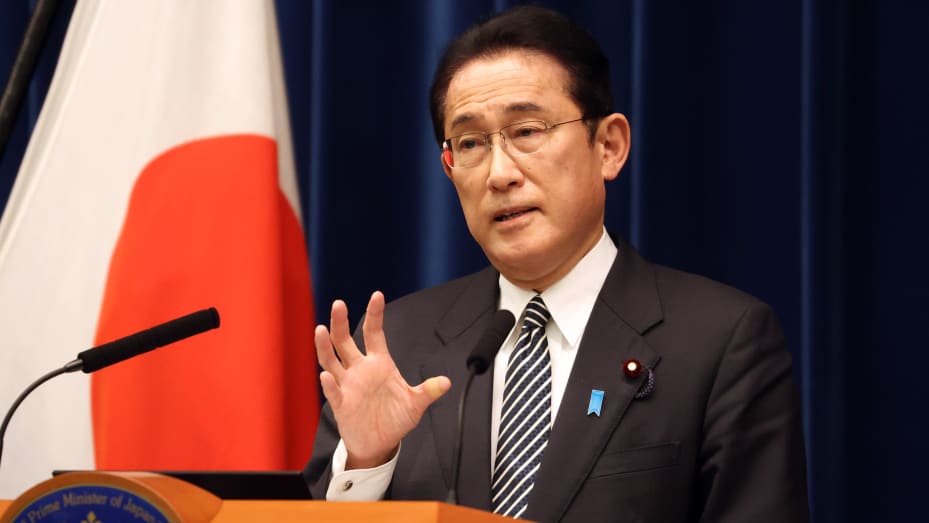


Japanese Prime Minister Fumio Kishida speaks to press members at Prime Minister’s official residence in Tokyo, Japan after a session on December 21, 2021.
Yoshikazu Tsuno | Anadolu Agency | Getty Images

Japan’s government is set to unveil its largest annual budget on Friday with $943 billion in spending for the fiscal year beginning next April, further straining the industrial world’s heaviest debt, a draft plan seen by Reuters showed.

The first annual budget to be compiled by Prime Minister Fumio Kishida’s government got a boost from Covid-19 countermeasures, social security spending to support a fast-ageing population and military outlays to deal with threats from China.

The 107.6 trillion yen ($943 billion) annual budget underscores the challenge for Kishida to realize “new capitalism” with a cycle of growth and wealth distribution and restore tattered public finances.

It would mark a 1% rise from this year’s initial level, rising 10 years in a row.

From Europe to America, policymakers globally are unwinding crisis-mode stimulus but Japan’s fragile economic recovery has kept it from following suit, straining public debt that tops twice the size of its economy.

In a show of will to improve public finances, Kishida’s government will likely trim new borrowing next fiscal year to 36.93 trillion yen from an initially planned 43.6 trillion yen for this year, the draft showed.

Excluding mandatory expenditure such as education and public works, Japan’s budget has been stretched, leaving little room for spending in growth areas like green and digital transformation.

The spending plan needs be approved by parliament by this fiscal year-end next March.

It will be rolled out along with the first extra budget for this fiscal year as a combined 16-month budget aimed for seamless spending to secure post-Covid recovery.

Japan’s economy, the world’s third largest, contracted an annualized 3.6% in the July-September quarter following a resurgence of Covid-19 cases, putting a drag on private consumption that makes up more than half of the economy.

In a glimmer of hope, tax revenue is expected to grow by 7.79 trillion yen from this year’s initial estimate to reach a record 65.24 trillion yen, the draft showed, in a sign of rising corporate profit and household income.
Japan Photo Journal: Capybaras soak in 'pomelo bath' during winter solstice

December 23, 2021 (Mainichi Japan)


(Mainichi/Noriko Tokuno)
Capybaras soak in a hot tub with pomelos and mandarin oranges at Nagasaki Bio Park in the city of Saikai, Nagasaki Prefecture, in southwestern Japan in accordance with winter solstice, which fell on Dec. 22, as seen in this recent photo. The event was held as part of the "Capybaras' open-air bath," which has become one of the park's winter traditions. Yuzu citrus fruit is normally used in special baths during winter solstice, but citrus including pomelos and mandarin oranges -- specialties of the area -- were used for this event. Visitors enthusiastically watched as capybaras surrounded by huge pomelos closed their eyes and relaxed in the tub. The "pomelo bath" event will be held until Dec. 26, and the open-air bath will be held from noon to 3 p.m. until the end of February 2022.
(Japanese original by Noriko Tokuno, Kyushu Photo Department)


1st life-size Gundam statue in west Japan unveiled to media during construction

Work to install a life-size RX-93ff Nu Gundam statue is revealed to the media in Fukuoka's Hakata Ward on Dec. 22, 2021. (Mainichi/Yoshiyuki Hirakawa)


FUKUOKA -- The first life-size "Mobile Suit Gundam" statue in west Japan, which is currently under construction and will become the symbol of a park themed on the popular anime series, was unveiled to the media and affiliated people on Dec. 22 in this southwest Japan city.

    The standing figure is under construction at the site of the LaLaport Fukuoka shopping mall to open in April 2022 in Fukuoka's Hakata Ward. Gundam Park Fukuoka will let fans experience the world of Gundam.

    The roughly 24.8-meter-tall, 80-metric-ton-heavy statue is the new RX-93ff Nu Gundam based on the mobile suit model controlled by protagonist Amuro Ray in the "Mobile Suit Gundam: Char's Counterattack" movie. The figure is supervised by Yoshiyuki Tomino, the general director of the anime series, and characterized by features including the colors red, blue and white used to convey his wish for peace.

    On Dec. 22, work to install the robot's head began just after noon using a crane. When it was installed about 10 minutes later, people watching over the work applauded. Final adjustments will be made under cover until the shopping mall's opening, so the work in progress was revealed only on Dec. 22. The completion of the statue's construction is aimed at the end of February.

    (Japanese original by Norihisa Ueda, Kyushu Business News Department)

    Friction between humans, crows declines amid pandemic in Japan

    This combined photo shows a garbage pickup point in June 2018, top, and in June 2021, during the coronavirus pandemic, in Sapporo's Chuo Ward. It seems the number of crows decreased in 2021 because restaurants were asked to close, resulting in less garbage. (Mainichi/Taichi Kaizuka)

    SAPPORO -- The relationship between crows and humans in Japan's cities has long been a contentious one. For one, it is not uncommon to see the contents of garbage bags strewn across sidewalks on pickup days after the big black birds have had at them, looking for food. But crow-human friction has decreased during the coronavirus pandemic, possibly because people are paying less attention to the birds, one expert says.

      One early morning in June, when restaurants were temporarily closed and serving alcohol was banned as countermeasures against viral spread, I took photos in the Susukino downtown area of Sapporo, Hokkaido's prefectural capital.

      I then compared these to photos I had taken at the same time of day on the same day of the week, and at the same locations in June three years earlier, and there seemed to be far fewer crows in the newer snaps. Three years ago, crows would swoop down onto garbage pickup spots even before the bags could be covered with the nets there to keep the animals at bay. But this year, there were scant few of the birds.

      However, "The crow population has not decreased," said Makiko Nakamura, 56, head of the nonprofit organization Sapporo Crow Research Group, which has been conducting research on crows mainly in Sapporo. She added, "Garbage is no more than a snack for crows. They get their staple foods from natural fields."

      So, has nothing changed during the pandemic? Nakamura said that there has been one change: the number of inquiries the group gets during crows' breeding season, from around April to July. Because crows are very wary during this period, Nakamura said the research group typically gets more inquiries about how to deal with the birds' aggression as well as about chicks falling out of nests. But consultations decreased drastically this year.

      But surveys at annual problem spots revealed no changes, such as in breeding numbers.

      "Humans may have become less conscious of crows, while their awareness of the coronavirus rose," Nakamura said. "The best countermeasure against crows during breeding season is to ignore them. The friction between people and crows may have declined because people are naturally ignoring them."

      Will conflict rise again when the infection situation settles down? We will have to see.

      (Japanese original by Taichi Kaizuka, Hokkaido Photo Group)


      Studies confirm soil from Ryugu contains organic substances

      By SHIORI OGAWA/ Staff Writer

      December 21, 2021 

      Photo/Illutration 

      Soil from the asteroid Ryugu brought back by the Hayabusa 2 space probe (Provided by the Japan Aerospace Exploration Agency)


      Soil samples collected from the asteroid Ryugu by Japan's Hayabusa 2 space probe contain organic substances, a discovery that will likely provide clues to the origin of life on Earth, according to researchers' preliminary analysis. 


      “We were able to prove that Ryugu retains the building blocks of the solar system,” said Toru Yada, an associate senior researcher at the Japan Aerospace Exploration Agency.


      Yada and other researchers published two research papers in the science journal Nature Astronomy on Dec. 20.


      It is the first time that the preliminary results of an analysis of the soil samples, which were returned to Earth last December, have been published.


      The researchers used an optical microscope to examine the soil samples collected from and below the surface of Ryugu. They captured the wavelength that indicates the existence of hydrocarbons, a constituent of organic substances.


      The samples also contain hydroxyl (OH) and carbonates, which the researchers say prove that Ryugu’s parent body contained water.


      The researchers also confirmed that the samples are black and fragile. They said the finding almost matches what they can see in images taken from above Ryugu by Hayabusa 2 and that the samples represent the general nature of the asteroid.


      “We are rejoicing at discovering new characteristics (of the soil) every time we identify them,” said Seiji Sugita, a professor of planetary science at the University of Tokyo, who also participated in the studies. “We’ll conduct further analysis to determine what kind of organic substances the samples have.”


      One of the papers is available at: (https://doi.org/10.1038/s41550-021-01550-6). The other is at: (https://doi.org/10.1038/s41550-021-01549-z).

      Myanmar fighting forces 4,200 people to flee into Thailand

      THE ASSOCIATED PRESS

      December 23, 2021 

      Photo/Illutration 

      In this photo provided by Thailand’s Ministry of Defense taken during the third week of Dec. 2021, Myanmar villagers rest in an evacuation area in Thailand after fleeing clashes between Myanmar troops and an ethnic Karen rebel group in Mae Sot, Tak province, northern Thailand. (Thailand Ministry of Defense via AP)


      BANGKOK--Fighting between Myanmar government forces and ethnic guerrillas has sent about 4,200 villagers fleeing across the border into Thailand over the past week, a Thai army officer said Wednesday.


      That number includes more than 2,500 who fled into Thailand on Friday from territory held by the ethic Karen minority. A similar wave took place in April, when several thousand villagers from Myanmar’s eastern state of Karen fled following airstrikes by the Myanmar government.


      Usually when such incidents occur, the villagers are allowed to stay in Thailand for a few days and then are returned to Myanmar.


      The Karen are one of several ethnic minorities that have been battling for decades for greater autonomy from Myanmar’s central government. Fighting between the two sides is intermittent but increased after the military seized power in February from the elected government of Aung San Suu Kyi.


      Thai Defense Ministry spokesperson Gen. Kongcheep Tantravanich said a total of 4,216 villagers crossed the Moei River into Thailand from Dec. 16 to Dec. 21 because of skirmishes between the Myanmar government and ethnic Karen forces. Of that number, 861 have returned and 3,355 are being sheltered in Mae Sot district in the western border province of Tak, he said. The Moei River marks the border between the two countries.


      The area where they are sheltered has been sealed as a precaution against the spread of COVID-19, and all those who fled are being tested for the virus, he said.


      The Thai army has warned Myanmar that it will retaliate if stray artillery shells land on Thai soil.


      Fighting on the Myanmar side of the river abated during the rainy season, but with the rains now mostly over, it is expected to resume in Karen territory as well as in areas controlled by other ethnic rebel groups.


      The most recent clashes were triggered by a raid last week by government soldiers on the town of Lay Kay Kaw, which is in territory under the de facto control of the Karen National Union, or KNU, the civil authority for the area.


      Independent Myanmar media reported that government troops seized 30-60 people associated with the organized opposition to the military government, including at least one elected lawmaker from Suu Kyi’s National League for Democracy party. The KNU has allowed opponents of the military-installed government to take refuge in its territory.

      The Karen, along with other ethnic minority groups, have a loose alliance with the army’s foes, who have established an alternative administration, the National Unity Government, and its armed wing, the People’s Defense Force, which is a conglomeration of lightly armed local self-defense groups.


      Jack Rosen: The dangerous, numbing blitz of Nazi comparisons


      JACK ROSEN
      DEC 22, 2021

      Sadly, when a FOX News host compares a respected epidemiologist to the notorious Nazi doctor Josef Mengele, we have not stooped to a new low. Our political discourse has been debased for some time. Over the course of the COVID pandemic we have seen yellow stars— used to identify Jews in World War II, millions of whom were destined for the gas chambers — used to protest mask mandates, T-shirts of President Joe Biden defaced to give him a Hitler mustache, and the like. And that’s the problem: We are becoming inured to the casual evocation of Nazi imagery in our politics, which actually diminishes the shock value of Nazi crimes against humanity, making the probability of their ideas and actions more likely to return.

      The Holocaust was a singular episode in human history. Never before had the extermination of a people, fueled by a radical racist political ideology, been executed on such a scale of cruelty and barbarism. However, the stain of the Holocaust is eternal, its depiction in history books and museums a perpetual reminder not only of the historic persecution of the Jewish people but of the potential for bottomless evil and as a clarion call to vigilance.

      Evoking Nazi imagery must shock. Our consciousnesses require it. Nazi symbols must jar us only to images of barbed wire and crematoriums, of shuffling skeletons and stacks of bodies. Instead, they are being used to score cheap points with viewers and to rouse the rabble against reasonable accommodations for public health.

      Lara Logan, the FOX Nation host who made the Dr. Anthony Fauci-Mengele comparison, cannot be excused for equating science-based vaccination requirements with the hideous experiments committed by Mengele on men, women and children. Indeed, if Ms. Logan needed to evoke an infamously cruel Nazi in order to make a point about vaccines, then she had no point at all.

      It is the sheer frequency and moral disparity of comments like Ms. Logan’s that pose a long-term danger that the Holocaust will become a malleable political prop rather than a towering monolith that warns of the depths of evil.

      In early July, less than a month after issuing a public apology for comparing coronavirus protections to the Holocaust, Congresswoman Marjorie Taylor Greene (R-Georgia) tweeted that Americans “don’t need (Joe Biden’s) medical brown shirts showing up at their door ordering vaccinations.”

      Rep. Greene’s Republican colleague, Rep. Lauren Boebert, compared U.S. federal COVID-19 vaccination efforts to Nazism, tweeting that Joe Biden “has deployed his Needle Nazis” to her Colorado district.

      In August, John Bennett, chairman of the Oklahoma Republican Party, posted a video online in which he compared vaccine mandates for businesses and public areas to the Nazis’ use of yellow stars to identify Jews.

      In September, Heidi Sampson, a Republican state representative in Maine, declared that “we have Josef Mengele and Joseph Goebbels being reincarnated here in the state of Maine” in reference to Gov. Janet Mills and her sister, who is an executive with MaineHealth, the state’s largest health care provider.

      Then, Kentucky Republican Rep. Thomas Massie tweeted a meme comparing COVID restrictions to the treatment of prisoners in concentration camps during the Holocaust. The meme, since deleted, showed a hand raised in a fist with a tattooed number visible on the wrist.

      Outside of COVID, Evangelical Christians have also offered Nazi analogies to describe what they see as threats to their religion. And such comparisons are not the domain of Republicans alone. Democrats, too, have invoked Nazi imagery to criticize former President Donald Trump.

      Paradoxically, the use of such Nazi imagery is itself inherently anti-Semitic. Evoking Nazis to oppose reasonable accommodations for public health demeans the experience of millions of Jews who actually suffered and perished under the Nazis. Diluting that history is a form of Holocaust denial.

      “Never forget” has long been the call of Jews and people of goodwill who understand that to avoid the repeat of last century’s atrocities we must submit ourselves to the full measure of their pain and cruelty.

      Ms. Logan and her cohorts, by equating the Holocaust with the baseless sense of victimization of their viewers and voters, diminishes the rawness and truth of the Nazis’ crimes against humanity and desensitizes Americans to the power of its lesson for future generations. Never forget? For many, the Holocaust is already forgotten.

      Jack Rosen is the president of the American Jewish Congress.

      First Published December 22, 2021


      Finally, the ‘truth’ comes out about birds


      FROM ST. LOUIS POST-DISPATCH
      DEC 22, 2021

      It turns out that birds are not real. Just check out the billboards, T-shirts, social media postings and messages on a truth van touring the country. Birds are actually government surveillance drones that recharge themselves by perching on power lines. That explains a lot. The fact that Twitter has a little bird as its symbol should tell people everything they need to know about the powerful forces at work.

      Of course, the “pro-bird” crowd will make the typical, predictable arguments about how there’s nothing to worry about, and that these are just, well … birds. But clued-in people know better. Wake up, America!

      A healthy movement is afoot across the country to inject a bit of humor into the crazed conspiracy “truther” mindset that inspired some of the insurrectionists who invaded the Capitol on Jan. 6. QAnon has finally met its match in 23-year-old Peter McIndoe, principal messenger behind the Birds Aren’t Real movement.

      This viral movement underscores how easy it is to create conspiracy theories out of something as stupid as the existence of birds. Just as Stephen Colbert stayed in character for 11 seasons as a crazed conservative in order to poke fun at crazed conservatives on his nightly Comedy Central show, Mr. McIndoe has insisted since 2017 that his movement is genuine.

      A video on his website, purportedly recorded in 1987, shows his team intensively researching to expose “the biggest crime ever perpetrated on the American people.” Since the Eisenhower administration, the U.S. government “has been committing genocide,” killing billions of birds to replace them with “sophisticated robot replicas.”

      A photo on his birdsarentreal.com website displays as evidence a photo of President John F. Kennedy with his hands on a Thanksgiving turkey with a sign hanging from its neck: “Robot bird Prototype.”

      Mr. McIndoe travels in a white van covered with messages exposing the truth about birds. There’s even a satellite dish on the van’s roof. He stood atop the van in July near the Gateway Arch to burn a St. Louis Cardinals flag in protest of the flag’s “pro-bird” message.

      Mr. McIndoe insisted in an interview on WREG-TV in Memphis that he’s not the “founder” of the movement but merely a messenger. Wearing a T-shirt that states: “Bird watching goes both ways,” he sat for a serious interview with two incredulous, unsuspecting morning show hosts. One interviewer suggested with a nervous laugh that this is “really satire” and asked what the message was with his movement. An uncomfortable silence followed. Mr. McIndoe leaned forward to state, deadpan, “Honestly, that’s kind of offensive.”

      His Memphis billboard proclaiming, “Birds Aren’t Real” in giant black letters has prompted what he says is an outpouring of support from “bird truthers.” The billboards have spread to Pittsburgh and Los Angeles.

      The truthers are everywhere. But then … so are those birds.

      This is seriously funny stuff — for a nation that badly needs to recover its sense of humor.

      St. Louis Post-Dispatch

      First Published December 22, 2021, 10:00pm


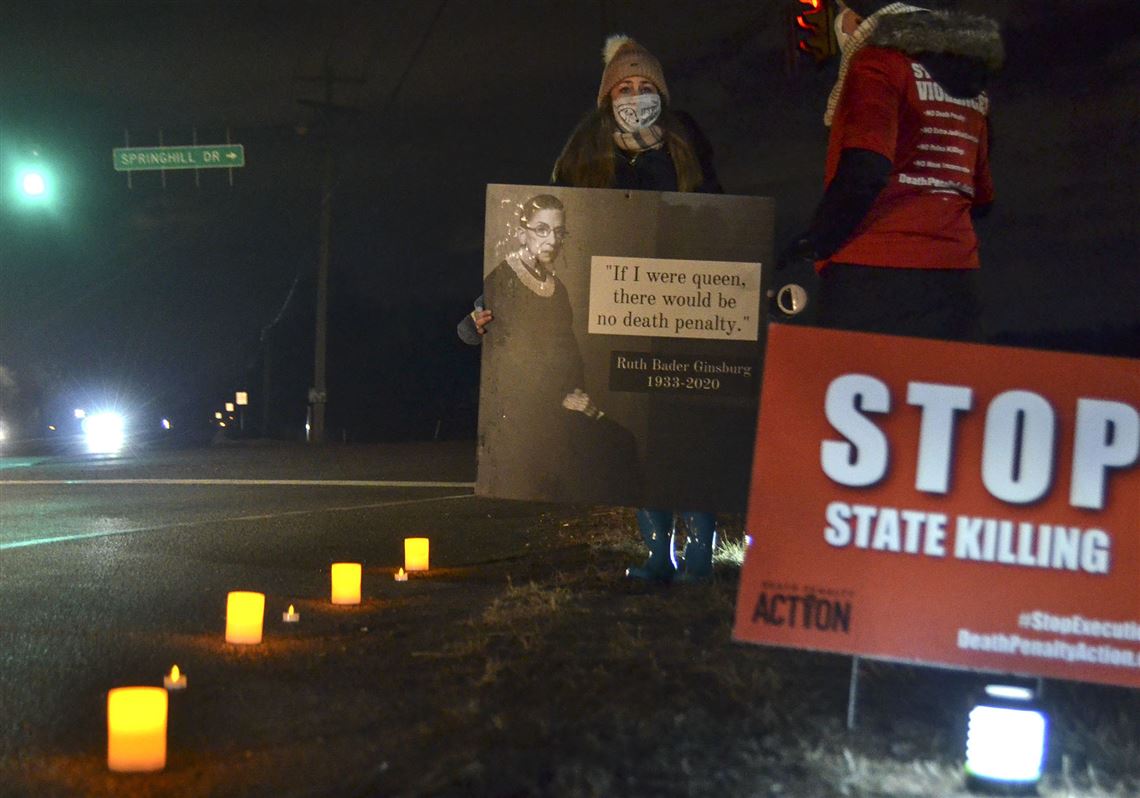
      It’s time to abolish the death penalty


      THE EDITORIAL BOARD
      Pittsburgh Post-Gazette

      DEC 22, 2021

      Quietly and without fanfare, the death penalty in the United States is dying, a trend Pennsylvania should applaud and encourage by abolishing its death penalty statute. With U.S. public support for capital punishment waning, five states and the federal government carried out 11 executions this year, the fewest nationwide since 1988.

      In the last decade, seven states have abolished capital punishment. The 27 states that still have death penalty laws use them less frequently, as local prosecutors become increasingly mindful of the enormous costs of trying and defending capital cases, and the real possibility of executing the innocent.

      Additionally, three states with death penalty laws, including Pennsylvania, have moratoriums on executions. In pausing executions, states have cited, among other things, egregious racial disparities and the failure of capital punishment to deter violent crime.

      The 11 executions in 2021, down from 17 in 2020, include three federal executions in January, part of an 11th-hour killing spree by the Trump Administration, the first federal executions in 17 years.

      Aside from a spate of 13 federal executions under President Donald Trump, a national movement to end capital punishment has grown since 1999, when executions peaked at 98.

      President Joe Biden, a former death penalty supporter, has called for ending the federal death penalty. This year, Virginia became the first Southern state, and the 23rd nationwide, to abolish capital punishment. Since 2011, Illinois, Connecticut, Maryland, New Hampshire, Delaware and Colorado also have scrapped the death penalty.

      Morally and practically, the arguments against the death penalty are compelling.

      Since 1976, when the U.S. Supreme Court reinstated capital punishment, more than 400 people have been sentenced to death in Pennsylvania, at a cost of $1 billion, former Pennsylvania Auditor General Eugene DePasquale reported in 2020. That resulted in only three executions. Another 10 death row prisoners were exonerated. Others were resentenced to mandatory life.

      Nationwide, 180 prisoners on death row were found to have been wrongly convicted.

      Prisoners spend an average of nearly 20 years on death row, as their cases wind through the appellate courts. Capital cases, often handled by taxpayer-funded public defenders, demand more expert witnesses, investigations and evaluations; they include automatic rights to appeal and require an additional defense attorney for sentencing. That’s money states could spend on victims’ services and real public safety measures.

      Despite Pennsylvania’s moratorium on executions, imposed by Gov. Tom Wolf in 2015, capital cases continue to be tried and appealed in this state.

      Pennsylvania has 115 prisoners on death row, about half of whom are Black. By contrast, African Americans make up 12 percent of the state’s population.

      No credible evidence – none – shows the death penalty deters violent crime or achieves any social good.

      When Gov. Wolf leaves office in January 2023, his moratorium on executions expires. To prevent more executions and excessive legal costs, Pennsylvania legislators should approve bipartisan bills to abolish the state’s death penalty law and move the nation closer to ending this barbaric, impractical and ineffective practice.

      First Published December 22, 2021

      MEA CULPA

      Intel apologizes for asking suppliers to avoid Xinjiang

      THE ASSOCIATED PRESS

      December 23, 2021 

      Photo/Illutration 

      The symbol for Intel appears on a screen at the Nasdaq MarketSite, in New York on Oct. 1, 2019. (AP Photo)


      BEIJING--Intel Corp. apologized Thursday for asking suppliers to avoid sourcing goods from Xinjiang after the chipmaker became the latest foreign brand to face the fury of state media regarding the region, where the ruling Communist Party is accused of widespread abuses.


      The company, in a statement on its social media account, said the reference to Xinjiang in a letter sent to suppliers was aimed at complying with U.S. regulations. Washington has barred imports of goods from Xinjiang over complaints of mass detentions of mostly Muslim minorities, forced abortions and other abuses in the northwestern region.


      State media and comments on Chinese websites criticized Intel for what Global Times, a newspaper published by the ruling party, called its “arrogant and vicious move.” Some called for a boycott of Intel products.


      The letter caused “concerns among our cherished Chinese partners, which we deeply regret,” said an Intel statement. It said the mention of Xinjiang referred to the need to comply with regulations, not a company position.


      Other companies including retailer H&M and shoe brand Nike have been targeted for criticism and calls for boycotts after expressing concern about Xinjiang or saying they would stop using materials produced there.


      Pop singer Wang Junkai, also known as Karry Wang, announced Wednesday he was pulling out of a deal to act as “brand ambassador” for Intel’s Core line of processor chips. Wang joined a series of Chinese singers, actors and other celebrities who have broke ties with foreign brands over Xinjiang, giving up millions of dollars in income to avoid retaliation by the ruling party.