Thursday, January 06, 2022


B.C.'s public sector unions set to begin bargaining


Bhinder Sajan
Published Jan. 4, 2022

VICTORIA -

The Finance Ministry says the vast majority of the 186 collective agreements in B.C.'s public sector expire in March 2022 – including those of the teachers' and nurses' unions.

A previous three-year agreement saw two per cent wage increases in each year. With inflation now far beyond that, it’s unclear what impact that will have on negotiations.

According to the province, every one per cent increase in adds almost $400 million to the operating budget. About 385,000 public sector workers are unionized employees paid under collective agreements or professionals paid through negotiated compensation agreements.

Bargaining is done through employers' associations, with the province ultimately responsible.

In a statement, the ministry added, "While negotiations under the 2022 mandate have not yet begun, bargaining is always best left to the parties at the table. Government is looking forward to sharing when there are updates on tentative and ratified agreements over the coming months."
Corning Inc. employees impacted by payroll vendor Kronos ransomware attack


by: George StockburgerPosted: Jan 5, 2022 

CORNING, N.Y. (WETM) – Kronos, a national payroll vendor contracted with Corning Incorporated, recently suffered a ransomware attack that Corning employees tell 18 News has impacted their payroll system.

After receiving several calls, emails, and messages from concerned Corning Inc. employees, 18 News reached out to the company for an update on their payroll and timekeeping systems.

A Corning Inc. spokesperson tells 18 News that the Kronos outage impacted a small portion of their employees who use the system and they are working to minimize any potential impacts that may arise until service is restored.

Corning says their ADP payroll platform continues to be fully operational, and employees are being paid as planned.

“We can confirm that Kronos, one of the third-party time and attendance tracking providers used at Corning, is experiencing an ongoing outage that has impacted many companies globally. Taking care of our people is our top priority, and we are committed to ensuring employees using the Kronos system are fairly and accurately compensated for hours worked.

In addition to their regular pay, Corning proactively took the extra step to thank our dedicated workforce who use the system with a one-time $500 cash gift they received in their last paycheck. For the upcoming pay period, we are providing a $1,000 advance of their annual bonus. Going forward, we will address any potential issues as they arise.”

CORNING INC.

A Corning Inc. spokesperson says they have also developed a support process to address employee payroll questions or concerns, as well as an interim, manual process to ensure all employees will quickly be made whole in their compensation

Kronos issued the following statement regarding the ransomware incident that was first reported in December impacting companies across the country:

We recently became aware of a ransomware incident that has disrupted the Kronos Private Cloud, which houses solutions used by a limited number of our customers. We took immediate action to investigate and mitigate the issue, and are working with leading cybersecurity experts. We recognize the seriousness of the issue and have mobilized all available resources to support our impacted customers. KRONOS

18 News will continue to monitor this story and bring updates on the system’s availability.

18 News can be contacted by emailing news@wetmtv.com

ONTARIO

Union representing cleaners at London hospital gives employer deadline to fix payroll issues

If the issue is not resolved by Friday, the union will file a grievance procedure

Cleaning staff at LHSC has not been paid in full due to a ransomware attack on the payroll system their employer Sodexo uses. (Dmitry Kalinovsky/Shutterstock)

The union representing cleaning staff at London Health Sciences Centre has given their employer, Sodexo, until Friday to resolve payroll issues that led over 50 workers to not receive full pay for nearly a month. 

Maria McFadden, business representative for Labourers International Union of North America (LiUNA) Local 1059 tells CBC News that if the error isn't fixed by then, the union will start a grievance process against Sodexo. 

A union grievance is filed when there's infractions against employees, which is the violation of a collective agreement. It includes workers being shortchanged on their wages. 

The inconsistent paycheques are due to a ransomware attack on the American-based Kronos payment software which Sodexo uses for payroll, that started about four weeks ago. 

McFadden said each worker is owed different amounts depending on the days and hours they worked. These range anywhere from $300 to 25 hours of work missing on their paystub for the recent pay period on Dec. 31. 

"That day the [Sodexo] rep got about 54 calls from different folks that hadn't been paid properly and till today's date, they still have not been paid what is owed to them," she said. 

'Nasty time of the year for this to happen'

McFadden said Sodexo notified Local 1059 of the issue right away and the union has been very understanding, but believes that enough time has passed, and this needs to be dealt with.  

"It's now been four weeks, so it's been a little while and our expectation is that Sodexo needs to get things done so that corrections can be made," she said. 

Workers make about $20 per hour on a bi-weekly basis. She is especially concerned that workers will struggle to pay the bills that are piling up from the holiday season. 

"Come January 1st people have bills to pay and rent is due, so it's a very nasty time of the year for workers to be going through this, it's a very difficult situation" she added. 

Time will tell if situation improves

McFadden highlights that the cleaners are continuing to work because they want to help out an already burdened hospital system during a pandemic.  

"It's a hospital setting so people feel they are obligated to work and want to take the best step they can and help others," she said. 

She says some workers are turning to get cash loans in order to make ends meet because they are really concerned that they haven't been paid properly. 

McFadden hopes that Sodexo will do right by their employees. "I hope they have some compassion and get this fixed, but time will tell and we'll see what happens on Friday," she said. 

CBC reached out to Sodexo and Kronos for a comment, but did not hear back at the time of publication.

‘Won’t take it any more’: South Korea’s Starbucks baristas rebel

Workers’ novel approach to labour activism holds lessons for old guard in country with a history of spirited protest.

Starbucks workers in South Korea have taken an innovative approach to labour activism [File: Kim Hong-Ji/Reuters]

By Steven Borowiec
Published On 6 Jan 2022

Seoul, South Korea – On weekday afternoons, the Starbucks in southern Seoul’s Yangjae neighbourhood swells with groups of office workers seeking after-lunch refreshments.

A line forms from the counter to the shop’s swinging glass doors as white-collar workers line up to order hot and cold drinks. Among the seasonal specials are the Lavender Beige Oat Latte topped with cornflower leaves and New Year Citrus Tea garnished with lemongrass and a slice of orange.

“We come here with colleagues after lunch because we know that everyone will be able to find something they like,” Yoon Min-ju, who works at a nearby interior design firm, told Al Jazeera.

“At smaller coffee shops, they usually only have basic coffee and tea. At Starbucks, even people who don’t like coffee or are dieting can order comfortably,” she said.

Starbucks is so popular in South Korea that it can appear like there is an outlet on nearly every block. The country is Starbucks’ fourth largest market, with 1,611 stores and almost 20,000 workers, which the company refers to as “partners”.

But despite the popularity of the brand – built on its sprawling menu, association with the American middle class and branded merchandise – the coffee giant is now facing a challenge to its image in South Korea in the form of scrutiny over working conditions at its stores. The way workers are responding could presage an evolution in labour activism in a country with a history of spirited protest.

In October, when the company held an event offering reusable cups with the purchase of a drink, baristas’ fatigue and frustrations boiled over.

On Blind, an app where employees can anonymously vent about workplace conditions, workers complained of low wages and poor conditions. Some recounted horror stories of having as many as 650 drinks on order at a time, while scrambling to pour, mix and serve an endless stream of customers while making no mistakes, smiling and maintaining friendly customer service.
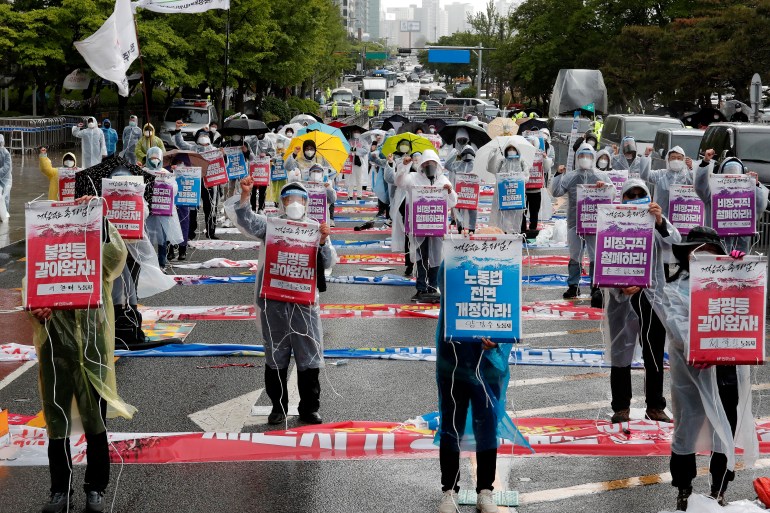
South Korea has a long history of boisterous protests by unions and labour activists 
[File: Ahn Young-joon/AP]

In December, Ryu Ho-jeong, a left-wing politician, released the results of a survey that found 613 Starbucks workers sought mental health treatment due to job stress in 2020, a more than five-fold increase compared with 2015. The survey also found that workplace accidents had tripled over the previous year.

To draw attention to their plight, workers hired a flatbed truck with a massive light-screen to drive from downtown Seoul to the busy Gangnam area in the city’s south, broadcasting their grievances to the hordes of customers that gather at Starbucks locations across the city after lunch. The screen carried text that addressed the company with messages including “‘Partners’ are your biggest asset. Don’t forget that” and “We won’t take it any more”.

The protest made national headlines, and succeeded in getting concessions from Starbucks Korea, which pledged to hire 1,600 more workers to ease conditions in their stores. The company, which entered South Korea in 1999 at a time when brewed coffee was a novelty, also promised to introduce wage increases based on seniority and performance.

While the Starbucks workers were waging their battle, the stalwarts of labour organising in South Korea took notice of how a group of young service industry workers were able to win both attention and material gains.

The Korean Confederation of Trade Unions, a major umbrella labour group that has more than one million members in industries across the country, welcomed the Starbucks workers’ actions and encouraged them to work towards establishing a union.

“Through the formation of a labour union, the workers can address their grievances,” the KCTU said in a statement.

The Starbucks protesters, most of them aged in their 20s and 30s, swiped left on the invitation to unionise, saying that instead of engaging in collective bargaining with Starbucks management, they could more effectively communicate their needs through innovative tactics like the truck protest.

In South Korea, labour unions have for decades been fixtures in shipyards and factories, but recent years have seen efforts towards unionisation at some of the country’s most innovative companies, including tech titans Kakao and Naver.
‘Militant struggle’

Yu Gyu-chang, a professor of human resource management at Hanyang University, told Al Jazeera that South Korean work culture is becoming more mindful of workers’ wellbeing.

“Social pressure has been increasing along with the voice of millennials and generation Z,” Yu said.

The increased labour organisation is coming at a time when inequality is a central topic in South Korea’s public discourse, reflected in the pop culture phenomenon Squid Game, as many in the country seek ways to earn a stable living in an increasingly cutthroat economy.

According to data released in December by the labour ministry, South Korea’s unionisation rate increased in 2020 to 14.2 percent, up from 12.5 percent the previous year.

“Many young people want to work at companies that have unions because they recognise that unions can provide protections and help them get the benefits they want,” Lee Byoung-hoon, an expert on industrial relations at Chung-Ang University, told Al Jazeera.

“What they don’t like is the old style of union activism in Korea, the militant struggle, the fighting and the protesting.”

Ryu, the politician, said in a statement that her survey showed that conditions for Starbucks workers are still in need of improvement.

“There will inevitably be a second and third truck protest,” she said.

While their victory is incomplete, the way the Starbucks workers grabbed their bosses’ – and the country’s – attention could portend an evolution in South Korean labour organising, away from the conventional protests of old and towards an era where workers seek fresh ways to communicate their demands.

“For protests by the young generation, more important than the success, failure or amount of attention they get, is that they don’t want their arguments or intentions to be misrepresented even a little,” said Lim Myung-ho, a professor of psychology at Dankook University.

“They have the confidence they can get their opinion out without outside help,” Lim said. “There will be more cases like Starbucks.”

SOURCE: AL JAZEERA
Companies still aren't hiring Black men, despite 10.6 million open jobs in the US. It's costing the economy $50 billion.

jlalljee@insider.com (Jason Lalljee) 
© MoMo Productions Researchers found the income deficit to be about $50 billion per year for Black men. MoMo Productions

For months, employers have been saying they can't find people to fill open jobs.

One segment of the population — Black men — has persistently high unemployment rates.

By not hiring them to fill the 10.6 million open jobs, companies are partially responsible for $50 billion missing in the economy, a new study says.

Despite a nationwide cry for workers, businesses aren't hiring Black men — and it's costing the country billions of dollars, according to a new study by the Center for Economic and Policy Research (CEPR).

The unemployment rate for Black men remains high: 7.3% in November, compared to 3.4% among white men looking for work, according to Labor Department data. Roughly 697,000 Black men need employment, even as the country recorded 10.6 million vacant jobs in November.


According to the CEPR study, Black men are excluded from the workforce due to racist hiring practices, as well as being killed and imprisoned at higher rates than other groups. This doesn't just hurt Black men and their families and communities — CEPR estimates that the lost income from racial discrimination costs the overall US economy $50 billion a year.

By focusing on closing the Black-white jobs gap, "we could add about $30 billion annually to Black communities and make a significant reduction in Black poverty," writes Algernon Austin, the author of the CEPR study.

The Portable Heater That Has Taken The World By StormSEE MORESponsored by ALPHA HEATER

The figure jumps to $50 billion when factoring in Black men of prime working age who die or are incarcerated. For that reason, as Austin told Insider, the unemployment rate is only part of the picture since it only captures people who are currently looking for work. The joblessness rate, or those who aren't working at all, is typically three times larger, he says.

"Since we typically focus on the unemployment rate, we are missing the full impact of joblessness for Black men," said Austin.

For Black men, there is never a period of "low" unemployment


The unemployment rate for Black men has never been "low," Austin says. It would be more correct to characterize it as high, very high, or extremely high.

While employers are calling the current labor conditions in the US a "shortage" as they struggle to hire, Black men of working age continue to have the highest unemployment rate of any gender or race. It's been that way for the past two decades, throughout job market ups and downs. Experiments on hiring discrimination stretching back to the 1970s show it happens from entry-level positions to jobs requiring a college degree, S. Michael Gaddis, a UCLA sociologist who studies employment discrimination told Insider.

"Black job-seekers face discrimination even when they have an elite college degree, such as one from Harvard or Stanford," Gaddis said.

The CEPR study found that although there are other groups that typically face high unemployment and labor market discrimination, such as Black women and other genders of color, those groups tend to rebound depending on the jobs climate, while Black men do not. Austin found that when the labor market is tight, for instance, Black women's employment-to-population ratio becomes very similar to that of white women.

Criminal justice and Black employment are inextricably linked

One major reason for Black men not working is that many of them are incarcerated or die at a young age.

Even before the pandemic, Black people saw roughly 74,000 more deaths than their white counterparts between 2016 and 2018, according to a report from last February — for reasons like greater infant mortality, environmental damage to Black communities, and lower-quality healthcare — in an examination of the 30 largest US cities, despite the fact that they make up much less of the country's population.

A Brookings Institute study from last March found that incarcerated Black men account for a third of all Black men excluded from the labor force.

Looking at a statistic like imprisonment for drug use reveals the disparity: Black and white people use drugs at similar rates, according to the National Survey on Drug Use and Health, yet the former are criminalized for it at much higher rates. Black people, who only represent 13% of the US population, account for nearly 40% of those incarcerated for drug law violations.

Amid the COVID-19 pandemic, Black Americans are also getting sick and dying at higher rates due to the pandemic's exacerbation of existing health inequities. But despite the prevalence of vaccines and an apparent market recovery, recent reports show that Black Americans continue to see higher rates of joblessness. The CEPR's report shows there is a wide pool of Black Americans to hire.

It's the "the self-evident discrimination in the labor market revealing itself," Dr. William Spriggs, an economics professor at Howard University and the chief economist for the AFL-CIO told Insider in September. He added: "The numbers this time are just startling."

Groups gather at Arizona capitol to call for environmental action, representation

Published: Wednesday, January 5, 2022 -

Rep. Andrés Cano (D-District 3), the ranking member on the House Natural Resources Energy and Water Committee, said Arizona is "ground zero for the climate crisis."

"We have an urgent and unique opportunity right in front of us. Mitigating the drought that we are in and creating a smarter, more sustainable economy will not only save our state in the long run, but it will spur innovation and strengthen our economy," he said.

The group called for action on climate change, water, and land protection and restoration.

In a statement issued after the press conference, it also asked for bills to measure and limit groundwater pumping in the state, especially outside active management areas and in areas where it can affect river flows. It requested that leaders consider sustainability in policies affecting growth and development, agricultural practices and the reclamation and treatment of wastewater flows.

"We know that these issues may not be on the agenda for the majority at the Legislature or the governor right now. But they should be, and we are committed to making sure these important issues are not ignored," said Sandy Bahr, director of the Arizona chapter of the Sierra Club, which called the press conference and issued the release.  

The speakers also expressed support for President Biden's ambitious plan to protect 30% of U.S. lands and waters by 2030.

But this week, the anniversary week of the January 6th insurrection, remarks also emphasized issues like respect for the will of voters, gerrymandering, treatment of tribal communities and environmental justice. 

"We care not only about being stewards of the Earth. We believe that each person's voice is sacred, and we express our voice through our vote. Further, we believe it is our duty to protect the voices of our neighbors," said Sarah King, chair of the Arizona Faith Network Earth Care Commission and board member of Arizona Interfaith Power and Light.

Cyndi Tuell, the Arizona/New Mexico director of the Western Watersheds Project, said the environmental community needs to  acknowledge the "extremely harsh, genocidal and racist" history of federal publicly managed lands.

"What we need to do is ask the communities that have been impacted, and that will be impacted, what we can do to help and to stop perpetuating the displacement," she said.

Tuell added that she hopes Biden's program will include tribal communities as coequals in the process rather than as "trustees to be managed by the federal government."

"There is no environmental movement except for the environmental justice movement. And our house is on fire; we need to take action and we need to take urgent action," she said.

Cuba’s vaccine success story sails past mark set by rich world’s Covid efforts

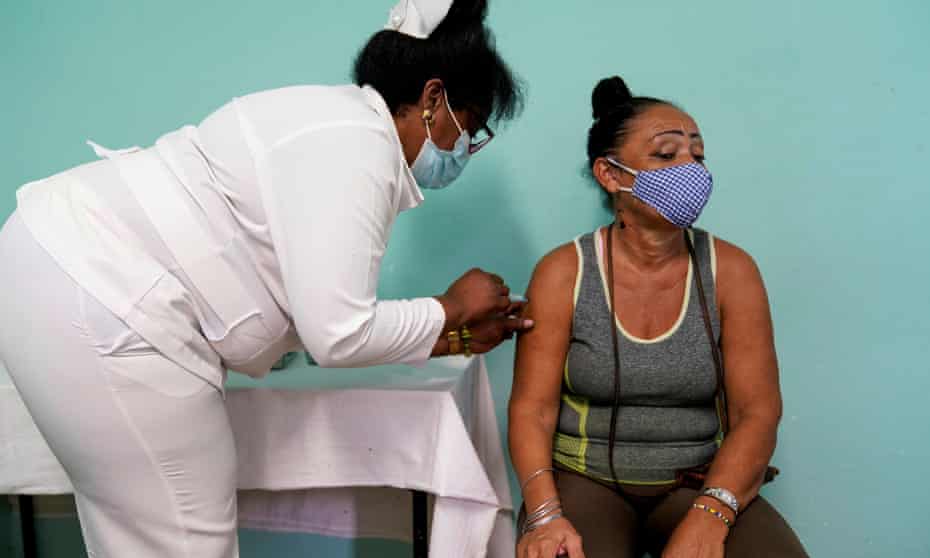
People receive booster doses of the Cuban-developed Abdala 
vaccine against Covid-19 in Havana last month.
 Photograph: Reuters

The island nation struggles to keep the lights on but has inoculated 90% of population with home-developed vaccines

Ed Augustin in Havana
Wed 5 Jan 2022 

General Máximo Gómez, a key figure in Cuba’s 19th-century wars of independence against Spain once said: “Cubans either don’t meet the mark – or go way past it.”

A century and a half later, the aphorism rings true. This downtrodden island struggles to keep the lights on, but has now vaccinated more of its citizens against Covid-19 than any of the world’s major nations.

More than 90% of the population has been vaccinated with at least one dose of Cuba’s homegrown vaccines, while 83% have been fully inoculated. Of countries with populations of over a million, only the United Arab Emirates has a stronger vaccination record.

“Cuba is a victim of magical realism,” said John Kirk, professor emeritus of Latin American studies at Dalhousie University, Canada. “The idea that Cuba, with only 11 million people, and limited income, could be a biotech power, might be incomprehensible for someone working at Pfizer, but for Cuba it is possible.”

Like most Latin American countries, Cuba knew it would struggle to buy vaccines on the international market. So in March 2020, with foreign exchange reserves plummeting due to the loss of tourism revenue and ferocious new US sanctions, the island’s scientists got to work.

A nurse shows a dose of the Soberana-02 Covid-19 vaccine during 
clinical trials in March 2021, 
Photograph: Reuters

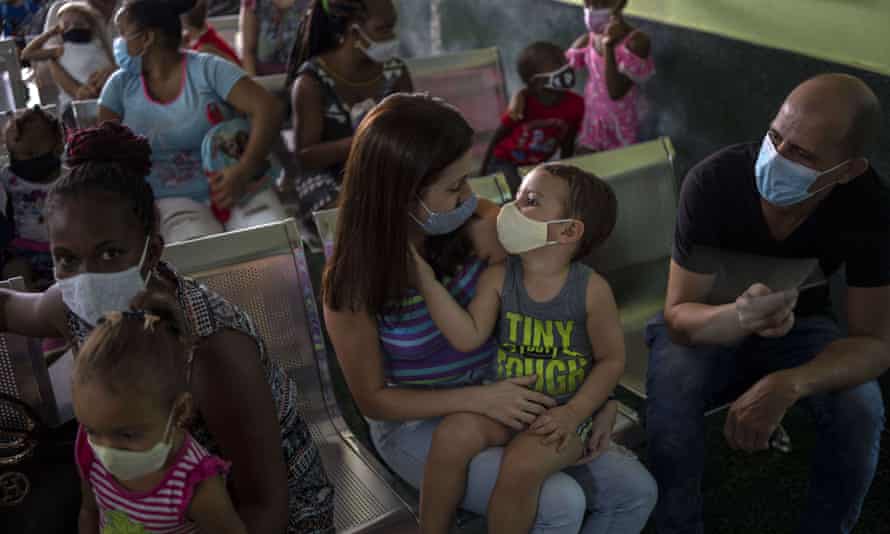
The gamble paid off: this spring Cuba became the smallest country in the world to successfully develop and produce its own Covid vaccines. Since then its well-staffed, if dilapidating universal health service, has rolled out injections at a fast clip, inoculating even young children (all vaccination on the island is voluntary).

Both vaccines are over 90% effective, according to Cuban-run clinical trials conducted last spring. Successful rollout has brought infection rates down from among the highest in the western hemisphere last summer to low levels today.


Cuba’s health system buckles under strain of overwhelming Covid surge

Last August the island reported hundreds of Covid deaths per week; last week there were three.

The vaccine success is all the more striking when set against the parlous state of the healthcare service in other areas. With hard currency inflows cut in half over the last two years, antibiotics are now so scarce that 20 pills of amoxicillin trade on the black market for the equivalent of a month’s minimum state salary. Out of plaster cast, doctors in some provinces now resort to wrapping broken bones in used cardboard.

“Ever since the 1959 revolution, Cubans have embarked on these grand crusades which are quixotic yet often successful,” said Gregory Biniowsky, a Havana-based lawyer.

A prime example, Biniowsky said, was Fidel Castro’s pipe dream of investing one billion dollars in biotech after the Soviet Union disintegrated. “Any rational adviser would have said this was not the time to invest resources in something that might bear fruit in 25 years. And yet here we are now … where these fruits of the biotech investment are saving lives.”

Other quests have dramatically failed: the Ten Million Ton Sugar Harvest of 1970 aimed to produce an unprecedented amount of sugar to spur growth. But to cut the cane, workers were pulled from their regular jobs, paralysing industry and wreaking havoc on the economy.

Last year Cuba harvested seven times less sugar than in 1959.

Parents wait to have their children vaccinated with the
 Soberana-02 Covid-19 vaccine, at a clinic in Havana in September 2021. 
Photograph: Ramón Espinosa/AP

“As a nation there’s a tendency to get really good with the big things, and awful at the everyday things,” said Hal Klepak, professor emeritus of history and strategy at the Royal Military College of Canada.

“The whole idea of electrifying the country [in under a decade], abolishing illiteracy in 2.5 years, and medical internationalism – these were all just mad schemes. And they did it.”


Today, Cuba posts tens of thousands of doctors and nurses doing humanitarian work abroad – but fails to grow enough potatoes for the population.

Cuba’s highly centralized, state planning system – one of the last in the world – goes some way to explaining this paradox. When there is political will from the top, objectives can be driven forward; when there’s a lack of direction, the island’s rigid, Kafkaesque bureaucracy can elevate passing the buck to an art form.

“In capitalism you tend to have, even with very little things, somebody to fill the market,” said Klepak. “The difference with Cuba is that for [most economic] decision-making, there isn’t anyone but the state.”

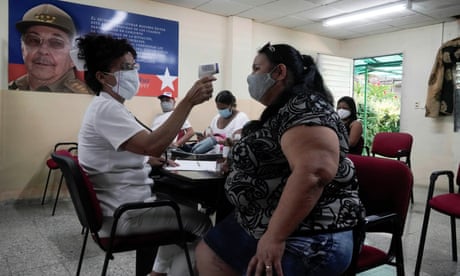
After registering less than 100 cases a day for weeks, infection rates are now rising due to the highly contagious Omicron variant. Cuban scientists have not released data on the efficacy of their vaccines against Omicron but have begun work to update their vaccine against the variant.

In the meantime, the Cuban ministry of public health has fast-tracked its booster campaign, and aims to give almost the entire population an extra shot of vaccine this month.
England’s farmers to be paid to rewild land

Nature recovery schemes are part of post-Brexit subsidies overhaul, but eco campaigners are sceptical


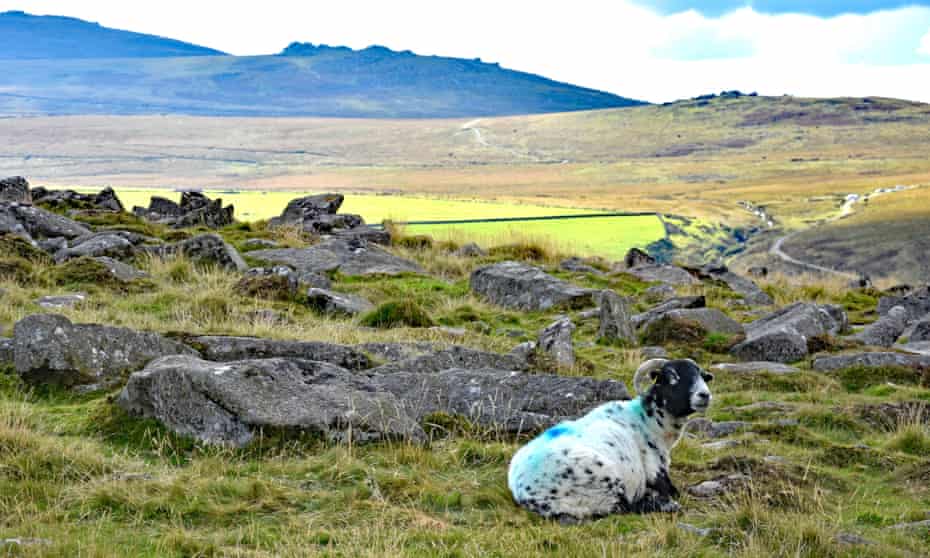
Farmers in areas such as Dartmoor in Devon, where there is a significant rewilding campaign, will be invited to bid for 10-15 pilot projects. 
Photograph: dpe123/Getty/iStockphoto


Fiona Harvey
THE GUARDIAN
Environment correspondent
Thu 6 Jan 2022 

Farmers in England will be given taxpayers’ cash to rewild their land, under plans for large-scale nature recovery projects announced by the government. These will lead to vast tracts of land being newly managed to conserve species, provide habitats for wildlife and restore health to rivers and streams.

Bids are being invited for 10-15 pilot projects, each covering at least 500 hectares and up to 5,000 hectares, to a total of approximately 10,000 hectares in the first two-year phase – about 10 times the size of Richmond Park in London. These pilots could involve full rewilding or other forms of management that focus on species recovery and wildlife habitats.

Rare fauna such as sand lizards, water voles and curlews will be targeted, with the aim of improving the status of about half of the most threatened species in England.


UK farmers urged to set aside 1% of land for wildlife havens


The exact funding has not been disclosed, as bids will be compared to determine value for money before a final decision on which should go ahead is made this summer. However, the total amount available for such schemes is expected to reach £700m to £800m a year by 2028. By 2042, the government aims to have up to 300,000 hectares of England covered by such “landscape recovery” projects – an area roughly the size of Lancashire.

Ministers also plan to offer English farmers payments for “local nature recovery”. The smaller-scale actions taken on their farms could include planting more trees, restoring peatlands or wetlands and leaving space for wildlife habitats. These payments, which will be revealed later this year, should also reach up to £800m a year by 2028.

George Eustice, the secretary of state for environment, food and rural affairs, said the aim was for wildlife and nature protection to run alongside food production as a matter of course for most farmers. He is expected to tell farmers at the Oxford Farming Conference on Thursday: “We want to see profitable farm businesses producing nutritious food and underpinning a growing rural economy, where nature is recovering and people have better access to it. Through our new schemes, we are going to work with farmers and land managers to halt the decline in species, reduce our greenhouse gas emissions, increase woodland, improve water and air quality and create more space for nature.”

As well as the two new schemes – landscape recovery and local nature recovery – farmers will also be able to apply for payments to help them protect their soil and take other basic environmental protection measures, under plans announced last year. Funding for these measures will also reach about £800m a year, as part of the post-Brexit overhaul of the £2.4bn-a-year farming subsidies into a system of “public money for public goods”. This means farmers are paid for making environmental improvements, rather than the amount of land they farm.

The water vole is one of the rare species to be helped by the schemes. 
Photograph: Mark Smith/Alamy

Green campaigners were sceptical over whether the new payments would be enough to meet the government’s aim of halting the loss of wild species abundance and managing 30% of land for the good of nature by 2030, as well as ensuring that farmers help to solve the climate crisis rather than add to it. The Wildlife Trusts, RSPB and National Trust charities said detail on how the schemes would work was still lacking.

Craig Bennett, the chief executive of The Wildlife Trusts, said: “The real test of this agricultural transition is not whether it is a little bit better or moderately better than what came before, but whether it will be enough to deliver on [the government’s targets]. Anything less than that means that this historic opportunity will have been wasted. While we’re hearing the right noises from the government, the devil will be in the detail and the detail is still not published nearly six years after the EU referendum.”

The schemes would fail unless more was done to help farmers move away from intensive practices, said Jo Lewis, the policy and strategy director at the Soil Association. This could include the introduction of ambitious targets for reducing pesticide and fertiliser use.

“These schemes won’t work in isolation. They risk failure if they are forced to compete with mounting commercial pressures that encourage more intensive farming and cheap food production, for which the environment and our health ultimately pay the price,” she said.

Though some are benefiting from high grain prices, many farmers are facing a difficult outlook, with rising input costs, plummeting exports due to Brexit red tape, and potential new competition from prospective importers after post-Brexit trade deals.


Rewilding 5% of England could create 20,000 rural jobs

Martin Lines, the UK chair of the Nature Friendly Farming Network, said that farmers who already take environmental measures were “left in limbo” before the schemes start in 2024. “Government has been running similar environmental stewardship schemes voluntarily for farmers for 20 or 30 years, yet we still have seen huge declines in wildlife. We need these schemes to be bolder and more ambitious, not just delivering more of the same with minor improvements,” he said.

Tenant farmers, who work on about a third of farmed land in the UK, are concerned over how they can access the new schemes. They also fear that their landlords may take advantage of large-scale rewilding to remove their tenancies.

George Dunn, of the Tenant Farmers Association, said: “It is alarming that, after at least three years of discussions with the Department for Environment, Food and Rural Affairs, it has no clear plan for access to these schemes by tenant farmers. [Current payments] are being removed while we have a vague commitment for further work to be undertaken on how tenants, and those who use common land, can access schemes. It does feel like we are pushing water uphill.”

Mark Tufnell, the president of the Country Land and Business Association, which represents 28,000 farmers, landowners and rural businesses, said: “The government must also ensure that policy changes look towards domestic food production and security. Britain is already at the forefront of agricultural innovation and animal welfare standards, and we must do more to make certain that our great produce is supported here and abroad. We need to guarantee that profitable agriculture remains a core part of the rural economy and feeds the nation sustainably.”
CRIMINAL CAPITALI$M
Top UK law firm fined record sum for breaching money-laundering rules


Mishcon de Reya agrees to pay fine of £232,500 after investigation by Solicitors Regulation Authority


The entrance to Mishcon de Reya’s offices in London. 
Photograph: Vindice/Alamy


Haroon Siddique and Harry Davies
Thu 6 Jan 2022 

Mishcon de Reya, one of the UK’s most prestigious law firms, has been fined a record amount for committing “serious breaches” of money-laundering rules.

The London-based firm has agreed to pay a fine of £232,500, plus a further £50,000 towards the costs of the investigation, which was carried out by the Solicitors Regulation Authority (SRA).

In its decision, published on Wednesday, the regulator said Mishcon de Reya’s conduct had “potential to cause significant harm by facilitating transactions that gave rise to a risk of facilitating money laundering”.

The SRA investigation concerned work the firm carried out for two unnamed individual clients between September 2015 and April 2017, and corporate vehicles connected with the same two individuals.
Advertisement

The work included the proposed acquisition of two separate entities that had “higher risk of money laundering or terrorist financing” under relevant money-laundering legislation, because they involved companies in high-risk jurisdictions.

The regulator found Mishcon de Reya failed to carry out the required level of due diligence or ongoing monitoring.

Additionally, between 22 July and 28 July 2016, a payment of £965,000 was made into Mishcon de Reya’s client account and three payments – the highest of $1,099,015, equivalent to £810,000 – were made out of it, none of which related to the delivery of services by the firm, contrary to SRA rules that forbid client accounts being used “as a banking facility”.

The firm accepted the SRA’s decision and fine, which is is almost double the previous highest of £124,436, imposed by the regulator on Find My Claims in 2019, for sending six million unsolicited marketing letters to members of the public in respect of mis-sold payment protection insurance (PPI).

A spokesperson for Mishcon de Reya disputed that the fine was the largest imposed by the SRA because the penalty covered two separate investigations rather than one.

The settlement will prevent the investigation looming over the firm as it prepares to float on the London Stock Exchange. The company is expected to seek a value of about £750m, based on typical valuations in the legal sector, a price tag that would make it the largest London-listed law firm, with every member of staff becoming a shareholder.

The firm is known for representing the wealthy, famous and powerful. High-profile cases include acting for Diana, Princess of Wales, during her divorce from Prince Charles and for Gina Miller when she took on the government over whether parliament had to approve the triggering of article 50 after the Brexit vote. Keir Starmer advised the firm while in parliament but ended the relationship when he became shadow Brexit secretary in 2016, subsequently turning down the offer of a lucrative second job with the firm.

The level of the SRA fine was based on 0.25% of turnover, in the middle of the band of up to 0.5%, because the SRA said “the breaches were serious but the risks did not crystallise into causing harm to clients or the wider public interest”. Based on Mishcon de Reya’s turnover of £155m, that would have been equivalent to £387,500 but it was reduced by the maximum allowable 40% discount to reflect mitigating circumstances.

A Mishcon de Reya spokesperson said: “We are pleased to have come to a settlement with the SRA relating to two separate and historic investigations in relation to which we have made appropriate admissions. Mitigating factors such as our cooperation with the SRA throughout the investigations and the corrective action we have taken since to prevent a recurrence have been recognised by the SRA in reaching this outcome.”
Mary Alice Thatch, Publisher Who Won Pardon for the Wilmington 10, Dies at 78

At the helm of The Wilmington Journal, she pushed to cover issues affecting the Black community that had been ignored by the mainstream press.


When Mary Alice Thatch took over the reins of The Wilmington Journal, she saw the Black-owned newspaper as a vital source of information for the city’s Black population and a force that spoke truth to power.

Credit...Paul R. Jervay Jr., via Associated Press

By Clay Risen
Jan. 5, 2022


Mary Alice Thatch, a crusading, third-generation newspaper publisher in North Carolina who led the fight to exonerate 10 civil rights activists wrongly convicted of arson in the 1970s, died on Dec. 28 at a hospital in Durham, N.C. She was 78.

Her daughter Johanna Thatch-Briggs confirmed the death but did not provide a cause.

Ms. Thatch had already had a long career in education when she took over the reins of The Wilmington Journal from her father, Thomas C. Jervay. Like him, she saw the Black-owned newspaper as a vital source of information for the city’s Black population and a force that spoke truth to power, white or otherwise.

“She was particularly committed to making sure that news that often is not represented in the mainstream media was always represented in The Wilmington Journal,” the Rev. Dr. William J. Barber II, a civil-rights leader, said in a phone interview.

Ms. Thatch’s reporters uncovered corruption and took on unchecked gentrification, while The Journal’s editorials pushed for voting rights and education reform. But her greatest achievement came in the early 2010s, when she took up the cause of the so-called Wilmington 10.

A group of nine Black men and one white woman, the Wilmington 10 were convicted in 1971 of dynamiting a white-owned grocery store, then shooting at the firefighters who responded. Although the case against them was flimsy — among other things, three key witnesses for the prosecution recanted their accounts — their appeal failed, and the U.S. Supreme Court declined to review it.


The Wilmington 10 became a cause célèbre. Some 10,000 people joined a protest march in 1977 in Washington, D.C., calling for their release. That same year, Amnesty International embraced them as a cause, and Andrew Young, the U.S. ambassador to the United Nations, cited them in an interview as an example of domestic political prisoners.


A review by the Department of Justice persuaded Gov. Jim Hunt of North Carolina in 1978 to commute the rest of their sentences, and in 1980, the U.S. Court of Appeals for the Fourth Circuit overturned the convictions. What remained was for the state to formally exonerate and compensate them through what, in North Carolina, is called a pardon of innocence.

At a 2011 meeting in Washington, Black newspaper publishers, including Ms. Thatch, listened to one of the 10, Dr. Benjamin F. Chavis, plead for their help in publicizing their case.

A few days later, Ms. Thatch called her lead reporter, Cash Michaels, and asked him to oversee a campaign to uncover the truth about the Wilmington 10, and make the case for a formal pardon.

“Being a part of the Black press and knowing that there’s strength in the press, knowing that there’s strength in that pen, I was compelled to fight for justice,” she said in an interview with her husband’s church.

Over several months, Mr. Michaels and his team re-interviewed witnesses and lawyers from the trial, and uncovered damning documents that showed how, for example, the prosecutor, faced with a Black-majority jury, faked illness to get a mistrial, then connived to get a white-majority jury when the case restarted.

Their reporting appeared in The Journal, and it was reprinted in Black newspapers around the country. Other news outlets, including The New York Times, published editorials in support.

What had seemed like history was once again news, and by the end of 2012, pressure was building on Gov. Bev Perdue of North Carolina to issue a pardon of innocence — which she did on Dec. 31, her final day in office.

“Without Ms. Thatch, there would have been a lot less pressure on the governor to do something,” said Kenneth Janken, a historian at Duke University and the author of “The Wilmington Ten: Violence, Injustice, and the Rise of Black Politics in the 1970s” (2016). “I wouldn’t underestimate the power of the press.”


This Jan. 21, 1976, file photo shows the Wilmington 10 at a news conference in Raleigh, North Carolina. From left, front row, they are Chavis, William (Joe) Wright, Connie Tindall and Jerry Jacobs. In the back row are Wayne Moore, Ann Shepard, James McKoy, Willie Vereen, Marvin Patrick and Reginald Epps. 
Credit...Associated Press

Mary Alice Jervay was born on July 6, 1943, in Wilmington. Her family lived in an apartment above The Journal’s offices, and during the day her mother, Willie (DeVane) Jervay, would help with production, as would Mary Alice, before she could even walk.

“My daddy used to say that I started at 3 or 4 months old, when I started crawling around on the floor,” she said in a 2013 interview. “I was hired as the janitor to clean the floor — with my diaper.”

Remembering Hank Aaron, Colin Powell, Stephen Sondheim, Beverly Cleary, DMX, Cicely Tyson, Larry King, Olympia Dukakis, Chuck Close, Michael K. Williams, Bob Dole, Janet Malcolm and many others who died this year.

Her grandfather, R.S. Jervay, had founded the newspaper as The Cape Fear Journal in 1927. It was Wilmington’s first Black-owned paper since The Daily Record, whose offices, once located across the street from where The Journal now stands, were burned down in 1898 when a white supremacist coup overthrew the biracial City Council and killed 24 Black and white residents.

Despite that legacy, Ms. Thatch did not initially pursue journalism as a career. She received a bachelor’s degree in business education from Elizabeth City State University and a master’s degree in the same subject from the University of North Carolina Greensboro. She then worked as a high school teacher in North Carolina and Ohio and as a consultant for the North Carolina State government.

She married John L. Thatch in 1970. Along with him and her daughter, she is survived by two other daughters, Shawn Thatch and Robin Thatch Johnson; seven grandchildren; and seven great-grandchildren.

By the time Ms. Thatch took over from her father in 1996, The Journal had become one of the best-known Black newspapers in the South, widely regarded for its fearlessness in the face of racist violence. A white supremacist had blown up The Journal’s offices in 1973, a calamity that her father quickly brushed off.

“She never forgot how even though the paper’s building was destroyed, he still made sure a paper came out that week,” Mr. Michaels said in an interview. “That’s the sort of strength and resilience she embodied.”

She was honored as publisher of the year in 2013 by the National Newspaper Publishers Association. And she continued to crusade for the Black community in Wilmington: Starting in 2016, she ran a weekly photo of Ebonee Spears, a Wilmington girl who had gone missing, on The Journal’s cover, according to The Charlotte News Observer.

Like most newspapers, The Wilmington Journal has recently faced financial challenges. A campaign in early 2021 raised $95,000, enough for the paper to keep its office building. Where it will go without its indomitable publisher at the helm remains an open question.


Clay Risen is an obituaries reporter for The New York Times. Previously, he was a senior editor on the Politics desk and a deputy op-ed editor on the Opinion desk. He is the author, most recently, of "Bourbon: The Story of Kentucky Whiskey." @risenc