Thursday, January 06, 2022

New research finds way to scrub carbon dioxide from factory emissions, make useful products
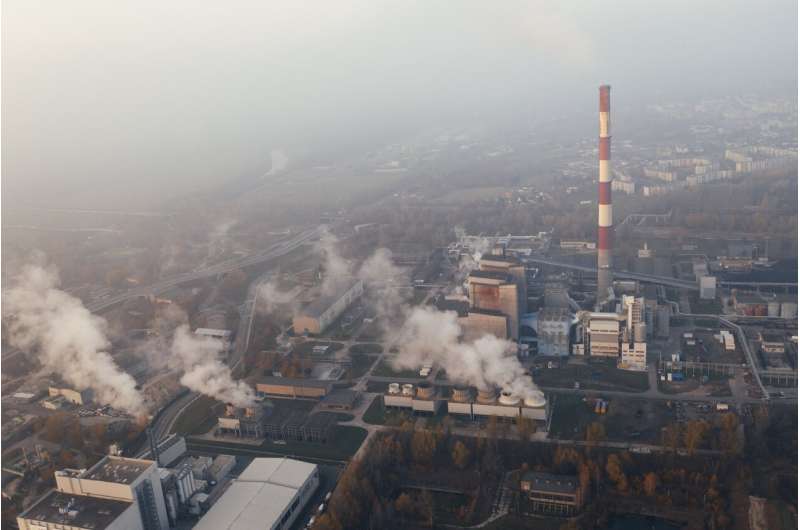
carbon dioxide
Credit: Unsplash/CC0 Public Domain

Carbon dioxide can be harvested from smokestacks and used to create commercially valuable chemicals thanks to a novel compound developed by a scientific collaboration led by an Oregon State University researcher.

Published in the Journal of Materials Chemistry A, the study shows that the new metal organic framework, loaded with a common industrial chemical, , can catalyze the production of cyclic carbonates while scrubbing CO2 from factory flue gases.

Carbon dioxide, a greenhouse gas, results from burning fossil fuels and is one of the primary causes of climate change. Cyclic carbonates are a class of compounds with great industrial interest, meaning the findings are a boost for green-economy initiatives because they show useful products such as battery electrolytes and pharmaceutical precursors can be derived from the same process deployed to clean emissions from manufacturing facilities.

The new, three-dimensional, lanthanide-based metal organic framework, or MOF, can also be used to catalyze cyclic carbonate production from biogas, a mix of , methane and other gases arising from the decomposition of organic matter.

A catalyst is a substance that increases the rate of a chemical reaction without itself undergoing any permanent chemical change, and lanthanides are a group of soft, silvery-white metals whose applications range from night vision goggles to flints for cigarette lighters.

Examples of lanthanides include cerium, europium and gadolinium.

"We've taken a big step toward solving a crucial challenge associated with the hoped-for circular carbon economy by developing an effective catalyst," said chemistry researcher Kyriakos Stylianou of the OSU College of Science, who led the study. "A key to that is understanding the molecular interactions between the active sites in MOFs with potentially reactive molecules."

A MOF is an inorganic-organic hybrid, a crystalline porous material made up of positively charged metal ions surrounded by organic "linker" molecules, in this case lanthanide metals and tetracarboxylate linkers.

The metal ions make nodes that bind the linkers' arms to form a repeating structure that looks something like a cage; the structure has nanosized pores that adsorb gases, similar to a sponge. MOFs can be designed with a variety of components, which determine the MOF's properties.

Lanthanide-based materials are generally stable because of the relatively large size of lanthanide ions, Stylianou said, and that's true as well with lanthanide MOFs, where the acidic metals form strong bonds with the linkers, keeping the MOFs stable in water and at high temperatures; that's important because  and biogas are hot as well as moisture rich.

The lanthanide MOFs are also selective for carbon dioxide, meaning they're not bothered by the presence of the other gases contained by industrial emissions and .

"We observed that within the pores, propylene oxide can directly bind to the cerium centers and activate interactions for the cycloaddition of carbon dioxide," Stylianou said. "Using our MOFs, stable after multiple cycles of carbon dioxide capture and conversion, we describe the fixation of carbon dioxide into the propylene oxide's epoxy ring for the production of cyclic carbonates."

Cyclic carbonates have a broad range of industrial applications, including as polar solvents, precursors for polycarbonate materials such as eyeglass lenses and digital discs, electrolytes in lithium batteries, and precursors for pharmaceuticals.

"These are very exciting findings," Stylianou said. "And being able to directly use carbon dioxide from impure sources saves the cost and energy of separating it before it can be used to make cyclic carbonates, which will be a boon for the green economy."

David Le, Ryan Loughran and Isabelle Brooks of the College of Science collaborated on this research, as did scientists from Columbia University and the University of Cambridge.Enhanced stability in the presence of water could help reduce smokestack emissions of greenhouse gases

More information: David H. Le et al, Lanthanide metal–organic frameworks for the fixation of CO2 under aqueous-rich and mixed-gas conditions, Journal of Materials Chemistry A (2021). DOI: 10.1039/D1TA09463G

Journal information: Journal of Materials Chemistry A 

Provided by Oregon State University 

OSU research finds way to scrub carbon dioxide from factory emissions, make useful products

January 03, 2022

CORVALLIS, Ore. – Carbon dioxide can be harvested from smokestacks and used to create commercially valuable chemicals thanks to a novel compound developed by a scientific collaboration led by an Oregon State University researcher.

Published in the Journal of Materials Chemistry A, the study shows that the new metal organic framework, loaded with a common industrial chemical, propylene oxide, can catalyze the production of cyclic carbonates while scrubbing CO2 from factory flue gases.

Carbon dioxide, a greenhouse gas, results from burning fossil fuels and is one of the primary causes of climate change. Cyclic carbonates are a class of compounds with great industrial interest, meaning the findings are a boost for green-economy initiatives because they show useful products such as battery electrolytes and pharmaceutical precursors can be derived from the same process deployed to clean emissions from manufacturing facilities.

The new, three-dimensional, lanthanide-based metal organic framework, or MOF, can also be used to catalyze cyclic carbonate production from biogas, a mix of carbon dioxide, methane and other gases arising from the decomposition of organic matter.

A catalyst is a substance that increases the rate of a chemical reaction without itself undergoing any permanent chemical change, and lanthanides are a group of soft, silvery-white metals whose applications range from night vision goggles to flints for cigarette lighters.

Examples of lanthanides include cerium, europium and gadolinium.

“We’ve taken a big step toward solving a crucial challenge associated with the hoped-for circular carbon economy by developing an effective catalyst,” said chemistry researcher Kyriakos Stylianou of the OSU College of Science, who led the study. “A key to that is understanding the molecular interactions between the active sites in MOFs with potentially reactive molecules.”

A MOF is an inorganic-organic hybrid, a crystalline porous material made up of positively charged metal ions surrounded by organic “linker” molecules, in this case lanthanide metals and tetracarboxylate linkers.

The metal ions make nodes that bind the linkers’ arms to form a repeating structure that looks something like a cage; the structure has nanosized pores that adsorb gases, similar to a sponge. MOFs can be designed with a variety of components, which determine the MOF’s properties.

Lanthanide-based materials are generally stable because of the relatively large size of lanthanide ions, Stylianou said, and that’s true as well with lanthanide MOFs, where the acidic metals form strong bonds with the linkers, keeping the MOFs stable in water and at high temperatures; that’s important because flue gases and biogas are hot as well as moisture rich.

The lanthanide MOFs are also selective for carbon dioxide, meaning they’re not bothered by the presence of the other gases contained by industrial emissions and biogas.

“We observed that within the pores, propylene oxide can directly bind to the cerium centers and activate interactions for the cycloaddition of carbon dioxide,” Stylianou said. “Using our MOFs, stable after multiple cycles of carbon dioxide capture and conversion, we describe the fixation of carbon dioxide into the propylene oxide’s epoxy ring for the production of cyclic carbonates.”

Cyclic carbonates have a broad range of industrial applications, including as polar solvents, precursors for polycarbonate materials such as eyeglass lenses and digital discs, electrolytes in lithium batteries, and precursors for pharmaceuticals.

“These are very exciting findings,” Stylianou said. “And being able to directly use carbon dioxide from impure sources saves the cost and energy of separating it before it can be used to make cyclic carbonates, which will be a boon for the green economy.”

David Le, Ryan Loughran and Isabelle Brooks of the College of Science collaborated on this research, as did scientists from Columbia University and the University of Cambridge.

The College of Science and the OSU Honors College funded the study.

About the OSU College of Science: As one of the largest academic units at OSU, the College of Science has seven departments and 12 pre-professional programs. It provides the basic science courses essential to the education of every OSU student, builds future leaders in science, and its faculty are international leaders in scientific research.

Novel Compound Harvests CO2 to Make Useful Product

A scientific collaboration led by a researcher at Oregon State University resulted in the development of a new compound that can harvest carbon dioxide from smokestacks and use it to produce commercially beneficial chemicals.
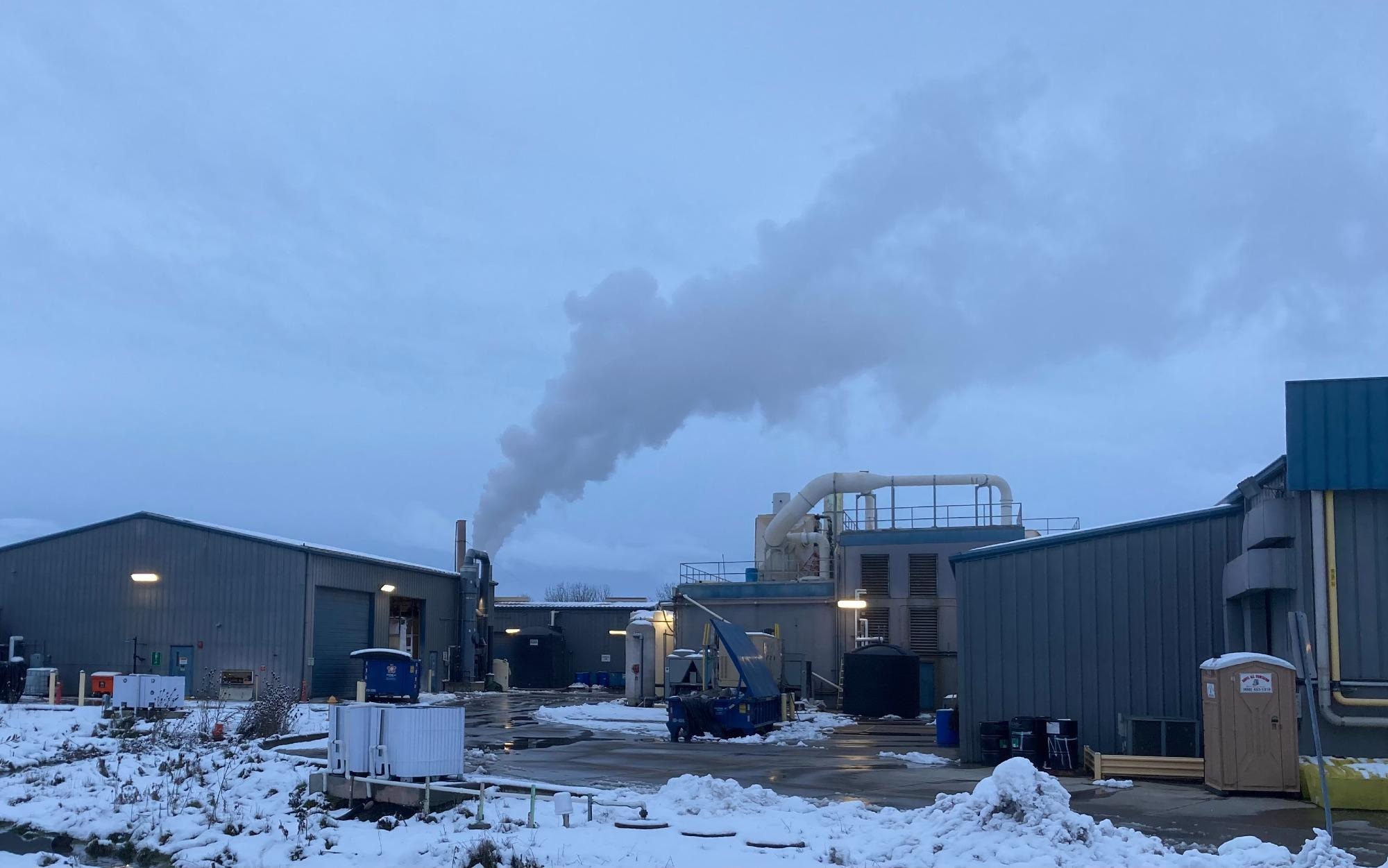
Novel Compound Harvests CO2 to Make Useful Products.
Selmet Inc. Image Credit: Oregon State University.

The study demonstrates that the new metal-organic framework, loaded with a general industrial chemical known as propylene oxide, has the potential to catalyze the production of cyclic carbonates while CO2 is being scrubbed from factory flue gases.

The study has been published in the Journal of Materials Chemistry A.

Carbon dioxide, a greenhouse gas that is caused by the burning of fossil fuels, is known to be one of the major reasons for climate change. Cyclic carbonates are considered to be a class of compounds having great industrial interest.

This implies the findings are a boost for green-economy initiatives since they exhibit useful applications like pharmaceutical precursors and battery electrolytes that could be derived from the same process dispensed to clean emissions from manufacturing facilities.

The latest, three-dimensional, lanthanide-based metal-organic framework (MOF) could also be utilized to catalyze cyclic carbonate production from biogas — a mix of methane, carbon dioxide and other gases emerging from the decomposition of organic matter.

A catalyst is defined as a substance that tends to raise the speed of a chemical reaction without experiencing any permanent chemical change, and lanthanides are known to be a group of soft and silvery-white metals whose applications range from night vision goggles to cigarette lighters’ flints.

Examples of lanthanides comprise gadolinium, europium and cerium.

Weve taken a big step toward solving a crucial challenge associated with the hoped-for circular carbon economy by developing an effective catalystA key to that is understanding the molecular interactions between the active sites in MOFs with potentially reactive molecules.

Kyriakos Stylianou, Study Lead Author and Chemistry Researcher, College of Science, Oregon State University

A MOF is an inorganic-organic hybrid, a crystalline porous material composed of positively charged metal ions encircled by the so-called organic “linker” molecules. Here, tetracarboxylate linkers and lanthanide metals are being used.

The metal ions create nodes that exhibit the potential to bind the linkers’ arms to develop a repeating structure that looks somewhat similar to a cage. The structure consists of nanosized pores that adsorb gases, identical to a sponge. MOFs could be designed with a range of components, which decide the properties of MOFs.

Normally, lanthanide-based materials are stable due to the comparatively large size of lanthanide ions. Stylianou feels that is true as well with lanthanide MOFs, where the acidic metals develop powerful bonds with the linkers, retaining the stability of MOFs in water and at high temperatures. This is significant since biogas and flue gases are hot as well as moisture-rich.

Also, the lanthanide MOFs are known to be selective for carbon dioxide, implying they are not bothered by the existence of the other gases contained by biogas and industrial emissions.

We observed that within the porespropylene oxide can directly bind to the cerium centers and activate interactions for the cycloaddition of carbon dioxideUsing our MOFsstable after multiple cycles of carbon dioxide capture and conversionwe describe the fixation of carbon dioxide into the propylene oxides epoxy ring for the production of cyclic carbonates.

Kyriakos Stylianou, Study Lead Author and Chemistry Researcher, College of Science, Oregon State University

Cyclic carbonates consist of a wide range of industrial applications, such as being polar solvents, precursors for polycarbonate materials like digital discs and eyeglass lenses, precursors for pharmaceuticals and electrolytes in lithium batteries.

These are very exciting findingsAnd being able to directly use carbon dioxide from impure sources saves the cost and energy of separating it before it can be used to make cyclic carbonateswhich will be a boon for the green economy.

Kyriakos Stylianou, Study Lead Author and Chemistry Researcher, College of Science, Oregon State University

David Le, Ryan Loughran and Isabelle Brooks of the College of Science collaborated on this study, along with researchers from the University of Cambridge and Columbia University.

The study was financially supported by the College of Science and the OSU Honors College.

Journal Reference:

Le, D. H., et al. (2021) Lanthanide metal–organic frameworks for the fixation of CO2 under aqueous-rich and mixed-gas conditions. Journal of Materials Chemistry A. doi.org/10.1039/D1TA09463G.

Source: https://oregonstate.edu/


From airlines and restaurants to slaughterhouses, Canada's worker shortage is spreading rapidly

Businesses large and small are being forced to temporarily

close their doors

The spread of the Omicron variant has caused staff shortages for all sorts of businesses. (Sam Nar/CBC)

An intensifying labour shortage is rippling through the economy, forcing businesses to curtail operations, reduce hours and in some cases, euthanize livestock.

The situation is a result of a chronic worker shortage worsened by the crush of new COVID-19 cases forcing many into isolation. School closures have also left some workers scrambling for child care and unable to go into work.

The result is rising absenteeism, prompting airlines to cancel flights, drugstores to close early and restaurants to move to takeout only.

At a slaughterhouse in Quebec, the worker shortage became so extreme in recent days it opted to euthanize thousands of chickens that couldn't be processed.

Exceldor Co-operative said in a statement that rising COVID-19 infections and a significant shortage of personnel have forced the company to resort to "humane euthanasia."

It blamed the protracted worker shortage on federal delays processing temporary foreign worker applications.

Meanwhile, some provinces have tried to ease staffing woes by shortening isolation periods, allowing people to return to work sooner.

Yet the sheer number of new daily cases caused by the highly transmissible Omicron variant continues to leave many confined to their homes and businesses struggling to remain open. Even those that remain open are facing a scheduling nightmare as mounting unplanned absences — on top of shifting public health restrictions — make operating difficult.

"Omicron has resulted in more unplanned absences, not to mention complications from sudden government restrictions," Retail Council of Canada spokesperson Michelle Wasylyshen said.

A surge of people unable to work and changing public health measures "throw schedules that were often planned weeks in advance upside down," she added.

Some businesses have responded to the disruption by drafting new plans for how to operate during the latest wave, while some must alter hours or close altogether.

Pharmacy chain Jean Coutu impacted

Drugstore chain Jean Coutu said on its website some of its stores may need to modify hours to ensure essential services are maintained.

Marie-Claude Bacon, a spokeswoman for Jean Coutu's parent company Metro Inc., said the health and safety of employees and customers has been the company's priority since the beginning of the pandemic.

"As absenteeism has been fluctuating over the course of the last 20 months, we continue to make the necessary staffing adjustments as need be at store and (distribution centre) levels to minimize impact on our operations," she wrote in an email.


B.C.'s public sector unions set to begin bargaining


Bhinder Sajan
Published Jan. 4, 2022

VICTORIA -

The Finance Ministry says the vast majority of the 186 collective agreements in B.C.'s public sector expire in March 2022 – including those of the teachers' and nurses' unions.

A previous three-year agreement saw two per cent wage increases in each year. With inflation now far beyond that, it’s unclear what impact that will have on negotiations.

According to the province, every one per cent increase in adds almost $400 million to the operating budget. About 385,000 public sector workers are unionized employees paid under collective agreements or professionals paid through negotiated compensation agreements.

Bargaining is done through employers' associations, with the province ultimately responsible.

In a statement, the ministry added, "While negotiations under the 2022 mandate have not yet begun, bargaining is always best left to the parties at the table. Government is looking forward to sharing when there are updates on tentative and ratified agreements over the coming months."
Corning Inc. employees impacted by payroll vendor Kronos ransomware attack


by: George StockburgerPosted: Jan 5, 2022 

CORNING, N.Y. (WETM) – Kronos, a national payroll vendor contracted with Corning Incorporated, recently suffered a ransomware attack that Corning employees tell 18 News has impacted their payroll system.

After receiving several calls, emails, and messages from concerned Corning Inc. employees, 18 News reached out to the company for an update on their payroll and timekeeping systems.

A Corning Inc. spokesperson tells 18 News that the Kronos outage impacted a small portion of their employees who use the system and they are working to minimize any potential impacts that may arise until service is restored.

Corning says their ADP payroll platform continues to be fully operational, and employees are being paid as planned.

“We can confirm that Kronos, one of the third-party time and attendance tracking providers used at Corning, is experiencing an ongoing outage that has impacted many companies globally. Taking care of our people is our top priority, and we are committed to ensuring employees using the Kronos system are fairly and accurately compensated for hours worked.

In addition to their regular pay, Corning proactively took the extra step to thank our dedicated workforce who use the system with a one-time $500 cash gift they received in their last paycheck. For the upcoming pay period, we are providing a $1,000 advance of their annual bonus. Going forward, we will address any potential issues as they arise.”

CORNING INC.

A Corning Inc. spokesperson says they have also developed a support process to address employee payroll questions or concerns, as well as an interim, manual process to ensure all employees will quickly be made whole in their compensation

Kronos issued the following statement regarding the ransomware incident that was first reported in December impacting companies across the country:

We recently became aware of a ransomware incident that has disrupted the Kronos Private Cloud, which houses solutions used by a limited number of our customers. We took immediate action to investigate and mitigate the issue, and are working with leading cybersecurity experts. We recognize the seriousness of the issue and have mobilized all available resources to support our impacted customers. KRONOS

18 News will continue to monitor this story and bring updates on the system’s availability.

18 News can be contacted by emailing news@wetmtv.com

ONTARIO

Union representing cleaners at London hospital gives employer deadline to fix payroll issues

If the issue is not resolved by Friday, the union will file a grievance procedure

Cleaning staff at LHSC has not been paid in full due to a ransomware attack on the payroll system their employer Sodexo uses. (Dmitry Kalinovsky/Shutterstock)

The union representing cleaning staff at London Health Sciences Centre has given their employer, Sodexo, until Friday to resolve payroll issues that led over 50 workers to not receive full pay for nearly a month. 

Maria McFadden, business representative for Labourers International Union of North America (LiUNA) Local 1059 tells CBC News that if the error isn't fixed by then, the union will start a grievance process against Sodexo. 

A union grievance is filed when there's infractions against employees, which is the violation of a collective agreement. It includes workers being shortchanged on their wages. 

The inconsistent paycheques are due to a ransomware attack on the American-based Kronos payment software which Sodexo uses for payroll, that started about four weeks ago. 

McFadden said each worker is owed different amounts depending on the days and hours they worked. These range anywhere from $300 to 25 hours of work missing on their paystub for the recent pay period on Dec. 31. 

"That day the [Sodexo] rep got about 54 calls from different folks that hadn't been paid properly and till today's date, they still have not been paid what is owed to them," she said. 

'Nasty time of the year for this to happen'

McFadden said Sodexo notified Local 1059 of the issue right away and the union has been very understanding, but believes that enough time has passed, and this needs to be dealt with.  

"It's now been four weeks, so it's been a little while and our expectation is that Sodexo needs to get things done so that corrections can be made," she said. 

Workers make about $20 per hour on a bi-weekly basis. She is especially concerned that workers will struggle to pay the bills that are piling up from the holiday season. 

"Come January 1st people have bills to pay and rent is due, so it's a very nasty time of the year for workers to be going through this, it's a very difficult situation" she added. 

Time will tell if situation improves

McFadden highlights that the cleaners are continuing to work because they want to help out an already burdened hospital system during a pandemic.  

"It's a hospital setting so people feel they are obligated to work and want to take the best step they can and help others," she said. 

She says some workers are turning to get cash loans in order to make ends meet because they are really concerned that they haven't been paid properly. 

McFadden hopes that Sodexo will do right by their employees. "I hope they have some compassion and get this fixed, but time will tell and we'll see what happens on Friday," she said. 

CBC reached out to Sodexo and Kronos for a comment, but did not hear back at the time of publication.

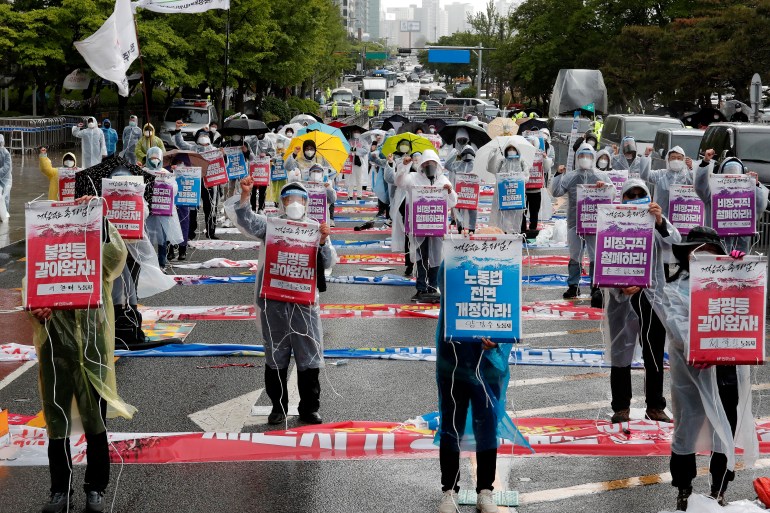
‘Won’t take it any more’: South Korea’s Starbucks baristas rebel

Workers’ novel approach to labour activism holds lessons for old guard in country with a history of spirited protest.

Starbucks workers in South Korea have taken an innovative approach to labour activism [File: Kim Hong-Ji/Reuters]

By Steven Borowiec
Published On 6 Jan 2022

Seoul, South Korea – On weekday afternoons, the Starbucks in southern Seoul’s Yangjae neighbourhood swells with groups of office workers seeking after-lunch refreshments.

A line forms from the counter to the shop’s swinging glass doors as white-collar workers line up to order hot and cold drinks. Among the seasonal specials are the Lavender Beige Oat Latte topped with cornflower leaves and New Year Citrus Tea garnished with lemongrass and a slice of orange.

“We come here with colleagues after lunch because we know that everyone will be able to find something they like,” Yoon Min-ju, who works at a nearby interior design firm, told Al Jazeera.

“At smaller coffee shops, they usually only have basic coffee and tea. At Starbucks, even people who don’t like coffee or are dieting can order comfortably,” she said.

Starbucks is so popular in South Korea that it can appear like there is an outlet on nearly every block. The country is Starbucks’ fourth largest market, with 1,611 stores and almost 20,000 workers, which the company refers to as “partners”.

But despite the popularity of the brand – built on its sprawling menu, association with the American middle class and branded merchandise – the coffee giant is now facing a challenge to its image in South Korea in the form of scrutiny over working conditions at its stores. The way workers are responding could presage an evolution in labour activism in a country with a history of spirited protest.

In October, when the company held an event offering reusable cups with the purchase of a drink, baristas’ fatigue and frustrations boiled over.

On Blind, an app where employees can anonymously vent about workplace conditions, workers complained of low wages and poor conditions. Some recounted horror stories of having as many as 650 drinks on order at a time, while scrambling to pour, mix and serve an endless stream of customers while making no mistakes, smiling and maintaining friendly customer service.
South Korea has a long history of boisterous protests by unions and labour activists 
[File: Ahn Young-joon/AP]

In December, Ryu Ho-jeong, a left-wing politician, released the results of a survey that found 613 Starbucks workers sought mental health treatment due to job stress in 2020, a more than five-fold increase compared with 2015. The survey also found that workplace accidents had tripled over the previous year.

To draw attention to their plight, workers hired a flatbed truck with a massive light-screen to drive from downtown Seoul to the busy Gangnam area in the city’s south, broadcasting their grievances to the hordes of customers that gather at Starbucks locations across the city after lunch. The screen carried text that addressed the company with messages including “‘Partners’ are your biggest asset. Don’t forget that” and “We won’t take it any more”.

The protest made national headlines, and succeeded in getting concessions from Starbucks Korea, which pledged to hire 1,600 more workers to ease conditions in their stores. The company, which entered South Korea in 1999 at a time when brewed coffee was a novelty, also promised to introduce wage increases based on seniority and performance.

While the Starbucks workers were waging their battle, the stalwarts of labour organising in South Korea took notice of how a group of young service industry workers were able to win both attention and material gains.

The Korean Confederation of Trade Unions, a major umbrella labour group that has more than one million members in industries across the country, welcomed the Starbucks workers’ actions and encouraged them to work towards establishing a union.

“Through the formation of a labour union, the workers can address their grievances,” the KCTU said in a statement.

The Starbucks protesters, most of them aged in their 20s and 30s, swiped left on the invitation to unionise, saying that instead of engaging in collective bargaining with Starbucks management, they could more effectively communicate their needs through innovative tactics like the truck protest.

In South Korea, labour unions have for decades been fixtures in shipyards and factories, but recent years have seen efforts towards unionisation at some of the country’s most innovative companies, including tech titans Kakao and Naver.
‘Militant struggle’

Yu Gyu-chang, a professor of human resource management at Hanyang University, told Al Jazeera that South Korean work culture is becoming more mindful of workers’ wellbeing.

“Social pressure has been increasing along with the voice of millennials and generation Z,” Yu said.

The increased labour organisation is coming at a time when inequality is a central topic in South Korea’s public discourse, reflected in the pop culture phenomenon Squid Game, as many in the country seek ways to earn a stable living in an increasingly cutthroat economy.

According to data released in December by the labour ministry, South Korea’s unionisation rate increased in 2020 to 14.2 percent, up from 12.5 percent the previous year.

“Many young people want to work at companies that have unions because they recognise that unions can provide protections and help them get the benefits they want,” Lee Byoung-hoon, an expert on industrial relations at Chung-Ang University, told Al Jazeera.

“What they don’t like is the old style of union activism in Korea, the militant struggle, the fighting and the protesting.”

Ryu, the politician, said in a statement that her survey showed that conditions for Starbucks workers are still in need of improvement.

“There will inevitably be a second and third truck protest,” she said.

While their victory is incomplete, the way the Starbucks workers grabbed their bosses’ – and the country’s – attention could portend an evolution in South Korean labour organising, away from the conventional protests of old and towards an era where workers seek fresh ways to communicate their demands.

“For protests by the young generation, more important than the success, failure or amount of attention they get, is that they don’t want their arguments or intentions to be misrepresented even a little,” said Lim Myung-ho, a professor of psychology at Dankook University.

“They have the confidence they can get their opinion out without outside help,” Lim said. “There will be more cases like Starbucks.”

SOURCE: AL JAZEERA
Companies still aren't hiring Black men, despite 10.6 million open jobs in the US. It's costing the economy $50 billion.

jlalljee@insider.com (Jason Lalljee) 
© MoMo Productions Researchers found the income deficit to be about $50 billion per year for Black men. MoMo Productions

For months, employers have been saying they can't find people to fill open jobs.

One segment of the population — Black men — has persistently high unemployment rates.

By not hiring them to fill the 10.6 million open jobs, companies are partially responsible for $50 billion missing in the economy, a new study says.

Despite a nationwide cry for workers, businesses aren't hiring Black men — and it's costing the country billions of dollars, according to a new study by the Center for Economic and Policy Research (CEPR).

The unemployment rate for Black men remains high: 7.3% in November, compared to 3.4% among white men looking for work, according to Labor Department data. Roughly 697,000 Black men need employment, even as the country recorded 10.6 million vacant jobs in November.


According to the CEPR study, Black men are excluded from the workforce due to racist hiring practices, as well as being killed and imprisoned at higher rates than other groups. This doesn't just hurt Black men and their families and communities — CEPR estimates that the lost income from racial discrimination costs the overall US economy $50 billion a year.

By focusing on closing the Black-white jobs gap, "we could add about $30 billion annually to Black communities and make a significant reduction in Black poverty," writes Algernon Austin, the author of the CEPR study.

The Portable Heater That Has Taken The World By StormSEE MORESponsored by ALPHA HEATER

The figure jumps to $50 billion when factoring in Black men of prime working age who die or are incarcerated. For that reason, as Austin told Insider, the unemployment rate is only part of the picture since it only captures people who are currently looking for work. The joblessness rate, or those who aren't working at all, is typically three times larger, he says.

"Since we typically focus on the unemployment rate, we are missing the full impact of joblessness for Black men," said Austin.

For Black men, there is never a period of "low" unemployment


The unemployment rate for Black men has never been "low," Austin says. It would be more correct to characterize it as high, very high, or extremely high.

While employers are calling the current labor conditions in the US a "shortage" as they struggle to hire, Black men of working age continue to have the highest unemployment rate of any gender or race. It's been that way for the past two decades, throughout job market ups and downs. Experiments on hiring discrimination stretching back to the 1970s show it happens from entry-level positions to jobs requiring a college degree, S. Michael Gaddis, a UCLA sociologist who studies employment discrimination told Insider.

"Black job-seekers face discrimination even when they have an elite college degree, such as one from Harvard or Stanford," Gaddis said.

The CEPR study found that although there are other groups that typically face high unemployment and labor market discrimination, such as Black women and other genders of color, those groups tend to rebound depending on the jobs climate, while Black men do not. Austin found that when the labor market is tight, for instance, Black women's employment-to-population ratio becomes very similar to that of white women.

Criminal justice and Black employment are inextricably linked

One major reason for Black men not working is that many of them are incarcerated or die at a young age.

Even before the pandemic, Black people saw roughly 74,000 more deaths than their white counterparts between 2016 and 2018, according to a report from last February — for reasons like greater infant mortality, environmental damage to Black communities, and lower-quality healthcare — in an examination of the 30 largest US cities, despite the fact that they make up much less of the country's population.

A Brookings Institute study from last March found that incarcerated Black men account for a third of all Black men excluded from the labor force.

Looking at a statistic like imprisonment for drug use reveals the disparity: Black and white people use drugs at similar rates, according to the National Survey on Drug Use and Health, yet the former are criminalized for it at much higher rates. Black people, who only represent 13% of the US population, account for nearly 40% of those incarcerated for drug law violations.

Amid the COVID-19 pandemic, Black Americans are also getting sick and dying at higher rates due to the pandemic's exacerbation of existing health inequities. But despite the prevalence of vaccines and an apparent market recovery, recent reports show that Black Americans continue to see higher rates of joblessness. The CEPR's report shows there is a wide pool of Black Americans to hire.

It's the "the self-evident discrimination in the labor market revealing itself," Dr. William Spriggs, an economics professor at Howard University and the chief economist for the AFL-CIO told Insider in September. He added: "The numbers this time are just startling."

Groups gather at Arizona capitol to call for environmental action, representation

Published: Wednesday, January 5, 2022 -

Rep. Andrés Cano (D-District 3), the ranking member on the House Natural Resources Energy and Water Committee, said Arizona is "ground zero for the climate crisis."

"We have an urgent and unique opportunity right in front of us. Mitigating the drought that we are in and creating a smarter, more sustainable economy will not only save our state in the long run, but it will spur innovation and strengthen our economy," he said.

The group called for action on climate change, water, and land protection and restoration.

In a statement issued after the press conference, it also asked for bills to measure and limit groundwater pumping in the state, especially outside active management areas and in areas where it can affect river flows. It requested that leaders consider sustainability in policies affecting growth and development, agricultural practices and the reclamation and treatment of wastewater flows.

"We know that these issues may not be on the agenda for the majority at the Legislature or the governor right now. But they should be, and we are committed to making sure these important issues are not ignored," said Sandy Bahr, director of the Arizona chapter of the Sierra Club, which called the press conference and issued the release.  

The speakers also expressed support for President Biden's ambitious plan to protect 30% of U.S. lands and waters by 2030.

But this week, the anniversary week of the January 6th insurrection, remarks also emphasized issues like respect for the will of voters, gerrymandering, treatment of tribal communities and environmental justice. 

"We care not only about being stewards of the Earth. We believe that each person's voice is sacred, and we express our voice through our vote. Further, we believe it is our duty to protect the voices of our neighbors," said Sarah King, chair of the Arizona Faith Network Earth Care Commission and board member of Arizona Interfaith Power and Light.

Cyndi Tuell, the Arizona/New Mexico director of the Western Watersheds Project, said the environmental community needs to  acknowledge the "extremely harsh, genocidal and racist" history of federal publicly managed lands.

"What we need to do is ask the communities that have been impacted, and that will be impacted, what we can do to help and to stop perpetuating the displacement," she said.

Tuell added that she hopes Biden's program will include tribal communities as coequals in the process rather than as "trustees to be managed by the federal government."

"There is no environmental movement except for the environmental justice movement. And our house is on fire; we need to take action and we need to take urgent action," she said.